INTRODUCTION
Soil fertility decline remains the major biophysical root cause of declining per capita food availability on smallholder farms of sub-Saharan Africa (SSA). Recent estimates indicate that by the year 2020, the SSA annual cereal imports will rise to more than 30 million metric tonnes, as the per-capita food production continues to decline against a background of rapidly growing population estimated at 3% per annum. This failure to match food supply to demand is mainly attributed to soil nutrient depletion following intensification of land use without proper land management practices and inadequate external inputs (Sanchez and Jama, Reference Sanchez, Jama, Vanlauwe, Diels, Sanginga and Merckx2002). For instance, in the central Kenya highlands, which has high population densities exceeding 1000 people km2, farms are characterized by widespread failure to make sufficient soil fertility replenishment investments, resulting in declining soil fertility, low returns to agricultural investment, decreased food security and general high food prices consequently threatening food security in this region (Odera et al., Reference Odera, Kimani and Musembi2000).
Use of fertilizers to replenish soil nutrients is one of the major ways of counterbalancing this low soil fertility, but the nutrients applied in mineral fertilizers by the smallholder farmers in central Kenya remain low due to insufficient amounts used. High costs of fertilizer, lack of credit, delays in delivery, poor transport and marketing infrastructure, have individually or jointly constrained the optimal use of fertilizer. Studies in the central highlands of Kenya have shown that manure is the most widely used organic fertilizer by approximately 80% of households However, on most farms, manure is not enough to fertilize the farms and the limited access to sufficient inorganic fertilizer continues to result in declining crop yields. In order to address these challenges, studies in the central highlands of Kenya and other areas in sub-Saharan Africa have identified integrated soil fertility management (ISFM) interventions that would help the low-resource farmers mitigate problems of food insecurity and improve resilience of the soil's productive capacity (Bationo et al., Reference Bationo, Mokwunye, Vlek, Koala and Shapiro2003). The ISFM interventions entail integrated use of mineral fertilizer with organics and encompasses their judicious manipulation to achieve productive and sustainable agricultural systems. The integration improves the agronomic efficiency of the external inputs used, reduces the risks of acidification and provides a more balanced supply of nutrients. At the core of the ISFM paradigm is the recognition that no single component of sustainable soil fertility management can stand on its own in meeting the requirements of sustainable soil fertility management.
Historical background: Research and dissemination of integrated soil fertility management practices
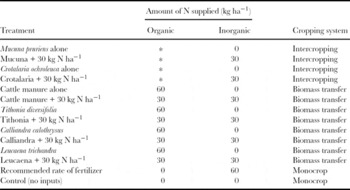
A project on ISFM was initiated in 2000 in Meru South district in the central highlands of Kenya. The project sought to address the problem of low soil fertility among smallholder farmers through promotion of the use of integrated methods of soil fertility management combining organic resources and mineral fertilizer. To achieve this an experiment that also acted as a demonstration for farmers was established in a primary school and served as a mother trial for the mother-baby trial model (CIMMYT, 1993) adopted in this study to disseminate the ISFM technologies. The experimental treatments in the mother trial consisted of two leguminous trees (Calliandra calothyrsus, Leucaena trichandra), two herbaceous legumes (Mucuna pruriens, Crotalaria ochroleuca), Tithonia diversifolia and cattle manure applied solely or combined with chemical fertilizer, chemical fertilizer alone at 60 kg N ha−1 and a control treatment (Table 1). Maize was used as the test crop. The leguminous trees were planted in nearby plots and biomass was cut and carried to the experimental plots. The herbaceous legumes were intercropped with the maize, with seeds sown two weeks after planting the maize.
Treatments showing organic resources and the amount of inorganic N applied in the demonstration trial at Kirege School, Chuka, Meru South district, Kenya.

*Total N applied varied among seasons and depended on amount of biomass produced during the previous season. Mean applied per season ranged from 34 to 40 kg N ha−1 for Mucuna pruriens and 36 to 43 kg N ha−1 for Crotalaria ochroleuca.
To introduce the ISFM technologies and practices to farmers and promote their adoption, participatory methods/approaches were used. The main method used was the mother-baby approach (Snapp, 1999), which was designed to improve the flow of information between farmers and researchers about technology performance and appropriateness under farmer conditions. This approach, in addition to generating data to assess the technology performance under realistic farmer conditions (through the baby trials), encouraged farmers to participate actively in the trials, and was therefore expected to stimulate farmer adoption of the new technologies and practices. In this approach all the farmers within the vicinity of the ‘mother’ sites were given equal opportunities to participate in the study through participation in field days, demonstrations, training and evaluation of treatment performance in the field, conducted every season during the grain filling stage. Farmers were allowed to discuss their observations freely and also encouraged to make choices on technologies they preferred and practice on their farms. Farmer groups were also formed in order to develop an effective working relationship and synergy.
After the technologies had been disseminated for almost four years, it was realised that no information existed on how farmers were taking up the technologies. Past research in Kenya shows that adoption of new agricultural technologies, including soil management practices, among the smallholder farmers in the region has generally lagged behind scientific and technological advances, and hence their impact on agricultural production has been low (Okuro et al., Reference Okuro, Muriithi, Mwangi, Verjuikl, Gethi and Groote2002). One of the main reasons advanced for low adoption is lack of adequate knowledge of farmers' adoption behaviour towards the new technologies. Analysis of factors that condition the uptake of technologies by farmers would therefore be an important link in the process of technology generation and dissemination as it would answer several questions regarding adoption of technologies, such as what categories of farmers adopt/do not adopt, and what factors drive adoption of technologies.
This study was therefore carried out to fill this important information gap. It aimed to determine and analyse household socio-economic and farm characteristics influencing smallholder farmers' decision to adopt the newly introduced ISFM technologies (involving combinations of organic and inorganic resources). Understanding the factors will provide insights for designing appropriate strategies, policies and programmes necessary for extending and fostering the adoption of ISFM technologies for soil fertility improvement among smallholder farmers in the region and other similar areas.
Conceptual framework
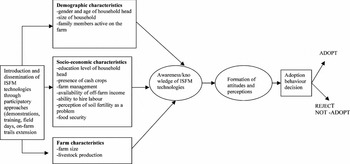
The conceptual framework of this paper is based on the principle of innovation-decision process described by Rogers (Reference Rogers1995). The farmers go through a stage of being aware or knowledgeable of a new technology, to forming a positive or negative attitude towards it and ultimately deciding whether to adopt the technology or not. According to Rogers (Reference Rogers1995) the technology is passed from its source to the end users through a medium (e.g. news media, opinion leaders, on-farm or on-station demonstrations, farmers' field days) and its diffusion to potential users is dependent to a great extent on the personal attributes of the individual user. This adoption behavioural framework has frequently been used to examine adoption of various technologies by farmers (Neupane et al., Reference Neupane, Sharma and Thapa2002) and was also adopted for this study. Figure 1 provides a simple schematic framework adopted for studying adoption decision by farmers involved in this study. Previous empirical and theoretical studies indicate that the adoption pattern of new technologies can be characterized fairly well in terms of qualitative response models (also called binary choice, discrete or dichotomous models). The logistic model is one of these and has widely been used in different adoption studies (for example; Chianu and Tsujii, Reference Chianu and Tsuji2004; Polson and Spencer, Reference Polson and Spenser1991) and was therefore adopted in the study.
Schematic framework for studying farmers adoption behaviour in Meru South District, Kenya. Adapted from Neupane et al. (Reference Neupane, Sharma and Thapa2002).

MATERIALS AND METHODS
Description of the study area
The study was conducted in Kirege location of Chuka division of Meru South district, Kenya. It covered nine villages namely Kianyungu, Iramba, Iruma, Kimbubu, Kariguni, Mukungugu, Nkabu and Gacagoni. According to agro-ecological conditions, the area lies in the Upper Midland Zone (UM2-UM3) (Jaetzold et al., Reference Jaetzold, Schmidt, Hornet and Shisanya2006) on the eastern slopes of Mount Kenya at an altitude of 1500 m asl with an annual mean temperature of 20 °C and a total rainfall of 1200–1400 mm. The rainfall is in two seasons; the long rains (LR) lasting from March to June, and short rains (SR) from October to December. The soils are mainly Rhodic Nitisols (Jaetzold et al., Reference Jaetzold, Schmidt, Hornet and Shisanya2006), which are deep and well weathered with moderate to high inherent fertility but over time soil fertility has declined due to continuous mining of nutrients without adequate replenishment. In the past, farmers used fallows to restore the fertility of depleted farmland. Population pressure has resulted in increased land-use intensity and has decreased the use of fallows. Recent studies have reported that the soils have generally low levels of organic carbon (< 2.0%), nitrogen (<0.2 %), phosphorus (< 10 ppm) and are moderately acidic (pH ranges from 4.8 to 5.4), conditions that result in low crop production. For instance, yield potential of the recommended maize variety is 6–10 t ha−1 but most farmers harvest between 0.5 and 1.5 t ha−1 (Mugwe et al., Reference Mugwe, Mugendi, Odee, Otieno, Bationo, Waswa, Kihara and Kimetu2007).
Kirege location has a high population density of about 600 persons km2. The inhabitants are the Ameru, one of the major tribes inhabiting the central highlands of Kenya. The area is dominated by farming systems with a complex integration of crops and livestock, and smallholder farms that are intensively managed with land sizes ranging from 0.1 to 3 ha with an average of 1.2 ha. The main cash crops are coffee (Coffea arabica) and tea (Camellia sinensis) while the main staple food crop is maize (Zea mays), which is cultivated from season to season mostly intercropped with beans (Phaseolus vulgaris). Other food crops include Irish potato (Solanum tuberosum), sweet potato (Ipomoea batatas), cassava (Manihot esculenta), banana (Musa spp.), and various fruits and vegetables that are mainly grown for subsistence consumption. Livestock production is a major enterprise especially dairy cattle of improved breeds. Other livestock in the area include sheep and goats.
Sampling frame and determination of adopters and non-adopters
A list of all farmers who had attended at least one field day from the 2000 long rains season to the 2002 short rains season (six cropping seasons) was compiled and this list formed the sampling frame. A sample of 106 farmers was consequently drawn randomly from this list and interviewed using a standard questionnaire (available on request from the corresponding author) in May 2004. The interviews were carried out with the assistance of technical assistants from the Kenya Agricultural Research Institute, Embu, and field assistants who were from the area to help in locate the farms and communicate in the local dialect. In order to ensure consistency and reliability of administering the questionnaires by the enumerators they were trained before the start of the interviews. This helped to minimize sampling errors. Pre-testing of the questionnaires was also carried out to ensure accurate and precise collection of data.
Before any data entry, all the filled interview schedule forms were examined thoroughly to determine farmers who had adopted the ISFM technologies (adopters) and those who had not (non-adopters). The ISFM technology consisted of the newly introduced organic materials (calliandra, leucaena, tithonia, mucuna, crotalaria) and cattle manure used in combination with fertilizer, applied and managed according to improved methods demonstrated during the training sessions. The measure of early adoption was the actual presence or use of the technology in farmers' fields and an adopter was defined as a farmer who had consistently used at least one of the technologies for at least three seasons since their introduction in 2000. The adopters had planted calliandra, leucaena and tithonia in three major farm niches: along terraces, around the homestead and in cropland. The majority had planted them along the terraces on steep farmlands where the trees also assisted in soil conservation.
Traditionally, farmers apply poorly decomposed cattle manure in open furrows usually without considering the recommended application rates and leave it exposed until they plant (Kihanda, 1996). At the demonstration site farmers were trained on use of well-decomposed manure, rates of application and covering manure immediately it is applied. Critical examination was therefore carried out for those farmers using cattle manure to determine any new technological components farmers had taken up. Results showed that the farmers had taken up several new technological components, mainly time of application, rate, type of fertilizer and mode of application. Since use of manure was not new in the area, farmers who were using manure were classified as adopters of the new ISFM technologies if they had taken up any of these technological components.
Statistical data analysis
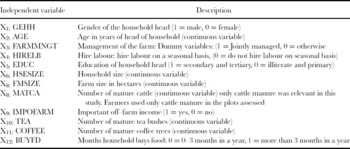
The adopters were given a code of 1 while non-adopters were given a code of 0. The data was entered in SPSS version 11.0 computer soft ware and first analysed using descriptive statistics to show characteristics of the adopters and non-adopters and their relationships with adoption. Cross-tabulation for categorical variables was used to test for association using Pearson chi-square statistic while the t-test was applied to detect differences in the mean of quantitative variables between the two groups of respondents (adopters and non-adopters) (Stern et al., Reference Stern, Coe, Allan and Dale2004). The data was also subjected to a logistic regression model analysis (Table 2).
Definition of farm and household variables hypothesized to influence adoption that were used to estimate the logistic regression model in Meru South district, Kenya.

RESULTS
Sample characteristics and their relationship with adoption
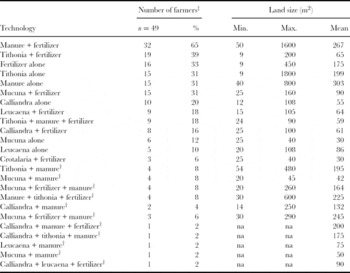
Demographic characteristics. The total number of respondents interviewed was 106; 49 (46%) were adopters and 59 (54%) were classified as non-adopters. Table 3 shows the soil fertility management inputs the 49 farmers were using to improve soil fertility on their farms. Some farmers used more than one technology but all the 49 farmers had at least one of the options combining an organic resource with mineral fertilizer and applied and managed the resources using improved methods as this is what constituted ISFM. The results showed that majority of the farmers used manure plus fertilizer and tithonia plus fertilizer with 65% and 39%, respectively (Table 3). Manure alone and manure plus fertilizer were used on the largest land sizes of 303 m2 and 267 m2, respectively. Some farmers were found to have developed their own innovations by mixing more than one organic input with mineral fertilizer, for example, manure plus tithonia plus fertilizer. Farmers reported that these innovations gave high crop yields.
Soil fertility replenishment inputs used by the 49 adopter households during 2004 long rains at Chuka, Meru South district, Kenya.

†Farmers' technology innovations.
‡Percentages do not add to 100 because farmers often practiced more than one technology in several plots.
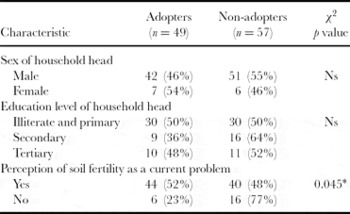
More than 80% of the farmers surveyed belonged to male-headed households (Table 4), which was expected in this region. In this region men are the landowners and take almost all decisions. Women on the other hand have user rights to the land and bear the bulk of the agricultural and domestic work. The female-headed households in the adopters and the non-adopters group were almost equal in percentages. Mean age of the adopters group was 44 years, while that of the non-adopters group was 47 years. This implies that adopters were generally younger than the non-adopters. The adopters and the non-adopters were similar in terms of level of education attained by the household heads (Table 4).
Demographic and socio-economic characteristics of adopter and non-adopter households of integrated soil fertility management in Meru South district, Kenya.

*Association significant at α = 0.05.
The majority of the households, 84 (79%) perceived soil fertility to be a current problem while the rest 22 (21%) did not perceive it to be a problem (Table 4). There exists a significant relationship between perception of soil fertility as a current problem and adoption of ISFM technology (Pearson χ2 = 4.432, p = 0.045). This implies that when farmers perceive soil fertility to be a current problem, they have a higher likelihood of adopting ISFM technology than those farmers who do not perceive soil fertility to be a problem and therefore sensitizing farmers about their soil fertility status would promote adoption.
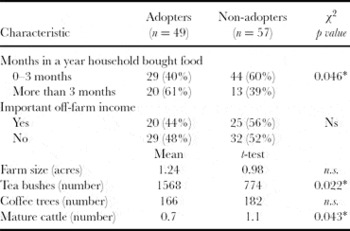
Resource endowment variables. Production of enough food for the household is one of the major objectives of farming in this region. Out of the sample households, 78 (73.5%) bought food to meet household food deficits for their household members (Table 5). This large percentage reveals that this is an area threatened by food insecurity and, considering that population pressure is increasing, the problem warrants urgent solutions. Out of the 33 farmers who bought food for more than three months 61% were adopters while 39% were non-adopters and there was a significant association (Pearson χ2 = 3.986, p = 0.046) between how many months households bought food and adoption (Table 5). This implies that farmers who are likely to adopt the technologies are those who do not produce enough food to meet their households' food demand for the year.
Farm and farmer characteristics of adopter and non-adopter households of integrated soil fertility management technologies in Meru South district, Kenya.

*Significant at α = 0.05.
Average farm size was 0.5 ha. (1.24 acres) for adopters, and 0.39 ha. (0.98 acres) for non-adopters, implying that adopters tended to have bigger farm sizes than non-adopters (Table 6). Tea and coffee were the main cash crops grown in the area. Adopters had significantly (p = 0.022) higher number of tea bushes than the non-adopters, but the number of coffee trees was not significantly different between the adopters and non-adopters (p = 0.338) (Table 6). Livestock production is one of the major farming activities in the central highlands of Kenya, and in this study farmers owned a wide range of livestock types that included cattle, sheep, goats and poultry. However, the most important type of livestock in production of manure was the cattle especially the mature ones. Non-adopters owned significantly (p = 0.043) higher numbers of mature cattle than adopters (Table 6).
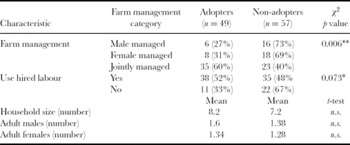
Labour variables of adopter and non-adopter households of integrated soil fertility management technologies in Meru South district, Kenya.

**association significant at α = 0.05
*association significant at α = 0.1.
Labour variables. There was a significant relationship between farm management category and adoption of ISFM technologies (Pearson χ2 = 10.329, p = 0.006) with more farmers accepting ISFM technologies in jointly managed farms (farms where both spouses worked on the farm full-time) than in either male-managed farms (husband working on the farm full-time) or female-managed farms (wife working on the farm full-time) (Table 5). In the category of either male- and female-managed farms, there were more non-adopters (60.3%) than adopters.
More non-adopters (67%) than adopters (33%) did not use hired labour and there was a significant relationship (Pearson χ2 = 3.204, p = 0.073) between hiring of labour on a seasonal basis and adoption (Table 5). This suggests that ability to hire labour on a seasonal basis positively influenced adoption of ISFM technologies. The adopters had a higher mean household size of 8.2 than non-adopters who had a mean of 7.2 though these means were not significantly different (Table 5). The mean number of adult males and females active on the farm were also not significantly different for adopter and non-adopters but adopters had generally higher numbers of adult males (1.6 persons) than non-adopters (1.4 persons).
Logistic regression model analysis of factors influencing adoption
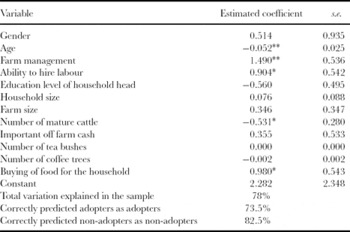
Generally there was low correlation between most independent variables implying reasonable independence between the factors. However, as expected, there was a significant correlation between household size and number of adult males and females. The results of the empirical model characterizing farmers' decision to adopt or not to adopt at least one of the ISFM technologies introduced are given in Table 7. The model had a good explanatory power and correctly predicted 78% of the adopters and non-adopters.
Parameter estimates of the logistic regression model for the household and farm characteristics that influence adoption of integrated soil fertility management technologies at Chuka, Meru South district, Kenya.

*, ** Significant at 10%, 5% level of probability.
Dependent variable = Adoption of ISFM (0 = No, 1 = Yes).
Independent variables = Refer to Table 2.
The age of the household head negatively influenced adoption at 5% probability level implying that younger households had a higher probability of adopting the ISFM technologies than the older households. The farm management variable was, however, the most important of the five variables influencing adoption as indicated by the magnitude of its coefficient and the level of significance. It positively influenced adoption with households who had both spouses working on-farm full-time having a higher probability of adopting the ISFM technologies than those who had only one of the spouses working on-farm full-time.
Ability to hire labour on a seasonal basis in this study positively influenced adoption at the 10% probability level, an implication that households that could afford to hire labour had a higher probability of adopting compared to households who were unable to hire labour. The odds in favour of adoption increased by a factor of 0.9 for households hiring labour with the probability of adoption of a farmer who could afford to able to hire labour increasing by a probability of 22%.
The number of mature cattle negatively influenced adoption with one unit increase of cattle reducing adoption by a factor of 0.6. This suggests that farmers with no or fewer mature cattle, and who would have little manure, have a higher probability of adopting the new ISFM technologies than farmers with many mature cattle. Buying of food for more than three months in a year positively influenced adoption implying that households that are food insecure and are net buyers of food are more likely to adopt ISFM technologies than households that are food secure and do not often buy food. The odds of adoption increased by a factor of almost one (0.98) for households buying food for more than three months in a year (probability increase of 25%).
DISCUSSION
Out of the 106 households surveyed, 46% were adopters, while 54% were non-adopters. This is an indication of good adoption and if the trend continues it is hoped that adoption will increase. The organic resources used by the majority of the farmers were cattle manure and tithonia and this could be attributed to availability of these two resources and the high yields obtained from plots that had these inputs applied (farmers reported high yields from these plots). Livestock keeping for milk and manure production is a major enterprise in this region and therefore manure is easily available. Tithonia, on the other hand, is found growing along roadsides and farm hedges. Modification of the technologies by the farmers by mixing organic resources is a reflection of their innovativeness and interest in addressing soil fertility problems. Mixing of organic resources results in increased nutrient supply and leads to better crop performance. It is possible that farmers made the modifications to fit their managerial and production systems and these modifications can lead to improvements that increase adoptability (Adesina et al., Reference Adesina, Coulibaly, Manyong, Sanginga, Mbila, Chianu and Kamleu1999).
The importance of farm management category in influencing adoption could be explained by the fact that ISFM technologies are labour demanding especially the biomass transfer technologies (Pali et al., Reference Pali, Delve and Nkonya2003) and farms where both the husband and wife worked on the farm full-time had more labour than farms that were managed by either the husband or the wife alone. Many farm-level studies of technology interventions identify the existence of labour bottlenecks (Elad and Houston, Reference Elad and Houston2002). In the study area, family labour is one of the most important inputs to smallholder farm production and single worker households with limited resources will often struggle to supply sufficient labour and therefore limit adoption of new technologies that create new demands for labour.
Farmers' age has been found to increase as well as decrease the probability of adoption. The negative influence of age on adoption in the current study is consistent with the findings of Odera et al. (Reference Odera, Kimani and Musembi2000) in Kenya who found age to negatively influence adoption of soil fertility replenishment practices. The importance of age in influencing (negatively) adoption is also in agreement with several other studies, for example, Bekele and Holden (Reference Bekele and Holden1998) in Ethiopia, Lapar and Pandey (Reference Lapar and Pandey1999) in Philippines, and Gockowski and Ndoumbe (Reference Gockowski and Ndoumbe2004) in Cameroon. An explanation for probability of adoption being higher among young farmers than old ones is that the young farmers have a tendency to be more innovative due to their longer planning horizons (Ervin and Ervin, 1989).
Hired labour influenced adoption positively possibly because the hired labour increased labour availability within the household to implement the technologies. In this region household members are usually the main source of labour and when it is not sufficient hired labour is sought. Hired labour is used by wealthy farmers in exchange for cash or food but for medium resource-poor farmers, hired labour is sometimes on a reciprocalFootnote 1 arrangement with the neighbours. These results corroborate the findings of Keil et al. (Reference Keil, Zeller and Franzel2005) who found adoption of improved fallows of leguminous trees for soil fertility improvement to increase with increasing availability of labour in Zambia. In central Kenya, Okuro et al. (Reference Okuro, Muriithi, Mwangi, Verjuikl, Gethi and Groote2002) also found hiring of labour to be positively related to probability of adoption of integrated use of manure and inorganic fertilizer while Oluoch-Kosura et al. (Reference Oluoch-Kosura, Marenya and Nzuma2001) reported availability of full-time labour to affect adoption of soil fertility management practices in Western Kenya.
The importance of food security is in agreement with the findings of Pilbeam et al. (Reference Pilbeam, Mathema, Gregory and Shakya2005) who linked adoption of soil fertility management practices with food insufficiency among households in Nepal. Food security, farmer income and consumer satisfaction in that order are the most important areas in agricultural production and therefore in this study farmers are motivated in applying technologies that increase food security.
Cattle manure is one of the key resources for soil fertility improvement in this region and sub-Saharan Africa as a whole that has been used for a long period. The high probability of adoption by farmers possessing few mature cattle is attributable to inadequate amounts of manure available for their farms and therefore more willing to look for alternatives to improve fertility of their soils. They therefore took up the new innovations that included improved technological components of managing manure so as to maximize the small quantities they had. On the other hand, farmers with enough cattle manure probably did not feel the need to have other soil fertility replenishment inputs. Indeed the data showed that all non-adopters used cattle manure to improve fertility of their soils and had been using it even before the project started in 2000. Farmers in the central highlands of Kenya attach a high value to cattle manure due to its multiple benefits.
CONCLUSIONS AND RECOMMENDATIONS
The factors that significantly influenced decision to adopt ISFM technologies or not were age of household head (negatively), farm management (positively), ability to hire labour (positively), number of mature cattle owned (negatively), and number of months in a year households bought food for the family (positively). The implication of these results is that the adoption of ISFM technologies could be enhanced through targeting of younger families where both spouses work on-farm full time and food insecure households. It is also important to target farmers that lack access to other sources of soil fertility improvement.
Two of the most important variables that were found to influence adoption, i.e. farm management and ability to hire labour are linked to labour availability and household wealth. For instance, good farm management implies efficient resource use, increase in productivity and increase in wealth which is critical for sustainable technology adoption and retention. This is critical since in this study and other past studies farmers mentioned that labour was one of the major problems they faced in implementation of the technologies involving organic resources. Research should explore ways of addressing the labour constraints by developing more cost-effective ways of preparation and application of organic resources to encourage greater adoption and wealth creation. In addition, adoption could be encouraged through development of policies and institutional support that focus on enhancing willingness and ability of farm households to use the technologies. This should go hand in hand with efforts to promote the technologies widely while taking into consideration key factors identified in this study as influencing adoption. Further studies should be carried out to carefully monitor and assess how farmers continue using and adapting the technologies, as this is a part of adoption process. Modifications and adaptations of technologies by farmers to understand how and why farmers modify/adapt the technologies is also recommended as it could be a way of perfecting the technologies to fit their circumstances.
Acknowledgements
The authors wish to express their gratitude to the Bentley Fellowship award to Jayne Mugwe that financed this study. The Rockefeller Foundation and the Belgium Government through the Flemish Interuniversity Council (VLIR) own initiative project are acknowledged for supporting the soil fertility project initiative where this work was carried out. We would also like to acknowledge the contribution of collaborators from Kenya Agricultural Research Institute, Kenya Forestry Research Institute, Kenyatta University, Katholeike University in Belgium and World Agroforestry Centre in Kenya, and the farmers in Chuka who participated in this study.