The rapid emergence of infections caused by multidrug-resistant organisms (MDRO) and the dwindling antimicrobial choices for treatment are now a global public health crisis. The estimated burden of antimicrobial resistance is 3-20-fold higher in low-income countries.Reference Allegranzi, Bagheri Nejad and Combescure 1
Fundamental requirements to effectively control MDRO in healthcare settings include infrastructure for rapid and accurate laboratory identification of MDRO, and an institution-specific strategy to mitigate transmission of MDRO—particularly with antimicrobial stewardship, contact precautions, and hand hygiene as core elements.Reference Sirinavin and Dowell 2 Countries may vary greatly in their capability to deploy the necessary resources to prevent transmission of MDROs, particularly if they are middle- or low-income nations. There is a paucity of data about antimicrobial resistance prevention from low- and middle-income nations, despite a higher burden of this problem in these countries. 3
The Research Committee of the Society for Healthcare Epidemiology of America (SHEA) conducted a survey to better understand self-reported capability of infection prevention programs related to identification and prevention of MDRO in countries outside the United States and Canada, comparing high- with middle- and low-income countries.
METHODS
We conducted a cross-sectional, anonymous, voluntary survey of infection control and prevention practices, capabilities, and barriers outside the United States and Canada.
The survey questionnaire (online supplement) was adapted from a previous survey in which US-based and international participants were included.Reference Drees, Pineles, Harris and Morgan 4 In addition to other questions, we specifically inquired about methicillin-resistant Staphylococcus aureus, vancomycin-resistant enterococci, carbapenem-resistant Enterobacteriaceae (CRE), extended-spectrum beta-lactamase (ESBL)-producing organisms, and multidrug-resistant Acinetobacter and Pseudomonas species. We also asked respondents to rank the top 3 barriers to MDRO prevention efforts in the acute care setting as most important (rank 1), of second importance (rank 2), and of third importance (rank 3) from a list of barriers. The questionnaire was pilot tested.
SHEA includes approximately 229 non-US/Canada based members. All were invited, with no incentives, to participate in an online self-administered questionnaire. The study was approved by the Medanta City Hospital Institutional Review Board.
To enhance participation and representativeness, after the initial round, we asked participants to further distribute the link to the questionnaire via existing networks (could have been non-SHEA) within their home countries in a snowball fashion.Reference Fowler 5
Participants were stratified according to their country’s economic development status as defined by the new country classifications of the World Bank as low-income, lower-middle-income, upper-middle-income, and high-income. 6 We conducted the χ2 test or Fisher exact test, as appropriate, to compare proportions. Stata, version 14 (StataCorp), was used for statistical analysis. We analyzed the question about barriers by selecting the most frequently reported important barriers and listed them in descending order according to how many respondents selected them (Table 3).
RESULTS
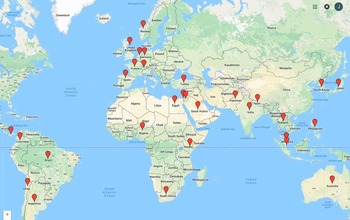
Of 229 survey invitations distributed, 76 individuals responded (response rate, 33%). The response rate was calculated on the basis of the initial number of SHEA members who were contacted because we were unable to determine the denominator once the survey was forwarded to other participants. The 76 respondents represent 30 unique countries (Figure 1), from the 4 World Bank income categories: 40 (53%) were high-, 18 (24%) were upper-middle-, 15 (20%) were lower-middle-, and 1 (1%) was a low-income country. Country data were missing for 2 respondents (3%).
Distribution of countries of survey participants.

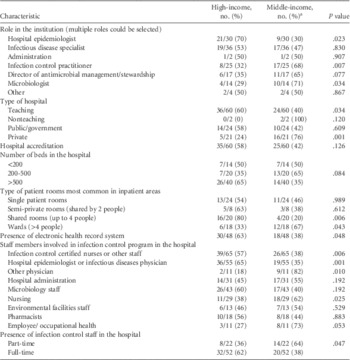
Of all the respondents, the most frequently reported hospital roles were infectious disease specialist (38 [50%]) and hospital epidemiologist (31 [41%]). However, respondents could answer yes to multiple roles. Most of the respondents were from large accredited teaching hospitals, had electronic health records (65%), and had a high proportion of full-time infection control staff. The role of hospital epidemiologist was reported at a significantly higher proportion in the high-income countries vs middle-income countries (70% vs 30%). In this analysis we compared high-income (40 [54%]) with middle-income (34 [46%]), combining 15 lower-middle and 18 upper-middle as well as including the 1 low-income country (Table 1).
General Characteristics of 76 Survey Respondents/Sites

NOTE. For many, but not all questions, respondents had the option of selecting multiple responses so the total responses may add up to more than 76. Respondents did not respond to all questions; hence some questions had missing data. Also, some questions had skip patterns.
a Only one country was low-income and it was classified under middle-income.
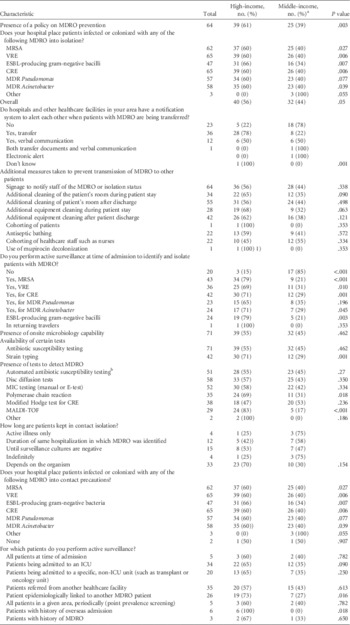
Only 5 participants (7%) reported performing any MDRO active surveillance for all patients at admission, 3 from high-income countries and 2 from middle-income countries. However, 36 participants (47%) performed active surveillance for patients referred from another healthcare facility.
Of all 76 respondents, 64 (84%) had a formal or informal antibiotic stewardship program at their institution, and 47 (62%) performed environmental monitoring (air, surfaces, or equipment) in their hospitals. There were no statistically significant differences between high- and middle-income countries for these two variables. Hand hygiene capability was high, with more than 90% of all respondents reporting use of alcohol-based hand rubs and monitoring of hand hygiene. There was no significant difference between high- and middle-income countries. Hand hygiene observation was mainly by direct observations (80%) and usually performed by infection control staff (78%).
High-income countries were more likely than middle-income countries to have an existing MDRO policy (61% vs 39%, P=.003). Also, respondents from high-income countries more frequently reported isolating patients infected with methicillin-resistant S. aureus, vancomycin-resistant enterococci, ESBL-producing organisms, CRE, and multidrug-resistant Acinetobacter. High-income countries differed (higher proportion) from middle-income countries about placing colonized or infected patients in private rooms only when it came to CRE (59% vs 41%, P=.02). Overall, duration of contact isolation did not differ between high-income and low-income countries. High-income countries had more capability to perform more advanced tests such as polymerase chain reaction and matrix-assisted laser desorption/ionization–time of flight testing (Table 2).
MDRO Control Policy and Laboratory Elements by Site Income Level for 76 Respondents

NOTE. For many but not all questions, respondents had the optional of selecting multiple responses so the total responses may add up to more than 76. Respondents did not respond to all questions; hence some questions had missing data. Also, some questions had skip patterns.
CRE, carbapenem-resistant Enterobacteriaceae; ESBL, extended-spectrum beta-lactamase; ICU, intensive care unit; MALDI-TOF, matrix-assisted laser desorption/ ionization–time of flight; MDR, multidrug-resistant; MDRO, multidrug-resistant organisms; MIC, minimum inhibitory concentration; MRSA, methicillin-resistant Staphylococcus aureus; VRE, vancomycin-resistant enterococci;.
a Only one country was low-income and it was classified under middle-income.
testing
b Such as VITEK (bioMérieux).
Middle-income countries were less likely than high-income countries to perform automatic re-isolation of MDRO-infected patients who were readmitted (13% vs 88%, P≤.001). They were also less likely to have a notification alert system when patients with MDRO were being transferred (22% vs 78%, P=.001) and less likely to perform active surveillance at time of admission to identify and isolate patients with MDRO (15% vs 85%, P<.001). Further, middle-income countries were less likely to produce antibiograms than high-income countries (36% vs 64%, P=.04) (Table 2).
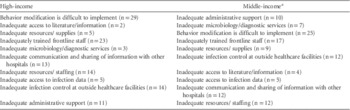
The most frequently selected barriers to preventing spread of MDRO differed by country income level (Table 3). The barrier most frequently selected by respondents from high-income countries was “behavior modification is difficult to implement.” For middle-income countries, the highest proportion was observed for “inadequate administrative support.”
Identified Barriers to Preventing Spread of MDRO by Income Level Sites From 76 Respondents

NOTE. n is the total number of participants who selected the corresponding barrier to preventing multidrug-resistant organisms (MDRO).
a Only one country was low-income and it was classified under middle-income.
DISCUSSION
Prevention of MDRO in healthcare settings remains a major challenge worldwide and requires tremendous investment in resources and infrastructure to be effective.Reference Muto, Jernigan and Ostrowsky 7 - Reference Ziakas, Anagnostou and Mylonakis 11 Our survey shows several important findings that have implications for MDRO prevention. First, most respondents came from teaching institutions and accredited public hospitals with more than 500 beds. Second, most respondents reported either full-time or part-time infection prevention staff. Most had a formal or informal antibiotic stewardship program in place. This is reassuring given the fundamental importance of these programs for MDRO prevention; however, there was considerable variability among respondents regarding the composition of infection control and ASPs. For example, few middle-income countries reported full-time infection control staff and the presence of a hospital epidemiologist compared with high-income countries. Third, the presence of single patient rooms was infrequent among the respondent institutions, with most rooms shared by 2-4 patients, which highlights the need to adapt infection control policies recommending single patient rooms for MDRO to specific settings on the basis of infrastructure capability.
We found several differences between high- and middle-income countries. Not unexpectedly, more high-income countries reported having written MDRO policies, using contact isolation practices for MDRO-infected patients, and having sophisticated testing such as matrix-assisted laser desorption/ ionization–time of flight, polymerase chain reaction, and strain typing. Fewer middle-income countries reported notification or alert systems for MDRO, and the ability to produce antibiograms. High-income countries were more likely to use contact precautions for vancomycin-resistant enterococci, methicillin-resistant S. aureus, CRE, and ESBL-producing organisms than middle-income countries. Similar to many US hospitals, most respondents indicated that contact precautions were kept in place for the duration of the index hospitalization and some performed surveillance cultures. Most respondents reported performing active surveillance on the basis of population type (eg, transplant patients) or interfacility transfer. Only 1 respondent indicated using mupirocin decolonization or cohorting of patients, but the use of antiseptic bathing and cohorting of healthcare workers was frequent among both middle- and high-income countries. Nearly all respondents reported high use of alcohol-based hand rubs and monitoring hand hygiene compliance by direct observations.
A number of barriers to MDRO prevention efforts were reported by both middle- and high-income countries: inadequate resources and training of front-line personnel, and challenges in implementing behavior change in healthcare workers.
Our study complements and extends other recent literature on this topic. A national survey of Australian hospitals showed that infection control management of resistant gram-negative bacteria varied considerably.Reference Rogers, Havers, Harris-Brown and Paterson 12 A survey by Lowe et alReference Lowe, Katz, McGeer, Muller and Group 13 demonstrated large variation in infection control practices, such as admission screening and contact precautions, for ESBL-producing organisms and CRE in Canadian hospitals. While these recent studies have focused on single countries or regions, most often in developed countries,Reference Rogers, Havers, Harris-Brown and Paterson 12 - Reference Nazeer and Al-Tawfiq 14 a global picture of infection prevention practices for MDRO prevention has thus far been lacking. In our survey, we found similar variability in practices and procedures; however, we did not collect data on MDRO rates to correlate practices with outcomes.
The situation for antimicrobial stewardship is similar; in a recent survey of 67 countries internationally, only half of the respondents had an antibiotic stewardship program. Main barriers to implementing antibiotic stewardship programs were lack of resources (funding or personnel), lack of electronic clinical decision support, and prescriber resistance. The most reported outcomes from antibiotic stewardship programs were reductions in healthcare-acquired infections, length of stay, and mortality.Reference Howard, Pulcini and Levy Hara 15
Findings of our study should be interpreted in the context of some limitations. We had a moderate response rate, but it is within the expected range for an electronic survey.Reference Horn, Green and Martinussen 16 - Reference Nulty 18 Second, the convenience sample in our survey consisted of SHEA members within the Research Network and is not representative of all international healthcare facilities. Most respondents were from large accredited teaching hospitals and had a high proportion of full-time infection control staff. Therefore, our findings cannot be generalized to all international healthcare facilities, particularly smaller, nonteaching hospitals or low-income countries. Third, we did not assess whether adherence to contact precautions was monitored; future studies should examine the fidelity of implementation to infection prevention practices globally. We do not have information on nonrespondents; respondents might have been more interested in or familiar with infection control practices. However, the survey was voluntary and anonymous; therefore, there was no incentive for respondents to give socially desirable answers.
These limitations notwithstanding, our findings have implications for healthcare workers, institutions, and policy makers engaged in MDRO prevention. Given the crisis in antimicrobial resistance worldwide, now is an important time to bolster the infrastructure, resources, and capabilities of all nations. Our findings demonstrate that challenges to implementation of infection prevention practices are similar worldwide, which suggests an opportunity to undertake large-scale global pragmatic clinical trials to evaluate the effects of behavioral interventions for reducing MDRO. Finally, studies focusing on low-income countries are urgently needed to better understand MDRO prevention and practices in areas of high prevalence and highly constrained resources. Studies in low- and moderate-income countries should focus on which interventions will maximize MDRO prevention given limited resources and barriers.
ACKNOWLEDGMENTS
We acknowledge Laure Herzog, Kristy Weinshel, and Lynne Batshon, for their contribution towards the administration of survey and retrieval of survey results; and the SHEA External Affairs Committee and Publications Committee, for reviewing this article.
Financial support. None reported.
Potential conflicts of interest. All authors report no conflicts of interest relevant to this article.
SUPPLEMENTARY MATERIAL
For supplementary material/s referred to in this article, please visit https://doi.org/doi:10.1017/ice.2016.242