Introduction
Prior to its conquest by the forces of sultan Suleiman the Magnificent (AH 958/AD 1551), the history of TripoliFootnote 1 through the Islamic era is, for the most part, written in a fragmentary way, especially for the first centuries after the Arab conquest of the 1st/7th century.Footnote 2
This is in part due to the fact that local sources remain scarce. It is true that Ibn Ghalbūn, who lived in Tripoli in the 12th/18th century, wrote a chronicle entitled al-Tidhkār fī-man malaka Ṭarābulus wa-mā kāna bi-hā min al-akhbār (‘The reminder of those who ruled Tripoli and of what happened there through history).Footnote 3 But despite this exciting title, the chapters on the first centuries of the Islamic era are very brief. Moreover, Ibn Ghalbūn filled those pages by collecting already familiar references from al-Bakrī or Ibn Khaldūn. The only monograph written in a western language dedicated to Tripoli in the Islamic era is based on this text. Ettore Rossi's Storia di Tripoli e della tripolitania: dalla conquista araba al 1911 was written in the late 1930s but only published in 1968 (Rossi Reference Rossi1968).
Despite this lack of bibliography, several milestones are well-known.Footnote 4 As a heritage from the late-Roman era, it was established that since the province of Ifrīqiya was detached from the province of Egypt at the end of the 1st/7th century, the Tripoli district belonged to Ifrīqiya (Djaït Reference Djaït1967, 88–92). The city was then managed closely by all the Ifrīqiyan rulers, either Aghlabids (184/800-297/909), Fatimids (297/909-364/973) or Zirids (364/973-543/1148).Footnote 5 On the one hand, they administered the city with great care because it was the most eastern outskirt of their territory, but also a political hotspot, showing its rebelliousness on several occasions. Therefore, it was not uncommon for Tripoli's governor to be chosen directly from the ruling family (al-Zāwī Reference al-Zāwī1970, 55–75). On the other hand, the city was keenly coveted. In an illustrative example from 267/880, al-ʽAbbās, son of the Egyptian ruler Aḥmad b. Ṭūlūn (r. 254/868–270/884), led an unsuccessful campaign to take the city from the Aghlabids (Talbi Reference Talbi1966, 346–53).
It is very difficult for historians to study the history of the city from a wider perspective, namely because we depend on the sources that were written elsewhere, particularly in the capital cities of Ifrīqiya – i.e. al-Qayrawān, Mahdia or Tunis. Yet, following the works of French theory, a corpus of thinkers emerging from the 1970s onwards, it has been proved that any historical discourse ought to deliver an imperial ideology (see especially Foucault Reference Foucault1971). Libya is particularly affected by this as it was considered a rebellious fringe, without any historical trajectory and no interests beyond being an intermediary step between East and West. Given this poor documentary record, Andalusian sources may offer original insight into the history of the city, especially its Mediterranean stature. Indeed, it sheds a new light on three major problems.
First, Tripoli appears to be an important place of learning, where many scholars from al-Andalus went for Islamic scholarship. Furthermore, the city polarised various networks, some Andalusians were particularly invested in for trading purposes. Finally, their role in the birth of the original city-state of Tripoli will be discussed with relation to the imperial strategy that the Umayyad Caliphate of Córdoba led in the Far Maghreb.
Andalusian scholars in Ifrīqiya
The rich Andalusian biographical tradition (ṭabaqāt) emerged in the mid-3rd/9th century.Footnote 6 It records thousands of biographies describing individuals from all periods, places and walks of life, though most belonged to the group of the Islamic scholars (ʽulamā’). This literature provides many details about who they were and what they did – such data was gathered in an online database managed by a team from the CSIC, the Prosopografía de los Ulemas de al-Andalus. Footnote 7
Beyond the individual specificities however, this literature tends to paint a stereotypical portrait of each one and sets up their identity as a group.Footnote 8 Incited by some Prophetic traditions (Gellens Reference Gellens, Eickelman and Piscatori1990, 50–54), the riḥla fī ṭalab al-ʽilm (‘travel in search of knowledge’), that is to say their trip to the East in order to learn from the greatest masters of their time, was one of the characteristics they shared. Such journeys were common for scholars from the Islamic West, for whom it provided access to a reputed Islamic knowledge (ʽilm). Since it contributed to the elevation of those who returned from the East, the riḥla also led to the emergence of local religious elites. Until the 5th/11th century, many Andalusian scholars performed a riḥla in order to acquire the Islamic knowledge (ʽilm) (Lenker Reference Lenker1982). Thus, the comparative study led by Sam Isaac Gellens showed that the Andalusians were those who performed the riḥla the most from all over the Islamic world, reinvesting the centres of the Islamic world despite their peripheral situation (Gellens Reference Gellens, Eickelman and Piscatori1990, 58–63). Considering this fact, we possess through the ṭabaqāt literature much data regarding the riḥla, to such an extent that a quantitative approach about its geographical structure proves to be very relevant. A qualitative analysis could also help understand the internal history of Tripoli and clarify its Mediterranean functions from an external point-of-view.Footnote 9
Using the tools of the PUA, it has been possible to select the Andalusian ʽulamā’ depending on the places they visited during their riḥla. It can thus be established that among the thousands of ʽulamā’ who lived in the Umayyad era, 432 travelled by land through the Maghreb toward the East. Only 14 did not break their journey in Ifrīqiya. The whole region can thus be considered as a hub. The contemporaries were aware of this since in the Andalusian ṭabaqāt-s, Ifrīqiya is perceived as the beginning of the Mashriq (Dejugnat Reference Dejugnat2010, 24–25). Ifrīqiya appears to have had a remarkably stable influence over the Andalusian scholars over time. Whereas this is undoubtedly true for the Aghlabid era (3rd/9th century),Footnote 10 the Fatimid era (4th/10th) has been undervalued. Given that the Fatimid caliphs belonged to the Ismāʽīlī branch of shiism, it is true they persecuted the Mālikī scholars (Halm Reference Halm1996, 242–47; Madelung Reference Madelung and Barrucand1999, 98–99). They also had violent arguments with the Umayyads of Cordoba – at that time, the two families were trying to settle a four centuries-old rivalry dating back to the time of the Prophet. However, that situation did not dissuade the Andalusians from going there, either to study or to rest, and during this time their number increased.
From the 2nd/8th to the 5th/11th century, the whole region was polarized by only one city, al-Qayrawān, the ‘Pride of the West’ (mafkhar al-Maghrib) according to al-Muqaddasī (d. c. 380/990) (al-Muqaddasī Reference al-Muqaddasī and De Goeje1877, 225; al-Muqaddasī Reference al-Muqaddasī and Collins2001, 187).
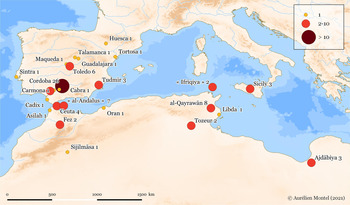
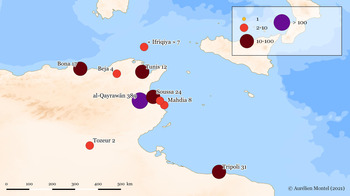
Indeed, the origins of the known students of Ibn Abī Zayd (310/922-386/996)Footnote 11 show that al-Qayrawān attracted scholars from across the Islamic West including Sicily or the Far Maghreb (Figure 1), due to its extended influence. In our case, 389 out of the 418 Andalusians who went to the Maghreb spent some time in the city, and 382 of them studied with its greatest Mālikī masters (Figure 2) (Montel Reference Montel and Denoix2017). From an Andalusian perspective, al-Qayrawān was ranked as the third most visited city in Islamic lands, coming far behind MeccaFootnote 12 and Cairo, but ahead of cities such as Baghdad or Medina.
Geographical origin of the Western students of Ibn Abī Zayd al-Qayrawānī (d. 386/996)

Ifrīqiyan cities where Andalusian scholars went to learn

Other cities had a lesser influence, as no Andalusian went there without also going to al-Qayrawān: Soussa (24 Andalusians), Bona (17), Tunis (12), Mahdia (8) or Beja (4). With the exception of Tozeur (2), Andalusian scholars went exclusively to cities located on the coastal itinerary that linked the farthest Maghreb to the Nile Delta (al-Yaʽqūbī Reference al-Yaʽqūbī and Juynboll1861, 136; al-Yaʽqūbī Reference al-Yaʽqūbī and Wiet1937, 208; Ibn Ḥawqal Reference Ibn Ḥawqal and Kramers1938–1939, I, 69–71; Ibn Ḥawqal Reference Ibn Ḥawqal, Kramers and Wiet1964–1965, I, 65–67; a-Muqaddasī Reference al-Muqaddasī and De Goeje1877, 24447; al-Muqaddasī Reference al-Muqaddasī and Collins2001, 202–04; al-Bakrī Reference al-Bakrī and Mc Guckin de Slane1859, 44–52; al-Bakrī Reference al-Bakrī, van Leeuwen and Ferré1992, II, 665–70). It comes as no surprise that other coastal cities such as Qabes, Sfax or Monastir are not found in that overview: even if the geographers describe them as very developed cities, their absence from biographical dictionaries indicates their scholarship networks were still in development.
On the eastern border of Ifrīqiya, Tripoli was ranked the second most visited city by the Andalusian scholars (31)Footnote 13 after al-Qayrawān. Mostly accessed by sea, they sometimes made stopovers before in other harbours and a few first crossed the Strait of Gibraltar and walked along the shore inland.Footnote 14
Tripoli as the core of the Andalusian scholarly communities
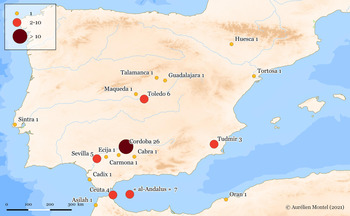
The chronological distribution of Andalusian scholars in Tripoli is remarkably stable. The city did not suffer any diminishing appeal when the Ismaïli caliphs were ruling. Out of 31 scholars, 15 went there during the Aghlabid era and 16 during the Fatimid-Zirid era. Regarding the geographical origin of these scholars, this complies with the political organisation of al-Andalus, with Cordoba as the main provider (15), followed by peripheral cities such as Elvira (4), Zaragoza (4), Toledo (2), Archidona (1), Badajoz (1), Madrid (1) and Sidonia (1) (Figure 3) (Fierro and Marín Reference Fierro, Marín, Cressier and García-Arenal1998; Urvoy Reference Urvoy and Khadri Jayyusi1992, 852).
Geographical origin of the Andalusian scholars who went to Tripoli

As historians, we do not know much about the cultural life in medieval Tripoli. However, the ṭabaqāt provide details indicating it was a considerably dynamic city.Footnote 15 On the same scale as Ifrīqiya, Tripoli was an important place for learning the Islamic scholarship. Atallah Habib's doctoral research showed that during the Fatimid era, Tripoli was the third most visited city by scholars from Ifrīqiya, after al-Qayrawān and Soussa (Atallah Reference Atallah2012, 429). Most Andalusians who came to Tripoli did the same and made good use of their stay to learn from the masters in the city. Only two visiting scholars did not study there.
The masters the Andalusians met in Tripoli were mālikī scholars, which is not surprising. Although it had not become fully dominant by this point, the Mālikī school was the main one in Ifrīqiya since its founding in al-Qayrawān at the start of the 3rd/9th century (Hentati Reference Hentati2004, 37–45; Idris Reference Idris1971, 32–38). Tripoli held an important role in the success of the Mālikī school as a scholar from the city, ʽAlī b. Ziyād al-Ṭarābulusī (d. 183/799), was among the first great mālikī scholars of Ifrīqiya.Footnote 16
Some of the masters are known to us thanks to the Ifrīqiyan ṭabaqāt tradition, but there are other masters we only know of because their name appeared in the Andalusian biographical literature, which demonstrates how fruitful this approach can be. The masters can be divided into two groups.
First, Eastern scholars who went to the Maghreb and settled there, including:
• Abū-l-Ḥasan Aḥmad b. ʽAbd Allāh b. Ṣāliḥ b. Muslim al-ʽIjlī al-Kūfī (d. 261/874),Footnote 17 native of Koufa, who had eight Andalusian disciples in Tripoli (n° 3, 4, 5, 8, 9, 20, 21, 24).
• His son, Abū Muslim Ṣāliḥ b. Aḥmad b. ʽAbd Allāh b. Ṣāliḥ al-Kūfī (d. 322/933), who had three Andalusian disciples (n° 8, 9, 12). No biography has been dedicated to him in any dictionary.
• Abū Isḥāq Ibrāhīm b. Dawūd b. Yaʽqūb al-Miṣrī al-Ṣīrafī (d. 298/911) (ʽIyāḍ Reference ʽIyāḍ and Ibn Tāwayt1980–1983, IV, 419; al-Maqrīzī Reference al-Maqrīzī and Yaʽlawī1987, I, 15–16), native of Egypt, who had one Andalusian disciples (n° 1).
The locals were not to be outdone. On an Ifrīqiyan scale, some may be considered second-rank masters, but the following did have good reputations:
- Ibn Zakrūn (d. 370/980) (ʽIyāḍ Reference ʽIyāḍ and Ibn Tāwayt1980–1983, VI, 274–75; Ibn Farḥūn Reference Ibn Farḥūn and al-Aḥmadī Abū-l-Nūr1972, II, 103), who had 5 Andalusian disciples (n° 11, 14, 24, 30, 31). He was among the greatest scholars of his time in Ifrīqiya and in his biography ʽIyāḍ grants him great qualities.Footnote 18 As a result his name was recorded in the memory of the urban populations. Thus in the description of Tripoli he wrote at the beginning of the 8th/14th century, al-Tijānī states that it was common knowledge the masjid al-Majāz, which was probably located outside the city walls, was his residence for almost forty years (al-Tijānī Reference al-Tijānī and ʽAbd al-Wahhāb1958, 251).
- Abū Bakr Abū Jaʽfar Muḥammad b. Yaḥyā b. Daḥmān al-Maṣīṣī, who had three Andalusian disciples (n° 2, 4, 15). No biography has been dedicated to him in any dictionary.
- Abū Sulaymān Abū ʽAbd Allāh Muḥammad b. Muʽāwiya al-Ṭarābulusī al-Ḥaḍramī (al-Mālikī Reference al-Mālikī, al-Bakkūsh and al-ʽArūsī al-Maṭwī1994, I, 290; ʽIyāḍ Reference ʽIyāḍ and Ibn Tāwayt1980–1983, III, 323; al-Maqrīzī Reference al-Maqrīzī and Yaʽlawī1987, VII, 276), who had 2 Andalusian disciples (n° 3, 6).
- Abū Jaʽfar Aḥmad b. al-Ḥusayn b. Muḥammad al-Ṭarābulusī al-Mu'addib, who had 1 Andalusian disciple (n° 25). No biography has been dedicated to him in any dictionary.
- Abū-l-Ḥasan ʽAlī b. Muḥammad al-Munammir al-Ṭarābulusī al-Faraḍī (348/959-432/1040) (ʽIyāḍ Reference ʽIyāḍ and Ibn Tāwayt1980–1983, VII, 274; al-Tijānī Reference al-Tijānī and ʽAbd al-Wahhāb1958, 265–66), who had 1 Andalusian disciple (n° 22).
- Abū-l-ʽAbbās Isḥāq b. Ibrāhīm al-Azdī al-Ṣā’igh b. Baṭrīqa (d. 303/915) (Abū-l-ʽArab and al-Khushanī Reference Abū-l-ʽArab, al-Khushanī and Bencheneb1915, 228; Abū-l-ʽArab and al-Khushanī Reference Abū-l-ʽArab, al-Khushanī and Bencheneb1920, 247; al-Dabbāgh and Ibn Nājī, Reference al-Dabbāgh, Ibn Nājī and Shabbūḥ1968–1978, II, 330–33), who had 1 Andalusian disciple (n° 27).
From this prosopographical data there is no doubt Tripoli was a great pole of Islamic scholarship in the Mediterranean region. Of course, the city could not challenge al-Qayrawān and Cairo, but it was close behind Alexandria and Damascus, which attracted about 70 and 50 Andalusian scholars respectively. In this regard, Andalusian scholars contributed in an important way to the influence of Tripoli.
Yet the attractiveness of Tripoli progressively declined after the middle of the 5th/11th century. The partition of the Fatimid empire, when Zirid emir al-Muʽizz b. Bādīs rejected shiism (440/1048), followed by the arrival of the Banū Hilāl, brought further difficulties to the Zirid emirate and accentuated a general crisis. The situation became so precarious that many scholars chose to flee Tripoli. At least two of them moved to al-Andalus in search of a better life.Footnote 19 Tripoli greatly suffered from this evolution: up to the 9th/15th century only three Andalusian scholars went there, and none did so for study.
Itineraries and networks around Tripoli
On a broader scale the journeys of these Andalusian scholars confirm the important functions of Tripoli, which have been partly described by Arabic geographers.
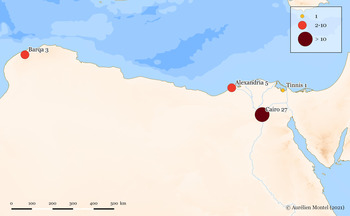
The city – located in a lightly urbanized region – functioned as the main anchor point in this itinerary that weaved along the shore and connected the Maghreb and Egypt. Although the road was not particularly safe, this seem not to have discouraged the scholars: among the 31 Andalusians who went to Tripoli, 27 were coming back/went to Miṣr (i.e. Cairo) on the same trip.Footnote 20 Among the Egyptian cities mentioned specifically, we note Alexandria,Footnote 21 Barqa,Footnote 22 Damietta and Tinnis,Footnote 23 visited by 5, 3, 3 and 1 Andalusian scholars respectively (Figure 4).Footnote 24
Cities where Andalusian scholars went to/from when coming from/to Tripoli.

Their travels confirm the vitality of that itinerary, which dates back to the Phoenician times and structures Mediterranean Islam from the strait of Gibraltar to the byzantine frontier.
If the relations of the city with its far hinterland remain rather unknown, the biographical literature sheds light on the important functions Tripoli held in the Mediterranean. Several Andalusian scholars sailed directly from al-Andalus to Tripoli – such as Muḥammad b. Waḍḍāḥ (n° 3) and Saʽīd b. Khumayr al-Ruʽaynī (n° 5), in the 3rd/9th century. Others, such as Qāsim b. Thābit al-ʽAwfī (n° 26), and probably his father (n° 27), returned home from there while coming back from the East. These examples clearly show that Tripoli, with one of the most important harbours in the Maghreb, was in fact a major hub connecting maritime and continental itineraries.
Nevertheless, that the city once maintained connections with Crete (Iqrītīsh) was unexpected. Crete entered the Islamic world at the beginning of the 3rd/9th century, when it was conquered by Andalusian exiles who fled the Iberian Peninsula after the Umayyad emir al-Ḥakam I (r. 180/796–206/822) had repressed an urban rebellion in 202/818 (Christides Reference Christides1984). After many attempts, the island was finally taken back by emperor Nicephore Phocas in 350/961. Thus, it was led by a family with Andalusian roots for a century and a half (Kremp Reference Kremp1995). Such a political situation may have attracted some scholars from the Iberian Peninsula. Maslama b. al-Qāsim al-Qurṭubī (n° 12), whose riḥla has been recently studied (see de Callataÿ and Moureau Reference De Callataÿ and Moureau2017), went to Crete in 350/961, sailing from Tripoli. This trip reveals the existence of a maritime route that has never been mentioned in the Arabic geographical literature: the anonymous author who wrote the Ḥudūd al-ʽĀlam (372/982) is the only one who locates the island 'north of Tripoli' (Anonymous Reference Sutūdah1962: 23; Anonymous Reference Minorsky1970, 60). This crossing from Tripoli confirms both the subsistence and resilience of that ancient itinerary, whose first attestations date back to the 7th century BC (Arnaud Reference Arnaud2005, 187–88).
More generally, Tripoli appears to be a place of importance regarding exchanges between the Islamic West and Eastern Mediterranean. Ibn Ḥawqal (d. about 378/988) states that numerous ships proceeding from the bilād al-Rūm, i.e. the Byzantine world, used to head to that harbour (Ibn Ḥawqal Reference Ibn Ḥawqal and Kramers1938–1939, I, 69; Ibn Ḥawqal, Reference Ibn Ḥawqal, Kramers and Wiet1964–1965, I, 65). The Ḥudūd al-ʽĀlam specifies that some traders he qualified as ‘Rūm’ also lived there (Anonymous Reference Sutūdah1962, 178; Anonymous Reference Minorsky1970, 153). The use of the term 'Rūm' is tricky. In those days it could either refer to the inhabitants of the Central and Eastern Mediterranean provinces of the Byzantine empire, or to the people of Southern Italy, which was still a Byzantine province too. In Tripoli, such merchants may have worked with Andalusians traders whose presence in the city has been confirmed in the same text (Anonymous Reference Sutūdah1962, 178; Anonymous Reference Minorsky1970, 153). In fact, scholars from al-Andalus may have conducted business during their time in Tripoli, even though the motive for their stay was never specifically related with trade. It was possibly the case for Muḥammad b. ʽĪsā al-Bayyānī (n° 30), from Cordoba, who was known to be a trader (al-tājir) and went to Tripoli in 338/949. In that regard, the Andalusian prosopographical literature confirms the commercial functions of the city prior to the 5th/11th century, when the Mediterranean trade gradually restarted thanks to Islamic dynamism.Footnote 25
This commercial role could explain the interest the Andalusians had for the city, where they seem to have developed a strong political role. Indeed, it is possible that the birth of the 'city-state' of Tripoli, which Michael Brett situates at the beginning of the 5th/11th century (Brett Reference Brett1986, 80–81), is closely linked to the influence they had on the urban elites.
Andalusian contributions to the birth of an original city-State
The first manifestation of a political autonomy that Tripoli maintained for centuries afterwards took place in 399/1008–1009. Taking advantage of the dispute between the Fatimid caliph al-Ḥākim (r. 386/996-411/1021) and its Zirid lieutenant over the status of the city, Falfūl b. Saʽīd al-Zanātī, the governor of Tripoli (al-Zāwī Reference al-Zāwī1970, 83), showed his political agency and gave his allegiance to the Umayyad caliph of Cordoba Muḥammad II (r. 399/1009–400/1010).Footnote 26 In his Bayān, Ibn ʽIdhārī (fl. 8th/14th century) narrates those events in these terms:
On Tuesday, after 17 nights in the month of shawwāl of that year [399/June 1009, the 14th], two ambassadors arrived. They said Falfūl b. Saʽīd b. Khazrūn al-Zanatī sent them to Muḥammad in order to submit to him. He promised to pronounce the duʽā’ in his favour, and asked for the right to strike dinars and dirhams in his name. Muḥammad agreed with them, offered them clothes, wrote to Falfūl about the matter, and sent him gifts. When they reached Tripoli, Falfūl had died, and Wurrū b. Saʽīd, his brother, had fled when Nāṣir al-DawlaFootnote 27 arrived to the city. He ordered to capture the men of Muḥammad b. Hishām [Muḥammad II], and had their heads cut off (Ibn ʽIdhārī Reference Ibn ʽIdhārī, Lévi-Provençal and Colin1983, III, 78; Ibn ʽIdhārī Reference Ibn ʽIdhārī and Maíllo Salgado1993, 76–77).Footnote 28
Even if no further action was taken, this pragmatic initiative confirmed Tripoli had acquired a Mediterranean stature, as well as a political autonomy that lasted until the end of the Hafsid rule.
Some may notice that this initiative was launched by a governor whose profile is very singular within the Fatimid-Zirid elites. Indeed, Falfūl b. Saʽīd belonged to the reigning family of the Maghrāwa, a Zanāta tribe that initially lived in Central Maghreb, but he moved to the Far Maghreb in order to serve the caliphate of Cordoba.Footnote 29 Although Falfūl b. Saʽīd decided instead to join the Zirids – in other words the Fatimids, who were the Umayyads of al-Andalus’ sworn enemies – he went back to his first allegiance on this occasion. He might have remembered that some members of his family were granted great honours by the caliphate of Cordoba, and were given principalities in the Far Maghreb, such as al-Muʽizz b. Zīrī in Fez, or his very uncle, Wānūdīn b. Khazrūn, in Sijilmāsa (397/1006). In this respect, the Andalusian influence in Eastern Ifrīqiya could not be regarded as insignificant. All things considered, Falfūl b. Saʽīd's initiative to pledge his allegiance to the Umayyad caliph would makes sense, although he failed.
Moreover, this initiative can probably be related to the presence of many Andalusians in Tripoli who had either settled there or were simply passing through. This is no exception. Historiography shows that an Andalusian diaspora has existed since the 3rd/9th century, scattered in the main cities of the Maghreb from Fez to al-Qayrawān, including Asilah, Oran, Tunis, and even Alexandria.Footnote 30 In some cases, the greatest families from the Andalusian community relied on outstanding social capital and were involved in lucrative long-distance trade. As a result the community fostered close links with ruling families. This is true in Fez (Montel Reference Montel2016), but also in al-Qayrawān, where the biographical literature signals that the Banū Khayrūn, originally from Cordoba, frequented the Aghlabid family, and later the first Fatimid caliph ʽUbayd Allāh (Abū-l-ʽArab and al-Khushanī Reference Abū-l-ʽArab, al-Khushanī and Bencheneb1915, 175, 233; Abū-l-ʽArab and al-Khushanī Reference Abū-l-ʽArab, al-Khushanī and Bencheneb1920, 263, 327; al-Mālikī Reference al-Mālikī, al-Bakkūsh and al-ʽArūsī al-Maṭwī1994, II, 52–56).
Thereby, the political initiative of Falfūl b. Saʽīd may be considered a result of a decisive pressure possibly exerted by the leaders of the Andalusian diaspora. In fact, this situation has already been observed in Ceuta (319/931) (Ferhat, Reference Ferhat2014, 55), and in Fez (363/974) (Montel Reference Montel and Dejugnat2020), where the elites gave, in the name of the inhabitants, their own cities to the Cordoban caliphs; it might as well have been the case in other cities that took the initiative to send embassies in Cordoba in order to recognize the Umayyads’ sovereignty, like Algiers (329/940) for instance (Ibn Ḥayyān Reference Ibn Ḥayyān, Chalmeta, Corriente and Ṣubḥ1979, 460–61; Ibn Ḥayyān Reference Ibn Ḥayyān, Viguera Molins and Corriente1981, 347). Falfūl b. Saʽīd did not live long enough to see his attempt fail. Still, his policy was sufficiently strong to give his family stable political supports: although not much is known about the internal history of Tripoli during the 5th/11th century, it is clear that Falfūl's kin kept ruling in a very autonomous way.Footnote 31
Concluding remarks
Any Andalusian entering Tripoli was at a real crossroad. First, the city was an important stopover, perhaps the most important on the route that went to/from the East and followed the southern shore of the Mediterranean. This geographical location can partly explain why the city was attractive, particularly for scholars and pilgrims. Tripoli also figures prominently in the Andalusians’ scholarly communities because of the great reputation of its scholars. Indeed, after those in al-Qayrawān, they were the most popular for Andalusians in search of Islamic knowledge in Ifrīqiya.
Secondly, Tripoli was also one of the main harbours of the Maghreb. This maritime orientation also benefited Andalusian traders based in the city who had the opportunity to deal with foreign partners from the Byzantine world in particular. From there they could also cross the sea and travel to any destination, including Crete, which offers a new perspective on the connections between the Maghreb, Central Mediterranean and the northern shore.
From a political point of view, it is likely the Andalusians behaved in Tripoli in the same way as they did elsewhere, using their social and political resources to support pledges of allegiances to the Umayyad caliphate. Tripoli being very far from the Iberian peninsula, that initiative failed as it was predictable. In the following centuries, the political influence of the Andalusians seems to have faded away. Even though many served the Berber dynasties and the sultanates that arose after the Almohad caliphate collapsed, leading their influence to increase across the Maghreb, the Andalusians never regained the position they had in Tripoli in the beginning of the 5th/11th century.
Appendix 1. List of the Andalusian scholars who went to Tripoli from the 3rd/9th to the 5th/11th century.Footnote 32
From Archidona
• 1 – Abū ʽAbd Allāh Muḥammad b. ʽĪsā b. Rifāʽa al-Khawlānī b. al-Qallās (c. 270/883–337/948).Footnote 33 He was in Tripoli in 285/898.Footnote 34 Ibrāhīm b. Dawūd b. Raqīq in particular taught him Saḥnūn's Mudawwana.
From Badajoz
• 2 – Abū-l-Walīd Hāshim b. Yaḥyā b. Ḥajjāj al-Baṭalyawsī (d. 385/995). He was in Tripoli in 338/940.Footnote 35
From Cordoba
• 3 – Abū ʽAbd Allāh Muḥammad b. Waḍḍāḥ b. Bazīʽ (199/814–287/900).Footnote 36
• 4 – Abū ʽAbd Allāh Muḥammad b. Ghālib al-Umawī b. al-Ṣaffār (d. 295/908).Footnote 37
• 5 – Abū ʽUthmān Abū Zayd Saʽīd b. Khumayr b. Marwān b. Sāllam b. al-Ruʽaynī (230/844–301/913). He was in Tripoli in 260/873.Footnote 38
• 6 - Abū ʽAbd al-Raḥmān Baqī b. Makhlad b. Yazīd al-Qurṭubī (201/817– 276/889).Footnote 39
• 7 – Abū ʽUthmān Saʽīd b. ʽUthmān b. Saʽīd b. Sulaymān b. Muḥammad b. Mālik b. ʽAbd Allāh al-Tujībī al-Aʽnāqī (233/847–305/917).Footnote 40
• 8 – Abū ʽAbd Allāh Muḥammad b. Qāsim b. Muḥammad b. Sayyār al-Bayyānī (263/877–327/939). He was in Tripoli between 294/906 and 299/911.Footnote 41
• 9 – Abū ʽUmar Aḥmad b. Duḥaym b. Khalīl b. ʽAbd al-Jabbār b. Ḥarb b. Abī Ḥarb (278/892-338/950). He was in Tripoli between 315/927 and 319/931.Footnote 42
• 10 – Abū Bakr Muḥammad b. Aḥmad b. Muḥammad al-Judhāmī (b. 336/947), from Cordoba.Footnote 43
• 11 – Abū Ḥafṣ ʽAbd Allāh b. Muḥammad b. ʽAbd Allāh b. ʽĀmir b. Abī ʽĀmir Muḥammad b. al-Walīd b. Yazīd b. ʽAbd al-Malik al-Maʽāfirī (m. 350/961). He was the father of Muḥammad b. Abī ʽĀmir, who became the almighty ḥājib of the late Andalusian caliphate. He may have died in Tripoli.Footnote 44
• 12 – Abū-l-Qāsim Maslama b. al-Qāsim b. Ibrāhīm b. ʽAbd Allāh b. Ḥātim (293/905–353/964). He was in Tripoli in 320/932.Footnote 45
• 13 – Abū ʽAbd Allāh ʽUbayd b. Muḥammad b. Aḥmad b. Muḥammad b. Aḥmad al-Qaysī b. Ḥumayd (310/922–392/1002). He was in Tripoli in 342/953.Footnote 46
• 14 – Abū Muḥammad ʽAbd Allāh b. Ibrāhīm b. Muḥammad b. ʽAbd Allāh b. Jaʽfar al-Umawī al-Aṣīlī (324/935–392/1002). He was in Tripoli between 351/960 and 366/976.Footnote 47
• 15 – Abū ʽAbd Allāh Muḥammad b. ʽAbd al-Malik b. Ṣafwān b. Marwān al-Ḥaddād al-Lakhmī al-Ruṣāfī (302/915–394/1004). He was in Tripoli between 338/949 and 339/951.Footnote 48
• 16 – Abū-l-Walīd ʽAbd Allāh b. Muḥammad b. Yūsuf b. Naṣr al-Azdī al-Ḥāfiẓ b. al-Faraḍī (351/962–403/1013). He was in Tripoli in 382/993.Footnote 49
• 17 – Abū ʽAbd al-Malik Marwān b. Muḥammad b. ʽAlī al-Asadī al-Qaṭṭān al-Būnī (d. 440/1048). He was in Tripoli before 405/1014.Footnote 50
From Elvira
• 18 – Abū ʽImrān Mūsā b. Aḥmad al-Thaqafī b. al-Lubb (d. 270/883).Footnote 51
• 19 – Abū-l-Khidhr Ḥāmid b. Akhṭāl b. Abī-l-ʽArīḍ al-Thaʽlabī al-Ilbīrī (d. 280/893). He was in Tripoli in 252/866.Footnote 52
• 20 – Abū ʽAbd Allāh Muḥammad b. Fuṭays b. Wāṣil al-Ghāfiqī al-Ilbīrī al-Zāhid (230/844–319/931). He was in Tripoli in 252/866.Footnote 53
• 21 – Abū Saʽīd ʽUthmān b. Jarīr b. Ḥamīd al-Kalbī (228/842–323/934).Footnote 54
From Madrid
• 22 – Abū Yaʽqūb Yūsuf b. ʽAbd al-Raḥmān b. ʽAbd Allāh b. Ḥammād (395/1004-473/1080).Footnote 55 Ibn al-Munammir taught him the Kitāb fī-l-Farā’iḍ, which he had written.
From Sidonia
• 23 – Abū Muḥammad ʽAbd Allāh b. Muḥammad b. Abī-l-Walīd al-Aʽraj (232/847–310/922).Footnote 56
From Toledo
• 24 – Abū-l-Faraj ʽAbdūs b. Muḥammad b. ʽAbdūs (d. 390/1000). He was in Tripoli in 356/967.Footnote 57
• 25 – Abū Jaʽfar Aḥmad b. Muḥammad b. Muḥammad b. ʽUbayda al-Umawī (353/964–400/1010). He was in Tripoli in 380/990.Footnote 58
From Zaragoza
• 26 – Abū Muḥammad Qāsim b. Thābit b. Ḥazm b. ʽAbd al-Raḥmān b. Muṭarrif b. Sulaymān b. Yaḥya al-ʽAwfī (255/868–302/915). He was in Tripoli in 288/904.Footnote 59
• 27 – Abū-l-Qāsim Thābit b. Ḥazm b. ʽAbd al-Raḥmān b. Muṭarrif b. Sulaymān b. Yaḥya al-ʽAwfī (217/832–313/925). He was in Tripoli in 288/904.Footnote 60
• 28 – Aḥmad b. Maysara al-Ghifārī (d. 322/933).Footnote 61
• 29 – Abū-l-ʽAbbās al-Walīd b. Bakr b. Makhlad b. Abī Ziyād al-ʽUmarī (d. 392/1002).Footnote 62
From an unknown origin
• 30 – Abū ʽAbd Allāh Muḥammad b. ʽĪsā al-Bayyānī (d. after 338/949).Footnote 63 He was in Tripoli in 338/949, where he had one local student (Abū Jaʽfar Aḥmad b. al-Ḥusayn b. Muḥammad al-Ṭarābulusī al-Mu'addib).
• 31 – Abū ʽImrān Mūsā b. ʽAbd al-Raḥmān al-Zāhid (d. 378/988).Footnote 64
Appendix 2. The life of Ibn Zakrūn, according to ʽIyāḍ's Tartīb al-madārik wa-taqrīb al-masālik li-maʽrifat aʽlām madhhab Mālik
Abū-l-Ḥasan b. al-Khaṣīb.
He was ʽAlī b. Aḥmad b. Zakariyyā’ b. al-Khaṣīb, known as Ibn Zakrūn al-Ṭarābulusī.
Al-Mālikī said: he was a virtuous, pious and abstinent man. He had excellence and devotion, reason and discreetness, a good constitution and a radiant face. He had many books about the fiqh, especially the inheritance (farā’iḍ), the stipulations (shurūṭ), and the devotional practices (raqā’iq). He wrote many books about ḥadīth and science of men (al-rijāl). He was a man of noble morality and tended to do good.
Abū ʽAbd Allāh al-Ajdābī said: he was the companion of Rabīʽ al-Qaṭṭān. With him he crossed wastelands and wandered the provinces of Syria. He was among his listeners and learned sanad with him. He listened to Abī ʽAbd Allāh al-Jīzī, Ibn al-Mundhir, Ibn Ramaḍān, Ibn Shaʽbān, Ibn al-Aʽrābī and Ibn al-Jārūd. He was a companion of Abū ʽAlī b. al-Kātib al-Zāhid al-Miṣrī, and then joined another group of hermits (nussāk). Transmit from him Abū-l-Ḥasan al-Qābisī, Abū-l-Ḥasan b. al-Munammir al-Ṭarābulusī, Abū-l-Qāsim b. Namir, Abū ʽAlī al-Ḥasan b. al-Muthannā (who became qāḍī of Tripoli), Abū-l-Ḥasan al-Ḥaṣā’idī al-Qāḍī, and, among the Andalusians, ʽAbdūs b. Muḥammad al-Ṭulayṭulī and others. Thus, he became admired by the people of Tripoli.
Abū-l-Ḥasan b. al-Munammir said: Abū-l-Ḥasan b. Zakrūn was among the humble ones, either with his food, his drinking, his clothing, his earnings and his words. The people learnt with him the fiqh, the haḍīth, and the abstinence from everything that is illicit (waraʽ).
Another said: he remained forty years without making anyone laugh, and without saying anything slanderous. He did not call anyone using a nickname. For fifty years he did not swear in the name of Allāh. In his presence, someone asked him: do you ever recant? He said: I swear no oath that I would break. He had a written correspondence with Rabīʽ al-Qaṭṭān.
He died in the year 370/980.Footnote 65