Protracted exposure to verbal conflict and violence between parents takes a substantial toll on children's emotional and behavioral adjustment, and is associated with higher levels of depression and anxiety, and greater difficulties with social relationships with peers (see Kouros, Cummings, & Davies, Reference Kouros, Cummings and Davies2010, for review). While research demonstrates the powerful role that cognitive appraisals may have for the interpretation of and response to threatening situations in middle and later childhood, less is known regarding the precursors of those emotional processes in the context of high levels of interparental conflict in early childhood (Cummings & Davies, Reference Cummings and Davies2002; Dadds, Atkinson, Turner, Blums, & Lendich, Reference Dadds, Atkinson, Turner, Blums and Lendich1999; Grych & Fincham, Reference Grych and Fincham1990). In addition, fewer studies of interparental conflict and children's emotional development (whether with older or younger children) have considered exposure to verbal and physical aggression in the context of other forms of environmental adversity, such as families' struggles with income poverty. To pursue these questions, this study considers ways that higher levels of exposure to arguing, threatening, and frightening behavior between adults (alone and in conjunction with other forms of environmental adversity) may canalize low-income children's experience of higher levels of difficulty processing emotional information, placing them at greater risk for difficulty in modulating emotions of fear, anxiety, and sadness as they enter school (Blair & Raver, Reference Blair and Raver2012; Yoshikawa, Aber, & Beardslee, Reference Yoshikawa, Aber and Beardslee2012). This theoretical framework of experiential canalization and accompanying empirical evidence to support it are briefly reviewed below. We then outline a set of pressing, unanswered questions in this area of scientific inquiry, along with our hypotheses, before presenting the methods and results of our study.
Interparental Aggression as a Stressor That Shapes the Ability to Recognize and Modulate Negative Emotion
From an evolutionary standpoint, safety and security represent the bedrock of survival for mammalian young. Conversely, both animal and human models have clearly illustrated that when individuals are faced with chronically unsafe and threatening rearing conditions, they subsequently show disruptions in their ability to manage emotions of fear, anxiety, and behavioral responses of withdrawal versus approach toward novelty (Luu, Tucker, & Derryberry, Reference Luu, Tucker and Derryberry1998). Developmental and clinical research have shown that interparental conflict and aggression detrimentally impact young children's peer relations and social problem solving with grave implications for child mental health and adjustment (Cummings & Davies, Reference Cummings and Davies2002). One mechanism may be that interparental aggression significantly disrupts children's ability to recognize and modulate negative emotion: in a set of landmark studies with young children, for example, children from high-conflict households showed greater physiological arousal as well as greater behavioral distress, and yet they perceived lower levels of angry affect when overhearing a simulated argument between adults than did children who lived in low-conflict households (Cummings, Pellegrini, Notarius, & Cummings, Reference Cummings, Pellegrini, Notarius and Cummings1989; El-Sheikh, Reference El-Sheikh1994). In short, children's encounters with parents' anger and aggression may “tune” or shape their neurobiological, cognitive, and behavioral responses in ways that may support their safety and adaptation in the short term (e.g., context of parental fighting) but may be maladaptive or costly in the long term (such as being less able to regulate emotion in less risky or frightening contexts, such in early school settings). The idea that development is shaped by biology and experience coactively to promote specific abilities in favor of others is known as experiential canalization (Gottlieb, Reference Gottlieb1991, Reference Gottlieb1997). Using this theoretical lens of experiential canalization, we and others have argued that this disruption in children's recognition of and response to scary and upsetting situations is undergirded by environmentally shaped neurocognitive processes: higher exposure to the acute and chronic dimensions of threat associated with parental fighting, aggression, and violence may lead to alterations in biobehavioral and cognitive responses among conflict-exposed children (Blair & Raver, Reference Blair and Raver2012; Davies, Sturge-Apple, Cicchetti, Manning, & Vonhold, Reference Davies, Sturge-Apple, Cicchetti, Manning and Vonhold2012). This theoretical framework is aligned with recent advances in psychological science suggesting that environmental adversity takes a toll on individuals' ability to detect and appraise stimuli “that signal safety or threat” as well as their ability to modulate mood states and emotions evoked by those stimuli, at both neurobiological and behavioral levels (Frankenhuis & de Weerth, Reference Frankenhuis and de Weerth2013; Gianaros & Hackman, Reference Gianaros and Hackman2013; McDermott, Westerlund, Zeanah, Nelson, & Fox, Reference McDermott, Westerlund, Zeanah, Nelson and Fox2012). With these findings, a number of new questions have arisen.
New Directions for the Study of Adversity, Interparental Aggression, and Emotional Processes
First, it is not clear whether long-term exposure to threatening and fear-inducing conditions of interparental aggression would lead to heightened skill in children's ability to recognize others' negative emotions or to profiles of cognitive and behavioral response that appear blunted, less accurate, or more distorted. The case could be made for ways that prolonged exposure to threatening and fear-inducing situations in the home would lead children to be hypervigilant to emotion cues signaling danger, termed the “sensitization hypothesis” by Cummings and Davies (Reference Cummings and Davies2002). Prolonged exposure to interparental fighting and violence could also be argued to lead children to accrue, store, and retrieve more emotional information about the causes and consequences of negative emotion. In support of this view, some previous studies using behavioral and attentional paradigms (including dot-probe and emotion matching tasks) demonstrate that chronic exposure to both parents' and peers' anger and aggression tunes children's attention and responsiveness in favor of heightened vigilance to emotionally negative stimuli (Cicchetti & Rogosch, Reference Cicchetti, Rogosch, Skinner and Zimmer-Gembeck2009; Ouellet-Morin et al., Reference Ouellet-Morin, Odgers, Danese, Bowes, Shakoor and Papadopoulos2011; Pollak, Messner, Kistler, & Cohn, Reference Pollak, Messner, Kistler and Cohn2009; Pollak, Vardi, Bechner, & Curtin, Reference Pollak, Vardi, Bechner and Curtin2005). In contrast, children exposed to high levels of parental harshness and aggression have been found to show significant deficits in encoding, processing, and retrieving emotional information, where prolonged exposure to threat increases children's arousal to such a great extent that they are less able to make accurate attributions about their own and others' emotions (Kim & Cicchetti, Reference Kim and Cicchetti2010; Sullivan, Carmody, & Lewis, Reference Sullivan, Carmody and Lewis2010). Recent work also highlights the ways that children exposed to higher levels of interparental conflict demonstrate compromised, less fully formed cognitive schema about emotions and relationships as a central feature of profiles of maladjustment (McCoy, Cummings, & Davies, Reference McCoy, Cummings and Davies2009).
In the following study, we consider the implications of this model of experiential canalization for young children exposed to varying levels of conflict and aggression in their households over time, prospectively examining whether verbal aggression and physical aggression between parents through infancy, toddlerhood, and early childhood is positively or negatively associated with their ability to accurately recognize and label emotional stimuli at 58 months of age. We also consider whether individual differences in exposure to interparental aggression are also positively or negatively predictive of a more molar measure of young children's ability to modulate negative emotions that are commonly triggered in frightening or threatening situations. We build on past studies in this area (see, e.g., Crockenberg & Langrock, Reference Crockenberg and Langrock2001; Cummings & Davies, Reference Cummings and Davies2002; Grych & Fincham, Reference Grych and Fincham1990; Kitzmann, Gaylord, Holt, & Kenny, Reference Kitzmann, Gaylord, Holt and Kenny2003), by specifically considering the risks posed by chronic exposure to threats posed by parental fighting and arguing for children's symptoms of withdrawal, anxiety, sadness, and fear (i.e., their internalizing problems) when they are 60 months of age.
Second, a number of investigators have pointed out that differences in findings of hypo- versus hypervigilant profiles of children's recognition of emotional information and their subsequent behavioral and affective responses may be due to variability in children's own initial reactivity in early infancy: that is, some children may be more vulnerable to the canalizing influence of chronic environmental stressors (including chronic exposure to conditions of high threat such as maltreatment and interparental conflict) than other children (see Blair & Raver, Reference Blair and Raver2012; Cicchetti, Rogosch, Gunnar, & Toth, Reference Cicchetti, Rogosch, Gunnar and Toth2010, for discussion). From this perspective, we were particularly interested in children's temperamental predisposition to responding to new and potentially frightening stimuli in ways that would be characterized as inhibited or fearful (as indicated by behavioral indicators of withdrawal and distress in the context of novelty; see Fox, Henderson, Rubin, Calkins, & Schmidt, Reference Fox, Henderson, Rubin, Calkins and Schmidt2001). While it is well established that high reactivity in the face of novelty places children at greater risk for later difficulty modulating feelings of fear, withdrawal, sadness, and anxiety, it is unclear whether this dimension of temperamental reactivity in infancy also plays a significant role in their ability to recognize and appropriately label negative emotion in early childhood (Degnan, Almas, & Fox, Reference Degnan, Almas and Fox2010). In short, research on interparental conflict, children's emotion recognition, and later adjustment would benefit from greater attention to the role of early temperamental proneness to become alarmed or distressed in new and potentially frightening situations. In addition, children's temperamental reactivity in the face of novelty may serve as a key moderator in predicting the link between exposure to angry, frightening encounters among adults in the household and later emotional development (see Obradovic, Bush, & Boyce, Reference Obradović, Bush and Boyce2011, for comprehensive review). Accordingly, we hypothesize that children's reactivity in the face of novelty in early infancy may play a key direct role in predicting their later ability to recognize and modulate negative emotion as well as moderating role in our models.
Third, new questions have arisen regarding the role of a complex array of poverty-related risks that may co-occur with family violence and that may also substantially compromise children's development of healthy emotional adjustment. One key concern when reviewing prior research is that poverty places adults at higher risk of greater frustration, anger, and proneness to losing emotional control, both in their relationships with their children and with one another: poverty could therefore serve as a significant confound in studies of interparental aggression and child emotional development. Findings from the national surveys as well as of those families applying for welfare and homeless shelter services suggest that relations between income poverty and domestic violence are complex, with poverty constraining women's ability to leave abusive relationships, placing women in less stable and less safe housing arrangements, and placing them at higher risk of losing their jobs and consequently their earnings (Browne, Salomon, & Bassuck, Reference Browne, Salomon and Bassuck1999; Goodman, Smyth, Borges, & Singer, Reference Goodman, Smyth, Borges and Singer2009; Stainbrook & Hornik, Reference Stainbrook and Hornik2006). From a scientific and a policy standpoint, it is particularly important to disentangle the role of interparental aggression from poverty for children's emotional development. Yet few studies have tested whether children's exposure to interparental conflict and aggression predict difficulties in recognizing and modulating negative emotion even after taking into account cumulative exposure to poverty (for exceptions, see Davies, Cicchetti, & Martin, in press; Santiago & Wadsworth, Reference Santiago and Wadsworth2009).
In addition, interparental violence may take place within a context of higher levels of chaotic family functioning and turbulence that may partially, if not fully, overlap with one another as well as with economic hardship. Household chaos, defined as a high level of disorganization, lack of structure, and high levels of unpredictability or instability in household composition, has been found in a number of studies to be a key poverty-related household stressor that is clearly predictive of lower self-regulation, lower academic achievement, and lower language acquisition (Evans, Gonnella, Marcynyszyn, Gentile, & Salpekar, Reference Evans, Gonnella, Marcynyszyn, Gentile and Salpekar2005; Garrett-Peters, Vernon-Feagans, Pan, Willoughby, & Family Life Project Key Investigators, Reference Garrett-Peters, Vernon-Feagans, Pan and Willoughby2013; Jaffee, Hanscombe, Haworth, Davis, & Plomin, Reference Jaffee, Hanscombe, Haworth, Davis and Plomin2012; Petrill, Pike, Tom, & Plomine, Reference Petrill, Pike, Tom and Plomine2004; Vernon-Feagans, Garrett-Peters, De Marco, & Bratsch, Reference Vernon-Feagans, Garrett-Peters, De Marco, Bratsch, Maholmes and King2012; Vernon-Feagans, Garrett-Peters, Willoughby, Mills-Koonce, & Family Life Project Key Investigators, Reference Vernon-Feagans, Garrett-Peters, Willoughby and Mills-Koonce2012). Chaotic household functioning, captured both by instability in the composition of the household and by the family's struggle to maintain regular rules and routines, may be intertwined with a pattern of higher conflict between parents. In the following analyses, we sought to distinguish the role of these forms of household instability and disorganization from the roles of income poverty and interparental aggression, with the hypothesis that household chaos may serve as an added, covarying source of stress that leads to higher emotional difficulty and lower levels of adjustment for young children.
Prior work by our research team (Vernon-Feagans, Garrett-Peters, Willoughby, et al., Reference Vernon-Feagans, Garrett-Peters, De Marco, Bratsch, Maholmes and King2012) has identified objective means of estimating both family instability (characterized by changes in caregivers, residential moves, and changes in people in the household over time) and household disorganization (characterized by low level of household preparation for home visits, messiness of the house, household density, and noise). These data collected by visiting the home many times over the children's first 3 years of life allow us to estimate children's cumulative exposure to these two forms of household chaos, without relying on parent subjective ratings, in a way that helps to parse the role of household chaos from children's exposure to interparental aggression, more specifically.
Additional questions have been raised regarding methodological challenges when studying the canalization of emotional processes through exposure to adversity both within and outside of the household. For example, inferences drawn from previous studies have been hampered by reliance on monomethod and single-reporter approaches to examination of the link between interparental aggression and child outcomes. More recent work using the Family Life Project has been able to robustly support linkages between interparental violence and biopsychological as well as behavioral markers in infancy and toddlerhood (Hibel, Granger, Blair, Cox, & Family Life Project Key Investigators, Reference Hibel, Granger, Blair and Cox2009; Towe-Goodman, Stifter, Coccia, Cox, & Family Life Project Key Investigators, Reference Towe-Goodman, Stifter, Coccia and Cox2011; Towe-Goodman, Stifter, Mills-Koonce, Granger, & Family Life Project Key Investigators, Reference Towe-Goodman, Stifter, Mills-Koonce and Granger2012). The following study extends this set of questions, considering ways that interparental aggression (as reported by the primary caregiver), family chaos (as independently rated by data collectors), and income poverty are related to children's skill in recognizing emotions (directly assessed by research staff), as well as children's difficulty modulating anxiety, fear, and sadness (as reported by the primary caregiver). Finally, while many studies were initially pathbreaking in establishing the link between interparental conflict at one time point and children's adjustment at a later time point, more recently investigators have called for greater attention to ways that children may be adversely affected by exposure to interparental conflict over longer periods of time (Blair et al., Reference Blair, Raver, Granger, Mills-Koonce and Hibel2011; Cicchetti & Cohen, Reference Cicchetti, Cohen, Cicchetti and Cohen1995; Cummings, Davies, & Campbell, Reference Cummings, Davies and Campbell2000; Kouros, Cummings, & Davies, Reference Kouros, Cummings and Davies2010). The following study addresses this by considering higher versus lower exposure to interparental aggression spanning from infancy through toddlerhood and early childhood as predictors of children's emotional adjustment at 58 months of age.
The Present Study
To address these linked economic, household, and adult relational conditions, we hypothesize that chronic income poverty and children's higher levels of exposure to household chaos (as indexed both by compositional characteristics of instability and by behavioral characteristics of the household such as disorganization) will each also be significant predictors of lower levels of accuracy in correctly identifying emotions and higher levels of difficulty in modulating negative emotions among young children in a racially diverse sample of over 1,000 families living in rural poverty. We predict that exposure to higher levels of interparental aggression from infancy through early childhood (in both verbal and physical forms) will continue to serve as a key predictor of these two dimensions of children's emotional adjustment at age 58 months, even after having statistically taken into account the roles of temperament, chronic family poverty, and higher exposure to family chaos.
Finally, while key psychobiological links have been identified in the “chain” of hypothesized causal links between interparental conflict and aggression to later levels of child adjustment problems, we know less about the aspects of early cognitive processing of emotional information that may serve as additional key links in that chain. Our hypothesis is that children's emotion recognition may serve as a key mechanism through which poverty, chaotic household conditions, and interparental aggression are linked to more molar behavioral outcomes such as children's difficulty modulating feelings of sadness, fear, and withdrawal; we will therefore conduct a final set of analyses wherein children's accuracy in identifying discrete emotions is considered as an intervening or statistically mediating variable linking multiple forms of adversity and parental report of child sadness, fear, and withdrawal (or internalizing difficulty), which will be tested against a model in which only direct paths are specified.
Method
Participants
The Family Life Project was designed to study young children and their families living in two of the four major geographical areas of the United States with high poverty rates (Dill, Reference Dill1999). Specifically, three counties in eastern North Carolina and three counties in central Pennsylvania were selected to be indicative of the Black South and Appalachia, respectively. The Family Life Project adopted a developmental epidemiological design in which sampling procedures were employed to recruit a representative sample of 1,292 children whose families resided in one of the six counties at the time of the child's birth. Low-income families in both states and African American families in North Carolina were oversampled (African American families were not oversampled in Pennsylvania because the target communities were at least 95% non-African American).
Procedures
Families were seen in home visits at child ages of approximately 2, 6, 15, 24, 36, 48, and 58 months. At 6, 24, and 36 months, families were seen in two separate visits. All home visits for data collection were 2 or more hours in duration. During visits for data collection, mothers completed questionnaires concerning family demographics, income, and a set of parent–child interaction tasks, yielding a comprehensive profile of families' exposure to income poverty, parents' engagement in reasoning, verbal aggression, and physical aggression, and child developmental status as well as changes in demographic characteristics of the family (Cox, Paley, Burchinal, & Payne, Reference Cox, Paley, Burchinal and Payne1999; NICHD Early Child Care Research Network, 1999). At approximately 58 months of age, children were administered tasks to assess their accuracy in correctly identifying emotions. Children were seated across from the experimenter at a convenient location in the home. At each time point, experimenters rated the home upon leaving the household for the level of chaos versus organization within the home.
Measures
In this study, children's ability to recognize and modulate negative emotions is operationalized as (a) accuracy in recognizing emotions, directly assessed through the Assessment of Children's Emotion Scale (ACES), and (b) parent report of sadness, anxiety, and withdrawal, on a subscale of the Strengths and Difficulties Questionnaire (SDQ). The ACES was developed to measure children's emotion knowledge, with an adapted version of the facial expressions subscale of the ACES administered to children at the 58-month home visit. The facial expressions subscale contains color photographs of children making faces that either clearly depict an emotion (joy, sadness, anger, or fear) or demonstrate no emotion at all. The child is asked by the experimenter to indicate if the child in the picture is feeling happy, sad, mad, scared, or is not feeling anything at all across eight trials. The reliability and validity of the ACES has been demonstrated in multiple studies using different samples of participants (Domitrovich, Cortes, & Greenberg, Reference Domitrovich, Cortes and Greenberg2007; Schultz, Izard, & Bear, Reference Schultz, Izard and Bear2004). For example, the accuracy of children's emotional attributions, as indexed by the ACES, is positively correlated with a composite teacher–peer rating of happiness (r = .19, p < .05) and negatively correlated with a parallel measure of aggression (r = –.16, p < .05; Schultz et al., Reference Schultz, Izard and Bear2004). For children's accuracy scores, 80% of relevant items are required to calculate the total score, which could range from 0 to 8. Children's difficulties managing sadness, anxiety, and withdrawal, as reported by parents on the SDQ (Goodman, Reference Goodman1997), were also collected at 58 months of age. This included their mean score across items 3, 8, 13, 16, and 24 from the emotional symptoms subscale (with items such as “many worries or often seems worried” and “often unhappy, depressed or tearful”), and response options ranging from 0 (not true) to 2 (certainly true), with adequate interitem reliability (α = 0.64) and well-established levels of discriminant and criterion validity (Goodman & Scott, Reference Goodman and Scott1999).
Temperamental proneness to distress in the face of novelty in infancy
During the 6-month home visit, temperamental proneness to distress was measured through the use of the corresponding 16-item subscale (fear/distress to novelty) of the revised version of Rothbart's Infant Behavior Questionnaire (Gartstein & Rothbart, Reference Gartstein and Rothbart2003). Sample items from the subscale include “How often during the last week did the baby startle (jump in surprise) to a sudden or loud noise” and “When visiting a new place, how often did the baby show distress (get upset) for the first few minutes?” A 7-point Likert scale (1 = never, 7 = always) was used to rate the frequency with which the child had exhibited the behaviors in the past 2 weeks. The revised Infant Behavior Questionnaire subscales were administered via computer using Blaise software. Item values were averaged to produce a score for the subscale, which demonstrated high interitem reliability (α = 0.87).
Exposure to chronic poverty
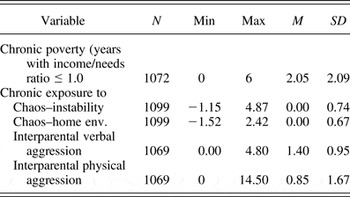
A child's exposure to chronic poverty was determined by calculating family income/needs ratio (i.e., as the family's estimated total household income for a given year divided by the federal poverty threshold for that year, adjusted for number of persons in the home). Family transitions into and out of poverty were calculated as 1 versus 0 for each assessment period (using federally recommended thresholds of income/needs ratio less than or equal to 1.0 defined as “poor” and coded as 1 while families whose income fell above 1.0 were coded as “nonpoor” for that assessment period and were given a score of 0). Chronicity of time spent in poverty from 15 to 58 months was calculated by summing the number of times families were categorized as poor over those five assessment periods (see Table 1).
Descriptive statistics for children's exposure to multiple forms of adversity from 6 to 58 months of age

Household chaos
Extending a prior study using the Family Life Project data (Vernon-Feagans, Garrett-Peters, Willoughby, et al., Reference Vernon-Feagans, Garrett-Peters, De Marco, Bratsch, Maholmes and King2012), 10 cumulative indicators of household chaos were derived from data collected at home visits when target children were approximately 2, 6, 15, 24, 36, 48, and 58 months old. They included (a) the total number of times the child moved physically to another residence, (b) the total number of changes in the primary caregiver (usually involved change in primary responsibility for child from mother to other adult), (c) the total number of changes in the secondary caregiver (either primary caregiver partner or primary caregiver grandmother), (d) the total number of different people in the household, (e) the total number of times household members moved into or out of the household, and (f) report of the average number of hours that the TV was on each day. A seventh indicator, average household density, was created, whereby at each visit, the number of rooms in the home was divided by the number of people residing in the home to create a household density score. The 8th, 9th, and 10th indicators were consensus ratings by the two data collectors who completed the home visit at each time point. These indicators were selected from the Post-Visit Inventory used in the Fast Track Intervention Study (Dodge, Pettit, & Bates, Reference Dodge, Pettit and Bates1994) at the home visits and captured the disorganization in the household. These included the following three items: home visit preparation by the household (0 = can't rate, 1 = surprise/difficulty, 2 = aware, but unprepared, 3 = aware/ready, and 4 = good hosts), the cleanliness of the household (0 = can't rate, 1 = very dirty, 2 = slightly dirty, 3 = messy, and 4 = clean), and the neighborhood noise level around the home (0 = can't rate, 1 = very quiet, 2 = average, 3 = noisy, and 4 = very noisy). Scores of “0” on these indicators were treated as missing in the analyses. Analyses suggested a two-factor solution. The first factor, household instability, included five variables: number of people moving in and out of the household, the total number of people in the household, the number of household moves, the number of changes in the primary caregiver, and the number of changes in the secondary caregiver. The second factor was labeled household disorganization, and it also included five variables: household density, numbers of hours of TV watching, preparation for home visits, cleanliness of the home, and neighborhood noise factors. Principal component analysis and exploratory factor analysis results were consistent across weighted and unweighted analyses. These 10 indicators were standardized (M = 0, SD = 1) and averaged to create two composite scores. Based on recent comprehensive analyses of these measures from 2 to 36 months, we were assured that the household instability and household disorganization composites demonstrated reasonable internal consistency (Cronbach αs = 0.76 and 0.67, respectively) and were positively correlated with each other (r = .38, p < .0001), as well as with parental education (r instability = –.34; r disorganization = –.56, ps < .0001) and household income (r instability = –.32; r disorganization = –.58, ps < .0001; Vernon-Feagans, Garrett-Peters, Willoughby, et al., Reference Vernon-Feagans, Garrett-Peters, De Marco, Bratsch, Maholmes and King2012).
Interparental aggression
Caregivers reported on their own and their partners' use of verbal aggression and physical aggression during the past 12 months (Conflict Tactics Scale—Couple Form R [CTS-R]; Straus & Gelles, Reference Straus and Gelles1990) across 6, 15, 24, 35, and 58 months of age. Given substantial evidence to suggest men underreport their own verbal and physical aggression, it has been recommended to base assessments of aggression in the home by relying on women's report (Stets & Straus, Reference Stets, Straus, Straus and Gelles1990; Straus & Sweet, Reference Straus and Sweet1992). The six-item verbal aggression scale assesses the frequency with which each individual used verbal acts that symbolically hurt the other party (α = 0.89; e.g., “How often has he insulted or swore at you?”), and the nine-item violence scale assesses the frequency with which physical force was used as a means of resolving the conflict (α = 0.81; e.g., “How often has he kicked, bit, or hit you with a fist?”); items ranged from 0 = never to 6 = more than 20 times in the past year. CTS data were extracted for all cases across all time points where the reporter on the CTS was the primary caregiver. (To clarify, if a primary caregiving respondent provided data on the CTS, it meant that she had a partner at that time point, regardless of her marital status and regardless of whether she was initially partnered at baseline.) Respondents' answers on items pertaining to verbal aggression and physical aggression/violence were calculated, as were respondents' answers regarding their partners' use of verbal aggression and physical aggression/violence. Inspection of zero-order correlations suggest that mothers' reports of their own engagement in levels of conflict and violence were strongly related to their reports of the level of conflict (e.g., r verbal = .84, p < .01, n = 979 at 6 months) and aggression (with r violence = .55, p < .01 for 6 month report) being used by the partner, and suggested that reports for mother and partner should be combined.
Key demographic covariates included child gender, child race/ethnicity, and maternal education in infancy, at baseline assessment.
Missing data
The current analytic sample consists of families whose children had valid data on the two outcome measures of emotion regulation (N = 1,025). The environmental adversity variables used in these analyses were created by averaging or summing scores across waves for respondents who had a minimum of two waves of valid data. The resulting variables varied in their numbers of valid cases: verbal aggression (N = 933), physical aggression (N = 933), chaos–instability (N = 1,025), chaos–home environment (N = 1,025), and chronic poverty (N = 924). In order to test for differences between families who were missing any measure of adversity (N = 177) and those who were not (N = 848), a logistic regression was run in which covariates (African American, child gender, and maternal age) and emotion regulation outcomes (emotion accuracy and difficulty regulating emotions) were used to predict missingness. For the most part, the results revealed no differences between the samples. The one exception was that African American families were more likely to have missing adversity data (B = 1.17, e B = 3.21, p < .001) relative to other racial/ethnic groups.
Analytic models were initially run using listwise deletion: 22% of the sample had missing data on any analytic variable resulting in a final N of 804. In order to maximize power and to capitalize on as much information as possible, the final analytic models were run in Mplus version 6 (Muthén & Muthén, Reference Muthén and Muthén1998–2010) using full information maximum likelihood (FIML). FIML estimates statistical parameters from data with missing values, allowing retention of the complete sample for all analyses. There were no substantive differences across the models run with listwise deletion and FIML.
Results
Descriptive data are presented to provide a broad overview of children's experiences of multiple forms of adversity, including interparental aggression (on both verbal and physical dimensions) and exposure to chronic poverty and to two forms of household chaos, from infancy through 58 months of age. Zero-order correlations between all key predictors and outcomes are estimated and presented. We then estimated the role of chronic exposure to interparental aggression from 6 to 58 months in predicting children's emotion regulation at 58 months of age (as indicated by their accuracy in identifying depictions of discrete emotions) using ordinary lest squares regression analyses. Given the nonnormality of the interparental aggression variables, models were run using bootstrapped standard errors with 5,000 sample replicates in order to correct for potential bias. In this first set of analyses, we also included child temperamental proneness to distress in the face of novelty (in early infancy) as well as key demographic covariates, including maternal education, child race/ethnicity, and child gender in the model. We then conduct additional regression analysis with chronicity of exposure to low income status (as calculated by families falling at or below 100% of the US poverty threshold) as well as exposure to two dimensions of household chaos to detect the extent to which interparental aggression remains a key predictor of children's ability to recognize negative emotions at 58 months, even after having taken these theoretically meaningful and potentially confounding variables into account. A model with infant temperamental proneness to distress in the face of novelty as a statistical moderator is then included to test whether associations differed for children with different early profiles of reactivity. All analyses were conducted with all continuous variables grand-mean centered. A second set of similar models are then fitted with maternal report of children's difficulty in regulating negative emotions of sadness, anxiety, and withdrawal as the dependent variable. To detect whether there was any evidence to support children's emotion recognition as a possible mechanism linking exposure to environmental adversity and parents' more molar reports of children's emotional difficulty, indirect effects were tested using the product coefficient method run using bias-corrected bootstrapping with 5,000 sample replicates (MacKinnon, Reference MacKinnon2008; Shrout & Bolger, Reference Shrout and Bolger2002).
Descriptive analyses of multiple forms of adversity faced by children from 2 to 58 months of age
As is clear from Table 1, many children in the Family Life Project have faced significant and chronic exposure to multiple forms of adversity from infancy through early childhood. On average, children were in households struggling with income poverty for 2 out of their first 5 years of life, with a substantial proportion of children exposed to substantial instability in household composition and in the level of disorganization within the home.
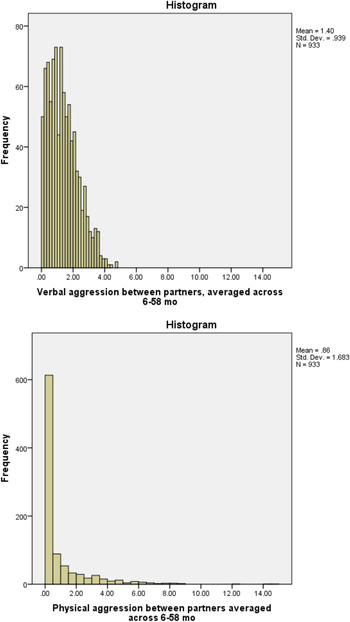
Cumulative exposure to angry encounters between parents was reported to be relatively rare for most children. For example, the mean number of times caregivers and their partners engaged in episodes of verbal aggression (such as swearing at one another, arguing with one another, or verbally threatening one another) was reported to be once to twice a year. The mean number of episodes of physical aggression (calculated across partners and across time) was even lower, with the average child exposed to an episode of physical aggression (such as hitting, slapping, or threatening with a weapon) less than once a year, across a 5-year period. As has been found in previous studies, measures of central tendency tend to obscure the reality that a small proportion of children in our sample were exposed to a high level of interparental conflict and violence: as is illustrated in Figure 1, histograms of the frequency of both forms of aggression suggest that while verbal aggression is relatively normally distributed, exposure to physical aggression is substantially skewed, where a small number of children are chronically exposed to a high number of incidents of physical violence between parents over time.
(Color online) Histograms of the frequency of both forms of aggression.

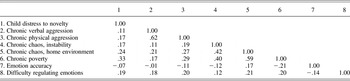
Zero-order correlations (Table 2) revealed that parents' reports of interparental aggression were only moderately related to cumulative experiences of poverty and chaos over time.
Zero-order correlations between primary predictors and outcomes

Note: All rs ≥ .11 are significant at the α = 0.01 level.
Predicting emotion recognition from infant temperament and multiple forms of adversity
Our first set of models tested whether children's accuracy on the ACES emotion recognition task at 58 months was significantly predicted by chronic exposure to interparental aggression, as indexed by cumulative levels of verbal aggression and physical aggression aggregated over time and across partners. In addition, this first set of models included child's temperamental reactivity at 6 months and child's membership in one of two racial/ethnic categories, as well as maternal age as key demographic predictors.
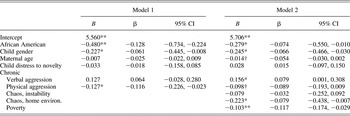
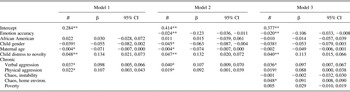
Model 1 (with demographic characteristics, interparental aggression, child reactivity at 6 months of age, and child's racial/ethnic group membership included) predicted 4% of the variance in children's 58-month ACES performance. As indicated in Table 3, parents' report of higher levels of physical aggression from infancy through early childhood was significantly predictive of children's lower ability to accurately identify emotions at 58 months (B = –0.13, β = –0.12, p = .01). Subsequent inclusion of additional poverty-related forms of adversity, including exposure to chronic poverty and two dimensions of family chaos, in Model 2 yielded almost twice as much proportion of variance explained in children's emotion knowledge (R 2 = .07). In this second model, higher levels of interparental verbal aggression were predictive of children's higher levels of accuracy in recognizing emotion at 58 months (B = 0.16, β = 0.08, p < .05); higher physical aggression continued to predict children's lower emotion recognition at 58 months (albeit at marginal levels of statistical significance), after including other forms of poverty-related adversity in the model. Results of Model 2 also highlight that children's chronic exposure to greater chaos in the home environment and a higher number of years spent in poverty were significant predictors of lower emotion recognition at age 58 months (see Table 2 for the magnitude of standardized and unstandardized coefficients). Across both models, children's temperamental proneness to distress in the context of novelty, as assessed in early infancy, was not a statistically significant predictor of emotion recognition at 58 months. A third model (not shown) with inclusion of distress to novelty by adversity interaction terms as additional predictors did not yield evidence of infant temperament as a moderator, that is, none of the interaction terms attained levels of statistical significance.
Standardized and unstandardized coefficients and bootstrapped confidence intervals with children's accuracy in identifying emotions as the dependent variable

†p < .10. *p < .05. **p < .01.
Predicting parent report of child difficulty modulating negative emotion from infant temperament and multiple forms of adversity
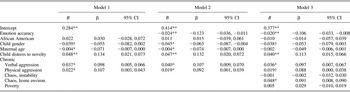
Next, we considered the ways that interparental aggression (both verbal and physical) might serve as key predictors of parental report of children's difficulties modulating feelings of sadness, anxiety, and withdrawal by conducting a second set of analyses, with parental report on the emotional symptoms subscale of the SDQ at 58 months as the dependent variable. Results of Model 1 (with both forms of interparental aggression, child temperament assessed in early infancy, and key covariates as predictors) explained 7% of the variance in child emotional symptoms SDQ scores. Higher chronic exposure to both forms of interparental aggression from infancy through early childhood was associated with higher levels of emotional difficulty at 58 months (see Table 4, columns 1 and 2). Higher temperamental proneness to distress in the face of novelty, assessed in early infancy, was also significantly predictive of higher levels of emotional regulatory difficulty at 58 months (see Table 3). In additional analyses (Model 2), the role of children's emotion recognition at 58 months was found to serve as a statistically significant additional predictor of their parent-reported difficulty modulating negative emotions, with Model 2 explaining 9% of the variance. The results of Model 3 suggest that interparental aggression and child temperamental proneness to distress remain significant predictors of 58-month SDQ scores, even after controlling for individual differences in chronic exposure to family chaos and poverty from infancy through early childhood (see Table 3, Model 3). In addition, higher levels of household disorganization are predictive of greater difficulty modulating negative emotions at 58 months. Inclusion of interaction terms for infant temperament by each form of adversity yielded scant evidence of infant temperament as a moderator, with one out of the five interaction terms yielding statistically significant results (i.e., infant temperament by household instability, B = –0.05, β = –0.10, p = .01). In short, combined with the null interaction results reported above for ACES as a dependent variable, infant temperament could not be detected as a statistical moderator of most forms of adversity for emotional adjustment at 58 months.
Standardized and unstandardized coefficients and bootstrapped confidence intervals with children's difficulty regulating sad, anxious, and withdrawn emotions as the dependent variable
†p < .10. *p < .05. **p < .01.
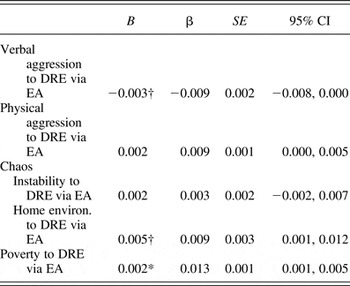
Standardized and unstandardized coefficients for indirect effects with bootstrapped confidence intervals

Note: DRE, Difficulty regulating emotion; EA, emotion accuracy; CI, confidence intervals of unstandaradized coefficients. †p < .10. *p < .05.
Finally, we completed additional analyses to test the indirect effect of environmental adversity on difficulty regulating emotions of sadness, anxiety, and withdrawal via children's skills in recognizing emotions, as reflected on their ACES performance. Specifically, we examined the role of emotion recognition as an intervening variable between chronic exposure to all forms of adversity: interparental verbal aggression, interparental physical aggression, both dimensions of family chaos, and poverty and children's difficulty modulating negative emotions as assessed on the parent-reported emotional symptoms subscale of the SDQ. Table 4 presents the coefficients and confidence intervals for the indirect paths from environmental adversity to emotional difficulty via emotion recognition (Path a × b). Findings from tests of the direct paths between environmental adversity and emotion recognition (Path a) and emotion recognition and difficulty modulating negative emotion (Path b) are presented in Table 2, Model 2 and Table 3, Model 3, respectively. Results of the analyses provide partial support for the role of emotion recognition as an intervening variable between environmental adversity and child difficulty modulating negative emotion (as reported by parents). For example, the indirect effects of interparental verbal aggression (B = –0.003, β = –0.009, p = .08) and chaos, as indexed by chronic disorganization (B = 0.005, β = 0.009, p = .09), attained trend levels of significance, falling just above the threshold of α set at 0.05. In addition, a statistically significant indirect effect of chronic poverty on difficulty modulating negative emotions via emotion recognition was found (B = 0.002, β = 0.013, p = .04).
Discussion
In this study, we sought to test the roles of children's exposure to multiple forms of environmental adversity in predicting their ability to recognize and modulate negative emotions such as sadness and fear. On average, children in our sample were in households struggling with income poverty for 2 out of their first 5 years of life, with a substantial proportion of children exposed to high levels of instability (vis-à-vis movements of adults in and out of their households) and to high levels of disorganization within the home. Chronic poverty and multiple indicators of chaotic household functioning were only moderately correlated, underscoring the ways that many families in our sample were able to maintain a high level of structure, stability, and ordered routine despite struggling to make ends meet on limited financial resources. Descriptive analyses also revealed that cumulative exposure to angry, physically and verbally aggressive encounters between parents was reported to be relatively rare for most children: the average number of episodes of aggression between caregivers and their respective romantic partners was reported by primary caregivers to be low (between once or twice a year for verbal aggression and less than once a year for physical aggression). It is important to note that a small proportion of children in our sample were exposed to a high level of interparental conflict and violence (as reported by their primary caregivers). For a small number of children, exposure to physically aggressive episodes such as adults slapping, hitting, or threatening one another with a knife occurred multiple times within a given year, and across multiple years. These descriptive statistics help to frame our primary question: what is the role of these multiple forms of adversity in shaping children's ability to accurately identify negative emotions, as well as their ability to modulate feelings of sadness, anxiety, and fear? To address this question, we first consider the role of interparental aggression for both emotional outcomes.
The role of interparental aggression for recognizing and modulating negative emotion
Our first set of analyses provided clear evidence for the ways that higher levels of verbal and physical aggression between parents during the period from infancy through early childhood significantly predict children's ability to accurately recognize and identify emotion at 58 months of age. As expected, higher levels of exposure to interparental physical aggression were associated with children's lower performance on a simple emotions labeling task. This finding lends clear support to previous findings of interpersonal violence-exposed children's significant deficits in encoding, processing, and retrieving emotional information, where prolonged exposure to violence may be so neurobiologically and cognitively disruptive that violence-exposed children are less able to make accurate attributions about their own and others' emotions (Kim & Cicchetti, Reference Kim and Cicchetti2010; Sullivan et al., Reference Sullivan, Carmody and Lewis2010).
To our surprise, higher levels of exposure to verbal aggression, not of parents' physical aggression, was associated with higher, rather than lower levels of emotion knowledge at 58 months of age. This contrasting set of findings for parents' verbal versus physical aggression is aligned with mixed findings in previous research on children's exposure to interparental aggression (Thompson & Meyer, Reference Thompson, Meyer and Gross2007). It should be noted that these findings are of exploratory rather than confirmatory empirical value: establishing the distinct roles of these two forms of parental conflict is difficult, given that we relied on parental report from primary caregivers. With these caveats in mind, these results lend support for greater specificity and complexity when examining the roles of multiple forms of interparental aggression in households for children's emotion recognition over time.
Our findings also highlight the ways that interparental aggression may powerfully shape children's ability to regulate their own feelings of sadness, withdrawal, and fear. Specifically, higher levels of verbal aggression between caregivers and their romantic partners were significantly associated with children's greater difficulty (as reported by caregivers) in these “internalizing” emotional states. Parents' use of physical aggression was also significantly associated with this important emotional outcome (albeit falling to marginal levels of statistical significance once other forms of poverty-related adversity had been taken into account). Across these findings, this study extends the work of our colleagues regarding the negative sequelae of interparental aggression for emotional development in infancy among Family Life Project participants (Towe-Goodman et al., Reference Towe-Goodman, Stifter, Coccia and Cox2011). Our analyses suggest support for the hypothesis that chronic exposure to high levels of interparental aggression exacts a high behavioral cost to young children's healthy emotional adjustment (see Davies, Sturge-Apple, et al., Reference Davies, Sturge-Apple, Cicchetti, Manning and Vonhold2012, for review).
These longitudinal findings regarding the role of interparental aggression for children's ability to recognize and modulate negative emotions were robust, even when we considered children's temperamental proneness to expressing distress in the face of novelty, assessed very early in infancy. Children's emotional reactivity in infancy was included in both sets of this study's models, strengthening our confidence in our results. In addition, children's greater proneness to distress in infancy was itself a significant predictor of later difficulty modulating negative emotions such as sadness, anxiety, and withdrawal, as reported by parents at 58 months. In contrast, early reactivity in infancy was not found to contribute significantly to predictions of variance in children's emotion recognition, nor was it found to substantively moderate the role of parental aggression for children's emotional adjustment in early childhood. In short, our results suggest that children's early reactivity may have set some children on a developmental course of greater vulnerability to internalizing emotional difficulty (though not for difficulty in accurately interpreting emotional information), as has been found in prior work on the enduring role of temperament for later psychosocial outcomes (Fox, Henderson, Marshall, Nichols, & Ghera, Reference Fox, Henderson, Marshall, Nichols and Ghera2005; Mian, Wainright, Briggs-Gowan, & Carter, Reference Mian, Wainwright, Briggs-Gowan and Carter2011).
The roles of poverty and chaos in the household as predictors of children's ability to recognize and modulate negative emotion
In addition, this study provides us with the opportunity to consider the roles of other forms of poverty-related adversity as distinct contributors to children's emotional adjustment, from infancy to early childhood. Our findings clearly highlight that children's exposure to higher levels of household chaos (specifically household disorganization) in the home environment and higher number of years spent in poverty significantly predict lower levels of accuracy in identifying emotions at age 58 months. These findings regarding the role of family chaos (in behavioral terms, though not in terms of family instability) are consistent with prior findings suggesting that families struggling with economic insecurity who experience high levels of disorganization, crowding, and noise are linked to poorer language skills, overall, in children (Evans, Reference Evans2006; Vernon-Feagans, Garrett-Peters, Willoughby, et al., Reference Vernon-Feagans, Garrett-Peters, De Marco, Bratsch, Maholmes and King2012). In addition, greater household disorganization was also clearly predictive of children's greater risk of difficulty regulating sadness, withdrawal, and fear, even after taking into account child characteristics such as temperament and the quality of interparental interaction (via caregivers' reports of physical and verbal aggression) in the home. To our knowledge, this is one of the first studies in the area of interparental violence to carefully distinguish the roles of multiple forms of environmental adversity in predicting children's recognition and modulation of negative emotions (see Davies, Sturge-Apple, et al., Reference Davies, Sturge-Apple, Cicchetti, Manning and Vonhold2012; Ingoldsby, Shaw, Owens, & Winslow, Reference Ingoldsby, Shaw, Owens and Winslow1999, for exceptions). Moreover, our findings are in keeping with theoretical models of chronic poverty and poverty-related stressors as key to shaping or “canalizing” emotional processes through neuroendocrine and behavioral pathways, over time (Blair & Raver, Reference Blair and Raver2012; Obradovic, Bush, Stamperdahl, Adler, & Boyce, Reference Obradović, Bush, Stamperdahl, Adler and Boyce2010).
Follow-up analyses of statistical mediation of children's modulation of internalizing emotions through emotion provide partial support for our model. Specifically, the indirect “effects” of interparental verbal aggression and chronic chaos in the home environment on children's internalizing emotional difficulty “through” the pathway of their accuracy in recognizing emotions fell just above the threshold of statistical significance, suggesting preliminary support for this proposed mechanisms. In addition, Sobel tests of statistical mediation suggest a statistically significant indirect “effect” of chronic poverty on difficulty modulating negative emotions via emotion recognition. These results are interpreted with considerable caution, because this statistical support is drawn from observed covariances between longitudinally collected variables, rather than from experimental data on which causal inference might be drawn. In short, these results suggest that children's ability to recognize and identify negative emotions accurately may be one (but certainly not the only) pathway by which environmental adversity on both economic and family functioning levels may be associated with children's internalizing difficulty over time.
Limitations and future directions
A key limitation to our study (as with many other studies of interparental aggression) is that reports of verbal and physical aggression between primary caregivers and their romantic partners were retrospectively reported. That is, we know less about the content or intensity of arguments and fights between parents in this study, and thus we can only speculate, rather than measure, the level of threat to which children in our sample were exposed. Closer attention to both the constructive and destructive tactics used by adults in the household during conflict, as well as to the type and intensity of emotions experienced by children during adults' fights (see Cummings & Davies, 2004; Davies, Martin, & Cicchetti, Reference Davies, Martin and Cicchetti2012; Davies, Sturge-Apple, et al., Reference Davies, Sturge-Apple, Cicchetti, Manning and Vonhold2012), would allow us to increase the precision and specificity of our models in future work. Another methodological limitation is that measures of children's emotion knowledge were relatively brief, with photographed stimuli used to elicit children's accuracy rather than more dynamic and sensitive measures such as those used in recent innovative work with maltreated children (see Pollak, Reference Pollak2008; Pollak et al., Reference Pollak, Messner, Kistler and Cohn2009; Shackman, Shackman, & Pollak, Reference Shackman, Shackman and Pollak2007; Zhang, Wang, & Luo, Reference Zhang, Wang and Luo2012). Despite this limitation, robust differences in the ability to accurately identify and interpret emotional cues were detected between children exposed to different levels and types of environmental stressors. This suggests that, if anything, this study may underestimate rather than overestimate the relationships between multiple forms of adversity and this important area of emotional self-regulation.
With these limitations in mind, our study points to ways that children's emotion recognition and modulation of negative emotion may be powerfully shaped by exposure to verbal and physical fighting between adults in the household. Our study supports recent formulations by others that different forms of interparental conflict (such as physical violence vs. verbal aggression) may need to be carefully distinguished from each other for their “unique implications” for children's emotional knowledge as well as for their modulation of biobehavioral arousal (see Davies, Martin, et al., Reference Davies, Martin and Cicchetti2012). This study's findings regarding the possible mediating role of emotion recognition also complement prior findings of the ways that children's physiological reactivity may mediate relationships between adversity (such as exposure to violence in the home) and later internalizing difficulty (Crockenberg & Langrock, Reference Crockenberg and Langrock2001; Davies, Sturges-Apple, et al., Reference Davies, Sturge-Apple, Cicchetti, Manning and Vonhold2012).
Finally, this paper also places interparental aggression within additional contexts both inside and outside the household when considering the experiential canalization of self-regulation from infancy through early childhood. These findings contribute to mounting evidence of the role of poverty-related risk for children's emotional adjustment, with greater attention to the developmental sequelae as social forces that many families in the United States must navigate during tough economic times (Raver, Blair, Willoughby, & Family Life Project Key Investigators, Reference Raver, Blair and Willoughby2012).