INTRODUCTION
Advances in critical care have led to improved survival rates among those admitted to intensive care units (ICUs) where over 55,000 patients are hospitalized each day in the United States (Schmitz et al., 1998). Medical and surgical management of critical illnesses can, and frequently does, result in de novo cognitive impairments. Current data suggest that 25 to 78% of survivors of critical illness develop significant and persistent cognitive impairments (Gordon et al., 2004; Hopkins & Brett, 2005; Hopkins et al., 1999; Jackson et al., 2003). However, cognitive impairments following critical illness and ICU treatment are understudied and have received little attention in the neuropsychological literature.
In the general critically ill population, approximately 33% of medical ICU survivors have cognitive impairments at 6-months after hospital discharge (Jackson et al., 2003). Cognitive impairments in survivors of critical illness occur in memory, attention, concentration, processing speed, and visual spatial abilities (Hopkins & Jackson, 2006). Slow psychomotor speed and executive dysfunction have also been reported (Sukantarat et al., 2005). In specific ICU populations, such as patients with acute respiratory distress syndrome (ARDS), up to 78% of patients had unfavorable cognitive sequelae at hospital discharge (Hopkins et al., 1999), 45% at 1 and 2 years (Hopkins et al., 2005), and approximately 25% at 6 years (Rothenhausler et al., 2001). ARDS is characterized by severe acute lung injury, hypoxemia, and reduced total thoracic compliance (see Ashbaugh et al., 1967; Hopkins et al., 2005). ARDS can occur in response to direct or indirect insults to the lungs (e.g., sepsis, trauma, pneumonia) and requires aggressive care, including positive pressure ventilation and increased oxygen concentrations with the risk of oxygen toxicity, barotraumas, and infection (The Acute Respiratory Distress Syndrome Network, 2000).
Some patients recovering from critical illness have dramatic recollections of the ICU and its associated treatments (Holland et al., 1997; Rundshagen et al., 2002), whereas 23 to 50% of ICU survivors do not recall their ICU experience (Bergbom-Engberg & Haljamea, 1989a; Capuzzo et al., 2001; Granberg et al., 1998; Jones et al., 2000). Possible contributing factors for lack of recall of the ICU and its associated treatments include traumatic stress, pain, hypoxia/anoxia, brain injury, and sedative/analgesic medications (McCartney & Boland, 1994; Skodol, 1999). However, studies suggest that sedation and analgesia do not fully prevent memory of unpleasant experiences in the ICU (Swaiss & Badran, 2004). When patients are able to recall memories of the ICU, these memories are predominately unpleasant and may lead to emotional morbidity, including depression, anxiety, agitation, and posttraumatic stress disorder (Goldman & Kimball, 1987; Schelling et al., 2000). The recollection of unpleasant memories persist well-beyond ICU discharge and can lead to difficulties in psychological and social functioning (Daffurn et al., 1994; Jones et al., 1994; Rundshagen et al., 2002; Schelling et al., 2000). To date, no studies have differentiated cognitive impairments in ICU patients with and without recall of their ICU stay.
The primary aim of this study was to examine cognitive sequelae in ARDS patients with and without recall of their ICU experience. We hypothesized that patients without recall of the ICU would have an increased rate and greater magnitude of cognitive impairment than those who recalled the ICU experience. Secondary aims were to examine the pattern of neuropsychological deficits in ARDS patients with and without ICU recall to determine whether patterns of deficits are stable over time. We also examined the relationships between estimated premorbid intellectual function, negative affect, and illness severity on cognitive performance.
METHODS
Acute respiratory distress syndrome survivors from a randomized clinical trial of higher tidal volume versus lower tidal volume ventilation management conducted from February 1994 to December 1999 were eligible for our study (Orme et al., 2003). Patients were invited to participate in an outcome study to assess cognitive function. A detailed description of the ventilation strategy has been published elsewhere (Orme et al., 2003). The inclusion criteria for the ventilation management study were as follows: tracheal intubation, ratio of arterial oxygen tension to inspired oxygen fraction (PaO2/FiO2) ≤ 150 mm Hg, pulmonary artery balloon occlusion pressure ≤ 18 mm Hg (when available), no clinical evidence of left atrial hypertension, diffuse infiltrates in three of four quadrants on chest radiographs, age ≥ 16 years, and presence of an ARDS risk factor (e.g., aspiration, multiple trauma, pancreatitis, pneumonia, sepsis). The exclusion criteria for the ventilation study were the following: disease states that were deemed to be rapidly terminal (e.g., liver failure, malignancy, acquired immune deficiency syndrome), traumatic brain injury, prior neurologic disease (e.g., stroke, dementia, multiple sclerosis), or enrollment in another ARDS study (e.g., NIH/NHLBI ARDS Network studies).
All ARDS survivors were evaluated for participation in our cognitive outcome study. There were 78 (65%) of the 120 patients in the ventilation study who survived. A total of 3 patients were excluded because of prior cognitive impairment, and 1 declined to participate, leaving 74 survivors who were enrolled in the cognitive outcome study. Of the 74 ARDS survivors, 3 died in the first year following hospital discharge from pulmonary fibrosis/cor pulmonale, liver failure, or diabetic complications. There were 5 survivors who declined to return for 1-year follow-up (busy schedules or not interested), resulting in 66 survivors who completed the 1-year evaluation. A total of 2 ARDS survivors died in the second year (bowel obstruction or cardiac failure) and 2 declined to return for the 2-year follow-up, resulting in 62 survivors who completed the 2-year evaluation. The LDS Hospital Institutional Review Board approved this study, and the study conformed to institutional and Federal guidelines for the protection of human subjects. Written informed consent was obtained before hospital discharge.
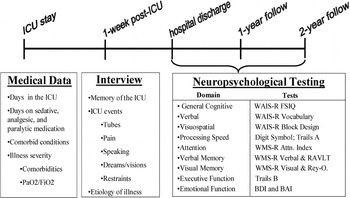
Figure 1 shows the timeline of measurements and data collection. Patient demographic and medical data were collected prospectively in an electronic medical record as part of routine clinical care. Data included length of stay, Acute Physiologic and Chronic Health Evaluation II (APACHE II) scores (Knaus et al., 1985), laboratory values (including glucose measurements), ventilator data, insulin doses, steroid therapy, and outcome data.

Timeline of study procedures for all participants. WAIS FSIQ = Wechsler Adult Intelligence Scale-Revised Full-Scale IQ; ICU = intensive care unit; WMS-R = Wechsler Memory Scale-Revised; RAVLT = Rey Auditory Verbal Learning Test; Rey-O = Rey–Osterrieth Complex Figure; PaO2/FiO2 = ratio of arterial oxygen tension to fraction of inspired oxygen; BDI = Beck Depression Inventory; BAI = Beck Anxiety Inventory.
ICU Memory
Memory of the ICU was examined using semistructured interviews conducted within 1 week following ICU discharge. Interviews were conducted by a neuropsychologist (R.O.H.) and were tape recorded and transcribed. Three independent reviewers coded the transcribed interviews for number and type of events. Data were checked for accuracy, and all discrepancies were resolved by R.O.H. by consulting the original transcripts. Interviews elicited information in four primary areas: (1) overall memory of the ICU; (2) specific memories of the ICU experience, including intubation, restraints, pain, medication, visitors, and ability to speak; (3) dreams or hallucinations; and (4) the etiology of the ARDS. Patients were divided into “ICU recall” and “no ICU recall” groups based on their responses to questions about general and specific memories of the ICU, with patients who denied any memory of the ICU being classified into the “no ICU recall” group. Patients who recalled dreams, but no other portions of the ICU were also classified in the “no ICU recall” group.
Neuropsychological Tests
Standardized neuropsychological tests were administered to all survivors at hospital discharge, and at 1 and 2 years after hospital discharge and assessed general intelligence, attention, verbal and visual memory, processing speed, executive function, and visuospatial abilities (see Table 1 for the neuropsychological tests). We chose this test battery because of its sensitivity in detecting impairments in patients with critical illness or hypoxia (Gale & Hopkins, 2004; Gale et al., 2000; Weaver et al., 2002). The Oklahoma Premorbid Intelligence Estimation method (OPIE; Scott et al., 1997) was used to estimate premorbid intelligence. Depression and anxiety were assessed using the Beck Depression and Anxiety Inventories, respectively (BDI and BAI, respectively; Beck, 1987; Beck & Steer, 1993).
Neuropsychological tests and cognitive domains

Raw test scores were converted to t (mean = 50; SD = 10) and Z scores (mean = 0; SD = 1) based on available normative data. When possible, scores took into account age, education, and sex. Normative data from Heaton et al. (1991) were used to convert the data from the Wechsler Adult Intelligence Scale-Revised (WAIS-R; Block Design, Digit Symbol and Vocabulary) and Trail-Making Test (Parts A and B). Trials 1 and 6 of the Rey Auditory Verbal Learning Test (RAVL) were converted to t and Z scores using norms stratified by age and sex (Geffen et al., 1990). Delayed recall raw scores from the Rey–Osterrieth Complex Figure (ROCFD) were converted using normative data reported by Meyers & Meyers (1995). Conversion of the subtests from the Wechsler Memory Scale-Revised (WMS-R; Logical Memory and Visual Reproduction) used data provided in the manual (Wechsler, 1987). Because the normative data in the WMS-R manual are interpolated for ages 25–34 years, alternative norms were used for that age cohort (Mittenberg et al., 1992). After transforming neuropsychological test scores to t and Z scores, composite function indices were created by averaging these scores within each cognitive domain, as described below. Description and calculation of the cognitive domains are presented in Table 1.
Determination of cognitive sequelae was completed in a similar manner to previous studies (Hopkins et al., 2005; Jackson et al., 2003; Weaver et al., 2002; White et al., 2006) by using the a priori definition of cognitive sequelae being present when 2 or more cognitive test scores were > 1.5 SD or 1 test score > 2 SD below the normative population mean values using age, gender, and education corrected t scores (Heaton et al., 1991). Magnitude of cognitive sequelae was derived using the demographically corrected t scores and assigning a numeric value of 1 for each SD the t scores were >1 SD below the mean and summing the total number of SDs below the mean across all tests. In this convention, t scores ≥ 40 received a score of 0, scores > 1 SD below the mean (30 to 39) received a score of 1, scores > 2 SD below the mean (20 to 29) received a score of 2, scores > 3 SD below the mean (10 to 19) received a score of 3, and so on.
Statistical Analysis
Descriptive statistics were calculated for each interview category, demographic variable, medical variable, measure of depression and anxiety, and rate of neurocognitive sequelae. Independent-samples t tests were used to compare demographic variables between the ICU recall and no ICU recall groups. Noncontinuous data comparisons between groups used the Pearson's χ2 statistic.
The primary outcome was the magnitude of neurocognitive sequelae. Repeated-measures analysis of variance (RMANOVA) was performed with impairment score and time as within-subjects factors and memory of the ICU as the between-subjects factor to test for group differences and examine cognitive sequelae over time. Significant main effects and interactions were decomposed using orthogonal Helmert contrasts and Bonferroni-corrected pairwise comparisons for between-group analysis at each time point (critical p = .016). Measures of effect size for all ANOVA analyses used partial eta squared (η2).
Cognitive Domain Analyses
To reduce Type I error, tests that have been theoretically and empirically shown to assess similar cognitive functions were grouped together to create a single score (see Gale & Hopkins, 2004). Eight domain scores were calculated, each one representing a dependent variable: general intellectual functioning, verbal skills, spatial skills, processing speed, executive functioning, attention, verbal memory, and visual memory. Profile analysis examined the differences in the pattern of neuropsychological performance between the ICU recall and the no ICU recall groups at hospital discharge. A profile analysis is a repeated measures multivariate analysis of variance designed to compare two or more groups on a series of test scores (Stevens, 1996). A second multivariate RMANOVA with time (discharge, 1-year, and 2-year follow-up) added as a within-subjects factor was carried out to examine cognitive performance changes over time. Helmert contrasts were again used as a tool for decomposition of effects, and Greenhouse–Geisser corrected p values are reported for all within-subject effects with more than two levels of a factor to correct for possible violations of sphericity.
Finally, to examine the relationship between cognitive performance and measures of illness severity, negative affect, and demographic variables, we conducted three canonical correlations with the dependent variables of cognitive sequelae at hospital discharge, and at 1 and 2 years. For the first canonical correlation, demographic variables (age, education, sex, and OPIE score) were the independent variables. The second canonical correlation included measures of negative affect (BDI and BAI scores at 1 and 2 years), and the third included markers of illness severity (Charlson Comorbidity Index, APACHE II, PaO2/FiO2 ratio, mean multiple organ failure score, days in the ICU, and days in the hospital) as the independent variables. Using multivariate analyses, such as canonical correlation and profile analysis, reduces the potential for Type I error and provides a tool to look beyond single bivariate associations to examine possible contributors to cognitive sequelae.
RESULTS
Of the 74 ARDS patients, 4 patients declined to complete the structured interview, resulting in 70 patients (39 women) whose data were included in the analysis. The mean ± SD age was 45.3 ± 16.3 years (range, 16 to 77 years), and mean education level was 13 ± 2.4 years (range, 8 to 23 years).
Recall of the ICU
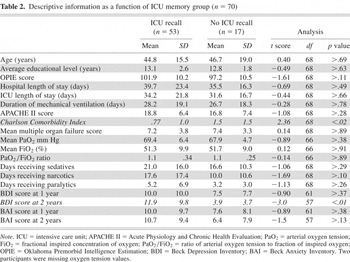
Descriptive, medical, and emotional status data for all 70 ARDS patients by ICU recall group are provided in Table 2. On the semistructured interview, 17 patients (24.3%) had no recall of their ICU experience. Of these 17 participants, 10 were women, whereas 29 of the 53 patients who recalled memories of the ICU were women. Male-to-female ratio was not significantly different between groups, χ2(1) = .09, p > .77. There were more comorbid disorders in the no ICU recall group, and higher depression scores at 2-year follow-up for the ICU recall group (Table 2).
Descriptive information as a function of ICU memory group (n = 70)

Of the 53 patients who could recall at least portions of their ICU experience, 34 (64%) recalled the etiology of their illness, 28 (53%) recalled feeding tubes or intravenous lines, and 36 patients (68%) recalled memories of visiting family and friends. Thirty-seven patients (70%) recalled treatment with mechanical ventilation; 90% described mechanical ventilation as an unpleasant experience. Thirty-three patients (62%) recalled restraints or being unable to move; all descriptions were unpleasant. Twelve patients (23%) had memories of being unable to speak. Vivid or real “dreams or hallucinations” were reported by 42 (79%) of the patients with ICU recall. Pain in the ICU was reported by 27 (51%) of patients. Patients were asked to rate their pain on a 10-point scale from “no pain at all” (a score of 0) to “intense pain” (a score of 10). The mean pain intensity rating was 7.5 ± 2.4.
Recall of the ICU and Rate of Cognitive Sequelae
At hospital discharge, cognitive sequelae were present in significantly more patients in the no ICU recall group (16/17; 94%) than those who reported recall of the ICU [34/53; 64%; χ2(1) = 5.66; p < .02]. Similar results were found at 1-year follow-up, where 11/16 (69%) of the no ICU recall group had cognitive sequelae and 18/47 (38%) of ICU recall group had cognitive sequelae (p < .035). Groups did not differ in the rate of cognitive sequelae at 2-year follow-up (p > .25), with 8/14 (57%) in the no ICU recall and 18/45 (40%) in the recall group.
Recall of the ICU and Magnitude of Cognitive Sequelae
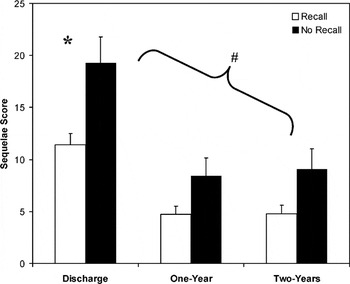
Mean scores on the primary outcome and magnitude of cognitive sequelae at discharge and at 1-year and 2-year follow-up, are presented in Figure 2 as a function of group. Scores for magnitude of cognitive sequelae had roughly normal distributions on the Box-M test for homogeneity of variance [F(6,2474) = 1.63; p < .13]. The Levene's test was also nonsignificant [F(1,49) = 2.35; p < .13]. Results of the RMANOVA indicate main effects of group [F(1,49) = 7.92; p < .01; η2 = .14] and interval after ARDS [F(1,62) = 52.28; p < .001; η2 = .52]. The group-by-time interaction was not significant [F(1,62) = 2.66; p > .10; η2 = .05]. All ARDS patients experienced greater magnitude of cognitive sequelae at hospital discharge compared with 1- and 2-year follow-up [F(1,49) = 60.02; p < .001; η2 = .55], with no differences between the 1- and 2-year measurements [F(1,49) = 1.22; p > .28; η2 = .06]. Between-group comparisons for the ICU recall and no ICU recall groups indicated significant differences at hospital discharge [t(68) = 3.15; p < .002], but not at 1-year [t(60) = 1.76; p > .08] or 2-year [t(57) = 1.84; p > .07] follow-up (Figure 2).

Mean and standard errors for overall impairment scores by intensive care unit memory group and time. The asterisk indicates increased magnitude of sequelae in the non-recall group (p < .001) at hospital discharge. The pound sign indicates that both groups had significantly greater magnitude of sequelae at discharge compared to both follow-up periods.
Neuropsychological Domain Scores
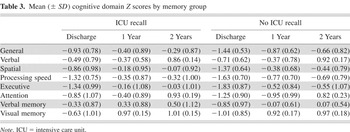
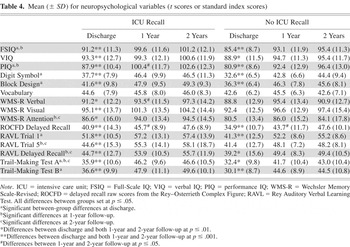
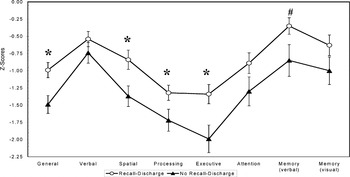
Cognitive profile scores by domain at hospital discharge, and at 1- and 2-year follow-up by group are shown in Table 3. Age- and education-corrected scores for each measure used, along with between-group comparisons, are shown in Table 4. All domain scores had roughly normal distributions as evidenced by nonsignificant Box-M test for homogeneity of variance [Fs > 0.98; ps > .50] and Levene's test for all domain variables [Fs < 0.96; ps > .33]. Results of the profile analysis at hospital discharge show the profiles were not flat [F(7,62) = 15.5; p < .001; η2 = .64], and parallel with no group by cognitive domain interaction [F(7,62) = 0.55; p > .55; η2 = .09] (Figure 3). The ICU recall group had higher average Z scores, −0.87 ± 0.28 versus −1.20 ± 0.37 for the no ICU recall group. Mean Z scores for both groups were significantly below normal population values in all cognitive domains. The profiles were not level [F(1,68) = 7.83, p < .007; η2 = .10], indicating significant differences in the between-group means. Significant domain differences were found for general intellectual functioning [t(68) = 2.34; p < .02], executive function [t(68) = 2.61; p < .01], processing speed [t(68) = 2.03; p < .05], and spatial skills [t(68) = 2.12; p < .04], with a trend toward better verbal memory in the ICU recall group [t(68) = 1.85; p < .07].
Mean (± SD) cognitive domain Z scores by memory group

Mean (± SD) for neuropsychological variables (t scores or standard index scores)


Profiles of performance across cognitive domains by intensive care unit memory group. Asterisks indicate group differences p < .05. The pound sign indicates p < .07.
The next question of interest was whether domain performance changed over time. Results of the multivariate RMANOVA with cognitive domain and time as within-subjects factors and ICU recall group as the between-subjects factor indicated significant improvement in the cognitive domain profile of both groups with increased time after hospitalization [F(2,56) = 60.83; p < .001; η2 = .69]. Both groups had significant cognitive improvement from hospital discharge to 1 and 2 years [F(1,57) = 122.97; p < .001; η2 = .68], but no differences were found between 1 and 2 years [F(1,57) = 2.68; p > .11; η2 = .05]. A significant main effect of group [F(1,57) = 4.31; p < .04; η2 = .07] indicated the expected lower cognitive domain scores in the no ICU recall group when collapsed across all three time periods. The group-by-time, group-by-cognitive domain, and group-by-cognitive domain-by-time interactions were not significant [all Fs < 0.79; ps > .61].
Correlational Analyses
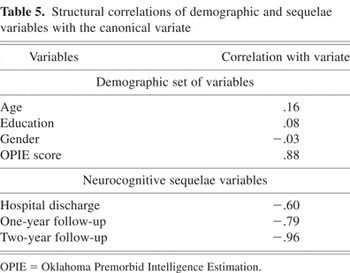
A canonical correlation between the demographic variables and the magnitude of cognitive sequelae scores was .51; [Wilks' λ = .71; χ2(12) = 22.1; p < .04], accounting for 26% of the variance. Structural correlations between the individual variables and the canonical variate are shown in Table 5, with a cutoff of .35 used for interpretation (Tabachnik & Fidell, 2001). Only the OPIE score significantly contributed to the canonical variate of magnitude of cognitive sequelae, indicating that individuals with higher estimated premorbid intellectual functioning had a lower magnitude of cognitive sequelae. For depression, anxiety, and illness severity, no significant canonical correlations were found [Rc = .43; χ2(12) = 22.5; p = .31 and Rc = .39; χ2(12) = 22.12; p = .39, respectively], indicating that cognitive sequelae were not related to depression, anxiety, or indices of illness severity.
Structural correlations of demographic and sequelae variables with the canonical variate

Finally, to examine the relationship between negative affect and ICU recall, we conducted point biserial correlations with BDI and BAI scores at discharge and at 1-year and 2-year follow-up. Depression score on the BDI at 2-year follow-up was associated with recall of the ICU [rpb = .37; p < .004]. No other point biserial correlations reached statistical significance [rpb < .20; ps > .13].
DISCUSSION
Approximately 24% of our prospectively identified ARDS survivors had no recall of their ICU experience, similar to rates between 23% and 50% found in other studies (Bergbom-Engberg & Haljamea, 1989a; Capuzzo et al., 2001; Granberg et al., 1998). Our data indicate both an increased rate and greater magnitude of cognitive sequelae in ARDS patients who did not recall their ICU experience. Patients with no ICU recall had a significantly higher prevalence rate of cognitive sequelae at hospital discharge and 1-year follow-up, but not at 2-year follow-up compared with patients with ICU recall. There was greater magnitude of cognitive sequelae in the no ICU recall group at hospital discharge. The magnitude of cognitive sequelae did not differ between the groups at 1- and 2-year follow-up.
Cognitive profile analysis indicates patients with no ICU recall were significantly worse than their counterparts on tests of general intellectual function, executive function, processing speed, and verbal memory. These results are in line with previous studies that report persistent impairments in cognitive performance following critical illness in ARDS (Rothenhausler et al., 2001) and medical ICU survivors (Jackson et al., 2003, 2004). However, this is the first study to report group differences in cognitive sequelae in patients with and without recall of their ICU experience.
Over 50% of patients who remembered the ICU recalled the etiology of their illness, feeding tubes or IV lines, mechanical ventilation, restraints or being unable to move, and vivid dreams. Nearly all of the patients who recalled ventilation and restraints described them as unpleasant experiences. These results are similar to studies that indicate adverse patient-reported memories of the ICU often include endotrachial suctioning (Leur et al., 2003), pain and discomfort (Simini, 1999; Turner et al., 1990), general fear and anxiety (Granberg et al., 1998; Hall-Lord et al., 1994; Turner et al., 1990), and fear and anxiety associated with nightmares and hallucinations (Bergbom-Engberg & Haljamea, 1989b; Green, 1996; Magarey & McCutcheon, 2005; McKegney, 1966). In our study, 79% of patients recalled enduring nightmares and hallucinations that were often described as vivid and lifelike, higher than prior reports (Bergbom-Engberg & Haljamea, 1989b; Green, 1996).
A difference in cognitive performance between ICU recall and nonrecall groups raises questions as to the specific contributing factors. There were no between-group differences for demographic variables; hospital length of stay; ICU length of stay; indices of illness severity; oxygen tension and inspiration variables; days receiving sedative, narcotic, or paralytic medications; or estimated premorbid intelligence levels, suggesting that these variables do not account for group differences in cognitive performance. However, the no ICU recall group had more comorbid disorders compared with those with ICU recall. Thus, it is possible that the increased number of comorbidities is associated with worse cognitive performance or that those with multiple comorbidities in this sample were more ill than their counterparts and, therefore, had more difficulty with recall and cognitive performance. Notably, other measures of illness severity did not differ between groups.
Other factors that were not specifically examined in the current study may contribute to decreased memory of the ICU experience and increased rate and magnitude of cognitive sequelae. Jones et al. (2000) propose a general nonspecific mechanism that is the result of several nonspecific factors, such as pain, sleep deprivation, metabolic disturbances leading to potential encephalopathy and delirium, as well as high doses of sedative and analgesic medication. Thus, the same mechanisms that play a role in impaired memory for events in the ICU may play a role in impaired cognitive function following critical illness and its treatment. In addition, hypoxia (whether due to anemia, hypotension, or oxygen desaturation), elevated cytokines and neurotoxic bacterial proteins from sepsis, hyperglycemia, other metabolic derangements, and inflammation likely contribute to poor cognitive functioning following critical illness (see Hopkins & Jackson, 2006). Reduced cognitive sequelae at follow-up may be the result of some degree of spontaneous recovery where the patient emerges from delirium, inflammation is reduced, medications are stabilized, and metabolic factors are controlled. These possibilities remain understudied in the immediate after-ICU time period. Studies to date indicate that cognitive function improves during the first 6 to 12 months after hospital discharge and remains consistent and disabling for up to 6 years after discharge (duration of the longest study; see Hopkins & Jackson, 2006), suggesting that while some recovery occurs initially, chronic cognitive impairments persist in many patients.
Relationship Between Cognitive Sequelae, Demographics, Severity of Illness, and Negative Affect
Overall magnitude of cognitive sequelae was significantly associated with the patient's estimated premorbid IQ in both groups. The ARDS patients with higher estimated premorbid intellectual functioning had a lower magnitude of cognitive sequelae. This finding is consistent with the hypothesis that a greater initial “brain capacity” or “cognitive reserve” (e.g., factors such as higher intelligence and higher educational and occupational attainment provide a buffer against brain dysfunction in the face of acquired central nervous system injury) in people with higher intellectual functioning results in decreased cognitive impairments after critical illness in such patients (Satz, 1993; Schmand et al., 1997). For example, an inverse relationship between higher premorbid intellectual function and frontal and parietal cerebral metabolism in patients with Alzheimer's disease is found (Alexander et al., 1997). Similarly, low educational and occupational attainment are related to an increased prevalence of Alzheimer's disease and subsequent rate of memory decline (Stern et al., 1995, 1999). A similar hypothesis of cognitive reserve could be generated in response to critical illness, although no studies have examined this question to date. Importantly, ICU recall and nonrecall groups did not differ in estimated premorbid intelligence. Thus, the relationship between magnitude of cognitive sequelae and premorbid intelligence cannot be accounted for by ability to recall the ICU.
The magnitude of cognitive sequelae did not correlate with indices of illness severity. In a review of the long-term effects of critical illness on cognitive function, Hopkins and Brett (2005) indicate that cognitive deficits appear to be independent of age and some markers of illness severity. Somewhat surprising, however, was the finding that cognitive deficits did not correlate with the latent component of depression and anxiety (i.e., negative affect), as the prevalence of depression and anxiety in ICU survivors ranges from 10 to 58% of patients (Al-Saidi et al., 2003; Angus et al., 2001; Hopkins et al., 1999; McCartney & Boland, 1994; Orme et al., 2003; Skodol, 1999). However, depression measured by the BDI at 2-year follow-up was related to ICU recall. This finding is consistent with previous studies that suggest the development of disorders of negative affect (e.g., posttraumatic stress disorder) following ICU stay is related to the number of unpleasant memories recalled (Schelling et al., 1998); however, other research suggests such a relationship may be primarily due to delusional memories, rather than factual recall (Jones et al., 2001). Research is needed to explicitly examine the relationship between depression and ICU recall.
Study Strengths and Limitations
The strengths of this study include the longitudinal prospective cohort study design, consistent follow-up times, high follow-up rates, detailed taped and transcribed ICU interviews regarding ICU recall, and a well-defined ARDS population. In addition, between-group comparisons used patients with the same illness and etiology, similar demographic variables (age, education, gender), illness severity, and duration in the hospital. A matched group such as this reduces the potential for spurious group differences.
The limitations of our study include the inability to measure premorbid cognitive and emotional function in each group. Therefore, we are unable to ensure that group differences are not the result of premorbid general group differences. In addition, we did not follow a control group of ICU survivors who did not have ARDS, thus the group differences in cognitive sequelae may be specific to ARDS and not generalize to other critically ill populations. Perhaps the different sedatives and narcotics, different doses of medications, and drug half-life may also have played a role in the group differences in cognitive sequelae. Finally, ICU recall was assessed by self-report. Self-reported recall may lead to unintentionally false reporting of memories; however, independent verification of each ICU memory is difficult given the number of consultations required with family members and medical providers as well as the times when no independent verification would be possible (e.g., when the patient was alone). However, previous investigations indicate self-reported ICU memories without independent verification are consistent across extended periods of time (Lof et al., 2006) and predict subsequent quality of life (Granja et al., 2005).
Our findings support emerging evidence that ARDS patients exhibit cognitive impairments following critical illness and ICU treatment. ARDS survivors with no ICU recall had worse initial cognitive outcomes that improved over time, compared with patients with ICU recall. It is unclear why patients with no ICU recall had worse cognitive outcome than patients with ICU recall. Additional research is required to elucidate the potential mechanisms for these differences. The inverse correlation of premorbid IQ estimates and cognitive sequelae potentially supports the hypothesis that initial cognitive reserve is associated with a lower rate of cognitive impairments after critical illness and ICU treatment. Neuropsychologists can play a key role in future research and assessment of critically ill patients regarding cognitive impairments, possible mechanisms, and potential interventions to prevent the observed cognitive impairments.
ACKNOWLEDGMENTS
This original research has not been published elsewhere and was sponsored by Deseret Foundation Grant numbers 300, 318, and 359 and NIH ARDS SCOR Grant no. HL50513. We thank Suzanne Stagg and Elizabeth Fong for transcribing the taped interviews.