Introduction
Organic cropping systems rely on ecologically based practices, such as biological pest management and composting, and the exclusion of synthetic chemicals. Under organic cropping systems, the fundamental components and natural processes of ecosystems—such as soil organism activities, nutrient cycling and species distribution and competition—are used as farm management toolsReference Greene and Kremen1. For example, crops are rotated, food and shelter are provided for the predators and parasites of crop pests, animal manure and crop residues are cycled, and planting/harvesting dates are carefully timed.
Crop acres under organic systems have grown rapidly during the past decade. Organic crop acres were more than 2.5 times higher in 2005 than in 1995, as acreage increased from 638,500 to more than 1.45 million2. As part of this growth, organic soybean acreage increased from less than 50,000 in 1995 to nearly 175,000 acres in 2001. However, increased supply, along with competition from China in both US and Japanese markets3 lowered prices for organic soybeans and acreage fell 27% in 2002. After 2002 organic soybean acreage stabilized and was about 122,000 acres in 2005.
Despite interest in organic soybean production there is little information about the relative costs and returns of organic and conventional production on US farms, and the characteristics of farms that are choosing the organic approach. Previous research examines organic crop returns using data from long-term experimental trialsReference Delate, Duffy, Chase, Holste, Friedrich and Wantate4–Reference Hanson, Lichtenberg and Peters6, but little has been reported about the commercial production of organic crops. The general objective of this study is to utilize farm survey data on US soybean production for 2006 in a comparison of conventional and organic systems. One objective is to describe characteristics of farms adopting the organic production approach and how these are related to the likelihood that a farm would choose an organic system. The second objective is to describe and contrast the costs of production for each system and to use these to determine the level of price premiums that make organic systems competitive with conventional systems. This is among the first studies to describe commercial organic soybean production across the major production area of the US and should be of interest to producers considering organic production and to end-users of organic soybeans.
Experimental Trials
Much of what is known about organic cropping systems stems from multidisciplinary research conducted with long-term experimental trials that compare the agronomic, economic and sometimes environmental performance of organic and conventional systems. The identical weather and soil conditions under which field experiments are conducted provide opportunities not possible with on-farm studies, such as replication, precise field measurements and long-term comparisons. In these types of studies, descriptive and analytical data are collected on crop yields and management practices, and the productivity, economic viability and, in some cases, the potential environmental impacts of different farming systems are statistically assessed.
Results of an economic analysis of organic cropping systems using data from 1999 to 2001 are reported from the Neely-Kinyon Long-Term Agroecological Research site in IowaReference Delate, Duffy, Chase, Holste, Friedrich and Wantate4. This study compares a conventional corn–soybean rotation with organic rotations that include corn, soybeans, oats and alfalfa. Both corn and soybean production costs are significantly higher in the conventional system compared to the organic systems mainly due to higher costs of chemical versus mechanical weed control, while crop yields are much the same. Results indicate that returns to corn and soybean production are significantly higher under the organic systems. Returns to land, labor and management are higher with the organic rotations regardless of whether an organic price premium is received. Sensitivity analysis of labor charges reveals that organic systems have higher returns even when labor is valued at $50 per hour.
Data from 22 years of experiments from the Rodale Institute Farming Systems Trial in Pennsylvania are used to compare conventional, organic animal and organic legume systemsReference Pimentel, Hepperly, Hanson, Doubs and Seidel7. Crop yields are similar with each system during normal years, but are higher for two organic systems under drought conditions. Energy input use, including fuels for farm machinery, fertilizers, seeds and herbicides, is about 30% less under the organic systems. Net returns to the organic rotations, without price premiums, are similar to those for conventional rotations during typical years, but are less when the costs of transition years are included. However, the organic price premium required to equalize returns is only 10% above the conventional price, much lower than normal price premiums for organic grains.
Long-term cropping system data during 1990–99 are used to examine the relative profitability of organic cropping systems in southwestern MinnesotaReference Mahoney, Olson, Porter, Huggins, Perillo and Crookston5. The research examines various corn, soybean, oats and alfalfa rotations and finds that even though crop yields are lower under the organic input strategy, so too are production costs in comparison to conventional strategies. As a result, the organic input strategy provides net returns that are not statistically different from those of conventional strategies without any organic price premium, and are significantly higher when historical organic price premiums are paid.
A similar analysis of organic and conventional crop rotations in the northern Great Plains of Canada is conducted with data from 1997 to 2000Reference Smith, Clapperton and Blackshaw8. Wheat, barley, peas and forage crops are part of the rotations. Some organic cropping systems are found to be more profitable than conventional systems, but this is conditional on the price premium and cropping system. Also, there is as much variation in net returns within organic and conventional systems as between the two. When costs of transition are taken into account, organic rotations have higher returns relative to many conventional rotations with price premiums at their most likely level, but require higher premiums to compete with the most profitable conventional rotations.
Data from long-term field trials covering 1982–1995 in southeastern Pennsylvania are used to evaluate the net returns to organic and conventional rotations using corn, wheat, soybeans and foragesReference Hanson, Lichtenberg and Peters6. Annual returns to organic rotations compare favorably with those of conventional rotations after the transition period, but high transition costs may not justify the use of organic systems in some cases. The organic rotations require much more family labor than conventional rotations. This could hinder organic adoption among farmers who primarily work off-farm because of the high opportunity cost of switching to organic farming that would result from foregone wages and benefits.
Long-term agricultural experiments are leading to an improved understanding of the main biophysical and economic processes associated with different farming systems, addressing basic research questions about yields, profitability and environmental impacts. In most of the situations studied, organic cropping systems generate economic returns equal to or greater than those of conventional systems, and sometimes much greater returns. Despite this progress, comparisons between conventional and organic cropping systems are problematic mainly because the latter employ unique approaches to nutrient availability, pest control and soil management that are profoundly different and may not be easily employed outside of the experimental setting. These experiments also leave out the ‘human factor’ – that valuable system of local knowledge and expertise that every farmer acquires through on-farm experience and experiments that plays a crucial role in organic farming. This study enhances the long-term experimental literature by reporting on actual farmer experience with organic systems.
Data
Data used in this study come from on-farm measurements made in USDA's 2006 Agricultural Resource Management Survey (ARMS) administered by the National Agricultural Statistics Service and Economic Research Service. The ARMS data include detailed farm financial information, such as farm income, expenses, assets and debt, as well as farm and operator characteristics. Specifically, this study uses a version of the 2006 ARMS that includes detailed information about the production practices and costs of soybean production. This version targeted soybean producers in 19 states that include 97% of US planted soybean acreage in 2006.
The 2006 ARMS soybean version includes a sub-sample targeting organic acreage. Of the total soybean sample of 4557 farms, 907 samples targeted organic operations in 15 states as identified from lists provided by state organic certifiers. After accounting for non-response and missing data, 2209 farms are available for analysis, including 238 operations producing organic soybeans in 2006. Characteristics and production costs are compared among conventional and organic producers in Corn Belt and Midwest States. The sample from IL, IN, IA, KS, MI, MN, MO, NE, ND, OH, SD and WI include 1425 conventional and 237 organic producers. Farm survey weights on the ARMS data, proportional to the probability of selection, ensure that the sample expands to represent soybean acreage in each state and that organic operations represent their correct proportion of the population despite their disproportionate share of the sample.
Costs of organic and conventional soybean production are computed according to procedures used by USDA9 and endorsed by the American Agricultural Economics Association10. Costs are computed per bushel and divided into three categories: operating costs, operating and capital costs, and total economic costs. Operating costs include costs for seed, fertilizer, chemicals, custom operations, fuel, lubrication, electricity, repairs, purchased irrigation water, hired labor and operating interest. Capital costs include the annualized cost of maintaining the capital (economic depreciation and interest) used in soybean production, and costs for non-real estate property taxes and insurance. Total economic costs are the sum of operating and capital costs, plus opportunity costs for unpaid labor and land, and allocated costs for general farm overhead items. Total operating costs is an indicator of the relative success of operations in terms of their ability to meet short-term financial obligations. The sum of operating and capital costs provides an indicator of whether operations can replace capital assets as needed and stay in business over time. Other costs are primarily opportunity costs of owned resources (land and labor) that may or may not influence production decisions. Opportunity costs of owned resources may vary significantly among producers and many producers are willing to accept returns to these resources different from assumed charges. Lifestyle preferences and costs of switching occupations, among others, affect producers' perceptions of their opportunity costs.
Survey Results
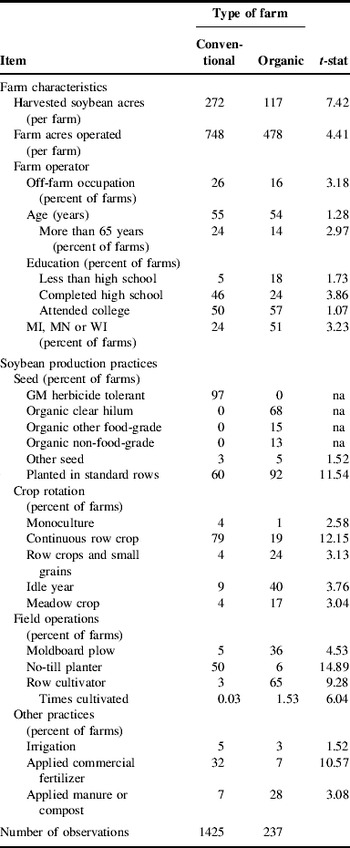
A summary of the ARMS data indicates that organic soybean production is conducted on smaller operations than conventional production. Conventional soybean producers harvest an average of 272 soybean acres as part of 748 acres in the farm operation, compared to 117 soybean acres on 478 farm acres by organic soybean producers (Table 1). Despite their smaller size, organic soybean producers are less likely to report off-farm employment as their major occupation (26 versus 16%). The average age of organic and conventional producers is much the same, but conventional producers are more likely to be over 65 (24 versus 14%). Significantly more of the conventional producers report a high school education (45 versus 24%). Interestingly, a higher proportion of organic producers have either not completed high school (18 versus 5%) or attended college (57 versus 50%), so there is no clear association between operator education and organic production. Organic producers are more often located in the northern states of MI, MN and WI in relation to the other Corn Belt and Midwest states included in the survey (51 versus 24%).
Test of equality of means on characteristics and practices of conventional and organic soybean farms, Corn Belt and Midwest, 2006.

Source: 2006 Agricultural Resource Management Survey, USDA National Agricultural Statistics Service and Economic Research Service.
Note: Statistical significance in test of equality of means is indicated by t-statistics greater than 1.96 and 1.65 at the 5 and 10% levels, respectively. na=not applicable.
Production practices used in conventional and organic soybean production are much different. Nearly all conventional producers use genetically modified herbicide tolerant seed (97%), while most organic producers use clear hilum seed (68%). Clear hilum is a food-grade soybean most often used for soymilk and tofu. More than 90% of organic producers plant soybeans in standard rows, compared to 60% of conventional producers. This allows organic producers to cultivate for weed control an average of 1.5 times, while conventional producers rarely cultivate for weeds. Nearly 80% of conventional producers use a crop rotation (3 years) comprised of continuous row crops, whereas organic producers more often rotate soybeans with small grain and meadow crops (e.g., alfalfa and other hay), and 40% include an idle year in the rotation. Organic producers more often control pests by using intensive tillage practices as 36% report using a moldboard plow, while half of conventional producers use a no-till planter and rely on chemical pest control.
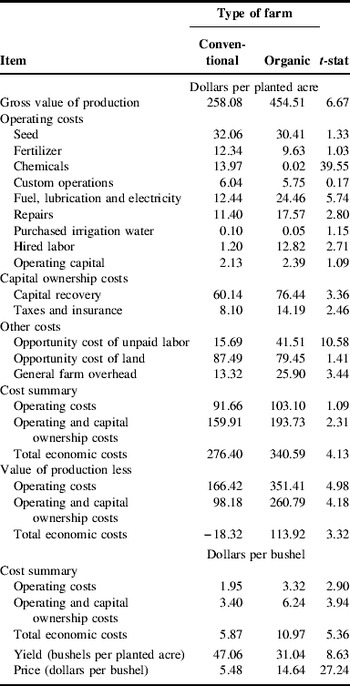
Average soybean operating costs per acre are not significantly different among conventional and organic producers, but their composition is very different (Table 2). Conventional production involves much higher chemical costs ($13.97 versus $0.02 per acre), while organic systems substitute field operations for chemicals and incur much higher fuel, repair and hired labor costs. Capital and other costs are also much higher for organic production due to the greater use of field machinery and unpaid labor. The paid and unpaid labor costs for organic production total $54.33 per acre, compared to $16.89 for conventional production. Total operating and capital costs and total economic costs are significantly higher for organic production, averaging more than $30 and $60 per acre higher, respectively, than for conventional production.
Test of equality of means on production costs and returns of conventional and organic soybean operations, Corn Belt and Midwest, 2006.

Source: 2006 Agricultural Resource Management Survey, USDA National Agricultural Statistics Service and Economic Research Service.
Note: Statistical significance in test of equality of means is indicated by t-statistics greater than 1.96 and 1.65 at the 5 and 10% levels, respectively. na=not applicable.
Organic soybean producers have an average yield in 2006 that is significantly lower than that of conventional producers (31 versus 47 bushels per acre). With lower yields and higher per-acre costs, operating costs per bushel for organic producers are $1.37 higher than for conventional producers, operating and capital costs are nearly $3 higher and total economic costs are more than $5 higher. Production costs of food-grade and non-food-grade organic soybeans are not significantly different. The average price premium received by organic producers is more than $9 per bushel in 2006 ($14.64 versus $5.48 per bushel), much higher than the average difference in total economic costs. The average price received for food-grade soybeans ($15.08 per bushel) is significantly greater than that for non-food-grade soybeans ($12.48 per bushel).
Organic soybean producers report that they had been producing organic for an average of 8 years in 2006. The primary reason given for producing organic is to increase farm income, reported by 47% of farmers, while 44% are split almost evenly between the reasons of protecting family and community health and being more environmentally friendly. Forty-three percent of organic producers regard achieving desirable yields as the most difficult aspect of production, followed by 10% who consider distance to markets. Only 5% report sourcing inputs and just 2% indicate costs of inputs as the most difficult aspect of organic production.
Empirical Procedure
The identical weather and soil conditions and field management practices under which cropping system experiments are conducted have the advantage of precise field measurements that are not possible using producer survey data. When using on-farm data to measure cost differences between cropping systems, other factors that affect costs should be addressed. A simple comparison of the mean difference between conventional and organic production costs can be misleading because other differences, such as in farm size, location, other technologies and management, may also influence cost levels. To isolate the effect that choice of the organic approach has on production costs, a treatment-effect model is employedReference Greene11.
The model accounts for observable differences between organic and conventional production using the detailed data from the ARMS. Unobservable differences are addressed by assuming a joint normal distribution between the errors of a selection equation (choice of the organic approach or not) and treatment equations (measures of production costs). This technique corrects for sample-selection bias and allows for an unbiased estimate of the impact that choice of the organic approach has on production costs. For example, differences in the level or type of management are not observable but may influence both the choice between organic and conventional production and the level of production costs.
Applying the treatment-effect model, the decision to choose the organic approach or not can be expressed with the latent variable Oi* indicating the net benefit from using this approach compared to not using, so that:

where Zi is a vector of operator, farm and regional characteristics. If the latent variable is positive, then the variable indicating organic production Oi equals one, and equals zero otherwise. A measure of the impact of the organic approach on production costs yi can be expressed by:

where Xi is a vector of operator, farm and regional characteristics.
Equation (2) cannot be estimated directly because the decision to choose the organic approach may be determined by unobservable variables, such as management factors, that may also affect production costs. If this is the case, the error terms in equations (1) and (2) will be correlated, leading to a biased estimate of δ. This selection bias can be accounted for by assuming a joint normal error distribution with the following form:
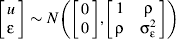
and by recognizing that the expected cost of choosing the organic approach is given by:

where λi is the inverse Mills ratio. To derive an unbiased estimate of δ, the two-stage approach begins with a probit estimation of equation (1). In the second stage, estimates of γ are used to compute the inverse Mills ratio, which is included as an additional term in a least-squares estimation of equation (2). This two-stage Heckman procedure is consistent, albeit not efficient. Efficient maximum likelihood parameter estimates can be obtained by maximizing:
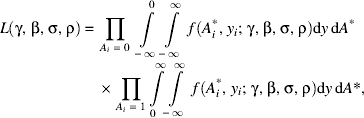
where f(A*i, yi; γ, β, σ, ρ) is the joint normal density function, which is a function of the parameters. In practice, the negative of the log of the likelihood function is minimized using the estimates from the Heckman procedure as starting values.
The model is specified using the three levels of production costs as the dependent variables: operating costs, operating and capital costs and total economic costs. The comprehensive nature of the ARMS provides data on a variety of operator, farm structural and financial, and enterprise characteristics that are used as independent variables. Once estimated, the difference in costs between organic and conventional systems is determined byReference Greene11:

where φ is the standard normal density function and Φ is the standard normal cumulative distribution function evaluated using the selection equation estimates.
Model Results
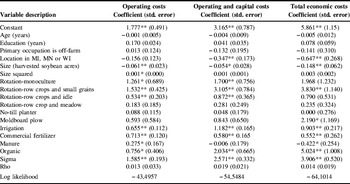
Estimates for a binomial probit model of choice of the organic approach by soybean producers are shown in Table 3. These estimates are nearly identical to those in the selection equations estimated in the treatment-effect models. Several coefficients estimated for farm operator characteristics are statistically significant. Operator age is specified with discrete categories with the age class of 50–65 years as the omitted group. The results indicate that the oldest farm operators, those more than 65 years old, are less likely to choose the organic approach than younger farmers. The oldest farm operators have fewer incentives to invest the financial and human capital resources necessary for organic production due to their shorter planning horizon. Operator education is also indicated with discrete categories, where high school graduates are the omitted group. These results reveal that both the most (those that attended college) and least (those not graduating from high school) educated are more likely to use the organic approach than high school graduates. Also, farm operators with a primary occupation off-farm are less likely to produce organic, perhaps because of the greater labor requirements of organic production.
Binomial probit maximum likelihood estimates: choice of the organic production approach by soybean producers, Corn Belt and Midwest, 2006.

Note: Dependent variable in the probit equation is whether the farm produced organic soybeans (0, 1). * and ** denote statistical significance at the 10 and 5% levels, respectively.
Size of operation and location also play a role in choice of the organic approach. As operated farm acreage increases, the likelihood of choosing the organic approach declines (at a decreasing rate). This may be due to the additional labor requirement of organic production, but also to the potentially higher returns per acre for smaller farmers from producing a relatively high valued crop. Location in the northern states of MI, MN and WI is associated with the adoption of organic soybeans, possibly due to less weed pressure that facilitates organic production in these areas, or because of markets for organic feed ingredients due to significant organic milk production in these states.
Coefficients on farm operator characteristics are not statistically significant in the treatment-effect models of soybean production costs, but those for farm size, measured as harvested soybean acres, and location are significant (Table 4). Soybean operating, operating and capital, and total economic costs per bushel all decline as size increases with the largest impact of size on total economic costs. Total economic costs include charges for capital and labor whose fixed amounts are spread over more units on larger enterprises. Location in the states of MI, MN and WI is also associated with lower operating and capital and total economic costs of soybean production.
Treatment-effect model maximum likelihood estimates: costs of soybean production, Corn Belt and Midwest, 2006.

Note: Dependent variables in each equation are the operating, operating and capital, and total economic costs per bushel of soybean production, respectively. * and ** denote statistical significance at the 10 and 5% levels, respectively.
Several production practices have a statistically significant effect on soybean production costs. Crop rotations are specified with continuous row crop as the deleted group. Thus, coefficients on the rotation variables indicate that monoculture, row crop and small grain rotations, and row crop and idle rotations are all associated with higher production costs than a continuous row crop system. Irrigation and the use of commercial fertilizers are also associated with higher per bushel soybean production costs.
The coefficients in Table 4 on the variable for organic soybean production are used in equation (4) to estimate the difference in costs between organic and conventional soybean production, and thus the price premium required for organic production to be competitive with conventional production. The results indicate that operating costs for organic soybean production are $0.82 per bushel higher, operating and capital ownership costs are $2.19 per bushel higher and total economic costs are $5.20 per bushel higher in 2006, after accounting for the influence of other factors on production costs and potential sample selection bias. The estimated correlation of errors of the selection and cost equations, rho, is not statistically significant in any of the models, suggesting that selection bias is not a significant problem with the sample.
Transition Costs
The estimated cost differences indicate the additional costs incurred by operations producing organic soybeans relative to conventional soybeans, but do not include the costs associated with the transition to organic production. Before an operation is certified to sell organic soybeans the cropland must be managed organically for a minimum of 36 months. This means that operations must undergo 3 years of higher costs before selling soybeans as certified organic.
Higher costs for 3 years can be considered as an investment necessary to return higher soybean prices over the expected life of the operation. The investment is determined by the estimated additional costs incurred by organic operations from the treatment-effect model for each year of the 3-year transition period. The annualized cost of this investment is computed using the capital recovery approach like the other capital costs10. The investment is spread over an expected life of 20 years.
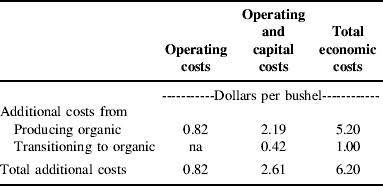
The estimated transition costs and total additional costs on organic operations are shown in Table 5. Transition costs are $0.42 per bushel for operating and capital costs and $1.00 per bushel for total economic costs. Thus, the total estimated additional costs for producing organic relative to conventional soybeans are $0.82 per bushel for operating costs, $2.61 per bushel for operating and capital costs and $6.20 per bushel for total economic costs.
Additional costs incurred for organic soybean production in relation to conventional soybean production, 2006.
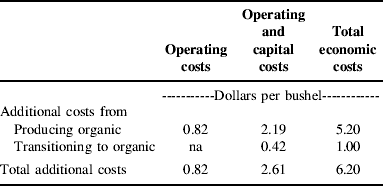
Note: Transition costs are treated as a capital investment necessary to return the higher organic soybean price over the expected life of the operation and thus are not part of annual operating costs. na=not applicable.
Conclusions
This study takes advantage of unique and detailed data from a survey of US soybean production for 2006. The data are unique in that they include a targeted survey of organic producers sampled at a much higher rate than their occurrence in the population. This allows for a statistical analysis of differences between conventional and organic crop production systems.
One objective of the study is to describe characteristics of farms adopting the organic production approach, and how these are related to the likelihood that a farm would choose an organic system. Size of operation is found to be one of the primary factors determining the likelihood of an operation using the organic approach. Because of economies of size, small farms likely view the organic approach as among the few alternatives to reorganize current resources to improve farm returns. Larger farms likely have less incentive to consider alternatives because of economies of size. Also, significant labor requirements associated with organic crop production may make organic production less practical on larger farms due to the need to hire additional labor, while the labor requirements on smaller farms are often met by operator and other unpaid sources. Marketing opportunities for food-grade soybeans may also be influencing the choice of organic production. Producers are able to market food-grade soybean production and earn higher profits than with feed-grade production despite lower yields associated with food-grade varieties, as production costs for food and feed-grade soybeans are not significantly different and the average price for food-grade soybeans is higher. The average price for food-grade soybeans was $2.60 per bushel higher in 2006.
The second objective of the study is to describe and contrast the costs of production for each system and to use these to determine soybean price premiums that make organic systems competitive with conventional systems. The results indicate that the average operating costs for producing organic soybeans are $0.82 per bushel higher, operating and capital costs are $2.61 per bushel higher and total economic costs are $6.20 per bushel higher, after accounting for the influence of other factors on production costs, sample selection bias and organic transition costs. These higher costs compare to an average price premium of $9.16 per bushel for organic soybeans in 2006, suggesting that organic soybean producers, on average, earned returns above costs ranging from about $3 to $8 per bushel in 2006.
Previous research, based on long-term cropping system data, also suggests that significant returns are possible from organic soybean production. However, these returns are the result of obtaining similar conventional and organic yields and lower organic production costs, while findings of this study show organic yields to be much lower and production costs to be higher. Experimental trials often compare soybean varieties of a similar type, such as food-grade soybeans, whereas the surveyed conventional and organic producers use varieties that are much different. Food-grade soybeans, including the clear hilum beans used by most organic producers, have been shown to yield significantly less than a typical Roundup Ready® system used by conventional growersReference Nelson, Case, Harder and Smoot12. Another reason for the yield differences may be the unique problems presented from implementing organic systems outside of the experimental setting, such as achieving effective weed control. The reason that organic soybeans are more profitable in the analysis of the 2006 ARMS data is not from higher yields and lower costs, but rather from the significant price premiums paid for organic soybeans.
Historical price premiums for organic soybeans have generally been high in comparison to other major field crops. Organic soybean prices from 1995 to 2003 were 2–3 times higher than conventional pricesReference Streff and Dobbs13, and an average price ratio of 2.67 is measured from the 2006 ARMS data. However, prices for conventional soybeans have increased dramatically since 2006. Soybean prices received by farmers that were $6.37 per bushel in January 2007 reached $13.00 per bushel in 2008 and remained above $9.00 per bushel into 200914. Organic soybean prices also moved much higher, up to around $28 per bushel for food-grade soybeans in 2008, and nearly $22 per bushel into 200915.
Much higher organic soybean prices in 2008 and 2009 are a signal that users of organic soybeans are attempting to retain and attract more organic acreage. However, higher fuel prices in 2008 increased costs of producing organic more than conventional production because of more tillage and mechanical weed control in organic systems. Also, the improved profit potential of conventional soybean production may have reduced incentives to invest the additional capital and labor for organic production, endure the transition period, and to take the additional risks of producing organic. When conventional soybean prices and/or fuel costs are high, expansion of US organic soybean acreage may be limited despite significant price premiums and profit potential from organic production. In addition, recessionary conditions in 2009 may slow the growth in demand for organic products as consumers, particularly those that don't already purchase organic products, become less willing and able to pay organic price premiums.
While results of this study provide insight about the profitability of organic soybean production, the findings are based only on a single year of data. The production of organic soybeans, in contrast to conventional soybeans, is most often part of a multi-year rotation of several crop enterprises. Organic soybean producers may rotate with less profitable enterprises, lowering overall cropping system returns, or the synergism associated with the management of multiple crop enterprises may result in an even greater profit potential than indicated by this single-enterprise analysis. A more thorough study of the profitability of organic systems would account for the inherent multi-year nature of organic cropping systems.