Biomass as an alternative to produce polymeric materials
Biomass is one of the most abundant natural resources, with an annual production of 1.3 billion dry tons in the United States alone. 1 Biomass is any organic matter that is renewable over time, and in the context of energy, it often refers to plant-based materials such as agricultural residues, forestry wastes, and energy crops. Reference Li, Zhao, Wang, Huber and Zhang2 The ongoing world energy crisis has led to the development of programs that have stimulated extensive research programs on biomass conversion. Energy security is now a primary concern for countries such as the United States that are highly dependent on imported crude oil to meet their domestic energy requirements. For instance, during the past 10 years, the US Department of Energy and the US Department of Agriculture have prioritized the development of bioenergy and bioproducts, with a production goal of 18% of the current US chemical commodities from biomass by 2020, and 25% by 2030. 1,Reference Scarlat, Dallemand, Monforti-Ferrario and Nita3 As a result, increased research on the utilization of lignocellulosic biomass (mainly composed of lignin, cellulose, and hemicellulose) to produce bio-based polymers and resins has been the subject of increased industrial and academic interest.
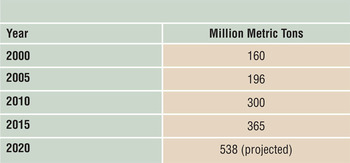
Modern-day needs for the polymer industry require metrics such as lower costs, higher performance, recycled feedstocks usage, lighter weight, lower carbon footprint, and lower environmental impact. Table I shows global plastic consumption. 4 By 2020, this production growth is estimated to have an annual increase of approximately 5.5%, reaching an estimated average value of 538 million metric tons by 2020. 4
Global plastic consumption. 4

In particular, thermosetting polymer resins play an important industrial role due to their high versatility with respect to physical, thermal, and mechanical properties, leading to materials with high modulus, strength, durability, and chemical resistance to solvents. One of the major driving factors for this market is the growing demand for composite materials. Thermoset resins are widely used as the matrix material in composite manufacturing. For example, in the United States, the demand for fiber-reinforced composites will increase 4.7% annually to 4.3 billion pounds (1.95 billion kg) in 2017, valued at USD$22.9 billion. 5
In the future, green composite materials and biopolymers will be two important areas of development and will strongly impact the economy of the polymer sector. For example, in 2012, the Nova-Institute in Germany released the results of a market study titled “Bio-Based Polymers in the World—Production, Capacities, and Applications: Status Quo and Trends toward 2020.” 6 The report forecasted a production capacity for bio-based polymers that will triple from 3.5 million tons in 2011 to nearly 12 million tons by 2020. There are several major players in the bulk biopolymers production industry; a list of companies can be found in Reference Reference Meyer7. According to these results, it is clear that the development of green polymers is growing and that this is supported not only by the industrial sector, but also by government entities and agencies.
In academia, worldwide interest in bio-based polymers has increased progressively in the past 20 years, as advances in technology have generated accumulated experience, allowing the development of new routes to produce bioplastics. As an example of the evolution of this field, a search of the Web of Science database using the words “polymers from renewable resources” identified more than 1500 scientific articles currently available with an exponential growth in the last 20 years, approximately 86% of these published in the last decade, providing evidence of rising interest in this field.
Within the field, a general goal has been to develop renewable polymers by replacing existing polymeric materials derived from petroleum chemicals. During the last decade, extensive and comprehensive reviews have been published. Reference Corma, Iborra and Velty8,Reference Mathers9 Some of these include a review of catalytic reactions that help to transform carbohydrates, vegetable oils, animal fats, and terpenes into valuable chemicals. Reference Corma, Iborra and Velty8,Reference Mathers9 Huber, Iborra, and Corma Reference Huber, Sara and Corma10 discuss current methods and future possibilities for obtaining transportation fuels from biomass.
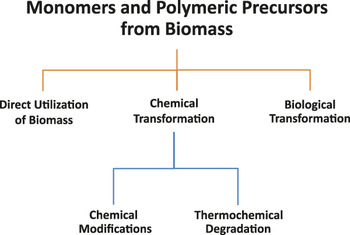
Three major pathways have been identified to produce monomers or their precursors from natural resources ( Figure 1 ), which include the direct utilization of biomass from nature, biological conversion, and thermochemical transformation of biomass. Reference Yao and Tang11 The thermochemical conversion of biomass into feedstocks for polymer science is considered to be the most promising technology within this field.
Classification of biomass conversion techniques. Chemical modification involves changing the chemical structure of the biomass. Thermochemical degradation involves breaking down the biomass structure into smaller components by heat.

Thermochemical transformation of biomass
The main challenge for biorefineries is the efficient, economic, and sustainable design of pretreatment processes allowing for the breaking and opening of the complex lignocellulosic structure to facilitate the formation of chemicals and fuels. Reference Travaini, Martin-Juarez, Lorenzo-Hernando and Bolado-Rodriguez12 This pathway involves degradation and transformation of natural materials by two main approaches—chemical treatment and thermochemical degradation of natural molecules. These chemical treatments have gained attention as promising methods to improve the biodegradability of cellulose by removing the lignin and hemicellulose sheath that is responsible for the rigid support and function of the plant-cell wall. Common chemical treatments require agents such as oxidizing agents, alkali, acids, and organic solvents that are able to break bonds—thus lowering the degree of polymerization—or extract certain compounds of interest, such as oligomers, alcohols, glucose, and xylose. Reference Garcia, Pizarro, Lavin and Bueno13,Reference Behera, Arora, Nandhagopal and Kumar14
In spite of the progress in chemical treatments, the thermochemical conversion of biomass remains dominant because these new technologies are highly efficient and sustainable with low environmental impact. Reference Garcia, Pizarro, Lavin and Bueno13 Biomass can be thermally treated by gasification, pyrolysis, or liquefaction with a solvent. With these processes, complex macromolecules and structures found in biomass are broken into smaller molecules in a gaseous or liquid state (with remnant solid products such as ash and carbon), which can subsequently be used as building blocks for further chemical synthesis. Reference Narodoslawsky, Niederl-Schmidinger and Halasz15 Among renewable sources, biomass is the only resource that can be directly converted into high-value end products using thermochemical conversion technology. Reference Hamelinck and Faaij16
Novel technologies such as combustion, pyrolysis, gasification, firing, liquefaction, and carbonization, based on lignocellulosic biomass refinery concepts, appear to be good alternatives for renewable production of energy, fuels, or value-added chemicals. Reference Thomas, Milne and Soltys17,Reference Patel, Zhang and Kumar18 In particular, biomass pyrolysis, with a long history of usage, has emerged as the frontier research domain. It is generally defined as the thermal decomposition of the biomass organic matrix in nonoxidizing atmospheres resulting in liquid bio-oil, biochar (solid fraction obtained after pyrolysis), and noncondensable gas products. Reference Kan, Strezov and Evans19
Fast pyrolysis bio-oil: From chemistry to products
Fast pyrolysis is a catalyzed high-temperature process in which the biomass is rapidly heated to 400–600°C in the absence of oxygen. Biomass decomposes to generate vapors and aerosols that are rapidly cooled and condensed to give bio-oil and some charcoal-like char. This process produces 60–75 wt% of liquid bio-oil, 15–25 wt% of solid char, and 10–20 wt% of noncondensable gases, depending on the type of feedstock and process used. Reference Mohan, Pittman and Steele20,Reference Balat, Kirtay and Balat21 The resulting organic mixture can be easily separated into two-phase chemicals composed of an aqueous, hydrophilic phase rich in sugars and a tar-based, hydrophobic phase rich in pyrolytic lignin. Reference Bridgwater, Czernik, Piskorz and Bridgwater22,Reference Rezaei, Shafaghat and Daud23 It is anticipated that both phases may be further utilized to synthesize new chemical and polymer substitutes for petrochemical products.
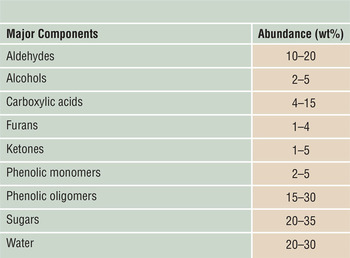
Research on bio-oils for energy use has grown dramatically in recent years. Most investigations are concerned with the optimization of pyrolysis parameters Reference Bridgwater, Czernik, Piskorz and Bridgwater22 or bio-oil quality in the context of improved bio-fuels Reference Lehto, Oasmaa, Solantausta, Kytö and Chiaramonti24,Reference Krutof and Hawboldt25 as an alternative to heat and power generation, Reference No26 hydrogen production, Reference Chattanathan, Adhikari and Abdoulmoumine27 and valued-added chemicals. Reference Shen, Jin, Hu, Xiao and Luo28 Due to the complexity of bio-oil and the multitude of its components (which, in turn, depend on the source of biomass, type of pyrolysis, temperature, and residence time), it often is important to employ different techniques to analyze the resultant bio-oil. Table II depicts the major components found in a typical pyrolysis oil. Reference Staš, Kubička, Chudoba and Pospíšil29
Major components found in pyrolysis oil. Reference Staš, Kubička, Chudoba and Pospíšil29

All of these components are primarily derived from depolymerization and fragmentation reactions of the three building blocks of lignocellulosic biomass—cellulose, hemicellulose, and lignin. Phenol and substituted phenols are mainly derived from the lignin fraction. Miscellaneous oxygenates, sugars, and furans (heterocyclic organic compounds with the formula C4H4O) are produced from cellulose and hemicellulose. Esters, acids, alcohols, ketones, and aldehydes most likely form as byproducts of the decomposition of oxygenated compounds, furans, and sugars. Reference Huber, Sara and Corma10
The presence of this vast amount of unique and multifunctional chemical compounds shows that bio-oil could serve as a raw material for the production of various specialty chemicals and resins. As a renewable liquid fuel, bio-oil can be easily stored and transported. However, compared to heavy petroleum fuel oil, bio-oils have certain properties limiting their application as fuels, including high water content, high viscosity, high ash content, high corrosiveness (acidity), and high oxygen content. Reference Xiu and Shahbazi30
Concerning oxygen content, bio-oils contain up to 45 wt% oxygen, a component of more than 400 compounds that have been identified in pyrolysis oil. Phenolic compounds found in bio-oils are composed of both simple phenols and oligomeric polyphenols, having multiple phenol structural units and containing a wide array of acidic, phenolic, and carboxylic acid hydroxyl groups, as well as aldehyde, alcohol, and ether functions. Reference Kim31 The molecular weight of these oligomers (product of lignin decomposition) ranges from several hundreds to 5000 g/mol, depending on the pyrolysis process. Reference Effendi, Gerhauser and Bridgwater32
Pyrolysis technologies based on biomass refining appear to be good alternatives for a sustainable route for biosourced chemicals. However, in spite of the potential of wood chemicals and forest derivatives, biomass refining is still facing several challenges that have limited its widespread adoption. These include feedstock diversity, biomass collection and transportation logistics, seasonal variation, land usage, compatibility with refinery infrastructure and facilities, market and economic viability, sustainability and consistent research, and development investments. Reference Maity33
Chemical modification
Few studies have been published on the use of bio-oil as a chemical source for macromolecular synthesis. Bio-oil chemistry is still in the early stages of development and understanding, and considerable work must be performed in order to make these bio-based chemicals profitable and more homogeneous for uses such as specialty chemicals and resins (e.g., epoxy, phenol-formaldehyde, polyurethane, and acrylic).
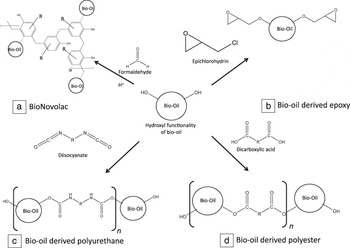
Presently, the use of bio-oil in polymer science has been focused on partially replacing commercial resins. Figure 2 exemplifies possible reactions of bio-oil to produce polymeric resins. In certain thermomechanically demanding applications, aromatic raw materials are needed to impart the required properties to the thermoset resin. The most abundantly available source of phenolics in nature is lignocellulosic biomass. Molecular aromatics can be obtained on a large scale by means of new and developing bio-oil technologies.
Possible reactions of hydroxyl functionalities of bio-oil. (a) BioNovolac, (b) bio-oil derived epoxy, (c) bio-oil derived polyurethane, and (d) bio-oil derived polyester. Note: R, alkyl group; n, number of repeating units.

Wei et al. studied the use of bio-oil derived from switchgrass to cure a commercial epoxy EPON 828 resin. Liquefaction time and temperature, as well as the optimal epoxy/bio-oil ratio were studied. They found that the oil hydroxyl number (mmol of hydroxyl groups per g bio-oil) had a significant effect on the glass-transition temperature (T g) of the modified epoxy resin. Reference Wei, Via, Wang, McDonald and Auad34 Celikbag et al. employed bio-oil derived from loblolly pine (one of several pines native to the Southeastern United States) to cross-link EPON 828. They found that the carbonyl groups in the bio-oil contributed to the curing of the epoxy resin along with the hydroxyl groups. Reference Celikbag, Robinson, Via, Adhikari and Auad35 The effect of the liquefaction temperature and time on the hydroxyl number, as well as its impact of the thermomechanical properties (modulus and glass transition) of the obtained materials, were assessed. Samples with the epoxy/bio-oil ratio of 7:1 showed the highest T g and modulus of 113°C and 1.24 GPa, respectively.
Sibaja et al. synthesized high-performance bio-based epoxy resins using fast pyrolysis bio-oil (containing lignin fragments) as a source of phenolic compounds. Reference Sibaja, Adhikari, Celikbag, Via and Auad36 The bio-oil reacted with epichlorohydrin (C3H5ClO) and an aqueous solution of sodium hydroxide in the presence of benzyltriethylammonium chloride (C6H5CH2N(Cl)(C2H5)3) as a phase-transfer catalyst. The amount of free phenolic hydroxyl groups before and after modification was quantified through P31-nuclear magnetic resonance spectroscopy; and the epoxy content of the bio-oil upon chemical functionalization was measured by titration using HBr in an acetic acid solution. Grafting of epoxy functions (cyclic ether with a three-atom ring) onto the monomer’s structure was studied by Fourier transform infrared (FTIR) spectroscopy. The epoxidized derivatives of the bio-oil were cured using 4-(dimethylamino)pyridine (DMAP) as reaction initiator. Thermomechanical characterization showed that the obtained materials behave as thermoset amorphous polymers, exhibiting moduli values on the order of 1–2 GPa at room temperature and T g above 100°C. Based on the results of this study, it is clear that these materials behave as glassy polymers at room temperature; and they could be used as thermosetting matrices for the development of composite materials. Likewise, they have potential as partial replacements in the formulation of commercial epoxy resins used as coatings and adhesives.
In order to assess the performance of the bio-based materials, the obtained thermomechanical properties of the 100 wt% epoxidized bio-oil and its blends with epoxidized resorcylic acid (3,5-dihydroxybenzoic acid) provide good blending conditions and low viscosity and do not raise the toxicity concerns of traditional epoxy precursors. The properties of these blends were compared to those of a commercial epoxy resin (Super Sap 100 Epoxy) polymerized both by condensation with a commercial amine and by anionic polymerization with DMAP. Testing showed a similar storage modulus (1.5 GPa) with a considerable increase in T g. The cross-linking density, which is proportional to the number of active chains and reactive groups, showed a considerably higher value for the epoxy based bio-oil of 9169 mol/m3 versus 731 mol/m3 for Super Sap 100 Epoxy.
Barde et al. Reference Barde, Sibaja and Auad37 synthesized bionovolac (phenol-formaldehyde-based resin) by partially replacing 10–50 wt% of phenol by pyrolysis bio-oil in the final composition. The phenol/bio-oil mixture was reacted with formaldehyde using oxalic acid as the catalyst and monitored by FTIR spectroscopy. The resulting bionovolac resin was purified by removing free phenol and the catalyst. It was physically blended with an epoxy resin derived from α-resorcylic acid, and the physical blend was cross-linked using DMAP as an initiator of the anionic polymerization. The resulting cross-linked resin was characterized using dynamic mechanical analysis and differential scanning calorimetry to assess the thermomechanical performance. The results revealed that the systems have high T g (∼120°C) and storage modulus (E′) of 1.74 GPa, comparable to similar commercial epoxy systems.
Bio-oil was also utilized to synthesize a new adhesive for application in particle boards. Here, the hydroxyl groups in bio-oil contributed to the condensation reactions with melamine-formaldehyde and melamine-urea-formaldehyde resin precursors, which ultimately affected the properties of the resulting resin system. Reference Kunaver, Jasiukaityte, Cuk and Guthrie38 Likewise, bio-oil has been used in blends for epoxy resins in wood composites at substitution rates of 30 wt% without any appreciable loss in mechanical properties. Reference Liu, Gao, Guo, Pan, Zhou, Cheng and Via39 Liu et al. hypothesized that the bio-oil not only reacted to the epoxy matrix, but also helped to stabilize the wood cell wall, resulting in better composite hydrophobicity. Such an achievement could be important as conventional epoxy resins in wood have resulted in delamination upon liquid water exposure; this has limited their use in exterior wood composite applications. Bio-oil has also proven effective for effective structural wood composites, when 25% was blended with polymeric diphenylmethane diisocyanate and wood flakes Reference Mao, Shi and Steele40 or when 20% oil was blended with phenol formaldehyde resin and then bonded to wood. Reference Özbay and Ayrilmis41
Other value-added transformations are also possible with bio-oil, for conversion into products. Zou et al. Reference Zou, Qin, Wang, Huang, Han and Li42 synthesized a polyurethane foam using bio-oil and reported that a high number of primary hydroxyl groups from the bio-oil was necessary to increase the mechanical and thermal properties of polyurethane foam. It could be hypothesized that the reaction behavior and the mechanical/thermal properties of the resulting polymer depend on the interaction between hydroxyl groups in bio-oil and the formaldehyde for phenol formaldehyde resin, isocyanate (functional group (R – N = C = O); R = alkyl group) for the polyurethane, epoxide groups for epoxy resin, and ester groups for polyester production (Figure 2).
Future trends: Composite materials
Researchers have made significant contributions in developing feedstocks and technologies for the future of biorefinery. Nevertheless, many of these technologies remain in the early stages of development. With only a few studies considering the use of biorefinery products in polymer synthesis, additional research and scientific understanding is essential to promote the development of this field and to transform the biorefinery concept into a profitable industry.
In the case of pyrolysis techniques, more experimental work is required to determine optimal operation conditions, including the catalysts used, catalyst deactivation, temperature, and pressure to control product yield. Moreover, purification and separation of the chemical compounds present in the pyrolysis bio-oils remains a major challenge, but is necessary to overcome the complexity of the plant biomass chemical constituents. Adequate isolation of certain groups of similar chemical products (i.e., phenolic products, sugars) can vastly improve the analysis and study of their structure and reactivity. Development of more efficient catalytic technologies, increasing the selectivity of the conversion toward particular products or family of products also remains as a challenge.
Fundamental understanding of both the structure and the chemistry of the products of fast pyrolysis of biomass is required for assessment of their reactivity under different reaction conditions. This will allow one to extract meaningful and valuable information for the structure–property–reactivity relationships of the obtained materials. In the case of aromatic bio-sourcing, pyrolysis techniques should be applied directly to lignin. Thus, more selective and richer aromatic fractions can be obtained, eliminating the influence and presence of hemicellulose and cellulose decomposition products.
Composite materials will be a sector highly influenced by the evolution in the polymer and materials industry. More research is needed for applications of new bio-based derived materials in the design and formulation of composite materials.
Acknowledgments
This work was supported by the NSF under Grant No. NSF EPS-115882, by the NSF-CREST under Grant No. HDR-1137681, and USDA-NIFA under Grant No. 2015–67021–22842.

Bernal Sibaja Hernández is a researcher at the National Laboratory of Nanotechnology in the National Center of High Technology, Costa Rica. He received his PhD degree in 2016 from Auburn University, where his research focused on the development of thermosetting materials from biomass. His current research interests focus on drug delivery systems, physical chemistry of macromolecules, biochemicals, biopolymers, and green chemistry. Hernández can be reached by email at bzs0035@tigermail.auburn.edu.

Mehul Barde is a doctoral candidate in the Department of Chemical Engineering at Auburn University. He obtained his BTech degree in surface-coating technology from the Institute of Chemical Technology, Mumbai, India. He was a technical executive in the Marine Coatings Division at AkzoNobel India Ltd. His research focuses on the synthesis of thermoset polymer networks from fast pyrolysis bio-oil. Barde can be reached by phone at 334-524-8531 or by email at mrb0063@auburn.edu.

Brian K. Via is the director of the Forest Products Development Center at Auburn University. He has more than seven years of industry experience at Louisiana Pacific Corporation and International Paper Corporation. His research interests include composites that are environmentally friendly and chemometric modeling. He is an associate editor for the Forest Products Journal and an editorial board member of the Journal of Analytical Methods in Chemistry. Via can be reached by phone at 334-844-1007 or by email at bkv0003@auburn.edu.

Maria L. Auad is the director of the Engineering Center for Polymer and Advanced Composites and a full professor in the Department of Chemical Engineering at Auburn University. Her research interests include control of microstructures and nanostructures in polymer and fibrous materials, polymers and coatings for structural and biomedical applications, shape-memory polymers, polymer nanocomposites, and sustainable materials. She has published more than 50 technical papers. Auad can be reached by phone at 334-844-5459 or by email at auad@auburn.edu.