Introduction
In the last 30-40 years, the volume of the literature regarding major incident planning has increased several fold. Major incidents such as the terrorist attacks in London and New York have further focused attention on the need to plan for these rare but devastating events. In political terms, the profile of emergency planning has arguably never been higher, with requirements for emergency planning in the UK now defined in national legislation. 1 The challenge for emergency planners is in synthesizing, appraising and using the published literature. The authors’ experience is that the published data is variable in both quality and scope.Reference Carley, Mackway-Jones and Donnan 2 , Reference Potter, Miner and Barnett 3 This leaves those in emergency planning with decisions in planning areas where little or no evidence exists, and contributes to the long-standing variable compliance with current guidance.Reference Potter, Miner and Barnett 3 - Reference Carley and Mackway-Jones 6
Determining the areas of missing and inadequate evidence requires an approach that encompasses the collective intelligenceReference Turoff and Hiltz 7 of experts in the field of major incident planning.Reference Turoff, Hiltz, White, Plotnick, Hendala and Xiang 8 Therefore, the Delphi technique was used to determine areas for future major incident research using a panel of international experts in the field. The aim of this study was to collate the opinions of experts and to reach consensus about the research priorities in the management of major incidents.
Methods
A three-round Delphi studyReference Linstone and Turoff 9 was conducted using a panel of 26 experts. A Delphi study is a structured process that uses a panel of experts to investigate a complex or imprecise issue using a series of structured statements. The stages involved in the Delphi method are outlined briefly in Table 1.
Stages in the Delphi Methodology

Expertise was determined using two criteria: (1) evidence of active research involvement as identified by the literature analysis previously described; and (2) evidence of current engagement with major incident education and training. These criteria ensured that decisions during the Delphi study were made by experts with domain knowledge, to facilitate implementation of any study recommendations.
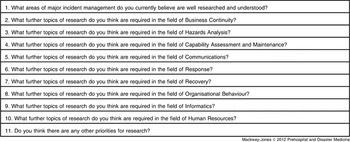
Round 1 of the Delphi study asked participants to consider major incident research requirements broadly in 11 areas identified in the literature analysis (Table 2). Participants were also asked to identify areas where the research base was adequate, and areas of research requirement that lay outside the 11 areas identified. The questions posed are shown in Table 2.
Questions posed in Delphi Round 1

Replies to Round 1 general questions were thematically reviewed and collated into a series of statements. Round 2 comprised an iteration of these statements to the expert panel. Panel members were required to express their level of agreement with each statement using a 7-point Likert scale.Reference Likert 10 Panel members were also asked to add any comments they felt were appropriate, and to mention any areas that they felt were important that had not already been identified. Statements that reached positive or negative consensus were removed at this stage.
The third and final round of the Delphi study re-presented the statements that had not reached consensus at the end of Round 2. For each statement, the experts were re-presented their own Round 2 score together with a summary of the rest of the panel's score (expressed as the median score). In this round, panel members could change their opinions in light of those of the rest of the panel. Consensus was defined a priori to be ≥80% at the end of Round 2 and ≥85% at the end of Round 3.
No additional statements were constructed and added in Round 3 as no panel members identified new areas of research priority in Round 2.
Results
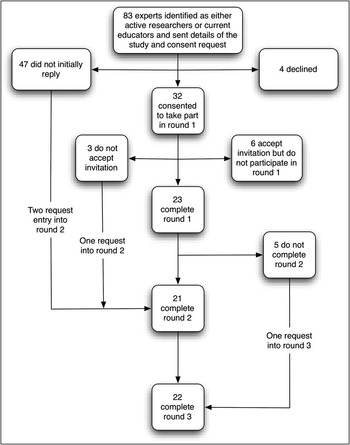
Eighty-three individuals were approached, and 32 agreed to participate. Twenty-three participants (79.5%) completed Round 1; 21 participants completed Round 2, and 22 completed Round 3. In total, 26 experts contributed to the study. A list of the active members of the Delphi panel can be found in Appendix 1 (online supplementary material). The participation flow is illustrated in Figure 1.
Participation Flow

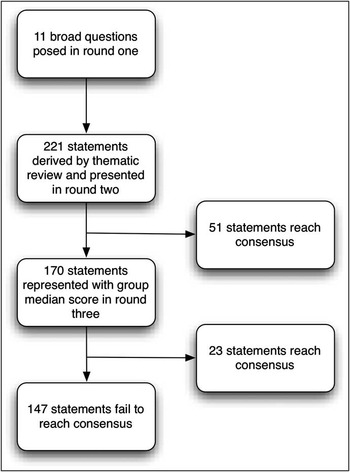
Round 1 generated 221 unique statements about priority research areas in major incident management. A total of 51 out of the 221 statements had reached consensus upon completion of Round 2. A further 23 statements reached consensus at the end of Round 3. The flow of statements is illustrated in Figure 2.
Statement Flow

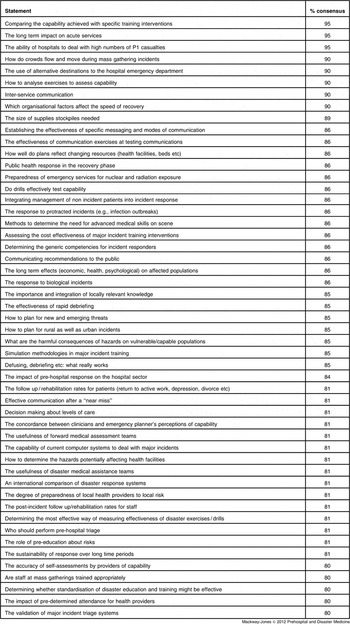
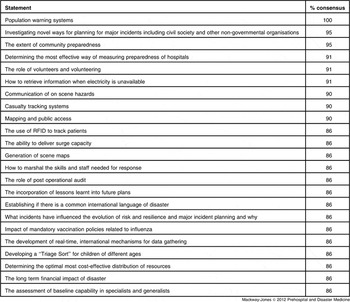
The 51 consensus statements that arose from Round 2 are shown in Table 3 and the additional 23 consensus statements that came from Round 3 are shown in Table 4. The statements that did not reach consensus are shown in Appendix 2 (online supplementary material).
The 51 Statements that Reached Consensus in Round 2

The 23 Statements that Reached Consensus in Round 3

Discussion
Conducting research into major incidents is difficult because the events are infrequent and expertise difficult to define. As experimentation is impossible, practice has traditionally been based upon case reports and the opinions of experts. The opinions of single authorities are susceptible to bias, as are committees and expert working groups through confounding by interpersonal relationships. The Delphi method was used as a multidisciplinary approach in an attempt to reduce bias.Reference Goodman 11 , Reference Whitman 12
The Delphi methodology has gained in popularity in health services research and has been used in the context of emergency planning to improve the care of children involved in major incidents,Reference Carley, Mackway-Jones and Donnan 13 , Reference Mackway-Jones, Carley and Robson 14 major incident burns victims,Reference Carley, Mackway-Jones, Randic and Dunn 15 - Reference Welling, Boers, Mackie, Patka and Bierens 17 and victims of chemical,Reference Crawford, Mackway-Jones, Russell and Carley 18 , Reference Crawford, Mackway-Jones, Russell and Carley 19 and biologicalReference Brown, Crawford, Carley and Mackway-Jones 20 incidents, as well as to investigate issues around role nomenclatureReference Mudalige, Carley and Mackway-Jones 21 and psychological debriefing.Reference Bisson, Witteveen, Ajdukovic, Johansen and Orengo Farcia 22
Statement of Principal Findings
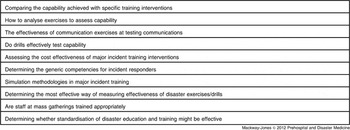
This expert Delphi study identified 74 topics for research in the field of health service management of major incidents. There are a number of clear themes within these topics. The largest of these (with 10 topics - see Table 5) is education and training.
Topics Identified in Education or Training

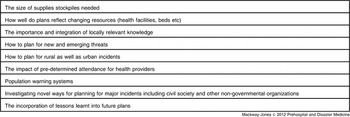
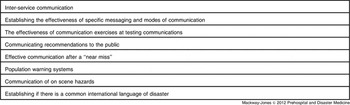
The next most significant themes were planning and communications with nine and eight topics respectively (Tables 6 and 7). Other themes included recovery, acute response, and prehospital care. It is of note that the expert panel failed to identify a single topic that they agreed was well researched and understood.
Topics Identified in Planning

Topics Identified in Communication

The Delphi study also produced 147 statements the panel of experts did not agree were important. Despite the failure to reach agreement, these statements undoubtedly include areas worthy of further study, and the list in Appendix 2 may be valuable to future researchers.
Limitations
As with all Delphi studies, the findings must be interpreted with some caution for a number of reasons. First, the definition of expertise is a subjective one and relies upon the researchers knowing who the potential experts in the field are. In this study, it was possible to identify active researchers through the linked literature analysis and to identify active educators through a database of major incident course providers. However, the criteria for invitation were a proxy for true expertise. Second, the Delphi method can only explore the areas raised by panel members, and therefore important topics may have been overlooked. Third, although consensus was reached on 74 statements, this does not necessarily mean true agreement as some panel members may have altered their views in order to draw the process to a close.
Unanswered Questions and Future Research
This Delphi study has identified a number of topics for research. However, it has not sought to prioritize them, nor was the feasibility of researching each area investigated. Ranking and further assessment of feasibility will be necessary before the topics can be rated as realistic research projects.
Conclusion
An international panel of experts was used to demonstrate consensus on 74 topics of research priority in major incidents management. The strongest themes within these topics were education and training, planning, and communication.
Disclaimer
This project was commissioned by the NIHR Service Delivery and Organisation (NIHR SDO) programme under the management of the National Institute for Health Research Evaluations, Trials and Studies Coordinating Centre (NETSCC) based at the University of Southampton. From January 2012, the NIHR SDO programme merged with the NIHR Health Services Research (NIHR HSR) program to establish the new NIHR Health Services and Delivery Research (NIHR HS&DR) program. The views and opinions expressed herein are those of the authors and do not necessarily reflect those of the NIHR HS&DR program, NIHR, NHS or the Department of Health.
Abbreviations
none