Introduction
Asking a question places significant constraints on what the recipient does next, and in this way places the questioner in an interactionally powerful position. Indeed, Sacks (Reference Sacks1992a:54) observes that in conversation, “the attempt to move into the position of questioner seems to be quite a thing that persons try to do … As long as one is in the position of doing the questions, then in part one has control of the conversation.” Although question recipients typically abide by the constraints questioners impose on them, they can and sometimes do resist these constraints (Heritage Reference Heritage1998, Stivers & Heritage Reference Stivers and Heritage2001, Raymond Reference Raymond2003, Golato & Fagyal Reference Golato and Fagyal2008, Bolden Reference Bolden2009, Heinemann Reference Heinemann and Sidnell2009). This article examines one way in which question recipients resist a yes–no question’s constraints: the use of what we term “transformative answers.” With a transformative answer, the question recipient (dis)confirms a somewhat different question than was originally posed. Through the design of the (dis)confirmation, the question recipient retroactively proposes alterations to the question’s terms or agenda. Relying on both Japanese and English conversation, we show that with transformative answers, question recipients indicate not only that there is a problem with the question but also what the problem is with providing a direct answer – a problem with the question’s design or agenda.
Questioning Constraints
When a person poses a question to another, she or he places constraints not only on the action the recipient should properly produce next (Schegloff Reference Schegloff1968) but also on the design that the action should take. A polar question constrains the response to yes or no (Raymond Reference Raymond2003); an alternative question (e.g., “Tea or coffee?”) constrains the answer to one of the alternatives provided; and a wh-question (e.g., “When did you get home last night?”) constrains the answer to, in this example, a time (Fox & Thompson in press) Most of the time, question recipients abide by the constraints placed on them and answer questions in the terms asked, as exemplified in extract (1). Here Mark is doling out ravioli for dinner. There is a mixture of types, and Kim has rejected one of them (line 1). Mark requests confirmation using a declarative question with rising intonation.Footnote 1 This is confirmed in line 3.
(1) RD
1 Kim: An’ you can have that one,
2 Mark: You don’t like=want thuh green one?,
3 Kim: → No
Answers that abide by the constraints set up by the question “accept the terms and presuppositions embodied in a YNI [yes-no interrogative]” (Raymond Reference Raymond2003: 949).
Extract (2) shows a case where the answer is a single turn-constructional unit (TCU) that directly answers the question, just as yes or no does, but resists the terms of the question by failing to offer an answer that conforms to them precisely. Raymond Reference Raymond2003 argues that nonconforming answers treat the question’s terms or its action as problematic. Here, during a family dinner, Cindy mentions that on a field trip to a local restaurant, her favorite part was going inside thuh z:ero freezer. In line 4 her father does an understanding check, asking for confirmation that it was zero degrees in there?
(2) SDFootnote 2
1 CIN: An’ my favorite (0.2) part was going in thuh z- (0.3)
2 uhm_ thuh z:ero freezer. Zero below.
3 (0.5)
4 DAD: [O:h. (It was) zero degrees in there?
5 CIN: [Zero-
6 MOM: [Mm hm:,
7 CIN: → [It was zero degrees in there_ [an’-
8 DAD: [And what was inside
9 hhuh huh/((coughing))
Cindy’s confirmation is direct but breaks out of the mould set by the question as she answers It was zero degrees in there. As Heritage (in press) shows, repetition – in contrast to a yes/no response – “asserts the respondent’s epistemic and social entitlement to the matter being addressed and does so by ‘confirming’ rather than affirming the proposition raised by the questioner, thereby claiming more epistemic rights over the information required than the original yes/no question conceded.” (For a related discussion, see Schegloff Reference Schegloff1996.)
Although they are nonconforming, direct answers such as that shown in extract (2) reflect a relatively low degree of resistance to the constraints of the question. They contest agency over the terms but do accept them insofar as they do not seek to alter them. Rather, they contest the implication of reduced agency over them. By contrast, when a speaker challenges the question through an initiation of repair (Drew Reference Drew1997, Schegloff Reference Schegloff2007a) s/he interrupts the progessivity of the sequence (Schegloff, Jefferson & Sacks Reference Schegloff, Jefferson and Sacks1977) and suggests that the question should be reformulated. This can reflect a high degree of resistance to the constraints of the question. Transformative answers, we suggest, also reflect a rather high degree of resistance but do not go so far as to disrupt sequence progressivity. Indeed, it is a hallmark of this sort of response that question recipients work to adjust the prior question’s terms or agenda retroactively and implicitly, and this modification is rarely brought to the surface of the interaction.
Transformative answers have been examined in various forms in studies of courtroom interaction (Drew Reference Drew, Drew and Heritage1992; Ehrlich & Sidnell Reference Ehrlich and Sidnell2006) and news interviews (Clayman & Heritage Reference Clayman and Heritage2002). Clayman and Heritage (Reference Clayman and Heritage2002:238–98) devote significant time to the topic of how interviewees design their responses, including the variety of forms of resistance observable in interviews. Consider extract (3):
(3) Clayman & Heritage (2002:254–55) IR: Ed Bradley IE: John Deutch
1 IE: hh Our most th:orough (0.2) and careful efforts
2 to determine (.) whether chemical agents were
3 us:ed in the Gulf, (.) .hh lead us to conclu:de
4 that there was no: (.) w:idespread use of
5 chemicals against U.S. troops.=
6 IR: =Was there any use.=Forget w[idespread. Was]=
7 IE: [I- I do ]=
8 IR: =[there any use.]
9 IE: =[ not belie:ve] I do not believe there was
10 any: o:ffensive use of chemical agents by:
11. hh uh- Iraqi: (0.2) uh military: (.) troops.
12 Ther[e was not-
13 IR: [Was there any- any accidental use. Were our
14 troops exposed in any way:.
15 (0.4)
16 IE: .hhh Uh- I do not believe that our troops
17 were: expo:sed in any widespread way to:
18 u[h: chemical
19 IR :[In any narrow way.=In any way.
20 IE :hh .hh The defense science board did an
21 independent study of this matter: .hh [and=
22 IR: [( )
23 IE: =fou:nd in their judgement that there was no::
24 confirmation .hh of chemical: (0.2) weapon (0.2)
25 widespread use: in the Gulf.
Here, the interviewer works to get the interviewee to state directly whether or not chemical weapons were used during the Gulf War (lines 7/9, 14–15, 20). The interviewee repeatedly resists the terms of the questions. Drew (Reference Drew, Drew and Heritage1992:490), discussing courtroom questioning, shows that witnesses who, in response to a question, offer “alternative descriptions” are specifically “avoiding what the question asks, and declining either to confirm or disconfirm.” Such alternative descriptions are “designed to qualify and replace the versions initially produced by the attorney” (1992:491).
Although transformative answers are common in contexts where someone is “in the hot seat,” as in the courtroom or a news interview, they are also found in ordinary conversation. Extract (4), in Japanese, offers an initial example. Here Kyoko and Mayumi are catching up by phone. Kyoko requests confirmation that a mutual friend, Nanao, is leaving the dance troupe with which Nanao has long been affiliated. Mayumi confirms with the transformative kubi ‘fired’.Footnote 3
(4) JAPN1684
01 KYO: [u::n.
‘Yeah.’
02 MAY: [.hhh >a soo< nanao to robin (0.4) kappuru na n da tte sa::.
oh so NAME and NAME couple CP N CP QT FP
.hhh >’Oh yeah< Nanao and Robin (0.4) are dating, (I) heard.’
03 (0.2)
04 KYO: nanaodemo yameru n deshoo.
NAME but quit N TAG
‘But Nanao is quitting, right.’
05 (0.3)
06 MAY: → kubi.
fired
‘(She’s) fired.’
07 (0.6)
08 KYO: rashii desu yo ne:.=[eh ka]ppuru na no::?=
seem CP FP FP couple CP FP
‘It seems like it.=Oh are (they) dating.’
09 MAY: =[u::n.]
‘Yeah.’
10 MAY: =kappuru na n da [tte sa:.]
couple CP N CP QT FP
‘(They) are dating, (I) heard.’
11 KYO: [hee:::::]
‘Wow:::::’
With kubi Mayumi confirms that their friend was fired, thus retroactively adjusting the terms of the question, replacing yameru with kubi.
A somewhat different sort of transformative answer is shown in extract (5).
Here, Hiroshi, who lives in Boston, has described a restaurant that he has enjoyed eating at in New York. Noboru, who lives in California and is less familiar with the east coast, asks whether Boston is close to New York. Hiroshi provides a transformative answer in line 2.
(5) JAPN4573
01 NOB: (eh) nyu- bosuton tte nyuuyooku kara chikai wake.
Boston QT New.York from close reason
‘Is Boston close from New York.’
02 HIR: → ee::to kuruma de y- yojikan gurai ssu kedo ne:.
well car by 4.hours about CP but FP
‘Let’s see, (it)’s about 4 hours by car.’
03 NOB: a yojikan ka.=
oh 4.hours Q
‘Oh 4 hours.=’
04 HIR: =a ha:i.
‘=Yes.’
05 NOB: a soo: hu::n.
‘Oh is that so. I see.’
Hiroshi’s response in (5) answers obliquely, offering an objective measure of distance rather than the subjective measure requested of him. Although Noboru, using his own understanding of ‘close’, can evaluate whether 4 hours constitutes ‘close’ (confirming answer), the answer Hiroshi provides can be heard to propose a retroactive transformation of the question from a question about relative proximity to a question about absolute distance.
Directness and transformation in answering a question are issues that participants treat as relevant in interaction. For instance, see extract (6). Here Guy has called Jon, but now Jon must look for a phone number. He asks whether Guy is calling long distance.
(6) NB
1 Jon: Uh I think so, dju wanna hold on a
2 minute?.h[h
3 Guy: [Yea[h.
4 Jon: [Are you calling long
5 distance?
6 Guy: → I’m uh I’m:-: in: uh No I’m not’n(l) in:
7 → uh,h long dis’nce I’m in: uh: Balboa.
8 Jon: A’right well hold o:n ah s:↑ee if I have a
9 card. I .h I may ha:ve.
In Guy’s response he wrestles with providing his location (I’m in Balboa) – a transformative answer – and No, a direct disconfirmation. Although both responses disconfirm the proposition that he is calling long distance, they differ in how directly they deal with this. The transformative answer I’m in: uh: Balboa adjusts the question from one about relative location to one of objective location, thus altering the agenda of the question significantly.
It has been established that working within a question’s constraints is preferred (Stivers & Heritage Reference Stivers and Heritage2001, Clayman & Heritage Reference Clayman and Heritage2002, Raymond Reference Raymond2003, Boyd & Heritage Reference Boyd, Heritage, Heritage and Maynard2006). However, we do not yet know how a nonconforming response that resists a question’s constraints, particularly one that is transformative, conveys which aspect of the question posed a problem for the delivery of a direct and conforming answer. Nor do we know how different practices of transformative answering might be arrayed in terms of degrees of question resistance. In this article, we examine the variety of ways in which transformative answers show what sort of problem there is with the question. We show that there are various ways to answer questions that convey what dimension of the question’s fit with the recipient and/or his circumstances caused difficulty in the delivery of a direct answer. We then ask what question recipients are doing when they provide transformative answers.
Data and Method
The data for this paper are drawn from a range of naturally occurring recorded interactions, including ordinary telephone conversations and videotaped recordings of conversations over dinner, during cooking, or while sitting together during a visit. The data are drawn from both Japanese and English contexts. The data come from the authors’ personal collections of recordings of naturally occurring conversations as well as from a publicly available corpus, the CallFriend corpus available at www.talkbank.org.
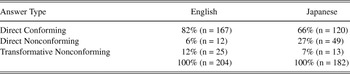
The project emerged as part of a larger cross-linguistic investigation of question–response sequences in conversation (Stivers et al. Reference Stivers, Enfield, Brown, Englert, Hayashi, Heinemann, Hoymann, Rossano, de Ruiter, Yoon and Levinson2009). As shown in Table 1, within that project framework, we found that although conforming answers are most common in both Japanese and English, the increased proportion of direct answer repeats (direct nonconforming) in Japanese is evident (Hayashi in press; Stivers in press). Transformative answers were relatively infrequent in both languages, but nonetheless present in both.
Distribution of answer types in functional questions.

The data have been analyzed using the methodology of Conversation Analysis (for reviews, see Heritage Reference Heritage1984b and Goodwin & Heritage Reference Goodwin and Heritage1990). In line with this methodology, a collection of instances beyond those found in our original corpora of question–response sequences was made, yielding a total of 69 core cases. Similarities and differences among the collected instances were examined qualitatively. In this way, the boundaries of transformative responses could be assessed (see Schegloff Reference Schegloff1996 for a description of this process). The cases shown here are representative of the cases in the collection but were selected for two reasons: (i) to best illustrate the range of operations within transformative answers, and (ii) as particularly clear examples of the phenomenon, although they are not qualitatively different from other instances in the collection.
This study relied equally on data from Japanese and English. Although Japanese speakers use transformative answers slightly less frequently than English speakers, the data we analyze suggest that when used, they are functioning in the same way in both language contexts. Thus, this article is not comparative by design but rather draws on two languages to exemplify an aspect of social behavior common across the two languages and cultures.
Analysis
If transformative answers to yes–no questions, through resisting the constraints of the question, convey some problem with answering the question posed, what problems do speakers show themselves to have with questions? How do they convey these problems, and to what effect in the interaction?
We identified two primary targets of transformation: the question’s turn design, as in extract (4), and its agenda, as in extract (5). Targets of transformation of the question’s design include lexical, syntactic, or morphological components of a turn – its terms. Targets of transformation of a question’s agenda include the question’s focus, bias, or presupposition. In what follows, we exemplify these sorts of transformations as we pursue what question recipients accomplish through this answer type.
Question design
A highly explicit form of transformative answer in our collection involves the speaker’s adjusting components of the question, treating them as problematic for the delivery of a direct answer. Of the 69 total cases in our collection across Japanese and English, 35% (n = 24) were of this variety. In all these cases, the questions’ terms are adjusted, but the degree of adjustment varies from some specification of a component to replacement of a component.
Specification. With cases of specification, a speaker narrows the scope of what she is confirming/disconfirming, treating the basic design of the question as acceptable but requiring specification or qualification. This was the practice relied on repeatedly in the interview regarding chemical weapons shown in extract (3). There, each time the interviewer attempted to block some specification (e.g., Forget widespread, line 7), the interviewee specified the answer’s terms in another way (offensive use, line 11). This practice is in operation in ordinary conversation as well. For instance, see extract (7). Here Beth and Sandra, housemates in a sorority house, are discussing a party that Sandra went to the night before. The target question, Was it like an excha:nge?, appears to be asking whether party attendees could come only from particular sorority and fraternity houses or whether it was open to everyone. Critically, Was it has two interpretations: ‘Was it [designed to be] an exchange?’ vs. ‘Was it [in the end] an exchange?’ The answer specifically deals with this ambiguity.
(7) SB1 55:35
1 Uria: So it was just like “euh”,
2 (0.4)
3 Vicki: ^It was pretty nice actually.
4 (0.8)
5 Uria: Was it an open party, or was it (an ex-)
6 I never understood that.
7 (0.4)
8 Vicki: We:ll:, [yea:h.
9 Uria: [( ) Was it like an excha:nge?,=
10 Vicki: → =It- I think it was supposed to be:,
11 Like- but- we:- tlk Kalie’s boyfriend
12 is not (.) in one uh thuh houses that
13 was invited but thuh- he was- he
14 jus’ walked in holding Kalie’s hand an’
15 the guy didn’t even say anything so:_
Vicki begins her answer as though to start with it was supposed to be. She restarts (Schegloff Reference Schegloff2007b) and adds I think, downgrading the strength of her forthcoming assertion (Kärkkäinen Reference Kärkkäinen2003). The answer I think it was supposed to be: targets was, specifying the turn component’s meaning and in so doing showing the constraints on her confirmation.
A similar case is shown in extract (8). Here, Mark and Kim are a married couple. Mark and one of his partners at work have recently announced to the other partners that they will be opening an independent restaurant. The two excluded partners, Jack and Mike, are relevant in line 1, when Mark asserts that he did not have too much conversation with Jack or Mike today. Given that Jack, Mike, Mark, and a fourth man, Pete, are all co-owners of the restaurant in which they currently work, it is unlikely that three owners were all working at the same time during the day. This appears to be behind Kim’s questions. First she asks, Did they work?, which is confirmed with a direct and conforming Mm hm, but when this is pursued with Both of ’em worked? (our target question), the answer focuses on worked.
(8) RD 19.00
1 Mark So_ (1.0) ya know. (3.8) Didn’t really have too much
2 conversation with Jack or Mike today,
3 (2.5)
4 Mark: Little bit but_°
5 (2.5)
6 Kim: Did they work?,
7 (0.8)
8 Mark: Mm hm,
9 (0.8)
10 Kim: Both of ‘em worked?
11 (0.2)
12 Mark: → Mike work- er Jack worked today an’ Mike works tonight.
13 (6.0)
14 Kim: They didn’t talk to you at a:ll er_
15 (1.0)
16 Mark: Yeah, Yeah I mean I didn’t (2.8) really (.) see ‘em much,
17 (10.0)
As in the previous case, here work is specified in a way that allows Kim to see how it is that Mark could have had an opportunity to have a conversation with both Jack and Mike: One overlapped his own work period during the day while the other began work shortly before Mark left. Thus, with the operation, Mark adjusts the scope of the term work. Here it is effectively modified twice – worked today and works tonight, both of which confirm.
A related sort of instance is shown in extract (9). Here the transformative answer targets a turn component as the problem and specifies it through a qualification of knew – knew fer su:re. This telephone call between former President Nixon and Chief of Staff Bob Haldeman took place during the Watergate scandal. Nixon asks Haldeman whether it is his view that John Dean probably:: didn’t kno:w ... what the truth really was (lines 5–7/9–10), which is followed by ’s that right? (line 10). To this Haldeman answers, I don’t think he knew fer su:re (line 11).
(9) Watergate
1 Nixon: phahhh Waaduh you uh hmhhhhh
2 (—): (hmhhh)
3 (Hal): °°(iffih cat)°°
4 Nixon: hhh (0.3) analyzing this Dean thing in so forth
5 uh:m? (0.2) pt It’s=yer view th’t Dean.
6 probably:: didn’t kno:w=.h hhh the ti:me
7 after the election they met<
8 (Hal): °°(Nuh ah)°°
9 Nixon: what the truth really was.>hheh=hhehh=hheh<
10 h=‘s thạt right?
11 Hald: → I don’t think he knew fer su:re,
12 Nixon: Tha[t’s w’t ’ee] hhe guessed it might be [(et set ettuh=
13 Hald: [I t h i n k][I think he had s’m
14 Nixon: =but)=
15 Hald: [Well we a[: l l guessed]
16 Nixon: [m- [En didn’t h]hh Didn’t theht
17 didn’t think he had any choice.h
I don’t think downgrades the certainty of Haldeman’s answer, but for our purposes here what is critical is that he ties his answer to Nixon’s question, allowing knew fer su:re to be heard as resetting the terms of the question. Thus, Haldeman’s confirmation is of the proposal that Dean did not know for sure rather than that Dean did not know.
Extract (10) shows another instance of specification. Here, at breakfast Tara has been telling housemate Alexa what happened to her the night before. Kristina has just come into the conversation, and Tara has announced that she had cried the night before while talking to an ex-boyfriend. Kristina asks, after an initiation of repair, You cried to him on the pho:ne? In response, Tara’s transformative answer overtly targets the turn components cried to him. She addresses the possible understanding that if you cry to someone, then you have cried on purpose. She specifically denies this and, having reset the terms of the question, she hearably confirms that she cried to him involuntarily.
(10) SB1 39.35
1 Tara: =and I <cri:ed.> (1.1)
2 ((other conversation in progress))
3 Kristina: (You did it) on thuh pho:ne?
4 Tara :What?
5 Kristina: You cried to him on the pho:ne?
6 Tara: Not on purpose;
7 (0.4)
8 Kristina: Oh::, ( [ that’s cu^:te.)
9 Alexa: [Didju fight? Or (?,)
10 Tara: [((nods)) Yeah I [( )
11 Kristina: [>No wait. (.) [Tell me what he said.
12 Kristina: >Tell me what he [said<
13 Tara: [Yes.
All the cases discussed thus far have involved question recipients explicitly adjusting the question’s terms through a specification of some component. In this way, although they accept the fundamental terms of the question, they modify them slightly. Such cases certainly resist the terms more than do cases of repetitional answers, such as that shown in extract (2). Whereas there the question’s design is accepted but the agency is contested, here the question recipient treats the terms as requiring adjustment prior to (dis)confirmation.
Replacement. Question recipients can even more strongly resist a question’s design through replacement transformations of some turn component. In these cases, one or more terms from the question are replaced in the answer. We see this if we return to extract (4). There it is a turn component – the word yameru ‘quit’ – that the question recipient targets as the problem in her answer kubi ‘fired’. In the answer turn, the speaker does two things: (i) She alters the question, replacing yameru with kubi; and (ii) she confirms that Nanao was fired.
Similarly, in extract (11) housemates Lance, Judy, and Gio are preparing dinner. Raw beef is being shaped into hamburger patties to be barbecued. Judy has nibbled on bits of raw beef, which occasions the following stretch of interaction.
(11) HM
1 LAN: This’s smelling goo:d_ I might start eating raw meat,
2 (0.2)
3 JUD: S::ee:?
4 (1.0)
5 LAN: Yeah but I’m not [that weird.]
6 GIO: [I th(h)ink ] it’s just all the spices.
7 (0.2)
8 LAN: It is.
10 JUD: =Have you <ever eaten> steak tartare?
11 (0.8)
12 GIO: → I tried it once.
13 (0.5)
14 JUD: I have.
15 (.)
16 LAN: It bit me b^ack.
17 GIO: hh [hh
18 JUD: [I l^ove it.
The target of our attention here is the question Have you <ever eaten> steak tartare? to which Gio responds I tried it once. The problem is a turn component, specifically the term eaten. Eaten implies that the person ate a full serving of steak tartare. Tried conveys that the person has tasted it but not necessarily eaten a full serving. Here the answerer adjusts the terms of the question, replacing eaten with tried and then, in the same turn, confirms that he did this. It is additionally qualified with once. Although this could have constituted a transformative answer on its own (e.g., if once were the full response), here it adds to the contrast being built between what eaten conveys and what its replacement tried conveys.
Both extracts (4) and (11) share an orientation to what Drew Reference Drew, Drew and Heritage1992 terms the “maximal property of description” (see also Drew Reference Drew, Atkinson and Heritage1984; Sacks Reference Sacks1992b:367–75). Specifically, in (4), although ‘quitting/leaving’ does not entail ‘being fired’, the latter does entail the former. Similarly, if you have ‘eaten’ something, then you have, by definition, ‘tried it’, but ‘trying’ something does not mean that you have ‘eaten it’. Drew Reference Drew, Drew and Heritage1992 suggests that, although all characterizations are only partial, all are nonetheless informative through the characterization’s implicatures. In these two cases, it is the implicature of the characterizations of how the employee came to separate from her job and of Gio’s level of acquaintance with steak tartare that are being quarreled with through the adjustment of the terms of the question.
Similarly, Levinson Reference Levinson2000 argues that there is a principle of conversation, the Q-principle, which states that speakers should not provide a statement that is “informationally weaker than [their] knowledge of the world allows,” and that recipients should assume speakers have behaved in a way consistent with this (Levinson Reference Levinson2000:76). Thus, to assert that you have ‘tried’ something when you have ‘eaten’ it would be actively misleading and a violation of the Q-principle because of the implicatures of ‘try’ and ‘eat’. Here we see that interactants are carefully attending to consequential lexical choices.
Similar to these cases is extract (12), which also involves the question recipient’s transforming the prior question through term replacement. Here, Jake and Maureen are brother and sister. Maureen is preparing dinner for them. A trip to the market has been planned, and Jake is apparently working under the impression that Maureen is not going to come to the market with their mother and him. When Maureen says that she will have to look at the salad dressing options, he apparently realizes that she is, in fact, planning to come (lines 6–7). This is visible both with the Oh (Heritage Reference Heritage, Atkinson and Heritage1984a) and with his redesign of the question from an interrogative (line 6) to a declarative plus tag (line 7) embodying a stronger presumption that she is going.
(12) MFD 19.29
1 Jake: Okay just dressing_
2 Jake: <What kInd of dressing.
3 (1.0)
4 Jake: Thousand Isle(s)/(‘n) o:r uh:m_
5 Maur: I gotta look. I want-
6 Jake: °( )° Are>you gonna come,<
7 Oh you’re gonna come with us yeah:?
8 (0.2)
9 Maur: → I:’m taking you.
10 (0.4)
11 Jake: In Mom’s car? Oh:.
12 Maur: No::?
13 Jake: Oh okay.
14 Jake: I thought Mom said she was taking me.
15 (0.6)
16 Maur: No:?,
17 Jake: W’ll that’s what she said.
Maureen’s answer, however, targets the turn component(s) come or come with us, which diminishes her role in the trip, implying that she neither initiated the trip nor will be driving: whereas driving entails coming with, coming with does not entail driving. In her answer, Maureen asserts that she is taking Jake. As in extracts (4) and (11), here too Maureen replaces one turn component with another. In so doing, she simultaneously adjusts the terms of the question and confirms the adjusted question.
In contrast to term-specifying transformations, term-replacing transformations more strongly resist the question as put. Based on the degree of adjustment necessary to (dis)confirm the proposition, specifying transformations resist the question to a lesser degree, whereas replacement transformations resist the question to a greater degree. However, term-transforming questions of both types accept and even promote the turn’s basic agenda. Thus, in this sense they are, across the board, less resistant than the agenda-transforming answers to which we now turn.
Agenda
A majority of transformative answers do not overtly adjust the question’s design but more subtly adjust the question by working to shift its focus, bias, or presupposition(s). Many of the evasive answers we associate with news interviews and courtrooms are of this variety. Agenda-transforming answers accounted for 65% (n = 45) of the transformative answers in our collection.
Questions set an agenda in a variety of ways. They are a common way for speakers to proffer a new or slightly changed topic (Schegloff Reference Schegloff2007a:170); they are also a resource for speakers to build a case for a particular claim or point of view (at the most extreme end, consider the courtroom; see Drew Reference Drew, Drew and Heritage1992). These agendas are commonly understood by recipients and thus may be cooperated with (as was the case in the first set of transformative answers) or resisted. In resisting a question’s agenda, the answer usually works to transform its focus, its bias, or its presupposition(s), though in doing so, these answers also reject the design of the question.
Focus. Question evasion is considered prototypical of politicians being interviewed by news media (Harris Reference Harris and Scannell1991).Footnote 4 Using the term in the narrow sense, question recipients who evade a question exploit a question response slot but respond not to the question as put to them but to some aspect of it, to the point where no answer to the initial question can even be inferred. Such answers, we suggest, belong to the class of transformative answers through their transformation of the question’s agenda. Clayman & Heritage Reference Clayman and Heritage2002 discuss several such cases, including the one reproduced here as extract (13). In this case, then President Bill Clinton is being interviewed about his alleged affair with Gennifer Flowers. Although the question as put does not specify “now” or “at this moment,” present tense and progressive aspect imply that.
(13) Clayman & Heritage Reference Clayman and Heritage2002:57
1 IR: I’m assuming from your answer (0.4) that you’re (.)
2 categorically denying (.) that=you ever had an affair.
3 (1.0)
4 IR: with Gennifer Flowers.
5 IE1: → .hh I said that before.
6 (.)
7 IE1: .hh °uh° An’ so has she.
The answer transforms the question from one whose agenda is the present to one focusing on the past when he denied the allegation.
Evasive answers such as this one are quite rare in ordinary conversation, but agenda-transforming answers do occur. Like term-transforming answers, agenda-transforming answers can be arrayed along a continuum from less to more resistant depending on the degree to which the questioner’s agenda – what underlies the question – is modified, replaced, or rejected. In extract (14), Aki, Hana, and Naomi are discussing the horrors of commuting in Japan, such as riding overcrowded commuter trains and driving in rush-hour traffic. Naomi will soon be returning to Japan from a small town in the midwestern United States, where she has had few of these concerns. Our target question is Aki’s question at line 10, eh aruite ikeru no? ‘Oh, can you walk to work?’ to which Naomi responds jite:nsha de juppun gurai ‘It’s ten minutes by bike’. Aki’s question is likely innocent, but relative to the ongoing discussion, where Aki and Hana have been treating it as undesirable to be in a commuting situation in Japan again, and Naomi’s efforts to assert that this will not affect her because she lives ‘close’, the question’s answer will either lend support to or undermine Naomi’s position.
(14) DEM10
01 AKI: mata sore de chotto: [konderu.]
also that by a.little crowded
‘Because of that, (the street) gets a bit crowded again.’
02 HAN: [soo::::: ]::, tsuukin ga
so commute SP
‘That’s right, commuting is (a
03 ne::[:::]
FP
headache).’
04 AKI: [u::]::n.
‘Yea:::h.’
05 HAN: kangaeru to ya desh:oo:.
think if dislike TAG
‘(You) feel depressed if (you) think about (it), right.’
06 (0.3)
07 NAO: >iya< atashi wa ie kara chikai node:[:,]
well I TP home from close because
‘>Well< my (work) is close from home, so...’
08 HAN: [a]
‘Oh’
09 hido::::[i::: (sore)]
terrible that
‘that’s unfair!’
[
10 AKI: [eh aruite i]keru no?
RC walk can.go FP
‘Oh can (you) walk to work?’
11 HAN: zu[ru::i.]
cunning
‘(That)’s cheating!’
12 NAO: → [jite:n]sha de juppun gurai.=
bicycle by 10.min about
‘(It)’s about 10 minutes by bike.=’
13 HAN: =so[n:na koto o yatte]ru hito tte=
such thing O doing person QT
‘=(It)’s rare to find someone who’s=’
14 AKI: [a:::::::::::::::::]
‘Oh::::::::::::::::’
15 HAN: =[nihon de mezurashii yo ne:.
Japan in rare FP FP
‘=doing that in Japan.’
[
16 NAO: =[AHAHAHAHAHAHAHAHAHAHAHA
With her response, Naomi conveys a problem with the agenda of the question of whether she can walk to work. Her response clearly conveys that she does not walk but rides a bike. However, it is not a problem with the design of the question, as would have been conveyed with ‘I can bike to work’. The agenda of the question focuses on Naomi’s manner of going to work, though in a context of understanding how close Naomi lives to her workplace. Naomi transforms the question into one about time by providing a time estimation supporting her position that she lives close to work (line 7).
In this case, abiding by the question as put potentially undermines Naomi’s prior claim that the typical commuting situation in Japan (e.g., having to ride overcrowded commuter trains, or having to drive in congested morning/evening traffic) is not an issue for her because she lives close to where she works. With a transformative answer, she allows the questioner to understand that one probably could walk the distance (although Naomi does not) but still is able to defend her prior claim that she lives close.
A second example is shown in extract (15). Here, Nancy, a college student, is going to be seeing a childhood friend whom she has not seen since that time. Cecilia asks Are you excited to meet her? (line 1).
(15) SB 2 58:29
1 CEC: Are you excited to meet her? ((As Nancy prepares to leave))
2 (1.2)
3 NAN: → just hope that it’s normal. and that we c’n:
4 → totally talk without there being any (0.5)
5 CEC: °Hostility.°=
6 NAN: → =resentment, competition, er anything like that.
Nancy’s answer transforms the question from one focusing on Nancy’s current emotional state (e.g., excited, nervous, happy) to one focusing on her hope or goal for the meeting. Here the contrastive marker just in the answer turn marks her departure from the question’s agenda. With it, Nancy does not transform the terms of the question by replacing or specifying them. Rather, she works to adjust the agenda by transforming the question’s focus. The gist of her response suggests that she is anxious about the meeting, and indeed a response such as I’m anxious would have taken issue with excited but would have accepted the agenda focusing on her emotional state. In contrast, this transformation resists that agenda.
In extract (16), Emma and Nancy are talking by phone about Nancy’s ex-partner. Here they have been talking about a check being returned and the fact that Nancy normally has no difficulty forwarding his mail. The agenda of Emma’s question at line 5, Yih know wher’e is the:n, is a shift in topic from a discussion of what Nancy does with her ex’s mail to talk that is moving toward the ex himself.
(16) NBII.2.R
1 Nan: I [jst uh,h for’d iz mai:l stick it in=
2 Emm: [°Mm:°
3 Nan: =th’envelope’n (0.4) send it all on up to
4 im en .hhh[hhh
5 Emm: [Yih know wher’e is the:n,
6 (0.8)
7 Nan: → I have never had any of it retu:rned
8 Emma,h
9 Emm: Oh::.
10 Nan: At a:ll, so: [I jist assume thet the=
11 Emm: [°( )°
12 Nan: =notice the e: the telegram thet went fr’m
13 th’bank w’ss return’ becuz he didn’t w:ant
14 to accept it.
15 (0.4)
16 Emm: OH:.h
Nancy’s response works to transform the agenda of the question as asked from one about the ex back to one focused on the mail. In this case, like the last, there may be an issue of Nancy’s prior stance on the matter as well. She has, in the past, indicated that there is minimal contact between them. Emma’s request for confirmation relies on an inference that if Nancy forwards his mail (as stated in line 1) then she must have an address and therefore know where he is, which suggests more contact than she had previously implied. Nancy’s answer works to minimize damage done to her previous position. A direct confirmation would undermine her position. With her answer Nancy specifically separates knowing where someone lives from knowing where he receives mail. The presupposition of Emma’s question is clearly that an address is one and the same thing. However, the design of Nancy’s response does not take issue with this presupposition but conveys that she has an address that mail seems to reach while maintaining that she has had no contact with him, thus declining to confirm that she really knows where he is. In this way, Nancy conveys that she means to target the agenda of Emma’s question, and that a shift to the topic of her ex is unwelcome, and she works to maintain her previously held position with respect to what she knows of her ex’s whereabouts.
Bias. One frequent sort of agenda transformation involves bias transformation. In these cases, questions typically request confirmation of a relative evaluation: that something is close, that someone is young, that the weather is warm. Transformative answers respond with an absolute measure of distance, age, temperature, and so on. We saw this first in extract (5); see also extract (17). Here Kanji has reported a visit to Reno, Nevada from his home in San Jose, California. Jun, who lives in Texas and does not know much about the geography of the western United States, asks (line 1) whether Reno is ‘close’ to San Jose. The transformative answer, karuma de rino da to:, go jikan gurai ‘It’s about 5 hours to Reno by car’, similar to the answer in extract (5), provides an absolute measure of time in response to the question. Here this is explicitly oriented to by Jun in line 5 with a sonna mon de iku n da, in particular sonna mon ‘only that long’, treating the distance as small and thus Reno as close. However, despite the fact that it provides the means for Jun to ascertain whether it is close or far and thus answer the question as put, it retroactively works to transform the question’s agenda into one about absolute distance.
(17) JAPN6228
1 JUN: .hh a nani jaa sannoze: kara da to rino tte chikai no ka na:.
oh what then San.Jose from CP if Reno QT close FP Q FP
‘.hh Oh, so is Reno close from San Jose?’
2 (0.4)
3 KAN: → kuruma de rino da to:, go jikan gurai.
car by Reno CP if 5hour about
‘It’s about 5 hours by car.’
4 (0.6)
5 JUN: a sonna mon de iku n da.
oh such thing in go N CP
‘Oh it’s just that.’
A similar case is shown in extract (18) involving Hiroshi and Noburu. Here Hiroshi asks about a restaurant he knows but that Noburu is unfamiliar with. Noburu then asks whether the restaurant opened ‘recently’, a relative evaluation. A confirmation would allow this to be an explanation for why Noburu might not be familiar with the restaurant.
(18) [JAPN4573—25:40]
01 HIR: origami tte yuu nihon shoku no mise shittemasu:?
NAME QT say Japan food LK store know
‘Do you know a Japanese restaurant called Origami?’
02 (0.4)
03 NOB: origami::?=
‘Origami::?= ’
04 HIR: =u::n.
‘ = Yeah.’
05 (0.5)
06 NOB: shiran.
‘Don’t know.’
07 HIR: kekkoo faasuto fuudo kankaku de yatteru rashii n desu kedo:,
rather fast food feeling with doing heard N CP but
‘It seems like a fast-food type restaurant.’
08 (.)
09 NOB: sore saikin dekita no.
that recent created FP
‘Did it open recently?’
10 HIR: u::::n ichi ne:n::: (0.6) gurai mae ka na.
um one year about before Q FP
‘Uh:::m about a year ago, I guess.’
11 NOB: hee:::[::
‘I see.’
Hiroshi’s transformative answer adjusts the question from one focusing on the subjective amount of time that has passed to objective time – about a year.
Presuppositions. A final sort of transformation involves presuppositions. All questions involve assumptions that must be true for the question to be valid. Our sense of transformation here has to do with transforming the presuppositions upon which the questioner can (and arguably should) build her questions. When question recipients treat presuppositions as problematic in these data, this involves two types of presuppositions. Some cases involve pragmatic presuppositions that cannot be located in a particular turn component but are implied by the turn as a whole. Levinson (Reference Levinson1983:177) discusses this type of presupposition as a relation between a speaker and the appropriateness of a sentence in context. For instance, see extract 19. Here, in line 1 Roy is completing a sequence concerning southern California beach parking and how in the spring it is not as bad as in the summer, when this conversation took place. Jim asks whether Roy has seen Dennis Rodman (lines 2–3). In response Roy counters the presupposition of Jim’s question.
(19) PC 11.00
1 ROY: not as bad as [now;
2 JIM: [have you seen D- Have you
3 seen Dennis Ro:dman?
4 (0.6)
5 ROY: → He sold his place.=
6 JIM: =Yeah I know_
7 (0.3)
8 ROY: Yeah his neighbors partied too much so he
9 (had to-) [he sold.]
10 JIM: [eh:: hh ] h h yeahh h h h h (.) exactl-
11 >It was< too noisy for ‘m.
Dennis Rodman is a retired professional basketball player and sometime actor. Given Rodman’s celebrity status and the apparent fact that Roy and Rodman do not know each other and that Roy lives most of the year in another part of the country, it is highly unlikely that Roy would have ever seen Rodman. Therefore the question of whether he has seen Dennis Rodman presupposes that Roy would nonetheless have had opportunities to see him. In this case, the special opportunity is that for some time Rodman lived in the area where Jim is visiting Roy – a house Roy rents during summer holidays. Roy’s problem with the question, then, is not that it was poorly designed in terms of its turn components, but that its pragmatic presupposition is incorrect. Had he provided a no answer, it would have implied that Roy had indeed had opportunities to see the celebrity but had failed to see him. By undercutting this presupposition, Roy only obliquely conveys that he has not seen him. Primarily Roy’s response resists the question’s design, agenda, and presuppositions and thus treats the question as not valid.
A second sort of presupposition involves the semantic presuppositions of the turn (Levinson Reference Levinson1983). This is exemplified in extract (20), where Geri and Shirley are discussing the mother of a mutual friend. Shirley has asserted that the mother is in: such agony. In this environment Geri asks .hh Wul will the remaining three yea:rs uhm see her in pai:n (lines 4–5).
(20) TC G&S
1 Shi: ... she fee:ls ez though, .hh yihkno:w
2 her mother is in: such agony now that w’d
3 only make it worse.=
4 Ger: → =.hh Wul will the remaining three yea:rs uhm
5 → see her in pai:n
6 Shi: .hhh She already is in a great deal of pain;
7 (0.7)
8 Shi: C’she has the chemotherapy the radiation.
When Shirley answers the question (line 6), as analyzed by Raymond Reference Raymond2003, she offers a nonconforming response that treats Geri’s question as problematic. Additionally, we can observe what Shirley points to as the problem with the question’s agenda: that its validity rests on the presupposition that the person in question is not currently in pain. This is conveyed particularly through already in Shirley’s answer. The problem appears to lie in the unmarked use of see. Had it been modified by also, the semantic presupposition would have been that she is in pain currently. By contrast, leaving it unmodified while asking about the future implies that the future will contrast with the present.
This section has examined a range of ways in which question recipients work to transform a question’s agenda through their answers. We have seen that these transformations involve adjustments of various aspects of the question. Thus, question recipients may work to transform the question’s focus (extracts 14–16), bias (5, 17–18) or presuppositions (19–20), but in each case the agenda – what the questioner is doing with her question – is fundamentally altered.
These transformations vary in the degree of resistance offered. Agenda transformations appear to be more resistant to the question than are turn design adjustments, in the sense that a question is treated as more valid if its agenda is treated as valid. However, if neither its agenda nor its terms are treated as valid, then this is quite a strong form of resistance. The last cases seen here resist the question’s presupposition, which is a particularly strong form of resistance because they treat the question’s design, agenda, and presuppositions as flawed and thus treat the question as invalid. Whereas other agenda-transforming answers work to address the question to some degree, presupposition transformations stop at the transformation; they assert the new presupposition. This effectively treats the question as unanswerable even if obliquely indicating confirmation or disconfirmation.
Alignment and affiliation
The transformative answers we’ve seen consistently involve question recipients being less than fully cooperative with the questioner: With them, question recipients resist the presuppositions the questioners made in asking the question (disaligning); they resist the terms in which the question is being asked (disaligning); or they resist what the questioner is trying to accomplish with the question (disaffiliative). And yet, in contrast to a totally uncooperative response such as a challenge to the question, transformative answers work to adjust the question so that it can be answered, leaving the potential point(s) of contention below the interactional surface. Put in these terms, we can see that depending on the balance of alignment and affiliation present in the answer, a question recipient can be analyzed as being more or less cooperative. On balance, question recipients who accept a question’s agenda but resist the terms can be understood to be more affiliative than question recipients who resist both the question’s agenda and its terms.
However, question recipients who attempt to cooperate partially do not always succeed: Success hinges on the questioner accepting the transformation. We saw the interviewer and interviewee clash over these issues in extract (3). Such clashes are rarely seen in ordinary conversation, but they do occur, albeit in a milder form. Return to extract (17), for instance. Five hours may be relatively close or relatively far, depending on your perspective. Leaving it to Jun to draw the ultimate conclusion minimizes the chances of conflict and helps to promote affiliation, provided that Jun accepts the transformation. However, in extract (17b) (following from 17), following Kanji’s answer, Jun insists on his question’s agenda and offers for confirmation a relative evaluation: that this is close. Indeed, at this point the two participants begin to disagree, as seen in Kanji’s declining to agree with Jun’s position in line 8 and then Kanji’s assertion of disagreement (line 13).
(17b) JAPN6228
6 JUN: a sonna mon de iku n da.
oh such thing in go N CP
‘Oh it’s just that.’
7 (0.3)
8 KAN: go jikan.
5 hour
‘5 hours.’
9 JUN: hu::n.
‘I see.’
10 KAN: un.
‘Yeah.’
11 JUN: .hh soo ka soo ka de- demo:, nanka ko[o nani:,]
so Q so Q but like this what
‘.hh I see I see. But, like,’
12 KAN: [tch! ( )]oo =
tch!
13 KAN: =chikaku wa nai yo
close TP NEG FP
‘It’s not that close,’
14 KAN: °go jikan tte iu no wa.° hh [hh hh hh
5 hour QT say N TP
‘5 hours isn’t.’
15 JUN: [u::n.
‘No::.’
Across agenda-transforming answers we see question recipients and questioners engaged in implicit conflict. So long as questioners accept question recipients’ transformations, such conflict stays implicit and questioners may succeed in achieving partial cooperation through a delicate balance of alignment and affiliation.
Discussion
This study extends work on how question recipients break from the constraints imposed by polar questions. We have focused on the ways in which transformative answers show which aspects of a question are problematic, and how they work to transform the question retrospectively through the design of the answer. We identified two primary sorts of transformations: term transformations and agenda transformations. Question recipients show themselves to target these dimensions of the question in different ways and to different ends. Question recipients transform the terms of the question through replacing or specifying a turn component, altering the turn’s design. We further observed that resetting the terms of the question appears primarily to be in the service of facilitating agreement by the answerer to the question posed. Question recipients transform the agenda of the question through shifting the focus of the answer away from the focus, bias, or presupposition(s) of the question while otherwise dealing with the question. Agenda transformations are arguably the least cooperative form of transformation, since what question recipients provide as a response is furthest removed from the question posed to them. Whereas term-adjusting answers still work to confirm the question put, agenda-adjusting answers work to evade the question.
Questioners can, in principle, hold question recipients accountable for not providing an unequivocal answer, but typically they do not do this in ordinary conversation. This is a hallmark of the institutional context (see Clayman & Heritage Reference Clayman and Heritage2002 for examples of interviewers doing this).
Conclusions
Respondents have a variety of ways to display their stance toward the questions addressed to them. Our aim in this article has been to explore and explicate the range of ways in which transformative answers are used by question recipients to address specific problems with the questions asked. Our findings contribute to a developing body of knowledge accumulated by recent Conversation Analytic work about various practices used to display resistance to questions, observed across many languages.
Many of these resources are turn-initial. Heritage Reference Heritage1998, for instance, has shown that by prefacing responses to questions with oh, speakers of English can imply that the question was “unexpected, unlooked for, or ‘out of left field’” (1998:294) and thereby indicate a problem about the question’s relevance, appropriateness, or presupposition. Bolden Reference Bolden2009 shows how Russian speakers sometimes preface a response to a question with a repeat of (a part of) the question, and, by doing so, indicate their resistance to, or rejection of, the underlying premises displayed by the design of the question. Schegloff & Lerner Reference Schegloff and Lerner2009 discuss Well-prefaced responses as indicating that the response to the question will not be straightforward. In Japanese, the token eh is used as a preface to a response to a question in order to register its producer’s stance that the question addressed to him embodies a move that departs from his expectation or supposition, either because it introduces a trajectory tangential to that being pursued by the prior talk, or because it displays a presupposition that is incongruous with that held by the eh-producer (Hayashi Reference Hayashi2009).
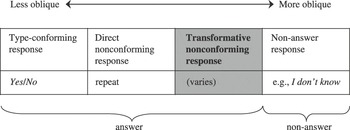
Besides the use of turn-initial items to indicate the respondent’s stance toward a question, research has also shown that repetitional answers – in constrast to yes/no answers – are used to resist the terms of the question. Repetition “confirms” rather than simply “assents to” the proposition raised by the questioner, and by doing so, it asserts the respondent’s epistemic and social entitlement to the matter being addressed (Schegloff Reference Schegloff1996, Raymond Reference Raymond2003, Stivers Reference Stivers2005). With such a claim of possessing more authoritative rights over the information at issue than the questioner had already conceded through the design of the question, the respondent conveys her resistance to the terms of the question (Heritage & Raymond Reference Heritage and Raymond2005, Heritage in press). However, what we can see in this study is that the sort of resistance embodied in a repetitional answer is rather low and appears primarily to focus on contesting reduced agency over the terms. By contrast, we can see that other forms of non-type-conforming answers embody much stronger resistance to the question’s terms and agenda.Footnote 5 As a contribution to an effort to map various forms of resistance to questions (Heritage in press), this study moves into unexplored terrain within the question–response system. More specifically, the forms of response we describe here fall somewhere between more prototypical answers to yes/no questions (e.g., answers with yes/no tokens, repetitional answers) and responses that do not provide “answers” (e.g., I don’t know). A schematic representation is shown in Figure 1.
Forms of response

Our analysis sheds light on the complexities and intricacies of such a seemingly simple act as “answering a question.” While the present study found little difference between Japanese and English speakers in their use of transformative answers, much remains to be investigated regarding whether cross-linguistic variation is observed in a larger sample of languages (see Stivers, Enfield & Levinson in press, for a beginning).