Introduction
Vaccinium L. (Ericaceae) is a large, almost world-wide, genus of 400–500 species. Vaccinium sect. Bracteata Nakai, with about 165 species, is predominantly Malesian and nearly half the species are recorded from New Guinea, an island known to have high endemicity but which is still relatively undercollected. Only 11 species in this section were recorded outside Malesia by Sleumer (1966–67). Only two new species, Vaccinium obatapaquiniorum Takeuchi (Takeuchi, Reference Takeuchi2008) and V. tectiflorum Danet (Danet, Reference Danet2005), have been added to Vaccinium sect. Bracteata in New Guinea since the Flora Malesiana account (Sleumer, 1966–67).
Species Description
Vaccinium utteridgei Argent, sp. nov.
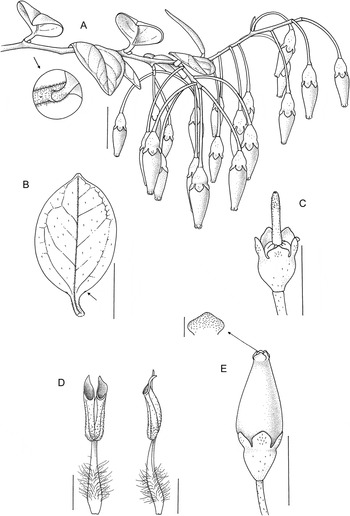
Similar to Vaccinium acrobracteatum K.Schum. but differing in the predominantly ovate not obovate to sub-spathulate leaves, the leaves smaller than in V. acrobracteatum, up to 25 × 16 mm vs. up to 90 × 55 mm. The racemes of this new species are glabrous except for sparse brown glandular hairs (without the dense muriculate hairs of Vaccinium acrobracteatum). The corolla is narrower than in Vaccinium acrobracteatum (up to 3 mm wide vs. 4–5 mm) and totally lacks the muriculate glands outside which are a conspicuous feature of V. acrobracteatum. Superficially close to the widespread (western) Vaccinium lucidum (Blume) Miq. which has a similar delicate habit, but this species is not recorded from New Guinea and differs significantly in the predominantly obovate leaves, hairs on the inside of the corolla and lack of the tooth-like, papillose back walls of the anther tubules of this new species. – Type: Cultivated at the Royal Botanic Garden Edinburgh under accession number 20002023, 11 vi 2012, G. Argent 00585A (holo BO; iso A, E, K, LAE). Original collecting locality: Indonesia, Province of Papua (West New Guinea), Freeport project area south of Puncak Jaya, ridge by army camp, mile 64, c.4°12′S 137°05′E. Fig. 1.
Vaccinium utteridgei Argent. A, habit with inset to show the indumentum on the stem; B, leaf with arrow to show the position of the basal glands; C, flower with corolla and stamens removed; D, stamens front and side view; E, flower with close-up of a corolla lobe. Scale bars = 1 cm except close-up in E = 1 mm.

Terrestrial sprawling shrub to c.80 cm. Twigs rounded, smooth, tomentose with a moderate covering of grey-white hairs. Leaves laxly spirally arranged, but distichous in disposition, ovate, elliptic or more rarely sub-orbicular, blade 17–25 × 9–16 mm; apex obtuse to rounded; base rounded or very broadly cuneate; margin entire, flat or very slightly recurved, narrowly sub-cartilaginous with one or a pair of marginal glands c.1.5 mm from the base of the petiole but often completely lacking. Mid-vein impressed above throughout its length, flat or very slightly raised below, lateral veins obscure or with a nearly basal pair curved and ascending to just above the middle of the leaf, reticulation obscure when fresh, fine but distinct when dry, sparsely glandular hairy above and below at first and with some tomentose hairs at the base of the mid-vein adaxially. Petiole 3–4 × c.1 mm, grooved above, tomentose. Racemes from the upper leaf axils, 5–8-flowered. Flowers hanging, rachis 20–25 mm, slender, c.1 mm in diameter, glabrous, pedicels 15–18 mm, slender, with sparse brown glandular hairs especially distally. Bracts elliptic, concave, 4–6 × 1–1.5 mm, completely glabrous, caducous well before anthesis. Calyx tube pyriform, c.3.5 × 2.5 mm, green, with sparse brown glandular hairs, the lobes 1.5–2 × c.1.5 mm, with some brown glandular hairs abaxially and with a minute, irregular fringe of white hairs on the margins, without a prominent terminal or lateral glands. Corolla maroon-pink, glabrous both outside and inside, narrowly urceolate, 8–9 × c.3 mm at the base, tapering to c.1.5 mm distally; the lobes erect, white, c.0.7 × 0.8 mm, broadly ovate, minutely papillose both inside and out. Filaments 2.5 mm, with long spreading white hairs from near the base to about half-way, glabrous and becoming very slender distally, anther cells oblongoid, c.1 mm, very finely echinulate, without spurs or glandular hairs; the tubules very short, c.0.7 mm including the erect, tooth-like, minutely papillose back walls. Disc green, glabrous. Style c.7.5 mm, columnar, without hairs but minutely papillose. Stigma circular, papillose. Fruit shiny, black, sub-spherical, 5–6 mm in diameter.
Distribution. Known only from the type locality.
Ecology. Collected at c.2700 m in sub-alpine ericaceous shrubbery on ridge.
Conservation status. Data Deficient. There was no indication from the details on the collection of its abundance. It is not in an area with a particular threat to the vegetation from the mining operation.
Etymology. Named in honour of Tim Utteridge, one of the collectors of this species, able botanist and great field companion.
Additional collection. Indonesia. Province of Papua (West New Guinea), Freeport project area south of Puncak Jaya, Ridge by army camp, Mile 64, c.4°12′S 137°05′E, 4 xi 2000 (fruit only), G. Argent, R.J. Johns & T. Utteridge 00585 (BO, E, K).
Seed taken from the wild collection, Argent et al. 00585, was grown at Edinburgh and the type was gathered from the cultivated collection when it flowered.
Acknowledgements
I am very grateful to the Royal Botanic Gardens, Kew for allowing me to participate in the Kew/Lippe expedition on which this species was collected and in particular to Professor R. J. Johns, organiser of the expedition. The species was ably illustrated by Gülnur Ekşi.