Introduction
According to Goleman (Reference Goleman1998), emotional intelligence refers to one’s ability to recognize and regulate their own emotions and those of others. In the view of Bar-On and Parker (Reference Bar-On and Parker2000), emotional intelligence is a noncognitive intelligence defined by an interconnected range of emotions, personality, individual and social skills, which influence individuals’ ability to manage the demands and pressures of the context in which they operate. The increased interest is based on the idea that individual’s emotional intelligence may be mainly responsible for variations on their behaviors and outcomes.
Understanding the relationship between emotional intelligence and work-related outcomes, such as motivation, organizational commitment and creativity, among others, is receiving increasing attention among practitioners and academics (Salovey & Mayer, Reference Salovey and Mayer1990; Goleman, Reference Goleman1995; Sosik & Megerian, Reference Sosik and Megerian1999; Wong & Law, Reference Wong and Law2002; Elsbach & Hargadon, Reference Elsbach and Hargadon2006; Christie, Jordan, Troth, & Lawrence, Reference Christie, Jordan, Troth and Lawrence2007; Zacker, Reference Zacker2013).
Emotional intelligence has been found to be positively correlated with superior performance in a number of work-related areas (Wong & Law, Reference Wong and Law2002; Emmerling & Goleman, Reference Emmerling and Goleman2005; Lyons & Schneider, Reference Lyons and Schneider2005 & Goleman, Reference Goleman1998), including sales performance (Wong et al., 2004), transformational leadership (Corona, 2010), task performance (Côté & Miners, Reference Côté and Miners2006), supervisor ratings of job performance (Slaski & Cartwright, Reference Slaski and Cartwright2002; Law, Wong, & Song, Reference Law, Wong and Song2004) and general leadership performance (Dulewicz, Young, & Dulewicz, Reference Dulewicz, Young and Dulewicz2005).
Management scholars have examined emotional expression as one component of the overall work experience and have found that emotions are significantly related to job satisfaction, job behavior and job resourcefulness (Staw, Sutton, & Pelled, Reference Staw, Sutton and Pelled1994; Dulewicz, Young, & Dulewicz, Reference Dulewicz, Young and Dulewicz2005). It is essential, therefore, to understand how higher emotional intelligence enables people to manage their emotions and help them deal with other people, like coworkers. Higher emotional intelligence represents a significant advantage because it enables better performance in the decision-making process, namely by allowing for a better understanding of how counterparts feel and behave. Emotional intelligence has benefitted from literature on leadership and group dynamics (Taylor et al., 2008), and research in the field of psychology is increasingly stressing the importance of emotional intelligence and its effects on life success (Bar-On, Reference Bar-On1997). Supporting this idea, research is showing that people with high levels of emotional intelligence are more efficient and exhibit higher group performance (Rice, Reference Rice1999). However, according to Furnham (Reference Furnham2016) there are a lack of investigation on the relationship between emotional intelligence and creativity, and in particular, the mediating effects are rather ignored and need further investigation (Carmeli, McKay, & Kaufman, Reference Carmeli, McKay and Kaufman2013).
This study is quantitative in nature, based on a structured questionnaire administered to a sample of Portuguese workers from different companies and industries. The main objective of this research is to identify the impact of emotional intelligence on creativity and, to fill this gap, we investigate this impact mediated by variables like job resourcefulness, self-motivation and organizational commitment. The role of individual success will be considered in the moderation of these relationships. This investigation is innovative in the sense that some of these relationships have been under or not explored and the insights that can be drawn from our conclusions may help workers and managers improve the effectiveness of their policies and of their work. Although the relationship between emotional intelligence and creativity has been discussed and investigated by several researchers, this investigation considers the mediating effects of behavioral variables that may amplify and establish its chain of effects. We believe that research in this area must consider the importance of emotional intelligence, both in the workplace and in daily life, owing to the intrinsic effects it may have.
Research background and hypothesis development
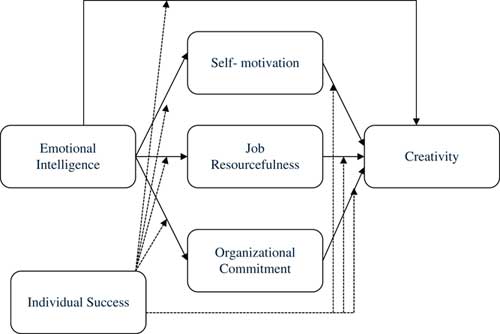
The conceptual model tested in this study is presented in Figure 1 and investigates the influence of emotional intelligence on creativity while considering the mediating role of self-motivation, job resourcefulness and organizational commitment. The moderating effect of individual success is also tested.
The conceptual model tested in this investigation Source: Author’s own (2015).

The role of emotional intelligence
Emotional intelligence refers to one’s ability to manage and monitor their own emotions; recognize different types of emotions in others; distinguish the difference between their emotions and those of others; direct information for decision-making (Salovey & Mayer, Reference Salovey and Mayer1990). ‘Emotional intelligence is an umbrella term that includes a collection of personality traits, affect, and self-perceived abilities, rather than actual aptitude’ (Joseph, Jin, Newman, & O’Boyle, 2015).
Goleman (Reference Goleman1998) states that the ‘Emotional intelligence of workers may be qualified in two areas: personal skills (how employees manage emotions) and social skills (how employees manage the emotions in relations with others). Personal skills include self-awareness, self-regulation and motivation. On the other hand, social skills involve empathy (awareness of the feelings, needs and concerns of others) and social skills (cause favorable responses in others).’
Kilduff, Chiaburu, and Menges (Reference Kilduff, Chiaburu and Menges2010) argue, ‘Individuals high in emotional intelligence are likely to draw upon their emotional skills to get ahead at work.’ In other words, emotional intelligence is the natural ability to feel, use, communicate, recognize, remember, describe, identify, learn from, manage, understand and explain emotions (Hein & Lehman, Reference Hein and Lehman2007). Succinctly, it refers to a person’s capacity to deal with emotions (Salovey & Mayer, Reference Salovey and Mayer1990; Mayer, Caruso, & Salovey, Reference Mayer, Caruso and Salovey2000; Law, Wong, & Song, Reference Law, Wong and Song2004; Wong, Wong, & Law, Reference Wong, Wong and Law2007). Some studies have emphasized the importance of self-motivation for beneficially reinforcing social interactions among educational institution employees (Anari, Reference Anari2011); in general, the influence of emotional intelligence has gotten more recognition in organizational environments.
According to Goleman (Reference Goleman1995), motivation forms a subcomponent of emotional intelligence. However, other researchers reject this notion arguing, ‘they are related, but separate’ (Salovey & Mayer, Reference Salovey and Mayer1990; Jordan, Ashkanasy & Hartel, 2003). Some researchers (Isen, Daubman, & Nowicki, Reference Isen, Daubman and Nowicki1987; Kaufman & Vosburg, Reference Kaufman and Vosburg1997; George & Zhou, 2002) have paid special attention to emotion as a factor that can influence creativity; however, the relationship between negative/positive emotions and creativity remains an on-going debate (Fong, Reference Fong2006).
People high in emotional intelligence tends to perform well and have a high capacity for personal development. People with emotional intelligence know how to manage their emotions and regulate those of others, which can help them create a better environment to perform both team and individual work. As such, emotional intelligence has been given emphasis in all contexts, from personal and organizational to individual and collective (Wong et al., Reference Wong, Wong and Law2007).
In relation to individual success, determining which factors help workers succeed has long been an issue of interest for researchers and professionals alike (Koustab, Reference Koustab2013). Factors that are typically considered important for achieving success include social skills, interpersonal facility, well-connected time, positive self-esteem (Berglas, Reference Berglas1986), energy and desire to perform an excellent job, setting priorities and working accordingly (Stuart-Kotze & Roskin, Reference Stuart-Kotze and Roskin1983) and having the ability to handle people.
Emotional intelligence has been found to explain, stimuli and predict several different work and life outcomes (Mayer & Salovey, 1995). Some factors related with emotional intelligence have been investigated, such as motivation, performance, trust, teamwork, organizational commitment, leadership, stress management, education, job performance, job satisfaction, political skill, job resourcefulness, sport, creativity, job satisfaction and life satisfaction (Feldman, Reference Feldman1996; Sosik & Megerian, Reference Sosik and Megerian1999; Licata, Mowen, Harris, & Brown, Reference Licata, Mowen, Harris and Brown2003; Lawrence, 2007; Hong, Catano, & Liao, Reference Hong, Catano and Liao2010; Meisler, Reference Meisler2013; Laborde et al., Reference Laborde, Lautenbach, Allen, Herbert and Achtzehn2014; Perera, Reference Perera2015).
The impact of emotional intelligence on self-motivation
Chiavenato (Reference Chiavenato2005) argues that ‘motivation is the internal pressure arising from the need, also internal, for the body to take action after reaching an energy state produced by exciting (via electrochemical) nerve structures and which instigates, guides and continues the activity behavior until some goal (goal, incentive) is achieved or the response is blocked.’ According to Weisinger (Reference Weisinger1998), self-motivation consists on the ability to get a job and continue it, that is, to progress and overcome all obstacles. In short, motivation is what compels a person to expend energy with purpose and a specific objective. A self-motivated worker, according to the self-determinant theory (Gunter, Reference Gunter2015) has a high intrinsic motivation, which means he is experiencing a sense of joy and enthusiasm performing the tasks they are engaged in.
Motivation has been defined with the inherent condition of taking action. Motivations, also seen as, something that encourages a person to achieve goals or that influence their learning strategies and cognitive process (Ormrod, Reference Ormrod1995). Many theories have been developed and much research has been conducted to help administrators recognize what motivates a person to behave in different ways (Fisher & Cole, Reference Fisher and Cole1993; Milkovich & dt Boudreau, Reference Milkovich and dt Boudreau1997). Understanding self-motivation is a key element for managers. One analysis reveals that if workers are motivated they exhibit much higher performance on tasks (Klein, Wesson, Hollenbeck, & Alge, Reference Klein, Wesson, Hollenbeck and Alge1999). According to Aronson, Wilson, and Akert (Reference Aronson, Wilson and Akert2002), ‘[i]ntrinsic motivation contrasts with extrinsic motivation (external factors) that can be measured in monetary terms, such as salary and bonuses, among others. Moreover, the intrinsic motivation refers to internal factors, such as options to choose from, perception of power and individual success’ (p. 56).
Humans are, by nature, active, curious and funny beings at their healthiest state, which generally leads them to enjoy learning and exploring. In this state, humans do not need external motivation to accomplish any challenges (LaGuardia, Ryan, Couchman, & Deci, Reference LaGuardia, Ryan, Couchman and Deci2000). LaGuardia et al. go on to affirm that ‘[t]his motivational natural trend is a [key] element in the cognitive, social and physical, as it is through action on their inherent interests that humans grow and acquire knowledge and skills’ (LaGuardia et al., Reference LaGuardia, Ryan, Couchman and Deci2000: 254). The trickiest part stems from understanding an individual’s personal vision and how it applies to the self-motivational plan (Harness, Reference Harness2013). A personal view is one of the main sources of charisma, which inspires and motivates employees to achieve higher levels of commitment and individual success (Bryman, Reference Bryman1992).
Some studies show that emotional intelligence plays an important role in the organization, direction and motivation of human activity (Chopra & Kanji, Reference Chopra and Kanji2010). An emotionally intelligent workforce is passionate, motivated and inspired (Emmerling & Boyatzis, Reference Emmerling and Boyatzis2012). According to Da Costa, Páez, Oriol, and Unzueta (Reference Da Costa, Páez, Oriol and Unzueta2014), ‘[p]eople who work in this organization are motivated by: expressing their emotions; talking to their colleagues about their emotions; and are sensitive to the feelings and emotions of their colleagues by putting themselves in their situation responding in a suitable way to their colleagues’ emotional reactions’ (p. 327). When people learn to stay focused in a clear way, it becomes easier to tease out which goals to aim for, and a clear intent combined with passion provides the extra energy required for a person to feel self-motivated.
Hong, Catano, & Liao (Reference Hong, Catano and Liao2010) studied the impact that emotional intelligence could have on self-motivation. They found that emotional intelligence has a positive impact on motivation, concluding that people with elevated emotional intelligence can feel and be more self-motivated than others. Therefore, emotionally intelligent employees are efficient enough to differentiate emotions, control them and use them to improve their performance and that of others, compared with employees who have lower emotional intelligence capabilities. Similarly, employees who have higher emotional intelligence are able to view their responsibilities constructively to increase their self-motivation.
Based on the above literature, the first hypothesis for this study is developed as follows:
Hypothesis 1: Emotional intelligence has a positive impact on self-motivation
Thus, this impact is valid for each of the three dimensions of self-motivation:
Hypothesis 1a: There is a positive impact of emotional intelligence on the need for achievement.
Hypothesis 1b: There is a positive impact of emotional intelligence on the need for affiliation.
Hypothesis 1c: There is a positive impact of emotional intelligence on the need for power.
The impact of emotional intelligence on job resourcefulness
According to Joelle and Coelho (Reference Joelle and Coelho2017), job resourcefulness may be seen as a trait of personality as well as an attitude that leads workers to overcome their limitations and overperform. Job resourcefulness is ‘the enduring disposition to garner scarce resources in the pursuit of job-related goals’ (Michel & Ashill, Reference Michel and Ashill2009) and at the same time it may be the ability to overcome obstacles and to achieve goals at work (Licata et al., Reference Licata, Mowen, Harris and Brown2003), which involves an internal motivation that influences behavior. Job resourcefulness is a concept closed to perseverance to overcome obstacles in the workplace, obtaining the creative performance (Sweetman, Luthans, Avey, & Luthans, Reference Sweetman, Luthans, Avey and Luthans2011). It is a skill that should be universally acknowledged within the context of achieving both personal and organizational success (Karen, Cummings, & Dyne, Reference Karen, Cummings and Dyne2002; Bozionelos, 2011; Supangco, Reference Supangco2010; Ghosh, Reference Ghosh2013). Therefore, we can say that those who exhibit high job resourcefulness have an inherent drive to accomplish job-related goals (even under resource-depleted conditions). Because those with high job resourcefulness can work more effectively when organizational resources are scarce, they will be able to use their energy to find innovative ways of addressing customer dissatisfaction (Licata et al., Reference Licata, Mowen, Harris and Brown2003).
The impact of emotional intelligence on job resourcefulness lacks empirical testing. However, literature shows job resourcefulness allows people to have a different view of how to deal with successes and failures. A person who excels at work achieves their goals more easily than those who do not try or are not interested in doing so because they have low emotional intelligence. According to Sanders III et al. (Reference Sanders, Hopkins and Geroy2003), workers with more spirituality are expected to be stronger and persevering. Licata et al. (Reference Licata, Mowen, Harris and Brown2003) showed that introversion, consciousness, openness, emotional instability and agreeableness might predict job resourcefulness.
Consequently, the following hypothesis has been deduced:
Hypothesis 2: There is a positive impact of emotional intelligence on job resourcefulness.
The impact of emotional intelligence on organizational commitment
Organizational commitment has been studied extensively over the past three decades (Kontoghiorphes & Bryant, Reference Kontoghiorphes and Bryant2004). From the literature, it can be understood that the most common definition is one in which organizational commitment presupposes an emotional attachment that makes employees feel they have a commitment to the organization they work for. According to Zeinabadi and Salehi (2011), ‘Organizational commitment is the willingness to exert extra effort for the benefit of the organization and a strong desire to maintain membership in the organization’ (p. 29). Organizational commitment may be defined as ‘a psychological state that characterizes the relationship between an employee and the organization and reduces the likelihood that he/she will leave it’ (Rego & Cunha, Reference Rego and Cunha2008: 59).
Allen and Meyer (Reference Allen and Meyer1990) suggested three major dimensions to conceptualize organizational commitment: affective commitment, continuance commitment and normative commitment. However, affective commitment is the most adopted dimension when it comes to mediate a relationship with individual or work-related outcomes (Chiu & Francesco, 2003).
Organizational commitment refers to a set of feelings that people experience and can be translated into time-dependent states of feeling (mood) and affective experiences of short duration (emotion) and traces of feelings (affective dispositions) that are stable trends of feeling and acting in a certain manner (Barsade & Gibson, Reference Barsade and Gibson2007; Baron, 2008; Davis, 2009). It denotes a desire and willingness to stay with the organization (Kleine & Weißenberger, Reference Kleine and Weißenberger2014). The different types of emotions workers experience are directly related to performance and can lead to a positive impact on the organization (Isen, 2002; Amabile, Barsade, Mueller, & Staw, Reference Amabile, Barsade, Mueller and Staw2005; Baron, 2008).
The contribution of emotional intelligence toward organizational commitment has been extensively documented in the literature (Masrek, Osman, Ibrahim, & Mansor, Reference Masrek, Osman, Ibrahim and Mansor2015). Given the importance of organizational commitment, researchers have examined various determinants or predictors of organizational commitment, one of them being emotional intelligence. Taboli (Reference Taboli2013) notes that employees who cannot evaluate and control their emotions and feelings also have less organizational commitment. Emotional intelligence is linked to greater job satisfaction, an increased ability to handle stress, a better orientation toward change and stronger organizational commitment (Carmeli, Reference Carmeli2003; Vakola, Tsaousis & Nikolaou, Reference Vakola, Tsaousis and Nikolaou2004). In other studies testing the influence of emotional intelligence on organizational commitment (Shamir, House & Arthur, Reference Shamir, House and Arthur1993; Petrides & Furnham, Reference Petrides and Furnham2001; Cell, 2008), all concluded that the results support this relationship.
The following hypothesis was then proposed:
Hypothesis 3: There is a positive impact of emotional intelligence on organizational commitment.
The impact of emotional intelligence on creativity
According to Amabile (2006), ‘creativity’ refers to the production of ideas, products and procedures. Oldham and Cummings (Reference Oldham and Cummings1996) further assert that it involves associating creative ideas with practical implications. Creativity has also been defined as ‘the production, conceptualization, or development of novel and useful ideas, processes, or procedures’ (Shalley et al., 2000: 215; Elsbach, 2006).
The concept of creativity today has been converted into a valuable resource (O’Neill, 2011) that takes on different characteristics in accordance with the context and environment in which it appears. Authors studying the relationship between emotional intelligence, leadership and creativity argued that leaders feel emotional intelligence as their main source of leadership to awaken employees’ creativity (George, Reference George2000; Zhou & George, 2003: 15; Antonakis, Ashkanasy, & Dasborough, Reference Antonakis, Ashkanasy and Dasborough2009). ‘A key determinant of creativity is personal style and individual preferences in processing information about [one’s] environment’ (Kozhevnikov, Reference Kozhevnikov2007: 464–481). Creative people are an asset to any organization, since creativity positively affects organizational performance.
Creativity is a skill with great relevance and importance both at the individual and at the organizational level, as it assumes something practical; that is, a person has creative ideas. Boren (Reference Boren2010) suggests ‘Emotional intelligence promotes the integration rather than the separation of reasoning and logic to emotions and feelings.’ Emotions direct cognition explores and examines the individual’s ability to calibrate and adjust their thoughts. It enables emotional information to improve cognitive ability. More creative persons also incline to be more intrinsically stimulated or self-motivated (Chang & Teng, Reference Chang and Teng2017).
A study on the impact of emotional intelligence on creativity revealed some of the outcomes that emotional strategies can have on stress at work, job satisfaction and service performance (Diefendorff, Croyle, & Gosserand, Reference Diefendorff, Croyle and Gosserand2005; Beal, Trougakos, Weiss, & Green, Reference Beal, Trougakos, Weiss and Green2006; Johnson & Spector, Reference Johnson and Spector2007; Groth, Hennig-Thrurau, & Walsh, 2009). The results show that emotional intelligence positively affects employee creativity (Ashforth & Humphrey, 1993; Grandey, 2003; Little, 2007). According to Parke, Seo, and Sherf (Reference Parke, Seo and Sherf2015), ‘emotional intelligence can predict different markers of creativity.’ ‘Individuals with the aptitude to practice equally positive and negative emotions do account being extra creative. It has also been found that creativity is generated by emotions’ (Boren, Reference Boren2010: 55–61).
The following hypothesis was then proposed:
Hypothesis 4: There is a positive impact of emotional intelligence on Creativity.
The impact of self-motivation on creativity
According to Amabile (1983), ‘[m]otivation is also related to the creative process, being a factor of the same measurement process. Motivation is the attitude in relation to a task, and the perception of one’s own motivations.’ Gioia and Poole (1984) argue that autonomous individuals are more likely to act creatively, because they can select routines that are relevant to solving problems and because they can make sense of situations in new ways and find new ways of acting. Amabile (2001) noted that creativity experience and creativity skills must be complemented by motivation to produce a highly creative behavior. In fact, many studies show that creative behavior is induced by employee motivation. Without self-motivation, we can say that a person loses their confidence and directly decreases their creativity potential (Chen & Chen, 2012). This can be a formula for provoking creativity and thus the creation of knowledge.
To be creative, an employee needs to be interested in the outcome and in finding ways to solve problems to achieve those outcomes. Therefore, motivation serves to direct the attention that employees devote to the heuristic issues of creative tasks (Woodman, Sawyer, & Griffin, Reference Woodman, Sawyer and Griffin1993).
Still other studies have been developed to show the effect of motivation on a person’s creativity. Motivation has been found to be conducive to creativity, while extrinsic motivation is in most cases harmful (Amabile, 1983). Intrinsically motivated employees tend to take greater risks (Amabile, Goldgard, & Brackfield, 2010).
Other studies related to motivation and (indirectly) to creativity concern the attention of control, constraints and goal establishment tasks. In the case of setting targets, it is assumed that more self-regulation results in more self-motivation and creativity (Simon, 1967; Kanfer & Ackerman, 1989; Amabile, 1983). Individuals who are extrinsically motivated find creative work more stressful than individuals who are intrinsically motivated find creativity as challenge and enjoyment (Ceci & Kumar, Reference Ceci and Kumar2016). Self-motivation directly stimulates creativity (Oldham & Cummings, Reference Oldham and Cummings1996; Shalley & Gilson, Reference Shalley and Gilson2004; Shalley et al., 2004; Griffin, Neal, & Parker, Reference Griffin, Neal and Parker2007). Consequently, when employees are intrinsically motivated they will be more excited and thus increase their creativity (Shalley, Zhou, & Oldham, 2004).
The following hypotheses were then proposed:
Hypothesis 5: There is a positive impact of self-motivation on creativity.
Hypothesis 5a: There is a positive impact of need for achievement on creativity.
Hypothesis 5b: There is a positive impact of need for affiliation on creativity.
Hypothesis 5c: There is a positive impact of need for power on creativity.
The impact of job resourcefulness on creativity
Creativity involves working to gather information from several sources, recognizing unusual connections and generating ideas with practical implications (Oldham & Cummings, Reference Oldham and Cummings1996); creative results are new and thus cannot be defined in advance. Therefore, creativity typically has more to do with qualitative rather than quantitative aspects of performance.
Dorenbosch, Engen, and Verhagen (Reference Dorenbosch, Engen and Verhagen2005) revealed that professionals whose work involves more skills and knowledge bases are more likely to have behavior-oriented creativity. These workers are more likely to generate ideas for improving services and new solutions to more problems than those with more routine work that does not require much effort or job resourcefulness. Zhou and Georges (2003) report that environmental or contextual factors may convolute some results, particularly those resulting from work contexts involving chronic, labor-intensive pressures, which have been shown to be particularly harmful for creativity (Amabile et al., Reference Amabile, Barsade, Mueller and Staw2005). Amabile et al. (2002) found that heavy workload, high pressure and frequent work interruptions cause employees to be less creative than they would be otherwise. Amabile and Conti (Reference Amiable and Conti1999) found that a number of environmental factors, including workload pressures, significantly increase downsizing, which in turn negatively affects creativity. In turn, job resourceful employees, according to its definition, are more prepared to face and overcome difficulties (Joelle & Coelho, Reference Joelle and Coelho2017) and therefore maintain their creative skills and behavior.
According to Licata et al. (Reference Licata, Mowen, Harris and Brown2003), employees with high job resourcefulness may find creative ways of addressing their problems. The inherent drive of resourceful employees has been established: Job resourcefulness leads employees to accomplish tasks efficiently (Licata et al., Reference Licata, Mowen, Harris and Brown2003), motivates higher levels of work performance (Harris, Graham, & Mason, 2006) and enables employees to use energy to find innovative ways of accomplishing goals (Michel & Ashill, Reference Michel and Ashill2009).
Consequently, the following hypothesis was proposed:
Hypothesis 6: There is a positive impact of job resourcefulness on creativity.
The impact of organizational commitment on creativity
Many studies highlight the importance of organizational behavior, which has been given increasing importance in the organizational context. Some studies also show that people adapt, perform better and have positive behaviors and attitudes regarding work when a good relationship exists among staff (O’Reilly & Chatman, Reference O’Reilly and Chatman1986; Cable & Judge, Reference Cable and Judge1996; Kristof-Brown, Zimmerman, & Johnson, Reference Kristof-Brown, Zimmerman and Johnson2005; Chen et al., 2008; Kim, 2012). Westerman and Vanka (2005) argue that many employees’ attitudes and behaviors are not determined only by workers or the workplace, rather they are also determined by the relationship between these two factors. Some studies have identified facilitators and barriers (Shalley, Zhou, & Oldham, 2004) of creative behaviors, but little emphasis has been given to organizational commitment, which can create a degree of myopia, thereby preventing change in organizations (Argyris, Reference Argyris1957; Kristof, Reference Kristof1996). On the other hand, some authors suggest that the match between people and environment has components that positively influence creative behavior (Cohen, Reference Cohen2012; Tierney, Farmer & Graen, Reference Tierney, Farmer and Graen1999). Van Maanen and Schein (Reference Van Maanen and Schein1979: 228) argue that creative individualists are the type of people who score high in organizational commitment (Chatman, 1991). According to Choi, Tran and Park (2015), creativity has a positive influence on work and organizational commitment because of the notion that creative workers are better able to tolerate anxiety and think laterally. This helps them to be more focused at work and in relation to the organization they belong to. When workers demonstrate creativity, they receive praise and respect from their supervisors, colleagues and even customers (Amabile et al., Reference Amabile, Barsade, Mueller and Staw2005), giving them further reason to have a positive attitude regarding their work, in turn making them more motivated and involved with the organization (Avery, McKay, & Wilson, Reference Avery, McKay and Wilson2007).
Nevertheless, some studies have suggested a negative relationship between organizational commitment and creativity because employees who feel connected to the organization tend to form homogeneous groups and cultures (Farabee, Reference Farabee2011). Shneider’s (1987) the attraction-selection-attrition framework theory helps clarify this negative denial. The model assumes that people are attracted to and selected by organizations that are similar to them. In addition, individuals who do not believe they fit well within an organization tend to leave.
Several different studies have shown that organizational commitment is positively related to employee creativity (Cekmecelioglu, Reference Cekmecelioglu2006; Hou et al., Reference Hou, Gao, Wang, Li and Yu2011). Therefore, highly committed employees who have a strong belief in and acceptance of organizational goals (Meyer & Allen, 1991) often exhibit the best creative performance.
Consequently, the following hypothesis can be deduced:
Hypothesis 7: There is a positive impact of organizational commitment on creativity.
The role of individual success
Individual or career success may be seen as the combination of intrinsic success that corresponds to aspects like job satisfaction and extrinsic success measured in terms of income and social status (Judge, Higgins, Thoresen, & Barrick, Reference Judge, Higgins, Thoresen and Barrick1999). According to these authors, personality traits are one of the important predictors of success. According to Qualter, Gardner, Pope, and Hutchinson (Reference Qualter, Gardner, Pope and Hutchinson2012), emotional skills may predict individual success, namely, academic achievements. At the same time, people with higher success seems to have a greater social capital (Seibert, Kraimer, & Liden, Reference Seibert, Kraimer and Liden2001), expressed in terms of access to information, of relations network, family resources, developmental contacts and influence, among others. This success, far beyond the intrinsic aspects linked to a psychological satisfaction, provides status and job mobility. These issues are capable of reinforcing confidence and therefore increase interpersonal intelligence and make it more effective in one’s daily life and interactions (Libbrecht, Livens, Carette, & Côté, Reference Libbrecht, Livens, Carette and Côté2014), which become more important when one advances in the career. Consequently, this increased confidence and interpersonal intelligence should boost the impacts the emotional intelligence have on its consequents. Therefore, individual success is tested as a moderator of the proposed relationships.
Methods
Sample and data collection
To test the proposed investigation model and research hypothesis, data were gathered using a structured questionnaire. The questionnaires were electronically delivered to individual workers using a snowball sampling technique. We identified 25 workers and asked them to answer the questionnaire and to identify and contact three other respondents, among their acquaintances, to send them the questionnaires. Consequently, once we had a new contact, who had previously agreed to respond, we repeated the procedure, on the basis of one-to-one approach, until obtaining the final sample. The electronic questionnaire forced the full answer. In total, 600 individuals were contacted, and 519 responses were returned.
This approach was chosen because creative behaviors may be seen as an expression of one’s mental processes that are related to emotional intelligence and may be critical in internal relationships, positive affects (Geher, Betancourt, & Jewell, 2017), teamwork and, therefore, to other work-related outcomes. Several different studies linking emotional intelligence and creativity are based on samples of indiscriminate adults (Furnham, Reference Furnham2016; Geher et al., Reference Geher, Betancourt and Jewell2017), so this sample constituted of indiscriminate workers from several different industries that seems particularly adequate and may give interesting clues to human resource managers.
The sample was 61.5% females and 38.5% males; 70.60% of respondents were under 35 years old, 29.10% were between 36 and 65 years, and 0.4% were above 65 years. Regarding education levels, 75.8% did not have college degrees and 24.3% were college graduates.
Measures
Emotional intelligence
Following Bradberry and Greaves (Reference Bradberry and Greaves2003), a standard questionnaire for emotional intelligence based on Goleman’s four competencies of emotional intelligence was used, consisting of 28 statements, such as ‘I trust in myskills’ and ‘I accept my fault and failures’, divided into four dimensions of emotional intelligence (self-awareness, self-management, social awareness and relationship management).
Self-motivation
In the case of this variable, we used a scale developed by Heckert et al. (Reference Heckert, Cuneio, Hannah, Adams, Droste, Mueller, Wallis, Griffin and Roberts1999) divided into three dimensions, namely ‘Need for achievement, Need for affiliation and Need for power.’ Items like ‘I try to do my best in my work’ and ‘It is important for me to do my best at work’ are used.
Job resourcefulness
This scale was created by Licata et al. (Reference Licata, Mowen, Harris and Brown2003) consisting of four items: ‘I am very intelligent and enterprising in the execution of my work’; ‘I am a very creative person in finding ways to do my job’; ‘I am proud to be able to make things happen even when difficulties arise’ and ‘I am imaginative when it comes to overcoming barriers in my work.’
Creativity
To measure creativity, we used a scale developed by Zhou and George (Reference Zhou and George2001) that included items like ‘I suggest new ways to reach goals’ and ‘I suggest new ways to improve quality.’
Self-reported data were used. Likewise, Shalley, Gilson, and Blum (Reference Shalley, Gilson and Blum2009) used self-reported data to assess creativity. According to Gilson, Mathieu, Shalley, and Ruddy (Reference Gilson, Mathieu, Shalley and Ruddy2005), the supervisor ratings may not be accurate at evaluating the creativity of the employees, namely the contact ones, since they do not observe most of the interactions.
Organizational commitment
This scale related to affective commitment, developed by Meyer, Allen and Smith (1993), consisting of six items: ‘I would love to spend the rest of my career in this organization’; ‘I feel that the problems of this organizational so belong to me’; ‘I do not feel like part of the family’ in this organization’; ‘I do not feel emotionally attached to this organization’; ‘My organization has great personal meaning for me’ and ‘I do not feel a strong sense of belonging to this organization.’
Individual success
Individual success focuses on employee behaviors or actions. In addition, the behaviors must be under individual control, thus excluding behaviors that are constrained by the environment (Rotundo & Sackett, Reference Rotundo and Sackett2002). For this variable, we used a scale developed by Turban and Dougherty (Reference Turban and Dougherty1994) related to career success, composed of three items: ‘How successful has your career been?’; ‘Compared to your co-workers, how do you evaluate the success of your career?’; ‘How successful has your career been, in your colleagues’ opinion?’
All items are measured on a 7-point Likert scale (1=strongly disagree to 7=strongly agree). Confirmatory factor analysis was used to assess the psychometric properties of the scales and the measurement model fit, using AMOS 19. The final model shows a good fit (incremental fit index (IFI)=0.963; tucker-lewis index (TLI)=0.955; confirmatory fit index (CFI)=0.963; root mean square error of approximation (RMSEA)=0.05; minimun discrepancy/degree freedom (CMIN/DF)=2.426; goodness of fit index (GFI)=0.907). From the original composite reliability scale, only the dimensions customer orientation, and quality of products and services, remained in the model.
Composite reliability and the average variance extracted were computed. All the scales showed values >0.824 on critical ratio and >0.61 on average variance extracted, which are in line with the recommendations (Hair, Black, Babin, & Anderson, 2009). Discriminant validity is based on the fact that all correlations between the constructs are significantly smaller than 1 and the squared correlations, for each pair of constructs, is always smaller than the variance extracted for the corresponding constructs (Fornell and Larcker, Reference Fornell and Larcker1981; Shiu et al., 2011), therefore supporting the discriminant validity.
When self-administered questionnaires are used, a common variance bias problem can emerge or increase (Podsakoff & MacKenzie, Reference Podsakoff and MacKenzie2003). According to Podsakoff and MacKenzie (Reference Podsakoff and MacKenzie2003), the common method variance tests will help in identifying the existence of variables that can cause measurement errors and systematic biases in the estimation of the relationships between constructs. The emergence of this problem may arise when: the information about the independent and dependent variables comes from the same respondent; the same scale format is used throughout the questionnaire; different constructs are measured at the same time and using the same instrument.
On the basis of suggestions by Podsakoff and Organ (Reference Podsakoff and Organ1986), a Harman’s single-factor test and a common latent factor analysis were performed to capture the common variance among all observed variables in the investigation. The Harman’s test showed that any factor could explain more than 24% of the variance and there were 15 factors with eigenvalues >1, explaining 68% of the total variance. A confirmatory factor analysis was conducted restricting all items of the model to load on a common single factor (Podsakoff & MacKenzie, Reference Podsakoff and MacKenzie2003). The resulting fit indices show the model did not provide a good fit for the data: CMIN/DF=5.7; IFI=0.582; TLI=0.544; CFI=0.577.
Procedure
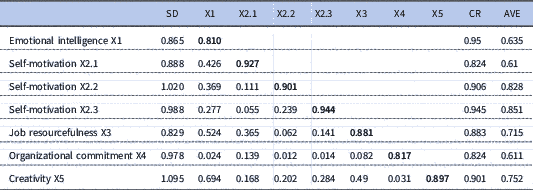
To test the proposed hypothesis, AMOS 21.0 software was used to model with SEM. All the items were measured on a 7-point Likert scale (1=strongly disagree and 7=strongly agree). The model showed a good fit (IFI=0.935; TLI=0.926; CFI=0.934; GFI=0.881; RMSEA=0.055; CMIN/DF=2.594). A multigroup analysis was performed to identify the effect of individual success in the proposed relationships (see Table 1).
Standard deviation, correlation matrix and Cronbach’s α

Notes: Diagonal in bold–Cronbach’s α.
CR=composite reliability; AVE=average variance extracted.
Two groups were created, the low and the high individual success groups, based on a cut point corresponding to the average of the variable. The low success group was composed of 280 respondents and the high success group was composed of 239 individuals.
Results and discussion
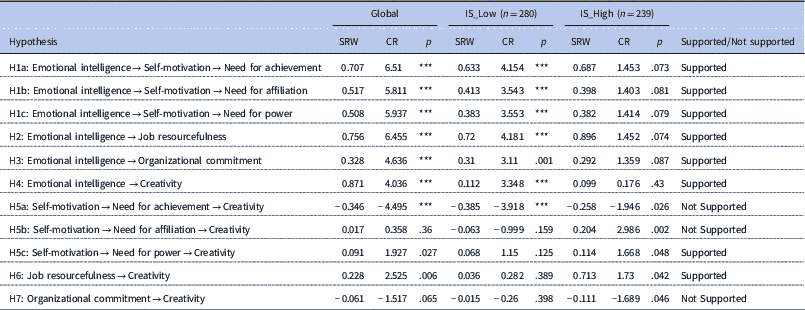
To test the proposed hypothesis, AMOS 21.0 software was used to perform confirmatory factor analysis and structural equation modeling. The structural model showed a good fit (IFI=0.924; TLI=0.916; CFI=0.924; GFI=0.866; RMSEA=0.059; CMIN/DF=2.817). A multigroup analysis was performed to identify the differences between people with higher individual success and people with lower individual success. Two groups were created based on the average values for the variable individual success. The group below the average is the lower individual success group and comprises 280 respondents, whereas the group above the average, the higher individual success group, includes 239 respondents. Results of the multigroup analysis are included in Table 2. χ2-test was performed to test the differences between the two groups and the results showed that the χ2-value was significant (p≤.01): constrained model (χ2=2802; degrees of freedom [df]=998); unconstrained model (χ2=2677.4; df=961); (Δχ2=125; Δdf=3, p≤.01) (see Table 2).
Results of hypothesis

Note: **p<.01; p<.05 (one-tailed tests); p≥.05: not significant.
CR=composite reliability; SRW=standardized regression weights.
Emotional intelligence has a positive impact on the three dimensions of self-motivation, thus supporting Hypotheses 1a, 1b and 1c. Apparently, people with higher emotional intelligence need less external motivation and are more reliant on themselves and on their intrinsic motivation, as sustained by Ryan and Laguardia (Reference LaGuardia, Ryan, Couchman and Deci2000: 254). Higher emotional intelligence leads to a higher need for achievement, a higher need for affiliation and a higher need for power. Our results are in accordance with those of Hong, Catano, and Liao (Reference Hong, Catano and Liao2010), who found that emotional intelligence produces more self-motivated people. This impact is higher among people with low individual success and it is not significant for those with high individual success. Apparently, people with low success need more emotional intelligence and this emotional intelligence has a greater impact on motivation. People with higher individual success are more self-confident, are likely to have high emotional intelligence and are naturally self-motivated. The positive impact was notorious in worker motivation, both in managing individual work and teamwork (Mayer, Caruso, & Salovey, Reference Mayer, Caruso and Salovey2000; Shipley, Jackson, & Segrest, Reference Shipley, Jackson and Secrets2010). A study by Christie et al. (Reference Christie, Jordan, Troth and Lawrence2007) also sought to ‘examine how emotional intelligence is related to motivation’ (p. 212–226). Several hypothesis have been developed in this direction, with Goleman (Reference Goleman1995) asserting that motivation is a component of emotional intelligence.
The relationship between emotional intelligence and job resourcefulness is positive, therefore supporting Hypothesis 2. Feldman (Reference Feldman1996) argues that ‘there is a connection between emotions and intelligence that does not contribute to the communication and performance of employees working in organizations, because the work is affected by one’s personal nature’ (p. 145–161). That being said, we can affirm that for a person to overcome obstacles at work, they must be self-motivated and have the determination and will to do so; in this sense, the job is affected by the worker’s personal nature and emotional intelligence plays an important role. Therefore, the ability to overcome difficulties at work is an intrinsic characteristic. Individual success appears to have a moderating effect in this relationship. Emotional intelligence has a positive impact on job resourcefulness but this impact is higher among people with greater individual success. People experiencing more success tend to feel more confident and more focused on achieving better results, putting all their efforts toward their individual performance, thus increasing their success. It appears to be a virtuous cycle.
There is a significant positive relationship between emotional intelligence and organizational commitment, thus supporting Hypothesis 3. We can say that these findings are in line with those reported by Ashforth and Humphrey (1995) and Carmelli (2003). According to Abraham (Reference Abraham2000), employees who have emotional intelligence are better able to manage their emotions, positive and negative, in both themselves and in others. They are also better able to control emotional states experienced at work and are more likely to be committed to their organization than are employees who have less emotional intelligence. Abraham (Reference Abraham2000) also suggests that employees with higher levels of emotional intelligence tend to maintain and extend their relationships with coworkers and superiors. People with lower individual success are more likely to transpose their emotional intelligence into organizational commitment. Apparently, people with higher individual success are less apt to maintain a commitment to their organizations, perhaps because they feel greater confidence in their ability to find new and different jobs. They are always in search of success.
The results show a positive relationship between emotional intelligence and creativity, therefore supporting Hypothesis 4. Chan (2005) contends that emotional intelligence has a positive relationship with creativity in the sense that people exhibit behaviors and adopt activities that can be seen as more creative or more ‘outside the box.’ According to Chao, Xinmei and Zizhen (Reference Chao, Xinmei and Zizhen2013), creativity may be stimulated by emotional intelligence. The same study showed that people with higher emotional intelligence exhibit greater creativity – if not blocked by other factors. However, this impact is much greater among people with low individual success. Apparently, when they possess higher emotional intelligence, this group is more likely to become creative, while people with higher individual success may tend to consider themselves naturally creative. Furthermore, emotional intelligence encourages and improves creativity and innovation among entrepreneurs (Chin, Raman, Yeow, & Eze, Reference Chin, Raman, Yeow and Eze2012).
The relationship between self-motivation and creativity, corresponding to Hypothesis 5, is only partially supported. The ‘need for achievement’ dimension has a negative relationship with creativity, and the ‘need for affiliation’ dimension is not significant. The ‘need for power’ dimension has a positive relationship with creativity, a result that is in line with existing research, such as that of Amabile (1985). However, the group with higher individual success presents a greater and significant relationship between the ‘need for affiliation,’ ‘need for power’ and ‘need for creativity.’ People more focused on their own success tend to convert their self-motivation into creativity, particularly when affiliation and power are present.
There is a positive relationship between job resourcefulness and creativity, thus supporting Hypothesis 6. According to Amabile and Conti (Reference Amiable and Conti1999), workload pressures tend to relate negatively with creativity (Karen, Cummings, & Dyne, Reference Karen, Cummings and Dyne2002). Consequently, people with a natural predisposition to overcome difficulties at work are better prepared to deal with workload pressures, and they tend to be more creative. This relationship appears to be valid only for the group with higher individual success, perhaps because they are more focused and put their efforts toward being different, avoiding routines (Ford, Reference Ford1996) and on differentiating themselves from others, achieving higher standards.
The relationship between organizational commitment and creativity is not significant, and is negative, therefore Hypothesis 7 is not supported. Although we had expected a positive relationship, past literature provides us examples of negative relationships between these two variables, including studies by Shneider (1987) and Farabee (Reference Farabee2011). Apparently, more committed groups tend to be more homogeneous, namely in terms of profiles and cultures, and that lack of diversity may lead to this negative impact. It seems that stronger links with the organization may block creativity and limit one’s capabilities of thinking ‘outside the box.’
Conclusions, theoretical and managerial implications
The objective of this paper was to study the impact of emotional intelligence on creativity, considering the mediating role of some variables, as well as the moderating effect of individual success on these relationships. To be able to answer to this question, we administered a questionnaire exclusively to workers. The collected data were analyzed using structural equations modelling, which helped us conclude that there is a positive relationship between emotional intelligence and all studied behavioral variables, and that only the link between organizational commitment and creativity seemed to exhibit a negative relationship. Individual success produced a moderating effect on almost every domain, as expected. At the same time, individual success seemed to moderate the proposed relationships and may provide excellent insight on how to deal with different employees to get the best of their creativity. Having competency in emotional intelligence has been proven to be an effective skill, contributing in part to an individual’s overall success in the workplace (Swanson Bowler, & Zobisch, Reference Swanson, Bowler and Zobisch2014).
Theoretical implications
Investigation relating emotional intelligence and creativity are scarce and failed to establish a clear link between both variables. This investigation takes this attempt further. At the same time, this relationship, that may be rather indirect, has been investigated using the mediating effects of motivation, job resourcefulness and organizational commitment. In particular, even if literature suggests that job resourcefulness may be linked with emotional intelligence and creativity, empirical testing was yet to be done. This set of relationships allowed to settle a chain of effects between emotional intelligence and creativity. Finally, the moderating role of success was tested showing how it may impact on these relationships.
Emotional intelligence can greatly contribute to the environment of an organization, especially in a time where teamwork has become increasingly popular with all its impacts. This paper can be considered innovative in the sense that the subject itself and the variables used have been, until present, insufficiently studied and developed.
Practical implications
The present study benefits individuals by alerting them to the important role that emotional intelligence has in their creativity and individual success. Emotional intelligence helps individuals to take advantage of their relationship with others and their team, in order to be more creative and more capable of expressing this creativity. At the same time, it also benefits organizations by encouraging them to take advantage of emotional intelligence to have workers more motivated, more committed and wishing to do their best for the organization, namely sharing their creativity. Even if emotional intelligence is an individual trait, managers can both contribute to increase the workers’ emotional intelligence and adopt more sophisticated selection and recruitment practices, giving priority to workers more prominent in this trait. To do so, organizations and managers may provide training to their staff in the areas of soft skills, such as emotional intelligence and team building, among others. Teams and their leaderships may reinforce social exchanges and therefore provide additional safety, comfort and energy to engage people in the creativity process. In practice, organizations should account for variables like self-motivation and commitment, since they are key elements in the workplace, particularly when leaders want to strengthen their relationship with employees and improve their exchanges. In addition to motivation, creativity is another variable that plays an important role in differentiation and in the creative nature of business. Job resourcefulness should also be valued by leaders, as well as organizational commitment; the latter is clearly advantageous for leaders who wish to retain loyal and committed employees. In practice, it can be applied in different ways, particularly by establishing ties with employees, understanding them better, communicating with them and motivating them without excessive pressure. If companies choose to take account of these variables, they can create a more favorable working environment, as well as foster more motivation among employees, creating harmony in the workplace and more efficiency.
Limitations and future research
One limitation relates to the fact that this study was quantitative (questionnaire), which does not assess progress over time. The fact that a survey was used as a data collection tool allowed for a greater range of magnitude; however, since the questionnaire was quite extensive, it may have negative impact on the response rate, making it difficult to collect data. This study could have also developed and explored other relationships such as, for example, job resourcefulness with motivation or creativity with individual success, among others. In addition to the assumptions, other variables could have been used in this study, such as trust, job satisfaction and productivity, perhaps even studying the moderating effect of these variables.