

1. Introduction
Utilizing data for the Brazilian Amazon, this paper examines the impact of improved property rights on the frontier farmer's investment, consumption and debt. The economic frontier consists of those areas on the fringes of population centers or in new settlements. On the frontier, farmers have access to markets, but typically they are informal and property rights are incomplete. Arguably, it is on this frontier that most socio-economic and environmental change is occurring, which certainly makes it worthy of analysis.Footnote 1
A study by the non-profit research organization Imazon suggests that only 14 per cent of privately owned land in the Brazilian Amazon is backed by a secure title deed (Barreto et al., Reference Barreto, Pinto, Brito and Hayashi2008). Property rights are not all-or-nothing, though. The degree to which property rights are complete can vary, depending on formal and informal institutions. On the Brazilian Amazon frontier, informal property rights can be established to varying degrees by the use of the land, a sales receipt, a tax bill or boundary demarcation, for example. Even if one has formal title to the land, property rights are not secure if they are not reasonably enforced through the government or if a competing title has been issued by another level of government. In Brazil, for instance, property rights are complicated by competing governmental jurisdictions between federal and state land agencies (Alston et al., Reference Alston, Libecap and Mueller1999).
A number of studies have examined the effects of land titling on such variables as land values, investment, labor supply, access to credit and beliefs. Galiani and Schargrodsky (Reference Galiani and Schargrodsky2010) provide a partial list of these studies. However, ‘formal title is not always necessary or sufficient for high levels of tenure security’ (Deininger, Reference Deininger2003: 39). Since ‘research efforts employ often-ambiguous concepts [of] ownership, security, and titles’, Daniel Bromley is concerned that ‘the empirical record, such as it is, overstates the benefits of “formalization”’ (Bromley, Reference Bromley2008: 24). In this regard, the literature would benefit from clarity regarding what constitutes an improvement in property rights for the institutional environments examined.
The present study analyzes the economic impact of a change in property rights differently, first by allowing for the degree to which property rights are complete to fall along a range of possibilities and, second, by explicitly considering several channels through which property rights affect the farmer's decisions to invest and consume. Toward this end, a representative agent model is employed. By incorporating a parameter for the degree to which property rights are complete into the model introduced below, the realistic states of world between no property rights and complete property rights can be examined. The parameter not only provides a general representation of property rights, but it also fits well into the subsequent model that is itself easily adaptable to a host of institutional environments.
The degree to which property rights are complete can affect the financial and labor resources the farmer spends to defend the land claim or the amount the farmer invests in capital stock through several channels explored below. Survey results for the Brazilian Amazon from Alston et al. (Reference Alston, Libecap and Mueller1999) support the notion that frontier farmers do indeed expend resources to defend their land claims. Actions to defend a land claim can include paying taxes on the land, participating in community meetings and clearing boundaries.
In order to explore the channels through which a change in property rights affects the economy, the model differentiates between expenditures of resources to defend the land claim when property rights are incomplete and investments in the capital stock that can also serve to improve property rights and/or reduce the cost of defending them. Both types of spending are likely to be present in the complex institutional environment of the economic frontier, where a number of official and traditional systems of land administration may be operating simultaneously. Expenditures to defend a land claim differ from investment spending in that the expenditures neither constitute an addition to the capital stock for production, nor have a cumulative impact on tenure security. For instance, a bribe might serve to defend a land claim under incomplete property rights, but would not necessarily make the property rights more complete, as a fence or certain plantings might.
The model also allows the degree to which property rights are complete to influence the farmer's decisions to invest and consume through its impact on the farmer's access to credit. Empirical evidence is divided on whether or not a credit channel exists, although little work has been done regarding informal credit sources which may be more relevant on the economic frontier.Footnote 2 Of course, improved property rights can affect access to credit not only through the collateralization of loans, but also through signaling and through lenders holding titles not as collateral, but to prevent the landholder from engaging in further borrowing (Siamwalla, Reference Siamwalla1990; Dower and Potamites, Reference Dower and Potamites2005). As with the other channels explored in this paper, though, the credit channel can be modeled as sufficiently weak or strong to reflect the particular economy being analyzed.
By calibrating the model to Brazilian data, the present study provides direct insights into how a change in property rights affects the farmer on the Brazilian Amazon frontier. However, the study also serves to inform future empirical studies as to the channels through which property rights affect a frontier farmer's decisions to invest and consume in ways that have not heretofore been explored. Accordingly, instruments of data gathering and measures of property rights can be better crafted to reflect and understand the institutional environments being examined.
2. The model
To address the issues at hand, a model is developed in which the representative farmer produces output with physical capital according to the function:
 $$Q = F\lpar K\rpar \comma \;$$
where Q and K represent output and the capital stock, respectively. The production function F(K) is increasing in the level of capital available at the beginning of the period.
The farmer chooses consumption (C) and investment to maximize utility over the infinite horizon:
 $$\int_0^\infty {U\lpar C\rpar }e^{-\beta t}dt\comma \; \ U^{\prime} \gt 0\comma \; \ U^{\prime \prime} \lt 0\comma \;$$
subject to the agent's budget constraint
 $$\dot{D} = C + I + \psi\lpar I - \delta K\rpar + E\lpar \rho \comma \; K\rpar + r_d D - F\lpar K\rpar $$
and the law of motion for capital
 $$\dot{K} = I - \delta K\comma \; $$
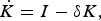
where β denotes the fixed time preference rate, δ denotes the depreciation rate of the capital stock, r d denotes the interest rate charged on the farmer's debt (D) and an overdot denotes a time derivative. Moreover, the total purchases of capital goods is represented by I + ψ(I − δK), the sum of realized net investment I and a nonnegative and strictly convex adjustment cost ψ(I − δK).
The degree to which property rights are complete, ρ, enters the model in two ways, first through the expenditure the representative farmer incurs to defend the property claim E(ρ, K), and second through the interest rate charged on the farmer's debt. To elaborate, the parameter ρ takes a value on a scale from 0 to 1, where ρ = 0 represents no (formal or informal) property rights and ρ = 1 represents complete property rights. The nonnegative expenditure function E(ρ, K) is decreasing in both ρ and K. In other words, the farmer needs to spend more to defend the land claim when the institutional environment for property rights is weak and when little capital has been invested in the land.Footnote 3 Of course, if property rights are complete, then the farmer does not need to make any expenditures to defend the property claim, E(1, K) = 0.Footnote 4
The interest rate faced by the farmer equals a base interest rate plus two premiums. Specifically,
 $$r_d = r^\ast + Z\lpar n\rpar + \Upsilon \lpar \rho\rpar .$$
The first premium, Z(n), is a function of the debt-to-output ratio, n≡ D/Q, and ensures convergence to a stationary equilibrium. Assuming that Z(n) is strictly increasing, the farmer's creditworthiness improves as its debt-to-output ratio declines. The latter premium, γ(ρ), provides the credit channel through which property rights affect the farmer's investment and welfare. The premium is decreasing in the degree to which property rights are complete. For complete property rights, ρ = 1, the premium equals zero. Moreover, in the special case where the interest rate does not depend on the degree to which property rights are complete, the premium also equals zero. Thus, the general model is applicable to environments where the credit channel exists and where it does not.
2.1. Solving the model
The solution to the representative farmer's optimization problem provides the following first-order conditions:
 $$U_C = -\lambda _1\comma \; $$
 $$\lambda _2 = -\lambda _1 \lpar 1 + \psi^{\prime}\rpar \comma \; $$
 $$\dot{\lambda}_1 = \lambda _1 \lpar \beta - r_d\rpar \comma \; $$
 $$\dot {\lambda }_2 = \lambda _1 [ F_K - E_K - \delta - \beta \lpar 1 + \psi^{\prime}\rpar \rsqb \comma \; $$
where λ1 and λ2 are the multipliers associated with the budget constraint and the law of motion for capital, respectively. Moreover, F K and E K represent the derivatives of the production function and the expenditure function with respect to capital.
2.2. Steady-state equilibrium
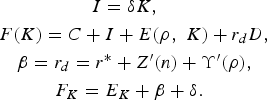
In the long run, the economy converges to a stationary equilibrium determined by the following steady-state conditions:
 $$\eqalign{& \quad \quad \quad \quad \quad I = \delta K\comma \; \cr & F\lpar K \rpar = C + I + E\lpar \rho \comma \; K\rpar + r_d D\comma \; \cr & \quad \beta =r_d = r^\ast + Z^{\prime} \lpar n \rpar + \Upsilon ^{\prime}\lpar \rho \rpar \comma \; \cr & \quad \quad \quad F_K = E_K + \beta + \delta.}$$
These equations can be solved for the steady-state changes in the capital stock, debt and consumption.
3. Steady-state analysis
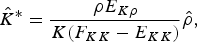
Given the equilibrium conditions above, a change in the degree to which property rights are complete affects the steady-state values of the capital stock, debt and consumption in the following ways:
 $$\hat{K}^\ast = \displaystyle{{\rho E_{K \rho}} \over {K\lpar F_{KK} - E_{KK}\rpar }} \hat{\rho}\comma \; $$
 $$\hat{D}^\ast = \left[\displaystyle{{\rho F_K E_{K \rho}} \over {Q\lpar F_{KK} - E_{KK}\rpar }} - \displaystyle{{\rho \Upsilon^{\prime} \lpar \rho\rpar } \over {nZ^{\prime}\lpar n\rpar }}\right]\hat{\rho}\comma \; $$
and
 $$\hat{C}^\ast = \displaystyle{\rho \over \gamma} \left[\displaystyle{{\beta E_{K\rho} \lpar 1 - nF_K\rpar } \over {Q\lpar F_{KK} - E_{KK}\rpar }} + \displaystyle{{\beta\Upsilon^{\prime} \lpar \rho\rpar } \over {Z^{\prime} \lpar n\rpar }} - \displaystyle{E_\rho \over Q}\right]\hat{\rho}\comma \; $$
where an overhat denotes percentage change in the given variable. The direction and magnitude of the steady-state changes depend in part on the values of the second derivatives E KK and E Kρ. If E KK and E Kρ are positive, then a one-unit increase in the capital stock reduces expenditures more when the capital stock is small and property rights are incomplete. This diminishing returns argument seems plausible and will be explored further.
Specifically, if diminishing returns exist for production as well, then equation (7) clearly shows that improved property rights reduce the capital stock across steady states. With better property rights, the farmer relies less on capital to defend the land claim, thereby discouraging overinvestment.
To understand the behavior of debt and consumption across steady states as represented by equations (8) and (9), three channels through which property rights affect the farmer will be explored. The first channel is the investment channel introduced above: improved property rights reduce the amount of capital needed to defend the land claim, thereby discouraging overinvestment. With less investment, the farmer does not acquire as much debt, but also does not produce as much output to generate as much consumption.
The second channel is the credit channel: improved property rights lower the interest rate premium faced by the farmer, which encourages the farmer to consume more initially. The higher associated debt, though, reduces consumption across steady states.
The remaining channel, which will be called the expenditure channel, pertains only to the change in steady-state consumption: improved property rights reduce the amount the farmer needs to spend to defend the land claim. Accordingly, more can be spent on consumption goods. Note that both the investment and expenditure channels work through the expenditure function, but the latter one more directly.
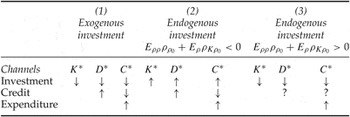
Column 1 of table 1 illustrates the directional pull of each of these channels on capital, debt and consumption across steady states. However, the overall steady-state change in debt and consumption cannot be known without calibrating the model, which will be done after two variants of the model are presented in the next section.
Impact of an exogenous improvement in property rights across steady states

4. Alternate model specifications and steady-state implications
Survey and empirical evidence suggest variants of this model are plausible as well. In the present form of the model, the farmer chooses the level of investment in each period to generate output and reduce expenditures for defending the land claim so as to maximize consumption over the infinite horizon. Conceivably, though, the farmer could use labor instead of or in addition to financial resources to defend the land claim and may be able to not only defend the claim but even strengthen it. Accordingly, in this section variants of the model will be considered, and their steady-state implications will be examined.
4.1. Model variant with labor used to defend land claim
To understand how the results might vary if labor resources are used to defend the land claim, the expenditure function is replaced with a comparable function for labor, l(ρ, K). As with the expenditure function in the previous model, the time required to defend the land claim, l, is decreasing in the degree to which property rights are complete, ρ, and non-increasing in the capital stock, K. The farmer's remaining time L ≡ T − l(ρ, K) is combined with capital to produce the farm's output Q ≡ F(K, L), where T represents the farmer's total fixed labor supply and F K > 0, F L > 0, F LL < 0, and F KK < 0. Thus, as before, capital is able to serve the dual roles in production and in defending the land claim, and incomplete property rights serve as a tax, in this case, on labor.
Solving the model in a manner similar to above, the steady-state change in capital is found to depend on the degree to which property rights are complete in the following way:
 $$\hat{K}^\ast = \displaystyle{{\rho \lpar F_{KL} l_\rho - F_{LL} l_K l_\rho + F_L l_{K\rho }\rpar \over K\lpar F_{KK} - 2F_{KL} l_K - F_{LL} l_K l_K - F_L l_{KK}\rpar }} \hat{\rho}. $$
Clearly, the magnitude and direction of change are influenced by the derivatives of the production and labor functions. In other words, the capital stock responds both to the release of labor from defending the land claim and to the equivalent increase in labor for production.
Without further empirical research into the nature of the labor function, equation (10) can best be understood by considering two special cases, one where l K < 0 and F KL = 0 and one where l K = 0 and F KL > 0. In the first case, the capital stock falls across steady states because less capital is needed to defend the land claim as the degree to which property rights are complete improves. Conceptually, this result is no different from what was found with the previous model. In the second case, though, an improvement in ρ necessarily reduces the time it takes to defend the land claim, freeing labor for production and thereby raising the marginal product of capital and the level of investment. Thus, the magnitude and direction of change in the capital stock are sensitive to institutions, technology, and other factors that may differ from one economy to another. Debt and consumption are similarly influenced by these competing forces on the capital stock.
4.2. Model variant with endogenous property rights
In both of the above variants of the model, the farmer takes action to defend the land claim, either through expenditures or labor, but cannot strengthen the land claim. In actuality, though, a farmer may be able to strengthen the land claim through investment in the land, depending on the society's institutional structures, including the legal system. For example, the government may be more willing to provide legal title if the farmer is able to demonstrate that the land has been improved through fencing, clearing, or some other means. Thus, the farmer has an incentive not only to invest in the land to increase production, but also to reduce the expenditures or labor required to defend the land claim. Accordingly, the third variant of the model allows for the degree to which property rights are complete to be a function of the capital stock.
One can also reasonably presume that the degree to which property rights are complete is not fully within the control of the farmer, but rather is constrained by the economy's institutional structures. Therefore, the degree to which property rights are complete, ρ, can be modeled as depending not only on the capital stock, but also on an exogenous, policy-determined component, ρ0. The resulting function, ρ = ρ(ρ0, K), is assumed to be increasing in both arguments.
Of course, this new function could be included in either of the previous variants of the model. For the following analysis, though, it will be added to the model where expenditures are used to defend the land claim. Accordingly, the expenditure function and the interest rate function now take the general forms of E(ρ(ρ0, K)) and r d = r* + Z(n) + γ (ρ(ρ0,K)). By solving the model again with these changes, the steady-state changes in the capital stock, debt and consumption depend on the exogenous, policy-determined degree to which property rights are complete, ρ0, in the following ways:
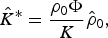 $$\hat {K}^\ast = \displaystyle{\rho _0 \Phi \over K} \hat {\rho }_0\comma \; $$
 $$\hat {D}^\ast = \left\{\displaystyle{\rho_0 F_K \Phi \over Q} - \displaystyle{\rho _0 \Upsilon^{\prime} \lpar \rho \rpar \over n{Z^{\prime}}\lpar n \rpar }\left[\displaystyle{\rho_0 F_K \Phi \over Q} + \rho _{\rho_0} \right]\right\}\hat{\rho}_0 \comma \; $$
and
 $$\hat {C}^\ast = \displaystyle{\rho _0 \over \gamma} \left[\displaystyle{\beta \Phi \lpar 1 - nF_K\rpar \over Q} + \displaystyle{\beta \Upsilon^{\prime}\lpar \rho \rpar \over Z^{\prime}\lpar n \rpar }\lpar \rho _K \Phi + \rho _{\rho _0}\rpar - \displaystyle{\rho _{\rho _0 } E_\rho \over Q} \right]\hat {\rho }_0 $$
where  $\Phi \equiv \displaystyle{E_{\rho\rho} \rho_{\rho_{0}} + E_{\rho} \rho_{K\rho_{0}} \over F_{KK} - E_{\rho\rho}\rho_{K}^{2} - E_{\rho}\rho_{KK}}$.
As solution (11) makes clear, the magnitude and direction of the steady-state change in the capital stock depend in part on E ρρ and ρKρ0. Consequently, if ρ has weak diminishing returns in reducing the expenditures required to defend the claim and ρ0 and K are strong complements in establishing property rights, then E ρρρρ0 + E ρ ρKρ0 < 0, and the capital stock will increase as a result of an improvement in ρ0. Not only does the exogenous change in property rights draw in capital to raise property rights overall, but also the overall change in property rights reduces the expenditure required to defend the property rights by a greater amount than it would otherwise. This result is consistent with claims in the literature that endogenously determined property rights will lead to higher investment in capital.
Nonetheless, without further empirical study, one cannot rule out the possibility that the expenditure function has strong diminishing returns or that the exogenously determined property rights and capital are weak complements or even substitutes in establishing overall property rights. Indeed, if ρ has strong diminishing returns in reducing the expenditures required to defend the claim and ρ0 and K are sufficiently weak complements in establishing property rights, then E ρρ ρρ0 + E ρ ρKρ0 > 0, and the capital stock falls as a result of an improvement in ρ0. In such a case, an improvement in ρ0 reduces the return to capital in strengthening the land claim.Footnote 5 Consequently, the impact of land reform policies will depend on the nature of the policies, existing property rights arrangements and institutions, and the ways in which property rights are defended and strengthened.
A comparison of steady-state solutions (7) through (9) and (11) through (13) also demonstrates that investment, credit and expenditure channels are all present regardless of whether investment is exogenous or endogenous. As table 1 illustrates, an improvement in ρ0 works through the investment channel either to raise or to lower all three variables across steady states and through the expenditure channel to raise consumption. For endogenous investment, the credit channel is more complicated. The interest rate premium is influenced directly by the exogenous increase in property rights and indirectly through the change in investment. An exogenous increase in property rights that raises investment would further decrease the interest rate premium, whereas lower investment would act to counter the fall in the premium. Perhaps this result explains why the empirical evidence on the credit channel is mixed. At the very least, the analysis reveals that more needs to be done empirically to understand the channels through which changes in property rights affect the agent's investment and consumption decisions.
5. Calibration of the initial model
To better understand the relative magnitudes of the three channels through which property rights can affect the farmer's investment, debt and consumption, the initial model is calibrated using data for the Brazilian Amazon. Toward this end, functional forms for production, the adjustment cost to investment, interest rate premiums and the expenditures to defend property rights are chosen, as well as the associated parameter values. For production, capital and a fixed quantity of labor are combined according to the Cobb–Douglas function
 $$Q \equiv F\lpar K\rpar = K^\alpha\comma \;$$
where α is the cost share of capital. With regard to investment, the adjustment cost function is chosen so that investment incurs increasing marginal cost:
 $$\psi = v\lpar I - \delta K\rpar ^2/2.$$
The parameter v can be related to observed parameters via equation (4). More specifically, since −λ2/λ1 represents the Tobin's q in the model, equation (4) can be written as q = 1 + ψ′. Therefore, in steady state,
 $$v = \psi^{\prime \prime} = 1/\delta \Omega K\comma \;$$
where  $\Omega \equiv {\hat {I}}/{\hat{q}}$ is the q-elasticity of investment spending. Furthermore, to capture the characteristics of the two interest rate premiums described in section 2, they are given the following functional forms:
 $$Z\lpar n\rpar = x_1 \lpar e^n - 1\rpar$$
and
 $$\Upsilon \lpar \rho\rpar = x_2\lpar e^{1 - \rho} - 1\rpar \comma \;$$
where x 1 and x 2 are nonnegative constants.
The chosen functional form for the expenditure to defend property rights,
 $$E\lpar {\rho\comma \; K}\rpar = x_3 \lpar {1 - \rho}\rpar K^{-\sigma}\comma \; \, x_3 \ge 0\comma \; \, \sigma \ge 0\comma \;$$
requires more explanation. Given the nonnegative constant x 3, this function has the necessary characteristics for the expenditure function set forth in section 2, namely E(ρ, K) ≥ 0, E(1, K) = 0, E ρ < 0 and E K < 0. With this functional form, the model can also examine the impact of a change in property rights when the investment channel is weak, strong or nonexistent, depending on the value of the parameter σ.
Presumably, if the investment channel does exist, σ > 0, then an increase in the capital stock reduces the expenditure more when property rights are incomplete or when the capital stock is small than when the opposite is true. Consistent with this assumption, the chosen functional form for the expenditure has positive second derivatives E KK and E Kρ.
Given these functional forms, the steady-state results (7) through (9) can be parameterized as
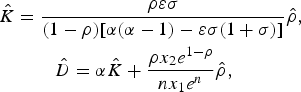 $$\eqalign{& \hat {K} = \displaystyle{\rho \varepsilon \sigma \over \lpar 1 - \rho\rpar [ \alpha \lpar \alpha - 1\rpar - \varepsilon \sigma \lpar 1 + \sigma\rpar \rsqb }\hat{\rho }\comma \; \cr & \quad \quad \quad \hat {D} = \alpha \hat {K} + \displaystyle{\rho x_2 e^{1-\rho } \over nx_1 e^n}\hat {\rho }\comma \; }$$
and
 $$\hat {C} = \displaystyle{1 \over \gamma}\left[\beta \lpar k\hat {K} - n\hat{D}\rpar + \displaystyle{\rho \varepsilon \over 1 - \rho }\hat {\rho }\right]\comma \;$$
where k, γ, and ɛ are the output shares of capital, consumption and expenditure to defend the land claim, respectively. The values of the parameters for these equations and the rest of the model are specified in accordance with available real-world data, empirical evidence and theory. In particular, the time preference rate (β), the depreciation rate (δ) and the intertemporal elasticity of substitution (τ) are set at 0.1, 0.05 and 0.25, respectively, based on estimates using national Brazilian statistics from Issler and Piqueira (Reference Issler and Piqueira2000), among others.Footnote 6 The income share of capital (α) is derived from equation (6) in steady state to be α = (β + δ)k − σɛ, which is consistent with the numerical value provided by Brazilian economists Ellery et al. (Reference Ellery, Gomes and Bugarin2001). Furthermore, estimates for the q-elasticity of investment spending (Ω) mostly lie between 0.2 and 2.3.Footnote 7 For this study, a value of 2 is chosen for Ω, given that smaller values result in very slow speeds of adjustment.
The output shares of capital (k), debt (n), consumption (γ), and expenditure to defend claim to property (ɛ) are a little more difficult to pin down. Following Ellery (Reference Ellery2002), though, a capital-output ratio of 2.7 is used. Regarding the debt:output ratio, access to credit appears to be more difficult in Brazil than in other countries. ‘Credit currently only amounts to 25 per cent of GDP in Brazil, compared with 60 per cent in Chile and more than 70 per cent in many developing countries’ (Santos, Reference Santos2005). Considering that the 25 per cent does not include informal credit, but also that rural farmers are less likely to have access to formal credit than the average Brazilian, low and high values of 0.1 and 0.4 are chosen for n. For the percentage of output spent to defend the property claim, Alston et al. (Reference Alston, Libecap and Mueller1999) surveyed Amazonian settlers regarding ‘what activities they undertook regularly to maintain their [property] claims’ (Alston et al., Reference Alston, Libecap and Mueller1999: 111). The most common response was the clearing of boundaries, which on average took the settler 5.5 to 6 days per year. Other activities pursued by some settlers included having their sales receipts for the land notarized, hiring a topographer to map their borders, building markers on their boundaries, making multiple trips to government offices to petition for titles, attending community meetings and paying membership to a community organization to signal that a claim was recognized by the community.Footnote 8 For a rough estimate of the total cost of maintaining and strengthening land claims, the authors aggregated the total time spent by each of seven settlers toward these ends. The amount of time ranged from 6 days to 30 days, with an average of 13.4 days. Assuming the farmer works 6 days per week all year, the average farmer is thus spending 4.28 per cent of the time devoted to work maintaining or strengthening the claim to land. Thus, a value of 0.04 is chosen for ɛ. Given the values of k, n and ɛ, the agent's budget constraint (1) in steady state, γ = 1 − δk − βn − ɛ, implies realistic values of 0.785 and 0.815 for the consumption share of output (γ).
The remaining parameters concern the functional forms for the interest rate premiums and the expenditure to defend the property claim, namely x 1, x 2 and σ. Since the interest rate premium Z(n) exists primarily to ensure convergence to a stationary equilibrium, x 1 is set at a low value of 0.02. The other interest rate premium, γ(ρ), however, is meant to capture the credit channel, whereby the degree to which property rights exist affects investment through the interest rate. Assuming the impact is moderate, the parameter x 2 is given the value 0.05, which means that the interest rate premium is at most 8.6 per cent. However, to allow for the possibility that the credit channel does not exist or is small, values for x 2 of zero and 0.02 are also considered. Finally, for larger values of σ, an increase in the capital stock will have a larger impact on reducing the expenditure necessary to defend the claim to property. Consequently, values of zero and one are chosen for σ, which allows for the possibilities that a one-unit change in the capital stock leads to no change, a 0.015 unit decrease, or a 0.030 unit decrease in the expenditure necessary to defend the land claim, respectively, for given values of ɛ and k.
6. Results of numerical simulations
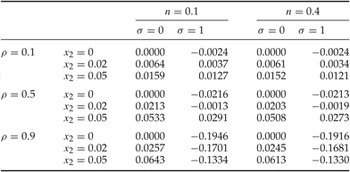
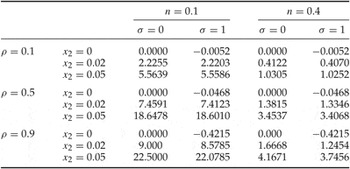
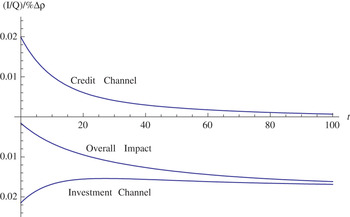
With the model calibrated, steady-state changes as well as the transitional dynamics can be better understood through numerical simulations. In particular, the transitional path of the model, which has been solved in the appendix, provides insights regarding the initial change in consumption and investment. As tables 2 and 3 make clear, improved property rights lead to higher initial consumption, but the impact on investment depends on the weight of the investment and credit channels. Consumption rises since fewer funds are needed to defend the land claim and the fall in the interest rate premium tilts spending to the present. Investment also rises for larger values of x 2 and smaller values of σ due to the lower interest rate premium. However, for smaller values of x 2 and larger values of σ, investment falls because the farmer needs less capital to defend the land claim.
Initial percentage change in consumption resulting from a 1% improvement in property rights

Initial change in the income share of investment resulting from a 1% improvement in property rights

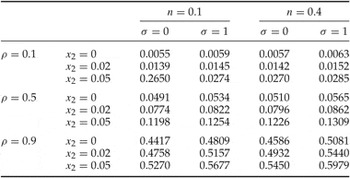
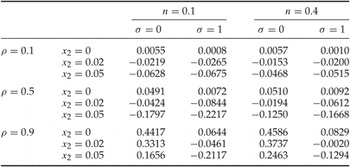
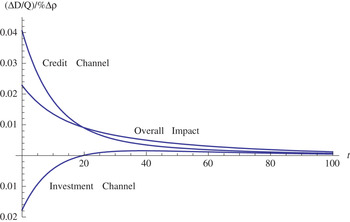
Although the initial change in consumption is positive, table 4 demonstrates that consumption falls across steady states for most combinations of parameter values. To understand the difference, one must first understand the steady-state change in debt. Numerical simulations illustrated in table 5 show that debt increases across steady states, except when x 2 is very close to zero. Consequently, if the credit channel exists, improved property rights tend to do more to encourage borrowing through lower interest rates than they do to reduce the need for debt-financed capital.
Steady-state percentage change in consumption resulting from a 1% improvement in property rights

Steady-state percentage change in debt resulting from a 1% improvement in property rights

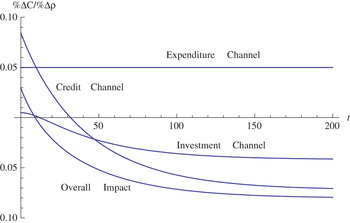
Since debt rises across steady states for almost all combinations of parameter values, debt servicing leaves fewer funds available for consumption. Nonetheless, when the parameters x 2 and σ both take low values, consumption rises. To understand this, recall that the interest rate does not fall as much when x 2 is small, which discourages the farmer from incurring as much debt. Also, the capital stock does not fall as much when σ is small, which results in higher output and consumption than would have occurred otherwise. Thus, when the interest rate and investment channels are sufficiently weak, consumption rises across steady state due to the reduced expenditures required to defend the land claim. Moreover, since consumption rises initially and falls across steady state for most combinations of parameter values, the welfare implications of improved property rights should be considered further.
Figures 1, 2 and 3 further illustrate how improved property rights influence consumption, investment and borrowing through the various channels. In generating these graphs, values for ρ, n, σ and x 2 were set at 0.5, 0.25, 1 and 0.02, respectively.
Consumption and its component channels following an improvement in property rights

Investment and its component channels following an improvement in property rights

Borrowing and its component channels following an improvement in property rights

7. Discussion on modeling
The models described in sections 2 and 4 are inspired by Alston et al. (Reference Alston, Libecap and Schneider1995), who found through surveys of settlers in the Brazilian Amazon that households undertake various activities (besides or in addition to investment) to defend or enhance their land claims. This is not to say the models developed here are only relevant to the Brazilian Amazon frontier; they should be generally applicable to economic frontiers throughout the developing world as well. Unfortunately, as Besley (Reference Besley1995) laments with regard to his data set on Ghana, existing empirical studies cannot confirm the broader applicability because of their more limited focus on investment to defend or enhance land claim.
Additional considerations have been made in the theoretical literature, although not in the same ways as presented above. For example, Grossman and Kim (Reference Grossman and Kim1995) assume resources are used to defend land claim, but more narrowly focus (in respect to this issue) on ‘fortifications’. The research intent differs as well. Whereas Grossman and Kim (Reference Grossman and Kim1995) analyze the equilibrium determinants of secure property claims, this paper more closely follows the approach of Besley (Reference Besley1995) in laying out a theoretical framework to motivate and inform empirical research regarding the channels through which property rights affect the decisions of land claimants.
Specifically, the present paper provides a theoretical basis for richer empirical consideration of property rights falling along a spectrum of possibilities whose set ρ ≡ {ρ1,…,ρn} may differ from one economy to another, or even from one community or individual to another.Footnote 9 Presumably, ordinal preferences between any two ρ in the set can be ascertained through survey or observation of the economic agent's behavior, as can the mechanisms through which a change in the degree of property rights affects the economy in question. These mechanisms may also differ in existence or degree of importance, depending on whether or how the agent accesses credit and uses resources to defend the land claim. Nevertheless, the general expenditure, labor, interest rate and property rights functions described above can be specified in ways that are most appropriate for a given institutional environment.
With further research, a heterogeneous-agent model may be found to be more appropriate for understanding the impact of property rights than the representative-agent model developed here. Indeed, the evolution of the economic frontier may be driven by differences between agents in their set ρ, perceptions of their set ρ, or access to credit, among other possibilities.Footnote 10 The Brazilian Amazon frontier, for example, shows a pattern of agents possessing, clearing and then selling land to agents who are more able to secure title for the land (Alston et al., Reference Alston, Libecap and Mueller1999).
8. Concluding remarks
This paper explores the channels through which an improvement in property rights affects the frontier farmer's investment, consumption and debt. The paper, being applied theory in nature, was informed by empirical research in the literature and is meant to inform future empirical research. The study finds that an improvement in property rights raises initial consumption and lowers the steady-state capital stock when the farmer incurs expenditures to defend the land claim, and property rights are exogenously determined. However, the effects on initial investment and steady-state debt and consumption depend on the strengths of the investment, credit and expenditure channels. Variants of the model not only show that results depend on the strengths of these three channels, but also on institutions and technology, which further highlights the basis and need for additional empirical research.
Surveys may take this research in surprising but important directions. Consider, for example, the work of Field (Reference Field2007), which finds that Peruvian urban ‘households with no legal claim to property spend an average of 13.4 hours per week maintaining informal tenure security, reflecting a 14% reduction in total household work hours for the typical squatter family’ and ‘are also 40% more likely to work inside of their home’ (Field, Reference Field2007: 1563). Might rural farmers and particularly those on the frontier find it necessary to work on or near their own land to maintain their property claims, rather than consider seasonal migration?
The present study, however, points to particular gaps in the empirical literature on property rights. More needs to be known as to how property claims are defended, how many resources are dedicated to this activity, what informal and formal credit and property rights arrangements and institutions exist, who has access to these arrangements and institutions and under what conditions, and how these arrangements and institutions affect the decision to invest in the land. One might suspect that differences will exist not only between countries, but even within a community, determined by such factors as size of the farm and distance from the market and seats of government. Knowledge of such differences and their implications would help policy makers design and support institutions that improve the frontier farmer's wellbeing.
Appendix: Solving for the transition path
In order to analyze the transitional dynamics of a change in the degree to which property rights are complete, first-order conditions provide the time paths of consumption,
 $$\dot{C} = \tau C\lpar {r_d -\beta}\rpar \comma \;$$
and investment
 $$\dot{I} = [ r_d \lpar 1 + \psi^{\prime}\rpar - F_K + E_K + \delta + \delta \psi^{\prime \prime}\lpar I - \delta K\rpar \rsqb /\psi^{\prime \prime}\comma \;$$
where τ ≡ −U C/U CCC denotes the intertemporal elasticity of substitution. These equations can be linearized, along with (1) and (2), around the new steady state (C*, D*, I*, K*) to generate the following system of first-order differential equations:
 $$\left[\matrix{{\dot {C}} \cr {\dot {D}} \cr {\dot {I}} \cr {\dot {K}} \cr}\right]= \left[\matrix{0 & \tau \gamma {Z}^{\prime}\lpar n \rpar & 0 & -\tau \gamma n{Z}^{\prime}\lpar n \rpar F_K \cr 1 & \beta + n{Z}^{\prime}\lpar n \rpar & 1 & -[ \beta +\delta +n^2{Z}^{\prime}\lpar n \rpar F_K \rsqb \cr 0 & {Z}^{\prime}\lpar n \rpar /\psi^{\prime \prime}F_K & \beta +\delta & X \cr 0 & 0 & 1 & -\delta \cr }\right]\left[\matrix{C\lpar t \rpar -C^\ast \cr D\lpar t \rpar -D^\ast \cr I\lpar t \rpar -I^\ast \cr K\lpar t \rpar -K^\ast \cr }\right]\comma \;$$
where X = [E KK − F KK − δ ψ′′ (β + δ) − nZ′(n)F K/F(K)]/ψ′′. Therefore, on the saddlepath, consumption, debt, investment and capital evolve according to
 $$\matrix{\hat{C}\lpar t\rpar = \hat{C}^\ast +{n\lpar Y_{12} e^{\eta _2 t}-Y_{11} e^{\eta _1 t}\rpar \over \gamma \lpar {Y_{21} -Y_{22} } \rpar }\hat {D}^\ast +{k\lpar Y_{11} Y_{22} e^{\eta _1 t}-Y_{12} Y_{21} e^{\eta _2 t}\rpar \over \gamma \lpar Y_{21} -Y_{22} \rpar }\hat{K}^\ast \comma \; \cr \hat{D}\lpar t\rpar =\left(1+{Y_{22} e^{\eta _2 t}-Y_{21} e^{\eta _2 t}\over{Y_{21} -Y_{22}}} \right)\hat{D}^\ast + {kY_{21} Y_{22} \lpar e^{\eta _1 t}-e^{\eta _2 t}\rpar \over n\lpar Y_{21} -Y_{22}\rpar }\hat {K}^\ast \comma \; \cr {I\lpar t\rpar \over{Q}}=\delta k\lpar 1+\hat{K}^\ast\rpar +{n\lpar Y_{32} e^{\eta_2 t}-Y_{31} e^{\eta_1 t} \rpar \over Y_{21} -Y_{22} }\hat {D}^\ast +{k\lpar Y_{31} Y_{22} e^{\eta_1 t}-Y_{32} Y_{21} e^{\eta_2 t}\rpar \over Y_{21} -Y_{22}}\hat {K}^\ast \comma \; }$$
and
 $$\hat{K}\lpar t\rpar ={n\lpar e^{\eta_2 t}-e^{\eta_1 t}\rpar \over k\lpar Y_{21} -Y_{22}\rpar }\hat {D}^\ast +\left(1+{Y_{22} e^{\eta_1 t}-Y_{21} e^{\eta_2 t}\over Y_{21} -Y_{22}}\right)\hat {K}^\ast \comma \;$$
where the system's negative eigenvalues are η1 and η2 and the system's eigenvectors are
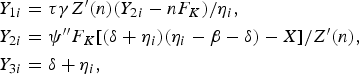 $$\eqalign{Y_{1i}&={\tau \gamma {Z}^\prime\lpar n \rpar \lpar {Y_{2i} -nF_K } \rpar /{\eta _i }}\comma \; \cr Y_{2i} &={\psi }^{\prime\prime} F_K [ \lpar \delta +\eta _i\rpar \lpar \eta_i -\beta -\delta\rpar -X\rsqb /Z^\prime\lpar n\rpar \comma \; \cr Y_{3i}&=\delta +\eta _i\comma \; }$$
when Y 4i is normalized to one.