INTRODUCTION
Patients with brain tumors can classically present with neurological symptomatology such as focalization symptoms, headache, dizziness, intracranial hypertension, and cognitive disorders. Behavioral or cognitive disorders can underlie delirium, personality changes, mood disorders (depression, mania), apathy or abulia, anxiety, and delirious or psychotic reactions (Rogers & Mendoza, Reference Rogers, Mendoza, Black and Loeffler1997; Price et al., Reference Price, Goetz, Lovell, Yudowfsky and Hales2002; Valentine, Reference Valentine, Holland, Breitbart and Jacobsen2010). An atypically psychiatric picture can be the only initial clinical presentation, and should alert the clinician and then be further explored through neuroimaging (Moise & Madhusoodanan, Reference Moise and Madhusoodanan2006).
Depression and anxiety manifestations can interfere either as pre-existing comorbidities to brain tumor discovery or predictors of later development of psychiatric disorders among these patients (Appleby et al., Reference Appleby, Appleby and Rabins2008). The incidence of depression in ambulatory patients with a primary brain tumor is estimated to be between 25% and 30% (Wellisch et al., Reference Wellisch, Kaleita and Freeman2002; Litofsky et al., Reference Litofsky, Farace and Anderson2004). Except for a case report regarding a parietal lobe tumor (Bhatia, Reference Bhatia1993), Cotard's syndrome and melancholia episodes or psychotic depression have been rarely described among brain tumor patients.
We report the case of a male patient confronted with an inoperable glioblastoma multiforme of poor prognosis, located on the splenium of the corpus callosum, who developed a major depressive disorder with psychotic features and Cotard's syndrome during his concomitant radiochemotherapy. To our knowledge, this is the first time major depression has been described as a complication of this particular tumor location.
CASE REPORT
A 60-year-old man was hospitalized in June 2010 in our oncologic department after a stereotactic biopsy histologically confirmed a glioblastoma multiforme of the splenium of the corpus callosum. The initial symptoms were a progressive paresis of the right leg associated with ataxia and abulia.
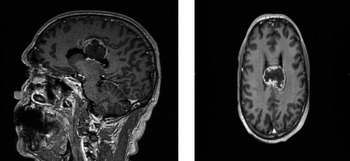
Localization of the tumor was incompatible with an open surgery resection (Fig. 1). Concomitant brain radiation (involved field, two coaxial isocentric fields, fractionated, once daily; cumulative dose 60 Gy, fraction size 2 Gy) and oral chemotherapy with temozolomide (75 mg/m2 body surface, total dose of 5260 mg) for a duration of 6 weeks followed by 6 cycles of temozolomide had already been prescribed by the interdisciplinary tumor board committee. A corticosteroid regimen was implemented (1 mg/kg/day of methylprednisolone).
Right panel: gadolinium enhanced, T1-weighted sagittal MRI shows contrast enhancement of lesion in body of the corpus callosum. Left panel: gadolinium enhanced, T1-weighted axial MRI of an irregularly enhancing lesion in the corpus callosum with necrosis

Four days after his diagnosis and the disclosure of his poor prognosis, the patient tried to commit suicide by ingesting medications, and he was transferred to a psychiatric crisis unit. Except for two past depressive episodes, 30 and 20 years earlier that occurred in the context of marital separation and temporary professional difficulties, respectively, he had never presented with recurrent depression or bipolar disorders. No familial psychiatric problems were found for either mood or psychotic disorders.
The first psychiatric assessment showed that the patient started to slightly criticize his suicide attempt but revealed no pessimism, carelessness, delirium, or discordance symptoms. Antidepressant treatment by serotonin and nor epinephrine reuptake inhibitor (SNRI) duloxetine 60 mg o.d. and anxiolytic treatment by alprazolam 0.25 mg t.i.d. was started. Neurological examination found impaired autonomy with ataxia, paresis of the legs, and the beginning of urinary incontinence. One week later, the patient was discharged from the psychiatric unit and continued his ambulatory chemotherapy and radiotherapy.
A few days later, at his home, the patient made a second suicide attempt by phlebotomy on his right wrist, but was not seen immediately by the psychiatric team. During his radiotherapy treatment, which occurred every day except weekends, a new psychiatric assessment was done, a couple of days following this second suicide attempt. During the patient's interview in presence of his wife, she confessed that the day before, his daughter (a 24-year-old) had found him with a knife. Therefore, the psychiatrist concluded that this had been an aborted suicide attempt, and that the patient had severe persistent depression.
The patient presented with an intense moral suffering with pessimistic ideas (“radiotherapy will not work”), a deep feeling of hopelessness (“the doctors will never cure me”), a loss of dignity, and an impotent feeling of guilt (“I am ashamed of myself and I want to kill myself”), morbid delirious ideas (“I've got a mental disease in my bowels and that' s why I am gonna die”), complete anhedonia, and incapacity to project himself into the future or to elaborate short-term projects (“I don't see any future because everything is blocked and dull”).
Because of intolerable side effects (gastralgia, dysuria, tremor), duloxetine was replaced by escitalopram 10 mg o.d.
The patient denied any auditory hallucinations. He stated that he was feeling very anxious, and all his complaints focused on his gastrointestinal system, which he thought was completely blocked, and, surprisingly, not on his brain and nervous system, although he was perfectly aware of his malignancy.
Intestinal occlusion had been ruled out by the oncologist and plain abdominal radiography.
The patient refused to feed himself because “it could block even more his bowels which are already full.” Nurses confirmed the absence of constipation but he denied that (“it was just small manure”). Then he made a delirious link between psychasthenia, masturbation (which he engaged in frequently), and his impaired intestinal function. He seemed to be more concerned and worried with “his bowel illness” than his brain tumor (“I'm going to die because the intestinal disease is more serious than my brain disorder”). He did not criticize at all his delirious, morbid, and hypochondriac ideas. The psychiatrist diagnosed a psychotic depression (melancholia) with Cotard's syndrome. Because of the patient's somatic problems, regular hospitalization in the oncologic and not psychiatric department was proposed.
The patient's treatment was altered with increased doses of escitalopram 15 mg o.d., introduction of lorazepam 4 mg/day and risperidone 2 mg/day. Five days later, the patient was discharged from the oncologic clinic and intensive psychiatric follow-up was done at home (three visits per day). Escitalopram and risperidone were increased up to 30 and 6 mg/day respectively and 1 month later the patient's mood improved and the delusional ideas disappeared.
DISCUSSION
Cotard's syndrome was first described during the nineteenth century by Jules Cotard (1840–1889), a Parisian neurologist in 1882 (Pearn & Gardner-Thorpe, Reference Pearn and Gardner-Thorpe2002). This rare psychiatric condition belongs to the category of delusional psychosis and psychotic depression with untoward consequences in terms of prognosis if not treated. Its clinical features are characterized by a nihilistic delusion relating to one's own body and the existence and development of a delusional belief that one's body or part of it is rotting away, is decayed, or has died (Gardner-Thorpe & Pearn, Reference Gardner-Thorpe and Pearn2004). It is considered as a variety of psychotic depression such as melancholia, with intense moral suffering and guilt, indignity and incurable ideas, suicidal ideas with voluntary mutilation, and a hypochondriacal delusion focused on body functioning (i.e., an impression that body works abnormally with organs changing forms and function) (Debruyne et al., Reference Debruyne, Portzky and Van den Eyden2009). Patients with this syndrome are generally convinced that they are not curable, reinforced by the fact that they complain of intensive pain even if no somatic abnormalities are found at clinical examination.
In this case report, the different causes of Cotard's syndrome are examined from a medical, iatrogenic, or psychogenesis point of view. A multifactorial origin should be suspected before one assumes one hypothesis over another one.
Medical
Depressive symptomatology can lead to brain tumor discovery or occur incidentally during tumoral progression. Tumors of the corpus callosum have been associated with significant depression (Nasrallah & McChesney, Reference Nasrallah and McChesney1981; Tanaghow et al., Reference Tanaghow, Lewis and Jones1989), apathy, and psychotic symptoms (Price et al., Reference Price, Goetz, Lovell, Yudowfsky and Hales2002). Some cases with agenesis of the corpus callosum have been reported to be associated with schizophrenia (David et al., Reference David, Wacharasindhu and Lishman1993).
One can give a neurophysiological explanation to this link by the involvement of adjacent structures in mood disorders (frontal lobes, deep midline and limbic structures [Price et al., Reference Price, Goetz, Lovell, Yudowfsky and Hales2002], or specific parts of the corpus callosum involving the rostrum and splenium [Nasrallah & McChesney, Reference Nasrallah and McChesney1981] which was the location of the tumor in our patient). Disorders of interhemispheric integration, transmission, and communication could be a neuropathological hypothesis for a range of psychiatric phenomena from affective to psychotic symptoms (David et al., Reference David, Wacharasindhu and Lishman1993).
Iatrogenic
Could treatment for glioblastoma multiforme be implicated in the occurrence of this psychiatric disorder?
Radiotherapy remains one of the principal therapeutic approaches for brain tumor treatment. Its psychological aftermaths remain complex, comprised of ambivalence, fear, anxiety, and anguish regarding irreversible sequels and side effects or hypothetical outcomes of the treatment. These feelings are increased by alopecia caused by brain radiotherapy, which impairs body image and confronts the patient with the reality of the existence of a malignancy (Perpère & Picgirard, Reference Perpère and Picgirard2010). Some other psychological reactions can be seen such as anger, feelings of double unfairness, and feelings of impending threat and extreme vulnerability (Perpère & Picgirard, Reference Perpère and Picgirard2010).
If chronic use of corticosteroids classically generates physical changes (Cushing's syndrome and weight gain), severe psychiatric adverse effects can occur in nearly 6% of patients, and mild-to- moderate reactions can occur in about 28% (Warrington & Bostwick, Reference Warrington and Bostwick2006).
Behavioral disturbances, personality changes (irritability), steroid psychosis (Sirois, Reference Sirois2003), and mood disorders (hypomania, mania, euphoria, depression) have been described with acute or chronic use of corticosteroids (Kershner & Wang-Cheng, Reference Kershner and Wang-Cheng1989; Stiefel et al., Reference Stiefel, Breitbart and Holland1989). It is commonly assumed that depression has a significant negative impact on outcome in patients with brain tumors (Litofsky & Resnick, Reference Litofsky and Resnick2009). To our knowledge, it is unusual that the combination of both radiotherapy and corticotherapy facilitates the occurrence of such a melancholic presentation aggravated by the coexistence of Cotard's syndrome.
Psychogenesis
Our patient had been told he had an inoperable brain tumor with a bad prognosis. We can hypothesize that for this patient, the confrontation of anxiety over his death (inoperable tumor with a disclosed bad prognosis and consciousness of a fatal outcome) associated with a loss of control with impaired autonomy and decreased narcissism and self esteem (the patient had been an active and athletic man), generated an acute psychotic episode. This could be understood to be a defense mechanism. This specific reaction has been described before in the case of disclosure with a fatal outcome in an advanced serious illness (Wanck, Reference Wanck1982; Irwin, Reference Irwin1984; Sirois, Reference Sirois1993).
CONCLUSIONS
This clinical observation reports a seldom seen association between a neurological and psychiatric disorder. The particularity of this case report is the fact that the gloomy prognosis is emphasized by both the presence of an inoperable brain tumor, and Cotard's syndrome with a high potential risk of suicide. Collaboration between the radiotherapy and neuro-oncology departments, and the psycho-oncology units or psychiatric departments are therefore paramount and essential for treating this double pathology and improving the patient's quality of life by alleviating both somatic and psychic suffering.
ACKNOWLEDGMENTS
The authors wish to thank Clive Bowman for all his advice.