Introduction
Nothing is more irritating to those who use the scientific names of organisms than to find those names have changed (Nimis Reference Nimis1998). This irritation is especially acute when there is a seemingly constant flux of advice as to what is or what is not to be employed. The feeling of frustration is often accentuated by the reasons for the change not being either explained or understood. Instability in scientific names results from either a combination of nomenclatural nuances, or new scientific data or opinions, or sometimes both. These problems are particularly acute in groups of organisms which include numerous species and also have not been subject to intensive research into their evolutionary history. It is pertinent to reflect that a scientific name is essentially a scientific hypothesis. The name is a statement that here is an organism (or group of organisms) with a particular circumscription and rank which should be classified in a particular way because of its relationships. And, as with any hypothesis, the concept represented by the name is open to testing.
Over the course of the last forty years in particular, the instability of names at the generic level has become notorious in the parmelioid lichens (i.e. most of the foliose representatives of the Parmeliaceae). The objective of this contribution is to explain the reasons for the changing concepts, and the progress made towards a phylogenetically robust and generally accepted system made during the last ten years.
Changing generic concepts
The generic concepts employed for lichen-forming fungi have evolved as a consequence of new understandings and new technologies, from the advent of light microscopes through the analysis of chemical products to scanning electron microscopy, cladistics, and now molecular phylogenetics. An overview of changing generic concepts in the pre-molecular age is provided by Hale (Reference Hale1984a), who noted that many genera introduced in the mid-1800s and then ignored were being reinstated. DePriest (Reference DePriest1999) explored the work of Hale and his contemporaries in some detail, and also tabulated lists of genera accepted in various works. However, an explanatory account, tracking the changing generic concepts in the parmelioid lichens from the first use of Parmelia by Acharius (Reference Acharius1803) to the present day, does not seem to have been produced. Now that an international consensus has emerged (Crespo et al. Reference Crespo, Kauff, Divakar, del Prado, Pérez-Ortega, Amo de Paz, Ferencova, Blanco, Roca-Valiente and Núñez-Zapata2010a), it is timely to explain the situation to lichenologists as a whole and place it in a historical perspectiveFootnote 1.
1803 –1850
The generic name Parmelia was introduced by Acharius (Reference Acharius1803: xxxiii) for lichens in a group including ones which had open rounded apothecia with a “margine thallo concolori”, and distinguished from Urceolaria by the apothecia being raised above the thallus surface rather than immersed. He did not take up Lichen sect. Imbricaria, which he had used earlier infragenerically (Acharius Reference Acharius1798: 107), for such foliose lichens, as that name was already in use in plantsFootnote 2. The genus included 204 species, the thalli of which were “polymorphus”, and this first circumscription included lichens with leprose and crustose thalli (e.g. Caloplaca cerina group, Rinodina, Tephromela, Trapelia) as well as macrolichens no longer regarded as parmelioid (e.g. Alectoria, Anaptychia, Collema, Lobaria, Physcia, Ramalina, Teloschistes). Subsequently, Acharius (in Luyken Reference Luyken1809: 91) restricted Parmelia to lichens with centrally fixed apothecia and foliose stellate to strap-like thalli. Sixty species were accepted in Acharius (Reference Acharius1810), including, in addition to ones now regarded as parmelioid, species now placed in genera as diverse as Degelia, Pannaria, Physcia, Physconia, and Xanthoria.
1851 –1919
Acharius' concept of the genus was generally adopted until the importance of ascospores in ascomycete classification started to be appreciated in the 1840s. The discovery that the ascospores differed in colour and/or septation in some Parmelia species quickly led to this segregation to re-circumscribed genera such as Physcia, or newly described ones such as Xanthoria. The application of names did, however, vary; for example Körber (Reference Körber1855) adopted Parmelia for foliose species with 1-septate brown spores (i.e. Anaptychia and Physcia in the modern sense), Imbricaria for those with 0-septate colourless spores (i.e. parmelioid lichens in the modern sense), and Physcia for ones with polarilocular colourless spores (i.e. Xanthoria species). However, Parmelia soon came to be accepted for species with simple colourless spores (e.g. Nylander Reference Nylander1855; Fries Reference Fries1861). Massalongo (Reference Massalongo1854) segregated Menegazzia primarily because of the very large thick-walled spores and later Parmotrema because of the perforated apothecia (Massalongo Reference Massalongo1860).
Nylander (Reference Nylander1860) stressed the colourless non-septate spores in his circumscription, accepting 46 species worldwide and arranging them into eight groups, many of which were later to be recognized as separate genera. However, Nylander appears never to have recognized Massalongo's two segregates, but he did introduce two novelties: Parmeliopsis separated by the conidium type as a subgenus name in 1861, raising it to generic rank in 1866; and later Hypogymnia with an inflated non-rhizinate thallus as a subgenus in 1881.
Vainio (Reference Vainio1890), wrestling with the huge diversity of parmelioid lichens he encountered in Brazil, was the first author to strive to distinguish groups of species within thegenus. He recognized three sections: Amphigymnia (broad and ascending lobes, often a broad zone without rhizines below, and also often cilia on the margins; with subsections Subglaucescens with grey or white thalli, and Subflavescens with yellowish thalli), Hypotrachyna (elongated lobes and minute rhizines; with subsections Cyclocheila with adpressed lobes and hardly raised apothecia, Irregularis with irregular broad lobes and raised apothecia, and Sublinearis with adpressed di- or trichotomous lobes and commonly sessile apothecia), and Xanthoparmelia (yellowish, adpressed, with elongated lobes; with subsections Endoleuca with a white medulla, and Endoxantha with a yellow medulla).
Independently, in cataloguing 380 species Nylander had under Parmelia amongst his “exotic” lichens, Hue (Reference Hue1892) confronted similar problems to Vainio, but on an ever grander scale. He recognized four subgenera, Anzia, Hypogymnia, Omphalodium and Parmelia, but divided the last into 12 “stirps”, several of which were destined to be treated as separate genera by future workers (e.g. stirps Parmeliae borreri, Parmeliae caperatae, Parmeliae conspersae, Parmeliae olivaceae, Parmeliae relicinae, Parmeliae saxatilis, Parmeliae stygiae, Parmeliae tiliaceae). However, no diagnoses were provided for these “stirps”. Hue subsequently recognized sections Everniiformes and Melaenoparmeliae (Hue Reference Hue1899). It is evident that Hue had a deeper appreciation of groupings within the genus than his predecessors and contemporaries, something that appears not to have been previously noted.
The first group of parmelioid lichens to be monographed in detail, with photographs and full descriptions, was subgenus Hypogymnia studied by Bitter (Reference Bitter1901). He set a standard scarcely to be emulated again until the 1970s, and dispersed the species through two sections, Solidae and Tubulosae, distinguished by a solid and hollow medulla respectively. Around this time, Zopf (Reference Zopf1903) introduced the generic name Pseudevernia for Parmelia furfuracea and some newly recognized, including chemically separated, species but this was not taken up until the 1950s and the species continued to languish in Everniaeformes.
Another critical study, this time of 14 brown species, was carried out by Rosendahl (Reference Rosendahl1907) who carefully studied anatomical features and compared them with some grey species, including Parmelia sulcata and Pseudevernia furfuracea; he noted differences in cortical structure and also found ascospore size to have value, at least as a specific criterion.
Zahlbruckner (Reference Zahlbruckner, Engler and Prantl1908), in an overview of the accepted genera of lichens worldwide, largely followed Vainio and Bitter, and recognized five subgenera within Parmelia: Euparmelia (with sections Everniaeformes, Melaenoparmelia, Xanthoparmelia with subsections Endoleuca and Endoxantha, Hypotrachyna with subsections Sublinearis, Cyclocheila and Irregularis, and Amphigymnia with subsections Subflavescentes and Subglaucesentes), Hypogymnia (with sections Tubulosae and Solidae), Menegazzia, and Omphalodium. Anzia (including section Pannoparmelia) and Parmeliopsis (including section Chondropsis) were treated as separate genera. Bitter's Hypogymnia sect. Solidae was raised to subgeneric rank as subgenus Allantoparmelia by Vainio (Reference Vainio1909) for the solid-lobed species of Hypogymnia, characterized by brown, narrowly lobed adpressed thalli lacking rhizines.
Dealing only with the French species, Harmand (Reference Harmand1909) differed in retaining Parmeliopsis as a subgenus and, interestingly, included Parmelia loxodes in sect. Xanthoparmelia, although this may have been inadvertent rather than prescient as it appears he saw no specimen. An interesting innovation was, however, the introduction of an additional subsection within sect. Amphigymnia: Olivascentes for P. acetabulum.
Lynge (Reference Lynge1914) revised the South American Parmeliaceae from the Regnell expedition, in which 39 of 76 species (i.e. 51 %) were described as new to science; again demonstrating the richness of the group in the tropics. He described Pseudoparmelia as a separate genus based on a single specimen in which the lower cortex lacked rhizines. Within Parmelia itself, he followed Vainio's scheme, but interpolating a new section Bicornuta for a single species with apically attenuated ascospores, P. semilunata.
1920 –1959
In his studies of lichens in the Philippine Islands, Vainio (Reference Vainio1923) replaced section Hypotrachyna with two sections he had previously recognized as subsections, sections Irregularis and Sublinearis, but did not provide an overall revision of his system. Du Rietz (Reference Du Rietz1924) was not content with Vainio's scheme, however, and introduced a new sectional name Reticulatae for sect. Irregularis and some additional species; his name is consequently superfluous and needs to be rejected.
Nevertheless, Zahlbruckner (Reference Zahlbruckner and Engler1926) did not modify his scheme from 1908, apart from the recognition of Pseudoparmelia as a genus separate from Parmelia; the type species of subgenus Allantoparmelia (i.e. P. alpicola) was retained in subgenus Hypogymnia, and Vainio's name was treated as a synonym in the Catalogus Lichenum Universalis (Zahlbruckner Reference Zahlbruckner1929). The Catalogus was a remarkable achievement, especially for a single person, and in it 629 species were accepted in Parmelia with full details of places of publication, synonyms and chresonymsFootnote 3.
Surprising as it may appear, the concept of fixing the application of scientific names by name-bearing types entered biological nomenclature rather late. The idea was proposed by American botanists in 1904, but not accepted at the subsequent International Botanical Congress in Vienna in 1905; this contributed to the break-away American Code of Botanical Nomenclature. It was not until the 5th International Botanical Congress in Cambridge in 1930 that the idea was accepted, and this did not become a requirement until 1958 (Perry Reference Perry and Hawksworth1991). Following the American trend, and the 1930 decision, in the case of fungal genera, including those that form lichens, the Americans Clements & Shear (Reference Clements and Shear1931) listed type species for both accepted genera and synonyms, many selected by them from “the best known or more important species generally included in the genus at present”. This is relevant here, as they understandably chose Parmelia conspersa as the type species of Parmelia, which was also one of the original species included in the genus by Acharius (Reference Acharius1803).
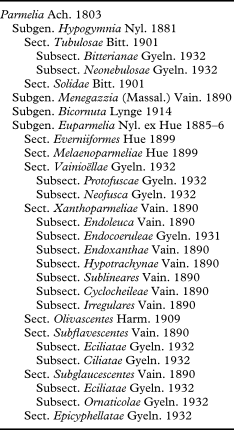
Almost all lichenologists were content to follow the system in Zahlbruckner's Catalogus, with one notable exception: the Hungarian lichenologist, and for a short time Minister of Culture and Education, Köfaragó-Gyelnik. He was generally viewed as something of a nomenclatural terrorist by his contemporaries who were infuriated by the large numbers of novel taxa he described, most of which they could not accept, and an apparent slackness in how he worked (Sjödin Reference Sjödin1954). However, as pointed out by Hale (Reference Hale1990), “he had a far deeper, though sometimes garbled, understanding of Xanthoparmelia – and other genera – than any other lichenologist of his day and was clearly far ahead of his time”, for example in his widespread use of chemical reagent tests. Gyelnik (Reference Gyelnik1932) elaborated his own system for the European parmelioid lichens with a series of subgenera, sections and subsections (Table 1). He stressed ascospore type and the presence of rhizines as subgeneric characters, thallus form and colour at the subgeneric level, and surface features, medulla colour and cilia at the subsectional level. Many of these characters were later to be utilized at the generic level in the 1970s and 1980s.
Gyelnik's (Reference Gyelnik1932) system for the parmelioid lichens

Hillmann (Reference Hillmann1936) was very conservative in his treatment of the central European parmelioid lichens, essentially following Zahlbruckner's system of subgenera and sections, apart from a new subsection Soraliferae within subgenus Hypogymnia for the P. physodes group, to differentiate them from the diffuse-sorediate species. He also introduced the new section Teretiuscula within subgen. Euparmelia for P. pubescens and P. minuscula with rounded fruticose to subfruticose lobes and no rhizines. In doing this, he seems to have been unaware of the earlier introduction of the generic name Pseudephebe by Choisy (Reference Choisy1930) for that group; Choisy speculated, in a diagrammatic evolutionary tree, that Pseudephebe was derived from Bryopogon (i.e. Bryoria) and leading to the foliose Melænoparmelia, a generic name he presumably based on Hue's sectional name although he did not attribute it to himFootnote 4. Hillmann's work is particularly notable for the large numbers of infraspecific taxa recognized, some of which later proved to have merit. The following year, Degelius (Reference Degelius1937) introduced the new generic name Cavernularia for inflated Hypogymnia-like species with narrow lobes and perforation-like depressions in the lower cortex.
The first major work on the group in North America then appeared (Berry (Reference Berry1941), in which 56 species were accepted, dispersed through the subgenera Menegazzia, Hypogymnia, Euparmelia (with four sections), and Pseudevernia. Of especial note, in addition to Berry's very detailed descriptions and ecological information, were the reduction of Pseudevernia to subgenus, and the recommendation that Parmelia saxatilis be selected as the type species of Parmelia (loc. cit.: 32). Räsänen (Reference Räsänen1943) went on to reduce Cavernularia to a section of Hypogymnia, and adopted a neater infrageneric system within Parmelia, recognizing eight discrete sections: Amphigymnia, Bicornuta, Cyclocheila, Hypotrachyna, Melanoparmelia, Pseudoparmelia, Sublinearis and Xanthoparmelia.
Krog (Reference Krog1951) applied chemical reagent and especially microcrystal tests to the parmelioid lichens, recognizing Hypogymnia and Pseudevernia at generic rank, but like Räsänen she did not accept Cavernularia as distinct from Hypogymnia; she also used the chemical products to support the exclusion of the Parmelia alpicola group from Hypogymnia. Asahina (Reference Asahina1952), however, was more conservative, maintaining both Hypogymnia and Menegazzia as subgenera in his treatment of the Japanese species. He did, however, distinguish two subsections within subgenus Euparmelia sect. Hypotrachyna: subsect. Myelochroa for species with a yellow or orange medulla, and subsect. Myeloleuca for ones with a colourless medulla. Yet perhaps the most foresighted worker on the classification of parmelioid lichens at this time was Choisy (Reference Choisy1952). Choisy resurrected and emended Massalongo's Parmotrema to embrace sections Amphigymnia and Hypotrachyna (including subsections [?] Irregularis, Regularis Footnote 5 for the Parmelia borreri group, and Sublineares) and combined Parmelia saxatilis and allied species into Parmotrema. The circumscription of Parmelia was emended to include only sections Xanthoparmelia, Melanoparmelia and Cyclocheileae.
Dodge (Reference Dodge1959) raised Amphigymnia to subgeneric rank, and also reinstated Omphalodium, characterized by umbilicate thalli, to its original rank of genus rather than subgenus.
The Code produced after the 8th International Botanical Congress in Paris in 1954 was the first to include a list of conserved generic names of lichens (Lanjouw et al. Reference Lanjouw, Baehni, Robyns, Rollins, Ross, Rousseau, Schulze, Smith, de Vilmorin and Stafleu1956). Amongst these was Parmelia which was conserved with P. saxatilis as the type species, as recommended by Berry (Reference Berry1941), not P. conspersa as selected by Clements & Shear (Reference Clements and Shear1931; see above). This proposal had been unanimously approved by the Special Committee for Lichens (Ahlner Reference Ahlner1954), and as each edition of the Code is endorsed by the successive congress this choice has to be regarded as approvedFootnote 6.
1960 –1973
Poelt (Reference Poelt1962) accepted Hypogymnia as a genus, and this decision was quickly followed by North American authors in particular. Lamb (Reference Lamb1964) transferred Hillman's sect. Teretiuscula species back into Alectoria where they had been placed by earlier workers.
The overview of Parmelia subgenus Parmelia by Hale & Kurokawa (Reference Hale and Kurokawa1964) marked a revival of interest in the genus. They endorsed the choice of P. saxatilis as type species, and Amphigymnia and Xanthoparmelia were also recognized as subgenera. Within subgen. Parmelia, five sections, four subsections, and two series were recognized; these included the new subsection Simplices for Parmelia borreri and related species, and a new series name was coined, sect. Bicornuta ser. Relicinae. Keys to species were provided, but descriptions were largely restricted to those new to science or for which new names were required. The brown species were omitted from their scheme as they had “yet to decide on their exact position in the genus” (loc. cit.: 121). This work was quickly followed by a detailed and exhaustive revision of subgenus Amphigymnia by Hale (Reference Hale1965), who selected P. tinctorum as its type. He regarded colour as “useless as a sectional character” but agreed with Gyelnik that cilia were important. Two sections were distinguished in the subgenus, Amphigymnia(syn. Subglauescentes) for species that lacked marginal or apical cilia, and Subflavescentes for ones with ciliate margins and apices; the latter section was divided into two subsections (Subflavescentes for species without maculae and Ornaticolae for ones with maculae) each of which had two series separated bythallus colour and the positions of rhizines.
Culberson & Culberson (Reference Culberson and Culberson1968) separated out the Parmelia cetrarioides group from P. sect. Amphigymnia into a new genus Cetrelia, emphasizing the marginal pycnidia and consistent absence of marginal cilia. They stressed the generally perforate apothecia, thick subhymenium, larger ascospore size, bifusiform conidia, and chemical products in separating Cetrelia from Platismatia.
1974 –1996
This is the period which witnessed an explosion in the number of new genera being segregated or resurrected from Parmelia. The starting shots were fired in 1974, when in a single year Hale re-introduced Parmotrema (Hale Reference Hale1974a), raised Hypotrachyna (Hale Reference Hale1974b), Relicina and Xanthoparmelia all to generic rank (Hale Reference Hale1974c), and also described two new genera, Bulbothrix (including sect. Bicornutae), and Parmelina (Hale Reference Hale1974c). These decisions were based primarily on differences in thallus lobe shapes, colour, marginal cilia, and rhizine types.
Everniastrum quickly followed for species formerly placed in subgenus Everniiformes (Hale 1976d), and Pseudoparmelia was extended to include Parmotrema-like species with a pored epicortex and rather adpressed narrow lobes with no marginal cilia (Hale Reference Hale1976c).
Hale did not deal with any of the brown species in the 1974 series of papers as they were the subject of a monograph being prepared by Esslinger (Reference Esslinger1977). In that work, Esslinger presented extremely detailed accounts of characters used in the systematics of the group and very full descriptions. He accepted 107 species dispersed through two subgenera, Allantoparmelia (rhizines absent) and Melanoparmelia (rhizines present); the latter subgenus had four sections, Melanoparmelia (dark, narrow-lobed, and saxicolous), Neofusca (brown or brown-black, usually HNO3+ blue-green, saxicolous or terricolous), Olivascentes (P. acetabulum group), and Vainioëllae (paler brown, broad-lobed, mainly on bark or wood). Interestingly in view of later developments, Esslinger pointed out the similarities and probable relationships of subgenus Neofusca to Xanthoparmelia, and of Melanoparmelia and Simplices. The fruticose to subfruticose genus Pseudephebe was naturally not treated by Esslinger as clearly alectorioid in thallus anatomy, but was re-instated by Brodo & Hawksworth (Reference Brodo and Hawksworth1977). Clearly influenced by Hale's more restrictive generic concepts, Esslinger (Reference Esslinger1978) went on to recognize three separate genera: Allantoparmelia, Melanelia (for subgen. Melanoparmelia), and Neofuscelia (for subgen. Neofusca). Presciently, he distinguished three subgenera within Melanelia: Melanelia, Olivascentes and Vainioëllae.
Such extensive changes did not gain rapid acceptance outside North America, and even there some dissenting views were expressed (Dey Reference Dey1978). Beltman (Reference Beltman1978) conducted a critical analysis of vegetative and ontogenetic characters in the family, including genera as circumscribed by Hale, which was illustrated by superb scanning electron micrographs; she rejected Hale's system on the basis of the ontogenetic studies in particular.
Krog & Swinscow (Reference Krog and Swinscow1979) raised Parmelia sect. Hypotrachyna to subgenus and discussed the typification of pertinent supraspecific names; they were convinced that it was a natural group, but considered the characters separating it were “not of great importance at generic level”. These sentiments were echoed by Hawksworth et al. (Reference Hawksworth, James and Coppins1980) who refrained from adopting most of the additional macrolichen genera recognized in the 1970s where there were “no correlations with ascocarp or pycnidial differences”. The generic segregates were not adopted by, for example, Poelt & Vězda (Reference Poelt and Vězda1981), Krog & Swinscow (Reference Krog and Swinscow1981) and Clauzade & Roux (Reference Clauzade and Roux1986). At the International Botanical Congress in Sydney in 1981, some problems with the generic circumscriptions were highlighted by the presentation of cell-wall composition data by Imshaug, from the studies of Ralph S. Common; his results on parmelioid lichens were never formally published, although the methodology was much later (Common Reference Common1991). At the same Congress, Krog (Reference Krog1982a) drew attention to the occurrence of four main conidium types in the parmelioid lichens which had not received much attention up to that time. Hale's emphasis on macroscopic features in generic circumscriptions had been motivated by pragmatic reasons, a way to sort quickly the huge collections he had been making in the tropics into manageable units (Hafellner et al. Reference Hafellner, Hertel, Rambold, Timdal and Hawksworth1994).
Further genera continued to be separated out through the 1980s. Sipman (Reference Sipman1980) introduced Cetrariastum for the former section Everniiformes, which he separated from Everniastrum. Culberson & Culberson (Reference Culberson and Culberson1981), however, did not accept Everniastrum and instead accepted 22 species in Cetrariastum, and introduced Concamarella for two South American species with a chambered upper cortex containing algae. Esslinger (Reference Esslinger1981) introduced Almbornia for two saxicolous subfruticose South African species, lacking rhizines, and with a dense chondroid medulla and a cortex unchanged or most faintly green-blue with HNO3. Krog (Reference Krog1982b) used differences in the type of pseudocyphellae in the recognition of Punctelia, with two subgenera differing in cortical compounds and conidium type: subgen. Punctelia with atranorin and unciform to filiform conidia (the Parmelia borreri group), and subgen. Flavopunctelia with usnic acid and bifusiformconidia (the P. flaventior group). Influenced by studies on conidium types in the family, Krog & Swinscow (Reference Krog and Swinscow1983) decided to accept Parmotrema after all, and later also adopted Hypotrachyna, Pseudoparmelia and Xanthoparmelia (Krog & Swinscow Reference Krog and Swinscow1987).
Hale (Reference Hale1984b) then raised Flavopunctelia to generic rank, and went on to introduce Arctoparmelia for P. centrifuga and similar species with usnic acid in the cortex, a velvety lower cortex, a pored epicortex, and cell wall chemistry (Hale Reference Hale1986). Three new genera were introduced by Elix et al. (Reference Elix, Johnston and Verdon1986b) for white medulla segregates from Pseudoparmelia s. str. with a yellow medulla: Canoparmelia, Paraparmelia, and Relicinopsis distinguished from each other primarily by cortical and medullary compounds, but supported by small differences in ascospore size ranges, ecology and distributions. The saxicolous arctic-alpine Brodoa was separated from Hypogymnia by virtue of the generally stuffed rather than lax medulla, cortex anatomy and larger ascospores (Goward Reference Goward1986). Flavoparmelia was introduced for species formerly referred to Pseudoparmelia but with usnic acid rather than atranorin in the cortex, and bifusiform rather than filiform conidia, differences in medullary chemistry, and thick-walled ascospores (Hale Reference Hale1986b). In revising Xanthoparmelia in Australasia, Elix et al. (Reference Elix, Johnston and Verdon1986b: 165), while adopting Hale's concept, noted similarities to Neofuscelia and some species then placed in Pseudoparmelia, and commented: “Whether or not this genus will ultimately accommodate grey and brown, usnic acid deficient, saxicolous species remains to be determined”.
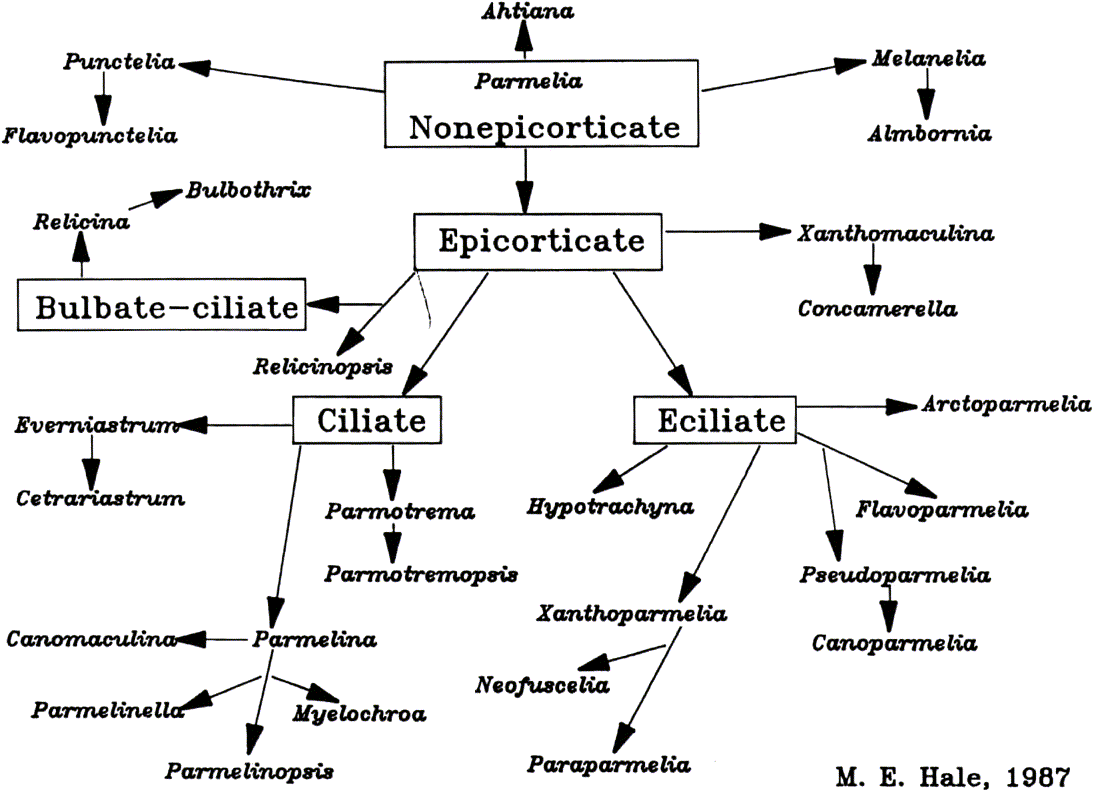
Nevertheless, despite such suspicions, the trend of circumscribing more genera continued. Elix & Hale (Reference Elix and Hale1987) separated out five genera from Parmelina: newly describing Canomaculina, Parmelinella, Parmelinopsis, and Parmotremopsis, and raising Myelochroa to generic rank. These five genera were differentiated on the basis of the medullary compounds, marginal cilia, lobe width, and ascospore sizes. At the International Botanical Congress in Berlin in 1987, Hale distributed a document listing the 26 genera he then accepted in Parmeliaceae (“excluding cetrarioid groups, Pseudevevtenia, and Hypogymniaceae” but actually also fruticose genera) with a figure indicating his personal view of their relationships (Fig. 1) which does not appear to have ever been formally published; it is presented here in view of its historical interest.
Hale's schematic representation of the relationship between the parmelioid lichen genera he recognized, presented at the XIVth International Botanical Congress in Berlin in 1987.

Awasthi (Reference Awasthi1987) introduced Parmelaria for two Himalayana Parmotrema-like species with dark wart-like pycnidia and large ascospores. Pleurosticta, originally described as a lichenicolous coelomycete growing on a parmelioid lichen (Petrak Reference Petrak1931), but found to be based on the regular cylindrical to fusiform conidia of Parmelia acetabulum (Santesson Reference Santesson1949), was resurrected by Lumbsch et al. (Reference Lumbsch, Kothe and ELix1988); they also discovered that it differed from other species that had been placed in Melanelia in having a pored epicortex.
Three genera were segregated from Xanthoparmelia around this time: Namakwa for a single South African saxicolous species with pseudocyphellae and uniseriate ascospores (Hale Reference Hale1988); Psiloparmelia for two species, one Central and South American and the other from southern Africa, distinguished by a velvety lower cortex lacking rhizines, and the absence of lichenin (Hale Reference Hale1989a); and Karoowia for 16 mainly South African saxicolous species with almost crustose thalli with almost placodioid margins, sometimes rhizoid-like attachments or bare below, and rather long cylindrical conidia (Hale Reference Hale1989a).
Also recognized around this time was Rimelia for 12 species of Parmotrema-like lichens (the Parmelia reticulata group) with distinct, fine white reticulate-maculate upper cortices, sometimes breaking open along the cracks (Hale & Fletcher Reference Hale and Fletcher1990). Rimeliella, also with a reticulate-maculate surface, was introduced by Kurokawa (Reference Kurokawa1991) for seven other species formerly placed in Parmotrema but distinguished on the basis of having mixed short and long rhizines and often sparsely branched marginal cilia; several species also produced usnic acid in the cortex.
More recently, Kurokawa (Reference Kurokawa1994) proposed a new subgenus Nipponoparmelia to include a group of East Asian species previously placed in Parmelia s. str. (Hale Reference Hale1987) that differed morphologically from other species in the genus in the lateral, punctate pseudocyphellae. Later, Marcano et al. (Reference Marcano, Mohali, Palacios-Prü and Morales1996) segregated Bulbotricella to include the single species Bulbothrix amazoniensis, which occurs in the Venezuelan Amazon and exhibits several singular features, notably multispored asci, obovate and acrogenous conidia, and a pored epicortex.
Unease about general acceptance of this increasing number of new generic names continued through the 1980s into the 1990s. A common practice that developed was to continue to use Parmelia in a broad sense, but also cite the segregate names or give them as an alternative (e.g. Santesson Reference Santesson1984; Awasthi Reference Awasthi1988; Purvis et al. Reference Purvis, Coppins, Hawksworth, James and Moore1992). Poelt (Reference Poelt and Hawksworth1991) was especially concerned about the use of cortical compounds (i.e. atranorin vs. usnic acid) as a generic criterion. Nimis (Reference Nimis1993: 471) commented that “at least in some cases, the characters which are utilized for defining the new genera are more appropriate for infrageneric units”, but he did accept Allantoparmelia and Parmotrema. Brusse (e.g. Brusse Reference Brusse1993) continued to use and describe novel species in Parmelia in the broad sense. The issue was hotly debated at an international meeting on ascomycete systematics in Paris in 1993, where Hawksworth acknowledged that there certainly were monophyletic groups within Parmelia s. lat. that would be recognized as corroborating evidence was obtained (Hafellner et al. Reference Hafellner, Hertel, Rambold, Timdal and Hawksworth1994).
The need for some synthesis was becoming critical, and sadly Hale's tragic death at the age of only 62 in 1990 precluded him from ever doing that; when one of the authors (DLH) last met him at the Smithsonian Institution on 28 June 1989, he was struggling to complete his monograph of Xanthoparmelia. In the event, that work treating 406 species was published posthumously (Hale Reference Hale1990), but in this he reflected on the history of studies of that group, and discussed the taxonomic importance of the characters used in species separation. For more information on Hale's work and the development of his concepts, see DePriest (Reference DePriest1999). In an issue of The Bryologist dedicated to Hale, Elix (Reference Elix1993) prepared the much-needed and extremely valuable synopsis of the 63 genera then being accepted in Parmelia s. lat., including a synoptic key. In this work, Elix recognized that the problem to be addressed was not so much grouping but ranking.
1997 –2010
The advent of molecular systematics in the mid-1990s provided an independent method of testing the phylogenetic significance of characters for the first time, as well as the monophyly of any proposed genera. The molecular age now made progress towards an international consensus on generic concepts in the parmelioid feasible.
The first attempt to test phylogenetic relationships and generic circumscriptions in the segregates from Parmelia (parmelioid) appeared in 1998 (Crespo & Cubero Reference Crespo and Cubero1998). This preliminary work was based on a single locus (rDNA nuclear ITS), and only 15 genera were included. Most of the genera Hale had segregated formed monophyletic clades, but others did not. The brown parmelioid Neofuscelia clustered within the yellow-green Xanthoparmelia, and the reticulate-maculate Rimelia within non-reticulated Parmotrema. However, the marker used was highly variable for suprageneric treatments, and being a single marker and including only a modest number of lineages, relationships amongst the genera were not well-supported. This pioneering phylogeny, together with two cladistic analyses of morphological and chemical features (Crespo et al. Reference Crespo, Gavilán, Elix and Gutiérrez1999; Louwhoff & Crisp Reference Louwhoff and Crisp2000), suggested that these traits were not suitable for the inference of phylogenetic relationships either. Louwhoff & Crisp (Reference Louwhoff and Crisp2000) indicated that Rimelia and Canomaculina might be better treated as subgenera of Parmotrema. Further, as a result of studying abundant material from South Africa, Esslinger (Reference Esslinger2000) noted that the HNO3+ blue-green reaction previously used in support of the recognition of Neofuscelia was absent in “a significant number of southern African species” but present in several members of Paraparmelia and Xanthoparmelia from the region.
In a further molecular phylogeny of the group, Crespo et al. (Reference Crespo, Blanco and Hawksworth2001) enlarged the data set, including species belonging to 30 genera in the family (with the type species of 21). In this work the mitochondrial DNA (mtDNA) SSU region was supported as a suitable locus to play a major role in establishing the phylogeny and circumscription of generic concepts in parmelioid lichens. Some clades identified appeared to correlate with differences in cell wall carbohydrates, epicortical extrolites, and other features. Moreover, this molecular marker indicated new relationships among genera and provided better support to inner nodes.
New morphological or chemical studies were also gradually becoming available to clarify and complement the molecular information. One of the most interesting foci was the circumscription of Xanthoparmelia, which was first described to include yellow-green species with usnic acid in the cortex. Elix (Reference Elix2003) subsumed Paraparmelia within Xanthoparmelia. Paraparmelia had been distinguished by the absence of usnic acid, but it was synonymized on the basis of morphological and chemical evidence. This decision marked the start of the development of a new circumscription for Xanthoparmelia. After that, several studies using multilocus molecular data showed the Xanthoparmelia lineage to be by far the largest group of parmelioid lichens. Moreover, chemical and morphological features, a peculiar cell-wall lichenan (xanthoparmelia-type, Elix Reference Elix1993), and other synapomorphies such as the smaller ascospores (Elix Reference Elix1993) with arachiform vacuoles (Del Prado et al. Reference Del Prado, Ferencovà, Armas-Crespo, Amo de Paz, Cubas and Crespo2007) also supported this monophyletic group. The circumscription of the genus was then enlarged to include Neofuscelia, Chondropsis, some species of Karoowia (Blanco et al. Reference Blanco, Crespo, Elix, Hawksworth and Lumbsch2004a), later Almbornia, Namakwa and Xanthomaculina (Thell et al. Reference Thell, Feuerer, Elix and Kärnefelt2006), and more recently also Karoowia, Omphalodiella and Placoparmelia (Amo de Paz et al. Reference Amo de Paz, Lumbsch, Cubas, Elix and Crespo2010 a, b).
In several other groups of genera, the results of molecular phylogenetic studies paralleled those found in Xanthoparmelia. Multilocus molecular analyses revealed another large lineage including Parmotrema, and several genera which nested within that genus were synonymized, notably Rimelia, Concamerella and Canomaculina (Blanco et al. Reference Blanco, Crespo, Divakar, Elix and Lumbsch2005). Interestingly, compared with other parmelioid clades, species of this lineage characteristically have larger ascospores with a thickened outer layer (epispore).
In contrast to the situation in Xanthoparmelia and Parmotrema, however, molecular studies revealed that Melanelia was polyphyletic and two new genera were described (Melanelixia and Melanohalea; Blanco et al. Reference Blanco, Crespo, Divakar, Esslinger, Hawksworth and Lumbsch2004b). Similarly, Hypotrachyna (Divakar et al. Reference Divakar, Crespo, Blanco and Lumbsch2006, Reference Divakar, Lumbsch, Ferencova, Del Prado and Crespo2010) also proved to be polyphyletic, and Remototrachyna was described as an independent lineage accommodating mostly species from south-east Asia. Further, analyses of Parmelina species revealed two groups meriting recognition as genera; Parmelina included species from Eurasia, and the new genus Austroparmelina ones from Australasia (Crespo et al. Reference Crespo, Ferencova, Pérez-Ortega, Argüello, Elix and Divakar2010b).
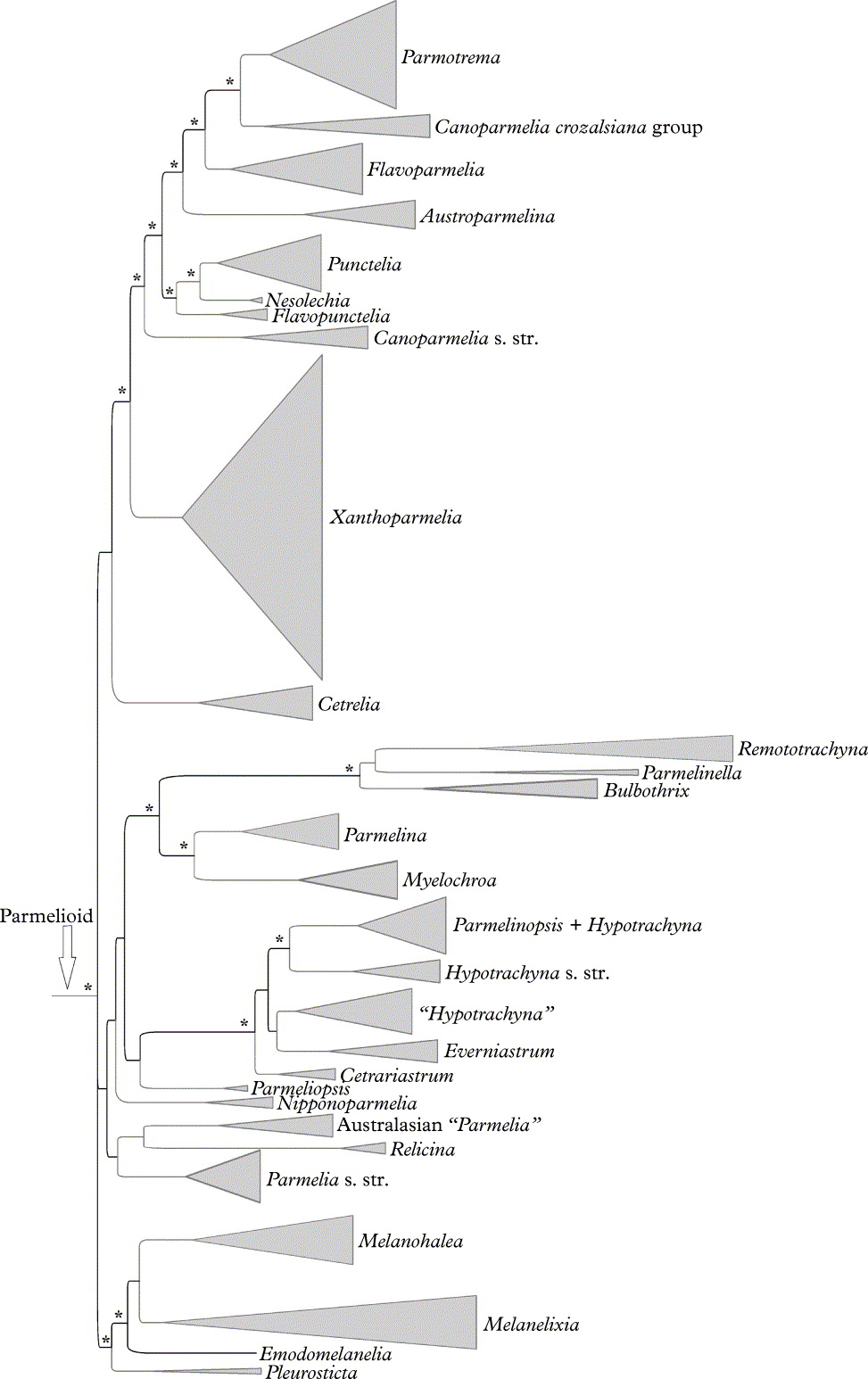
However, all these studies demonstrate that the parmelioid lichens constitute a monophyletic group, supported by multilocus data sets (Blanco et al. Reference Blanco, Crespo, Ree and Lumbsch2006; Crespo et al. Reference Crespo, Lumbsch, Mattsson, Blanco, Divakar, Articus, Wiklund, Bawingan and Wedin2007, Reference Crespo, Kauff, Divakar, del Prado, Pérez-Ortega, Amo de Paz, Ferencova, Blanco, Roca-Valiente and Núñez-Zapata2010a) and make it one of the best phylogenetically investigated groups of lichenized fungi. Indeed, 75 % of the species are gathered into a monophyletic cluster where the main relationships are well-known; in this cluster are Parmotrema, Flavoparmelia, Austroparmelina, Flavopunctelia, Punctelia, Canoparmelia, Xanthoparmelia, and Cetrelia. The remaining 25 % of species are included in genera where the relationships are not yet as clear. This minority group comprises Hypotrachyna and other smaller genera, including Parmelina and Myelochroa, Parmelia s. str., Melanelixia, Melanohalea, Nipponoparmelia, and Bulbothrix (Crespo et al. Reference Crespo, Kauff, Divakar, del Prado, Pérez-Ortega, Amo de Paz, Ferencova, Blanco, Roca-Valiente and Núñez-Zapata2010a). Tropical and subtropical lineages have evolved faster than those from temperate or cooler regions and the acceleration may be due to the largest number of generations occurring in mild environments (Lumbsch et al. Reference Lumbsch, Hipp, Divakar, Blanco and Crespo2008).
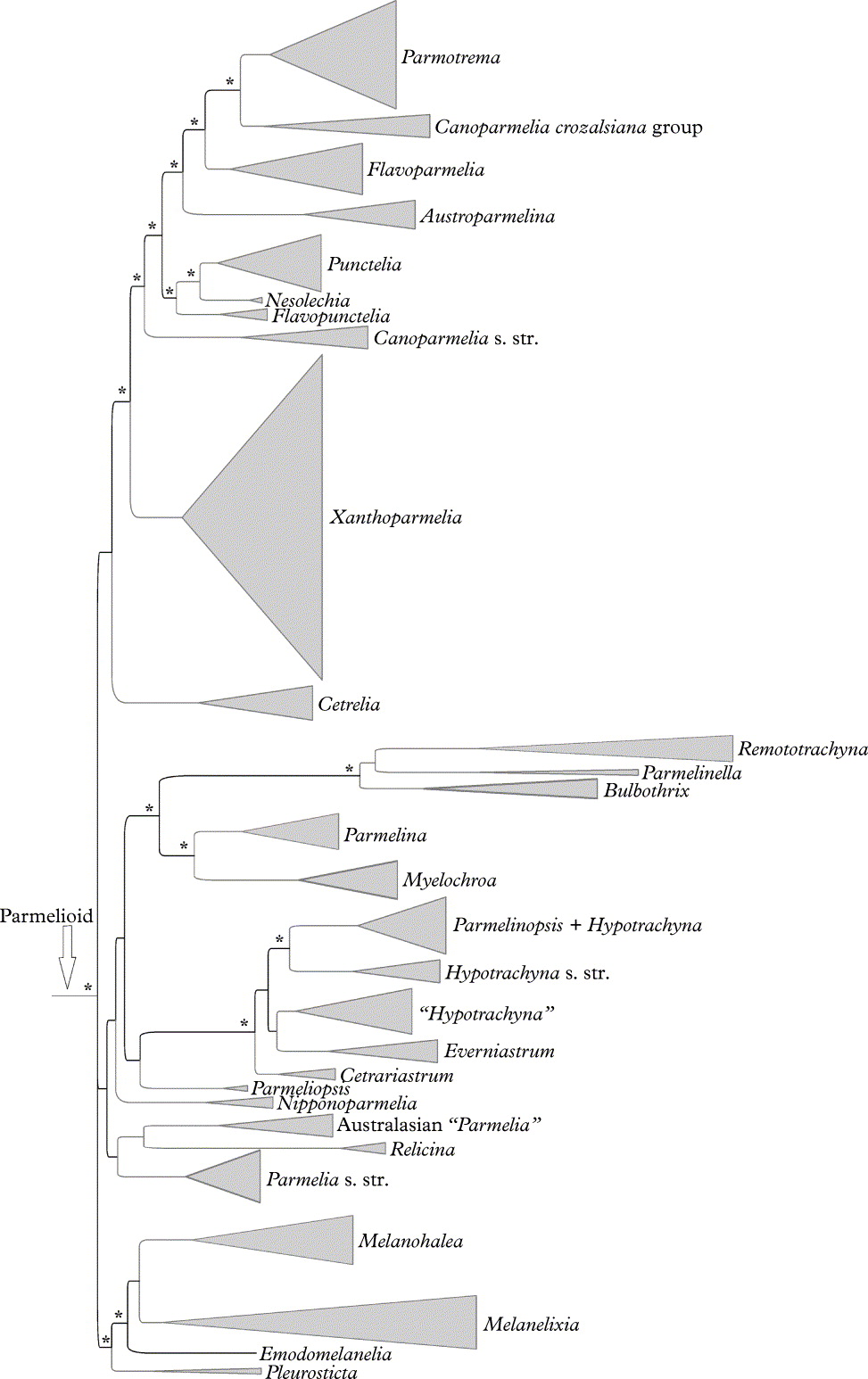
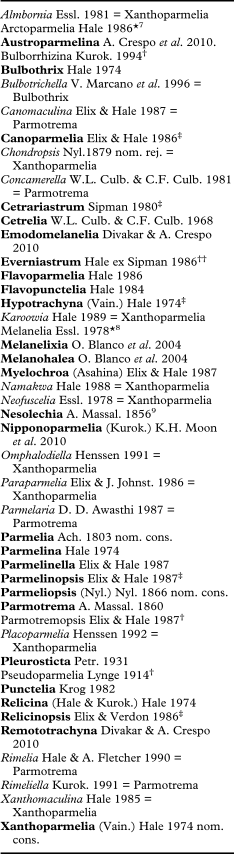
Our current understanding of the relationships amongst the parmelioid lichens is summarized in Figure 2, and the current application of the generic names of parmelioid lichens is given in Table 2.
A simplified consensus modern phylogenetic tree of the parmelioid and similar lichens, based on that of Crespo et al. (Reference Crespo, Kauff, Divakar, del Prado, Pérez-Ortega, Amo de Paz, Ferencova, Blanco, Roca-Valiente and Núñez-Zapata2010a). The molecular tree was obtained from a Bayesian analysis of a 3-gene dataset. An asterisk (*) on the branches represents supported nodes. The sizes of triangles are in proportion to the number of species described in each genus.
Current state of generic names in parmelioid lichens. Accepted names are indicated in bold face and synonyms in italics.
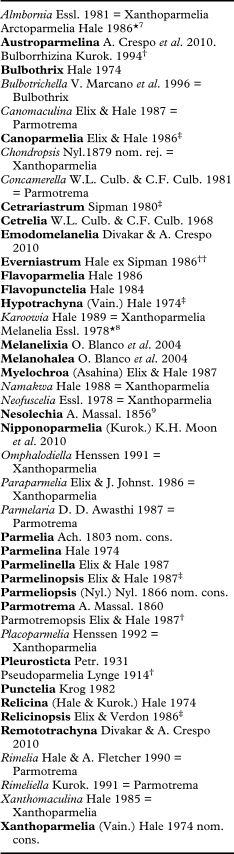
* = Belongs to non-parmelioid groups.
† = Uncertain status because of lack of molecular studies including the type species of the genus.
‡ = Generic status and or circumscription require further study.
Characters used in generic circumscriptions
The extensive molecular data now available in the parmelioid lichens permits an assessment of the phylogenetic value of different characters at the generic level. However, as stated by Lumbsch (Reference Lumbsch, Frisvad, Bridge and Arora1998: 365): “a character by itself has no taxonomic value a priori but may have importance when correlated with other independent characters. This however, can only be evaluated a posteriori”.
Ascomata
The position of apothecia has traditionally been used to distinguish the cetrarioid and parmelioid groups of genera within Parmeliaceae: cetrarioid genera are characterized by marginal apothecia, while parmelioid genera are distinguished by laminal apothecia. Recent molecular studies have shown that the genera Cetrelia and Parmelaria, previously considered as cetrarioid lichens, belong to the parmelioid group, while Melanelia s. str. is actually cetrarioid. That Parmelaria is found to be a synonym of Parmotrema, suggests that this character is shared for most species of all genera of cetrarioid lichens, but is not universally of value in generic classifications (Blanco et al. Reference Blanco, Crespo, Divakar, Esslinger, Hawksworth and Lumbsch2004b, Reference Blanco, Crespo, Divakar, Elix and Lumbsch2005; Thell et al. Reference Thell, Högnabba, Elix, Feuerer, Kärnefelt, Myllys, Randlane, Saag, Stenroos and Ahti2009; Crespo et al. Reference Crespo, Kauff, Divakar, del Prado, Pérez-Ortega, Amo de Paz, Ferencova, Blanco, Roca-Valiente and Núñez-Zapata2010a). Similarly some genera, notably Karoowia and Omphalodiella, are characterized by having the apothecia immersed in the thallus (Hale Reference Hale1989a; Henssen Reference Henssen1991). However, Amo de Paz et al. (Reference Amo de Paz, Lumbsch, Cubas, Elix and Crespo2010b) synonymized Karoowia and Omphalodiella within Xanthoparmelia, finding this of no importance at the generic level.
Perforate apothecia are a particular feature of Parmotrema, though they do not occur in all species of the genus; we have not encountered them in any other parmelioid genus although they do occur in Cetrelia and Platismatia (Culberson & Culberson Reference Culberson and Culberson1968). Ascomatal anatomy has largely been ignored in taxonomic studies of parmelioid lichens, based on the assumptions that they are uniform within the group, and also because they are rare or unknown in many species. Some preliminary scanning electron micrographs suggested that there could be significant differences in the structure of the true (cupular) exciples in a range of parmelioid lichens (Sincock Reference Sincock1982), but this aspect remains in need of more critical studies only recently initiated (Z. Ferencova, unpublished data). However, it has recently been shown that Remototrachyna differs from Hypotrachyna in the anatomy of the cupular exciple, in the thickness of the hyphal walls, and this is supported in the molecular phylogeny (Divakar et al. Reference Divakar, Lumbsch, Ferencova, Del Prado and Crespo2010). Similarly, Australasian species of Parmelina and some Canoparmelia species are now being accommodated in the newly described lineage Austroparmelina, which differs from Parmelina in having a cupulate exciple consisting of a plectenchyma with thick hyphal walls (Crespo et al. Reference Crespo, Ferencova, Pérez-Ortega, Argüello, Elix and Divakar2010b).
The only detailed ontogenetic study of parmelioid lichen remains that of Letrouit-Galinou (Reference Letrouit-Galinou1970) on Xanthoparmelia conspersa. All asci are of the lecanoralean-type, but Thell et al. (Reference Thell, Mattsson and Kärnefelt1995) distinguished eight ascus “forms” with the alectorioid and parmelioid lichens which were different from the cetrarioid. It is evident that these characters merit further scrutiny, but this requires critical transmission-electron microscopic (TEM) studies based on freshly collected material of a wider range of species in order to make an objective estimate of its value. Similarly, whether or not there are differences in interascal (hamathecial) elements, for example in their branching and apical structures, has yet to be studied in depth.
Ascospore characters have historically received scant recognition in taxonomic studies of parmelioid lichens, although Ahti (Reference Ahti1966) has already noted their importance as specific characters in the brown corticolous species. Their size and shape have been considered of value at the generic level in Parmeliaceae (Elix Reference Elix1993, Reference Elix1994; Divakar & Upreti Reference Divakar and Upreti2005), and as more attention is devoted to them it is becoming clear that ascospore features are as important in the family as in other lichenized and non-lichenized ascomycetes. Thick-walled ascospores are a particular feature of the Parmotrema clade, and a distinctive vacuolar body appear as a synapomorphy in the Xanthoparmelia clade; in all species of the latter genus so far examined, the vacuolar body is arachiform (Del Prado et al. Reference Del Prado, Ferencovà, Armas-Crespo, Amo de Paz, Cubas and Crespo2007).
Conidiomata
In some earlier classifications, the position where the conidiomata arose was regarded as significant. Indeed, the parmelioid group was distinguished from the morphologically similar cetrarioid group in having laminal immersed pycnidia as opposed to marginal emergent pycnidia. However, in the current classification, Parmelaria with marginal emergent pycnidia belongs with the parmelioid lichens (Crespo et al. Reference Crespo, Kauff, Divakar, del Prado, Pérez-Ortega, Amo de Paz, Ferencova, Blanco, Roca-Valiente and Núñez-Zapata2010a). The anatomical structure of the pycnidial walls, however, has hardly been investigated.
Conidia were considered to be of particular importance as taxonomic characters in macrolichens by Choisy in the mid-20th century, but have been accorded little attention by most subsequent workers. The arrangement of the conidiogenous cells was regarded as the basis for the separation of Parmeliopsis and Imshaugia from the rest of the parmelioids. These two genera have the so-called exobasidial arrangement (the Psora-type), while in the main parmelioid clade they are endobasidial (Parmelia-type) (Vobis & Hawksworth Reference Vobis, Hawksworth, Cole and Kendrick1981; Meyer Reference Meyer1982, Reference Meyer1985). However, molecular studies have now shown that Parmeliopsis belongs amongst the parmelioids and Imshaugia to other non-parmelioid groups (Divakar et al. Reference Divakar, Crespo, Blanco and Lumbsch2006; Crespo et al. Reference Crespo, Lumbsch, Mattsson, Blanco, Divakar, Articus, Wiklund, Bawingan and Wedin2007, Reference Crespo, Kauff, Divakar, del Prado, Pérez-Ortega, Amo de Paz, Ferencova, Blanco, Roca-Valiente and Núñez-Zapata2010a). Thus, the arrangement of the conidiogenous cells appears to be of little value for distinguishing these main groups, though it is useful for generic distinctions.
Conidial type has been used as a correlating feature in several generic delimitations in Parmeliaceae (Krog Reference Krog1982b; Hale Reference Hale1984a; Elix Reference Elix1993). Flavopunctelia is segregated from Punctelia, and Relicina from Bulbothrix, in having bifusiform and unciform conidia respectively (Hale Reference Hale1974a, Reference Hale1984b; Krog Reference Krog1982b). The evaluation of the significance of conidial shape using molecular markers showed that most of the lineages are supported by consistencies in conidium type: for example, Flavopunctelia with bifusiform, Punctelia unciform, Relicina bifusiform, Bulbothrix cylindrical, and Parmeliopsis with falcate, although Xanthoparmelia has species with bifusiform and cylindrical types (Crespo et al. Reference Crespo, Kauff, Divakar, del Prado, Pérez-Ortega, Amo de Paz, Ferencova, Blanco, Roca-Valiente and Núñez-Zapata2010a). These correlations show that conidial type merits more attention ingeneric circumscriptions, but we stress that critical high-power microscopy using appropriate mountants that do not affect size and shape is necessary for their proper study. Conidia also merit more attention at the species level, as made clear by Culberson & Culberson (Reference Culberson and Culberson1980) who used them to support the separation of two species now placed in Punctelia.
Cortical chemistry
Cortical and medullary compounds in lichens and their use as taxonomic characters have been assessed, but only prior to the eruption of molecularly-based phylogenetic studies (Hawksworth Reference Hawksworth, Brown, Hawksworth and Bailey1976; Lumbsch Reference Lumbsch, Frisvad, Bridge and Arora1998). It was generally accepted that, due to their postulated biological, ecological and consequently evolutionary significance, the cortical compounds had an important role in systematic arrangements (Elix Reference Elix1993); there was general agreement on the correlation of this character with generic level or higher taxonomic ranks. However, Culberson & Culberson (Reference Culberson and Culberson1970) already cautioned that chemical data were likely to be of most value at the infrageneric level.
Atranorin and usnic acids are the compounds responsible for the grey and yellow-green upper surface, respectively, in parmelioid lichens. Likewise, brown to almost black surfaces are due to melanins. The case of the presence of atranorin and usnic acid usually excluding each other was used to propose the separation of usnic acid containing species of Lecanora under the resurrected generic name Straminella (Pérez-Ortega et al. Reference Pérez-Ortega, Spribille, Palice, Elix and Printzen2010). Moreover, differences in the anatomy of groups of Lecanora species with atranorin and Lecanora species with usnic acid supported the dichotomy. However, deeper investigations showed that in many cases species shared crossed characters, concluding that it “does not mean that all taxa in Lecanora with usnic acid will remain in the genus, but it is clear that there is not a simple dichotomy” (Lumbsch Reference Lumbsch, Frisvad, Bridge and Arora1998).
Some parmelioid genera were segregated primarily on this feature: for example, Flavopunctelia from Punctelia (Hale Reference Hale1984b), Relicina from Bulbothrix (Hale Reference Hale1974a), Paraparmelia from Xanthoparmelia (Elix et al. Reference Elix, Johnston and Verdon1986b), Flavoparmelia from Pseudoparmelia (Hale Reference Hale1986b), and Neofuscelia and Melanelia from Xanthoparmelia and other brown Parmelia s. lat. species (Esslinger Reference Esslinger1978). However, in some other genera of the family, differences in cortical chemistry have been accorded less status and variability allowed within the genus, as in Canoparmelia (Elix et al. Reference Elix, Johnston and Verdon1986b), Hypotrachyna (Hale Reference Hale1975), Parmeliopsis (Hawksworth Reference Hawksworth1985), and Parmotrema (Hale Reference Hale1974b). On the other hand, improved analytical techniques (HPLC) have shown that in several cases the presence/absence of compounds was not properly diagnosed previously and has a wider variation than had been assumed (Elix Reference Elix1993, Reference Elix2003). Taking note of such variations, Elix (Reference Elix2003) synonymized Paraparmelia under Xanthoparmelia.
As a result of molecular phylogenetic studies, Blanco et al. (Reference Blanco, Crespo, Elix, Hawksworth and Lumbsch2004a) synonymized Neofuscelia (brown upper surface due to melanoid substances) with Xanthoparmelia (yellow-green upper surface due to usnic acid) and the study also supported the previous synonymy of Paraparmelia (grey upper surface containing atranorin) within Xanthoparmelia. The only character that had separated these three genera was the colour of the upper surface. In further molecular studies, three more genera having a brown upper surface, Almbornia, Omphalodiella and Placoparmelia, clustered within Xanthoparmelia and so were also synonymized within it (Thell et al. Reference Thell, Feuerer, Elix and Kärnefelt2006; Amo de Paz et al. Reference Amo de Paz, Lumbsch, Cubas, Elix and Crespo2010a).
Molecular phylogenetic studies have shown that cortical chemistry (atranorin, usnic acid and melanin) is a homoplasic state in this group of lichenized fungi (Blanco et al. Reference Blanco, Crespo, Elix, Hawksworth and Lumbsch2004a, Reference Blanco, Crespo, Ree and Lumbsch2006; Thell et al. Reference Thell, Feuerer, Elix and Kärnefelt2006; Crespo et al. Reference Crespo, Lumbsch, Mattsson, Blanco, Divakar, Articus, Wiklund, Bawingan and Wedin2007, Reference Crespo, Kauff, Divakar, del Prado, Pérez-Ortega, Amo de Paz, Ferencova, Blanco, Roca-Valiente and Núñez-Zapata2010a; Amo de Paz et al. Reference Amo de Paz, Lumbsch, Cubas, Elix and Crespo2010b). These compounds appear to have been lost and gained several times, indicating that the taxonomic value of these features had been overestimated in previous classifications.
It should be noted that Relicina (with usnic acid), which was segregated from Bulbothrix (with atranorin), proved to be distant phylogenetically and independently monophyletic (Divakar et al. Reference Divakar, Crespo, Blanco and Lumbsch2006, Reference Divakar, Lumbsch, Ferencova, Del Prado and Crespo2010; Crespo et al. Reference Crespo, Lumbsch, Mattsson, Blanco, Divakar, Articus, Wiklund, Bawingan and Wedin2007, Reference Crespo, Kauff, Divakar, del Prado, Pérez-Ortega, Amo de Paz, Ferencova, Blanco, Roca-Valiente and Núñez-Zapata2010a); this is not an exception as Relicina is also distinguished from Bulbothrix in having bifusiform conidia.
We conclude that cortical substances alone cannot be used as a key character for generic separations in parmelioid lichens as it was previously supported in parmelioid (Elix Reference Elix1993) and also in other groups (Hawksworth Reference Hawksworth, Brown, Hawksworth and Bailey1976; Lumbsch Reference Lumbsch, Frisvad, Bridge and Arora1998).
Fungal wall polysaccharides
Structural polysaccharides in hyphal walls, such as chitin and β-glucan, are fundamental characters in fungal phyla (Bartnicki-Garcia Reference Bartnicki-Garcia1968; Adl et al. Reference Adl, Simpson, Farmer, Andersen, Anderson, Barta, Bowser, Brugerolle, Fensome and Fredericq2005; Kirk et al. Reference Kirk, Cannon, Minter and Stalpers2008). The chemical characterization of these complex polysaccharide molecules requires extraction from substantial amounts of material, purification, and mass-spectrography, but differential staining has been used as diagnostic in some cases. The taxonomic utility of this feature was developed in Parmeliaceae by Common (Imshaug Reference Imshaug1981; Common Reference Common1991), who distinguished four major groups of compounds: isolichenan, Xanthoparmelia-type lichenan, Cetraria-type lichenan, and intermediate-type lichenan. These polysaccharides have been identified by their staining properties with different iodine reagents (Common Reference Common1991), but difficulties with the precision of the technique have been articulated (Elix Reference Elix1993, Reference Elix1994; Divakar & Upreti Reference Divakar and Upreti2005).
In spite of difficulties, these structural polysaccharides prove to be diagnostic for some genera of parmelioid lichens, for example Xanthoparmelia-type lichenan in Xanthoparmelia, Cetraria-type lichenan in Parmotrema, and isolichenan in Flavoparmelia (Elix Reference Elix1993, Reference Elix1994). The taxonomic value of these compounds is vindicated by their occurrence in particular molecularly substantiated lineages. In the current generic system, Xanthoparmelia is characterized by Xanthoparmelia-type lichenan, and Parmotrema by intermediate type lichenan (Blanco et al. Reference Blanco, Crespo, Elix, Hawksworth and Lumbsch2004a, Reference Blanco, Crespo, Divakar, Elix and Lumbsch2005; Crespo et al. Reference Crespo, Lumbsch, Mattsson, Blanco, Divakar, Articus, Wiklund, Bawingan and Wedin2007, Reference Crespo, Kauff, Divakar, del Prado, Pérez-Ortega, Amo de Paz, Ferencova, Blanco, Roca-Valiente and Núñez-Zapata2010a).
It is therefore clear that structural fungal-wall polysaccharides proved to be synapomorphic, suggesting that these are reliable characters for use in the generic circumscription of parmelioid lichens.
Another group of fungal wall compounds which has proved of particular value at the generic level in ascomycetes is the alkali-extractable and water soluble heteromannans (Leal et al. Reference Leal, Prieto, Bernabé and Hawksworth2010). These complex polysaccharides have repeating units and side chains that require NMR studies for their characterization; 39 such compounds have been recognized, and in ascomycetes in general prove to be phylogenetically informative around the generic level and above. However, to date those in any member of Lecanoromycetes have yet to be fully characterized. Gorin & Iacomini (Reference Gorin and Iacomini1985) did include Parmelia sulcata in a study suggesting that galactomannans were typical of different lichens, but they did not include other parmelioid species. Subsequent studies on Parmotrema and Rimelia species revealed such small differences in galactomannans and glucans that it was suggested that these did not support the separation of those two genera (Carbonero et al. Reference Carbonero, Mellinger, Eliasaro, Gorin and Iacomini2005a, b). However, a small pilot study on a few selected species drawn from a wider range of parmelioid genera that we conducted to assess the efficacy of the approach in this group, gave problematic results (A. Prieto, J. A. Leal, A. Crespo & D. L. Hawksworth, unpublished data) and has yet to be evaluated further.
Surface features
The pioneering scanning electron microscopic study by Hale (Reference Hale1973) revealed a suite of characters that he later emphasized in generic separations. He discovered that some had a thin 0·6–1 µm thick polysaccharide layer above the cortical hyphae, for which the term “epicortex” was proposed by Hawksworth (Hale Reference Hale1973), while some did not, as in Pseudevernia where the surface comprised the stubby hyphal tips. In species with an epicortex, he found that the layer could either be continuous (non-pored) or be perforated by minute discrete pores (pored) which were generally roughly circular but sometimes tended to coalesce, formingfenestrations observable as faint imprecise bleached spots (Blanco et al. Reference Blanco, Crespo, Elix, Hawksworth and Lumbsch2004). The surfaces could appear quite smooth, or be reticulately maculate. The pseudocyphellae occurred in species with a non-pored epicortex; they were structurally more complex and did not originate in the same way as epicortical pores (Hale Reference Hale1981).
All these features were used in generic separations, for example Canomaculina and Rimelia were segregated from Parmelina and Parmotrema in having effigurate white and reticulate maculae respectively (Elix & Hale Reference Elix and Hale1987; Hale & Fletcher Reference Hale and Fletcher1990). Louwhoff & Crisp (Reference Louwhoff and Crisp2000) suggested that Canomaculina and Rimelia should be included in Parmotrema based on a cladistic study of morphological and chemical features, and this was confirmed by subsequent molecular phylogenetic studies, later Canomaculina and Rimelia being formally synonymized under Parmotrema by Blanco et al. (Reference Blanco, Crespo, Divakar, Elix and Lumbsch2005).
A pseudocyphellate upper surface, with or without a non-pored epicortex, was regarded as a key character for distinguishing Cetrelia, Flavopunctelia, Parmelia s. str, Pleurosticta, and Punctelia from other parmelioid genera (Krog Reference Krog1982; Hale Reference Hale1984b, Reference Hale1987). Most of these genera formed monophyletic groups in molecular phylogenetic studies (Wedin et al. Reference Wedin, Döring and Mattsson1999; Crespo et al. Reference Crespo, Blanco and Hawksworth2001, Reference Crespo, Lumbsch, Mattsson, Blanco, Divakar, Articus, Wiklund, Bawingan and Wedin2007, Reference Crespo, Kauff, Divakar, del Prado, Pérez-Ortega, Amo de Paz, Ferencova, Blanco, Roca-Valiente and Núñez-Zapata2010a; Blanco et al. Reference Blanco, Crespo, Divakar, Elix and Lumbsch2005, Reference Blanco, Crespo, Ree and Lumbsch2006; Lumbsch et al. Reference Lumbsch, Hipp, Divakar, Blanco and Crespo2008). However, Parmelia s. str. proved to be polyphyletic and a generic rank was subsequently accorded to the species included in Parmelia subgen. Nipponoparmelia; that independent monophyletic lineage is corroborated by the presence of marginal round pseudocyphellae (Crespo et al. Reference Crespo, Kauff, Divakar, del Prado, Pérez-Ortega, Amo de Paz, Ferencova, Blanco, Roca-Valiente and Núñez-Zapata2010a). Melanelia s. lat., as circumscribed by Esslinger (Reference Esslinger1978), included brown parmelioid lichens all with a negative reaction to HNO3, but with or without pseudocyphellae. In the molecular phylogenetic study of Blanco et al. (Reference Blanco, Crespo, Elix, Hawksworth and Lumbsch2004b), three independent groups were found within this concept, and two were described as new genera: Melanelixia with a pored epicortex and no pseudocyphellae, and Melanohalea with a non-pored epicortex and pseudocyphellae.
It must, however, be recognized that all “pseudocyphellae” are not necessarily homologous. Feuerer & Marth (Reference Feuerer and Marth1997) pointed out that in those of Flavopunctelia and Punctelia, areas of the cortex are missing so that the medullary tissues reach the surface (Punctelia-type), whereas in 140 other members of the family investigated these represented altered areas of the cortex where the polysaccharide matrix had been reduced (Cetraria-type).
Molecular phylogenetic inferences of character evolution suggest that the non-pored epicortex (mostly occurring in pseudocyphellate species) appears to have been gained more often than lost in the phylogeny of parmelioid lichens, evolving independently in the Cetrelia, Punctelia, Flavopunctelia, Parmelia, Melanohalea, and Nipponoparmelia lineages (Crespo et al. Reference Crespo, Lumbsch, Mattsson, Blanco, Divakar, Articus, Wiklund, Bawingan and Wedin2007, Reference Crespo, Kauff, Divakar, del Prado, Pérez-Ortega, Amo de Paz, Ferencova, Blanco, Roca-Valiente and Núñez-Zapata2010a). Consequently, this feature could be regarded as a key character for generic delimitation in the parmelioid lichens.
Growth forms
Traditionally, growth forms (e.g. crustose, fruticose, foliose, umblicate, peltate) were used as a basis for generic delimitation within Parmeliaceae, and indeed in lichenized fungi in general. In the parmelioid lichens, the following growth forms have been employed as generic criteria: subcrustose in Karoowia (Hale Reference Hale1989a), peltate in Omphalodiella (Henssen Reference Henssen1991), foliose in Parmelia (Elix Reference Elix1993), umbilicate in Xanthomaculina (Hale Reference Hale1985), and subfruticose in Almbornia (Esslinger Reference Esslinger1981). Re-evaluation of these phenotypic features, in the light of molecular data, resulted in the synonymy of several genera viz.: Almbornia, Chondropsis, Karoowia, Omphalodiella, Placoparmelia, and Xanthomaculina within Xanthoparmelia (Blanco et al. Reference Blanco, Crespo, Elix, Hawksworth and Lumbsch2004a; Thell et al. Reference Thell, Feuerer, Elix and Kärnefelt2006; Amo de Paz et al. Reference Amo de Paz, Lumbsch, Cubas, Elix and Crespo2010a, b).
In several molecular studies, growth forms have been found to be homoplasious (Crespo et al. Reference Crespo, Blanco and Hawksworth2001, Reference Crespo, Lumbsch, Mattsson, Blanco, Divakar, Articus, Wiklund, Bawingan and Wedin2007, Reference Crespo, Kauff, Divakar, del Prado, Pérez-Ortega, Amo de Paz, Ferencova, Blanco, Roca-Valiente and Núñez-Zapata2010a; Schmitt et al. Reference Schmitt, Messuti, Feige and Lumbsch2001; Blanco et al. Reference Blanco, Crespo, Elix, Hawksworth and Lumbsch2004a; Divakar et al. Reference Divakar, Crespo, Blanco and Lumbsch2006; Thell et al. Reference Thell, Feuerer, Elix and Kärnefelt2006; Tehler & Irestedt Reference Tehler and Irestedt2007; Amo de Paz et al. Reference Amo de Paz, Lumbsch, Cubas, Elix and Crespo2010a, b), and thus it is clear that they cannot be used as a basis for generic separations in Parmeliaceae. This result parallelsthe situation in several other lichenized families (Grube & Hawksworth Reference Grube and Hawksworth2007).
Especially fascinating is the placement of the lichenicolous fungus Nesolechia oxyspora, the type and perhaps only species of the genus, in the parmelioid clade. It has no independent thallus. Although at least three laboratories have yielded this result, some researchers sceptical, especially as the ascospore shape and lack of any distinct exciple is so different from other parmelioid lichens. This fungus is reported from the thalli of 19 genera and 64 species of parmelioid lichens, and there are some statistical differences between the ascospore shapes and sizes found on some differentparmelioid hosts (Doré et al. Reference Doré, Cole and Hawksworth2006).
Cilia and rhizines
The types of marginal cilia and rhizines, and the presence/absence of such features, have been widely used to distinguish genera of parmelioid lichens (Hale Reference Hale1975, Reference Hale1976a, b; Sipman Reference Sipman1986; Elix Reference Elix1993, Reference Elix1994; Divakar & Upreti Reference Divakar and Upreti2005). Bulbothrix and Relicina are distinguished from other parmelioid lichens in having bulbate cilia in which oil globules accumulate in the swollen base (Feuerer & Marth Reference Feuerer and Marth1997). Parmelina and Parmelinella are characterized by simple marginal cilia in the axils of lobes and simple rhizines on the lower surface; Canoparmelia lacks marginal cilia and has simple rhizines; and Hypotrachyna has dichotomous rhizines (Hale Reference Hale1974a, c; Elix & Hale Reference Elix and Hale1987; Elix et al. Reference Elix, Johnston and Verdon1986b). However, in some cases a range of these features has been accepted within a single genus: Bulbothrix species may have simple to dichotomous rhizines, Parmotrema species marginal cilia or not, Parmelia s. str. simple to squarrose rhizines, and Parmelinopsis simple to sparsely dichotomous rhizines (Hale Reference Hale1965, Reference Hale1976a, Reference Hale1987; Elix & Hale Reference Elix and Hale1987; Divakar et al. Reference Divakar, Upreti and Elix2001). Oil globules may be present in the rhizines as well as in bulbate cilia (Feuerer & Marth Reference Feuerer and Marth1997); indeed, this appears to be the case in most genera of the family apart from Xanthoparmelia, according to unpublished studies by R. S. Common (Hale Reference Hale1990).
Divakar et al. (Reference Divakar, Crespo, Blanco and Lumbsch2006) tested the phylogenetic significance of these features and concluded that none corresponded to the major lineages: for example, Parmelinopsis grouped with Hypotrachyna, and some species of Bulbothrix with Parmelinella. In a recent molecular phylogenetic study Canoparmelia proved to be polyphyletic; some species were transferred to Austroparmelina and others to Parmotrema (Crespo et al. Reference Crespo, Ferencova, Pérez-Ortega, Argüello, Elix and Divakar2010b). Phylogenetic inference studies of the character states indicate that simple cilia and rhizines have been lost and gained several times, but bulbate cilia have been gained more than lost in parmelioid lichens. These results suggest that while cilia and rhizines are not reliable characters for generic circumscriptions, bulbate cilia may distinguish divergent lineages. Nevertheless, Divakar et al. (Reference Divakar and Upreti2005) confirmed that rhizines were useful characters at the species level in Parmelia s. str., such as the molecular separation of P. barrenoae from P. sulcata which was supported by the occurrence of simple instead of squarrose rhizines.
Extrolites
Extrolites (‘secondary metabolites’) are compounds excreted and deposited on the surface of the fungal hyphae which have been used extensively in lichen taxonomy since the mid-19th century. Unlike the cortical compounds (see above), variations in medullary chemical constituents have been used mainly at species level and below in lichen taxonomy. However, there are some exceptions where these metabolic products have been employed as markers in generic rank when marked chemical differences involving different groups of compounds were distinctive; for example between Cetrelia and Platismatia having orcinol and β-orcinol derivatives and aliphatic acids respectively, and between Myelochroa (β-orcinol derivatives, secalonic acids, and triterpenes) and Parmelina (orcinol derivatives or aliphatic acids).
Hawksworth (Reference Hawksworth, Brown, Hawksworth and Bailey1976) and Lumbsch (Reference Lumbsch, Frisvad, Bridge and Arora1998) critically discussed and summarized the important role and the historical evolution of extrolites in the taxonomy of lichens. Biochemical information can be chemosyndromic, involving suites of biosynthetically related compounds, and compounds that can occur at extremely low concentrations; the sensitivity of detection methods thus has to be considered. There has been little critical study of correlations between medullary chemical variation and phylogeny in the parmelioid lichens. In a re-evaluation of the phylogenetic/taxonomic significance of medullary extrolites, Divakar et al. (Reference Divakar, Crespo, Blanco and Lumbsch2006) sought support for divergent lineages in hypotrachynoid lichens but their results were inconclusive; species clustered in one group (Group I) contained orcinol depsides, β-orcinol depsides, orcinol depsidones, β-orcinol depsidones, aliphatic acids and benzyl esters and similar compounds, and these groups of compounds were also found in the divergent lineage Group II, along with bis-xanthones in some cases. Moreover, the newly described lineage Remototrachyna contains orcinol depsides, β-orcinol depsidones and aliphatic acids. Similar results were reported in Crespo et al. (Reference Crespo, Ferencova, Pérez-Ortega, Argüello, Elix and Divakar2010b), where medullary extrolites did not conclusively support the independent lineage named as Austroparmelina. Furthermore, a recent study suggests that the value of extrolites at the species level may have been overemphasized within yellow-green Xanthoparmelia species (Leavitt et al. Reference Leavitt, Johnson and St Clair2011). However, Blanco et al. (Reference Blanco, Crespo, Divakar, Esslinger, Hawksworth and Lumbsch2004b) found orcinoldepsides and β-orcinol depsidones to support the phylogenetic lineages Melanelixia and Melanohalea respectively. Further critical investigations are needed to develop any generalization as to the taxonomic significance of medullary extrolites, but the value of these features may have to be considered case-by-case.
Discussion
Molecular characters are now universally accepted in biology as appropriate tools for phylogenetic reconstruction and the testing of taxonomic hypotheses. The Parmeliaceae is now amongst the better-known families of fungi from a molecular phylogenetic perspective. Molecular phylogeny provides hypotheses showing monophyletic lineages of species. In parmelioid, as in other groups of fungi apart from molecular data, there are few, if any, characters that can be considered truly synapomorphic. The most common situation is that each lineage is characterized by a combination of a low number of morphological or anatomical characters, cell-wall chemistry, cortical chemistry features, and less frequently a peculiar composition of medullary extrolites, and ecological and biogeographic traits.
Crespo et al. (Reference Crespo, Lumbsch, Mattsson, Blanco, Divakar, Articus, Wiklund, Bawingan and Wedin2007) already identified some evolutionary traits that emerged as related to morphological features. However, most of the analyzed vegetative features were found not to be synapomorphic and to have been gained and/or lost in many groups; among such characters are, for example, growth form, rhizines and cilia, and presumed gas-exchange structures (e.g. pored epicortex, pseudocyphellae, maculae). In contrast, generative characters related to the apothecia (perforation, ascospore and exciple types), or conidiomata (conidum type) proved to be more constant in monophyletic lineages.
As is the case in ascomycete fungi in general, it is the ascomatal and conidiomatal features that are the most critical for the delimitation and characterization of genera in the parmelioid lichens. The emphasis on these characters in deciding ranks to be accorded to clades also ensures that generic concepts in these lichenized fungi are not inconsistent with those in non-lichenized groups, a charge levied at some of the genera that were proposed in the 1970s and 1980s in particular (see above) and which limited their acceptance. The laminar position of the apothecia, something stressed in the separation from cetrarioid groups, is not a synapomorphy in the parmelioid lichens, but it is a common feature exhibited by most species in all genera. The cupulate exciple is apparently the most important ancestral character in the family, and it is a synapomorphy in the node relating the core of the family with the crustose genus Protoparmelia. The anatomy of this exciple can be correlated with eachgenus, but that does not mean that each genus is characterized by a particular type of exciple. The previously largely overlooked ascospores have proved to provide several features that are valuable at the rank of genus (e.g. the thickness of the perispore, shape of the vacuolar body, size ranges of variability) and are also highly significant at this level, but again most are not synapomorphic. Exceptionally, Xanthoparmelia presents a peculiar type of small ascospores and it is of special interest that this genus, showing the highest number of synapomorphies, is the first lineage to have become separated from the rest of the parmelioid clade in the course of evolution, at about 50 Myra (unpublished data from our research group).
In a similar way to the ascospores, the conidia are also found to be an important character in the definition and circumscription of genera, with different conidium types often being consistent within clades. However, this character merits more attention than it has currently received, and needs high-power microscopic observations in appropriate mountants.
The use of cortical chemistry has been postulated as a key character in the recognition of genera, but while the molecular phylogenetic work has substantiated its importance to the characterization of genera, that proves not to be as critical as formerly expected. Indeed, in all lineages studied, the cortical extrolites, such as usnic acid, melanins or atranorin, can be gained and lost. In contrast, it seems likely that there is a good correlation with cell wall polysaccharide chemistry in those cases where it has been studied (i.e. Parmotrema and Xanthoparmelia) but data are currently missing on these features for most clades.
As more genes and more species have been studied during the last 10–12 years, the phylogenetic trees produced have become particularly robust. Further, characters which were not emphasized in earlier classifications, such as ascospore and conidium types, prove to be significant. In addition, there is a strong correlation between the occurrence of different species of lichenicolous fungi and the clades now being accepted as genera which is indicative of long-term co-speciation, a topic which will be considered in a separate future publication.
The generic system that is now proposed (Fig. 2) can consequently be commended for general use and, as it is based on so many different gene sequences and so many species, no major surprises are to be anticipated as different gene sequences or even whole genome data become available.
We would like to stress that the resolution of the uncertainties over generic concepts in parmelioid lichens has only been achievable through the co-operation of numerous specialists and collectors, and the foresight of different funding agencies. Systematic lichenology, as is the case with systematic mycology in general, is now at a stage where significant progress in phylogenetic reconstruction and revisions of generic concepts require not only a combination of molecular and critical morphological skills, but also the study of large numbers of species/specimens. With the background of experience of work in this group of lichens, we caution against formal changes in taxonomy being introduced in other groups on the basis of preliminary and incomplete data sets. Name changes should only be made when the information from several independent data sets, based on comprehensive taxon sampling, is overwhelming and is likely to be sufficiently robust not to be called into question by fresh studies of additional species in the group.
This work could not have been completed without the help of J. A. Elix (Canberra), generously dedicating his expertise to us; we express our gratitude to him. Also the participation of H. T. Lumbsch (Chicago) in our project has been essential and he has all our appreciation. DLH is grateful to the late M. E. Hale for stimulating and amicable discussions on generic concepts in the parmelioid lichens, from the early 1970s until his untimely and sad death. We also thank the two anonymous reviewers for their helpful comments.The work behind this review has been undertaken with the support of various grants. In particular we acknowledge Spanish Ministerio de Ciencia e Innovación (CGL2008-01125-E/BOS, CGL2007-64652/BOS, CGL 2008-01600, CGL2010-21646), Ramon y Cajal grant (RYC02007-01576) to PKD and funds of the Universidad Complutense de Madrid. We acknowledge the Encyclopedia Of Life (EOL) and all participants at the Parmeliaceae meeting in Chicago, May 2010.