

The rise of China makes it increasingly important to understand China's foreign policies. Powerful states tend to reshape global governance, and some observers foresee conflict with the United States,Footnote 1 while others expect China's stake in the existing system to temper conflict.Footnote 2 Chinese policies are a complex mix of cooperation and challenge, and assessments of their ultimate objectives are highly uncertain.Footnote 3 How this posture evolves may depend on the development of China's network of international relationships, which will constrain its choices and provide opportunities to exert influence in the future.Footnote 4 Foreign direct investment (FDI) is among the most important constituents of this network, and the political strategies that influence Chinese FDI remain unexamined. We explore what may be learned about Chinese strategies using firm-level data on Chinese outward FDI.
An extensive literature examines the policy preferences of the United States because it plays a unique global leadership role. US preferences played a key role in shaping the international security environment and the global trade and finance regimes.Footnote 5 Substantial literatures have explored US trade policy, foreign investment policy, foreign aid, influence over international organizations, and voting in the United Nations. Chinese foreign policy is much more sparsely studied, and while there have been recent studies of China's trade and aid policies, this is the first study to use firm-level FDI data to ask questions about Chinese foreign policy.
Outward FDI is a key component of China's global engagement. Since launching its Going Out strategy in 1999, China has become one of the leading sources of foreign investment, with nearly 19,000 firms investing in 180 countries and regions. China is unusually well positioned to employ FDI as a policy tool because Chinese firms are subject to extraordinary state influence, and many of the most important firms are state owned. Indeed, we find patterns consistent with the interpretation that China deploys its FDI for political purposes in a way that is analogous to foreign aid, rather than treating FDI as conventional investment. Since FDI is the leading source of international capital flows, attracting FDI is crucial to the economic strategies of developing countries. Chinese FDI now dwarfs flows from multilateral organizations and US foreign aid, and Chinese global influence has grown in proportion.
Our empirical strategy draws on existing theory to identify host-country characteristics relevant to Chinese foreign policy, and it uses firm characteristics to identify the firms most susceptible to state influence. From the US foreign policy literature we draw the expectation that benefits are targeted to countries that vote similarly in the UN General Assembly (UNGA) and that have temporary membership in the UN Security Council (UNSC).Footnote 6 From the China-specific literature we draw the expectation that benefits are targeted to countries that do not recognize Taiwan, that avoid official meetings with the Dalai Lama, that are listed by the Ministry of Commerce (MOFCOM) as priority investment destinations, and that receive high-level diplomatic delegations. If the patterns we find are due to state guidance of investment, host-country characteristics favoring investment should have their strongest effects on investment by prominent and state-owned enterprises (SOEs) because those firms are expected to have the least autonomy.Footnote 7
Our data are observational, so we are cautious about making causal claims. However, across an array of conventional indicators, our results are consistent with the interpretation that the Chinese state directs FDI to favored countries. These results are strengthened for firms that are prominent, state owned, or both. The results hold under country, year, and sector fixed effects, which control for a number of alternative interpretations and permit the interpretation that the results are due to within-country variation in political affinity over time.
Argument
China has a history of combining foreign aid and FDI by SOEs.Footnote 8 In the 1970s, this was epitomized by the construction of the TAZARA railway linking Zambia and Tanzania, conceived as an outlet for Zambian copper that would avoid white-ruled Rhodesia and South Africa.Footnote 9 Deng Xiaoping and his successors took a pragmatic approach to foreign policy and focused on economic development.Footnote 10 However, after decades of sustained growth, which made China the second-largest economy in the world, China began to seek a commensurate global role. It has asserted territorial claims in the South China Sea, taken a more proprietary stance toward Taiwan, and expanded its military capabilities in the Western Pacific. It has expanded its share of votes in the IMF and the World Bank and has achieved a degree of international recognition of the renminbi, while vocally challenging the leading role of the US dollar.Footnote 11 The Going Out policy announced in 1999 aimed to give Chinese firms a global presence, and was followed by a rapid expansion of outward FDI. The Belt and Road Initiative, launched in 2013, was an ambitious plan to build infrastructure for China's trading partners in Asia, Europe, and Africa.Footnote 12 To support these goals, China proposed the creation of the Asian Infrastructure Investment Bank, which began operations in 2016 and had 100 members by the end of 2019.Footnote 13
This history makes it plausible to interpret correlations between FDI and political orientations as evidence of a deliberate state strategy. We are able to make stronger inferences, however, by using several variables that address different questions about the mechanism of influence. Features of China's regime for outward FDI—state guidance and diplomatic visits—allow us to link FDI to state policies. Two known sore points in Chinese diplomacy—the status of Taiwan and meetings with the Dalai Lama—allow us to anchor our interpretations in substantive politics. Two variables that have been widely used in political science—UNGA voting similarity and UNSC temporary membership—indicate whether official influence is employed systematically. We further refine our inferences by interacting each variable with state ownership and firm size, firm characteristics that indicate susceptibility to government guidance.
China's Regime for Outward FDI
China commands uniquely powerful instruments for guiding outward FDI. FDI is subject to licensing requirements, prohibitions, special procedures for sensitive countries, administrative guidance, and earmarked credit. The state guides investments to particular countries and sectors that it identifies as strategic priorities and keeps tight control over investment in sensitive countries.Footnote 14 Financing is another lever of control over FDI. The China Development Bank and the Export–Import Bank of China have actively supported FDI, while the China Banking Regulatory Commission has ordered banks to reduce their offshore exposure, resulting in substantial asset sell-offs in some cases.Footnote 15 The most explicit state intervention takes the form of a series of Catalogs of Countries and Industries for Guiding Investment Overseas (对外投资国别产业导向目录) issued by MOFCOM. The guidelines have gradually expanded the list of countries in which investment is officially encouraged.Footnote 16 We use these guidelines as a measure of state guidance.
State visits by the president (chairman) and premier of China often lead to stronger commercial ties.Footnote 17 Economic cooperation and foreign aid agreements with China tend to be coordinated with state visits.Footnote 18 Chinese leaders are often accompanied on state visits by delegations of business executives, and these visits appear to promote surges of Chinese investment.Footnote 19 Participation in presidential delegations is prestigious and provides an opportunity to strengthen a manager's political connections, and investing in a country with good relations with China is a way to demonstrate loyalty. Delegation members often come from SOEs, but most of the executives who accompanied President Xi Jinping during his visit to the United States in September 2015 represented private firms.Footnote 20 The combination of explicit state guidance and economic diplomacy allows China to funnel its investment flows to support foreign policies.
Anchoring Variables
China pursues its long-term goal of reuniting with Taiwan by attempting to isolate Taiwan diplomatically.Footnote 21 Taiwan's independence is an uncomfortable anomaly for China's leadership, posing questions about its legitimacy. In the 1950s and the 1990s the Taiwan Strait was the site of militarized interstate disputes with the United States that underscored Taiwan's importance to China, and Taiwan's independence has generally been understood to rest on tenuous deterrence. Breaking relations with Taiwan was the price China exacted for normalizing relations with the United States. Chinese leaders from Deng Xiaoping to Xi Jinping have reiterated the call for peaceful unification with Taiwan.
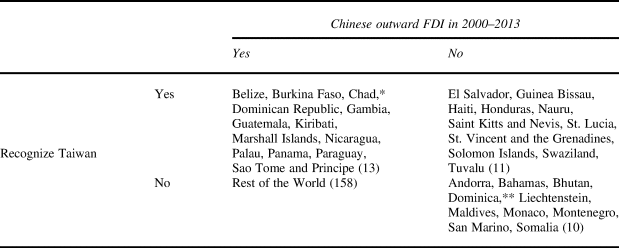
China has waged a systematic campaign using aid, trade, and investment to persuade other countries to break ties with Taiwan, while Taiwan has made counter-efforts as an attempt to secure its external sovereignty.Footnote 22 It has been suggested that diplomatic recognition of Taiwan typically makes countries ineligible to receive aid or official development finance from China.Footnote 23 As the left column of Table 1 shows, of the twenty-one UN member countries that received no direct investment from China during the period of our study, eleven recognized Taiwan. Between 2000 and 2013, China convinced ten countries to withdraw their diplomatic recognition of Taiwan, including Chad, Senegal, and Malawi, each of which has subsequently received Chinese FDI.
Taiwan recognition and China's outward FDI, 2000–2013

Notes: The cells list countries according to recognition of Taiwan and receipt of Chinese outward FDI in 2000–2013. The number of countries in each category is in parentheses. *Chad severed ties with Taiwan in 2006, the year after its first Chinese investment. **Dominica severed ties with Taiwan in 2004.
A similar anchoring role is played by meetings between senior government officials and the fourteenth Dalai Lama, Tenzin Gyatso, the leader of Tibetan Buddhism. China regards official acknowledgment of the Dalai Lama as interference in Chinese internal affairs. China regularly protests such meetings and frequently threatens to punish the offending countries by disrupting trade ties. For example, two Chinese trade delegations to France were canceled in retaliation for President Nicolas Sarkozy's meeting with the Dalai Lama in 2008. Fuchs and Klann estimate that high-level meetings with the Dalai Lama reduce exports to China by 16.9 percent,Footnote 24 and Lin, Hu, and Fuchs find that the reductions in trade are mainly attributable to reduced orders by SOEs.Footnote 25
Influence in the United Nations
Alignment in UNGA voting represents a broad gauge of foreign policy orientations. UNGA votes are not legally binding, but the competition to frame international norms is significant. International treaties that began as initiatives in the UNGA strengthen norms that support democracy and human rights.Footnote 26 During the Cold War, the US Congress regarded UNGA voting as sufficiently important to require the State Department to compile a list of important votes and to condition US foreign aid disbursement on how the recipients voted.Footnote 27 Growing evidence links Chinese foreign aid to UNGA voting as well.Footnote 28 Votes in the UNGA line up on a dimension that corresponds to alignment with US foreign policy,Footnote 29 and China typically opposes US positions, so correlations with UNGA voting are consistent with a systematic policy of targeting FDI to aligned countries. An interpretive difficulty arises, however, because these correlations could be due to the choices of firms, rather than to state policy. Chinese firms may expect their investments to be more secure in countries with strong bilateral ties.Footnote 30
Temporary membership in the UNSC avoids these interpretive problems because it represents a plausibly exogenous shock to a country's international influence so it has been widely used to identify political manipulation.Footnote 31 Temporary members are elected by the UNGA, but according to rules about geographical representation and norms about alternation within constituencies, and elections are rarely contested, so they are difficult to manipulate.Footnote 32 Temporary membership is limited to two years, and terms cannot be consecutive, so the end of membership is exogenous. Since temporary membership is not related to a country's ideological alignment or treatment of foreign investment, it can be relevant to investment decisions only because it is linked to foreign policy.
The UNSC plays an important role in Chinese foreign policy because China holds a permanent chair and exercises veto power, and China sees it as a means to constrain the United States. The UNSC serves as a mechanism for weaker states to coordinate opposition to US initiatives when they have sufficient consensus.Footnote 33 It can constrain the United States because the US public and key US allies look to the UNSC for signals about whether US initiatives are broadly regarded as legitimate, so it is more costly for US presidents to use force when they lack UNSC support.Footnote 34 Passing resolutions requires the support of some temporary members, and no permanent member relishes being diplomatically isolated, so there is a market for the votes of temporary members. US foreign aid temporarily increases when a country becomes a UNSC member, as does multilateral support from the World Bank and the IMF.Footnote 35 As China seeks to expand its influence in multilateral forums and frequently finds itself in opposition to US policies, it faces increasing incentives to bid for the votes of temporary UNSC members.
Firm-Level Characteristics
Firm-level variation makes it possible to make stronger inferences. We expect SOEs and large firms to be more responsive to state guidance and less averse to political risk than other firms, so we can use their differential responses to foreign policy variables to gauge the persuasiveness of the firm-preference versus state-direction interpretations of our results.Footnote 36
State ownership. State ownership is so widespread in China that we focus on a set of firms that are solely owned by the state. These firms’ profits flow directly into the state budget, and their managers are hired and overseen by government ministries. They are in the direct line of command of state agencies, expected to respond to state policies, and implicitly insured by the state, making them less deterred by political risks. SOEs enjoy easier access to credit from state-owned banks, which facilitates risky investments.Footnote 37
A subset of state firms are centrally controlled SOEs, most of which are under the direct management of the State-owned Assets Supervision and Administration Commission of the State Council (SASAC). The centrally controlled SOEs carry out 75 percent of foreign investment volume,Footnote 38 although they are responsible for a small share of the FDI transactions by the 18,974 firms in our data set. Central SOEs are often granted permission to invest in strategically sensitive regions and receive preferential financing and government subsidies. This is part of China's “large enterprise strategy,” which promotes large SOEs in selected “monopoly industries” (垄断行业).Footnote 39 On the other hand, central SOEs are deployed for state purposes. During the turmoil in China's stock market in summer 2015, for example, SASAC ordered the centrally controlled SOEs to hold shares to stabilize prices.Footnote 40
Firm size. We expect large firms to be less risk averse than smaller firms and more responsive to state guidance. We define size in terms of the extent of a firm's previous investments in foreign countries. Firms with extensive foreign holdings should be less risk averse because their risks are diversified and their global operations provide the resources to weather setbacks in particular markets. They should also be less concerned about political risks emanating from any particular country because their positions in other countries give them bargaining leverage.Footnote 41
On the other hand, large firms are more exposed to interference from the Chinese state than smaller firms. Autonomy from the state takes the form of agency slack. Entrepreneurs have the advantage of asymmetric information vis-à-vis the state because they have direct experience with their businesses and government officials have to economize their monitoring activities.Footnote 42 The largest firms are the most important to monitor closely, so they are subject to the most effective and continuous control. If investment in a particular country is odious to firms but valuable to the state, large firms will be selected to take on the task.
Summary of Predictions
If Chinese outward FDI is directed by the state to destinations that support Chinese foreign policy, it should respond to investment guidelines and state visits; it should reflect Chinese foreign policy priorities, including nonrecognition of Taiwan and discouraging meetings with the Dalai Lama; and it should respond to voting in the UNGA and election as a temporary member of the UNSC. Chinese firms can be expected to prefer to invest in countries with strong relations with China, however, so we interact our policy variables with firm characteristics to unravel these motivations. If firm preferences drive investment decisions, these effects should be strongest for private and small firms, which are most risk averse and therefore most sensitive to the economic externalities of diplomacy. In contrast, if investment decisions are directed by the state, these effects should be strongest for SOEs and large firms, which are least risk averse and most subject to state control.
Data
We use the comprehensive data maintained by MOFCOM from 2000 to 2013 to track Chinese firms’ FDI decisions.Footnote 43 Approval from MOFCOM is required for outward investment projects worth more than USD 100 million by Chinese firms.Footnote 44
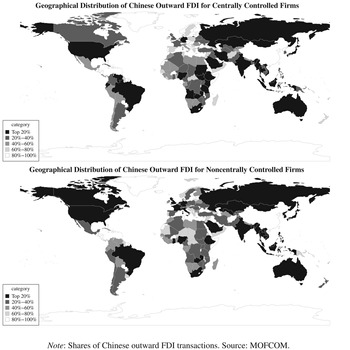
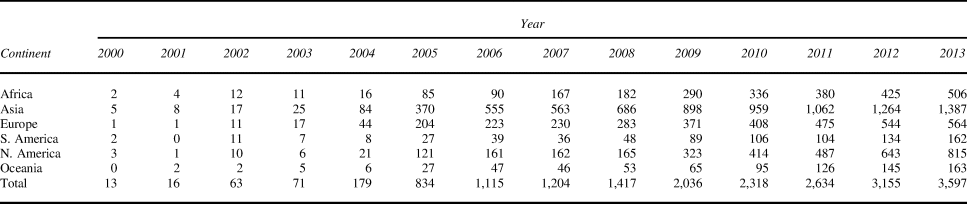
MOFCOM recorded 26,954 investment transactions by 18,974 firms in 180 countries or regions from 2000 to 2013. An average of 0.044 percent of the firms made an investment in each country-year. Table 2 shows the distribution of Chinese outward FDI over this period in tabular form, and Figure 1 provides a geographical representation. Asia is the most prominent recipient of Chinese FDI, followed by North America and Europe. Centrally controlled SOEs direct more of their FDI to Africa and the Middle East than other firms, and less to Europe and Canada.
Geographical distribution of Chinese outward FDI

Geographical distribution of Chinese outward FDI, 2000–2013

Note: Number of outward FDI transactions per year (UN members only).
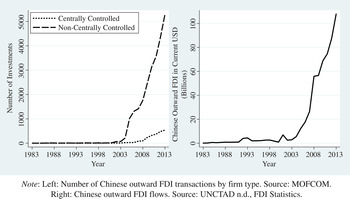
Figure 2 displays the distribution of transactions over time, indicating that the momentum for Chinese firms to invest abroad took off after the Chinese government initiated its Going Out strategy in 1999. Investments made after 1999 account for 99.5 percent of all transactions, so we narrow our sample period to 2000–2013.
Growth of Chinese outward FDI, 1983–2013

Firm Characteristics: State Ownership and Firm Size
We use the National Enterprise Credit Information Publicity System to identify SOEs,Footnote 45 and we use information provided by MOFCOM to identify centrally controlled SOEs. Firm size is measured as a lagged cumulative count of a firm's previous foreign investments, and network variables for the number of previous investments in the target country and in neighboring countries are used as firm-level controls.
Directives and Leader Visits
China's MOFCOM and Ministry of Foreign Affairs jointly issued a series of Catalogs of Countries and Industries for Guiding Investment Overseas in 2004, 2005, and 2007. Each catalog expanded the group of countries subject to investment promotion, so we code a dummy variable, directive, as 1 for every year t after country i is included in the catalog.
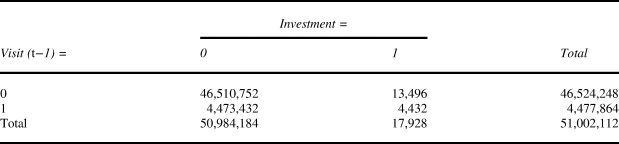
Announcements of leader visits are gathered from news releases published by China's Ministry of Foreign Affairs.Footnote 46 We construct a dummy variable, visiti ,t−1, which takes the value 1 if the Chinese president (chairman) or premier visited country i in year t−1. In Table 3, we summarize the relationship between investments and diplomatic visits. Investments occur in 0.10 percent of firm-country-years preceded by visits and in 0.03 percent of those not preceded by visits from top Chinese leaders.
Leader visits and investments

Note: Units are firm-country-years with and without investments. Pearson chi-squared(1) = 5.7×10³, Pr = 0.000.
Foreign Policy Objectives
taiwan recognition is a dummy variable coded 1 for countries that recognize Taiwan, and dalai lama meeting is a dummy variable coded 1 during years when a meeting occurs with a country's senior leaders.Footnote 47 unga voting ranges from 0 to 1 and measures voting agreement with China.Footnote 48 unsc temporary membership is a dummy variable coded 1 for all two-year periods in which a country is a temporary member.Footnote 49
Empirical Results
The following linear model is estimated to accommodate three-way fixed effects and the large size of the data set:
 $$y_{i,j,t} = \beta _0 + X_{i,t}\beta + Z_{\,j,t}\gamma + W_{i,t}\delta + \mu _i + \nu _j + \tau _t + \epsilon _{i,j,t}$$
The dependent variable is an indicator for countries i that received investments by firms j in years t.Footnote 50 X is a vector of country-level controls: ln gdp, ln population, gdp growth, ln exports, ln imports, resources, and polity.Footnote 51 Z is a vector of firm-level controls: firm, country, which is the number of prior investments firm i has made in country i; firm, neighbor, which is the number of prior investments firm j has made in country i's neighboring countries; and firm, cumulative, which is the number of prior investments firm j has made worldwide. W is a vector of country-specific affinity measures: directive, visit, taiwan, dalai lama, un voting, and unsc. Finally, μ i is a vector of country fixed effects; v j is a vector of sector fixed effects; and τ t is a vector of year fixed effects. The firm-level and affinity variables are lagged one year, with the exception of UNSC membership and Taiwan.
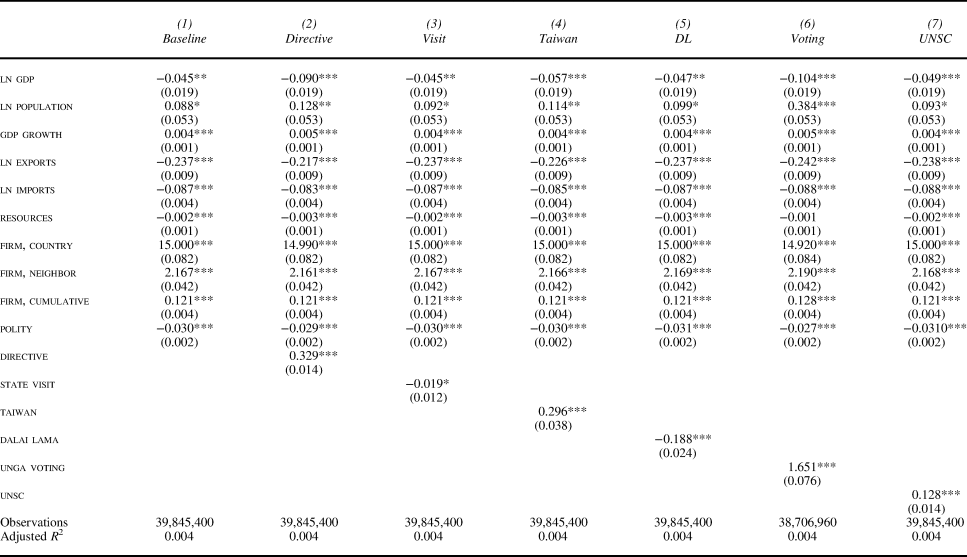
The results are presented in Table 4.Footnote 52 The variables that capture firms’ within-country, neighboring-country, and global investment networks are strong predictors of investment. Democracy (polity) is robustly associated with reduced investment. The country-level controls are not consistently robust to fixed effects, but have the expected positive and significant effects in models without fixed effects (see Table A8 in the online supplement).
Chinese outward FDI and Chinese foreign policy

Notes: Standard errors in parentheses. All models include country, year, and sector fixed effects. Coefficients and standard errors scaled by a factor of 1,000. DL stands for Dalai Lama. *p < .10; **p < .05; ***p < .01.
The models in Table 4 do not differentiate firm types, so the estimated quantities are average effects. Directives issued by MOFCOM have the expected positive coefficient: on average, firms invest 75 percent more frequently than the baseline when a country is added to the preferred list.Footnote 53 Countries that host high-level meetings with the Dalai Lama receive 43 percent fewer investments. Similarly, UN voting alignment with China is associated with greater investment. Investments are 59 percent more likely in a country that increases its voting alignment with China by one standard deviation than in an average country. Countries receive 29 percent more investments while serving as temporary UNSC members. These results support the interpretation that China actively uses investment guidance to reward countries that align with Chinese priorities.
In contrast, the estimated average effects of state visits are negative, while Taiwan recognition is associated with more, rather than less, investment. The effects change substantially when we condition on types of firms, and the differences in the effects help pin down our interpretations.
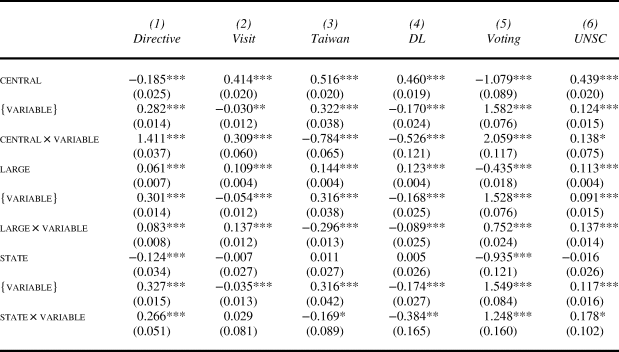
We next examine how responses to Chinese foreign policy priorities differ according to firm type. In Table 5, we summarize the results of models that include a vector of firm types ∈ {central, large, soe} as indicator variables and include interactions between firm type and a vector of foreign policy variables ∈ {directive, leader visit, taiwan, dalai lama, un voting, unsc}.
Effects of foreign policy by firm type

Notes: Summary results of equations varying firm types and foreign policy variables. Variable refers to the variable reported at the top of each column. All models include the full set of controls and country, year, and sector fixed effects. Coefficients and standard errors scaled by 1,000. Standard errors in parentheses. DL stands for Dalai Lama. p < .10; **p < .05; ***p < .01.
Our new estimation equations take the following general form:
 $$y_{i,j,t} = \beta _0 + X_{i,t}\beta + Z_{\,j,t}\gamma + W_{i,t}\delta + \left( {W_{i,t} \times \theta _{\,j,t}} \right)\zeta + \mu _i + \nu _j + \tau _t + \epsilon _{i,j,t}$$
where θ ∈ {central, large, soe} and W × θ are interaction terms, for example visit × soe.
We summarize the results of interest from eighteen equations in Table 5. Columns represent the foreign policy variables, and blocks of rows correspond to firm types. Each block of three coefficients summarizes the results for a firm type, a foreign policy variable indicated by the column heading, and their interaction from one of eighteen equations. Full estimation results are in Tables A10–A12 in the online supplement. The results suggest that centrally controlled firms, large firms, and SOEs respond to Chinese foreign policies to a substantially greater degree than other firms.
The most direct measure of Chinese government guidance is MOFCOM investment directives. State guidance is associated with more investment by firms of all types, but the estimated effects are substantially greater for state-owned and large firms. Firms that are not state-owned are estimated to increase investment by 74 percent when a country is added to the preferred list, while SOEs increase investment by 1.9 times, and centrally controlled firms increase it by 6.6 times. Firms with no foreign affiliates increase investment by 68 percent when a country is endorsed by MOFCOM, and firms with two foreign affiliates increase it by 83 percent. This is consistent with the interpretation that the Chinese state focuses on large and state-owned firms when it seeks to influence outward FDI, and rules out the alternative hypothesis that large and state-owned firms are able to use political resources to evade control. In contrast to MOFCOM guidance, state visits are significantly associated with less investment for firms that are not state owned and have no foreign affiliates. For SOEs, this effect becomes insignificant, and centrally controlled SOEs are 33 percent more likely to invest in countries that receive state visits. Firms with no foreign affiliates are 12 percent less likely to invest in countries that receive visits, while firms that have two foreign affiliates are 33 percent more likely.Footnote 54
Only large and centrally controlled firms appear to be deterred from investing in countries that recognize Taiwan. Indeed, firms that are not state owned or that have no foreign affiliates are 72 percent more inclined to invest in countries that recognize Taiwan than in those that do not. This effect becomes insignificant for SOEsFootnote 55 and those with a single foreign affiliate, while centrally controlled firms are 48 percent less likely to invest in countries that recognize Taiwan, and those with two affiliates are 38 percent less likely. Since the time variation in Taiwan recognition consists of countries that broke diplomatic relations with Taiwan after 2000, this implies that only large and centrally controlled firms systematically shifted their investments to favor countries that complied with Chinese diplomatic pressure. Dalai Lama meetings appear to deter investments by all types of firms: firms that are not state owned reduce their investments in countries that host these meetings by 40 percent. The estimated coefficients are 3.2 times stronger for SOEs than for other firms (4.1 times stronger for centrally controlled SOEs), and 2.1 times stronger for firms with two foreign affiliates than for firms with none.
Voting alignment in the UNGA and temporary UNSC membership are associated with greater investment by firms of all types, but the estimated effects are much stronger for state-owned, centrally controlled, and large firms with foreign affiliates. Firms that are not state owned and that have no foreign affiliates are 15 percent more likely to invest in countries that shift their UN voting profiles one standard deviation closer to China, which means voting with China an additional 16 percent of the time. The corresponding estimates are 68 percent for SOEs, 108 percent for centrally controlled firms, and 26 percent for firms with two foreign affiliates. When countries become temporary UNSC members, the probability of investment by firms that are not state owned is estimated to increase by 27 percent, and the probability of investment by firms that have no foreign affiliates is estimated to increase by 21 percent. The probability of investment is estimated to increase by 70 percent for SOEs, by 30 percent for centrally controlled firms (but from a baseline probability of investment that is twice as high as for firms that are not centrally controlled), and by 55 percent for firms with two foreign affiliates.
To summarize these results according to firm type, centrally controlled SOEs and large firms with foreign affiliates conform to official policy across all six variables that measure Chinese foreign policy objectives. They respond to MOFCOM directives and diplomatic visits by top leaders; they withhold investment from countries that recognize Taiwan or host meetings with the Dalai Lama; and they channel investment to countries aligned with China in the UN or holding temporary UNSC membership. The broader set of SOEs follows the pattern except that diplomatic visits and Taiwan recognition have insignificant effects. Since these are fixed-effect estimates, they can be interpreted as effects on Chinese FDI of changes in a country's foreign policy orientation. In addition, we find that state-owned, centrally controlled, and large firms conform to Chinese policy more closely than other firms on all counts but one: SOEs do not respond differently than other firms to state visits.Footnote 56 Firms of all types respond to MOFCOM directives, Dalai Lama meetings, UN voting, and UNSC membership, but these effects are weaker than for large and state-owned firms. Small firms and non-SOEs are more likely to invest in countries that recognize Taiwan than in countries that do not, and less likely to invest in countries that receive high-level visits from China.
This pattern of results is consistent with the hypothesis that the Chinese government exercises significant control over outward investment by Chinese firms, and that SOEs, centrally controlled SOEs, and large firms are most responsive to the measures of control we can quantify. These results appear to be inconsistent with the alternative interpretation that firms voluntarily invest in countries with affinity for China to reduce political risk because the firms that appear the most responsive to official guidance are the SOEs and large firms that are least sensitive to risk. Indeed, it is challenging for the alternative interpretation that the estimated effects of Taiwan recognition and state visits are reversed in the subsets of non-SOE and small firms that should be most risk averse.
The six foreign policy variables capture different motivations for state intervention and various mechanisms of influence. MOFCOM directives are a straightforward measure of state influence efforts, so the results indicate that the costs of supporting foreign policy fall primarily on state-owned, centrally controlled, and large firms. Similarly, diplomatic visits are deliberate efforts to improve bilateral relations, and only large and centrally controlled firms respond. Taiwan recognition and Dalai Lama meetings anchor our interpretations because discouraging these stances is known to be a long-standing priority of the Chinese government. Correlations with UNGA voting and UNSC temporary membership suggest that state intervention in firms’ investment strategies is systematic.
Combining these findings strengthens the case for interpreting them as evidence of a systematic policy of employing FDI to build foreign policy influence. Because we have found that SOEs, centrally controlled SOEs, and large firms respond more readily to MOFCOM directives, and that centrally controlled and large firms respond most strongly to state visits, we have a firmly established view of the role these firms play in Chinese foreign policy by the time we turn to examining the effects of UN voting alignment on investment. Consequently, we can be reasonably confident in interpreting our findings that SOEs, centrally controlled SOEs, and large firms respond most strongly to UN voting alignment with China as suggesting that China actively channels investment to diplomatic allies. We cannot tell whether the Chinese strategy is intended to influence UN voting per se or a broader diplomatic posture that is correlated with UN voting. In either case, the relationship between changes in UN voting alignment and change in Chinese FDI is consistent with a systematic policy of building influence.
Finally, the most reasonable interpretation of the estimated effect of temporary membership on the UNSC is official state influence. Temporary membership is not randomly distributed, but it is outside China's control—it is determined by rotation and agreements within regions, and it ends exogenously after two years.Footnote 57 There is no obvious reason why UNSC temporary membership should affect investment opportunities for Chinese firms except through Chinese foreign policy, and again the effects are strongest for SOEs and large firms. We interpret our results as suggesting that the state deploys its most prominent firms to buy influence on the UNSC.
Conclusion
Chinese firms have become a leading source of FDI, particularly in Asia, Africa, and Latin America. Most of these flows come from SOEs, and China exercises an extraordinary degree of direct and indirect control over its firms’ foreign investments. We find evidence consistent with the interpretation that China deploys this influence to support its foreign policies in both narrowly focused and systematic ways.
To make this argument, we must address an inference problem: patterns in the data may not demonstrate a deliberate state strategy because Chinese firms may prefer to invest in countries aligned with China just to reduce political risk. We use three strategies to strengthen our inferences. First, we use estimation with country fixed effects, which control for time-invariant country characteristics that might be associated with bilateral relations and with investment opportunities. Second, we use a range of foreign policy variables that capture different features of the data-generating mechanism. Official guidance and state visits link investments to state policies; Taiwan recognition and Dalai Lama meetings anchor our interpretations in substantive politics; UNGA voting and temporary UNSC membership indicate the breadth of state influence. Temporary UNSC membership provides a particularly credible way to identify political manipulation. Third, we use firm-level characteristics to refine our inferences.
We find that the correlations between investment and country-level variables associated with affinity for China are stronger when interacted with firm size and state ownership. These results are consistent with the hypothesis that the state directs outward FDI, but are challenging for the alternative interpretation that firms voluntarily choose to follow Chinese foreign policy. If firms chose to adhere to official guidance solely to minimize the risks of their investments, it would be puzzling that the firms that are least exposed to political risk are most responsive to state policy. Indeed, we find that investments by firms that are not state owned and that do not have foreign affiliates do not respond to state visits or to Taiwan recognition.
Multinational firms control most global trade and manufacturing, and foreign investment is one of the most important sources of financing for development. China has a unique capacity to channel foreign investment to cultivate influence, and the rise of China lends its policies global significance. The evidence suggests that it has deployed its FDI to isolate Taiwan and the Dalai Lama, to build a bloc of countries that support its diplomatic positions, and to build support on the UNSC.
If this interpretation of the data is correct, our findings pose additional questions, which we cannot answer here, about the influence of Chinese firms over the political development and foreign policies of the countries in which they invest. Competition for FDI is often viewed as an influence for good governance around the world, but we find that Chinese FDI is attracted to undemocratic countries. We cannot conclude from our results whether Chinese FDI affects political development, but this is an important question for future research. Similarly, if our interpretation is correct, Chinese FDI creates incentives for countries to conform to Chinese foreign policy. However, our results do not indicate how strong these incentives may be, or how effectively they might influence countries’ foreign policy alignments. This opens up another important frontier for future research.
Data Availability Statement
Replication files for this research note may be found at <https://doi.org/10.7910/DVN/QSJXLL>.
Supplementary Material
Supplementary material for this research note is available at <https://doi.org/10.1017/S0020818321000308>.
Acknowledgments
We thank Andreas Fuchs, Quan Li, Lizhi Liu, Zhikuo Liu, and Austin Strange, as well as participants in the Development Economics Prospects Group Seminar at the World Bank, and in the International Political Economy Society, for comments and suggestions. The findings, interpretations, and conclusions expressed in this paper are those of the authors, and do not necessarily represent the views of the institutions with which the authors are affiliated.