INTRODUCTION
Greater species diversity in riparian areas has contributed to recognizing them as priority habitats for protection (Franklin Reference FRANKLIN and Naiman1992, Naiman et al. Reference NAIMAN, DÉCAMPS and MCCLAIN2005). However, whether riparian habitats show higher diversity compared with non-riparian habitats, and how riparian habitats contribute to the diversity of the surrounding landscape depends on the taxon and ecosystem (Sabo et al. Reference SABO, SPONSELLER, DIXON, GADE, HARMS, HEFFERNAN, JANI, KATZ, WOYKAN, WATTS and WELTER2005, Soykan et al. Reference SOYKAN, BRAND, RIES, STROMBERG, HASS, SIMMONS, PATTERSON and SABO2012).
Studies on bats in riparian areas have focused mainly on insectivorous communities in temperate regions, followed by some studies in the Palaeotropics and very few studies in the Neotropics. High diversity and species richness of bat assemblages (sensu Fauth et al. Reference FAUTH, BERNARDO, CAMARA, RESETARITS, VAN BUSKIRK and MCCOLLUM1996) in riparian areas are associated with the availability of feeding resources such as insect prey and fruits (Fukui et al. Reference FUKUI, MURAKAMI, NAKANO and AOI2006, Grindal et al. Reference GRINDAL, MORISSETTE and BRIGHAM1999, Holloway & Barclay Reference HOLLOWAY and BARCLAY2000, Monadjem & Reside Reference MONADJEM and RESIDE2008), topography (Lloyd et al. Reference LLOYD, LAW and GOLDINGAY2006) and vegetation structure (Ober & Hayes Reference OBER and HAYES2008, Williams et al. Reference WILLIAMS, O'FARRELL and RIDDLE2006). A few studies in the Neotropics have described bat assemblages in riparian forests, but mostly within rain forests and/or agricultural landscapes (de la Peña-Cuéllar et al. Reference DE LA PEÑA-CUÉLLAR, BENÍTEZ-MALVIDO, AVILA-CABADILLA, MARTÍNEZ-RAMOS and ESTRADA2015, Estrada & Coates-Estrada Reference ESTRADA and COATES-ESTRADA2001, Galindo-González & Sosa Reference GALINDO-GONZÁLEZ and SOSA2003, Griscom et al. Reference GRISCOM, KALKO and ASHTON2007, Medina et al. Reference MEDINA, HARVEY, SÁNCHEZ-MERLO, VÍLCHEZ and HERNÁNDEZ2007). However, for tropical dry forest (TDF), one of the most abundant and threatened ecosystems in the Neotropics (Sánchez-Azofeifa et al. Reference SÁNCHEZ-AZOFEIFA, QUESADA, RODRÍGUEZ, NASSAR, STONER, CASTILLO, GARVIN, ZENT, CALVO-ALVARADO, KALACSKA, FAJARDO, GAMMON and CUEVAS-REYES2005), studies designed to evaluate the importance of riparian habitat for bat communities are scarce (Avila-Cabadilla et al. Reference AVILA-CABADILLA, STONER, HENRY and ALVAREZ-AÑORVE2009, Reference AVILA-CABADILLA, SÁNCHEZ-AZOFEIFA, STONER, ALVAREZ-AÑORVE, QUESADA and PORTILLO-QUINTERO2012; Chávez & Ceballos Reference CHÁVEZ and CEBALLOS2001).
In general, fauna inhabiting TDF show behavioural adaptations to cope with severe biotic and abiotic conditions during the dry season (i.e. little water availability, high temperatures and sparse distribution of feeding resources) (Stoner & Timm Reference STONER, TIMM, Dirzo, Young, Mooney and Ceballos2011). Behavioural adaptations allow animals to obtain sufficient resources, cope with the hot and dry environment, and reduce competition. These adaptations involve local movements, short- and long-distance migration, changing diets, timing of activity and seasonality of reproduction (Stoner & Timm Reference STONER, TIMM, Dirzo, Young, Mooney and Ceballos2011).
Local movements of fauna in TDF often involve the exploitation of riparian habitats or adjacent higher-altitude areas that contain more resources (Stoner & Timm Reference STONER, TIMM, Dirzo, Young, Mooney and Ceballos2011). For example, animals that have widespread presence in dry forest during the rainy season, retreat to riparian habitat during the dry season (Janzen & Wilson Reference JANZEN, WILSON and Janzen1983, Núñez-Perez Reference NÚÑEZ-PEREZ2006) or use riparian vegetation as a permanent part of their home ranges (Valenzuela & Ceballos Reference VALENZUELA and CEBALLOS2000). These movements may explain greater species richness for some animal groups in riparian forest than in dry forest (i.e. small mammals, frugivorous birds) (Griscom et al. Reference GRISCOM, KALKO and ASHTON2007).
In particular, bat presence in more complex vegetation, characteristic of riparian forests, has been associated with greater productivity and higher availability of food and refuges (Castro-Luna et al. Reference CASTRO-LUNA, SOSA and CASTILLO-CAMPOS2007, Holloway & Barclay Reference HOLLOWAY and BARCLAY2000, Medellín et al. Reference MEDELLÍN, EQUIHUA and AMIN2000, Ortiz-Ramírez et al. Reference ORTIZ-RAMÍREZ, LORENZO, NARAJO and LEÓN-PANIAGUA2006). Moreover, phyllostomid bat activity in flight corridors, such as the ones defined by the riparian vegetation, is influenced by the density of surrounding vegetation (Caras & Korine Reference CARAS and KORINE2009). For these reasons, we hypothesize that a greater abundance and species richness of frugivores will be found in riparian forest (RF) than in the upland dry forest (UDF), as well as a different species composition. Furthermore, we expect that the structural complexity of the vegetation will explain the variation in bat abundance, species richness and species composition.
METHODS
Study site
The study was performed in the Chamela–Cuixmala Biosphere Reserve and surrounding areas (19°22′–19°35′N, 104°56′–105°03′W), located in the central western coast of Mexico in the state of Jalisco. The main vegetation types in the region include UDF and RF. Upland dry forest grows mainly on hills, covering 92.1% of the Chamela-Cuixmala Biosphere Reserve and 56.1% of the Jalisco coast. Riparian forest is found along the permanent and temporary waterways, representing 2% of the land cover in Chamela–Cuixmala Biosphere Reserve and 3.7% of the Jalisco coast (Durán et al. Reference DURÁN, BALVANERA, LOTT, SEGURA, ROSAS, ISLAS, FRANCO, Noguera, Vega and Quesada2002, Lott et al. Reference LOTT, BULLOCK and SOLIS-MAGALLANES1987, Sánchez-Azofeifa et al. Reference SÁNCHEZ-AZOFEIFA, QUESADA, CUEVAS-REYES, CASTILLO and SÁNCHEZ-MONTOYA2009). Average annual precipitation based on almost 30 y (1977–2006) is 741 ± 261 (SD) mm and occurs mainly from June to October (Avila-Cabadilla et al. Reference AVILA-CABADILLA, STONER, HENRY and ALVAREZ-AÑORVE2009).
Studied vegetation
In Chamela, there are 23 chiropterophilic and 12 chiropterochoric plant species (nine and eight families respectively) reported for UDF, while for RF there are eight chiropterophilic (six families) and 12 chiropterochoric species reported (eight families including Moraceae and Piperaceae) (Avila-Cabadilla et al. Reference AVILA-CABADILLA, SÁNCHEZ-AZOFEIFA, STONER, ALVAREZ-AÑORVE, QUESADA and PORTILLO-QUINTERO2012, Lobova et al. Reference LOBOVA, GEISELMAN and MORI2009, Stoner Reference STONER, Noguera, Vega and Quesada2002). The main flowering peak occurs in July while the second takes place in January; the main fruiting peak occurs from October to December while the second peak takes place from January to March (Bullock & Solis-Magallanes Reference BULLOCK and SOLIS-MAGALLANES1990, Stoner et al. Reference STONER, O-SALAZAR, FERNÁNDEZ and QUESADA2003). In UDF, canopy height is 5–10 m and on average trees have a diameter at breast height (dbh) < 10 cm (Lott & Atkinson Reference LOTT, ATKINSON, Noguera, Vega and Quesada2002). The maximum height of the understorey is 4–5 m (Durán et al. Reference DURÁN, BALVANERA, LOTT, SEGURA, ROSAS, ISLAS, FRANCO, Noguera, Vega and Quesada2002). In RF the height of the canopy varies between 20 and 30 m. Tree density in RF is lower than in the UDF but trees with a dbh above 30 cm are more abundant (Durán et al. Reference DURÁN, BALVANERA, LOTT, SEGURA, ROSAS, ISLAS, FRANCO, Noguera, Vega and Quesada2002). Most trees in RF keep their leaves during the dry season.
Sampling design and mist-net data collection
Sampling was performed at three sites of RF and three sites of UDF. The sites were chosen based on the following criteria: (1) their degree of preservation: old-growth forests with at least 50 y since the last anthropogenic disturbance, (2) the area of the vegetation patch: at least 100 m wide and 500 m long for vegetation strips along the flight path, and (3) the minimal linear distance between sites: at least 1 km in order to avoid spatial correlation in samples. The maximum linear distance among sampling sites was 2.5 km. The specific UDF site locations were: 19°30′0.90″N, 105°2′40.60″O (UDF1); 19°27′12.16″N, 105° 2′0.10″O (UDF2); 19°31′47.60″N, 105°1′14.30″O (UDF3); and the specific RF sites location were: 19°26′48.50″N, 105°1′0.20″O (RF1); 19°29′29.60″N, 105° 2′19.90″O (RF2); and 19°30′38.30″N, 105° 2′8.70″O (RF3).
Bat sampling was carried out at each site, by using five mist nets of 12 × 1.6 m, placed at ground level, and crossing artificial or natural flight paths such as streams and trails, which is an appropriate method for sampling phyllostomids (Kalko & Handley Reference KALKO and HANDLEY2001). Distance between nets was never shorter than 30 m. Nets were opened at sunset for 5 h, the peak foraging period for most phyllostomid bats (Fenton & Kunz Reference FENTON, KUNZ, Baker, Jones and Carter1977), and checked at least every 30 min.
Sites were sampled approximately every 79 ± 22.6 (SD) d from February 2010 to March 2011. Mist netting of bats was performed during both the dry and the rainy seasons, completing six sampling nights at each site per season. We never sampled two consecutive nights at the same site in order to avoid biases due to trap-shy behaviour (Marques et al. Reference MARQUES, RAMOS PEREIRA, MARQUES, SANTOS, SANTANA, BEJA and PALMEIRIM2013). The order in which each site was sampled during each sampling period was randomized. Mist nets were not set during nights with full moon or heavy rain in order to avoid variation in capture success associated with these conditions. Captured bats were identified to species with dichotomous keys (Medellín et al. Reference MEDELLÍN, ARITA and SÁNCHEZ2008, Timm & LaVal Reference TIMM and LAVAL1998) and adults were marked with plastic necklaces with individual numbers. Species were classified as predominantly frugivores or predominantly nectarivores (sensu Lobova et al. Reference LOBOVA, GEISELMAN and MORI2009). We followed Silkes et al. (Reference SILKES and GANNON2011) guidelines for the study of wild mammals in research.
Vegetation sampling
Two transects of 250 × 2 m were set at each study site next to the flight corridors in which the nets were placed (3–10 m away) and covering an area of 0.1 ha (adapted after Gentry Reference GENTRY1982). The starting point for defining each transect was chosen randomly. Within each transect, we recorded plant species and we measured the following structural attributes of the vegetation: (1) basal area, (2) maximum canopy height, (3) number of individuals and (4) percentage of canopy cover. Only woody plants with a dbh ≥ 2.5 cm were included in the sample. The diameter for lianas was measured at the base of the plants (Gentry Reference GENTRY1982). Each transect was divided into three segments of equal length (83.3 m) and in each segment the height of the three tallest trees was measured with a laser distance measurer (Stanley TLM 300) to obtain an average of the nine tallest trees for each transect (adapted after Holdridge Reference HOLDRIDGE1967). The percentage of canopy cover was measured with a spherical densitometer during the rainy season. In total, seven points were measured within each transect, each point located 36 m from the next.
Data analysis
All statistical analyses were performed using the R software (v. 2.13.0) unless otherwise stated. Sampling completeness of bat ensembles in all sampling sites was assessed by calculating the quotient of the number of observed species divided by the number of species estimated with the Jackknife 1 index. A minimum of 90% of completeness was considered a satisfactory level of sampling efficiency (Moreno & Halffter Reference MORENO and HALFFTER2000). In addition, we tested for spatial autocorrelation, testing for correlation between geographic and ecological distance matrices. The Bray–Curtis coefficient was used for the construction of the ecological distance matrix, and the Euclidean distance between sites for the construction of the geographic matrix. This analysis was carried out with a Mantel test based on Spearman rank correlation coefficients and using 10 000 iterations in the vegan R package.
In order to graphically represent ensemble attributes, we built rank-abundance graphs following Feinsinger (Reference FEINSINGER2001). We graphed the log10 pi (pi being the proportion of individuals of a given species relative to all captured individuals per habitat) versus the species of each habitat ranked from left to right according to their relative abundance. This method allows visualizing some ensemble attributes such as species richness (number of points), evenness (slope), composition (numbers representing species) and species relative abundance (order of the species in the graph). We tested for significant effects of the habitat on the evenness with an ANCOVA (Crawley Reference CRAWLEY2007).
For the comparison of bat ensembles in terms of species richness, we computed the sampled-based rarefaction curves and rescaled it to the number of individuals (EstimateS, v. 8.2). Significant differences in species richness were recognized when the 95% confidence intervals of the accumulation curve showed no overlap. A curve was separately built for each ensemble occurring in each habitat.
We evaluated the among habitat differences in terms of ensemble composition through a non-metric multidimensional scaling (NMDS) based on Bray–Curtis dissimilarity matrices (Kindt & Coe Reference KINDT and COE2005, McCune & Grace Reference MCCUNE and GRACE2002). For the ordination we used the square root of the number of individuals for each species, which avoids biases toward the species with the largest difference in abundance when using the Bray–Curtis coefficients (Kindt & Coe Reference KINDT and COE2005). We employed the stress value (Kindt & Coe Reference KINDT and COE2005) (scaled from 0–100) to evaluate how successfully the distances between ensembles in the ordination space reflect the distance between ensembles in the original space (distance matrix). Lower values of stress indicate a more reliable ordination. Finally, we used the envfit function from the vegan R package to test for the effect of habitat on ensemble composition. This function allows calculating the centroids for each level of the categorical variables in the ordination space, and evaluates whether the observed distance among centroids is greater than expected by chance. The significance of the differences (alpha = 0.05) was evaluated through a randomization test (10 000 permutations).
In order to evaluate the response of bat abundance to habitat type, we fitted generalized linear models (GLMs) considering habitat as a categorical independent factor. To evaluate bat response to vegetation structure we selected basal area as an independent factor for GLMs, among all structural vegetation attributes measured. Basal area has been reported as one of the vegetation attributes most influencing bat ensemble composition and structure (Ortiz-Ramírez et al. Reference ORTIZ-RAMÍREZ, LORENZO, NARAJO and LEÓN-PANIAGUA2006). This parameter is also correlated with most of the measured vegetation attributes. The response variables tested with the models were: (1) estimated species richness, given by Jackknife 1; (2) total frugivore abundance and species abundance (for those species with more than 10 captures per habitat); and (3) species diversity, given by the Simpson and Alpha diversity indices. Estimated species richness and bat abundance data were modelled using the Poisson error distribution with the log link function. Diversity indices were modelled using the Gaussian error distribution with the identity link function (Crawley Reference CRAWLEY2007). The minimum adequate model was selected manually following Crawley (Reference CRAWLEY2007) and then evaluated.
RESULTS
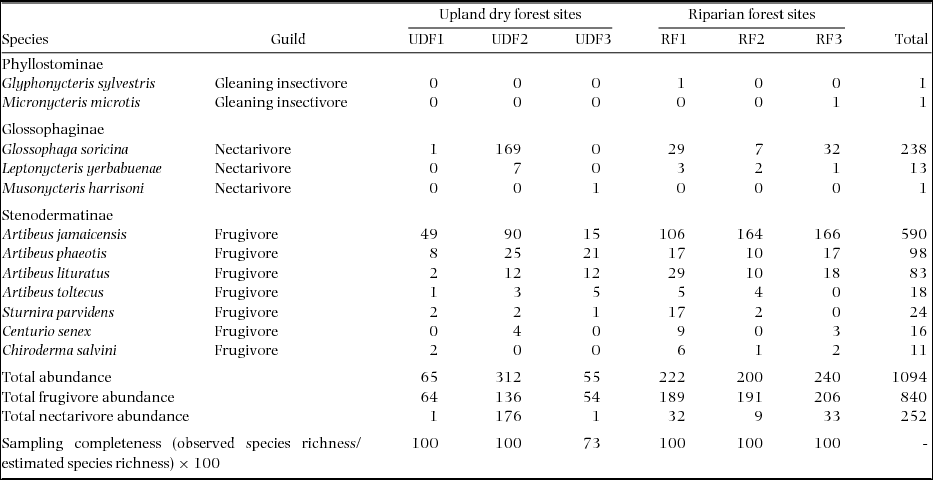
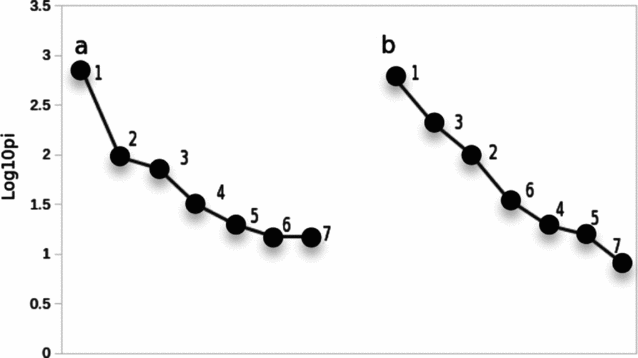
Seventy-two sampling nights (1800 net h) resulted in the capture of 1094 phyllostomids belonging to three subfamilies and 12 species (Table 1). Only three individuals of A. jamaicensis were recaptured in RF. Frugivores represented 77% of all captures (840 individuals) while nectarivores comprised 23% (252 individuals). The two most abundant species (Artibeus jamaicensis and A. phaeotis) were the same in RF and UDF. According to the ANCOVA model, there is no evidence to support an effect of habitat on species dominance (F = 0.044, P = 0.837, df = 1,10) (Figure 1). The sampling effort carried out was sufficient to reach a high degree of sampling completeness, allowing us to properly characterize the frugivore response (Table 1). The average sampling completeness for frugivores, per habitat, ranged from 91% to 100%. In addition, we found no evidence of spatial structure in our dataset since the geographic and ecological distance matrices were not significantly correlated (r s = 0.14, P = 0.43).
Number of bats captured and sampling completeness for each study site at Chamela-Cuixmala, Jalisco. Taxonomic designation of bat species follows Simmons (Reference SIMMONS, Wilson and Reeder2005).

Rank abundance plots for frugivorous bat species captured at Chamela–Cuixmala, Jalisco, in all sampling sites. Habitat: Upland dry forest (a), and riparian forest (b). Species key: (1) Artibeus jamaicensis, (2) Artibeus phaeotis, (3) Artibeus lituratus, (4) Chiroderma salvini, (5) Sturnira parvidens, (6) Artibeus toltecus, (7) Centurio senex.

Vegetation attributes
The vegetation in RF showed a higher structural complexity than UDF. RF forest contained significantly more individuals, greater canopy height, greater basal area and greater canopy cover compared with UDF. Although the number of species was higher in RF, these differences were not significant (Table 2).
Mean and 95% confidence intervals (in parentheses) of vegetation structural attributes of upland dry forest (UDF) and riparian forest (RF) sites at Chamela–Cuixmala, Jalisco. For habitat comparisons through a generalized linear model, the number of individuals and number of species were analysed with a Poisson error distribution and a χ2 test. Maximum height of canopy, canopy cover and basal area were analysed with a Gaussian error distribution and an F test.

Variation in frugivorous bat ensembles between habitats
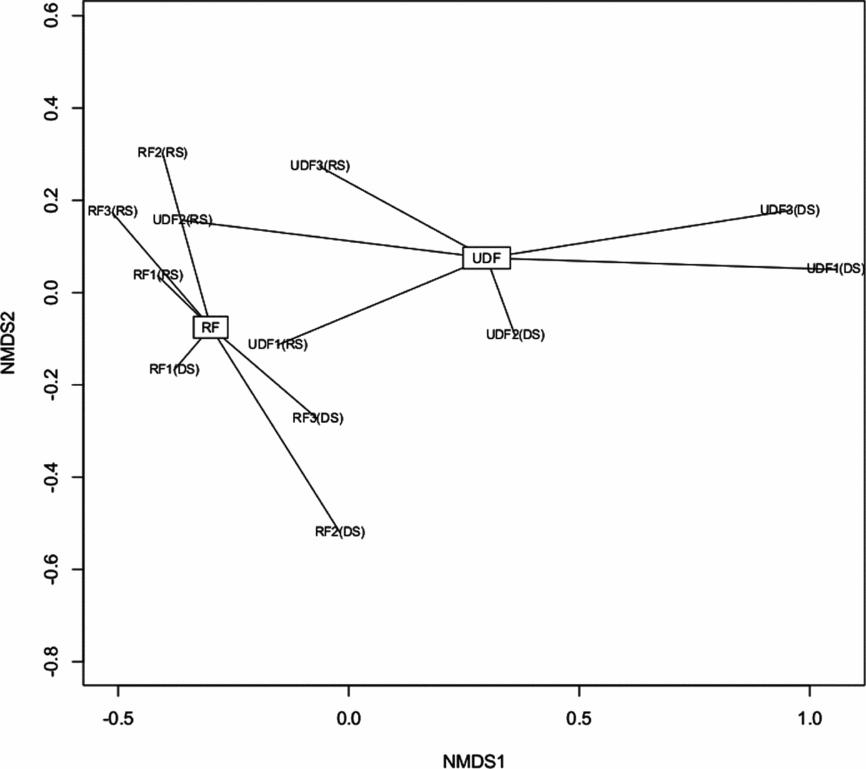
We found no significant differences in frugivorous species richness and diversity between habitats. In both habitats we found the same number of rarified and estimated species richness (seven species) and a similar value in terms of species diversity (for RF: Alpha = 1.12 and Simpson = 1.75; for UDF: Alpha = 1.33 and Simpson = 2.36). Regarding species composition, we found a greater difference than expected by chance between UDF and RF (r2 = 0.307, P = 0.038, Figure 2). Low stress and high R2 values were reached indicating that the resulting ordinations were also adequate for mapping the ensemble dissimilarities (Stress: 7; non-metric fit R2 = 0.99).
Non-metric multidimensional scaling ordination of sampling sites in terms of their species composition. Abbreviations: UDF1–UDF3 are sampling sites corresponding to upland dry forest; RF1–RF3 are sampling sites corresponding to riparian forest. Seasons: rainy (RS) and dry seasons (DS). Distance between centroids (marked with a square) is greater than expected by chance (r2 = 0.307, P = 0.038). Stress value: 7; non-metric fit, R 2 = 0.99.

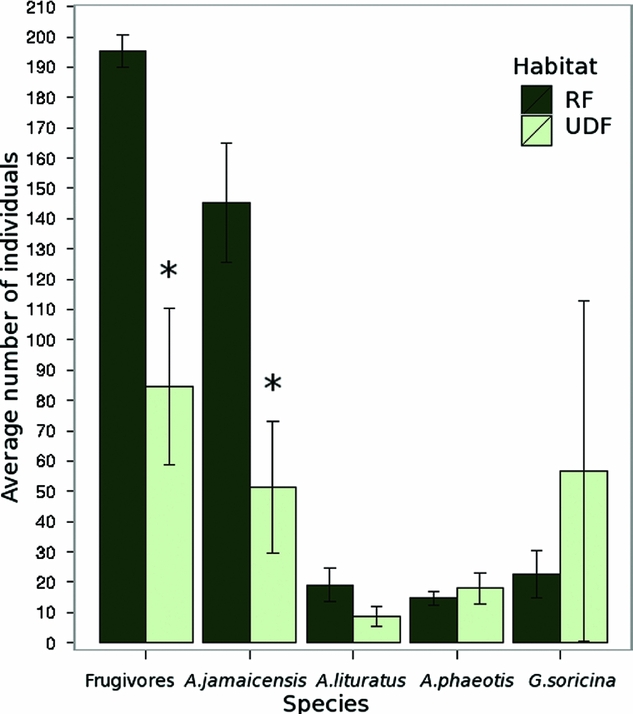
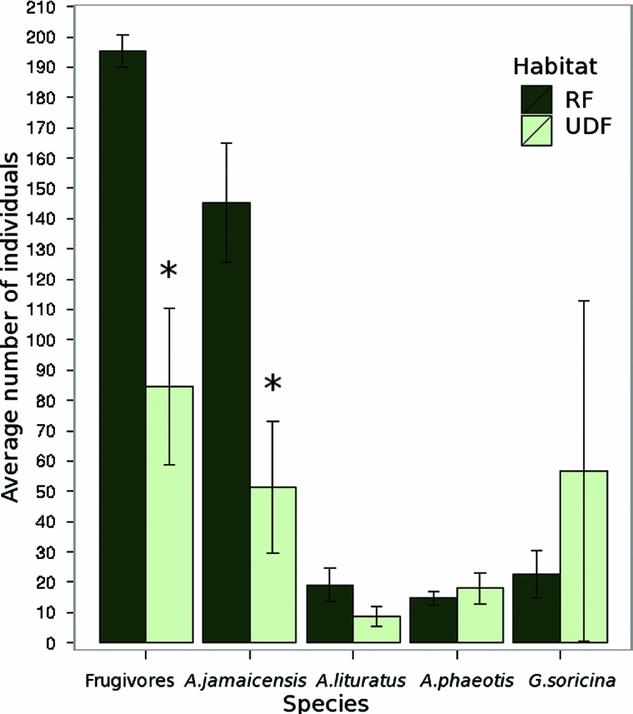
The overall abundance of frugivorous bats was significantly higher in RF than in UDF (F = 11.202, P = 0.028, df = 1,4, R2 = 0.748) (Figure 3). Just four species were analysed at the population level: Artibeus jamaicensis, A. lituratus, A. phaeotis and Glossophaga soricina, a nectarivorous bat that also includes fruits in its diet (Figure 3). The species A. jamaicensis was present in higher abundance in RF than in UDF (F = 7.92, P = 0.048, df = 1,4, R2 = 0.647). Abundance of A. phaeotis, A. lituratus and G. soricina did not show significant variations between habitats.
Average abundance (± SE) of frugivorous bats and the four most abundant species at Chamela-Cuixmala, Jalisco, per habitat. Habitat: upland dry forest (UDF) and riparian forest (RF). Asterisks on top of the bars show significant differences in abundance for frugivorous bats and for each species. Species: Artibeus jamaicensis, Artibeus lituratus, Artibeus phaeotis, Glossophaga soricina.
Influence of vegetation structure on bat ensembles and populations
We found a significant relationship among the variation of vegetation basal area and the variation in overall frugivore bat abundance (F = 26.7, P = 0.047, df = 1,4, R2 = 0.859) and abundance of A. jamaicensis (F = 9.12, P = 0.039 df = 1,4, R2 = 0.661).
DISCUSSION
Our data support our hypothesis that RF has a greater abundance and different composition of frugivores that UDF. However, we found no evidence of an effect of habitat type or vegetation attributes on species richness. We also found an effect of vegetation structural complexity (i.e. basal area) on frugivorous bat abundance. Similar to our findings, different taxonomic and functional groups of fauna in several ecosystems show higher activity or number of individuals in riparian habitats compared with nearby upland areas, probably due to a higher availability of water and feeding resources, as well as appropriate commuting areas (Keuroghlian & Eaton Reference KEUROGHLIAN and EATON2008, Lehmkuhl et al. Reference LEHMKUHL, PEFFER and O'CONNELL2008, Milakovic et al. Reference MILAKOVIC, PARKER, GUSTINE, LAY, WALKER and GILLINGHAM2011, Salvador et al. Reference SALVADOR, CLAVERO and PITMAN2011).
Higher abundance of frugivorous bats in RF than in UDF can be explained by an increase in bat activity in RF because it may provide greater food resources. Bat occurrence is related to abundance and distribution of their feeding resources. For example, abundance of insectivorous bats is related to abundance and distribution of insects in riparian zones in temperate forest in Canada (Holloway & Barclay Reference HOLLOWAY and BARCLAY2000) and in dry woodlands in South Africa (Rautenbach et al. Reference RAUTENBACH, FENTON and WHITING1996), while frugivorous bat activity is related to fruit mass in semideciduous forests in Mexico (Vargas-Contreras et al. Reference VARGAS-CONTRERAS, MEDELLÍN, ESCALONA-SEGURA and INTERIÁN-SOSA2009). In our study region, frugivorous bats feed mainly on fruits of plants from the Moraceae and Piperaceae, which are largely restricted to RF (Avila-Cabadilla et al. Reference AVILA-CABADILLA, SÁNCHEZ-AZOFEIFA, STONER, ALVAREZ-AÑORVE, QUESADA and PORTILLO-QUINTERO2012, Stoner Reference STONER, Noguera, Vega and Quesada2002). In RF we captured A. jamaicensis and A. lituratus feeding on Ficus sp. fruits (Moraceae) during the rainy season, and also on fruits of Sideroxylon capiri Pittier (Sapotaceae) and Brosimum alicastrum Swartz (Moraceae) during the dry season.
Our results also support the idea that vegetation structure influences faunal assemblages because complex vegetation may offer more feeding resources and refuges (August Reference AUGUST1983, Holloway & Barclay Reference HOLLOWAY and BARCLAY2000). In the case of bats, proper flight space is likely more abundant in RF than in UDF. A high density of stems and lianas characterize UDF, some of them spiny (Durán et al. Reference DURÁN, BALVANERA, LOTT, SEGURA, ROSAS, ISLAS, FRANCO, Noguera, Vega and Quesada2002), which could become a cumbersome obstacle to avoid. In contrast, RF is less dense and shows a greater tree height and diameter as well as greater canopy cover (Lott et al. Reference LOTT, BULLOCK and SOLIS-MAGALLANES1987). A greater canopy cover could reduce the risk of predation by owls and hawks (Castro-Luna et al. Reference CASTRO-LUNA, SOSA and CASTILLO-CAMPOS2007, Estrada et al. Reference ESTRADA, COATES-ESTRADA and MERITT1993, Fenton et al. Reference FENTON, ACHARYA, AUDET, HICKEY, MERRIMAN, OBRIST, SYME and ADKINS1992). In addition, due to the presence of large rivers and temporary creeks, RF offers more natural corridors that represent flyways for bats. Basal area which is higher in RF, is important for explaining variation in the abundance of A. jamaicensis. This species might locally depend on temporal roosts (i.e. foliage and cavities) (Evelyn & Styles Reference EVELYN and STYLES2003, Hofstede & Fenton Reference HOFSTEDE and FENTON2005, Morrison & Handley Reference MORRISON, HANDLEY, Handley, Wilson and Gardner1991). Although UDF may offer more small hollow trees (dbh < 0.60 m), medium-sized frugivorous phyllostomids prefer roosting in trees with diameter at breast height > 0.60 m (Ortiz-Ramírez et al. Reference ORTIZ-RAMÍREZ, LORENZO, NARAJO and LEÓN-PANIAGUA2006), which are more abundant in RF (Durán et al. Reference DURÁN, BALVANERA, LOTT, SEGURA, ROSAS, ISLAS, FRANCO, Noguera, Vega and Quesada2002, Lott et al. Reference LOTT, BULLOCK and SOLIS-MAGALLANES1987, Segura et al. Reference SEGURA, BALVANERA, DURÁN and PEREZ2003).
We detected specificity in bat response to habitat and vegetation structure. Unlike A. jamaicensis, the species A. lituratus, A. phaeotis and G. soricina do not appear to show higher activity in RF than UDF or to be related to vegetation structure. Previous studies carried out at different spatial scales, reported bat species-specific responses to structural features of vegetation and landscape attributes (Avila-Cabadilla et al. Reference AVILA-CABADILLA, SÁNCHEZ-AZOFEIFA, STONER, ALVAREZ-AÑORVE, QUESADA and PORTILLO-QUINTERO2012, Caras & Korine Reference CARAS and KORINE2009, Klinbeil & Willig Reference KLINBEIL and WILLIG2010), indicating the necessity of evaluating bat responses at the species level, not only at the assemblage and ensemble level.
Our results support the importance of RF for frugivorous bats in terms of abundance and composition, despite the small amount of area covered by this habitat (2% of the land cover in Chamela–Cuixmala Biosphere Reserve and 3.7% of Jalisco coast). Additionally, the lack of differences in species richness between UDF and RF, highlight the importance of both habitats for maintaining frugivorous bats and their ecological interactions as well as the related ecosystem processes and services in tropical dry forest landscapes. As human activities worldwide have altered the structure and function of riparian ecosystems (National Research Council 2002) and tropical dry forest is among the most threatened terrestrial ecosystem in the Neotropics (Sánchez-Azofeifa et al. Reference SÁNCHEZ-AZOFEIFA, QUESADA, RODRÍGUEZ, NASSAR, STONER, CASTILLO, GARVIN, ZENT, CALVO-ALVARADO, KALACSKA, FAJARDO, GAMMON and CUEVAS-REYES2005), in order to maintain bat populations and the ecosystem services they provide, conservation efforts within TDF should be focused not only on UDF habitats, but specifically target RF habitats within this endangered ecosystem.
ACKNOWLEDGEMENTS
M. Zarazúa obtained a scholarship from the Consejo Nacional de Ciencia y Tecnología (CONACyT) as part of the Programa de Posgrado en Ciencias Biológicas, Universidad Nacional Autónoma de México. Financial support for fieldwork was provided by Universidad Nacional Autónoma de México through the operational budget allocated to the Laboratorio de Ecología y Conservación de Mamíferos Tropicales at IIES-UNAM. The funders had no role in study design, data collection and analysis, decision to publish or preparation of the manuscript. We thank G. Herrera, H. Arita, E. Mendoza, S. Montiel and A. Estrada for criticisms and suggestions that improved the manuscript. We thank J. M. Lobato-García for technical assistance, and G. Verduzco and M.C. Juan Martínez-Cruz for collaboration in plant species identification. Fieldwork was performed with the help of L. Pahua, A. González-Gallina, F. Parraguirre, I. Gómez, B. del Valle, O. Maya, J. Patiño, Y. Gómez, B. Sandoval, C. Leal, R. Saldaña, G. Verduzco and O. Chaves. For logistical support we thank the Programa de Posgrado en Ciencias Biológicas, the Dirección General de Estudios de Posgrado, the Instituto de Investigaciones en Ecosistemas y Sustentabilidad and the Estación de Biología Chamela, from the Universidad Nacional Autónoma de México.