Introduction
Lack of canine population management in developing countries has led to the overpopulation that emerges as a public health problem since dogs can harbour infections by pathogens potentially transmissible to humans (Katagiri & Oliveira-Sequeira, Reference Katagiri and Oliveira-Sequeira2008). Among the zoonotic infections, those caused by hookworms stand out for their worldwide distribution and for veterinary and public health relevance. Canine hookworms include the species Ancylostoma caninum, Ancylostoma braziliense, Ancylostoma ceylanicum and Uncinaria stenocephala, and, of these, A. caninum is one of the most prevalent and pathogenic gastrointestinal parasites, causing an acute or chronic haemorrhagic anaemia, particularly severe in young pups (Bowman et al., Reference Bowman, Montgomery, Zajac, Eberhard and Kazacos2010). From a public health perspective, the most common situation related to dog hookworms is cutaneous larva migrans (CLM), a neglected parasitic skin disease commonly found in resource-poor communities in tropical countries (Lesshafft et al., Reference Lesshafft, Schuster, Reichert, Talhari, Ignatius and Feldmeier2012). The skin lesions, also called creeping eruptions or sand-worm disease, are due to the penetration and migration of canine hookworm infective larvae, producing an erythematous, linear or serpiginous track that is intensely pruritic and self-limiting (Bowman et al., Reference Bowman, Montgomery, Zajac, Eberhard and Kazacos2010). Even though both A. caninum and A. braziliense are the most common canine hookworms, there is evidence that the latter is most often responsible for limiting CLM (Traub et al., Reference Traub, Robertson, Irwin, Mencke and Thompson2005; Palmer et al., Reference Palmer, Traub, Robertson, Hobbs, Elliot, While, Rees and Thompson2007; Bowman et al., Reference Bowman, Montgomery, Zajac, Eberhard and Kazacos2010).
Despite the recognized importance of hookworms in low-income settings in the world, there is still limited information to date on the occurrence of these species in South America. However, investigations have provided data on the overall prevalence of Ancylostoma spp. infection in dogs (Fontanarrosa et al., Reference Fontanarrosa, Vezzani, Basabe and Eiras2006; Katagiri & Oliveira-Sequeira, Reference Katagiri and Oliveira-Sequeira2008; Gingrich et al., Reference Gingrich, Scorza, Clifford, Olea-Popelka and Lappin2010; Mandarino-Pereira et al., Reference Mandarino-Pereira, Souza, Lopes and Pereira2010; Soriano et al., Reference Soriano, Pierangeli, Roccia, Bergagna, Lazzarini, Celescinco, Saiz, Kossman, Contreras, Arias and Basualdo2010; Heukelbach et al., Reference Heukelbach, Frank, Ariza, Lopes, Silva, Borges, Limongi, De Alencar and Klimpel2012) and on soil contamination by hookworm eggs (Mandarino-Pereira et al., Reference Mandarino-Pereira, Souza, Lopes and Pereira2010; Marques et al., Reference Marques, Guimarães, Boas, Carnaúba and Moraes2012; Sprenger et al., Reference Sprenger, Green and Molento2014; La Sala et al., Reference La Sala, Leiboff, Burgos and Costamagna2015). To a lesser extent, adults of both A. caninum and A. braziliense have been reported to infect dogs in Brazil but, as far as we know, in surveys based on parasitological findings at necropsy (Heukelbach & Feldmeier, Reference Heukelbach and Feldmeier2008; Klimpel et al., Reference Klimpel, Heukelbach, Pothmann and Rückert2010; Coelho et al., Reference Coelho, Amarante, Apolinário, Coelho and Bresciani2011). With the advent of molecular biology, polymerase chain reaction (PCR)-based methods have allowed us to differentiate canine Ancylostoma species in microscopic-positive stool samples, resulting in improvement of the accuracy of diagnosis as well as in the elucidation of epidemiological aspects (Traub et al., Reference Traub, Robertson, Irwin, Mencke and Thompson2004a). Therefore, based on microscopy and molecular analyses, we aimed here to assess the occurrence and the frequency of infection of hookworm species in dogs living in households of an inland municipality in São Paulo State, Brazil. To the best of our knowledge, this is the first survey conducted in South America in which the identification of hookworm species in a canine population was based on a PCR technique instead of examination of adult worms recovered during necropsy of euthanized animals.
Materials and methods
Collection and processing of faecal samples
Dogs from Pratânia, a small municipality with both low economic and social development located in São Paulo State, Brazil (22°48’30’’S and 48°39’58’’W), were enrolled in the study. All dogs found living in households with schoolchildren were screened for a coproparasitological survey (David et al., Reference David, Coradi, Oliveira-Sequeira, Ribolla, Katagiri and Guimarães2011). A single faecal sample from each dog was recovered immediately after a warm-water enema-induced evacuation. Unpreserved faecal samples were stored in plastic vials (at 4°C) and sent to the laboratory at the Department of Parasitology, Universidade Estadual Paulista (UNESP) for analysis within 24 h. All samples were examined microscopically for parasite eggs, cysts and oocysts after concentration by centrifugal sedimentation and by centrifugal flotation using saturated zinc sulphate (specific gravity 1.18) (Garcia, Reference Garcia2001). Data regarding age, gender, breed and urban or rural location were obtained for all the dogs sampled. The age of dogs was either provided by the owners or estimated by dentition analysis into three categories, namely pups less than 6 months, juveniles from 6 months to less than 1 year and adults more than 1 year old.
Molecular analysis
For molecular characterization, all hookworm eggs from microscopically positive faecal samples were submitted to DNA extraction using the QIAamp®DNA Stool Mini Kit (Qiagen, Hilden, Germany) following the manufacturer's instructions, and the DNA elution obtained was stored at − 20°C until use. To optimize disruption of eggs, prior to DNA extraction, samples were suspended in 1.4 ml ATL tissue lysis buffer (Qiagen) and the suspension was then subjected to three cycles of freezing at liquid nitrogen temperatures followed by thawing at 96–98°C (Traub et al., Reference Traub, Robertson, Irwin, Mencke and Thompson2004a). Amplification of the ITS1–5.8S–ITS2 region was carried out according to previously published protocols (Traub et al., Reference Traub, Robertson, Irwin, Mencke and Thompson2004a; Palmer et al., Reference Palmer, Traub, Robertson, Hobbs, Elliot, While, Rees and Thompson2007). For species identification, the primers RTGHFI (5’-CGTGCTAGTCTTCAGGACTTTG-3′) and RTABCR1 (5′-CGGGAATTGCTATAAGCAAGTGC-3′) were employed to amplify a 545-bp DNA fragment of A. caninum, A. ceylanicum and U. stenocephala hookworms. Then, in a separate PCR, a 673-bp fragment of A. braziliense was amplified using RTGHF1 and the highly specific reverse primer RTAYR1 (5′-CTGCTGAAAAGTCCTCAAGTCC-3′). Positive and negative controls were included in all PCR experiments and the amplicons were visualized on 1.5% agarose/ethidium bromide gels.
For determining the nucleotide sequences, PCR products were excised from the agarose gel, purified using the Ultrafree® DA kit (Millipore Corp., Billerica, Massachusetts, USA) and both strands were sequenced by Macrogen (Seoul, South Korea) using the PCR primers. The resulting nucleotide sequences were analysed using Chromas Lite 2.01 (Technelysium Pty Ltd, South Brisbane, Brisbane, Australia) and nBLAST searches of the GenBank database, and they were aligned against reference sequences using the Clustal X2 sequence alignment program (Larkin et al., Reference Larkin, Blackshields, Brown, Chenna, McGettigan, McWilliam, Valentin, Wallace, Wilm, Lopez, Thompson, Gibson and Higgins2007). Neighbour-joining analyses were performed using Tamura–Nei parameter distance estimates (Tamura et al., Reference Coelho, Amarante, Apolinário, Coelho and Bresciani2011), and a phylogenetic tree was constructed by using MEGA 5.0 (www.megasoftware.net). The bootstrap values were obtained using 1000 replicates.
Data analysis
Prevalence was calculated for each enteric parasite on the basis of microscopic examination. Regarding hookworm species, the prevalence was determined considering PCR results, and associations with host factors (age, sex, breed, households) were evaluated. All analyses were made using the Student's t-test (P < 0.05) and employing SAS® software, Version 9.1.3 (Cary, North Carolina, USA).
Results
Single faecal samples were collected from 278 dogs, comprising 143 males and 135 females, with the majority (212) being adults and all (278) of mixed-breeding. Up to 160 dogs lived in urban households compared with 118 from rural areas.
Microscopic examination revealed that 67.3% of dogs were positive for at least one parasite species, with the most prevalent parasite being the hookworm Ancylostoma spp. (56.6%) followed by the ascarid nematode Toxocara canis (11.9%), Isospora spp. (11.9%), Giardia spp. (5.8%), Sarcocystis spp. (4.0%), ‘Hammondia-like’ (1.4%), Dipylidium caninum (1.1%) and Trichuris vulpis (0.7%). No statistically significant differences were detected between the overall prevalence of intestinal parasites and the variables analysed.
Of 158 samples positive for hookworm eggs, 106 (67.1%) were amplified by PCR and, of those, 88 (55.7%) were successfully sequenced for species identification. Molecular analyses revealed that single infections with A. caninum or with A. braziliense were recorded in 61.4% and 12.5% of the dogs, respectively. Mixed infections with both species were identified in 26.1% of dogs. Both species were found among dogs living in urban and rural zones; however, in the latter, A. braziliense was detected only in dogs harbouring mixed infections (table 1). Analysis of prevalence of each hookworm species according to age, gender, sex and household location showed no statistically significant differences. No A. ceylanicum infection was detected in this population.
Hookworm infections in dogs from Pratânia, São Paulo State, relative to household location; N= number of dogs sampled.

*Prevalence of infection (%) from 88/106 PCR products successfully sequenced for species identification.
Number of nucleotide sequences retrieved: 1 n= 54; 2 n= 11; 3 n= 23.
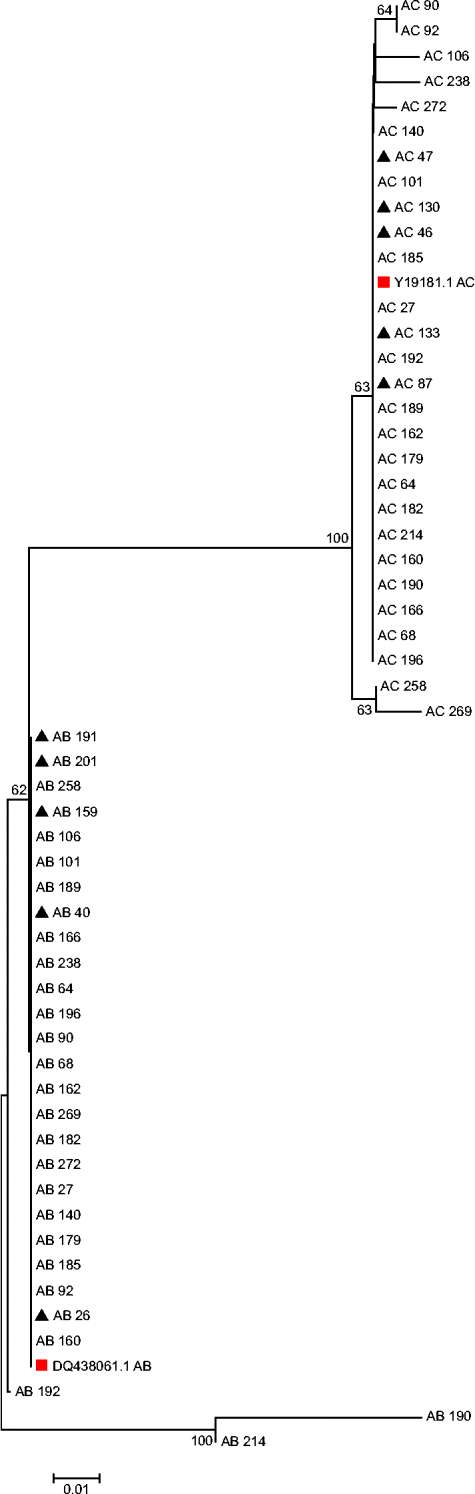
For each species, comparative analysis revealed that retrieved sequences were closely related to reference sequences, exhibiting high identity rates of 98–100% and 99–100%, respectively, for A. caninum and A. braziliense. No novel sequence was described. Phylogenetic trees were constructed based on 33 nucleotide sequences randomly selected. Among these sequences, 23 were related to mixed infections and the remaining to single infections with A. caninum (AC46, AC47, AC87, AC130 and AC133) or with A. braziliense (AB26, AB40, AB159, AB191 and AB201). The phylogenetic tree demonstrated a distinct separation of the sequences into two major clusters (fig. 1).
Phylogenetic tree of canine hookworm isolates based on the ITS1 and 5.8S rRNA sequences retrieved from single infections with A. caninum (n= 5) or with A. braziliense (n= 5) and from mixed infections with both species (n= 23); bootstrap values obtained from 1000 replicates (>50% shown) with single infections (red squares) and reference sequences (black triangles) highlighted.

Discussion
Dogs often harbour several enteric parasites and most of them have potential for transmission to humans, representing a public health concern. Still today, the high level of environmental contamination with canine faeces exposes both dogs and human beings to infective parasitic elements, particularly in low-income areas (Traversa et al., Reference Traversa, Frangipane di Regalbono, Di Cesare, La Torre, Drake and Pietrobelli2014). In the present study, a high overall prevalence (67.3%) of canine gastrointestinal parasites was recorded and zoonotic parasites were more frequent, highlighting infections by the Ancylostomatidae (56.6%), followed by Toxocara canis (11.9%) and Giardia spp. (5.8%). These findings agree with recent data reported in different parts of the world (Little et al., Reference Little, Johnson, Lewis, Jaklitsch, Payton, Blagburn, Bowman, Moroff, Tams, Rich and Aucoin2009; Scorza et al., Reference Scorza, Duncan, Miles and Lappin2011; Riggio et al., Reference Riggio, Mannella, Ariti and Perrucci2013; Cardoso et al., Reference Cardoso, Costa, Figueiredo, Castro and Conceição2014), including in Brazil (Heukelbach & Feldmeier, Reference Heukelbach and Feldmeier2008; Katagiri & Oliveira-Sequeira, Reference Katagiri and Oliveira-Sequeira2008; Klimpel et al., Reference Klimpel, Heukelbach, Pothmann and Rückert2010).
Hookworms have been found to be a common intestinal parasite infecting owned and stray dogs (Traversa et al., Reference Traversa, Frangipane di Regalbono, Di Cesare, La Torre, Drake and Pietrobelli2014). Although no statistically significant differences were observed between hookworm prevalence rate and variables such as age, gender, breed and household location, some interesting findings deserve comments. In general, higher prevalence rates of infection have been commonly registered in stray dogs and also in young dogs. The present results did not fit this pattern as all dogs had an owner and the population consisted mostly of adult dogs. Although hookworm infections are more frequently detected in young dogs, as they grow they continue to be susceptible and can be infected. In the present study, the fact that up to 70% of the dogs were adults and the high frequency of Ancylostomatidae eggs recorded reinforce this observation. Furthermore, according to almost all owners, the majority of these dogs had never been dewormed in their lives which, probably, contributed to the high frequency of hookworm infection. Another aspect to be stressed is that although the dogs had an owner, they did not live in restricted conditions, since most of them were reared with free access to the streets in both urban and rural areas. Thus, dogs were allowed to defecate outside their households, leading to environmental contamination, even in urban zones where, due the lack of infrastructure, a considerable part of the streets were unpaved.
Hookworms are the only helminths producing strongyle-type eggs in dogs, and these are easily identifiable by standard flotation and microscopy. So, PCR is not necessary to determine the prevalence of hookworms per se, but is necessary to differentiate between the species of Ancylostoma. Based on molecular methods, the present analyses demonstrated that of 158 microscopy-positive hookworm samples, 67% were amplified successfully by PCR. Amplification was not observed for all samples, and similar findings have been reported by other researchers (Palmer et al., Reference Palmer, Traub, Robertson, Hobbs, Elliot, While, Rees and Thompson2007; Mahdy et al., Reference Mahdy, Lim, Ngui, Fatimah, Choy, Yap, Al-Mekhlafi, Ibrahim and Surin2012). According to some authors this can be associated with the presence of inhibitors in faeces or the low number of eggs in the stool, resulting in a low amount of DNA (Palmer et al., Reference Palmer, Traub, Robertson, Hobbs, Elliot, While, Rees and Thompson2007). Despite this, out of 88 hookworm-positive faecal samples that were both amplified and sequenced; only A. caninum and A. braziliense were isolated from dogs – 61.4% were found to be infected with A. caninum, 12.5% with A. braziliense and 26.1% with mixed infections. These results are consistent with previous surveys based on PCR methods, which also demonstrated the predominance of A. caninum among dogs in regions of Asia (Traub et al., Reference Traub, Robertson, Irwin, Mencke and Thompson2004b, Reference Traub, Inpankaew, Sutthikornchai, Sukthana and Thompson2008; Mahdy et al., Reference Mahdy, Lim, Ngui, Fatimah, Choy, Yap, Al-Mekhlafi, Ibrahim and Surin2012), Australia (Palmer et al., Reference Palmer, Traub, Robertson, Hobbs, Elliot, While, Rees and Thompson2007) and the USA (Liotta et al., Reference Liotta, Koompapong, Yaros, Prullage and Bowman2012). In Brazil, prevalence data of each species have been recorded only by post-mortem examination and A. caninum had been reported to be the predominant hookworm, often as the only one identified (Heukelbach & Feldmeier, Reference Heukelbach and Feldmeier2008; Klimpel et al., Reference Klimpel, Heukelbach, Pothmann and Rückert2010; Coelho et al., Reference Coelho, Amarante, Apolinário, Coelho and Bresciani2011). In the present investigation, A. braziliense was also detected but few molecular studies have reported the occurrence of this species in dogs (Traub et al., Reference Traub, Robertson, Irwin, Mencke and Thompson2004a; Liotta et al., Reference Liotta, Koompapong, Yaros, Prullage and Bowman2012; Ngui et al., Reference Ngui, Lim, Traub, Mahmud and Mistam2012).
In a public health context, notwithstanding the widespread distribution of A. caninum, it seems that the occurrence of CLM follows the geographical distribution of A. braziliense and most reported cases have been in tourists who have visited regions where this species is endemic in dogs and cats (Bowman et al., Reference Bowman, Montgomery, Zajac, Eberhard and Kazacos2010). However, it is not easy to establish an association because in many areas the animals can harbour mixed infections (Bowman et al., Reference Bowman, Montgomery, Zajac, Eberhard and Kazacos2010).
Although CLM has been reported sporadically in low-income countries, it is known that low socio-economic status and certain behaviour, such as walking barefoot on contaminated soil, are probably risk factors for the occurrence of this syndrome (Heukelbach & Feldmeier, Reference Heukelbach and Feldmeier2008). A relevant study carried out in deprived communities of India showed that A. braziliense was detected in up to 60% of dogs (Traub et al., Reference Traub, Robertson, Irwin, Mencke and Thompson2004b, 2005) and in these areas most of the population (64%) admitted to walking barefoot outdoors (Traub et al., Reference Traub, Robertson, Irwin, Mencke and Thompson2004b). In this scenario, the authors believe that these findings would account for the high incidence of creeping eruptions observed among the human population (Traub et al., Reference Traub, Robertson, Irwin, Mencke and Thompson2004b). In the present study, no association could be made between the presence of dogs infected with hookworms, especially harbouring A. braziliense, and the occurrence of CLM. During the survey, in visits to the local primary healthcare centre, the workers were informed that no patients were registered as CLM cases. However, the habit of walking barefoot outside the household was very common, particularly among children living in the rural zone, who are at a constant risk of infection by hookworm larvae.
To our knowledge, the present study is the first parasitological survey and, so far, the only one in South America in which the PCR technique was employed for differential diagnosis of canine hookworm species directly from eggs in stool samples, avoiding post-mortem examination. The findings assembled herein confirm that molecular methods have clearly enabled further improvements in parasite diagnosis and epidemiology, while providing interesting insights on canine hookworm prevalence and reinforcing the need for future studies that focus on clarifying the relationship between species distribution and the occurrence of cutaneous larva migrans.
Acknowledgements
The authors would like to thank all the owners who participated in the study.
Financial support
This work was supported by the Fundação de Amparo à Pesquisa do Estado de São Paulo (FAPESP) through the research grant process 06/56151-3.
Conflict of interest
None.
Ethical standards
All procedures were conducted according to the animal protocols reviewed and approved by the Ethics Committee on Animal Experimentation (CEEA) of the Bioscience Institute, IBB-UNESP (Protocol number 027/06CEEA). Permission forms were handed out to dog owners, who signed them before animal sampling was done.