For modern musicology, Jacobus de IspaniaFootnote 1 remains the chief witness to changes that took place in the theory of music and compositional practice in Paris in the first decades of the fourteenth century, changes defined in terms of the opposition ‘Ars Antiqua’ or ‘Ars Vetus’ and ‘Ars Nova’. It is known that in the seventh book of his Speculum musicae Jacobus, presenting himself as one of the ‘antiqui’, cited anonymously from Ars Nova theorists whom he called ‘moderni doctores’ and of whom he was critical. Some of these citations have long been identified as being from three treatises by Johannes de Muris: Notitia artis musicae, Compendium and Musica speculativa, as well as from Ars Nova by Philippe de Vitry.Footnote 2 More recently Karen Desmond has put forward the hypothesis that Jacobus cited from the text that was ‘the common ancestor’ for the body of surviving treatises associated with Philippe de Vitry.Footnote 3
The dating of the treatises by Muris cited by Jacobus in the seventh book of Speculum is beyond doubt only in the case of the two authorial versions of Musica speculativa. Thus Desmond recently argued that, although in one of the transmissions Notitia carries the date 1319, the part of that treatise with the title ‘Conclusiones’ was composed later, perhaps in the mid- to late 1320s, as a separate whole.Footnote 4 Desmond also questions the currently accepted dating of the Compendium. She points to the possible link between this treatise and the three libelli from the manuscript BnF lat. 7378A and suggests moving the 1322 dating of the creation of the Compendium proposed by Ulrich Michels to the late 1320s or after.Footnote 5 Desmond's edition of the libelli, currently in preparation, will presumably allow a closer examination of these issues.Footnote 6
In this study, I concentrate on the citations by Jacobus from Muris's Musica speculativa. I seek to determine which of the versions of Musica speculativa was the one used by Jacobus. The earliest transmissions of both authorial versions of Musica speculativa, version A created in Paris at the Sorbonne in 1323, and version B prepared in 1325, come from the 1360s (version B) and 1370s (version A). The earliest extant transmission of the ‘mixed’ A/B version is dated to 1369.Footnote 7 There can thus be no doubt that the citations included in the work of Jacobus are the earliest witness of the relevant passages taken from Musica speculativa known today.
Michels suggested version A as Jacobus's source.Footnote 8 More than twenty years later Christoph Falkenroth undermined Michels's view, demonstrating that Jacobus ‘very probably knew version B, which was available to him as a model’ (‘sehr wahrscheinlich die Fassung B gekannt hat und sie ihm als Vorlage zur Verfügung stand’).Footnote 9 Lawrence Gushee questioned this opinion and indicated version A as Jacobus's possible source.Footnote 10 Scholars accepted Falkenroth's opinion; it was taken into account by, among others, Margaret Bent.Footnote 11 Recently, Anna Zayaruznaya has regarded it as conclusive.Footnote 12 In most general terms, the year 1325 is now considered to be the terminus post quem for the creation of the seventh book of Speculum. Desmond is even inclined to consider the A/B version as the source of the citations, in this way moving the terminus post quem for the final book of Jacobus's work to an even later period.Footnote 13
The importance of these recent scholarly discussions underlines the need for a new analysis of the passages quoted by Jacobus. This is possible because access to sources is a great deal easier today than thirty years ago, and the quality of digital copies – vastly exceeding that of old microfilms – facilitates detailed research both of the accuracy of the citations given in Speculum musicae and of the extant transmissions of the treatises by Muris. Defining the version of Musica speculativa from which Jacobus quoted may provide us with new arguments for dating the Notitia and Compendium. This in turn may have important repercussions for the potential date range of Speculum musicae, Book 7.
Musica speculativa and its versions
Collecting, ordering and describing the extant manuscripts of music treatises by Muris – including dozens of copies of Musica speculativa – was an enormously significant contribution made by Michels. Michels's list encompassed more than forty manuscripts and a few prints, forty-seven items in total.Footnote 14 Michels also systematised the copies of Musica speculativa according to four identified versions: A, B, mixed A/B and shortened A.
During the fifty years that have passed since the publication of Michels's monograph the number of known transmissions of Musica speculativa has increased.Footnote 15 At present there are at least fifty-two known copies of all its versions (not counting commentaries and excerpts). We know that transmissions of version A, which constitute half the existing copies, come mainly from central Europe. Moreover, the core of the relatively cohesive manuscript tradition is constituted by fifteenth-century manuscripts written in the university circles of Prague, Erfurt, Kraków, Leipzig, Vienna and Basel, as well as those from Benedictine monasteries, such as Melk and Tegernsee. Paris may be represented here by only one manuscript held in the collection of St Paul's Abbey in Lavanttal (A-SPL cod. 264/4, all manuscripts are listed and described in Appendix II).Footnote 16 A-SPL cod. 264/4, dated c.1400 (and after 1394), includes the copy of Musica speculativa, the explicit of which served as the basis for dating version A (fol. 49r): ‘Explicit musica speculativa secundum boetium per magistrum Johannem de muris abbreviata Parisius in sorbona. Anno Domini 1323.’ The manuscript contains the full text of the treatise. There are two indications that the manuscript A-SPL cod. 264/4 originates from Paris. The first is the information received by Martin Gerbert in 1782 from his correspondent in Paris about the discovery of this manuscript by the abbot of Saint Léger de Soissons, Barthélemi Mercier (1734–99), librarian at the Parisian abbey of the Canons Regular at Sainte-Geneviève.Footnote 17 The second is the document included in that manuscript, titled ‘Epistola ab Universitate Parisiensi regi Francorum directa’ with the date 1394 (fol. 70r), which provides the grounds for dating the manuscript. Its contents, which include three treatises by Muris (alongside Musica speculativa, also Notitia and Compendium) and texts originating from his circle, as well as by other authors who were active and studied in Paris, allow us to regard A-SPL cod. 264/4 as one of the most important sources of the theory of music as taught in fourteenth-century Paris.Footnote 18
The evidence of this modest but very important witness of Musica speculativa version A is supported by an unfortunately incomplete fifteenth-century copy in the manuscript GB-Ob B77. Its explicit confirms the date, 1323 (adding the month, June), and the place where version A was written, the Sorbonne University in Paris (fol. 99v): ‘Explicit Musica boeti abbreviata a magistro Johanne de Muris Anno domini 1323o mense Junii parisius in Sarbona.’ This codex, copied in England, contains a list of titles of Propositiones from the introductory part of the treatise and the text of Musica speculativa starting from the first Conclusio; the diagrams are not included.Footnote 19
Although version B is predominantly transmitted in Italian manuscripts, there is one copy of probable Parisian provenance: BnF lat. 7378A. The explicit in the form of an arithmetical rebus indicates the date 1325, but does not give either the title of the treatise or the place of its creation (fol. 54v): ‘hic liber expletur sic / quod nimis est resecetur / si minus addatur et sic / ars vera paratur. Sume 10. / cubice duplate terque quadrate / et semis. Armonie sunt hee / sic abreviate’. This is the earliest known witness of version B, copied around 1362 or after.Footnote 20
Differences of content between versions A and B concern not only alternative prefaces but also abridgements and reformulations introduced by Muris to version B: of the introductory Propositiones in the first part and in some sections of the second part. On the other hand, the eighteen Conclusiones of the first part of Musica speculativa are without any apparent changes. These differences are illustrated in a synoptic table by Falkenroth.Footnote 21
The A/B version is currently found in five transmissions of Musica speculativa, and we can identify three different combinations of A and B versions within this group. The oldest known transmission is preserved in manuscript E-Sc 5-3-23 written in Paris c.1369, as we learn from the colophon to the treatise Algorismus de minutiis by Johannes de Lineriis that precedes Muris's Musica speculativa.Footnote 22 This transmission represents a combination of the main text of Musica speculativa with the incipit ‘Omnem doctrinam’ from version A but with the prologue ‘Quoniam musica’ from version B added at the end.
The second transmission of version A/B, preserved in the manuscript GB-Gu 461 was copied, as the colophon tells us, in Rouen in 1384 by Robertus Robillart, a student at the University of Paris, and according to Meyer most probably based on the Parisian model.Footnote 23 This text is a combination of the prologues of both versions of ‘Etsi bestialium’ and ‘Quoniam musica’ with the main text ‘Omnem doctrinam’ in the B version, with some passages taken from the A version. The same combination of A and B versions is found in manuscript I-Ma C 241inf. The text of Musica speculativa was entered in this manuscript in 1401 in Paris by Giovanni Contarini, a student from Venice.Footnote 24
The last two transmissions of version A/B – D-B lat. fol. 600 and BnF lat. 7295 – come from the first decades of the fifteenth century. They represent a combination of the prologue ‘Etsi bestialium voluptatum’ from version A, and the main text ‘Omnem doctrinam’ from version B together with the B version's prologue, ‘Quoniam musica’. According to Christian Meyer, all these texts originate from Paris or duplicate the Parisian model. Moreover, three of them were written by identifiable students at the University of Paris.Footnote 25 We thus have to agree with Meyer that version A/B reflects the teaching of music in Paris in the second half of the fourteenth century.Footnote 26
Finally, the fourth, shortened version, undated, but known from two fifteenth-century transmissions, is an abridgement of version A and was most probably produced in the area of present-day Austria: one of the sources comes from the community of the University of Vienna (A-Wn cod. 5203, olim. Philos. 387), the other from the Benedictine abbey in Melk (A-M cod. 1916).Footnote 27
Citations from Musica speculativa in Speculum musicae
The seventh book of Speculum musicae has survived only in one copy, made in the fifteenth century in Italy and now held at the Bibliothèque Nationale de France in Paris, BnF lat. 7207.Footnote 28 Jacobus referred to the treatise by Muris describing it as ‘opus de abbreviatione Boetii’.Footnote 29 He quoted the last Conclusio (Conclusio decima octava), which belongs to the part of the treatise that had not been abridged during the editing of version B.Footnote 30 Jacobus also quoted the penultimate Propositio (Propositio tertia) from the introductory part, considerably abridged by Muris in version B.Footnote 31 I provide Jacobus's citation from the eighteenth Conclusio in full as Appendix I. The complete citation from the third Propositio is explored in the following.
Jacobus became acquainted with Musica speculativa when writing the seventh book, which is devoted to musica mensurabilis, that is, to issues of polyphony, rhythm and notation.Footnote 32 He devoted chapters 2–10 to discant. His heroes there are Guido, Franco and Lambertus (quoted as ‘quidam Aristoteles’) on the one hand, and Muris, the only ‘modernus doctor’ in this company, on the other. The eighteenth Conclusio of Musica speculativa is, most probably, the earliest extant text arguing against the treatment of the fourth as an ‘absolute’ consonance within a three-voice structure: Muris admitted it as a consonance only when placed above the fifth, that is, being the upper part of the octave.
The first sign of an extensive polemic against Muris, which fills chapters 6, 7 and 8, appears already in chapter 5, where Jacobus starts to discuss consonances to be used in discant. He quotes Guido's opinion that ‘there are three consonances which principally should be used in diaphonia, i.e. the fourth, the fifth and the octave’.Footnote 33 Then he gives an example, a three-voice section where the fourths are placed underneath fifths (see Figure 1).
BnF lat. 7207, fol. 276r (source: https://gallica.bnf.fr). (colour online)

Finally, Jacobus remarks that such arrangement of the fourths and fifths ‘is against a certain modern scholar who does not regard the fourth under the fifth as a consonance, but above the fifth’.Footnote 34
Jacobus's polemic against Muris has long been known; it is nevertheless worth recalling here both for the essence of the disagreement and for the argumentation used by the author of Speculum musicae.Footnote 35
‘The fourth with an octave is not a consonance’ (‘Nulla fit armonia diatessaron cum diapason’) claimed Muris, referring to the Pythagoreans’ views on the eleventh, quoted by Boethius.Footnote 36 Pythagoreans explained the insufficient pleasure that this sound offered to the ear because of its numerical ratio, which did not match that of consonances. Later in the Musica speculativa, again following Boethius, Muris quoted the view of Ptolemy, who regarded the eleventh as a good consonance. Taking the side of the Pythagoreans, Muris believed that their arguments implicitly concerned the question whether ‘the fourth before the fifth, and thus under the fifth, is a consonance’ (‘Utrum diatessaron ante, id est sub diapente sit consonantia’). Finally he concluded that the fourth is a consonance only when it appears ‘after the fifth’, that is, ‘above the fifth’, constituting the upper part of the (harmonically divided) octave; but when placed ‘under the fifth’, that is, ‘before the fifth’, it is not a consonance.
Jacobus, defending the status of the fourth, adopted the following strategy in his polemic: first he quoted the views of Muris stated in the eighteenth Conclusio, and then he presented his own arguments. Above all, however, he pointed out the contradictions in the views of the author of Musica speculativa, who in the third Propositio of the same treatise listed the fourth as one of the perfect consonances alongside the octave and the fifth without any caveat. Thus, the seventh book of Speculum musicae contains first citations from the eighteenth Conclusio (in chapter 6) and then citations from the third Propositio (in chapter 7).
Conclusio octava decima/The eighteenth conclusion
The eighteenth is one of the most extensive of the Conclusiones in Musica speculativa and the only one where the author takes a view on the question of polyphony. As mentioned previously, it belongs to the part of the treatise where Muris, when preparing version B, did not make any abridgements. The Parisian transmissions of versions A and B, from which I quote later, differ at some points. They reveal both incidental scribal errors and variant readings, which arose from scribal errors and gained permanence over several decades of circulation. Such errors and variant readings are part of the manuscript traditions of versions A and B, but they do not constitute actual differences between versions A and B as intended by the author. Changes that might have been introduced by the author himself can, however, also be identified.
Clearly it was not Jacobus's intention to copy the text of the eighteenth Conclusio at length. He selected only those sections that he regarded as the most significant, and paraphrased, abbreviated or simply omitted the others (see Appendix I). Jacobus left out over 30 per cent of the text of the eighteenth Conclusio (which he counted as the seventeenth).Footnote 37 On the other hand, he cited nearly in full its most important, final passage, where Muris included his own opinion on the subject of the fourth's double nature. It is also there that we find the two significant variants that differentiate both Parisian transmissions of versions A and B, and which consistently appear throughout the whole extant manuscript tradition of the treatise Musica speculativa. Significantly, both variants are located precisely in those places in the text by Jacobus where Roger Bragard introduced emendations, replacing the readings cited by Jacobus with the readings taken from manuscript A-SPL cod. 264/4, published by Gerbert.Footnote 38
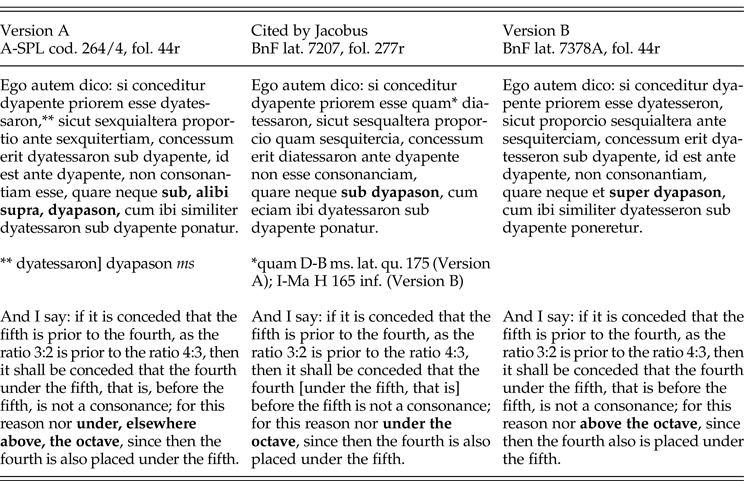
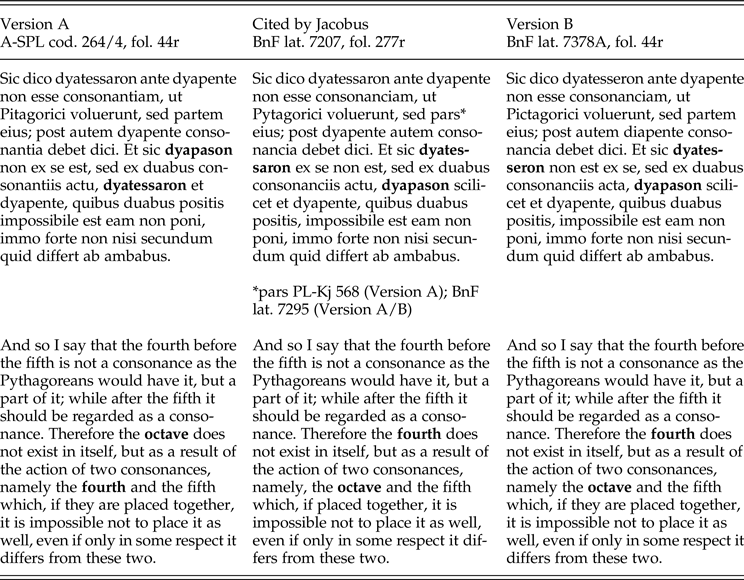
Tables 1 and 2 present, with translations, the two relevant sections taken from the final passage of the eighteenth Conclusio cited by Jacobus, in comparison with the Parisian transmissions of versions A and B. I retain the original orthography adding my own punctuation and emphases.
Comparison of the first variant of the eighteenth Conclusio

Comparison of the second variant of the eighteenth Conclusio

Let us begin with Jacobus's citation. To start with, it has to be noted that in the manuscript of Speculum the words ‘sub dyapente id est’ have been omitted, but this is more likely to be a mistake by the scribe than the author.Footnote 39 The formulation ‘neque sub dyapason’, cited later by Jacobus, was intended by the author of Musica speculativa as a logical consequence of ‘sub dyapente’, that is, ‘ante dyapente’: Muris argues that the fourth is not a consonance when it is under the fifth, and for that reason it is also not a consonance under the octave, since also then it is placed under the fifth (which is part of that octave). The fourth ‘under (i.e., before) the octave’ obviously forms the eleventh, which the Pythagoreans did not regard as a consonance. Thus Muris questioned the consonant nature of the fourth under the fifth pointing to the similarity of such placing to the fourth placed under the octave. However, what is missing in his argument is any indication of the status of the fourth placed above the octave: Johannes does not explain whether it is then a consonance, such as when its position is above the fifth. The final, most pertinent point in Jacobus's critique of the views of Johannes is directed precisely at this gap.
Jacobus, BnF lat. 7207, fol. 277r:Footnote 40
si esset simile de duabus illis questionibus, tunc si dyatessaron sub dyapente non est consonantia, sed supra diapente est optima consonantia, similiter dyatessaron sub dyapason non esset consonantia, sed supra dyapason. Hoc autem non Boethius dicit, non Ptolomeus, sed per indifferentiam loqui videntur sive dyatessaron sub dyapason ponatur, sive supra, quia non variatur eius proportio hic vel ibi. Ex hiis vel aliis, que induci possent, videtur non esset simile de duabus illis questionibus.
(if there were a similarity between the two issues then, if the fourth under the fifth is not a consonance but is the best consonance above the fifth, this means that similarly the fourth would not be a consonance under the octave, but above the octave. Boethius does not say that, Ptolemy does not say that, and they seem not to differentiate whether the fourth is placed under, or above the octave, since its ratio does not change either here or there. These or other [things] which might be added show that there is no similarity as to these issues.)
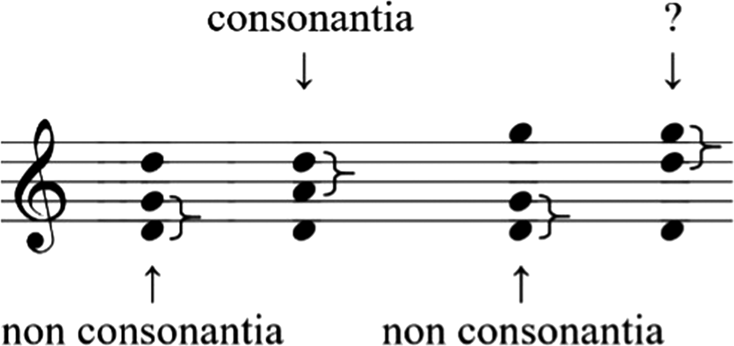
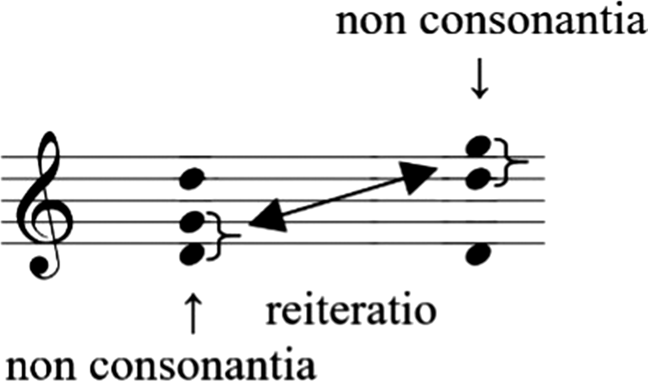
Example 1 may illustrate the reading of version A criticised by Jacobus.
The fourth as ‘non consonantia’ under the fifth and under the octave.

The reading of version B introduces a change in Johannes's argument in relation to the version quoted by Jacobus: the preposition ‘sub’ [diapason] is replaced by ‘super’ [diapason]. According to this change the fourth is not a consonance either ‘under’ the fifth or ‘above’ the octave, since there also the fourth is under the fifth. This new reading is obviously based on the claim which Johannes presented a little earlier in the eighteenth Conclusio (omitted in Jacobus's quotation) that every interval above the octave is a reiteration of that interval within the octave (see Appendix I, sentences 19–20). In other words, the fourth above the octave is the same as the fourth within the octave (counting from its lowest note): in both cases it is positioned under the fifth and as such is not a consonance.
The new reading of version B may be presented as Example 2.
The fourth as ‘non consonantia’ under the fifth and above the octave.

The reading of version B is thus an emendation of the text, furthermore it seems to follow Jacobus's critical comment to a significant extent: it entirely excludes the possibility that the fourth above the octave is a consonance, and pushes into the background the similarity of the issues of the consonant/dissonant nature of the fourth when it is placed respectively under the fifth and under the octave. At first glance, this new reading may seem awkward in formulation, but indeed it presents a reasonable solution, because on the one hand it avoids the errors pointed out by Jacobus, on the other it defends the thesis of Muris, that the fourth under the fifth is not a consonance. It also saves a connection between this thesis and the status of diapason cum diatessaron as ‘nulla harmonia’ highlighted in the headline of the eighteenth Conclusio.
Since we do not find the old ‘sub diapason’ reading in any of the transmissions of version B known today, we may suppose that the new ‘super diapason’ reading belonged from the beginning to version B as its integral part.Footnote 41 This in turn would be a sign that the new reading might have been introduced by the author himself. It also appears in all four transmissions of version A/B, where the main text is based on version B. The new reading also found its way into later Parisian transmissions of version A, as is shown by the manuscript E-Sc 5-3-23 containing version A/B, with the main text taken from version A.
Manuscript A-SPL cod. 264/4 reflects this picture: the phrase ‘sub, alibi supra, diapason’ (‘under, elsewhere above, the octave’) indicates that the scribe copied an old transmission of version A with the reading ‘sub diapason’, and while doing so noticed that ‘elsewhere’, that is, in a different manuscript(s), the reading is ‘supra diapason’. An evident scribal error ‘dyapason’ instead of ‘dyatessaron’ at the beginning of the quoted section – a result of misreading of very similar abbreviations used for ‘diapason’ and ‘diatessaron’ (in both cases close to the form ‘diaon’) is also to be noted. The transmission in A-SPL cod. 264/4 confirms the reading of Jacobus, while at the same time indicating the intentional practice of the scribe, who checked his exemplar against another source.Footnote 42 Eventually the old reading ‘sub diapason’ was almost totally eliminated from manuscripts of version A. Its trace survived only in A-SPL cod. 264/4 and three fifteenth-century manuscripts from outside France: D-TRs Ms. 8o 1893/1481, CZ-Pu adlig. 44.E.8 (2815) and CZ-Pu V.F.6. (928).Footnote 43
Let us now analyse the second variant: it shows that Jacobus quoted from a better exemplar than the one used by the scribe of A-SPL cod. 264/4.
The two sentences presented and translated in Table 2 form the final conclusion by Muris on the subject of the double nature of the fourth. According to the version cited by Jacobus, the fourth has no independent existence, but is, in a sense, an interval that is secondary to the fifth and the octave: it arises as the ‘difference’ between the octave and the fifth. We find the same text in the Parisian transmission of version B and its later transmissions, as well as in all the manuscripts of the A/B version.
A different reading is revealed in the A-SPL cod. 264/4 transmission of version A. There, in place of the fourth, it is the octave which appears as the interval devoid of independent existence, arising as a result of combining the fourth and the fifth. Clearly, the claim that the octave is the sum of the fourth and the fifth does not produce any doubts, but the argument as a whole is erroneous, since it denies the octave the status of an independent consonance. A misreading of ‘diapason’ instead of ‘diatessaron’ is the origin of this error (see the version labelled 1 below, witnessed by D-EF CA 2o 395, fol. 212v). Then a subsequent copyist adapted the rest of the sentence to this error in order to make it meaningful, and changed the second ‘dyapason’ to ‘dyatessaron’ (see version 2 below, witnessed by CZ-Pak, LXXIX (1272), fol. 81r):
Et sic dyatessaron non ex se est, sed ex duabus consonanciis actu, dyapason et dyapente
1. Et sic dyapason non ex se est, sed ex duabus consonanciis actu, dyapason et dyapente
2. Et sic dyapason non ex se est, sed ex duabus consonanciis actu, dyatessaron et dyapente
The writer of manuscript A-SPL cod. 264/4 probably copied this erroneous reading from his exemplar, because it is replicated in a significant part of the manuscript tradition of version A. This phenomenon can only be explained by force of habit, typical of lectio facilior (‘easier reading’). The correct reading, convergent with the text quoted by Jacobus, is to be found in the following transmissions of version A: GB-Ob B77, I-Vnm, lat. VIII. 24 (3434), A-Wn cod. 5274 (olim. Philos. 113); PL-Kj, 568, and the manuscript from Stiftungsbibliothek am Oberlandesgericht Celle B V 9, not known until recently.Footnote 44 It is also transmitted in the fourteenth-century Parisian manuscript E-Sc 5-3-23 containing version A/B, with the main text taken from version A.
I do not provide a detailed analysis of minor variant readings (concerning, for instance, the order of words), since they do not influence understandings of Muris's arguments and are of no significance in this case; they can all be found scattered in later transmissions of the two versions of the treatise.
Let us now examine the citations from the third Propositio comparing them to the (later) manuscript tradition of Musica speculativa.
Tertia propositio/The third proposition
Let Jacobus speak for himself:
Speculum musicae VII, 7. BnF lat. 7207, fol. 277v:Footnote 45
Hic eciam actor, quicquid hic dicat alibi in eodem opere, tenere videtur dyatessaron perfectam esse consonanciam. Dicit enim in tercia proposicione illius tractatus sic: ‘Iam tres armonias perfectas esse sonantes.’ Ille tres armonie, ut dicit, sunt dyapason in dupla, dyapente in sesqualtera, dyatessaron in sesquitercia. Sic igitur absolute loquendo vocat ibi dyatessaron perfectam armoniam. Non videtur autem una consonancia perfecta ab alia suam tollere perfeccionem: omnia bene consonant et unum perfectum alteri perfecto. Unde si dyatessaron sit perfecta consonancia, dyapente sibi iuncta, que etiam perfecta est ante vel post, non aufert ab illam suam perfeccionem. Dicit autem hic in exposicione illius tercie proposicionis: ‘Armonias autem non esse pauciores tribus experiencia docuit. Sed an plures sint, quas natura voluit revelare, deus novit. Perfecciores autem hiis tribus usque ad nos nemo videtur expertus fuisse.’
(That same author, whatever he might say in another place in his work, seems to maintain that the fourth is a perfect consonance. Thus, this is what he says in the third Propositio of his treatise: ‘Already three perfect harmonies can be heard.’ These three harmonies, according to him, are: the octave in the ratio 2:1, the fifth in the ratio 3:2, the fourth in the ratio 4:3. Therefore, to put it simply, here he calls the fourth a perfect consonance. However, it does not seem that one perfect consonance should take away perfection from another; everything sounds well together with one perfect next to another perfect. Hence, if the fourth is a perfect consonance, then the fifth combined with it, which is also perfect both before [it] and after [it], does not take away from it the perfection belonging to it. Moreover, in the explanation of this third Propositio he says: ‘Experience teaches that there are no fewer harmonies than three. Whether there are more of them than nature has deigned to reveal, God knows. However, nobody has experienced any more perfect ones than these three in our times.’)
Falkenroth pointed to the last three sentences of the preceding passage – ‘Armonias autem non esse pauciores tribus experiencia docuit. Sed an plures sint, quas natura voluit revelare, deus novit. Perfecciores autem hiis tribus usque ad nos nemo videtur expertus fuisse’ – arguing that they come from version B and that this was the version of Musica speculativa used by Jacobus.Footnote 46 Indeed, in all the transmissions of version B the sentence: ‘Armonias autem non esse pauciores tribus experiencia docuit’ is at the beginning of the third Propositio and follows the title ‘Iam tres armonias perfctas esse sonantes’. However, Falkenroth did not explain the phrases ‘quas natura voluit revelare’ and ‘usque ad nos’ which appear in the next sentences, phrases transmitted only in version A. As already noted by Gushee, Jacobus could not have taken these phrases from version B since they were not there.Footnote 47
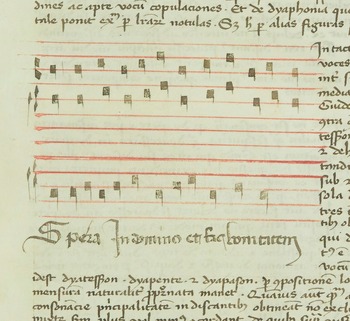
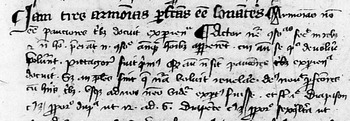
On the other hand, in nearly all the transmissions of version A, the third Propositio begins with the words ‘Auctor naturae’, which follow immediately after the title ‘Iam tres armonias’. There is, however, one exception: the transmission of version A in A-SPL cod. 264/4 (fol. 38r) quoted earlier. There the sentence ‘Armonias autem non esse pauciores tribus experiencia docuit’ immediately follows the title (see Figure 2).
A-SPL cod. 264/4, fol. 38r. Reproduced by kind permission of the Library of the Benediktinerstift St Paul im Lavanttal.

A translation of text in Figure 2 is as follows:
Now three perfect harmonies can be heard. Experience has taught us that there are no fewer than three harmonies. The Creator established the consonances in nature, not man. That is because consonances existed before they were revealed to people. To whom then did they deign to descend? Pythagoras was the first. And that there are no fewer of them than three is taught by experience. But are there more of them than nature deigned to reveal, God knows. However, nobody up to our times has experienced any more perfect than those three. And these are: the octave with the ratio dupla, as 12 ad 6, the fifth with the ratio sexquialtera, as …
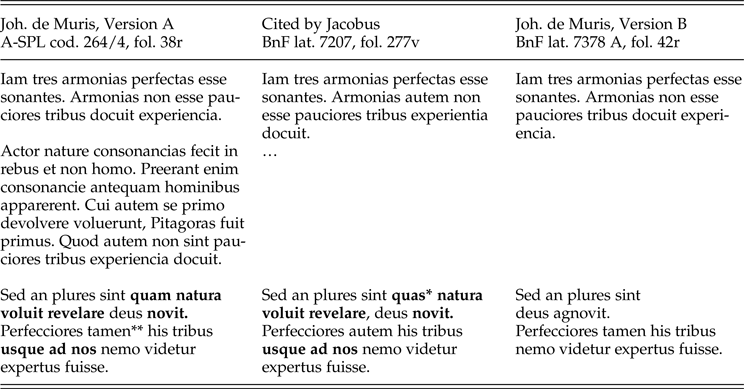
If that was the text of the third Propositio from which Jacobus had quoted, we could assume that he omitted the passage regarding the divine origin of consonances and Pythagoras's revelation, since that passage was not part of the dispute with the author of Musica speculativa. Table 3 provides a comparison of the text quoted by Jacobus with the Parisian transmissions of versions A and B.
Comparison of the variants of the third Propositio

*quas D-EF CA 2o 395, PL-Kj 546, PL-Kj 1927, PL-Kj 1865, D-B lat. qu. 175, D-Mbs clm 24108, CZ-Pu V.F.6 (928), US-NYcub MS X 510 H 74
**tamen] cū ms (probably a misreading of the regular abbreviation for ‘tamen’ composed of t and n)
The text cited by Jacobus, when included in the manuscript tradition of Musica speculativa, gives credibility to the transmission of version A quoted previously and confirms that the author of Speculum musicae had a similar text at his disposal. Moreover, we have here an example of double verification, since in this constellation the text transmitted in A-SPL cod. 264/4 provides us with evidence that the text quoted by Jacobus came from version A.
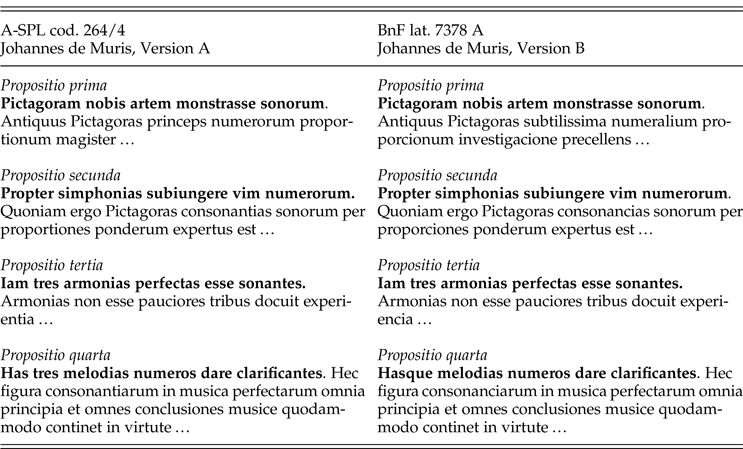
The comparison shown in Table 3 points to the conclusion that the ‘cut’ made when abridging the original version of the treatise came not directly after the title of the third Propositio but after its first sentence. Evidence of Muris applying this solution is provided by a comparison of the titles and initial sentences of all four Propositiones in both versions transmitted by the Parisian manuscripts (see Table 4).
Comparison of the titles and initial sentences of Propositiones

The sentence ‘Armonias non esse pauciores tribus docuit experiencia’ in manuscript A-SPL cod. 264/4 served to explain the content of the title verse ‘Iam tres armonias perfectas esse sonantes’. The key word in this sentence is ‘experientia’: the author uses it to refer to the ‘experience’ of Pythagoras, interpreted in the categories of Aristotelian theory of knowledge, and that is the interpretation presented in the first Propositio.Footnote 48 Without this sentence the title verse of the third Propositio might be incomprehensible to readers and students. This sentence is repeated almost word for word a little later as part of the argument on the subject of the number of consonances. Thus we cannot exclude the possibility that during later editing this repetition was removed, the first sentence was crossed out since it was easier to eliminate than its iteration involved in the argument establishing the number of perfect consonances.
Conclusions
This study has considered Jacobus's citations, in his Speculum musicae, from Muris's Musica speculativa, situating them within the manuscript tradition of Muris's treatise, and comparing them against particular versions. In consequence, it has been possible to distinguish relevant variants, two of which pertain to the eighteenth Conclusio. The first variant, ‘sub diapason’ as opposed to ‘super diapason’, clearly separates Jacobus's citation from version B, and its connection instead to version A is confirmed by A-SPL cod. 264/4 and three other copies of version A. An analysis of this particular variant allows us to suppose that the reading in version B is an emendation introduced by Muris himself in response to Jacobus's criticism. The second variant that appears in the eighteenth Conclusio – ‘diatessaron non ex se’ as opposed to ‘diapason non ex se’ – separates Jacobus's quotation from the reading given in A-SPL cod. 264/4, which at this point has the erroneous ‘diapason non ex se’. There are other similar errors in A-SPL cod. 264/4 (see Appendix I, sentence 24). We may therefore assume that Jacobus, in whose text we find the correct reading ‘diatessaron non ex se’, was quoting Musica speculativa from a different (better) copy than the one used by the copyist of A-SPL cod. 264/4. Jacobus's exemplar would then contain two original readings of the eighteenth Conclusio of version A. Obviously, the citations from the third Propositio derive from the same exemplar of the treatise. Since the third Propositio links Jacobus's quotation with the transmission of A-SPL cod. 264/4, both these texts derive from a common ancestor, the lost original of the treatise Musica speculativa from the year 1323. It is highly probable that Jacobus was quoting from one of its earliest copies. The relationship between A-SPL cod. 264/4 and the original is, however, more distant.Footnote 49
Dating the creation of version A of Musica speculativa to June 1323 thus provides us with a safe terminus post quem for Jacobus's quotations. The hypothetical terminus ante quem – the year 1325, the date of the edition of version B – is based on the supposition that Muris introduced the emendation ‘super diapason’ in response to Jacobus's earlier criticism. In essence, Jacobus's critical comments are the only explanation for the introduction of this emendation. Clearly, this hypothesis implies some form of contact between Jacobus and Muris. In fact, an indication for this hypothesis is provided by the author of Speculum himself, when he writes that ‘although in this work I will on more than one occasion speak against the opinions of the Moderni, where they oppose the views of the Antiqui, I still like them personally’ (‘etsi in hoc opere dicturus aliqua sum contra dicta Modernorum ubi obviant dictis Antiquorum, diligo tamen personas eorum’).Footnote 50 These words support Desmond's observations about the possible exchanges between Jacobus and Muris regarding Notitia, and between Jacobus and Philippe de Vitry regarding his treatise.Footnote 51 The emendation introduced into version B of Musica speculativa under the influence of Jacobus's criticism fits well with this scenario.
A date of completion before 1325 is therefore probable for the other treatises quoted in the seventh book of Speculum. As indicated by Jacobus himself, Musica speculativa occupies a special place there. At first, when introducing the question ‘Utrum diatessaron ante diapente sit consonantia’, Jacobus stresses, that it is incidentally (‘ex incidenti’) discussed ‘at this place’ (‘hic’, see Appendix I, sentence 4). Further, at the end of the quotation from the eighteenth Conclusio, Jacobus explains that ‘these are the quoted words of a scholar to which I would have responded, I think, earlier in the appropriate place, as well as to other words in the quoted work, had I seen that work’ (see Appendix I, sentence 35). In other words, Jacobus's polemic against Muris is included in the seventh book (the proper subject of which is cantus mensurabilis and the controversies between Antiqui and Moderni relating to it) only because Jacobus did not know Muris's Musica speculativa previously. Finally, Jacobus closes the polemic with the following: ‘Sed iam cesset haec incidentalis digressio. Ad propositum revertamus’ (‘But let us stop this incidental digression. Let us go back to the subject’).Footnote 52 Jacobus ends the incidental digression and returns to the subject of discantus he started earlier. In the second of two chapters that follow, we find the differentiation between cantus, discantus regularis and discantus irregularis together with the appropriate definitions taken from the last chapter of the Compendium, a treatise to which Jacobus refers frequently.Footnote 53 This categorises the question of ‘diatessaron ante diapente’ from Musica speculativa as ‘incidentalis digressio’, while the Compendium stands within the framework of the earlier conceived ‘propositum’. That the Compendium holds this position is an indication that Jacobus became familiar with it before he read Musica speculativa. Assuming some kind of personal contact between Jacobus and de Muris, this suggests that Muris's Compendium was written earlier than his Musica speculativa.
This dating of the Compendium diverges from that of Desmond, who moves the date of creation of the Compendium to the late 1320s, and who also regards the Conclusiones as a later text, independent of Muris's earliest musical treatise, Notitia.Footnote 54 I cannot understand why Desmond places the copy of the Compendium in BAV 1146 among those sources that, according to her, indicate the independence of the Conclusiones from the Notitia.Footnote 55 The explicit Desmond quotes, in fact, points to the opposite conclusion:
BAV Reg. lat. 1146 (14th cent., England), fol. 5r (https://digi.vatlib.it/view/MSS_Reg.lat.1146)
Explicit compendium tractatus Magistri Johannis de Muris.
Sciatur autem prenominatus magister quemdam tractatum artis musice compilavit. Cuius libellus iste compendium appellatur ab ipso sub brevitate extractus. In quo tractatu [ Capitulum octavum eadem manu, marg.] ille magister ponit 9 conclusiones, ut ad eas determinant que sunt ille sequentes: [sex tituli conclusionum sequuntur].
(The end of the abridgment of a treatise [the Notitia] by Magister Johannes de Muris.
It should be known that the above named magister compiled a certain treatise concerning ars musica. This little book extracted of it by himself for the reason of brevity is named ‘Compendium’. This magister placed in that treatise [chapter 8, marg., in the same hand] nine Conclusiones, as they are defined by the following: [then follow the shortened titles of six of the nine Conclusiones.])
According to the preceding annotation, the Compendium is an abbreviated version of some ‘tractatus artis musice’ (that has to be identified as Notitia artis musicae), an abbreviation produced by Muris. Further on we learn in the eighth chapter of this treatise that the same magister placed nine Conclusiones, and indeed, the list of Conclusiones is located at the beginning of the eighth chapter of the second book of Notitia (as in Michels's edition).Footnote 56 Michels saw this annotation as a particularly significant document in establishing the relationship between Notitia and Compendium.Footnote 57
The dating of the treatises by Muris quoted in the seventh book of the Speculum would thus look approximately as follows:
1. Notitia (1321)Footnote 58
2. Compendium (before 1323)
3. Jacobus's citations from Musica speculativa, version A (1323–5).
This dating returns to the chronology proposed by Michels, but based on different arguments, both regarding the issue of identification of the version of Musica speculativa quoted by Jacobus, and the temporal framework of these quotations.
Since all the transmissions of Musica speculativa known today were written after the death of its author, the quotations included in Speculum musicae are the only witnesses to the text of Musica speculativa and its reception within the lifetime of Muris. The credibility of the author of Speculum musicae makes his testimony particularly valuable. His intellectual refinement and high degree of competence in the area of music theory leave no doubt as to his correct understanding of the quoted text. Also the fact that he was disputing the views of a living theorist provides some guarantee of the authenticity and accuracy of the quoted sections of Musica speculativa. Jacobus was a most careful and critical reader of Muris's treatise. Citations in Jacobus's Speculum represent an especially valuable witness to the transmission of Musica speculativa, which offer an important insight into the development of this treatise's manuscript tradition. The text quoted by Jacobus comes from version A of Muris's Musica speculativa, dated 1323, and, most probably, transmits a part of its oldest layer.
Appendix I: Jacobus, Speculum musicae VII, 6
BnF lat. 7207, fol. 276v; see Roger Bragard, ed., Jacobi Leodiensis Speculum musicae, Corpus Scriptorum de Musica 3 (American Institute of Musicology 1973), Book VII, Chapter 6, 14–16.
1Videtur quod dyatessaron sub dyapente non sit consonancia, quia dyapente est prior consonancia quam dyatessaron, sicut proporcio sesqualtera quam sesquitercia. 2Ergo dyatessaron ante dyapente non est consonancia, sed post. 3In oppositum est Guido, qui in exemplo sui discantus prius posito dyatessaron preponit ipsi dyapente.
4Responsio: hec questio hic ex incidenti propterea mota est, quia cum Guido, sicut visum est, tres dicat esse consonancias, quibus principalius in discantibus est utendum, que sunt dyapason, dyapente et dyatessaron, quantum ad consonancias vocum inequalium, exemplificansque de illis preponit dyatessaron ipsi dyapente. 5Hoc autem facere non deberet, si dyatessaron ante dyapente non esset consonancia, sed post. 6Huius autem oppositum tenet quidam modernus doctor in quodam opere de abreviacione Boecii. 7Et ut magis appareat illius doctoris intencio, ponantur hic verba eius, postea respondebitur ad tactam questionem et ad dicta doctoris. 8Dicit igitur sic in XVIIIa [ XVIIa ms] proposicione partis prime operis illius:

Commentary on the Latin texts
The three texts in the table belong to two different categories: two are copies and one is quotation. The task of the scribes of A-SPL cod. 264/4 and BnF lat. 7378A was faithfully to copy the text of Musica speculativa from the exemplar provided. On the other hand, Jacobus cited the text as needed in the context of his polemic with Muris. Hence in Jacobus's citations we find reformulations, paraphrases, abbreviations and even omissions of some sentences. The most faithfully quoted are the ‘polemical’ points. It should be emphasised that the passages quoted by Jacobus do not contain any errors or misreadings. However, corrupted readings appear in A-SPL Cod. 264/4 and BnF lat. 7378A: they are given in italics. The explanations below have been correlated with the numbering of sentences in the above texts.
10–11
In the exposition of the eighteenth Conclusio Jacobus replaced the expression ‘eo quod’ with equivalent ‘quia’ (because). The reading ‘quia’ also appears in the transmission of version A in GB-Ob B77. However, we may suppose that this convergence is coincidental.
The variant ‘venit’ versus ‘veniret’ may result from omitting the corresponding abbreviation or from the desire to simplify the text. It is not a grammatical error, nor does it affect the understanding of the text. The variation of ‘venit’/‘veniret’ appears in transmissions of both version A and version B.
The pronoun ‘huius’ added to ‘causam’ links sentences 10 and 11. It also appears in two Cracovian transmissions of version A: PL-Kj 546 (marg.) and PL-Kj 1865. It could be regarded as a stylistic improvement.
The more elegant expression ‘genus multiplicitatis et superparticularitatis’ used by Jacobus does not appear in any other transmission of Musica speculativa and as such was probably introduced by the author of Speculum. The expression ‘genus multiplicis et superparticularis’ found in all the known transmissions of the treatise by Muris is a kind of abbreviation to be understood as ‘genus proportionis multiplicis et superparticularis’.
12–15
Jacobus omits the laborious calculation of the ratios of the eleventh and formulates his own conclusion.
16–18
In Jacobus's text the pronoun ‘illi’ replaces ‘Pictagorici’. This variant does not appear in the known transmissions of versions A and B.
The expression ‘concinenti’ in A-SPL cod. 264/4 is a misreading of ‘convenienti’, known only from that transmission. In the manuscript tradition of Musica speculativa we find the expressions ‘in inconvenienti’, ‘in convenienti’ and ‘inconvenienti’. Jacobus's reading is confirmed in the following transmssions of version A: PL-Kj568, US-NYcub MS X 510 H 74, GB-Ob B77, I-Vnm lat. VIII. 24 (3434), D-Dl C 99a, D-B lat. qu. 175, D-Mbs clm 24108.
In the ending of this passage Jacobus uses a paraphrase. The pronoun ‘istis’ was probably added by Jacobus, as well as ‘ipsos’ replacing ‘eos’.
19–20
This passage contains the theory of reiteratio, omitted in Jacobus's quotation. The adverb ‘vere’ transmitted in A-SPL cod. 264/4 is an isolated misreading of ‘videtur’; ‘sonus’ transmitted in BnF lat. 7378A is a corrupted reading of ‘sonans’.
21
This sentence is reformulated by Jacobus.
24
Here, ‘dyapason’ versus ‘diatessaron’ is a misreading of the transmission A-SPL cod. 264/4.
25
Variants ‘neque sub, alibi supra, dyapason’/‘neque sub dyapason’/‘nec supra dyapason’ are discussed earlier.
26
Here, ‘numerus’ versus ‘de natura’ is an isolated misreading of A-SPL cod. 264/4; ‘cum modo’ versus ‘ad modum’ is an isolated misreading of A-SPL cod. 264/4.
28
Here, ‘composita’ versus ‘comparantur’ is an isolated misreading of A-SPL cod. 264/4.
34
The text ‘diapason non ex se est, sed ex duabus consonantiis actu, diatessaron et dyapente’ versus dyatessaron ex se non est, sed ex duabus consonantiis actu, dyapason scilicet et diapente is discussed earlier.
Translation
1There is a view that the fourth under the fifth is not a consonance, because the fifth is a prior consonance to the fourth, as the ratio 3:2 is prior to 4:3. 2Therefore the fourth before the fifth is not a consonance, but it is after [the fifth]. 3On the opposite side is Guido, who in the example of his discantus quoted above places the fourth prior to the fifth.
4Response: this question was touched upon incidentally at this place because when Guido, as has been shown, says that there are three consonances that in principle should be used in the discantus – and these are the octave, the fifth and the fourth, as regards intervals of notes of varying pitch – when providing the example of them he places the fourth before the fifth. 5But he should not do that if the fourth prior to the fifth were not a consonance, but after [the fifth]. 6A view opposed to this is taken by a certain modern scholar in a certain work concerning abbreviation of Boethius. 7In order to make the intention of this scholar clearer his words will be quoted, followed by the response given to the question he takes up and regarding this scholar's words. 8This is what he says in the eighteenth propositio of the first part of his work:
9The fourth and the octave do not form any harmony.
10The Pythagoreans denied that the octave with the fourth form good harmony, since it does not reach the ear sweetly and pleasantly. 11Seeking the reason for this they discovered that it is outside genus multiplicitatis [xn: n] and genus superparticularitatis [(n+1): n], while every perfect consonance is contained within these genera. […] 15Whereas this one is based on the ratio dupla superbipartiens [(2n+2): n], where they are in the relation 8:3 to each other. […] 16And they held on in this [belief] as if in some discomfiture. 17Hence it seems to have been their intention that the ascending fourth above which a fifth ascends is not a consonance, as is the case [i.e. the fourth is a consonance] when the fourth ascends on the ascending fifth, even though in both cases there is an octave between the extremes. 18While Ptolemy does not agree with them but admonishes them, claiming that the octave with the fourth is a good consonance. […] 21And in his view it is not discomfiting that it remains in the genus superpartiens, as it is formed in the first species of this genus. 22Neither Boethius in his Musica nor other musicians whose works I have read resolve this question. 23But I do know that [it] is similar to the question whether the fourth under the fifth is a consonance, since undoubtedly it is the best consonance when above the fifth. 24And I say: if it is conceded that the fifth is prior to the fourth, as the ratio 3:2 is prior to the ratio 4:3, then it shall be conceded that the fourth [under the fifth, that is] before the fifth is not a consonance; 25for this reason nor under the octave, since then the fourth is also placed under the fifth.
26Also from the nature of consonances, since they arise as do numbers and ratios, it follows that they arise more when ascending than descending. 27Hence the fourth is more consonant after the fifth than before [the fifth]. 28Also the comparison of the octave to the fifth comes earlier than comparison to the fourth, as one compares 12 to 8 before comparing to 9, since 8 precedes 9 […] 31and the fourth [precedes the fifth] by one whole tone. This is true in so far as the fourth is sonantia, but not consonantia. 32The whole tone also precedes the fourth yet is not a consonance but part of a consonance. 33And so I say that the fourth before the fifth is not a consonance as the Pythagoreans would have it, but a part of it; while after the fifth it should be regarded as a consonance. 34Therefore the fourth does not exist in itself, but as a result of the action of two consonances, namely, the octave and the fifth which, if placed together, it is impossible not to place it as well, even if only in some respect it differs from these two.
35These are the quoted words of a scholar to which I would have responded, I think, earlier in the appropriate place, as well as to other words in the quoted work, had I seen that work.
Appendix II: manuscript sigla
-
A-M (Melk, Benediktinerstift Melk, Bibliothek) cod. 1916
-
origin: Benedictine Abbey of Melk, 15th cent.
-
fols. 44r–50r: Musica speculativa, abbreviated version A
-
A-SPL cod. 264/4
-
origin: France, Paris, Sorbonne?, after 1394
-
fols. 37r–49r: Musica speculativa, version A
-
A-Wn cod. 5203 (olim. Philos. 387)
-
origin: University of Vienna, 15th cent.
-
fols. 128v–131r: Musica speculativa, abbreviated version A
-
A-Wn cod. 5274 (olim. Philos. 113)
-
origin: University of Leipzig 1503
-
fols. 138r–154r: Musica speculativa, version A
-
CZ-Pak LXXIX (1272)
-
origin not known, 1374–1376; prov. University of Prague?
-
fols. 77v–83r: Musica speculativa, version A
-
CZ-Pu adlig. 44.E.8 (2815)
-
origin: Czech Lands, University of Prague? 15th cent.
-
fols. 58r–65v: Musica speculativa, version A
-
CZ-Pu V.F.6. (928)
-
origin: University of Prague, c.1431
-
fols. 26v–58v: Musica speculativa, version A (copied and commented by Wenceslaus de Prachatycz)
-
D-B lat. fol. 600
-
origin: France?, prov. Paris, 15th cent.
-
fols. 1r–2v: Musica speculativa, version A/B
-
D-B lat. qu. 175
-
origin: University of Cracow, 1474
-
fols. 157r–192v: Musica speculativa, version A (copied by Johannes de Szydlow)
-
D-EF CA 2o 395
-
origin unknown, 1373; prov. Erfurt, Collegium Amplonianum
-
fols. 207r–214r: Musica speculativa, version A
-
D-Mbs clm 24108
-
origin unknown, 16th cent.
-
fols. 1r–27r: Musica speculativa, version A
-
D-TRs Ms. 8o 1893/1481
-
origin unknown, 15th cent.; prov. Trier, Benedictine Abbaye St. Matthias
-
fols. 58v–68v: Musica speculativa, version A
-
D-Cso (Stiftungsbibliothek am Oberlandesgericht Celle) B V 9
-
origin: University Leipzig, 1496
-
fols. 1v–13v: Musica speculativa, version A
-
D-Dl C 99a
-
origin unknown, 15th cent.
-
fols. 58r–69r: Musica speculativa, Version A
-
E-Sc 5-3-23
-
origin: Paris, c.1369
-
fols. 91v–101v: Musica speculativa, version A/B
-
BnF lat. 7207
-
origin: Italy, 1430–60
-
fols. 1r–293r: Jacobus, Speculum musicae
-
BnF lat. 7295
-
origin: France (?Paris ?Dijon) c.1440
-
fols. 100v–110r: Musica speculativa, version A/B
-
BnF lat. 7378A
-
origin: Paris, 14th cent. (1362 and following years)
-
fols. 41v–45v: Musica speculativa, version B
-
GB-Gu 461
-
origin: France, Rouen, 1384
-
fols. 42v–65r: Musica speculativa, Version A/B
-
GB-Ob B77
-
origin: University of Oxford, 15th cent.
-
fols. 95r–99v: Musica speculativa, version A
-
I-Ma C 241 inf.
-
origin: Paris, 1401
-
fols. 126r–132v: Musica speculativa, version A/B
-
I-Ma H 165 inf.
-
origin: Italy, Milan, 15th cent., version B
-
fols. 2r–18v: Musica speculativa, version B (copied and glossed by Fr. Gafurio)
-
BAV Reg. lat. 1146
-
origin: England, 14th cent.
-
fols. 2r–5r: Johannes de Muris, Compendium
-
I-Vnm lat. VIII. 24 (3434)
-
origin: Belgium, Flanders, 15th cent.
-
fols. 90r–108r: Musica speculativa, version A
-
PL-Kj 546
-
origin: University of Cracow, 1427
-
fols. 99r–108r: Musica speculativa, version A
-
PL-Kj 568
-
origin: Germany (Erfurt or Braunschweig), c.1465; prov. University of Cracow (since c.1485)
-
fols. 81v–85r: Musica speculativa, version A
-
PL-Kj 1865
-
origin: University of Cracow, 1460
-
fols. 18v–37v: Musica speculativa, version A
-
PL-Kj 1927
-
origin: University of Cracow, 1444–45
-
fols. 113r–132v: Musica speculativa, version A
-
US-NYcub MS X 510 H 74
-
origin: University of Basel, 1476
-
fols. 158r–177r: Musica speculativa, version A