Introduction
In the European Union alone, it has been estimated that over 5 million people, or 12 percent of the population, currently suffer from dementing disorders and this proportion is expected to double by 2040 (Ferri et al., Reference Ferri2005; Wimo et al., Reference Wimo, Jonsson and Winblad2006). Western healthcare policies in recent decades have emphasized the importance of maintaining care at home for as long as possible (Health Council of the Netherlands, 2002; Moise et al., Reference Moise, Schwarzinger and Um2004). In line with this policy, several services for respite care for people with dementia and their carers have been developed with the aim of decreasing caregiver burden and postponing institutionalization (Lee and Cameron, Reference Lee and Cameron2008). Among these services, day hospitals and specialized day-care programs offer support to people with dementia and their caregivers, and provide rehabilitation for participants. Cornerstones of these facilities are a structured day program, social interaction and respite for caregivers.
Psychogeriatric day-care began in the Netherlands in skilled psychogeriatric nursing homes, with day-care participants initially cared for on the same wards as institutionalized people with dementia. In 1977 the Government decided to cover the costs of skilled psychogeriatric day-care (SPDC) through the Exceptional Medical Expenses Act (AWBZ), the financial basis of Dutch nursing homes (Ribbe, Reference Ribbe1993). Since this decision the number of places has increased steadily and separate accommodation has been arranged for day care, mostly in or adjacent to the nursing-home building. Currently, about 4000 SPDC places are available. In the Netherlands, valid data regarding the use of community care and healthcare services by people with dementia do not exist. The same is true for SPDC utilization and discharge figures. Based on extrapolations we estimate that SPDC reaches just under 10 percent of all community-living persons with dementia known to their GP, often just prior to institutionalization (Health Council of the Netherlands, 2002; Ministry of Health, Welfare and Sport, 2005). As the Dutch skilled day-care facilities are part of the nursing home organization they have a similar multidisciplinary professional staff and most of them routinely provide systematic assessment, rehabilitation, education and support activities. In this way they are akin to the British “day hospitals” and the American “medical adult day service programs” (Leitsch et al., Reference Leitsch, Zarit, Townsend and Greene2001; Hoe et al., Reference Hoe, Ashaye and Orrell2005; Reilly et al., Reference Reilly, Venables, Hughes, Challis and Abendstern2006). However, in the Netherlands, the vast majority of clients are people with dementia and their caregivers. Participants visit the SPDC on a regular basis, usually two to four days each week. Opening hours are fixed, with most facilities opening at approximately 9.30 a.m. and closing at 4.30 p.m. Transportation is included. There are no standards regarding the content, specific target population, quality and staffing of the SPDC. Studies of the Dutch SPDC are scarce and do not address these issues (Diesfeldt, Reference Diesfeldt1992; Schols et al., Reference Schols, Frijters, Koopmans, Diederiks, Sturmans and Crebolder1998; Huijvenaar et al., Reference Huijvenaar, Borghouts, Lakerveld, Hogeling and ten Horn2001; Dröes et al., Reference Dröes, Meiland, Schmitz and Tilburg2004).
In order to meet the increasing need for high-quality supportive and rehabilitative care for people living for with long-term conditions at home, it is vital to develop standards for good care and to improve services. The first issue regarding optimization of care services concerns the link between user needs and care service provision. Initially, SPDC centers were designed without a substantial contribution from potential users and currently we do not know how day programs meet needs of participants with dementia and their carers. Research on this subject is scarce. Only a few studies have addressed the involvement of carers or participants in improvement and evaluation of day care (Chenoweth and Kilstoff, Reference Chenoweth and Kilstoff1998; Carroll et al., Reference Carroll, Vetor and Holmes2005), and their focus was primarily on the process of involvement.
Secondly, as professionals, we would like to increase quality by incorporating evidence-based interventions in a way that is both acceptable and attractive to users. Thus, when improving and reforming services, we have to incorporate user needs and wishes in line with professional standards. We therefore set up a project to optimize the SPDC, with a particular focus on tailor-made and evidence-based care. As part of this project, the present study focuses on user perspectives. The objective of the present paper is to explore the needs and wishes of informal caregivers of people with dementia attending or formerly attending skilled psychogeriatric day-care. We decided to ask informal caregivers to be participants in the study as they usually play a key role in initiating and continuing SPDC.
Methods
We chose a qualitative, explorative research method using semi-structured interviews with caregivers of SPDC-attendees as the primary data source. As an additional data source, focus-groups with professionals were used on salient issues which needed clarification or elaboration, i.e. information not to be expected due to the choice of the sample or findings contradictory to the authors' experience.
The design and elaboration of the study was discussed with an external audit committee.
Participants and sampling
Recruitment took place among informal caregivers of people with dementia attending – or formerly attending – a specific psychogeriatric day-care department in the north of the Netherlands. In order to obtain a wide range of experience and ideas, purposive sampling was carried out using a predefined set of sampling criteria. The following criteria were applied: length of attendance at the SPDC, age, stage of dementia (Reisberg et al., Reference Reisberg, Ferris, de Leon and Crook1982) and living situation of care recipient, type of caregiver, physical distance traveled by carer to the care recipient, and caregivers' coping attitude. A “coping attitude,” according to de Vugt et al. (Reference de Vugt2004), was used as a sampling criterion as different coping strategies are associated with burden and therefore possibly with different needs.
A social worker in the department collected data on all sampling criteria from existing SPDC files. Regarding the sample size we used the concept of saturation, i.e. the number of people who need to be interviewed before no new data emerged. Using the sampling criteria interviewees were recruited consecutively with recruitment continuing until saturation was reached.
Based on literature and personal communications we expected to achieve a sample of about 13 caregivers (Beeckaart, Reference Beeckaert2004). However, no new categories emerged from the seventh interview onwards and interviewing was therefore halted after nine interviews due to saturation. Four selected caregivers were not willing or able to participate: one because of health issues, another as a result of the recent loss of a family member, and two gave no reason for refusal. Caregivers with similar characteristics were sought as substitutes for these non-participants. One caregiver/recipient dyad involved an ethnic minority. In two cases attendance at the SPDC had stopped: one former attendee was admitted to a nursing home, and another had recently stopped attending the SPDC at the request of the facility. One caregiver was dissatisfied with SPDC; however, her bad experiences with SPDC did not yield additional information of significance.
Professionals specialized in dementia were recruited from different organizations in the north of the Netherlands to form two professional focus groups, one consisting of eight community mental health nurses and one of six specialized home care nurses. The focus group meetings were guided by a trained moderator.
Interview
Caregivers were invited by letter to participate in the interview. After written consent was obtained, they were contacted and the interviews were undertaken in their home or other convenient place by alternating the two researchers, both of whom were specialized nursing home physicians with long-term experience in dementia and who were unacquainted with the participants. The interview was conducted by telephone on two occasions and typically lasted between 45 and 90 minutes. All interviews were audio-taped and fully transcribed for analysis. Each interview was observed by the researcher who was not conducting the interview in order to check the transcript, and to give feedback on interview content and technique. As a check, the interviewee was asked to comment on a written summary of the interview findings, based on the transcript codes (see below).
Each interview began with an explanation of the research goal and procedures, including acquiring permission to audio-tape the interview and a guarantee regarding anonymity of views recorded. As our primary research interest was the needs and wishes concerning SPDC, the interview questions were open and neutral while the motivation for the project was taken into consideration in guiding the interview. For this reason, participants' opinions that bore some relevance to innovative concepts of SPDC were discussed in greater depth. A topic list was used to ensure interviewers did not omit asking questions about certain issues. The topics related to the functioning of the caregiver and person with dementia attending the SPDC (e.g. social contacts, behavior, incontinence and sleeping disorders), health care (e.g. physical care and emergency provisions) and knowledge about dementia. No substantial changes were made to the topic list during the interview period, with the exception of the question “How does the interviewee label the condition of the person attending day-care?” which was asked from the third interview onwards. The interviewer could, therefore, use the same term as the interviewee, and the interviewee was not confronted or embarrassed by a diagnostic label which he or she had not fully accepted.
Caregiver: “That label [dementia]. I've also read a thing or two about it. I still have my doubts about it.”
At the end of the interview general exploratory closing questions on the caregivers' experience of SPDC were asked.
Ethics
Although it was not necessary to gain formal approval for the study from the Medical Ethical Committee, participants were informed in writing about study methods and procedures. They were assured of confidentiality regarding their responses and statements and steps were taken to protect identities in reporting the study findings. Participants were able to contact an independent professional with questions or criticisms regarding the study.
Analysis
Thematic analysis was conducted concurrently with data collection (Boyatzis, Reference Boyatzis1998). After each interview, the two researchers examined and coded the transcript independently, labeling the transcript segments which they felt were relevant to the research question. They then met to discuss and substantiate their coding until consensus was reached on all codes in the transcript. As the analysis progressed, codes were grouped into relevant categories. After the analysis of each subsequent interview, categories were added or changed. Arguments for changing categories were documented separately.
Transcripts of the focus group-interviews were analyzed using an identical method. Once all interviews, repeated readings and discussions of the data were completed, conceptually similar categories were arranged into comprehensive themes and dimensions. The software package “Kwalitan 5.0” was used to manage and help analyze the data (Peters, Reference Peters2005).
Results
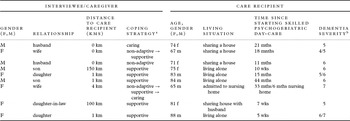
Characteristics of the sample of caregiver/recipient dyads are summarized in Table 1. All the caregivers in this study were family members of the care recipients.
Characteristics of interviewed caregivers and the person they cared for

ade Vugt et al. (Reference de Vugt2004) suggested three different care strategies: (i) non-adaptive, characterized by a lack of understanding and acceptance, (ii) supportive, and (iii) caring. Where several strategies are listed, the social worker feels that the caregiver has progressed over time from one care strategy to another.
bStaging in accordance with the Global Deterioration Scale (Reisberg et al., Reference Reisberg, Ferris, de Leon and Crook1982), ranging from 1 (no cognitive decline) to 7 (severe cognitive decline or late dementia).
Several caregivers stated that the attendee offered resistance to attending SPDC in the beginning, although they did not mention barriers of their own. Caregivers mentioned barriers concerning professional services not yet used (e.g. home care), but once a service had been initiated, former barriers seem no longer worth mentioning. As this outcome was not expected this issue was elaborated in the focus groups. Unlike the caregivers, focus group members mentioned several important barriers to SPDC for caregivers and persons with dementia. These can be categorized in terms of “stigma of SPDC,” problems with the acceptance of the diagnosis of “dementia,” unwillingness to share care with others, giving up autonomy, fear of the unknown and insufficient tailoring of care. Moreover, focus group members pointed to lack of familiarity with SPDC on the part of the referring professionals as a barrier for attending SPDC.
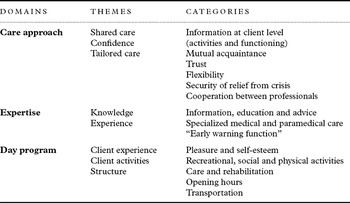
Apart from these barriers, the needs and wishes expressed by caregivers can be grouped into three domains: care approach, expertise and day program (Table 2).
Outline of main interview findings

Care approach (Box 1)
Caregivers responded positively to the concept of care being shared with staff, including informing each other, cooperating with professionals and seeking agreement on the type and extent of care. They wanted to see the staff acting in a way that inspires confidence and provides a feeling of security. These aspects of care were perceived as fairly common. Caregivers also assumed and expected that professionals would share care between them, even if they were working in different settings. However, focus group findings suggest that these last expectations were rarely met, with defective exchange of information and lack of agreement on responsibilities between professionals being widespread.
It is essential for the care-giving relationship that staff members know the participants well and that the caregivers are also acquainted with staff-members. A certain familiarity – knowing names, faces and background – seems to contribute to caregivers' confidence regarding the facility and when entrusting the person being cared for to the staff. This familiarity can also be instrumental in giving the person with dementia and the carer several subjects to talk about.
Responding flexibly to clients' conditions was mentioned by caregivers and focus group members, for example in the event of initial resistance to visiting the SPDC. The same flexibility with regard to the facility's schedule is important to caregivers. Caregivers are reassured by the knowledge that the organization can arrange urgent nursing home admission if needed.
Box 1. Examples of interview quotes regarding needs and wishes of the caregiver related to the care approach.
Care approach
- Information at client level/cooperation
If he wasn't feeling well one morning, then I'd ring up and I'd say “Just keep an eye on him because he's not too good.” Or they'd say: “We've given him an aspirin because he wasn't feeling too good.” That's how it goes, that's how it went with us. But it would be good to hear from time-to-time how he is doing at the day center.
In the beginning, the very beginning, I said once to M. [social worker], I would like to have a look, or a video tape, to see what is going on over there.
This week I [community mental health nurse in focus group] visited a client, who receives home care and attends SPDC and the nursing home physician and the general practitioner are involved. I reported that her [patient's] ankles were rather swollen and her children contacted me about that. I discussed this at the day-care center, that it should be taken care of. Yes indeed, we see that too. So everyone sees it and it was reported too, but nobody made up their minds about it and took the necessary steps.
- Mutual familiarity
What would be nice is if you had a photo of all of you, of everyone who works there, including the more highly-trained staff, with your names underneath. . . . Yes, if I had that at home, because R. [partner] knows that so-and-so lives in V., and so-and-so lives in N. Once when I was there I said: “Is that Mary?” Well, then he does know that so-and-so lives in V., but not the first name. So I sometimes ring [. . .] so then I know names that are there, but I don't know who they belong to. And I think that would be a very good idea.
- Trust
For me the greatest relief was actually that I had a single point of contact and not an administrative one like at the CIZ [care assessment center] or wherever, but really someone who came to my mother and who I could go to with questions.
After a few times, it actually went really smoothly. She was ready for T. [the taxi driver], who also handled her really well, as I understand it. I've never met him but I've heard about him.
- Flexibility
Then one day I had to have a scan. So I took an extra day, and then I rang the day center, I said: “You know, my kids, they all have teaching jobs you know.” “Well,” they said, “have her come an extra day, it doesn't matter.”
- Crisis care
Let's say he had to go into hospital tomorrow for six weeks or however long, and that there is then a place for her in the nursing home. And I do find that, yeah, and that's what they said too, that if they pull out of day-care, that certainly is gone too.
Expertise (Box 2)
Caregivers need general information about dementia, the prognosis and the care facilities available to them. Caregivers are frequently confronted with behavioral and psychological symptoms of dementia (BPSD): agitation, aggression, anxiety, apathy, changed sleep patterns and appetite disturbances. Safety issues such as falling, handling drugs, the danger of gas stoves, and arranging aids and adaptations to the home were key areas where information was needed, although not all caregivers requested it. The provision of medical and para-medical advice was much appreciated.
Both caregivers and the professional focus groups saw identification of the early warnings of problems or changes in health and functioning as a major role of SPDC.
Box 2. Examples of interview quotes regarding needs and wishes of the caregiver related to professionals' expertise.
Expertise
- Information and advice (education and counseling)
I would have liked a little more explanation about, yep, she's got Alzheimer's, or she has dementia, once again I still don't know the difference . . . that means that things will only get worse.
If someone had just said at the time, she can still live at home for a while, then I would been able to look into nursing homes in the meantime. Then I would definitely have looked around. What I now suddenly have to do at a moment's notice, I could have taken my time over.
- Specialized medical and paramedical care
But M. [social worker] said that I also had to give her some self-esteem, that she does things that are easy, but never two or three instructions at the same time. First this, and once that's done; then that. But I'm trying to do that at present and, you know, I do manage a bit with some things.
She has diabetes, she was given medicine and she didn't eat. Now we've switched to Brinta [a breakfast cereal]. No, that was A's idea [staff member]. If it doesn't get better, you have to give her something else.
Then she sometimes gets aggressive in the sense of she's awfully strong.She has poked me now and again, you know. And so what do you do? You poke back, don't you?
The last time that he was so confused, then I just rang up [the center], but then the doctor comes straightaway to have a look at him. When we stopped the medicine, then the doctor from the day center was also there to tell us how we should gradually cut back.
So I have to arrange all that with the center. They're more familiar with that stuff; they deal with those people every day. I can always ring them. They'll know . . . you're also closer to the heart of things there, as it were. Yeah, they're specialists there, which is always good.
- Early warning function
At one time she was walking around with swollen legs for a long time and in fact we all of us, and I mean myself, but also the people from Home Care, etc., we weren't very alert to that. So in retrospect, with a physical complaint like that, we should have been on to it more quickly.
Day program (Box 3)
Caregivers commented widely on their experiences – and those of the person they care for – in participating in SPDC and of the benefits of dignity and self-esteem this brought. Most caregivers saw physical activities as an important part of the day program, but differed with regard to other activities. One caregiver expected therapeutic activities aimed at rehabilitating specific areas such as speech, reading and arithmetic. Another regarded making no demands on the person with dementia as most appropriate. The focus groups emphasized the importance of individualized activities and of SPDC programs targeting special groups such as younger people with dementia and clients from ethnic minorities. The latter was generally related to the aspect of reaching those specific groups.
With regard to SPDC opening hours, caregivers mentioned some problems in adjusting the timing of personal care and transportation to SPDC in the initial period. One caregiver adjusted working hours to SPDC opening hours. Focus group members were of the opinion that relatively inflexible opening hours interfered with utilization of SPDC. In terms of transport, it was considered important to have a driver who is specifically skilled in managing people with dementia, safe vehicles and reliable time schedules.
Box 3. Examples of interview quotes regarding needs and wishes of the caregiver related to the day program.
Day program
- Pleasure and self esteem
He enjoys going there, which I also think is very important.
Last night he said: “One more day, eh, to work and (then) we've got two days off.” He even calls it work, you know . . . “Then I can relax,” he says, “and there are more people there and here I'm all by myself.” And he's right.
At the day center he could be himself, just as he was at that moment. He didn't have to keep up appearances; he didn't have to pretend to be anything other than what he was. That's really good, the activities, the things they do with him, well, at his own level and there he also feels, there he can. . . . For just a moment he was a person of value.
- Recreational, social and physical activities
Because there he's forced to walk, because he's pretty lazy where that's concerned, but anyway, that's a very good thing, because here I have great difficulty getting him to walk.
Since he's been going to the day center, that he now and then pours himself a cup of coffee. I think that they do that there, and that that he, well, that he's learned it there, tidying up and taking things to the kitchen.
Last year he colored in a . . . nice flower . . . really beautifully; they gave him colored pencils at the center. And so he should, because he used to be a painter. My brother said: “I got a box like that Dad, you can, you can color that in the right colors.” “Oh son, I'm not going to start on that.” The fact that he did it there: “They wanted me to do it, it was a kind of therapy,” he says “otherwise I wouldn't have done it” and I reckon he doesn't actually want to do anything there.
Of course you have a day program and everything but, but if the man doesn't want to do anything, then let him.
- Transport
Now he also has a bus with steps, but for a while he had a bus, well, then he had to get in stepping on one of those plastic things where you just about sag. Getting onto the bus was so difficult for him.
Then I had no idea when the bus, what time they came, not in the beginning. And that's why I started on Home Care a bit earlier.
- Opening hours
But I used to go to work as well during the day. Then I worked from nine thirty to quarter past four. So then I had to bike really fast to get here, otherwise the bus would already be standing at the door.
Discussion
This is the first Dutch study of the needs and wishes of caregivers using a skilled psychogeriatric day-care facility with the aim of optimizing the services provided.
The caregivers expressed a wish to become known to the SPDC professionals and to be kept informed about the care recipient's experiences. These findings can be regarded as important aspects of a good relationship with formal care providers. This is in line with the findings of Jeon et al. (Reference Jeon, Brodaty and Chesterson2005) who identified the nurse-family relationship as an important element in providing quality respite services.
In our study caregivers also wished for (and assumed) cooperation between all professionals involved in the care of their relatives. However, according to the experience of professionals in the focus groups, inter-agency collaboration in the care for people with dementia and their carers tends not to be common practice. In general, professionals and policy-makers stress the importance of improving collaboration, yet there is no hard evidence of the effect of integrated services on the health and quality of life outcomes for people with dementia or their carers (NICE-SCIE, 2007). Service users tend to be concerned about collaboration if the care they experience is inadequate, whereas professionals stress collaboration in a bid to prevent such inadequacies
Caregivers appreciated the flexibility of SPDC and the guarantee of crisis intervention. Although such opportunities are used infrequently in our experience, the knowledge that they exist is reassuring. We are not aware of studies on the use of flexible services; however, the call for flexibility in care services for people with dementia is quite common (Moise, Reference Moise, Schwarzinger and Um2004; Shanley, Reference Shanley2006).
Caregivers wish to be given information about the disorder, the prognosis and how to manage accompanying behavioral problems. They are confronted in daily care with a range of practical problems. However, in this respect, caregivers' needs and wishes do not match the professional resources provided by the SPDC regarding advice, support and treatment, which implies underutilization of available services provided by the SPDC. Such underutilization within specific care facilities has been described elsewhere (Shacke and Zank, 2006). In general, underutilization of services for people with dementia is a well-known phenomenon (Brodaty et al., Reference Brodaty, Thomson, Thompson and Fine2005). Lack of awareness and information about services, perceived lack of need and negative perceptions of services are given as the main reasons for this (Tester, Reference Tester1999; Brodaty et al., Reference Brodaty, Thomson, Thompson and Fine2005). Our findings regarding barriers to attending SPDC are largely in line with this, including unwillingness to share care with others, concern about loss of autonomy and fear of the unknown.
Positive experiences of care receipients attending SPDC were mentioned as highly important, especially enhancing self-esteem in a social environment without the high demands of everyday home life. This aspect of day care is an essential part of proficient care and professionals must be aware of this, especially when providing highly demanding “therapeutic” activities. Furthermore, caregivers wished to include more physical activities during the day, despite the regular physical activity already provided by the facility. Stressing the importance of more physical activity reflects public campaigns to encourage more exercise in general and is in line with findings on the effects of physical activity on functioning in people with dementia (Heyn et al., Reference Heyn, Abreu and Ottenbacher2004).
The researchers employed several procedures to ensure quality and validity of the study findings. The study, however, has some limitations. We decided to interview caregivers of people with dementia as informal caregivers because they are key persons with regard to initiating and continuing SPDC. Thus, clients' own perspectives were not addressed although they could express preferences for everyday care, which would possibly have been significant in improving the care provided (Whitlatch et al., Reference Whitlatch, Feinberg and Tucke2005). Ideally, the views of everyone directly involved in care shouldbe considered in developing care programs and facilities. In addition, by selecting only users or former users of SPDC, non-users' perspectives were not addressed directly.
The qualitative, explorative nature of the study precludes generalization. However, the findings may apply beyond the Dutch SPDC, because of similarities with British “day hospitals” and American “medical adult day programs”.
With regard to the focus and methodology of the study, respondents reflected only on their own experiences. They were asked for advice regarding improvements of SPDC, but not for their views on subjects such as research-driven innovations in dementia care. They are probably largely unaware of the possibilities, especially regarding non-pharmacological interventions.
Recommendations
We can make several recommendations for care on the basis of these findings. SPDC should inform caregivers thoroughly about the experiences of the care recipients. Arrangements must be made to share knowledge regarding dementia and related issues with the caregivers. Underutilization of existing professional resources and available services point to the need for a more proactive approach by professionals even if caregivers do not actively seek advice. In order to develop strategies to diminish underutilization of SPDC, further study needs to be undertaken into non-users' perspectives.
SPDC should also give early warning of problems or changes in the health and functioning of the attendee. For SPDC this implies the presence of staff with adequate competencies to detect the medical and behavioral signals.
As most people with dementia receive care from several professionals and agencies, informal caregivers must understand their procedures and how they are cooperating with each other. Ideally, a personal adviser for caregivers (e.g. a social worker) should be available in this respect. Nevertheless, professionals need to work towards improving collaboration of services across agencies in order to help care-users navigate the maze of health and social services.
SPDC should offer flexibility with regard to schedules by adjusting the service according to each person's condition and offer a guarantee of crisis-intervention, possibly in collaboration with other health care agencies. (Shanley, Reference Shanley2006)
Finally, one widely voiced request from caregivers was that SPDC should offer physical activities on a regular basis. It is vital that the facility is improved in a way that maximizes positive experiences for the users. There is therefore a need for further study into the preferences for activities among those attending the SPDC.
Conflict of interest
None.
Description of authors' roles:
J.D. de Jong and F. Boersma both designed the study, collected and analyzed the data, and wrote the paper.
Acknowledgments
This study was conducted on behalf of the Foundation for Research into Innovations in Nursing and Care (Stichting Wetenschappelijk Onderzoek naar Zorgvernieuwing in de Verpleging en Verzorging), Groningen, The Netherlands. It was supported by a grant (project no. 3220/GD50.05) from Open Ankh, a Dutch umbrella organization of 11 foundations active in the field of mental health care, care for the handicapped and care for the elderly.