





Gender disparities exist in the clinical presentation, risk factors, prevalence and outcomes of psychosis, Reference Domenicano, Onofrio, Citton, Vecchioni, De Donatis and Bertelli1,Reference Sommer, Brand, Stuijt and Touw2 reflecting patterns increasingly recognised across other areas of healthcare, including cardiovascular medicine. Reference Bastian-Pétrel, Rohmann, Oertelt-Prigione, Piccininni, Gayraud and Kelly-Irving3 However, despite clear evidence of gender differences, clinical services continue to adopt gender-neutral approaches that risk overlooking the unique needs of women. Reference Cotton, Lambert, Berk, Schimmelmann, Butselaar and McGorry4,Reference Riecher-Rössler, Butler and Kulkarni5 Whereas our focus is on cis-gendered women, who comprise the large majority of those attending Early Intervention in Psychosis (EIP) services, we recognise that sex and gender exist along continua and intersect in ways that extend beyond binary categories, and clinical services must be responsive to these complexities.
Women tend to present with first-episode psychosis (FEP) later than men, often around key hormonal or reproductive transitions such as the menstrual cycle, postpartum and perimenopause. These periods have been associated with increased vulnerability to symptom emergence or relapse. Reference Häfner6,Reference Pelizza, Ricci, Leuci, Quattrone, Palmisano and Pupo7 Such patterns highlight a notable interaction between reproductive health and psychosis that is rarely accounted for in routine psychiatric care.
Women also often display different early symptom profiles, typically fewer negative symptoms and less cognitive impairment, but more prominent affective and trauma-related symptoms and have lower rates of substance misuse. Reference Carter, Wootton, Archie, Terry and Anderson8,Reference Seeman9 Such presentations can contribute to diagnostic overshadowing, with clinicians interpreting early psychotic symptoms through affective or psychosocial lenses, leading to delays in recognition and referral to early intervention services. Reference Irving, Colling, Shetty, Pritchard, Stewart and Fusar-Poli10–Reference Oduola, Craig, Iacoponi, Macdonald and Morgan12 Together, these gendered patterns illustrate how ostensibly gender-neutral service models risk overlooking the specific ways in which psychosis emerges and is identified in women.
More recent longitudinal research challenges earlier assumptions of a more favourable course of illness in women. Although women often present later and with fewer risk factors, they experience similar or higher rates of relapse, rehospitalisation and persistent affective symptoms compared with men. Reference Ayesa-Arriola, de la Foz, Setién-Suero, Ramírez-Bonilla, Suárez-Pinilla and Son13–Reference Mayston, Kebede, Fekadu, Medhin, Hanlon and Alem15 Recent reviews suggest that these disadvantages may not reflect inherent illness trajectories, but rather suboptimal care, informed by research excluding women, and therefore failure to recognise their distinct needs. Reference Sommer, Brand, Stuijt and Touw2
Several structural and clinical factors contribute to this gap. Women remain underrepresented in some areas of psychiatric research, and sex- and gender-specific analyses are frequently absent even when women are included. As a result, the evidence base informing psychiatric care may not adequately capture women’s experiences, treatment responses or reproductive health needs. Reference Howard, Ehrlich, Gamlen and Oram16 As a result, services often pay inadequate attention to reproductive and menstrual health needs; in addition to caregiving responsibilities, stigma surrounding motherhood and fears of child welfare intervention can delay help-seeking and complicate engagement with services. Reference Bacon, Sweeney, Batchelor, Grant, Mantovani and Peter17,Reference Oram, Khalifeh and Howard18 Trauma-informed practices are also insufficiently integrated into many services, despite the high prevalence of trauma among women with psychosis. Reference Mansueto and Faravelli19–Reference Scholes, Price and Berry21 Furthermore, upper age thresholds of 35 years in many EIP services disproportionately exclude women who present later in life. Reference O’Driscoll, Free, Attard, Carter, Mason and Shaikh22 Recent calls have argued that EIP services should incorporate gender-specific and lifespan-informed approaches to care. Reference Naughton, McGinty, Duffy, Marshall, Corrigan and Clarke23
Whereas clinician perspectives on gender-sensitive EIP provision have recently gained attention, Reference McGinty, Naughton, Farrelly, O’Donnell, Stano and Gaynor24 there remains a lack of research exploring the lived experiences of women navigating these services, prompting calls for qualitative work that centres women’s voices to inform more gender-responsive early intervention models. Reference Roberts and Parry11,Reference Mazza, Caroppo, De Berardis, Marano, Avallone and Kotzalidis25
The present study addresses this gap by qualitatively exploring the experiences of cis-gender women accessing EIP services in Ireland. Through reflexive thematic analysis, we examine how women make sense of their experience of psychosis and highlight priorities for improving care for women experiencing FEP across in-patient, community and early intervention settings.
Method
Study design
This qualitative study employed semi-structured interviews with women who had experienced FEP and received care through an EIP service. This Irish service operates a hub-and-spoke model in which specialist EIP interventions are delivered in partnership with local community mental health teams (CMHTs) through a shared-care approach. Consequently, participants reflected on their experiences across the range of services involved in their care, including EIP services, CMHTs and, where relevant, in-patient psychiatric care.
The study adopted an inductive, constructivist epistemology, recognising that knowledge is co-constructed through the interaction of participants’ narratives, contextual factors and researcher interpretation. Reflexive thematic analysis (RTA) Reference Braun and Clarke26 guided data analysis, enabling flexible engagement with the data while foregrounding reflexivity. RTA was chosen because it supports in-depth exploration of lived experience and allows nuanced attention to the gendered and contextual dimensions of women’s interactions with EIP services.
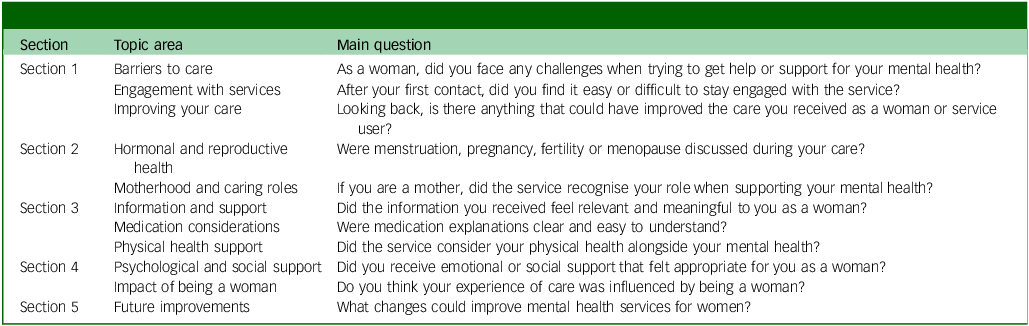
Topic guide questions were co-developed following a review of the literature on women’s experiences of first-episode psychosis by the research team (G.M., M.C., S.N. and K.G.), and in collaboration with two individuals with lived experience. Their input helped refine the interview guide and ensure that it addressed topics considered meaningful and relevant by women with lived experience of first-episode psychosis (see Table 1). Guided by a constructivist epistemology, interviews focused on how participants made meaning of their experiences of receiving psychiatric care for psychosis. Interviews were understood as co-constructed encounters in which meaning was shaped through dialogue between participant and researcher. Reflexive diary notes documented the researcher’s assumptions, emotional responses and evolving interpretations, and these reflections informed ongoing questioning and analytic decision-making. A researcher positionality statement is provided in the supplementary materials available at https://doi.org/10.1192/bjo.2026.12085.
Interview schedule

Table 1 Long description
A table with five sections and multiple topic areas, each with a main question. Section 1 focuses on barriers to care, engagement with services, and improving care, with questions about challenges faced, ease of staying engaged, and potential improvements. Section 2 covers hormonal and reproductive health, motherhood and caring roles, with questions about discussions on menstruation, pregnancy, fertility, menopause, and recognition of motherhood roles. Section 3 addresses information and support, medication considerations, and physical health support, asking about the relevance of information, clarity of medication explanations, and consideration of physical health. Section 4 explores psychological and social support and the impact of being a woman, with questions about emotional or social support and the influence of being a woman on the experience of care. Section 5 discusses future improvements, asking what changes could improve mental health services for women.
Participants and procedure
Participants were recruited from two community mental health services in Ireland that had access to an EIP service. A purposive sampling strategy was employed, with consultant psychiatrists and multidisciplinary team clinicians identifying suitable candidates who met the inclusion criteria of self-identifying as female and being clinically stable with regard to participation.
Maximum-variation sampling was used to capture heterogeneity across characteristics theoretically relevant to women’s experiences of psychosis care, including age, diagnostic profile, caregiving and parental status, stage of illness and level and type of mental health service engagement.
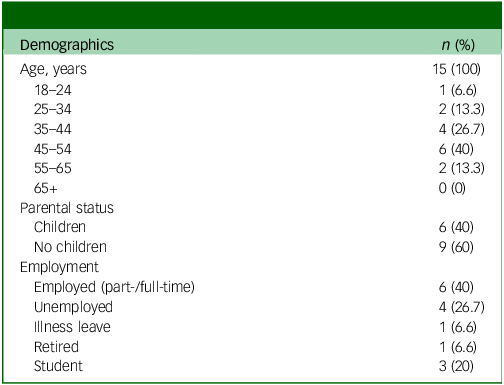
Fifteen women aged between 19 and 65 years participated (N = 15). All had experienced a first episode of psychosis and had received care through EIP and/or adult CMHT. Participants were recruited on the basis of self-identifying as women. Gender identity was not formally assessed as part of the study, and the sample available for recruitment did not include any individuals known to identify as transgender or gender diverse. Participant demographic characteristics (including age, parental status and employment status) are presented in Table 2.
Participant demographics

Table 2 Long description
A table titled ‘Participant demographics’ with two columns: Demographics and n (%). The table has 15 rows, including a header row. The Demographics column lists age groups, parental status, and employment status. The n (%) column lists the number and percentage of participants in each category. Age groups are 18-24, 25-34, 35-44, 45-54, 55-65, and 65+. Parental status is divided into Children and No children. Employment status includes Employed (part-/full-time), Unemployed, Illness leave, Retired, and Student. The table shows that the highest percentage of participants (40 percent) are aged 45-54, 60 percent have no children, and 40 percent are employed either part-time or full-time.
Participants were initially approached via telephone by a clinical gatekeeper, provided with an information sheet and contacted by the research team only if they expressed interest and consented to being contacted. Written informed consent was obtained prior to interviews. Interviews lasted between 45 and 90 min and followed a topic guide exploring the following: experiences of safety and trust in services; the role of reproductive and hormonal health in care; service accessibility; motherhood and caregiving responsibilities; clinical encounters and communication; experiences of medication; and preferences for support as a woman.
Data analysis
Interviews were all conducted remotely via telephone in a private room, audio-recorded, transcribed verbatim and anonymised. Analysis followed Braun and Clarke’s six phases of RTA. Reference Braun and Clarke27 Initial coding was conducted in Microsoft Excel (Microsoft 365; Microsoft Corporation, Redmond, Washington, USA; Windows 11; https://www.microsoft.com/microsoft-365/excel), using free-text and colour-coding by G.M. and R.F. Codes were then collated into themes, refined through iterative team discussion and finalised into four overarching themes. Reflexivity was central to the process, with memo-writing used to document assumptions and interpretative decision-making. Two researchers independently coded transcripts and discussed discrepancies with the research team, to enhance rigour.
Results
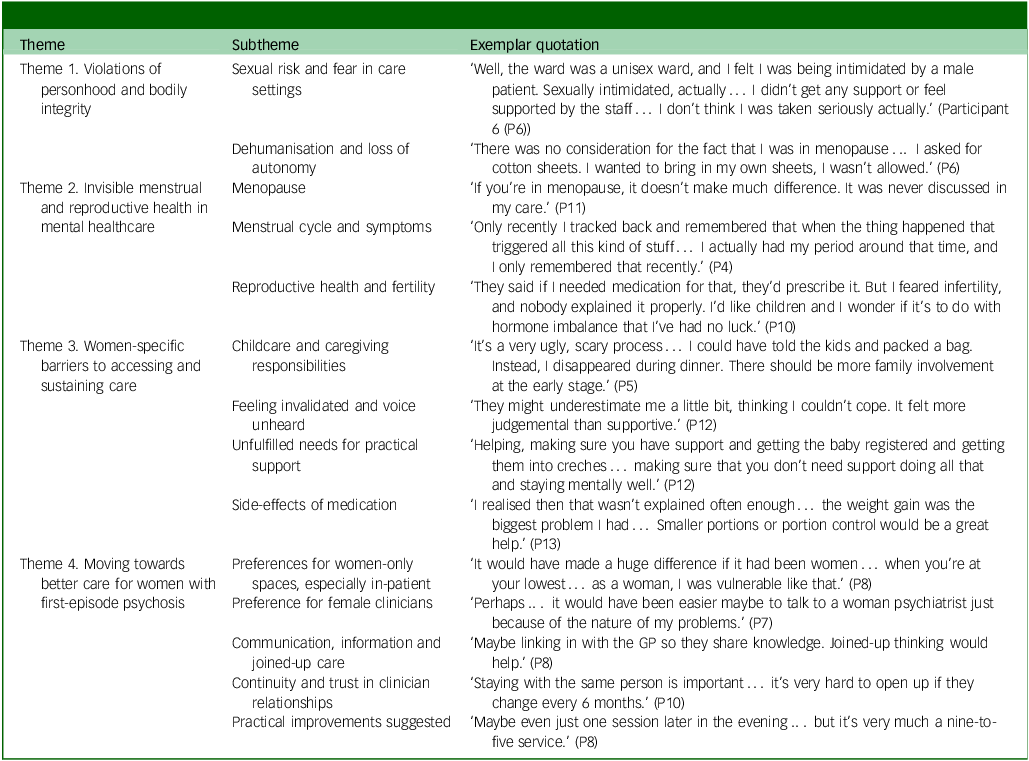
A reflexive thematic analysis of interviews with 15 cis-gender women attending an EIP service in Ireland identified four overarching themes: (a) violations of personhood and bodily integrity; (b) invisible menstrual and reproductive health in mental healthcare; (c) women-specific barriers to accessing and sustaining care; and (d) moving towards better care for women with FEP (see Table 3 for supporting quotations).
Themes, subthemes and exemplar quotations

Table 3 Long description
The table presents a reflexive thematic analysis of interviews with 15 cis-gender women attending an early intervention psychosis service in Ireland. It is organized into four themes, each with subthemes and exemplar quotations. The table has four columns: Theme, Subtheme, and Exemplar quotation. Theme 1, Violations of personhood and bodily integrity, includes two subthemes: Sexual risk and fear in care settings and Dehumanisation and loss of autonomy. Theme 2, Invisible hormonal and reproductive health in mental healthcare, includes three subthemes: Menopause, Menstrual cycle and symptoms, and Reproductive health and fertility. Theme 3, Women-specific barriers to accessing and sustaining care, includes four subthemes: Childcare and caregiving responsibilities, Feeling invalidated and voice unheard, Unfulfilled needs for practical support, and Side-effects of medication. Theme 4, Moving towards better care for women with first-episode psychosis, includes five subthemes: Preferences for women-only spaces, especially in-patient, Preference for female clinicians, Communication, information and joined-up care, Continuity and trust in clinician relationships, and Practical improvements suggested. Each subtheme is accompanied by exemplar quotations that illustrate the themes and subthemes.
GP, general practitioner.
Theme 1: violations of personhood and bodily integrity
This theme reflects women’s accounts of feeling unsafe, intimidated or overlooked in in-patient psychiatric environments, all of which happened to be mixed-gender wards. Women described feeling unsafe, disbelieved and stripped of agency. Whereas participants reflected on care received across multiple service settings, concerns relating to physical and sexual safety were discussed primarily in the context of in-patient admissions. Two subthemes were identified: (a) sexual risk and fear in care settings and (b) dehumanisation and loss of autonomy.
Sexual risk and fear in care settings
Many participants recounted experiences of sexual intimidation or threat during in-patient stays. Several described their experiences on mixed-gender wards as profoundly unsafe:
‘I didn’t feel safe on the ward with men… One said he was going to knife me. I was terrified.’ (Participant 5 (P5))
Women linked this lack of safety to systemic gender-blindness in in-patient provision, notably the lack of single-gender wards, which necessitated mixed-gender ward placement:
‘It was a mixed-sex ward, and I felt sexually intimidated. I wanted to call the police.’ (P6)
‘Even when I wasn’t directly threatened, I was always on edge. You never relaxed, you’re constantly alert.’ (P9)
‘In hospital there was a man who was kind of saying like he kind of wanted me as a girlfriend and all that stuff. But the hosp – but then the nurses were like… very like supportive.’ (P4)
Some accounts illustrated how some women felt that their safety concerns were not fully acknowledged by the service, which contributed to feelings of vulnerability.
Dehumanisation and loss of autonomy
Beyond physical safety, participants expressed feelings of humiliation and that female-specific needs were not addressed:
‘I felt sorry for people that might be menstruating, actually, because the toilets were often unusable. And that’s again, back to the men and the women in one, often the men would use the women’s toilets, which was really frustrating, and then leave them in a mess.’ (P6)
‘There was no consideration for the fact that I was in menopause, no acknowledgement of the things I needed to keep myself comfortable. I was sleeping in a bed with almost what felt like plastic sheets, and I was sweating like crazy and… I asked for cotton sheets. I wanted to bring in my own sheets, I wasn’t allowed.’ (P6)
These accounts suggested that participants’ experiences of dignity and autonomy extended beyond clinical care and were influenced by whether everyday women-specific needs, such as privacy, menstruation and menopausal symptoms, were adequately accommodated within the in-patient environment.
Theme 2: invisible menstrual and reproductive health in mental healthcare
Participants highlighted how hormonal, reproductive and gynaecological issues were seldom discussed or integrated into their mental healthcare. Three interlinked subthemes emerged: (a) menopause and perimenopausal experiences; (b) menstrual cycle and symptom fluctuation; and (c) reproductive health and fertility concerns.
Menopause and perimenopausal experiences
Women reported that menopausal symptoms were seldom acknowledged within their care, even when these affected mood:
‘If you’re in menopause, it doesn’t make much difference. It was never discussed in my care.’ (P11)
[Re. menopause] ‘But there will, when I go into it there will have to be a conversation, but I think I’ll be the one bringing it up.’ (P5)
Several described the intersection between menopausal transition and psychotic vulnerability yet found no structured support for this phase: ‘No, I didn’t have any effects yet, just started into menopause, but it was never discussed.’ (P8)
Menstrual cycle and symptom fluctuation
Participants frequently linked mood or psychotic symptom exacerbation to their menstrual cycles:
‘ I notice I’m more anxious and drained during my period, it definitely affects my recovery.’ (P8)
‘Only recently I tracked back and remembered that when the thing happened that triggered all this kind of stuff – last spring, whether you want to call that psychosis or – or a spiritual awakening, or a seizure or whatever. Em, I actually had my period around that time, and I only remembered that recently.’ (P4)
Reproductive health and fertility concerns
Concerns about fertility, prolactin-related effects and medication risks were described as insufficiently addressed:
‘I feared infertility, and nobody explained it properly… I’d like children and I wonder if it’s to do with hormone imbalance that I’ve had no luck.’ (P10)
Others described prolonged amenorrhoea and felt that this was not closely followed up in their care:
‘I wasn’t ready to have a baby, but it was upsetting. I felt like my womanhood was taken away.’ (P12)
‘But no period for like 8 years or something. That’s like prime age for having children.’ (P13)
Theme 3: women-specific barriers to accessing and sustaining care
This theme encompassed structural, relational and social barriers that uniquely hindered women’s engagement with EIP services. Three subthemes were identified: (a) childcare and caregiving responsibilities; (b) feeling invalidated and unheard; and (c) medication side-effects and embodiment.
Childcare and caregiving responsibilities
Motherhood shaped women’s ability to seek and sustain care. Sudden admissions were described as traumatic for both mothers and children:
‘I disappeared during dinner; my kids had no idea where I’d gone.’ (P5)
Some described practical inflexibilities:
‘There should be out-of-hours support… especially for women with postpartum depression or childcare duties.’ (P12)
Feeling invalidated and unheard
Women reported feeling dismissed or invalidated within clinical interactions:
‘They might underestimate me a little bit, thinking I couldn’t cope. It felt more judgemental than supportive.’ (P12)
Past traumatic experiences were sometimes experienced as being met with insufficient acknowledgement or understanding:
‘He didn’t believe me… he was telling everything back to my actual abuser… it made me extremely fearful.’ (P10)
Medication side-effects and embodiment
Weight gain, hormonal changes and sexual side-effects significantly affected well-being and adherence:
‘I put three stone on from the olanzapine… a bit of information… would definitely have helped.’ (P11)
Sexual side-effects were also distressing:
‘It really affected me. It killed my sex drive.’ (P13)
Theme 4: moving towards better care for women with FEP
The final theme captured women’s visions for safer, more responsive and relationally attuned care. Subthemes included the following: (a) preference for female clinicians and women-only spaces; (b) improved communication and information-sharing; and (c) practical recommendations for service reform.
Preference for female clinicians and women-only spaces
Many participants expressed greater comfort with female staff and advocated for women-only wards or groups:
‘When you’re at your lowest, being around men can feel unsafe. A women-only ward would make a huge difference.’ (P8)
‘I’ve two female doctors. So, you know, I think that’s helpful… Yeah, I don’t think I would have had felt as supported by male doctors.’ (P6)
‘I had some really embarrassing bodily function-related problems, I couldn’t articulate certain things the way I would have articulated if I talked to a woman.’ (P7)
Participants also noted that it would be helpful to have a choice of male or female clinicians:
‘Maybe like if you’re gonna see your psychiatrist or psychologist, they… ask like which gender you prefer.’ (P3)
Improved communication and information-sharing
Participants emphasised the need for transparent, coordinated information across providers:
‘If psychiatry and GP [general practitioner] actually talked, I wouldn’t have to explain my story again every time.’ (P8)
Women also sought clearer guidance on medications, physical health and available supports:
‘Definitely more information, more support would help.’ (P12)
Building consistent therapeutic relationships was central to recovery:
‘Staying with the same person is important… it’s very hard to open up if they change every 6 months.’ (P10)
Practical recommendations for service reform
Participants proposed tangible service adaptations, including flexible scheduling and tailored medication planning:
‘Maybe even just one session later in the evening… it’s very much a nine-to-five service.’ (P8)
Others emphasised shared decision-making:
‘In future I’d like to try to up the medication first… and then see if hospital is needed.’ (P5)
Discussion
This study provides one of the first in-depth qualitative examinations of women’s experiences of FEP within EIP and adult mental health services in Ireland. The findings reveal that women described how their experiences of care were shaped profoundly by issues of safety, autonomy and gendered expectations, many of which remain insufficiently recognised in current service design. Across participants’ accounts, women described feeling unsafe in mixed-gender in-patient settings, a perception that hormonal and reproductive health needs were not well addressed and being overburdened by caregiving responsibilities. Collectively, these findings highlight persistent gaps in sex- and gender-responsive psychosis care, and reinforce calls within the international literature to better incorporate women’s lived experiences into service development. Reference Roberts and Parry11,Reference Mazza, Caroppo, De Berardis, Marano, Avallone and Kotzalidis25
Women’s safety, autonomy and trust: a fundamental gap in in-patient psychiatric environments
Women’s accounts consistently foregrounded physical and sexual safety as important aspects of their care experience, with these concerns arising primarily in relation to in-patient admissions rather than community-based EIP or general adult services. Mixed-gender in-patient wards were described as unpredictable and, for many, frightening environments marked by intimidation, sexual harassment and inadequate awareness of women’s needs and safety concerns. These findings echo longstanding concerns about gender-based violence in psychiatric settings Reference Oram, Khalifeh and Howard18,Reference Warburton28 and align with recent critiques that FEP care insufficiently addresses women’s safety needs, particularly at admission and during acute distress. Reference O’Dwyer, Tarzia, Fernbacher and Hegarty29
Experiences that participants interpreted as being ignored, isolated or lacking autonomy further undermined their sense of trust and safety. These dynamics reflected broader patterns of gendered disempowerment in acute psychiatry, where women are more likely to report feeling dismissed, infantilised or disbelieved. Reference Howard, Ehrlich, Gamlen and Oram16 The present findings reinforce the need for trauma-informed, gender-sensitive in-patient policies and the expansion of women-only spaces as a matter of basic safety and dignity.
Invisible menstrual and hormonal health: the neglected clinical domain
Across the sample, participants described an absence of attention to menstrual, perimenopausal and reproductive health, despite the potential relevance of hormonal transitions in the exacerbation of psychosis symptoms. Reference Riecher-Rössler, Butler and Kulkarni5 Women reported prolonged amenorrhoea, prolactin-related symptoms, menopausal discomfort or changes in symptom severity around their cycle, and several felt that these concerns were not fully reflected in their treatment discussions. Recent clinical guidance has also highlighted the importance of considering sex-specific factors when selecting antipsychotic medication for women with FEP, including reproductive health, endocrine effects and differential side-effect profiles. Reference Hynes-Ryan, Keating, Carolan, Brand, Dazzan and Gaughran30
This disconnect mirrors critiques that psychiatric care remains ‘gender-blind’ in relation to women’s physiology. Reference Hartnett, MacHale and Duffy31 Similar sex- and gender-based biases have been identified in other areas of medicine, including cardiac care, where research underpinning clinical guidelines has historically underrepresented women’s experiences and presentations. Reference Bastian-Pétrel, Rohmann, Oertelt-Prigione, Piccininni, Gayraud and Kelly-Irving3 Failure to inquire about or accommodate menstrual experiences not only compromises clinical understanding but contributes to women feeling unseen, misunderstood and physically uncomfortable within services. For women experiencing psychosis, especially during high-risk phases such as postpartum or perimenopause, this omission represents a substantive clinical gap with potentially serious consequences.
Gendered barriers to access and care continuity
The women in this study described caregiving responsibilities, fear of judgement as mothers and a lack of flexible service provision as major obstacles to care. Sudden in-patient admissions were particularly distressing, often occurring without opportunity to prepare children or arrange support. These findings align with evidence that motherhood shapes help-seeking behaviour, and that stigma surrounding mental illness and parenting disproportionately affects women. Reference Ferrari, Flora, Anderson, Haughton, Tuck and Archie32
Women also described feeling invalidated or unheard. Such experiences are known to erode engagement in mental health services, particularly for those with histories of interpersonal trauma or gender-based violence. Reference Scholes, Price and Berry21,Reference Lock, Lavis, Pendrous and Greenfield33
Towards gender-responsive EIP: implications for service development
Participants provided clear and actionable recommendations for improving women’s experiences of FEP care. These priorities are consistent with emerging frameworks for sex- and gender-sensitive psychosis care, which argue that gender-neutral EIP models overlook foundational aspects of women’s safety, embodiment and social context. Reference Mazza, Caroppo, De Berardis, Marano, Avallone and Kotzalidis25 Women’s recommendations therefore reflect not only personal preference but also systemic shortcomings in service design.
To support translation into practice, the study’s findings can be distilled into a set of concrete clinical recommendations, presented below.
-
(a) Sex- and gender-sensitive safety in in-patient environments. Women described feeling unsafe in mixed-gender in-patient settings, highlighting the need for access to women-only beds or clearly designated female spaces. Whereas Irish in-patient services operate as approved centres with mandatory policies on safety, privacy and dignity, women’s accounts suggest that the consistency and effectiveness of these measures in mixed-gender settings require further attention. Broader consultation on this matter with women who have lived experience may be useful to explore this further. Ensuring physically and psychologically safe environments is foundational to therapeutic engagement and recovery, both locally and internationally.
-
(b) Integrating reproductive, menstrual and hormonal health. Routine psychiatric care should incorporate enquiry about menstrual cycles, hormonal transitions (including postpartum and perimenopause) and reproductive health concerns. Monitoring the endocrine side-effects of antipsychotic medication should be standard practice, as should discussions regarding medication-related sexual side-effects, given their potential impact on well-being, relationships and treatment adherence. Women also highlighted the importance of receiving information regarding potential medication side-effects, including weight gain, and strategies to mitigate their impact. Enhanced integration across primary care, including general practitioners and menopause specialists, secondary care services and sexual and reproductive medicine and perinatal mental health services, would facilitate more holistic and coordinated care while reducing service fragmentation.
-
(c) Flexible and family-inclusive service delivery. Caregiving responsibilities were a significant barrier to accessing and sustaining care. Services should offer greater flexibility through adaptable appointment scheduling, home visits where appropriate and improved access to social work support to assist with childcare arrangements before and during admission.
-
(d) Trauma-informed, gender-responsive training. Training across both out- and in-patient settings should explicitly address hormonal transitions and the impacts of gender-based violence and trauma on women’s mental health. Although services may aim to operate within trauma-informed frameworks, women’s experiences suggest that consistency across care settings can vary, particularly regarding in-patient admissions. Building staff capacity to maintain trauma-informed, gender-responsive practice throughout care transitions is essential.
-
(e) Collaborative and integrated care pathways. Women emphasised the need for more joined-up care. Improved communication and coordination across mental, physical and reproductive health services would reduce fragmentation, ensure continuity and prevent important clinical information from being overlooked.
Strengths and limitations
A major strength of this study is its exclusive focus on women with lived experience of FEP, an underrepresented group in psychosis research. The interviews explored a broad range of aspects of care provision, including in- and out-patient care and interventions. The use of reflexive thematic analysis allowed for nuanced, participant-centred interpretation.
Limitations include the absence of transgender participants, reflecting the demographic profile of the clinical population at the time of recruitment. Findings are also drawn from a single geographical area and may not fully reflect experiences across other healthcare services in Ireland or internationally. We are unable to provide detailed information regarding age at first episode, illness duration or previous hospitalisation history, limiting our ability to contextualise participants’ stage of recovery. Nor did we collect ethnicity data, limiting consideration of how this may have shaped participants’ experiences. Although there is a growing body of qualitative research examining women’s experiences of psychosis and early intervention, this remains a relatively underexplored area. As such, these findings should be interpreted cautiously. Nonetheless, the themes align with existing international literature and contribute to ongoing discussions about sex, gender and women’s experiences within EIP care.
Summary
This study illuminates critical gaps in how women experience early psychosis care, revealing concerns about reproductive health awareness and gender-responsive in-patient care and practice. Women’s accounts suggest that current services are not yet fully equipped to meet their needs. This situation must be understood within the context of notable resource and funding constraints affecting mental health services more broadly. Embedding sex- and gender-sensitive, trauma-informed and hormonal understanding within psychosis care is essential to advancing equity, and is likely to lead to improved outcomes for women experiencing FEP.
Supplementary material
The supplementary material is available online at https://doi.org/10.1192/bjo.2026.12085
Data availability
The data that support the findings of this study are available from the corresponding author upon reasonable request.
Acknowledgements
The authors thank Zandra McKinney for her invaluable support as the clinical gatekeeper, facilitating access and coordination throughout the study. Additionally, the authors thank Rita Bourke and Micheal Norton for their contributions as Patient and Public Involvement contributors.
Author contributions
S.N., M.C. and K.G. conceived the idea for the study. G.M. conducted interviews and analysis and drafted the first version of the manuscript. R.F., A.S. and P.O. contributed to data collection and analysis. S.N. and M.C. secured funding and provided project supervision. All authors critically revised the manuscript and approved the final version for submission.
Funding
This research was funded by the St. John of God Research Foundation (grant no. 2024_2037).
Declaration of interest
None.
Ethical standards
This study was approved by the St. John of God Research Ethics Committee (ID no. 2024-2037). All procedures were conducted in accordance with the ethical standards of the responsible committee, and with the 1964 Helsinki Declaration and its later amendments.


 Open access


eLetters
No eLetters have been published for this article.