Cheeses differ according to milk source, lipid content, maturity, weight, moisture content, texture, internal and external appearance. The organoleptic characteristics are due to local environmental conditions, manufacturing practices and storage conditions (Cronin et al. Reference Cronin, Ziino, Condurso, McSweeney, Mills, Ross and Stanton2007). Among Italian cheese productions, Pasta filata cheeses include semi-soft (e.g., Mozzarella and Scamorza), and semi-hard and hard cheeses (e.g., Caciocavallo, Provola, Ragusano and Provolone). They owe the name to the Italian terms which literally mean ‘stretched curd’ and their manufacturing consists essentially of two steps: curd making and cooking/stretching (Ziino et al. Reference Ziino, Condurso, Romeo, Giuffrida and Verzera2005). After production, semi-hard cheeses undergo different maturation processes according to the storage conditions. This process influences texture, flavour and all the other chemical and physical properties of the cheese (Pantaleão et al. Reference Pantaleão, Pintado and Poças2007). In unpackaged cheese, water loss depends on the chemical properties of the cheese and on the storage conditions (Poças et al. Reference Poças, Pintado and Robertson2009). Optimal packaging could prevent or minimise quality changes, resulting in increased shelf life as well as quality maintenance (Dukalska et al. Reference Dukalska, Muizniece-Brasava, Murniece, Dabina-Bicka, Kozlinskis and Sarvi2011). One of the most common methods to reduce the incidence of oxidative damages is vacuum-packaging, which may not be the most suitable packaging method for all kinds of cheeses, due to possible undesired modifications of their structure and appearance (Favati et al. Reference Favati, Galgano and Pace2007). Modified Atmosphere Packaging is a valid solution to preserve several foods, including cheeses. A suitable CO2 level in the headspace will provide protection against oxidation and lipolysis (Pintado & Malcata, Reference Pintado and Malcata2000; Papaioannou et al. Reference Papaioannou, Chouliara, Karatapanis, Kontominas and Savvaidis2007). However, a high level can cause the packing to collapse. Also the choice of the proper packaging techniques and characteristics (barrier properties to gas and water vapour, size and shape of packaging) is important in maintaining the quality of packaged cheese and extending its shelf life. Calabrian Provola cheese (CPc) is produced in several areas of Southern Italy (Calabria region) and is well-accepted nationwide for its sensory characteristics (such as flavour and consistency). It is a cow's milk cheese in the shape of a tapering cylinder, bound with natural fibre string. Generally its rind is compact, smooth and shiny with a light yellow or white colour, depending on ripening. CPc is normally marketed fresh or after a short ripening time (about 30 d). CPc was traditionally sold unpackaged in local markets with a declared expiry date of about 45 d, but in recent years packaging (such as vacuum packaging or protective atmosphere) have been used to improve its quality and extend its shelf life. Some studies have been conducted on compositional and microbiological quality of Calabrian dairy products (Micari et al. Reference Micari, Caridi, Colacino, Foti and Ramondino2002; Trombetta et al. Reference Trombetta, Naccari, Cristani, Licata and Giofrè2008; Naccari et al. Reference Naccari, Galceran, Moyano, Cristani, Siracusa and Trombetta2009; Campolo et al. Reference Campolo, Romeo, Attinà, Zappalà and Palmeri2013; Giuffrè et al. Reference Giuffrè, Sicari, Louadj and Alampi2013) but there is a lack of information concerning the qualitative characteristics of Provola cheese under different packaging conditions. The aim of this study was the evaluation of the effect of different storage techniques and packaging forms on quality of this traditional Calabrian cheese.
Materials and methods
Cheesemaking
The Calabrian Provola cheese (CPc) used was manufactured in the Cimino & Ioppoli s.r.l. dairy situated in Crotone (Calabria, Italy) from pasteurised cow's milk coagulated with calf rennet at a level of 1·0% (v/v) with the addition of 1% commercial starter culture (Lyofast ST044; Sacco, Como, Italy). After coagulation, the curd was cut to a granular consistency, favouring the draining of the whey and it was subsequently ripened to achieve a pH of 5·0–5·3. The curd was then cut into slices and submitted to manual spinning in hot water (80–90 °C). After this, it was pressed into a mould to give it its shape and then salted in brine (20% NaCl) for 1 h. The cheeses were bound with a natural fibre string and left to mature in stockrooms for about 24 h without any control of humidity or temperature. Physical characteristics of CPc after production were: weight of 0·5–0·6 kg, 6·5 cm (major diameter), 4·5 cm (minor diameter) and length of 15 cm.
Experimental design
To compare the effects of different types of packaging on cheese quality during a storage period of 65 d, three types of packaging were tested. Each of the packaged cheeses was stored at both 4 and 7 °C. The unpackaged control cheese was also stored at both 4 and 7 °C, giving a total of eight different treatments. The sampling for each treatment was carried out in triplicate at every monitoring time.
Experimental procedure
CPc were submitted to the following packaging conditions: vacuum packaging (VP) and modified atmosphere (MAP), consisting of 70% N2 (E941) and 30% CO2 (E290). The VP samples were packed in PA/PE (Polyammide/Polyethylene) film (Alpak, Italy) and hermetically sealed with a Veripack Freedom LX/FL 143 vacuum chamber machine (Varese, Italy). The PA/PE pouch was of 200 µm thickness, with an oxygen permeability of 13 cm3/m2/d/atm at 85% of relative humidity, at 23 °C and a water vapour permeability of 1·3 g/m2/d at 85% RH, at 23 °C. The MAP samples were of two types, henceforth called MAP A and MAP B. MAP A consisted of a rigid thermoformed tray (Polyethylene/Ethylene vinyl alcohol/Polyvinyl Chloride + Polyvinyl alcohol − PE/EVOH/PVC + PVA) (Hafliger, Italy) with a PE/PET (Polyethylene/Polyethylene terephthalate) lid sealed with a Ormad SNC OS 1000 VG machine (Bari, Italy). The tray was of 275 µm thickness, with an oxygen permeability of 10 cm3/m2/d/atm at 85% of relative humidity, at 23 °C, and a water vapour permeability of 0·6 g/m2/d at 85% RH at 23 °C. The lid was of 85µm thickness, with an oxygen permeability of 32 cm3/m2/d/atm at 85% of relative humidity at 23 °C, and a water vapour permeability of 2·3 g/m2/d at 85% RH at 23 °C. MAP B consisted of a Polyethylene/Ethylene vinyl alcohol/Polyammide/Polyethylene (PE/EVOH/PA/PE) pouch (Krehalon, USA) sealed with a TecnovacS100 DGT chamber machine (Bergamo, Italy). The film used was of 70 µm thickness, with an oxygen permeability of 3·3 cm3/m2/d/atm at 75% of relative humidity at 23 °C, and a water vapour permeability of 1·3 g/m2/d at 65% RH, at 23 °C. Unpackaged CPc (UP) was used as a control. CPc samples were stored in refrigerated incubators Foc 225 I (Velp Scientifica, Italy) at two temperatures: 4 and 7 °C. Quality variations were analysed over 65 d at 10, 21, 35 and 65 d. The cheese was sliced into circles (thickness of 2 cm) allowing analyses to be performed on the cheese surface (the external layer of the section with a thickness of 0·5 cm) and the cheese core (the rest of the cheese section). Each treated cheese was tested for the following properties: moisture content, water activity, chloride content (cheese surface and cheese core separately); colour (cheese surface only); hardness (cheese cut into cubes), total microbial count, fat content and peroxide value (homogenised cheese). Each property was tested considering the three criteria of packaging type, storage time, and storage temperature.
Microbiological analysis
Total mesophilic bacteria were monitored on the packaged and unpackaged samples at the various storage times to evaluate the possibility of extending the Calabrian Provola cheese shelf life and identifying proper packaging conditions for this dairy product. About 10 g of grated sample were homogenised in 10 ml of sterile water in Bag Mixer (Interscience, France), submitted to serial dilutions, and plated on Plate Count Agar (PCA) selective medium (Oxoid, Milan, Italy) at 25 °C for 48 h. Analysis was made in triplicate taking samples from the eight different treatments. Results were expressed as log colony-forming units (cfu) per gram of cheese.
Physical and chemical analyses
The gas composition, expressed as oxygen and carbon dioxide percentages, was determined using a Gas Analyser (CheckPoint; PBI Dansensor, Ringstedt, Denmark) provided with a built-in pump that draws in the atmosphere through a needle inserted into the packaging. The measurement was made in three different packaged cheeses from the eight treatments. The colour of the CPc samples was measured using a tristimulus colorimeter (Konica Minolta CM-700d, Osaka, Japan) with reference to the CIELAB colour space. The L*a*b* colour coordinates were measured using D65 illuminant. This analysis was assessed on five randomly chosen points of the surface and the measurement was made in three replicates from the eight treatments. Moisture content (%) was determined by weight loss in a static oven at 105 °C to constant weight (AOAC, Reference Helrich1990). The water activity (a w) was measured by an electronic hygrometer (Aqualab LITE; Decagon devices Inc., Washington) which uses the chilled-mirror dew-point technique to measure the a w of a sample. The pH was measured with a pHmeter (Basic 20, Crison instruments, S.A. Alella Barcelona, Spain) according to the AOAC method (AOAC, Reference Horwitz1980a). Total free acidity was determined by titration with NaOH and expressed as g % of Lactic acid (AOAC, Reference Horwitz1980b). Chloride content, expressed as % NaCl, was measured by titration with AgNO3 according to the Mohr method. The above mentioned analyses were performed on CPc extracts obtained from the cheese surface and cheese core and for each cheese part the measurements were made in three replicates from the eight treatments. Fat content (%) was determined according to Folch et al. (Reference Folch, Lees and Sloane-Stanley1957). Peroxide value was quantified by the method reported in Commission Regulation (EC) 2568/91 (1991) and expressed as mEq O2/kg of cheese fat. Both analyses were made in triplicate taking samples from the eight different treatments. Hardness of samples was measured by using a texturometer (mod.TA-XT2i; Stable Microsystems, Surrey, UK) equipped with a standard plunger (Ø 3 mm) at a crosshead speed of 0·5 mm/s and a penetration distance of 10 mm. Cheeses were cut in cubes (20 × 20 × 20 mm) for texture analysis, and the penetration force, expressed as Newton (N), was evaluated taking the maximum peak of the recorded force. For each treatment the texture parameters were measured on three cubes, each one obtained from three cheeses, for a total of nine replicates.
Statistical analysis
The obtained data were elaborated using statistical analysis of variance (one-way and multivariate analysis) and post-hoc test (Tukey test) by SPSS software (Version 15·0, SPSS Inc., Chicago, IL, USA).
Results and discussions
Microbiological analyses
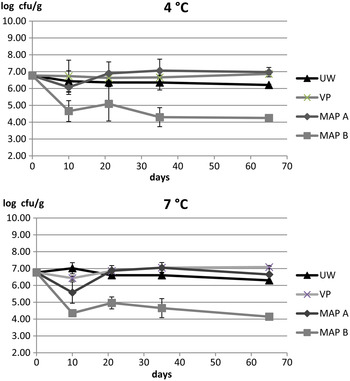
After cheesemaking, the unpackaged cheese had a total mesophilic microbial count of 6·7 log cfu/g. As illustrated in Fig. 1, UP and VP CPc maintained initial bacterial count during storage time at both temperatures (P > 0·05). For those cheeses packaged in a protective atmosphere, the total microbial count showed differences between MAP A and MAP B. For both packagings the total number of mesophilic bacteria fell at 10 d, but whereas in MAP A it increased to reach its original count after 65 d (probably due to higher O2 percentage in the package during monitoring, P = 0·015), in MAP B the microbial count significantly decreased to about 4 log CFU/g at 65 d (P < 0·01). These results were similar at both storage temperatures (P > 0·05). Thus MAP B had the lowest bacterial count (4·25 and 4·14 log cfu/g at 4 and 7 °C respectively) compared to VP (6·87 and 7·09 log cfu/g at 4 and 7 °C), MAP A (6·97 and 6·65 log cfu/g at 4 and 7 °C) and UP (6·21 and 6·30 log cfu/g at 4 and 7 °C).
Viable total microbial count on Calabrian Provola cheeses during storage (n = 3). UW, Unpackaged cheese; VP, Vacuum Packaged cheese; MAP A, Cheese packaged in thermoformed tray; MAP B, Cheese packaged in plastic pouch.

Physicochemical analyses
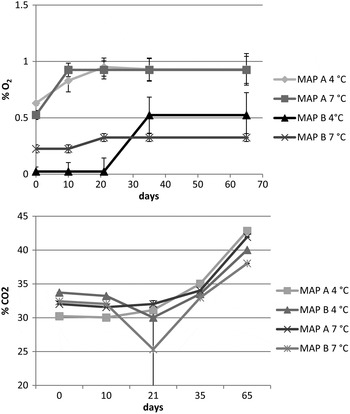
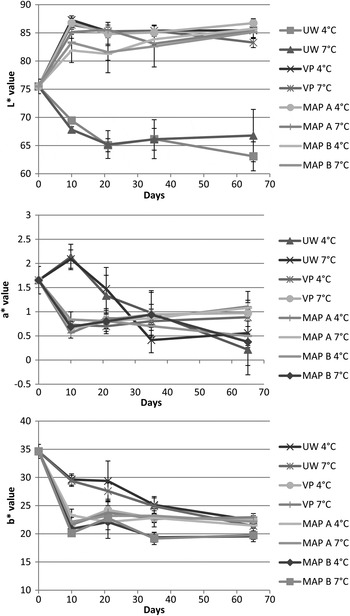
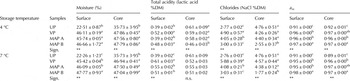
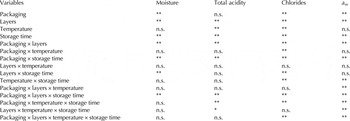
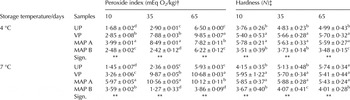
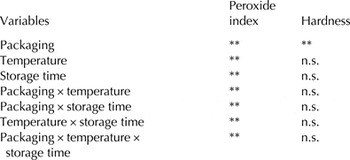
The trend of gas evolution in the packaging atmosphere is linked to gas permeability of packaging materials and/or microbial growth. As illustrated in Fig. 2, the gas composition in the headspace of packaged samples during storage changed with some differences. For MAP A and MAP B the different storage temperatures did not cause the percentage of O2 to vary at 65 d. However, MAP A showed a higher O2 content at all times. In each case the oxygen level was less than 1% and the differences immediately after packaging content could be due to the different packaging machines. The CO2 content was in general similar for both packaging types and after 21 d the gas tended to increase until the end of monitoring. This observed trend in the headspace was confirmed by technical characteristics of the packaging materials used and by the total microbial count. Colour changes on the CPc surface regarded principally the b* chromatic parameter which is an important index of consumer acceptance for this type of cheese, denoting the amount of yellow. L*, a* and b* values measured at 0, 10, 21, 35 and 65 d are reported in Fig. 3. The general trend was a lightening of its yellow shade during the storage period. After 10 and 21 d UP samples showed the highest b* value, probably due to the formation of a rind on the cheese surface and to the absence of any packaging. Also regarding the L* value, UP Provola cheese surface was significantly different from other samples, whereas evident differences were not observed in the a* parameter during storage. According to multivariate analysis, temperature did not affect the considered cheese colour parameters (P > 0·05) unlike packaging and storage time (P < 0·05). Table 1 reports the results of qualitative characteristics of CPc after 65 d of storage, considering in particular variations between the cheese surface and the cheese core. The results by one way ANOVA were expressed among samples for cheese part and physico-chemical determinations. Moreover in Table 2 influence of different variables are reported by multivariate statistical analysis. As expected, moisture percentage of CPc (48·52% after cheesemaking) tended to decrease during storage, with significant differences among samples showing, in particular, the lowest amount in CPc unwrapped samples. In fact, statistical data elaboration revealed a high influence of sample and time variables (P = 0·00) and none of thermal variable (P > 0·05), as showed in Table 2. For the water activity in the samples, no differences due to the two storage temperatures were observed (P > 0·05), but significant differences (P = 0·004) were evident in the outer layers of CPc among packaging types during monitoring times. In all cases (considered variables: temperature and Provola layers) UP showed the lowest a w, particularly at the end of the storage time, whereas VP and MAPA were close to the original value of 0·97 and MAP B was subjected to an increase during time in both layers. Concerning the total acidity of CPc, an increase from the original content of 0·30 Lactic acid % d/m was observed after 65 d of storage with different results among samples and among cheese layers. Multivariate analysis showed that the studied packaging types did not influence the results on total acidic amount, whereas significant differences were observed considering the other variables. Chloride amount, expressed as NaCl percentage, varied during monitoring times. At 65 d of storage, an increase from initial content (4·28% on dry matter) was generally observed in cheese core with the exception of MAP B CPc. This trend was not observed in surface layers of vacuum packed CPc that maintained approximately the original content. UP cheeses manifested the lowest percentages at both storage temperatures. In general, this index revealed a great variation influenced by all considered variables. In Table 3 peroxide value and hardness are reported, which indicate possible quality decay in Provola cheeses. During monitoring, the general trend was an increase in the peroxide value at both storage temperatures from the value quantified after cheesemaking (1·90 mEq O2/kg). Also, among samples the lowest value after 65 d of storage, were observed in UP at 4 °C and MAP B at both storage temperatures. As already reported, MAP B was the packaging type with the lowest Oxygen Transmission Rate, so, it is possible that it positively influenced the level of oxidation in cheeses, also demonstrated by low amount of peroxides. As reported by Park (Reference Park2001), when the oxygen supply was unlimited, the rate of lipid oxidation was not dependent on gas concentration, which explains the low values on UP samples. Moreover also the compact rind formed on the cheese surface could obstruct gas diffusion and subsequently reduce the oxygen reaction on the lipid substrate. As reported in Table 4 all variables affected results of peroxide value (P < 0·01). The cheese hardness, expressed as penetration force (N), increased during the storage time from the original value of 3·16 N to about 5·5 N, showing a similar trend for VP and MAP A CPc. Hardness of unwrapped cheeses showed a more regular increase. From multivariate data analysis, storage temperature and time did not affect this physical parameter, but great influence was attributed to the packaging variable. At the end of monitoring, MAP B possessed the lowest values of hardness (3·48 N at 4 °C and 4·01 N at 7 °C) with no relevant variations compared to the original texture. Probably the trend of cheese hardness during monitoring times was related to the water distribution throughout the cheese, as demonstrated by activity water values.
Gas composition of different packaging s of Calabrian Provola cheeses during storage (n = 3). UP, Unpackaged cheese; VP, Vacuum Packaged cheese; MAP A, Cheese packaged in thermoformed tray; MAP B, Cheese packaged in plastic pouch.

Variation of L* a* and b* colour parameters in CPc stored under several packaging conditions (n = 3). UW, Unpackaged cheese; VP, Vacuum Packaged cheese; MAP A, Cheese packaged in thermoformed tray; MAP B, Cheese packaged in plastic pouch.

Qualitative characteristics of the different layers of Calabrian Provola cheeses stored for 65 d

UP, Unpackaged cheese; VP, Vacuum Packaged cheese; MAP A, Cheese packaged in thermoformed tray; MAP B, Cheese packaged in plastic pouch
Values are Means ± SD. n = 3, n.s. not significant (P < 0·05). Data followed by different letters are significantly different by Tukey's multiple range test (P < 0·05)
Results of multivariate analysis on some physicochemical parameters of CPc

n.s. not significant (P < 0·05)
Qualitative characteristics of Calabrian Provola cheeses stored for 65 d

UP, Unpackaged cheese; VP, Vacuum Packaged cheese; MAP A, Cheese packaged in thermoformed tray; MAP B, Cheese packaged in plastic pouch
Values are means ± SD
n.s, a–d see Table 1
† (n = 3)
‡ (n = 9)
Results of multivariate analysis on Peroxide index and Hardness of CPc

n.s., not significant (P > 0·05)
Conclusions
In this study several packaging types were evaluated for their ability to preserve the quality of a typical dairy product of Southern Italy, sold generally without packaging. It is worth noting that these Pasta filata cheeses can be affected by microbiological problems and can sometimes appear not homogeneous because of the short and not standardised drying times before the sale. Therefore the choice of a proper packaging for the Calabrian Provola cheese is also fundamental for the preservation of its original quality. Compared to the sale without any form of packaging, the analytical results of some parameter (moisture, acidity and oxidative index) indicate the suitability of both vacuum and modified atmosphere packaging from the organoleptic point of view. In particular, the packaging in PE/EVOH/PA/PE multilayer film and protective atmosphere demonstrated a more positive effect on the maintenance of cheese quality, improving their characteristics and prolonging its shelf life.
The results can promote the export of Calabrian Provola cheeses, a typical Southern Italian dairy product, to new, more distant markets, preserving their qualitative properties.
This work was supported by APQ -Accordo di Programma Quadro (APQ) Ricerca Scientifica e Innovazione Tecnologica nella Regione Calabria. I atto integrativo – Azione 3 – Sostegno alla domanda di innovazione nel settore alimentare. Project: Tecniche innovative per il confezionamento delle provole