In recent years, pandemics such as severe acute respiratory syndrome (SARS), swine flu (H1N1), and coronavirus disease (COVID-19) have had a serious influence on global economic and social development. Outbreaks of major epidemics triggered the extraordinary and sudden surge in demand for the manufacture of emergency supplies. Reference Ranney, Griffeth and Jha1 The surge in demand for emergency supplies and equipment has brought new challenges to existing manufacturing systems and producing modes, leading to technological and management innovations in the field of emergency manufacturing.
Scholars had conducted studies on issues related to “emergency manufacturing” in the context of pandemics from different perspectives, including the development of new manufacturing technology, the optimization of manufacturing processes, Reference Carter, Reed and Morrell2 and so on, but there had not yet been systematic study on the impact of major epidemics on emergency manufacturing industry from a quantitative perspective. Based on this, the present study reviewed and summarized the current research results and developments in the field of emergency manufacturing.
Methods
Data Sources
A literature search was conducted based on the WOS Core Collection database with the keyword query formulation “(TI=(manufactur*)) AND (TI=(pandemic) OR TI=(epidemic) OR TI=(covid-19) OR TI=(coronavirus) OR TI=(h1n1) OR TI=(h2n2) OR TI=(h3n2) OR TI=(SARS) OR TI=(sars-cov*) OR TI=(personal protective equipment) OR TI=(PPE) OR TI=(N95) OR TI=(protective mask) OR TI=(respirator) OR TI=(vaccine) OR TI =(protective clothing) OR TI=(ventilator) OR TI=(surgical masks) OR TI=(testing swab) OR TI=(oxygen valves) OR TI=(face shield))” and an unlimited time span. The search results showed 592 articles. The literature was filtered to eliminate “noise,” resulting in 286 articles.
Research Methods
In this paper, first, the number of publications in the field of emergency manufacturing research from 2006 to 2023 was counted using Excel, and, second, the WOS data analysis panel of CiteSpace 6.2.R2 Reference Chen3 was used to visualize and analyze the knowledge mapping of document co-citation networks, keyword clustering, and keywords burst in the research literature in the field of emergency manufacturing.
Results
The number of publications for the period 2020 to April 2023 totaled 236, accounting for 82% of the total research sample. It showed that there had been an explosion of scientific research results during the last 3 years of the COVID-19 pandemic. The global COVID-19 had greatly triggered knowledge innovation in the novel field of emergency manufacturing.
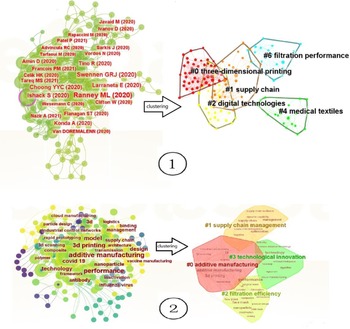
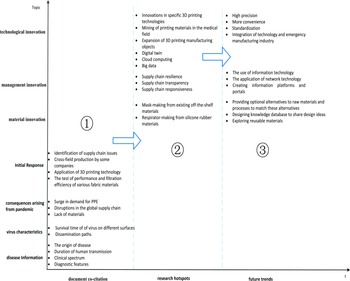
From the analysis of the document co-citation network and its clusters (Figure 1-①), the surge in demand for emergency supplies and supply chain disruptions caused by the pandemic Reference Ranney, Griffeth and Jha1 laid the foundation for current emergency manufacturing innovation. Disaster information and virus characteristics Reference Balachandar, Mahalaxmi and Kaavya4 provided the research direction for this field (Figure 2-①), which in turn gave rise to subsequent research hotspots in the era of pandemics such as 3-dimensional printing technology, supply chain management, and medical textiles (see Figure 2-②).
The document co-citation network and keywords co-occurrence network and their clusters map.

The evolution process of the topics.

The keywords co-occurrence network and its clusters (see Figure 1-②) showed that the field research hotspots focused on pandemic-triggered emergency manufacturing technology innovations, pandemic-triggered emergency manufacturing material innovations, and pandemic-triggered emergency manufacturing management innovations. Emerging technologies such as additive manufacturing technology, the digital twin, and the Internet of things are widely used in the emergency manufacturing process during major epidemics. The research covers various aspects such as some specific aspects of printing emergency supplies, using additive manufacturing technologies (including printed materials, model design files, the expansion of the types of emergency materials printed, and quality testing of the finished printed products); crisis simulation using computer simulation technology to mimic scenarios after an epidemic, achieving better control over resources in the manufacturing process; remote collaboration using cloud computing to maintain efficiency and productivity even when working remotely under an epidemic; and using blockchain technology for source identification and anti-counterfeiting of raw materials for emergency supplies. Reference Pour, Nazzal and Darras5 Emergency manufacturing material innovations include the application of novel materials such as silicone rubber, stainless steel wheeled structures, and protein receptors in the manufacturing process of respirators Reference Rebelo, Neutel and Alves6 and vaccines. In the aspect of emergency manufacturing management innovations, supply chain responsiveness, supply chain resilience, and supply chain transparency have become research hotspots, and scholars have used technologies such as block chain to provide traceability solution of emergency supply chains Reference Ilhaam, Mazin and Raja7 (see Figure 2-②).
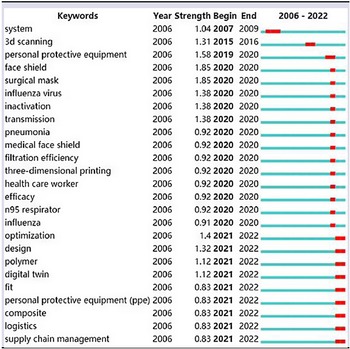
The high-burst keywords indicated that research trends in the post-pandemic era mainly focus on the application innovation of additive manufacturing and new information and communication technology (ICT), innovation of emergency manufacturing materials, and construction of an emergency supply chain system (see Table 1 and Figure 2-③). To meet the technological innovation of emergency manufacturing, additive manufacturing technology in the future will develop in the direction of higher precision, more convenience, safety, standardization, and networking. Reference Clifton, Damon and Martin8 New ICT will further need to be deeply integrated with the emergency manufacturing industry so as to strengthen the stress capacity of manufacturing application scenario transformation, and realize the supply chain collaborative arrangement from offline to online. Reference Alcock, Boutilier and Siddiq9 In terms of material innovation, in the future, during the design process of innovative personal protective equipment (PPE), attention should be given to providing optional alternatives to raw materials and processes to match those alternatives. This conceptualized design idea can be built into a knowledge database and shared on the web to guide people to use local materials and processes for more efficient emergency manufacturing and reduced reliance on global supply chains. In addition, there is also a trend to explore easily disposable and reusable raw materials to produce PPE. In the aspect of management innovation, the use of information and network technology, the collection and analysis of information flow within the supply chain, big data analysis, manufacturing intelligence, and control of logistics processes have all become future research targets for the management optimization of emergency supply chains. In addition, multilateral and regional entities and governments need to act together to create vaccine information platforms and portals and develop financial incentives and policies to attract all types of companies to share information related to the pandemic. Reference Sodhi, Tang and Willenson10
Top 25 keywords with strongest bursts

Discussion
The rise of pandemic-triggered emergency manufacturing research is exposed through the document co-citation network, with keyword clustering to analyze current research hotspots and keyword bursts to explore future research trends. This study provides scholars with a systematic and quantitative analysis of emergency production innovations during major epidemics.
There are limitations in this study. First, this research is conducted at a time when COVID-19 has not been declared over, and we are still in the post-pandemic era. It is not the best time to draw conclusions and reflect. Second, it only selects data sets from the Web of Science database, and it does not integrate data sets from other databases. In the future, as knowledge map software becomes more powerful, a comprehensive visual mapping of the emergency manufacturing field will be provided.
Conclusions
In this paper, we found that a novel study field of pandemic-triggered emergency manufacturing is evolving through literature research. The research hotspots and trends in this field are mainly focused on technological innovation, management innovation, and material innovation. The research summarizes the past and points out future research directions for subsequent studies.
Author contribution
The first author, Tian Xie, developed the study’s main design and performed the main writing of the manuscript. Juan Wu performed the material preparation, data collection and analysis, and relevant writing of the manuscript. Yao-Yao Wei was responsible for concept design and software guidance. Wei-Fan Chen and Krista Chen were responsible for the results analysis and assisted in revising and embellishing the thesis for this study. All authors were involved in the writing of this article, discussed the results, and contributed to the final manuscript.
Funding statement
This work was supported by the National Natural Science Foundation of China (No. 71974090), Philosophy and Social Science Foundation of Hunan Province of China (18YBQ105), Youth Talents Support Program of Hunan Province of China (2018HXQ03), Key Scientific Research Project of Education Department (20A443), Social Science Key Breeding Project of USC (2018XZX16), Doctoral Scientific Research Foundation of USC (No. 2013XQD27), Philosophy and Social Science Foundation Youth Project of Hunan Province of China (19YBQ093), Scientific Research Project of Education Department (No. 20C1625), State Scholarship Fund (202108430098) from CSC, and State Scholarship Fund (202208430061) from CSC.
Competing interests
The authors report no conflicts of interest.