Implications
Feed restriction and the associated prolonged feeling of hunger in broiler breeders is a major welfare concern. The results from this experiment suggest that high-fibre diets may provide a transient alleviation of hunger, and that diets with a high proportion of insoluble fibre induce behavioural signs (reduction in stereotypic pecking, increased foraging, fewer incidents of tail pecking, higher levels of dust bathing and other comfort behaviour) of improved well-being in broiler breeders growing at commercial rates without adverse effects on litter quality.
Introduction
Modern broiler chickens have been selected for fast and efficient growth for decades (Sandøe et al., Reference Sandøe, Nielsen, Christensen and Sørensen1999). This increase in growth rate has consequences for the parent stock. Female broiler breeders are raised under severe feed restriction in order to control ovarian function and improve egg production and hatchability and to lower mortality (Hocking et al., Reference Hocking, Bernard and Robertson2002) with associated implications for welfare through prolonged feelings of hunger (Mench, Reference Mench2002; Arnould and Leterrier, Reference Arnould and Leterrier2007). Compromised welfare due to quantitative feed restriction may be expressed as excessive water intake, stereotypic pecking directed towards objects in the environment, a general increase in activity (Zuidhof et al., Reference Zuidhof, Robinson, Feddes, Hardin, Wilson, Mckay and Newcombe1995; Hocking et al., Reference Hocking, Maxwell and Mitchell1996; Savory and Kostal, Reference Savory and Kostal2006) and increased corticosterone level in the blood (Mench, Reference Mench1991; Hocking et al., Reference Hocking, Maxwell, Robertson and Mitchell2001). The European Food Safety Authority (EFSA) Panel on Animal Health and Welfare (2010) rates feed restriction among the top welfare hazards for growing female broiler breeders.
Diet dilution has been used as an alternative to quantitative feed restriction. Attempts to feed broiler breeders with high-fibre diets in order to increase satiety and improve welfare have been studied using different kinds of fibre sources (Zuidhof et al., Reference Zuidhof, Robinson, Feddes, Hardin, Wilson, Mckay and Newcombe1995; De Jong et al., Reference de Jong, Enting, van Voorst and Blokhuis2005b; Sandilands et al., Reference Sandilands, Tolkamp, Savory and Kyriazakis2006). However, previous attempts to feed high-fibre diets to growing broiler breeders have often concentrated on one fibre source at a time (e.g. Hocking et al., Reference Hocking, Zaczek, Jones and Macleod2004), sometimes used in combination with appetite suppressants, such as calcium propionate (e.g. Sandilands et al., Reference Sandilands, Tolkamp, Savory and Kyriazakis2006), which lead to a significant reduction in food intake when food is available on an ad libitum or equivalent schedule. Although calcium propionate has been used to successfully limit growth as well as stereotypic behaviour on an ad libitum fed diet containing oat hulls (Sandilands et al., Reference Sandilands, Tolkamp and Kyriazakis2005; Tolkamp et al., Reference Tolkamp, Sandilands and Kyriazakis2005), it is uncertain how this is achieved, as no metabolic or physiological effects have been found (Pinchasov and Elmaliah, Reference Pinchasov and Elmaliah1994). If the food has an unpleasant taste or results in intestinal discomfort, the observed reduction in feeding motivation may reflect a dislike for that particular feed and not a reduction in hunger, and the welfare improvement may therefore not be real.
Others have applied a less restrictive feeding regime than used commercially (e.g. Hocking et al., Reference Hocking, Maxwell and Mitchell1996) or given ad libitum access to high-fibre diets (Savory and Lariviere, Reference Savory and Lariviere2000). Although this has led to increased satiety, the resulting higher growth has negative effects on productivity, thus making the diets unsuitable for practical use. D'Eath et al. (Reference D'Eath, Tolkamp, Kyriazakis and Lawrence2009) emphasised that comparisons of feeding schedules resulting in differences in live weight do not compare like with like. De Jong et al. (Reference de Jong, Enting, van Voorst and Blokhuis2005b) found some welfare improvements in terms of reduced hunger and frustration when energy content of the diet was lowered by 23%, but they conclude that more extreme diet modifications are required to improve substantially the welfare of growing broiler breeders.
In this experiment, we aimed to limit the growth of the broiler breeders to that recommended by industry, although still allowing the birds quantitatively more feed than is used commercially today. By using different types of fibre sources in our feed mixture, we aimed to compose feeds, which differed from current commercial feeds in energy content (∼32% reduction) as well as fibre content, and in the ratio of soluble and insoluble fibre (ISF). We hypothesised that the birds fed quantitatively more feed would show: (i) less signs of hunger and (ii) changes in behaviour indicative of improved welfare compared with control-fed birds, and that these effects would be more pronounced in birds fed a high-fibre diet with higher ratios of soluble fibre due to their greater capacity for absorbing water and increasing the volume of gut content (Hocking et al., Reference Hocking, Zaczek, Jones and Macleod2004).
Material and methods
Animals and housing
Day-old female Ross 308 broiler breeders (n = 720) were obtained from a hatchery (day 0), divided into groups of 30, weighed and allocated to 24 pens situated in one room. Each pen measured (W × L × H) 0.95 m × 1.65 m × 0.61 m and consisted of a solid floor with wire mesh walls and roof, half of which was a hinged wire-mesh lid divided into two halves. Each pen was mounted on legs, thereby raising it 0.74 m above floor level to enable easy access to the birds for husbandry procedures. The pens contained a circular feeder (d = 33 cm) and five water nipples (Corti piston nipples 80, Corti Zootecnici S.r.l., Monvalle, Italy) without drip cups attached to a water pipe hanging along the back wall of the pen. The type of nipple was chosen to allow a water flow of up to 110 ml/min, and the height of the nipples was increased as the chickens grew.
The floor of each pen was bedded with wood shavings. As the fibre-rich diets required sufficient water to allow swelling, bedding needed to be added or replaced regularly. Litter samples for dry matter (DM) estimation were taken before any addition of fresh litter had taken place (day 25), as well as on day 99, which was 4 days after a complete replacement of litter in all pens.
Lights were on 23 h during the first 2 days, 20 h during days 2 and 3, and hours of light was then reduced by 2 h every second day until day 14, when lights were on for 8 h from 0700 to 1500 h until the end of the experiment. Water was available 24 h while the birds were fed ad libitum (days 0 to 7) and subsequently during the period of light only. The ambient temperature during the first 3 days was 32°C after which it gradually declined on a weekly basis to reach 21°C by day 42 at which it remained for the rest of the experiment.
The chickens remained in these pens until day 54. They were then moved to an identical house with the same type of raised pens as previously used, except no feeder was present and the nipples were fitted with drip cups. The group size was reduced to 16 birds per pen, and 10 groups were made for each of the three feeding treatments by mixing birds from all eight pens within each feed. Birds were chosen at random, although very large (i.e. potentially males) and very small birds (i.e. potentially subclinically ill) were not chosen.
Some birds showed signs of having been pecked on the tail feathers, and their tails were sprayed with oil of hartshorn solution (Pyroleum Animale Crudum, Porcivet from Kruuse, Denmark) as anti-pecking treatment, leaving a black colouration on the feathers. This was, however, not always successful, and if pecking persisted, the affected birds (14 birds from four pens on feed C1 (1 × fibre content, 80% ISF) and seven birds from three pens on feed H2 (2 × fibre content, 89% ISF)) were removed from the experiment and humanely killed by cervical dislocation. In two cases (one C1 and one H2), it was decided to remove all birds from a pen due to tail pecking.
Weighing schedule and feeding treatments
Birds were weighed on a pen basis on days 0 and 12, and weekly thereafter until day 109. As the weighing began within half an hour of feeding, the daily feed allowance at the day of weighing was subtracted from the pen LW to account for differences in gut fill between feeding treatments. Daily feed allowance was adjusted twice weekly based on the growth of the birds in the previous week, and to account for reductions in the group size due to mortality or birds being removed for testing. Initial feed allowance was estimated from growth data obtained from a different group of chickens fed ad libitum for 56 days on the same feeds (data not shown).
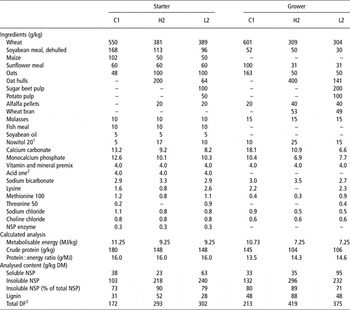
Three feeds were formulated, each in a starter (2 mm pellets) and a grower (3.5 mm pellets) version. The control feed (C1) was a commercial diet with a fibre content (non-starch polysaccharides, NSP) in the grower version of 165 g/kg DM of which 80% was ISF. The remaining two grower feeds both had twice the fibre content of C1, but the proportion of ISF was either higher (89% of NSP; H2) or lower (71% of NSP; L2) than C1 (Knudsen, Reference Knudsen1997; Table 1).
Composition and calculated energy and protein content of the starter (fed days 19 to 38) and grower (fed days 39 to 109) versions of feeds C1, H2 and L2

C1 = commercial control diet; H2 = high proportion of insoluble fibre; L2 = low proportion of insoluble fibre; NSP = non-starch polysaccharides; DM = dry matter; DF = dietary fibre.
1Nowitol 20: fat mixture with 20% linoleic acid incorporating soya and palm oils, and industrial fatty acid byproducts.
2Acid One: Salts derived from formic acid and lactic acid.
3DF = NSP + lignin.
All groups were fed ad libitum until day 7 on a commercial starter feed (2 mm pellets, 11.8 MJ ME/kg, 200 g protein/kg), and during the first 3 days additional feed was spread on lengths of paper placed underneath the drinking nipples. This was done to ensure that all chickens learned to feed and associate pellets with food. The starter versions of the three feeds C1, H2 and L2 were fed during days 19 to 38, and from day 39 the grower versions were fed until day 109, where the experiment ended and the birds were killed.
From day 8 the birds were fed once a day, where a pre-weighed amount of food was released at 0800 h from a container above the pen. The container was filled via an automatic pneumatic system, which allowed different feeds and different amounts to be allocated to each pen. The refilling of the container occurred between 0900 and 1030 h every day, in order to separate in time the sound of the filling from feeding. Until day 54, the birds were fed in a circular feeder and thereafter by scatter feeding via two outlets in the roof of each pen. Scatter feeding is used commercially to encourage foraging, prolong feeding and improve uniformity of LW (Hocking et al., Reference Hocking, Zaczek, Jones and Macleod2004). Water usage was measured hourly on a pen basis by water meters (MHJ Agroteknik A/S, Bjerringbro, Denmark). Owing to technical failure in the automatic data storage, data on water usage from days 86 to 90 were lost.
Hunger tests
Two different hunger tests were carried out. One (Novel Food test) aimed to test the conflict between fear and hunger level of the birds by presenting them with a novel food in a novel trough. The other (Feeding Rate test) tested the rate of intake in pairs of birds after 24 h food restriction. In addition, the Feeding Rate test allowed us to measure the compensatory feed intake when given ad libitum access to the feeds, which has been suggested as a parameter to quantify hunger (de Jong et al., Reference de Jong, van Voorst and Blokhuis2003).
The Novel Food test was adapted from tests by Savory et al. (Reference Savory, Maros and Rutter1993) and carried out by three experimenters on day 48. Each pen was tested once only, and the test was carried out at four time points relative to feeding at 0800 h (−45, +90, +240 and +375 min from feeding). The test consisted of placing a novel, 50 cm long trough (made from grey plastic guttering) filled with 200 g of whole wheat in the pen, allowing the birds access for 2 min. This was intended to introduce a conflict between fear of novelty and motivation to eat, thus assessing the level of hunger. We expected the birds to eat the most at a time of maximum hunger, presumed to be just before their normal feeding time, when they would have been without food for almost 24 h. Similarly, the birds would eat the least amount just after feeding. The latency of the first bird to eat from the trough, the number of birds at the trough after 1 min and at the end of the test (2 min), as well as the amount of wheat eaten were recorded. For comparison, a similar test was carried out on day 48 on different groups of chickens fed ad libitum on the same feeds.
The Feeding Rate test, carried out when the birds were 74 to 102 days of age, was adapted from the feeding motivation test by Sandilands et al. (Reference Sandilands, Tolkamp and Kyriazakis2005) to overcome some of the problems associated with their version (i.e. comparison of birds inexperienced with feed withdrawal and with ad libitum feeding, respectively; see Discussion). Two birds were removed from their home pen at 1300 h, weighed and placed in a pen identical to those in which the birds were housed until day 54. The feeder was covered by a lid, and contained a pre-weighed amount of their normal feed, that is, C1, H2 or L2. At their normal feeding time the following day, the birds were allowed access to the feed for 2 min after which the lid was replaced, and the remaining food and the birds were weighed. Subsequently they were allowed ad libitum access to their usual feed, and the feed intake of each pair was estimated by weighing the feeder after 24 and 48 h access, at which point the birds were also weighed. After 5 days of ad libitum feeding the food was weighed and the lids were replaced. Following 24 h food withdrawal, the birds were re-tested, that is, given access to the food for 2 min. The idea behind the test is that level of hunger is reflected in speed of eating, and as well as testing differences in hunger levels between the three feeds, we wanted to investigate whether birds that are accustomed to 24 h food withdrawals (i.e. because they have been restrictively fed once a day for several weeks) would eat slower (indicating a lower level of hunger) than birds that have been ad libitum fed before a 24 h food withdrawal.
Behavioural observations
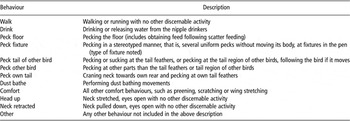
Behavioural observations were carried out using time sampling (scanning) every 30 min throughout the light period on days 98 and 99. For each bird its posture was noted (standing or sitting/lying) together with its behaviour as defined in Table 2. Data were expressed as percentage of birds in a pen to account for slight differences in the group size due to mortalities.
Ethogram of mutually exclusive behavioural measurements

Blood sampling and analyses
A total of 56 birds were blood sampled on day 104 between 1200 and 1320 h. Treatment and cages were assigned for sampling in a completely balanced design. Two birds per cage were randomly selected using the same procedure for all cages (first bird: the third hen from the left, second bird: the third hen from the right) and taken out of the cage. Blood was collected from the wing by venipuncture using a needle (0.6 × 16 mm, 23G) and a 5 ml syringe. Blood (4 ml) was collected into heparinised tubes and immediately stored on ice. The sampled blood were within 1 h after sampling centrifuged at 2000 × g for 15 min at 4°C, and plasma samples stored in 0.5 ml eppendorph tubes at −20°C until analysis. Time of day and duration of handling (from touching the bird until blood sampling completed) were registered for each individual to the nearest second. The bird was then weighed to the nearest gram and humanely killed by cervical dislocation. In addition, it was noted if the birds had had their tail feathers pecked or not.
Plasma was analysed for concentrations of corticosterone, glucose, lactate, non-esterified fatty acids (NEFA), phospholipids, and β-hydroxybutyrate (BOHB). These latter parameters were chosen, as they are commonly used to reflect nutritional state in mammals. Blood plasma corticosterone was assayed using a specific radioimmunoassay (Etches, Reference Etches1976). All other analyses were performed using an autoanalyzer (ADVIA 1650®, Siemens Medical Solutions, Tarrytown, NY 10591, USA). Glucose and lactate were determined according to standard procedures (Siemens Diagnostics Clinical Methods for ADVIA 1650®). NEFA were determined using the Wako, NEFA C ACS-ACOD assay method. Choline-containing phospholipids were determined using the Wako Phospholipid DAOS method. BOHB was determined in a two-step kinetic procedure, that is, as an increase in absorbance at 340 nm due to the production of nicotinamide adenine dinucleotide (NADH), at a slightly alkaline pH: (i) in the presence of BOHB dehydrogenase (total NADH production) and (ii) without BOHB dehydrogenase (unspecific NADH production). The difference between the two determinations was considered BOHB specific reduction of NAD+. Sample blank was in all instances included, as the analyses involved oxamic acid in the media to inhibit lactate dehydrogenase activity as proposed by Harano et al. (Reference Harano, Ohtsuki, Ida, Kojima, Harada, Okanishi, Kashiwagi, Ochi, Uno and Shigeta1985). All metabolites had inter- and intra-assay coefficients of variations (CV; n = 48) of 3% and 2%, respectively. The relative bias was in all instances below ±5% for both low- and high-control material (n = 36).
Statistical analysis
Data were analysed using the statistical package Minitab (release 12.22).
LW within day, litter DM and compensatory feed intake were analysed using a simple one-way ANOVA fitting feed as the explanatory parameter. Daily feed allowance did not vary within day between pens on the same feed. Regression analyses were carried out on water usage (daily pen means) with age for each feed. Data from two pens fed C1 were excluded due to unusually high standard residuals. Hourly water usage for days 92 to 99 were analysed using a general linear model (GLM) with feed and time as fixed effects and day fitted as a random effect.
Data relating to hunger tests and blood analyses were analysed using GLMs. Data from the Novel Food test were analysed with experimenter fitted as random effect, and feed and time after feeding as fixed effects. Analyses of the Feeding Rate test used mean pre-test LW (−18 h) of the pair as covariate in the analysis of the first test, and mean LW after 48 h ad libitum feeding as covariate in the second test. Feed was fitted as fixed effect and week of test as a random effect. Both covariates were used when the differences in intake between the two tests were analysed. In the analyses of blood sample data, feed and tail pecked (yes, no) were modelled as fixed effects with LW and handling time as covariates.
Behavioural data from observations in the home pen were analysed using GLM when normally distributed residuals could be obtained. This was the case for drinking, pecking floor, head up and neck retracted, where feed and time of day were fitted as fixed effects. Walking was analysed within time of day, as it was predominantly observed immediately before feeding. The remaining behavioural variables were analysed for feed effects using χ 2 analysis based on their occurrence.
Comparisons of significant factors were done using Tukey simultaneous tests. The results are given as least squared means ± s.e., unless otherwise stated.
Results
Feed allowance and LW gain
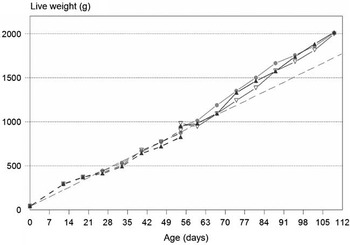
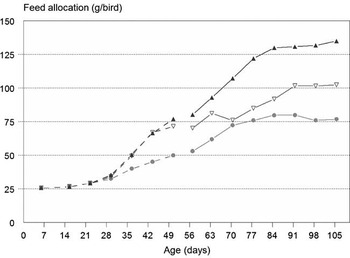
Figure 1 shows the LW of the birds across time for each of the three feed types used. The birds were relocated and mixed on day 54, and the mean weight per chicken before mixing (27 to 28 birds per pen) was 874, 902 and 826 g for feeds C1, H2 and L2, respectively, with a mean CV of 14% per pen. Following mixing, the same values (16 birds per pen) were 890, 907 and 867 g with a mean CV of 10% per pen. The LW was slightly higher than those recommended by commercial breeders after day 70 (Figure 1). On day 109, the mean group size was 7.3, 8.2 and 8.9 for feeds C1, H2 and L2, respectively, and the mean CV for LW within pen was 7.2%, 9.2% and 10.6%, respectively. The similar growth rates on the three feeds were achieved on widely different amounts of each feed in quantitative terms (Figure 2). The difference in feed allocation on the two fibre-rich feeds may reflect higher spillage or lower utilisation on feed L2. Wet litter may increase food wastage during scatter feeding, and compared with commercial standards (Aviagen, 2007) feed allocation on C1 was 15% higher and on L2 25% higher in terms of energy content. Adjusting feed allocation in grams accordingly gave an estimated intake on both high-fibre feeds of 44 ± 3% more than on feed C1 on days 54 to 109.
Mean (±s.e.) live weight (g) plotted against age (days) for birds on feeds C1 (circles;  ), H2 (open triangles;
 ) and L2 (closed triangles;
 ). The thin stippled line indicates the growth curve as recommended by commercial breeders. On day 54 the birds were weighed before and after regrouping.

Mean daily feed allocation (g) plotted against age (days) for birds on feeds C1 (circles;  ), H2 (open triangles;
 ) and L2 (closed triangles;
 ).

When comparing the food allowance to the intake of ad libitum fed birds on the same feeds at the same age (day 32), the reduction in terms of energy was equivalent to approximately 25% of ad libitum intake on all three feeds. If the comparison is made at similar LW (∼1500 g), the reduction was equivalent to 56%, 48% and 76% of ad libitum energy intake on feeds C1, H2 and L2, respectively.
Water usage and litter DM
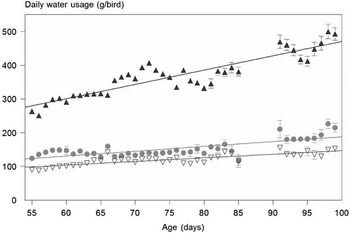
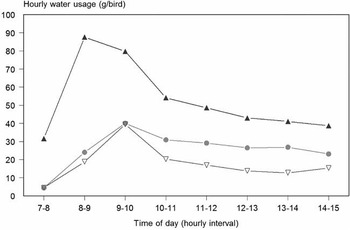
Significant differences were found in water usage between birds on the three feeds (151, 120 and 364 (±6.4) g water per bird per day, for feeds C1, H2 and L2, respectively; F2,25 = 520.1; P = 0.001). Figure 3 shows the daily water usage per bird with age (days 55 to 99). The regression line coefficients and statistics are given in Table 3. A significant interaction between feed and time was found for hourly water intake (F14,1566 = 71.0; P < 0.001), with birds on L2 drinking more water throughout the day and in particular around feeding (Figure 4). The difference in daily water intake between birds on feeds C1 and H2 occurred during the last 5 h of the light period. Water-to-feed ratios for days 80 to 102 were calculated to be 2.3, 1.3 and 3.3 g/g for feeds C1, H2 and L2, respectively. For comparison, the water-to-feed ratio recommended by the breeding companies for the commercial feed C1 is 1.8.
Mean daily water usage (g/bird; ±se) for birds on feeds C1 (circles;  ), H2 (open triangles;
 ) and L2 (closed triangles;
 ). Data loss occurred on days 86 to 90. Equation coefficients are given in Table 3.

Coefficients and statistics for regression analyses of daily water usage (g/bird) with age (days) for each of the three feeds

C1 = commercial control diet; H2 = high proportion of insoluble fibre; L2 = low proportion of insoluble fibre.
Mean (days 92 to 98) hourly water usage (g/bird; ±s.e.) for birds on feeds C1 (circles;  ), H2 (open triangles;
 ) and L2 (closed triangles;
 ).

The differences in water intake were also reflected in the litter DM content, which differed significantly between all three feeds on day 25 (57%, 65% and 31% (±2%); F2,21 = 77.6; P < 0.001) and on day 99 (41%, 70% and 25% (±3%); F2,25 = 61.3; P < 0.001) for feeds C1, H2 and L2, respectively.
Hunger tests
No significant interaction between feed and time since feeding was found for any of the variables associated with the Novel Food test. No differences were found in the latency to eat from the trough (18 ± 3 s) and the number of birds at the trough after 1 min (13.0 ± 1.1). However, an overall effect of feed was found after 2 min, with fewer birds on L2 present at the trough (12.5) than on feeds C1 and H2 (18.2 and 15.8 (±0.9), respectively; F2,10 = 8.6; P = 0.007). This was also reflected in a significantly reduced intake of wheat for birds on L2 (126, 107 and 60 g (±8.8), for feeds C1, H2 and L2, respectively; F2,10 = 13.9; P = 0.001). There was also a significant effect of time since feeding (F2,10 = 3.8; P = 0.048), with the lowest intake 90 min after feeding (103, 71, 109 and 107 g (±9.2) for −45, 90, 240 and 375 min from feeding). The number of birds at the trough after 2 min was also reduced at this time point, but not significantly (16.0, 13.2, 16.3 and 16.5 (±0.97) birds for −45, 90, 240 and 375 min from feeding; F3,10 = 2.6; P = 0.110). In a similar test carried out on different birds fed ad libitum, only three out of 192 birds approached the trough (data not shown).
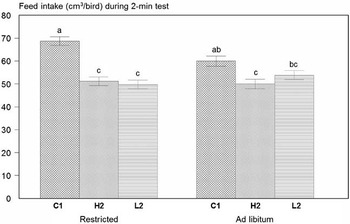
There were no significant differences between the birds on the three feeds selected for the Feeding Rate test in their pre-test LW (−18 h; 1646 ± 29 g). Figure 5 shows the amount of food eaten per bird during the two Feeding Rate tests. Birds on feed C1 ate significantly more than birds on the other two feeds in the first test (F2,53 = 31.6; P < 0.001). The same result was obtained when analysing the data using weight instead of volume of the feed. When the test was repeated after 5 days of ad libitum feeding followed by 24 h food withdrawal, birds on feed C1 no longer differed from birds on L2, but had a significantly higher intake than birds on H2 (F2,51 = 5.0; P = 0.011). No significant effect of feed was found in intake between the two Feeding Rate tests, whether analysed across tests (Figure 5) or as the difference (overall mean difference 2.0 ± 1.45 cm3).
Feed intake per bird during two 2-min Feeding Rate tests conducted after 24 h feed withdrawal. Bars on the left are birds tested on restricted feeding and on the right the same birds tested after 6 days of ad libitum feeding. The results are given in volume to allow for small differences in density between the feeds. Bars with different letters (a, b and c) differ significantly (P < 0.008).

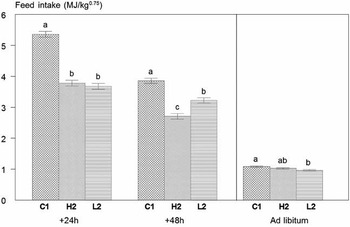
Compensatory feed intake (i.e. the amount of feed consumed when given ad libitum access after restricted feeding; MJ/kgLW0.75) after 24 h (F2,54 = 103.9; P < 0.001) and 48 h ad libitum access (F2,54 = 42.6; P < 0.001) were significantly higher in birds on C1, and after 48 h birds on H2 had the lowest compensatory intake (Figure 6). The intake after 24 h, however, did not differ between feeds when analysed in grams adjusted for LW, and the overall raw mean intake was 255 ± 5 g, which was 70% to 85% more than the intake (in gram) by birds of the same LW fed ad libitum on the starter version. LW after 48 h ad libitum access were 1937, 1837 and 1801 (±16) g for feeds C1, H2 and L2, respectively (F2,53 = 20.5; P < 0.001).
Compensatory feed intake (MJ/kg LW0.75) following 24 and 48 h ad libitum access to feed. Within day, bars with different letters (a, b and c) differ significantly (P < 0.008). For comparison the daily feed intake of 32-day-old birds of similar mean LW, but fed ad libitum from hatch on the three starter feeds are shown (F2,21 = 5.8; P = 0.01).

Behaviour in home pen
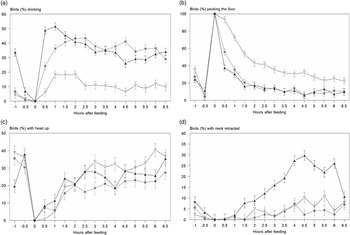
Almost 75% of the behaviour observed in the home pens was either drinking, pecking floor or head up (see Table 2 for definitions). Drinking behaviour was significantly influenced by an interaction between feed and time of day (F30,848 = 8.3; P < 0.001; Figure 7a). The water usage was reflected in the observed drinking behaviour of birds on feeds H2 and L2, whereas birds on feed C1 displayed more drinking behaviour than would have been expected from the measure of water usage (see Figure 4).
Mean percentage (±s.e.) of birds (a) drinking, (b) pecking the floor, (c) with head up and (d) with neck retracted in relation to feeding time for birds on feeds C1 (circles;  ), H2 (open triangles;
 ) and L2 (closed triangles;
 ). Please note different y-axes scales.

An interaction between feed and time of day way also found for pecking the floor (F30,848 = 4.8; P < 0.001), head up (F30,848 = 1.7; P < 0.015) and neck retracted (F30,848 = 4.7; P < 0.001). More birds on feed H2 continued to peck the floor in the period after feeding and remained at a higher level than birds on the other two feeds throughout the rest of the light period (Figure 7b). Birds on feed C1 generally had the lowest occurrence of head up, and before feeding this behaviour was least prominent in L2 birds (Figure 7c), who at this time were observed more often as drinking (Figure 7a). Birds on L2 were observed with neck retracted more often than other birds, and this behaviour increased gradually after feeding to be among those most frequently observed in L2 birds (Figure 7d).
The majority of walking occurred during the observation immediately before feeding, and a lower percentage of birds on feed L2 were observed walking at this time point compared with C1 birds (59%, 51% and 39% (±5.8%) for feeds C1, H2 and L2, respectively; F2,52 = 3.2; P = 0.05). In comparison, the overall mean percentage of birds observed walking in the 30 min before that was 10% ± 2% and during the observations following (but not including) feeding the percentage was 5% ± 1%.
Dust bathing was observed 23 times during the two observation days, and birds on feed H2 were significantly more likely to be seen dust bathing (χ 2 = 10.0; d.f. = 2; P = 0.007) than birds on the other feeds (3, 15 and 5 times, respectively, for feeds C1, H2 and L2). Birds fed L2 appeared to have a scruffier plumage, but this was not quantified.
The incidence of tail pecking differed significantly between birds on the three feeds (F2,877 = 88.6; P < 0.001), with the highest level found in birds on feed C1 and the lowest in birds on feed L2 (10.5%, 5.1% and 0.2% (±0.6%) for feeds C1, H2 and L2, respectively). Only 10 incidents of pecking other parts than the tail feathers of other birds were observed. Pecking own tail feathers was observed 14 times, of which 11 occurred in birds on C1 (χ 2 = 15.1; d.f. = 2; P = 0.001). Comfort behaviour was more frequently observed in birds on H2 (107, 153 and 105 times for feeds C1, H2 and L2, respectively; χ 2 = 24.3; d.f. = 6; P = 0.001).
Pecking at fixtures in a stereotypic manner was observed 128 times during the two observation days, and bird on feed C1 were significantly more likely to be seen pecking fixtures (χ 2 = 32.2; d.f. = 6; P < 0.001) than birds on the other feeds (78, 24 and 26 times, for feeds C1, H2 and L2, respectively). Birds on H2 were never observed pecking stereotypically at the red plastic tubing at the ends of the water pipes, whereas half of the stereotypic pecks by birds on L2 were directed at these.
Blood parameters
The average handling time of the birds before blood sampling was 91 ± 4 s. No effects of feed or tail pecking were found on concentrations of corticosterone (mean ± s.e. = 2.23 ± 0.146 ng/ml), glucose (14.2 ± 0.10 mM), NEFA (86.1 ± 1.85 μEq/l), glucose : NEFA ratio (169.7 ± 3.98) or lactate (6.3 ± 0.20 mM). A significant effect of feed was found on concentrations of phospholipids (F2,49 = 8.1; P = 0.001) with birds on feed C1 having significantly lower concentrations (2.92 ± 0.06 mM) than birds on feed H2 (3.26 ± 0.06 mM) and birds on feed L2 being intermediate (3.10 ± 0.05 mM). For BOHB (F2,49 = 7.1; P = 0.002) birds on C1 had significantly lower concentrations than birds on the other two feeds (0.31, 0.43 and 0.39 (±0.02) mM for feeds C1, H2 and L2, respectively).
Discussion
Inclusion of twice as much fibre in feeds H2 and L2 made it possible to feed these in higher quantities than the C1 while maintaining similar LW. The differences in feed allowance affected water usage, behaviour during hunger tests and in home pen, as well as some blood parameters. These aspects are discussed in turn below.
Water usage and nipple-directed behaviour
In this experiment, we allowed free access to water during light hours in order to ensure that the birds had access to sufficient amounts of water to allow swelling of the food in the gut to aid the feeling of satiety. Birds on feed L2, which had the highest feed allowance and were fed more soluble fibre, had a significantly higher water usage, especially around feeding time, and drinking was observed three times as often compared with birds fed H2.
However, on feed H2, which had a similar fibre level to feed L2, the water intake was lower than that of the control birds on feed C1. Birds on feed H2 had dry, friable litter with little need for replenishment. Birds on H2 were never observed pecking stereotypically at the red plastic tubing at the ends of the water pipes, whereas 70% and 50% of the stereotypic pecks by birds on C1 and L2, respectively, were directed at these (data not shown). This may reflect the lesser use of the nipple drinkers by birds on H2. Reduced water intake in birds fed diets with high content of oat hulls, the main ingredient in H2, was also found by Hocking (Reference Hocking2006). There may be a reduced need for water consumption in connection with diets high in ISF, as the water-to-feed ratio on feed H2 was below that recommended by breeders for commercial diets, such as C1.
Birds on C1 were observed drinking more often than expected from their food allowance. This may have been caused by birds on C1 using more water than demanded by thirst, as indicated by the relatively high water-to-feed ratio. The increased water usage may have been redirected foraging behaviour or because manipulation of the nipple drinkers had become part of the stereotypic behaviour of these birds, as suggested by Jones et al. (Reference Jones, Zaczek, MacLeod and Hocking2004). The latter could not be distinguished from drinking during the behavioural observations. However, as observed drinking behaviour was much higher than water usage would indicate, it is most likely that not all of the drinking behaviour involved obtaining water, but instead were part of the stereotypic pecking performed by the birds.
The condition of the litter meant that is was necessary to change or add fresh litter frequently for feeds C1 and, especially, L2. In general, birds on feed L2 appeared scruffier in their plumage, and the higher water content of their litter may have affected their thermoregulation. In addition, scatter feeding in wet litter is likely to lead to high levels of food wastage. The successful use of high-fibre diets for broiler breeders requires water not to be a limiting factor. Novel, innovative methods may need to be employed to manage litter condition, so that dry litter can be obtained despite a higher than current water usage.
Hunger tests
The Novel Food test intended to create a conflict of motivation in the birds by presenting a novel object (a grey elongated trough) which would have induced a certain level of fear (Richard et al., Reference Richard, Land, Saint-Dizier, Leterrier and Faure2010), whereas a feeling of hunger and the possibility of obtaining feed would have led the birds to explore this novelty and subsequently obtain nutriments in the form of whole wheat. The test separated birds on L2 from the other two feeding treatments as fewer birds fed from the novel trough and consequently ate less whole wheat. This may reflect a lower motivation to explore novelty caused by a higher level of satiety. The finding that birds on all feeds fed less from the trough at the first test after feeding, and that ad libitum fed birds do not feed at all, indicate that the test does reflect level of hunger. This would suggest that birds on feed L2 are less hungry overall than birds on the other feeds. All birds had, however, returned to pre-feeding levels 4 h following feeding, indicating that the alleviation of hunger is short-lived. Savory et al. (Reference Savory, Maros and Rutter1993) found no effects of time of day on the operant response of broiler breeders on restricted diets concluding that these birds were as hungry after the daily meal as before it. In this experiment, the results from the hunger test indicate that the fibre diets did offer some hunger relief, albeit transient.
A high level of hunger is often associated with a faster intake of food (Nielsen, Reference Nielsen1999). In the Feeding Rate test, birds on feed C1 ate more feed during the test than birds on the other two feeds, suggesting that these birds were hungrier at their usual feeding time (i.e. after 24 h food withdrawal) than those fed restrictively on H2 and L2. Using the same test paradigm, we also examined differences in feeding motivation between chronic and acute feed deprivation. We found no significant differences between the amount of food eaten after 24 h food withdrawal when restrictively fed and when fed ad libitum for 5 days, indicating that the birds were equally hungry in both situations. This is in contrast to the results of Savory et al. (Reference Savory, Maros and Rutter1993) in which restrictively fed broiler breeders were found to be three times as food motivated in an operant task as birds fed ad libitum and then fasted for 72 h. These differences could be caused by differences in test conditions, such as duration of food withdrawal and differences between operant tasks and free feeding. In both test situations in this experiment, birds fed H2 were less hungry than birds fed the C1. The version of the test used here overcome the problems raised by Sandilands et al. (Reference Sandilands, Tolkamp and Kyriazakis2005), who compared birds fed either ad libitum or restrictively all the time. This meant that the former were not accustomed to periods of feed deprivation, and consequently had not learned rapid feeding techniques. In the present experiment, all birds tested were or had been feed restricted, and all had experience with feeding from a feeder. The remaining limitations of the test are associated with ceiling effects when the test animal eats at maximum rate although feeding motivation is higher (Day et al., Reference Day, Kyriazakis and Rogers1997).
Compensatory feed intake, especially on the second day after being allowed free access to food, has been found to reflect the level of hunger in growing broiler breeders (de Jong et al., Reference de Jong, van Voorst and Blokhuis2003). The compensatory intake on all three feeds was substantially higher than birds of the same LW fed the starter version ad libitum. The intake of the birds during the first 24 h did not differ in terms of grams, indicating that the birds were eating to near capacity. The consumption of the two fibre diets on the second day indicated less hunger than control birds, and this was in particular the case for feed H2. This finding is in contrast with the conclusion reached by Savory and Lariviere (Reference Savory and Lariviere2000), that feeding motivation is positively correlated with suppression of growth rate regardless of how this suppression is achieved. Although the birds in this experiment had similar growth suppression, the hunger tests indicated significant differences in the motivation to feed. In addition, this was not a result of negative feedback from the diet, which could be a consequence when appetite suppressants are used.
Behaviour in home pen
Foraging and floor pecking
Pecking at the floor comprised the movements to obtain the feed when it was scattered in the litter, and this behaviour was therefore dominant at the time of feeding for all feeds. However, whereas this behaviour waned in birds on C1 and L2, birds on feed H2 continued to peck the floor and were observed in this behaviour twice as often as birds on the other feeding treatments. The occurrence of this behaviour does not correspond to the amount of feed scattered, as L2 received 70% more food than C1, but pecked the floor to a similar extent. The high friability of the litter in the H2 treatment may have encouraged scraping and foraging. Increased foraging has been found in growing broiler breeders when the feed contained oat hulls (Hocking et al., Reference Hocking, Zaczek, Jones and Macleod2004; Sandilands et al., Reference Sandilands, Tolkamp, Savory and Kyriazakis2006). The high content of oat hulls in feed H2 may thus have rendered it more crumbly than the other feeds (Hocking, Reference Hocking2006), although pellet quality was deemed high by the manufacturer. Combined with the dry litter on this feeding treatment, this could lead to rewarded foraging long after feeding time, even if only tiny crumbs were found infrequently. De Jong et al. (Reference de Jong, Fillerup and Blokhuis2005a) found more foraging when scatter feeding was used compared with trough feeding. Although they concluded that scatter feeding per se did not improve the welfare of growing broiler breeders, the combination of increased food allowance combined with rewarded foraging behaviour, as occurred in the present experiment, may reduce the frustration associated with restricted feeding (Kasanen et al., Reference Kasanen, Sørensen, Forkman and Sandøe2010). In addition, prolonged feeding may contribute to the feeling of satiety, even if the birds are never fully sated.
Tail feather pecking
Pecking and sucking (Blokhuis et al., Reference Blokhuis, Beuving and Rommers1993) of the tail feathers was almost completely absent in the L2 fed birds, whereas in pens fed C1 and – to a lesser extent – H2, it developed into vent pecking. Impact of feeding on feather pecking in laying hens was reviewed by van Krimpen et al. (Reference van Krimpen, Kwakkel, Reuvekamp, van der Peet-Schwering, den Hartog and Verstegen2005), and they found evidence of increased feather pecking in diets deficient in protein, with a high-energy or low-fibre content, or with larger particle size (pellets). All of these factors may have contributed to the differences in tail feather pecking found between the feeding treatments in this experiment.
Stereotypic and self-pecking
In general, birds fed C1 were more often seen pecking stereotypically at fixtures as well as pecking at their own tail. Stereotypic pecking is likely to be a consequence of the lower level of feeding compared with the other two feeding treatments, as has also been found in food restricted sows (Appleby and Lawrence, Reference Appleby and Lawrence1987). Pecking their own feathers has been observed in parrots (van Zeeland et al., Reference van Zeeland, Spruit, Rodenburg, Riedstra, van Hierden, Buitenhuis, Korte and Lumeij2009) and laying hens (Blokhuis et al., Reference Blokhuis, Beuving and Rommers1993), but not necessarily towards the tail. It is not clear whether the behaviour observed in this experiment is a grooming disorder, or a form of misdirected tail pecking.
Other behaviour
Locomotion was mainly seen immediately before feeding and was likely to be anticipatory excitement caused by the imminent arrival of the once-a-day meal (Savory and Maros, Reference Savory and Maros1993). Head up most likely reflected the level of alertness among the birds, which was relatively high before feeding and reached similar high levels towards the end of the light period for all birds.
Neck retracted was almost predominantly seen in birds on L2. It was included in the ethogram as this behavioural pattern became obvious in these birds over the course of the experiment. In 95% of cases, the birds were standing up with a hunched and listless appearance with the head close to the body, a posture used in clinical diagnosis of avian illness by veterinarians (Ritchie et al., Reference Ritchie, Harrison and Harrison1994). A clinical assessment suggests that the birds were experiencing intestinal pain or discomfort. Savory et al. (Reference Savory, Hocking, Mann and Maxwell1996) found indicators of physiological stress when feeding diets with 40% sugar beet pulp, but they did not report observing behaviour similar to retracted neck. The reason why the birds were not observed sitting while in this posture is likely due to the poor quality of the litter, which could have deterred close contact.
The friability of the litter due to differences in water-to-feed intake may also have affected the level of dust bathing, which was predominantly seen in birds on feed H2. These birds also displayed more comfort behaviour overall, as also found by Hocking (Reference Hocking2006) in birds fed diets with a high content of oat-hulls. Comfort behaviour is generally found to reflect well-being in birds (Mollenhorst et al., Reference Mollenhorst, Rodenburg, Bokkers, Koene and de Boer2005, Botreau et al., Reference Botreau, Veissier, Butterworth, Bracke and Keeling2007, Bayram and Ozkan, Reference Bayram and Ozkan2010), although comfort behaviour sometimes is interpreted as displacement behaviour induced by frustration (Duncan and Wood-Gush, Reference Duncan and Wood-Gush1972; Kostal et al., Reference Kostal, Savory and Hughes1992). The general behaviour of birds on feed H2, including the foraging, albeit scarcely rewarded, did not appear to indicate frustration.
Blood parameters
Blood samples were taken to obtain crude measures of the stressfulness and energy mobilisation of the different feeding regimes through measures of corticosterone and metabolites (Mormede et al., Reference Mormede, Andanson, Auperin, Beerda, Guemene, Malmkvist, Manteca, Manteuffel, Prunet, van Reenen, Richard and Vessier2007). De Jong et al. (Reference de Jong, van Voorst and Blokhuis2003) found lower plasma corticosterone levels in broiler breeders when hunger was significantly reduced. No differences were found in this measure in this experiment. Most metabolites were also found in similar concentrations on all feeds, which may reflect the timing of the sampling (4 to 5 h post feeding), where also the Novel Food test indicated hunger levels had reached pre-feeding levels. The lower plasma concentration of BOHB- found in C1 may reflect the higher energy concentration of this feed, although, as similar growth was achieved on all three feeds, available energy should not differ. Phospholipids are energy-rich compounds and their lower concentration in C1 compared with H2 may suggest that less energy is available for the birds on the C1 at this point after feeding, and perhaps reflects the longer feeding time of birds on H2.
Conclusions
The results from this experiment show that high-fibre diets can alleviate the feeling of hunger experienced by broiler breeders compared with current commercial feeds, albeit for a limited time. Contrary to our expectations the birds fed the highest proportion of soluble fibre (feed L2), displayed behavioural signs indicative of discomfort (e.g. prolonged standing with neck retracted). In addition, the high-water usage on this diet created problems with litter quality, which need to be solved while ensuring sufficient access to drinking water when feeding high-fibre diets. The behavioural expression of the birds fed a relatively high proportion of ISF (feed H2; reduction in stereotypic pecking, less tail pecking, higher levels of dust bathing and other comfort behaviour) indicates that their well-being was improved compared with the birds fed C1.
Acknowledgements
The project was supported by the Danish Food Industry Agency under the Ministry of Food, Agriculture and Fisheries. DanHatch A/S provided the parent stock and DLG made and provided the feeds. We are grateful to Mr Gert Nielsen for the care and husbandry of the birds, to Ms Mette Lindstrøm Bech for carrying out the Feeding Rate test, to Mr Niels Kristian Nielsen for the construction of scatter feeders, to Dr Torben Larsen for help with plasma results and to Dr Daniel Guémenè, INRA, for providing the corticosterone analysis.