Introduction
Existential concerns in nursing homes
Entering a nursing home is a major life transition for many older adults. In the Belgian context, nursing homes (NHs) refer to residential care settings that provide long-term, permanent care within a home-like environment for older adults who can no longer live independently at home (Departement Zorg 2024, 5). The transition is often experienced as emotionally challenging, with older adults reporting feeling worried, sad and lost, particularly during the initial adaptation period (O’Neill et al. Reference O’Neill, Ryan, Tracey and Laird2020a, Reference O’Neill, Ryan, Tracey and Laird2020b). As they need to adjust to new routines, changing social contexts, and a potentially perceived loss of autonomy and independence, deeper existential questions or concerns may also come to the foreground.
Existential concerns are givens or fundamental aspects of what it means to be human (Yalom Reference Yalom1980). Among them, death, freedom/responsibility, existential isolation, and meaninglessness are frequently identified as core existential givens (Yalom Reference Yalom1980). While these concerns influence our lives, we typically only become aware of them through or in certain circumstances (Yalom Reference Yalom1980). Transitioning to or living in a nursing home can be such a circumstance, and research has shown that existential concerns can indeed become salient themes for some nursing home residents (NHRs) (van der Vaart and van Oudenaarden Reference van der Vaart and van Oudenaarden2018; Balkin et al. Reference Balkin, Grønkjær, Martinsen, Kymre and Kollerup2024).
Yet, despite their potential importance, existential concerns are not always recognized by nursing staff or reflected in nursing home policies (van der Vaart and van Oudenaarden Reference van der Vaart and van Oudenaarden2018; Bäckersten et al. Reference Bäckersten, Molander, Benkel and Nyblom2024). Beyond nursing home policies, the relative neglect of existential concerns may also reflect the broader socio-historical attitudes towards ageing and older adults (Längle Reference Längle2001; Tinker et al. Reference Tinker, Hussain, D’Cruz, Tai and Zaidman2016). Ageing has long been approached predominantly through biomedical and deficit-oriented lenses, which risk reinforcing ageist assumptions and narrowing attention to clinical domains, while overlooking older adults’ lived subjective experiences, including their lived existential concerns (Tinker et al. Reference Tinker, Hussain, D’Cruz, Tai and Zaidman2016; Pickard Reference Pickard2018). As a result, existential concerns may remain under-represented not only in care practices and policy but also in research agendas (Pickard Reference Pickard2018; Settersten and Angel Reference Settersten, Angel, Settersten and Angel2011, 3–13). Explicit awareness of existential concerns is therefore fundamental to ensuring that important dimensions of older adults’ experience do not remain unseen. By prioritizing existential dimensions of care, such as supporting and validating residents’ ongoing search for meaning, nursing staff can provide truly holistic care while actively challenging ageist practices that reduce older adults to their physical limitations or dependencies. In this way, attention to existential concerns becomes not merely a component of holistic care but a practical means of resisting and transforming ageist assumptions (Pickard Reference Pickard2018; Balkin et al. Reference Balkin, Grønkjær, Martinsen, Kymre and Kollerup2024).
Within the broader spectrum of existential concerns, two givens have received growing attention in geriatric research: (a lack of) meaning in life (MIL) and existential isolation or loneliness (EI-EL) (e.g. Hupkens et al. Reference Hupkens, Machielse, Goumans and Derkx2018; Sjöberg et al. Reference Sjöberg, Beck, Rasmussen and Edberg2018). Generally MIL is defined three-dimensionally with the components of coherence (i.e. feeling that one’s life and experiences make sense), purpose (i.e. having directed life goals) and significance (i.e. feeling that one’s life is valued and significant) (Heintzelman and King Reference Heintzelman and King2014; George and Park Reference George and Park2016; Martela and Steger Reference Martela and Steger2016). A sense of MIL is typically derived from sources of meaning such as social relationships, daily activities or religion (Martela and Steger Reference Martela and Steger2016). For older adults living in NHs, however, maintaining MIL can be challenging, as this transition may alter or disrupt established sources of meaning: familiar relationships and societal/community roles may become less accessible, and personal routines – another potential source of meaning – are often replaced by the routines of the NH (Reker Reference Reker1997; Heintzelman and King Reference Heintzelman and King2014; Dewitte et al. Reference Dewitte, Vandenbulcke, Schellekens and Dezutter2021).
Existential isolation is described by Yalom (Reference Yalom1980) as experiencing an unbridgeable distinction between oneself and others. In contemporary research, however, two lines of conceptualizations of this existential concern have emerged (Gil Álvarez et al. Reference Gil Álvarez, Haugan, Larsson, Saarelainen, Duppen and Dezutter2023). Some authors refer to EI focusing on the feeling of aloneness in one’s unique perception of the world – that is, one has a unique perspective on the world, which consequently cannot be shared or understood by someone else (Pinel et al. Reference Pinel, Long, Murdoch and Helm2016; Helm et al. Reference Helm, Greenberg, Park and Pinel2019). Other authors refer to EL focusing on the feeling of disconnection with the world that inherently involves distress or suffering (Bolmsjö et al. Reference Bolmsjö, Tengland and Rämgård2019; Carr and Fang Reference Carr and Fang2021). In other words, existential loneliness explicitly involves negative feelings, whereas existential isolation can be seen as a more neutral experience that may, but does not necessarily, lead to negative feelings (Gil Álvarez et al. Reference Gil Álvarez, Haugan, Larsson, Saarelainen, Duppen and Dezutter2023). However, both conceptualizations are inspired by existential philosophers who posed this existential given of our ultimate uniqueness and, consequently, ultimate aloneness (Heidegger Reference Heidegger1927; Rank Reference Rank1929; Sartre Reference Sartre1969). In the present study, we adopt the existential loneliness conceptualization as it aligns with our measurement (see ‘Methods’) and with dominant gerontological and nursing research, where EL is typically reported as an emotionally aversive experience (e.g. Bolmsjö et al. Reference Bolmsjö, Tengland and Rämgård2019; Carr and Fang Reference Carr and Fang2021).
However, three important remarks need to be made. First, EL can be distinguished from other forms of loneliness such as emotional loneliness (lack of intimate relationships) or social loneliness (lack of social networks) – forms that are more commonly studied in gerontological research on later life (see e.g. Dahlberg and McKee Reference Dahlberg and McKee2014; Donovan and Blazer Reference Donovan and Blazer2020). While these three forms share a distressing/negative valence, EL refers to a deeper sense of disconnection from the world. Preliminary evidence suggests that, despite their relatedness, these forms are also distinct (van Tilburg Reference van Tilburg2022; McKenna-Plumley et al. Reference McKenna-Plumley, Turner, Yang and Groarke2023), though more research is needed.
Second, the experience of EL differs from other forms of aloneness in which feeling apart from others and the world may be experienced positively. For instance, EI – defined as feeling alone in one’s unique perception of the world – has in some contexts been described as a positive experience, mainly through affirming one’s uniqueness and the uniqueness of one’s life (Breitbart Reference Breitbart2017; Costello Reference Costello2017). This distinction may be especially relevant in older age. Older adults may develop a greater need for silence, solitude and life reflection (Tornstam Reference Tornstam1989; Hupkens et al. Reference Hupkens, Machielse, Goumans and Derkx2018). Such needs – and the more deliberate forms of distancing from others and the world that may accompany them – can be experienced positively and may affirm a sense of existential uniqueness. These experiences are therefore conceptually distinct from EL as a distressing form of feeling apart from others and the world.
Third, when discussing loneliness in old age, it is important to acknowledge that, while ageist stereotypes often frame loneliness as inevitably linked to ageing, research shows loneliness to be a prevalent experience across age groups; thus, it is not unique to or specifically a problem of old age (Hagan Reference Hagan2021; Surkalim et al. Reference Surkalim, Luo, Eres, Gebel, van Buskirk J, Bauman and Ding2022). Similarly, EL should not be understood as inherent to older age; rather, it may become salient for some individuals in specific circumstances – such as the NH transition – where existential questions about one’s place in the world come to the foreground. Indeed, research on EL suggests that certain NH-characteristics – such as waiting for care or witnessing the suffering of fellow residents – can trigger or intensify EL (Larsson et al. Reference Larsson, Beck and Blomqvist2023). Moreover, broader societal factors may also contribute to feelings of EL: in many Western societies, autonomy and independence are highly valued ideals, yet these are often difficult for NHRs to maintain (Längle Reference Längle2001; van Loon et al. Reference van Loon, Janssen, Janssen, de Rooij and Luijkx2024). This discrepancy may position them as a ‘side group’ outside dominant cultural expectations, thereby evoking or reinforcing feelings of EL (Helm et al. Reference Helm, Greenberg, Park and Pinel2019).
Existential concerns as predictors of depressive symptoms
Although MIL and EL are increasingly recognized as shaping the lived experience of NHRs, they remain largely overlooked in research on mental health outcomes in this population – particularly with regard to depression and depressive symptoms. For decades, high prevalence rates of depressive symptoms have been reported among NHRs, with rates ranging from 14 per cent to 82 per cent (Seitz et al. Reference Seitz, Purandare and Conn2010; Chau et al. Reference Chau, Kissane and Davison2019; Fornaro et al. Reference Fornaro, Solmi, Stubbs, Veronese, Monaco, Novello, Fusco, Anastasia, De Berardis, Carvalho, De Bartolomeis and Vieta2020; Matos Queirós et al. Reference Matos Queirós, Von Gunten, Martins, Wellens and Verloo2021; Gillis et al. Reference Gillis, Van Herbruggen, De Witte, Baeck, Van Bogaert, Lahaye and van Diermen2025). Although numerous risk factors have been proposed – such as cognitive impairment, functional impairment and limited perceived social support – most work has focused on risk factors situated within a bio-psycho-social model (Kloos et al. Reference Kloos, Trompetter, Bohlmeijer and Westerhof2019; Chau et al. Reference Chau, Kissane and Davison2019, Reference Chau, Kissane and Davison2021; Chyr et al. Reference Chyr, Drabo and Fabius2020). Existential concerns, by contrast, have received comparatively limited empirical attention.
Yet existential philosophers and psychiatrists have long suggested that unacknowledged or unresolved existential concerns, such as diminished MIL and heightened EI-EL, may contribute to psychopathology, including depressive symptoms (Heidegger Reference Heidegger1927; Frankl Reference Frankl1968; Yalom Reference Yalom1980). Empirical findings align with this view: lower MIL consistently relates to higher depressive symptoms across the lifespan, including in older adults (e.g. Steger Reference Steger and Wong2013; Haugan Reference Haugan2014; Van Der Heyden et al. Reference Van Der Heyden, Dezutter and Beyers2015; Glaw et al. Reference Glaw, Kable, Hazelton and Inder2017; Volkert et al. Reference Volkert, Härter, Dehoust, Ausín, Canuto, Da Ronch, Suling, Grassi, Munoz, Santos-olmo, Sehner, Weber, Wegscheider, Wittchen, Schulz and Andreas2019; Çekiç et al. Reference Çekiç, Yılmaz Bulut and Aydın2024). Research on EI-EL is more limited but similarly shows positive associations with depressive symptoms (Kretschmer and Storm Reference Kretschmer and Storm2017; Constantino et al. Reference Constantino, Sommer, Goodwin, Coyne and Pinel2019; Helm et al. Reference Helm, Medrano, Allen and Greenberg2020; Vail et al. Reference Vail, Galgali, Reed, Helm, Edwards, Jimenez, Arndt, Lehinger, Sedivy, Mcgeary, Nabity and Cobos2023). However, three key issues complicate the interpretation of this relationship between these existential concerns and depressive symptoms.
First, as the majority of research has been cross-sectional, the directionality or temporal order of these relationships is still unclear. Furthermore, the few longitudinal studies on MIL and depressive symptoms show inconsistent findings. While most studies suggest that lower MIL predicts depressive symptoms over time but not the other way around (Fry Reference Fry2000; Krause Reference Krause2007; Mascaro and Rosen Reference Mascaro and Rosen2008; Dezutter et al. Reference Dezutter, Luyckx and Wachholtz2015; Dewitte et al. Reference Dewitte, Hill, Vandenbulcke and Dezutter2022), one study did find that depressive symptoms predict lower purpose in life (considered one component of MIL) (Hedberg et al. Reference Hedberg, Brulin, Aléx and Gustafson2011). Additionally, a bi-directional relationship between these variables has also been found (Gudmundsdottir et al. Reference Gudmundsdottir, Pfund, Hill and Olaru2024; Weziak-Bialowolska and Bialowolski Reference Weziak-Bialowolska and Bialowolski2024). Longitudinal studies on the relationship between EI-EL and depressive symptoms are even scarcer. Only one study in a student population showed that depressive symptoms predicted EI over time, but not the other way around (Helm Reference Helm2019).
Second, although some studies have focused on older adults, NHRs were generally not included. To our knowledge, only two longitudinal studies have investigated the relationship between MIL and depressive symptoms in NHRs, of which one specifically in NHRs with Alzheimer’s disease (Fry Reference Fry2000; Dewitte et al. Reference Dewitte, Hill, Vandenbulcke and Dezutter2022). Both reported that MIL predicted lower depressive symptoms over time (for Fry (Reference Fry2000) as a subcomponent of psychological wellbeing), with no evidence for a bi-directional relationship. So far, no longitudinal study exists on EI-EL and depressive symptoms in NHRs.
Third, previous longitudinal research has relied on cross-lagged panel models (CLPMs), which have faced increasing scrutiny in recent years (Lucas Reference Lucas2023). They use structural equation modelling (SEM) to assess the reciprocal relationships between variables over time (i.e. cross-lagged paths) while accounting for the covariance of the variables within time and the stability of these variables over time (i.e. autoregressive paths) (Hamaker et al. Reference Hamaker, Kuiper and Grasman2015). A key limitation, however, is that CLPMs account only for the stability of the variables over time, but not for stable trait-like individual differences. As a result, CLPMs cannot distinguish between-person variance from within-person variance, which potentially leads to inaccurate estimates of the cross-lagged relationships (Hamaker et al. Reference Hamaker, Kuiper and Grasman2015; Lucas Reference Lucas2023). To address this, Hamaker et al. (Reference Hamaker, Kuiper and Grasman2015) introduced the random intercept cross-lagged panel model (RI-CLPM) – an extension of the classic CLPM – which models a trait-like latent variable (the random intercept) to capture stable trait-like differences. In doing so, the RI-CLPM isolates the within-person variance, allowing for more accurate estimates of the within-person (i.e. cross-lagged) relationships between variables over time (Hamaker et al. Reference Hamaker, Kuiper and Grasman2015). Beyond methodological refinement, examining within-person processes is theoretically important. Theoretical existential accounts (e.g. Frankl Reference Frankl1968; Yalom Reference Yalom1980) suggest that existential concerns may contribute to psychopathology but do not specify the level at which these dynamics operate. While between-person findings can indicate that individuals low in MIL or high in EL are generally more prone to depressive symptoms, they cannot reveal whether increases in an individual’s MIL – or decreases in their EL – are followed by reductions in that same individual’s depressive symptoms. Focusing on within-person associations therefore has practical implications as well, offering insight for more tailored, person-centred interventions (Hamaker et al. Reference Hamaker, Kuiper and Grasman2015; Etherson et al. Reference Etherson, Smith, Hill and Flett2022).
In light of these gaps, the current study investigates the longitudinal relationships between the existential concerns of MIL and EL and depressive symptoms in NHRs, aiming to replicate and extend prior longitudinal work by (1) focusing on NHRs as a population of older adults vulnerable to depressive symptoms, (2) including both MIL and EL as potential predictors or outcomes of depressive symptoms and (3) improving statistical rigour by using RI-CLPM.
Based on theoretical accounts (Heidegger Reference Heidegger1927; Frankl Reference Frankl1968; Yalom Reference Yalom1980) and prior empirical work (Fry Reference Fry2000; Helm Reference Helm2019; Dewitte et al. Reference Dewitte, Hill, Vandenbulcke and Dezutter2022), we formulated the following hypotheses for the RI-CLPM analyses: (1) between-person level: MIL will negatively and EL will positively be associated with depressive symptoms; (2) within-person level: within-person deviations in MIL will negatively and within-person deviations in EL will positively predict subsequent changes in depressive symptoms over time. However, given some indications that the relationships may also be reversed, we will also explore whether depressive symptoms predict lower MIL and higher EL over time, or whether their relationships are bi-directional. In addition, (3) we will evaluate whether accounting for stable between-person differences alters conclusions about longitudinal associations, comparing findings from RI-CLPM with those obtained using classic CLPM.
Methods
Participants and procedure
This study was pre-registered on the Open Science Framework (OSF: https://osf.io/k9q3h/) and approved by the ethical committee of KU Leuven (SMEC ID G-2020-1832). Flemish (i.e. in the Dutch-speaking part of Belgium) NHs were contacted to ask for their participation in a three-year mixed-method project with yearly quantitative measurements and one-time qualitative interviews (OSF: https://osf.io/429dg/ for the overarching project page). In total, 47 NHs were contacted, and 22 (47%) agreed to participate. Inclusion criteria for the residents were being a long-term resident of the NH, aged 65 or older, Dutch-speaking, and cognitively and physically able to verbally answer questionnaires. Residents with a formal diagnosis of dementia – as communicated by the head nurse or psychologist of the NH – were excluded due to concerns regarding the length and cognitive demands of all questionnaires administered for the broader project.
From March to June 2022 (T1), residents who were considered potential participants for the longitudinal quantitative study were visited in their private room. Some NHs provided a list of residents whom they considered eligible participants, while in other NHs the researcher team went knocking door-to-door in non-dementia wards to assess eligibility. If residents agreed to participate by giving their written informed consent, questionnaires were administered in a structured interview format, conducted by a member of the research team (i.e. either the first author, master students in clinical psychology or intern students applied psychology). All students were trained in advance by the first and second authors, with a specific focus on standardizing the approach, being attentive to possible signs of refusal, tiredness or distress in the residents, as well as responding appropriately to these during the interviews.
To minimize potential power imbalances between residents and researchers, several rapport-building strategies were employed. First, the interview always started with providing participants an information sheet about the study. Interviewers used their clinical skills to explain this information in a manner tailored to each person’s specific needs and to create as safe a context as possible for the interview. Second, the structure of the interview was carefully designed to facilitate trust and comfort: the interview started with more general questions about demographic variables, which gave residents the opportunity to talk about their careers, life partners and so on, followed by questions on MIL – a questionnaire that was framed positively – and only then moved to the more sensitive questions about depressive symptoms and EL. Third, all interviews ended with an after-care letter, which was also verbally explained by the interviewers and which indicated whom the participants could contact in case of further questions or needs. This approach largely aligns with the recommendations of Naughton-Doe et al. (Reference Naughton-Doe, Barke, Manchester, Willis and Wigfield2022) on ethical issues when interviewing older people. Participants frequently reported feeling relieved by the opportunity to reflect on the topics discussed, suggesting that perceived power dynamics were limited; nevertheless, we are aware that such dynamics cannot be entirely ruled out in research in institutional contexts.
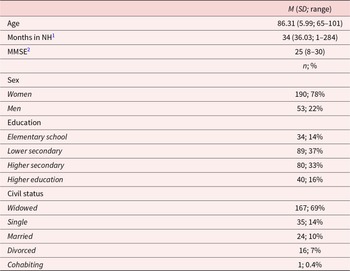
At T1, 243 out of 330 residents approached (74%) joined the study. Descriptives of these residents can be found in Table 1. At T2 (February to June 2023), 173 out of 243 residents participated again (drop-out rate of 29%). Reasons for drop-out were passing away (n = 26), refusing participation (n = 23), cognitive impairment (n = 14), having moved away (n = 3), being sick (n = 3), and being absent (n = 1). At T3 (February to June 2024), 117 residents joined a third time (drop-out rate of 32% between T2 and T3). Drop-out reasons at T3 were: passing away (n = 34), refusal (n = 8), being sick (n = 7), cognitive impairment (n = 5), or having moved away (n = 2). To achieve a sufficient sample size at T3, residents who had participated at T1 but not at T2 and were still available at T3 were re-invited; seven residents (6%) rejoined for the final wave, resulting in a total of 124 participants at T3. Participants who dropped out at any point tended to be older (M = 87.15, SD = 6.05) than those who joined all waves (M = 85.40, SD = 5.82) (t (241) = 2.294, p = 0.023), but did not significantly differ on any of the other baseline variables (education, sex, civil status, MIL, EL and depressive symptoms).
Participants’ descriptives at T1
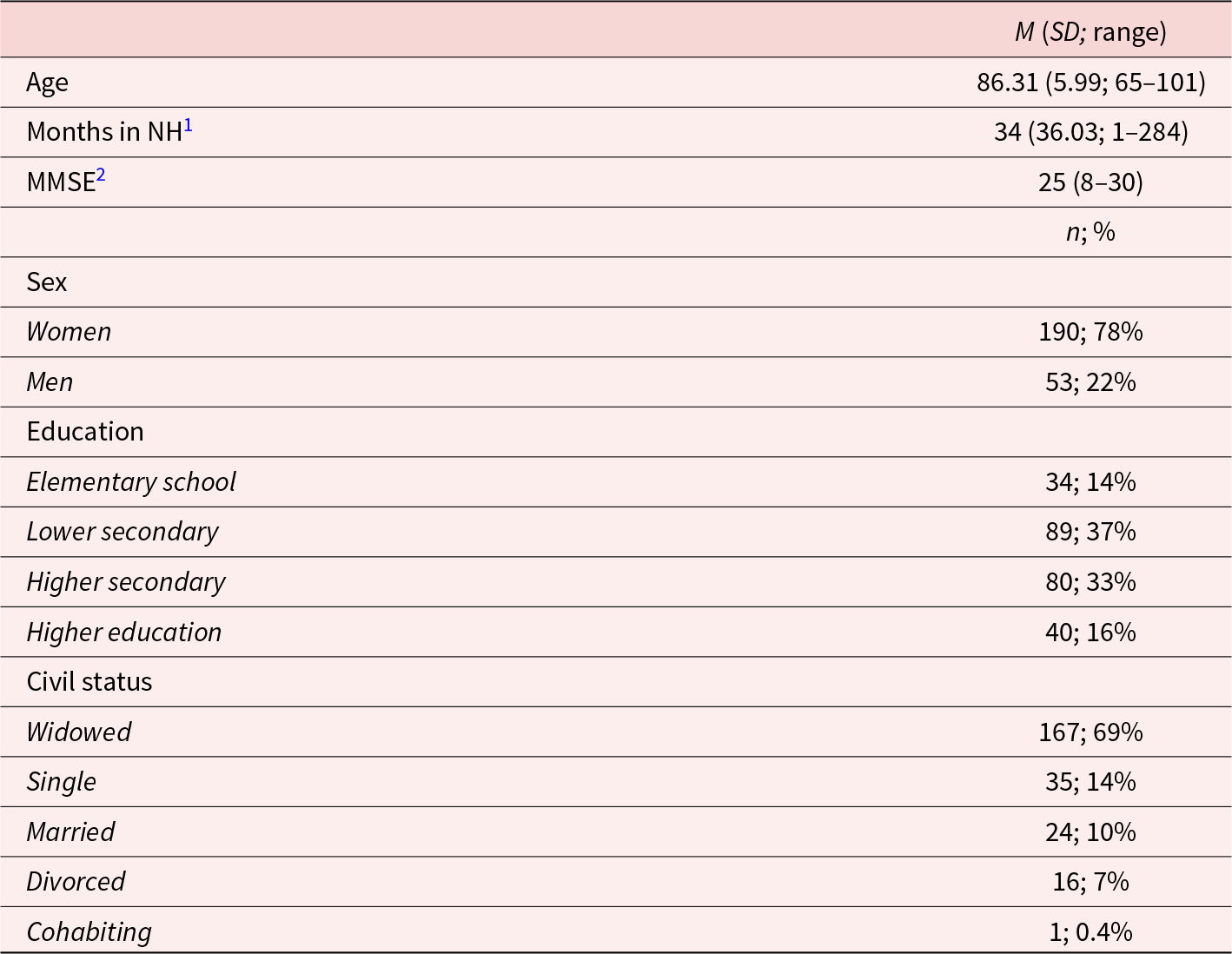
Table 1 Long description
Descriptive characteristics are reported for 243 nursing home residents, including age, length of stay, cognitive screening score, sex, education, and civil status. Average age was 86.31 years with a range from 65 to 101. Average time living in the nursing home was 34 months, ranging from 1 to 284 months. The MMSE cognitive score had a median of 25 with a range from 8 to 30. Women made up 78 percent of participants and men 22 percent. Education was most commonly lower secondary at 37 percent and higher secondary at 33 percent, followed by higher education at 16 percent and elementary school at 14 percent. Civil status was predominantly widowed at 69 percent; single was 14 percent, married 10 percent, divorced 7 percent, and cohabiting 0.4 percent. Some variables were taken from resident files and had missing values, so percentages may reflect available data rather than the full sample.
Note: n = 243, M = mean, SD = standard deviation, NH = nursing home.
1 This information was taken from the residents’ files and was missing for 16 participants.
2 This information was taken from the residents’ files and was missing for 86 participants.
Measures
All measurements retained their original response format (i.e. Likert scale options were unchanged). However, visual aids were provided for the answer options to help reduce cognitive load for participants.
Meaning in life
The Three-Dimensional Meaning in Life Scale (3DM) was used, containing 11 items that were rated on a scale from 1 (not true at all) to 7 (very true) (Martela and Steger Reference Martela and Steger2023). Items load on three subscales: coherence (e.g. Most things that happen in my life do make sense), purpose (e.g. I pursue one or more big purposes in my life) and significance (e.g. My life is full of value). Mean scores for the total scale were calculated with a higher score indicating a higher MIL level. The 3DM was chosen because it aligns with the current consensus conceptualization of MIL encompassing coherence, purpose and significance – unlike other MIL scales that do not cover all three dimensions – and has been validated in adults up to 73 years old (Martela and Steger Reference Martela and Steger2023). McDonald’s omega was 0.78 at T1, 0.85 at T2 and 0.84 at T3. The 3DM was translated into Dutch by the research team using back-translations.
Existential loneliness
The Dutch version of the Isolation subscale of the Existential Concerns Questionnaire (ECQ) was used (van Bruggen et al. Reference van Bruggen, ten Klooster, Westerhof, Vos, de Kleine, Bohlmeijer and Glas2017). Three items (e.g. I have the anxious feeling that there is a gap between me and other people) were rated on a scale from 1 (totally not) to 4 (very much). Mean scores were calculated with a higher score indicating higher EL. This ECQ Isolation subscale was chosen because it aligns with the qualitative findings of EL as an emotionally aversive experience, rather than a neutral awareness of aloneness as captured by some other EI/EL measures. It has been validated in a Dutch adult population up to 84 years old (van Bruggen et al. Reference van Bruggen, ten Klooster, Westerhof, Vos, de Kleine, Bohlmeijer and Glas2017). McDonald’s omega was 0.67 at T1, 0.65 at T2 and 0.55 at T3. This questionnaire thus showed a rather low reliability in our population. Exploratory analyses showed that removing any of the three items did not improve reliability.
Depressive symptoms
The Center for Epidemiological Studies-Depression (CES-D) 20-item version, translated into Dutch by Bouma et al. (Reference Bouma, Ranchor, Sanderman and van Sonderen2012), was used to assess depressive symptoms (Radloff Reference Radloff1977). Twenty items, rated on a scale from 0 (rarely or none of the time) to 3 (most of the time), load on four subscales: somatic-retarded activity (e.g. I felt that I could not shake off the blues even with help from my family or friends), depressed affect (e.g. I felt depressed), positive affect (e.g. I felt I was just as good as other people) and interpersonal affect (e.g. People were unfriendly). Mean scores were calculated with a higher score indicating a higher level of depressive symptoms (referred to as DepSym further on). The CES-D was selected as it has been validated in Dutch-speaking older adults living in nursing homes (Dozeman et al. Reference Dozeman, van Schaik, van Marwijk, Stek, van der Horst and Beekman2011). McDonald’s omega was 0.88 at T1, 0.79 at T2 and 0.88 at T3.
Data analysis
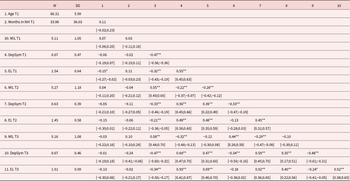
Preliminary analyses were performed in SPSS 28. For these preliminary analyses, scale scores were calculated if at least 80 per cent of the scale items were completed. First, missing scale values were explored (full output on OSF: https://osf.io/k9q3h/). Across all waves, between 4 per cent and 21 per cent of the participants had at least one missing score on the main variables (MIL, DepSym and EL). Missing values were the highest at T2 and T3 for MIL (respectively 13% and 21%) and DepSym (respectively 17% and 18%). Participants with missing MIL or DepSym scores at T2 were significantly older than those who provided a score, while those with missing MIL or DepSym scores at T3 were significantly less educated. Second, nesting effects (influence of being a resident in a particular NH on outcome variables) were assessed by calculating the intraclass correlation coefficient (ICC) for each of the outcome variables. The ICCs for MIL were 0.00 at each time point, for DepSym 0.03, 0.07 and 0.00, and for EL 0.01, 0.00 and 0.10 at respectively T1, T2 and T3, indicating that the data were not substantially nested within NHs and did not require multi-level analysis. Third, we calculated Pearson correlations and descriptive statistics for the main variables (see Table 2). For the demographics of sex, civil status and education level, independent sample t-tests and one-way ANOVAs were performed. Full output and post hoc Tukey tests can be found on OSF (https://osf.io/k9q3h/).
Means, standard deviations and bivariate Pearson correlations of main study variables at T1, T2 and T3
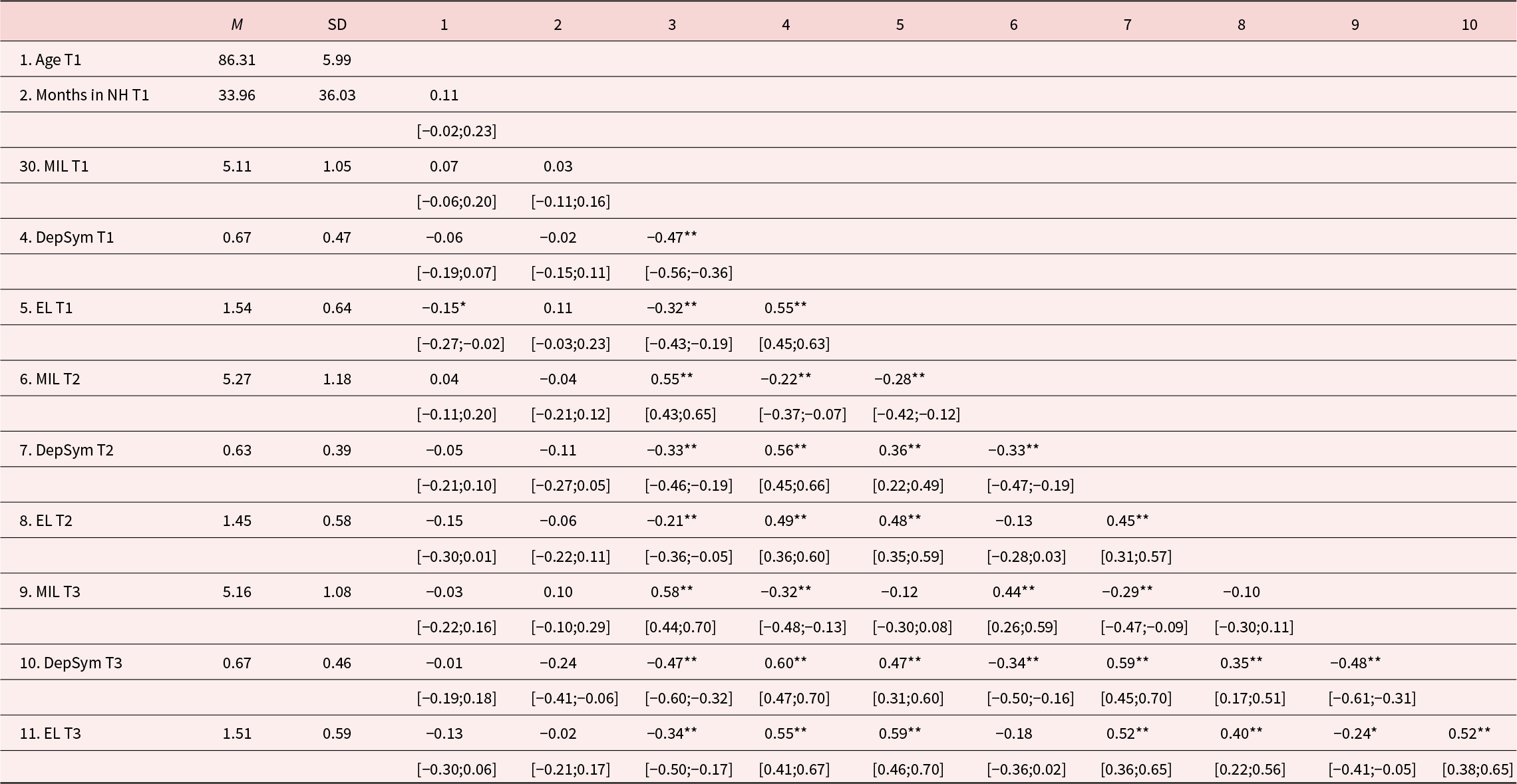
Table 2 Long description
The table reports means and standard deviations for age, months in a nursing home, and three psychosocial measures across three waves: meaning in life, depressive symptoms, and existential loneliness. Participants average about 86 years old and about 34 months in the nursing home at baseline. Depressive symptoms and existential loneliness show strong positive correlations within each wave and across waves, with values around one half to three fifths. Meaning in life is consistently negatively related to depressive symptoms, with moderate to strong negative correlations across waves, and is also negatively related to existential loneliness, generally small to moderate. Meaning in life is moderately stable over time, with positive correlations between waves in the mid four tenths to high five tenths. Age and months in the nursing home have weak or near zero correlations with the psychosocial measures, aside from a small negative link between age and baseline existential loneliness. Confidence intervals are provided for each correlation, and statistical significance is indicated, so non-significant small correlations should be interpreted cautiously.
Note: * p < 0.05, ** p < 0.01; M = mean, SD = standard deviation, MIL = meaning in life, DepSym = depressive symptoms, EL = existential loneliness. Values in square brackets represent the 95 per cent confidence intervals for the correlation.
For the primary longitudinal analysis, RI-CLPMs were performed using the lavaan package in R (4.4.2) (Rosseel Reference Rosseel2012). Full information likelihood estimation (FIML) was used to handle missing data under the assumption of data missing at random (MAR), and MLR was used to handle non-normality in the data (Rosseel Reference Rosseel2012). We first ran two baseline models, in which all paths were freely estimated over time: one without covariates and one including the demographic variables that had shown significant medium-sized association with the main variables in the preliminary analysis (i.e. sex, education level and civil status; see ‘Results’). These covariates were added as predictors of the random intercepts (Mulder and Hamaker Reference Mulder and Hamaker2021). Second, this baseline model with covariates was compared to three alternative models where either the cross-lagged paths or the stability paths, or both, were fixed. Fit of the different models was assessed using chi-square (χ2), root mean square error of approximation (RMSEA), standardized root mean square residual (SRMR) and comparative fit index (CFI) as fit indices, where χ2 should be as small as possible, RMSEA and SRMR should be smaller than 0.08 and CFI should be lager than 0.90 (Kline Reference Kline2015). Chi-square difference tests and changes in CFI and RMSEA were used to compare model fit. If the model with fixed paths did not fit significantly worse than the freely estimated model (as indicated by CFI difference < 0.010, RMSEA difference < 0.015 and a non-significant Chi-square difference test), this more restricted model was favoured for the sake of parsimony (Kline Reference Kline2015).
In addition, we ran a number of sensitivity models (full output of all sensitivity analyses on OSF: https://osf.io/k9q3h/). First, longitudinal measurement invariance was tested: for EL, acceptable measurement invariance was reached, but MIL and DepSym showed only borderline acceptable configural invariance, suggesting caution when interpreting these variables over time. Second, to evaluate the robustness of the RI-CLPM findings and to lower the sample size to parameter ratio (Kline Reference Kline2015; Raymaekers et al. Reference Raymaekers, Luyckx and Moons2020), we ran additional bivariate models with MIL and DepSym, on the one hand, and EL and DepSym, on the other hand: these models showed the same patterns of results as the main RI-CLPM models. Finally, to be able to compare our findings with previous studies that solely used CLPM, we ran classic CLPM models.
Results
Preliminary analyses
Means, standard deviations and bivariate Pearson correlations of the main variables at each time point can be found in Table 2. Age was significantly associated with only one variable – a small negative correlation with EL at T1. Length of stay in the NH was not significantly correlated with any variable. The three main variables (MIL, EL, DepSym) correlated with each other with the expected valences. Independent sample t-tests showed that women scored significantly higher than men on MIL at T1 (t(230) = −2.12, p = 0.035) and T2 (t(51) = −2.33, p = 0.012). One-way ANOVA and post hoc Tukey tests showed that residents who did higher education scored significantly higher on EL at T1 (F(3,230) = 4.81, p = 0.003) and T2 (F(3,154) = 1.03, p = 0.027) than residents who only did elementary school; divorced residents scored significantly higher on DepSym at T1 (F(3,235) = 4.06, p = 0.008) than residents with all other civil states; and divorced residents also scored significantly higher on EL at T1 (F(3,230) = 4.43, p = 0.005) and T2 (F(3,154) = 3.75, p = 0.012) than widowed residents. Based on these analyses, sex, education level and civil status of T1 were taken as control variables in the RI-CLPMs.
Primary analyses: RI-CLPM
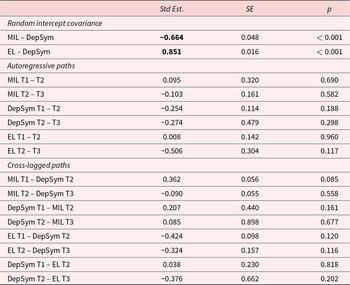
The first baseline model (Table 3), which tested the relationships between MIL, EL and DepSym without any constraints or covariates, had a good fit (χ2 (7) = 11.10, p = 0.13, CFI = 0.990, RMSEA = 0.049, SRMR = 0.041). On a between-person level, the covariance of the random intercepts of MIL and DepSym showed a significant negative relationship, and the covariance of the random intercepts of EL and DepSym showed a significant positive relationship. On a within-person level, none of the cross-lagged relationships were significant.
Baseline RI-CLPM without covariates
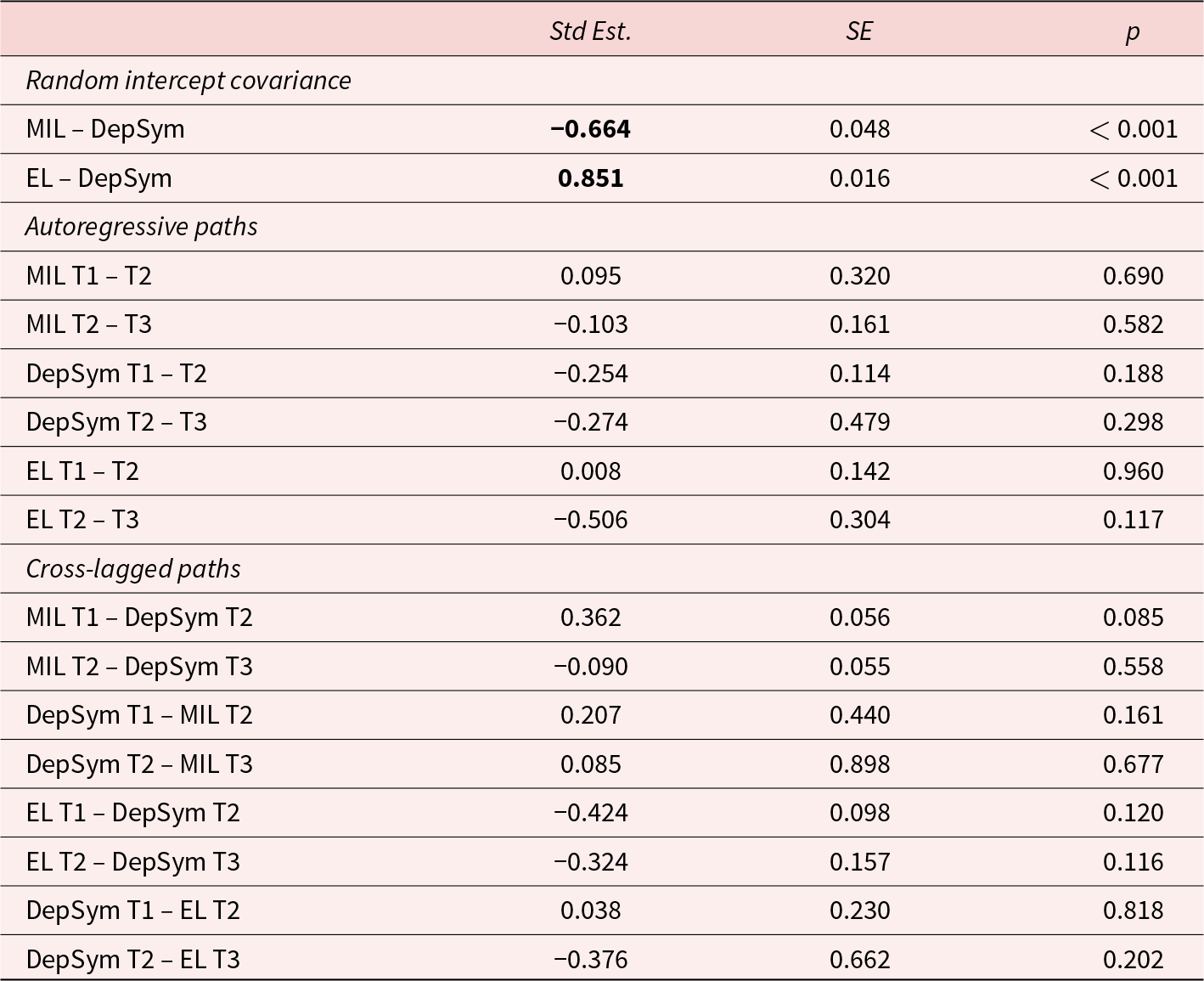
Table 3 Long description
The table reports standardized estimates, standard errors, and p values for random-intercept covariances plus autoregressive and cross-lagged paths among meaning in life, depressive symptoms, and existential loneliness across three time points. At the between-person level, depressive symptoms show a strong negative covariance with meaning in life (standardized estimate minus 0.664, p less than 0.001) and a strong positive covariance with existential loneliness (0.851, p less than 0.001). Autoregressive paths are small to moderate and not statistically significant, including meaning in life from time 1 to 2 (0.095, p 0.690) and time 2 to 3 (minus 0.103, p 0.582), depressive symptoms from time 1 to 2 (minus 0.254, p 0.188) and time 2 to 3 (minus 0.274, p 0.298), and existential loneliness from time 1 to 2 (0.008, p 0.960) and time 2 to 3 (minus 0.506, p 0.117). Cross-lagged paths are also not statistically significant; the closest is meaning in life at time 1 predicting depressive symptoms at time 2 (0.362, p 0.085). Other cross-lagged estimates are smaller in magnitude and have p values above 0.10, such as existential loneliness at time 1 predicting depressive symptoms at time 2 (minus 0.424, p 0.120) and depressive symptoms at time 2 predicting existential loneliness at time 3 (minus 0.376, p 0.202). Overall, the clearest pattern is strong between-person association of depressive symptoms with lower meaning in life and higher existential loneliness, while evidence for directional effects over time is weak in this model.
Note: n = 243, Std Est. = standardised estimate, SE = standard error, MIL = meaning in life, DepSym = depressive symptoms, EL = existential loneliness.
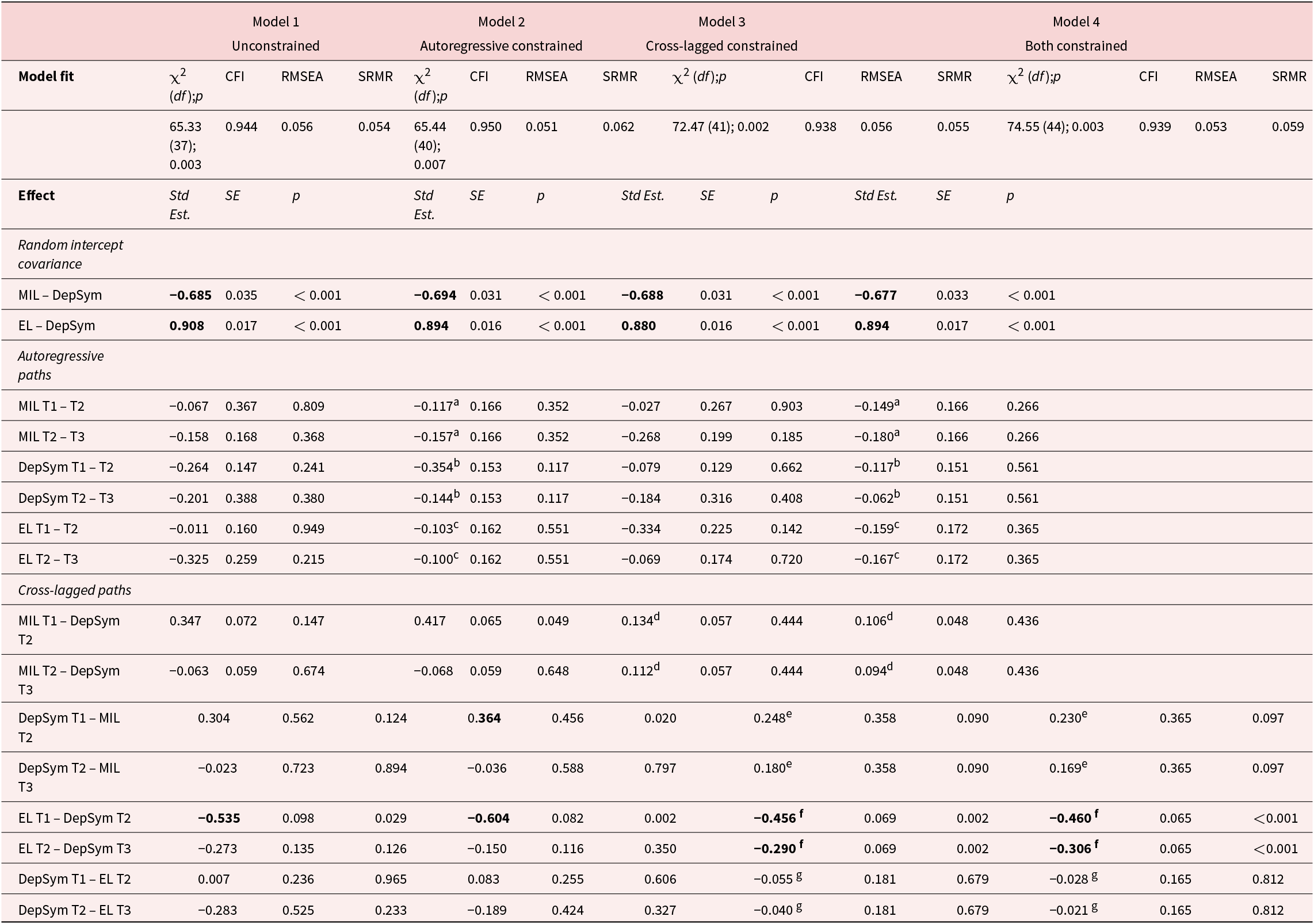
This baseline model was rerun including covariates, and compared to three other models where the autoregressive and cross-lagged paths were alternately or both fixed to be equal over time (Table 4). All models showed an equally acceptable fit, including the most parsimonious constrained model (Model 4), which is therefore regarded as the preferred model. However, for completeness, results of all four models are discussed. In all models, the between-person random intercept covariances remained consistent: MIL was negatively associated with DepSym, and EL was positively associated with DepSym. On a within-person level, however, significant cross-lagged paths differed across models and were generally of opposite valence to the between-person effects. While EL T1 had a significant negative effect on DepSym T2 in all four models, two models (including the preferred model) also showed a negative effect of EL T2 on DepSym T3, and one model showed an additional positive effect of DepSym T1 on MIL T2. These different results depending on model constraints might indicate non-robustness of these effects.
Summary of the RI-CLPM models with covariates
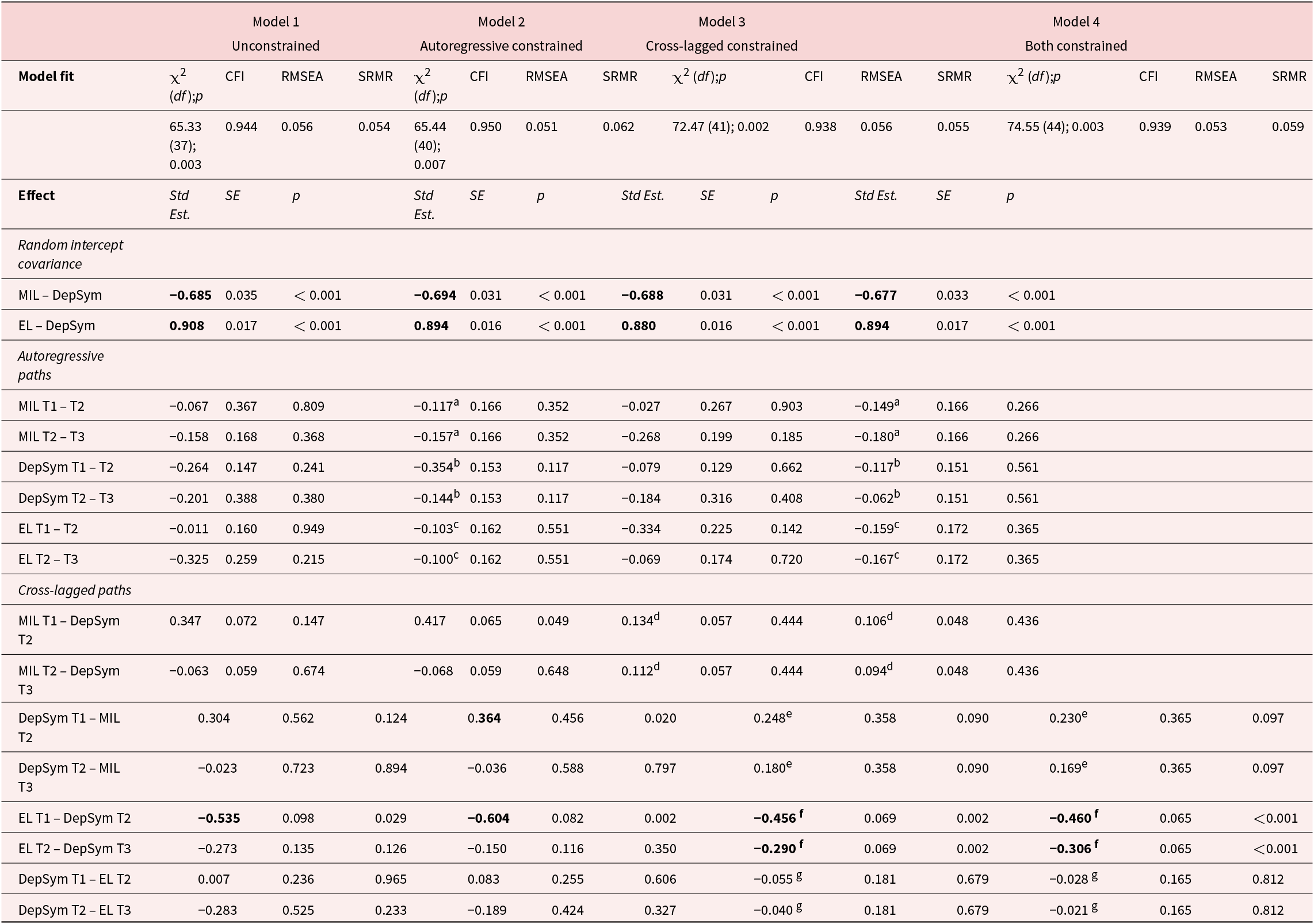
Table 4 Long description
The table compares four related longitudinal models (unconstrained, autoregressive constrained, cross-lagged constrained, and both constrained) using fit indices and standardized estimates with standard errors and p values. Model fit is similar across models: comparative fit index is about 0.94 to 0.95, root mean square error of approximation about 0.05 to 0.06, and standardized root mean square residual about 0.05 to 0.06; the chi-square tests are statistically significant in all models. The strongest and most consistent results are the random-intercept covariances: meaning in life is strongly negatively associated with depressive symptoms (about minus 0.68 to minus 0.69, p less than 0.001), and existential loneliness is strongly positively associated with depressive symptoms (about 0.88 to 0.91, p less than 0.001). Autoregressive paths for meaning in life, depressive symptoms, and existential loneliness from one wave to the next are small and not statistically significant across models. Cross-lagged paths are mixed: existential loneliness at time 1 predicts lower depressive symptoms at time 2 in all models (about minus 0.46 to minus 0.60, statistically significant), and in the constrained cross-lagged and both-constrained models existential loneliness at time 2 also predicts lower depressive symptoms at time 3 (about minus 0.29 to minus 0.31, statistically significant). In the autoregressive constrained model only, meaning in life at time 1 predicts higher depressive symptoms at time 2 (about 0.42, p about 0.05), and depressive symptoms at time 1 predicts higher meaning in life at time 2 (about 0.36, p about 0.02); these effects are not significant in the other models. Several paths are constrained to be equal over time in some models, so individual time-specific differences may be masked, and statistical significance varies by constraint choice.
Note: n = 243, estimates in bold are significant at least at the 0.05 level, estimates with the same superscript were constrained over time, Std Est. = standardised estimate, SE = standard error, CFI = comparative fit index, RMSEA = root mean square approximation, SRMR = standardised root mean square residual, MIL = meaning in life, DepSym = depressive symptoms, EL = existential loneliness.
Additional analyses: classical CLPM
In addition, we tested a classical baseline CLPM including covariates. The model fit was worse than for the RI-CLPM (χ2(28) = 110.35, p < 0.001, CFI = 0.837, RMSEA = 0.110, SRMR = 0.081). In addition to all autoregressive paths of MIL and DepSym being significant (p < 0.01), a number of significant cross-lagged paths emerged. More specifically, MIL at T1 negatively predicted DepSym at T2 (β = −0.064, p = 0.020) and MIL at T2 negatively predicted DepSym at T3 (β = −0.086, p = 0.006). Moreover, DepSym at T1 positively predicted EL at T2 (β = 0.42, p < 0.001) and DepSym at T2 positively predicted EL at T3 (β = 0.68, p < 0.001). This baseline CLPM model was compared to three models alternately constraining autoregressive and/or cross-lagged paths; however, model fit could not be improved. Nonetheless, the results of the significant autoregressive paths of MIL and DepSym, and the significant cross-lagged paths of MIL on DepSym and DepSym on EL stayed consistent across all models. Full output for all additional models can be found on OSF (https://osf.io/k9q3h/).
Discussion
This study investigated the longitudinal relationships between existential concerns – MIL and EL – and depressive symptoms in NHRs. In short, three key findings emerged: (1) our RI-CLPMs showed that on a between-person level, MIL and EL were consistently respectively negatively and positively related to depressive symptoms; (2) on a within-person level the relationships over time showed inconsistent results of opposite valence to the between-person relationships (i.e. EL negatively predicted depressive symptoms over time (in four out of five RI-CLPMs) and depressive symptoms positively predicted MIL over time (in one out of five RI-CLPMs); and (3) our CLPMs (mixing between- and within-person relationships) showed that MIL consistently negatively predicted depressive symptoms, and depressive symptoms positively predicted EL; however, these models had poorer fit.
Between-person relationships between existential concerns and depressive symptoms
On a between-person level (i.e. comparing residents to one another), our results suggest that residents who, on average across the study period, reported higher levels of MIL also tended to report fewer depressive symptoms, whereas those reporting higher levels of EL tended to report more depressive symptoms. Notably, effect sizes were consistently larger for the association between EL and depressive symptoms than for the association between MIL and depressive symptoms, suggesting that higher overall levels of EL may be particularly salient for residents’ mental health.
These findings both underscore and extend the growing attention to existential concerns in geriatric care by demonstrating their strong association with NHRs’ mental health (here in terms of depressive symptoms). This is particularly relevant given that existential concerns are often insufficiently recognized by NH staff or inadequately addressed in NH policies (van der Vaart and van Oudenaarden Reference van der Vaart and van Oudenaarden2018; Bäckersten et al. Reference Bäckersten, Molander, Benkel and Nyblom2024). At the same time, research on depression in later life continues to prioritize biomedical and psychosocial risk factors, leaving existential concerns relatively under-explored (Kloos et al. Reference Kloos, Trompetter, Bohlmeijer and Westerhof2019; Chau et al. Reference Chau, Kissane and Davison2019, Reference Chau, Kissane and Davison2021; Chyr et al. Reference Chyr, Drabo and Fabius2020).
The finding that, across time, between-person differences in MIL and EL are consistently associated with depressive symptoms suggests that it may be valuable to identify residents who persistently score higher on EL or lower on MIL, as these individuals may reflect a more enduring vulnerability to depressive symptoms and may warrant closer clinical attention. Person-oriented approaches such as latent class analysis could help identify such subgroups, though this would require larger samples than the current study.
Our data do not speak directly to the sources of these stable differences in EL and MIL, so this remains an open question for future research. Although the between-person effects may reflect relatively enduring individual characteristics, they may also be shaped or maintained by contextual factors. One important avenue may be examining whether structural features of NH environments contribute to persistently elevated existential concerns among certain residents. In this context, institutional care culture may play an important role. Nursing homes differ in how they operationalize person-centred care, particularly in the extent to which they support continuity with residents’ pre-admission lives, for example through personalized daily routines (Ettelt et al. Reference Ettelt, Williams, Damant, Perkins and Wittenberg2022). As continuity has been identified as an important source of meaning in later life (Vissers et al. Reference Vissers, Peltomäki, Duppen, Haugan, Larsson, Saarelainen and Dezutter2024), care cultures that actively foster such continuity – for instance by enabling residents to engage in familiar domestic activities (Ettelt et al. Reference Ettelt, Williams, Damant, Perkins and Wittenberg2022) – may be associated with higher overall levels of MIL and better mental health among residents.
Similarly, care dynamics may implicitly be associated with experiences of EL. For instance, drawing on Buber’s (Reference Buber1947) distinction between I-Thou and I-It relationships, Yalom (Reference Yalom1980) argued that I-thou relationships (i.e. characterized by mutuality, respect and authentic presence) may alleviate existential isolation, in contrast to more functional task-oriented I-It relationships. In the NH context, high work pressure and routinized medical care may let NH professionals slide into I-It interactions, in which residents risk being approached in a more objectifying manner. Indeed, nurse assistants have reported a tension between the need to focus on tasks and their desire and perceived need to attend to relational aspects of care (Beck et al. Reference Beck, Törnquist, Broström and Edberg2012). Moreover, Holmberg and Godskesen (Reference Holmberg and Godskesen2022) observed that interactions between NH staff and residents varied depending on the staff member, ranging from more task-oriented I-It interactions to more relational I-Thou encounters. Actively fostering and integrating I-Thou care dynamics – where residents are recognized as whole persons with their own preferences, values and autonomy (Santos et al. (Reference Santos, Costa, dos Santos and Spindola2025)) – may therefore be associated with lower overall levels of EL and better mental health among residents.
Beyond institutional culture and care practices, the importance of taking existential concerns into account also extends to the societal level. Existential concerns such as MIL and EL are not solely individual experiences but are embedded within broader social and cultural contexts. In Western societies, NHRs may be positioned as a outsider group that no longer meets dominant cultural ideals of productivity, autonomy and independence, which may contribute to experiences of EL (Längle Reference Längle2001; Helm et al. Reference Helm, Greenberg, Park and Pinel2019; van Loon et al. Reference van Loon, Janssen, Janssen, de Rooij and Luijkx2024). Societal initiatives aimed at integrating NHs into community life (Hämel Reference Hämel2016), as well as cultural recognition and support of volunteers to bridge the gap between NHs and the broader community, may therefore help counteract residents’ experiences of EL (Sundström et al. Reference Sundström, Edberg, Rämgård and Blomqvist2018). Given the strong between-person associations observed in this study between EL and depressive symptoms, examining whether such initiatives are related not only to lower overall levels of EL but also to more favourable mental health profiles among residents represents an important direction for future research.
At the same time, these considerations remain speculative, as our between-person findings reflect stable differences between individuals rather than temporal or causal processes. To understand how changes in existential concerns and depressive symptoms unfold over time within individuals, it is therefore necessary to turn to the within-person cross-lagged relationships.
Within-person relationships between existential concerns and depressive symptoms
At the within-person level (i.e. how fluctuations in one variable within each resident over time relate to changes in another variable), the RI-CLPM revealed a more complex and unexpected pattern than hypothesized: depending on the model, EL negatively predicted depressive symptoms over time and depressive symptoms positively predicted MIL over time. These results contrast with (1) previous longitudinal studies using classic CLPM, in which MIL was found to predict less depressive symptoms in NHRs over time (Fry Reference Fry2000; Dewitte et al. Reference Dewitte, Hill, Vandenbulcke and Dezutter2022), and (2) the valence of our RI-CLPM between-person relationships, where MIL was negatively and EL was positively related to depressive symptoms.
Potential explanations
Some explanations can be given for these inconsistent and unexpected within-person relationships. First, one explanation may lie in the time-lag between our measurement points. By adopting a one-year time-lag, we may have captured more trait-like, time-invariant experiences rather than state-like, time-variant fluctuations (Mulder and Hamaker Reference Mulder and Hamaker2021). It is plausible that MIL, EL and depressive symptoms may fluctuate in short time periods (such as days, weeks or months), potentially revealing different relationships in these timescales. Similarly, a one-year time-lag may fail to capture within-person dynamics in depressive symptoms, and especially in our sample of NHRs, since the average level of depressive symptoms was low. This could imply that the depressive symptoms observed were of a more transient or fluctuating nature. In line with this interpretation, prior research has shown that 80-year olds with subsyndromal depression (i.e. presence of two or more depressive symptoms) often experience some depressive symptoms as more temporary, alternating with moments of contentment and happiness (Ludvigsson et al. Reference Ludvigsson, Milberg, Marcusson and Wressle2015). Taken together, our one-year time-lag may not have caught finer temporal dynamics. Nonetheless, since our RI-CLPMs showed better fit than the CLPMs, this underscores the importance of distinguishing between- from within-person variance, even with long time-lags, despite the fact that a one-year time-lag might have been too long to detect consistent within-person relationships between our variables.
Second, it is possible – and has been shown in other research – that within-person relationships reverse valence compared to the between-person relationships, a phenomenon known as Simpson’s paradox (Dietvorst et al. Reference Dietvorst, Hiemstra, Hillegers and Keijsers2018; Mulder and Hamaker Reference Mulder and Hamaker2021). Kievit et al. (Reference Kievit, Frankenhuis, Waldorp and Borsboom2013) even argued that such reversals occur more often than expected, especially when comparing between- and within-person effects. In the present study, one explanation for EL predicting fewer depressive symptoms within individuals over time is that confronting or acknowledging EL may initiate an adaptive process. Although EL is inherently distressing, engaging with this experience rather than avoiding it may allow individuals to reposition themselves towards this existential concern, thereby gradually reducing associated distress and depressive symptoms. This can occur even though individuals who generally experience more EL also tend to have more concurrent depressive symptoms. The latter aligns with ideas of Fuchs (Reference Fuchs2013) and findings of Lloyd et al. (Reference Lloyd, af Klinteberg and DeMarinis2015) suggesting that people who are more sensitive to existential themes are also more prone to psychopathology. At the same time, client-centred psychotherapy proposes that such sensitivity can also foster resilience over time (Vanhooren Reference Vanhooren2023). Consistent with this view, Chung et al. (Reference Chung, Olofsson, Wong and Rämgård2020) reported that although older adults described EL as an emotionally aversive experience, they were not passive sufferers; instead, some described coping strategies that allowed them to reframe EL as an opportunity for reflection on their lives and sense of meaning. Indeed, EL has been characterized as a potentially transformative experience that, when adequately processed, may facilitate inner growth (Booth Reference Booth1997; Ettema et al. Reference Ettema, Derksen and Van Leeuwen2010) and, once coped with, may resemble a more positive experience of solitude in later life (Jansson et al. Reference Jansson, Karisto and Pitkälä2023). In the context of the present study, the one-year time lag may have captured such gradual transformational processes in some older adults, whereby initially distressing experiences of EL were transformed into a positive or meaningful experience and consequently associated with fewer depressive symptoms over time. Future research should explore how these potential transformational processes unfold in older adults, and which factors might contribute to it, including those specific to the NH setting. While the study of Chung et al. (Reference Chung, Olofsson, Wong and Rämgård2020) found that most older adults mainly relied on internal coping mechanisms through accepting and reframing the experience, some described more external mechanisms such as trying new things and socializing. In this vein, it could be interesting to investigate how the NH context may enable or constrain these coping mechanisms. Structural NH factors, such as opportunities for meaningful activities and self-growth, and a care culture that validates existential concerns may facilitate these processes, while limited autonomy and rigid routines may constrain them.
Nevertheless, while these theoretical and empirical perspectives may explain the opposing valence of between-person and within-person associations, it is also possible that heterogeneity in intra-individual processes underlies the observed Simpson’s paradox (Kievit et al. Reference Kievit, Frankenhuis, Waldorp and Borsboom2013). Specifically, different subgroups of NHRs may vary in how changes in EL are experienced and regulated over time, resulting in qualitatively distinct within-person dynamics that are averaged in the present analyses. Such heterogeneity cannot be fully captured by variable-centred models and invites future person-oriented research, such as growth mixture modelling, to examine whether distinct subgroups of residents exhibit differential within-person responses to existential concerns.
Or statistically spurious effects?
Beyond these interpretations, it also seems plausible that the significant within-person cross-lagged effects are spurious, as they were not robust across models with different constraints. Several factors may have impacted the robustness. First, the measurement invariance of two variables, MIL and depressive symptoms, was only borderline acceptable, potentially introducing inconsistencies in the estimated parameters (Putnick and Bornstein Reference Putnick and Bornstein2016). Second, the within-person variances of the variables – particularly depressive symptoms (ranging from 0.016 to 0.089 across time points) – were low. Limited variance reduces the reliability of within-person estimates, leading to higher standard errors and reduced statistical power (Mulder Reference Mulder2023).
Third, the within-person variance in RI-CLPM reflects someone’s temporal deviations from their expected level (Hamaker et al. Reference Hamaker, Kuiper and Grasman2015). Consequently, if a resident has a temporary increase in EL, which coincides with a temporary increase in depressive symptoms, both deviations might over time naturally return to their baseline expected score. However, looking at the within cross-lagged paths this pattern then gives the false impression that EL negatively predicts later depressive symptoms, when actually what plays is natural regression to the mean for both scores over time (Sorjonen et al. Reference Sorjonen, Nilsonne, Melin and Ingre2023). This same mechanism might underlie the observed positive within-person relationship between depressive symptoms and MIL. A key nuance to consider is that the extent to which a variable regresses to the mean depends on its within-person variance. Depressive symptoms had lower within-person variance than MIL and EL, making depressive symptoms more prone to simply regress to the mean. In contrast, MIL and EL with higher within-person variability are more likely to fluctuate in different directions over time rather than just returning to the mean. This difference in within-person variance may increase the likelihood of a spurious effect, where changes in EL and MIL appear to predict decreases in depressive symptoms, even if the primary driving mechanism for depressive symptoms is regression to the mean.
For these three reasons, the significant within-person relationships observed in some of our RI-CLPMs are potentially spurious. Replication studies that take into account the key methodological considerations revealed in the current study are needed to further clarify the complex within-person interplay of these experiences.
Mixing between- and within-person relationships
To compare our RI-CLPM findings with previous studies that solely used CLPM, we additionally conducted classic CLPMs. Although the model fit of our CLPMs was suboptimal, they consistently showed a negative effect of MIL on depressive symptoms and a positive effect of depressive symptoms on EL. These differences from our RI-CLPM results foremost show the substantial influence of the chosen modelling approach. Furthermore, comparing these results, two observations can be made.
First, while our RI-CLPM findings differ from earlier studies, our CLPM findings align more closely with previous research using CLPM. For instance, two longitudinal studies in NHRs also found MIL to predict fewer depressive symptoms (Fry Reference Fry2000; Dewitte et al. Reference Dewitte, Hill, Vandenbulcke and Dezutter2022), while two others reported a bi-directional effect (Gudmundsdottir et al. Reference Gudmundsdottir, Pfund, Hill and Olaru2024; Weziak-Bialowolska and Bialowolski Reference Weziak-Bialowolska and Bialowolski2024). Additionally, our result of depressive symptoms predicting more EL aligns with the only existing longitudinal study on this relationship in a student population (Helm Reference Helm2019).
Second, to date only two studies have used RI-CLPM to examine longitudinal relationships between existential concerns and depressive symptoms. Etherson et al. (Reference Etherson, Smith, Hill and Flett2022) examined depressive symptoms and mattering (considered a subcomponent of MIL), while Gudmundsdottir et al. (Reference Gudmundsdottir, Pfund, Hill and Olaru2024) investigated depressive symptoms and purpose (considered a subcomponent of MIL). Both studies reached similar conclusions when comparing their RI-CLPM and CLPM results: while RI-CLPM indicated no significant cross-lagged relationships, CLPM indicated multiple significant cross-lagged relationships. Together with the present findings, this pattern underscores the importance of extending longitudinal CLPM research by incorporating RI-CLPM approaches that explicitly disentangle between-person from within-person effects.
This distinction has important clinical implications. Our between-person findings suggest the existence of a vulnerable subgroup of residents characterized by persistently elevated existential concerns and depressive symptoms, warranting clinical attention. However, understanding how existential struggles and depressive symptoms fluctuate within a resident is crucial for intervention strategies. If one experience (e.g. existential concerns) influences another experience (e.g. depressive symptoms) within a resident over time, targeted interventions could be designed accordingly. Yet, current research has not yet provided conclusive answers to these within-person dynamics. As noted previously, a valuable next step may be the application of person-oriented approaches to examine whether distinct subgroups of residents exist at both the between- and the within-person level. Should such subgroups be identified, intervention studies tailored to the specific needs and dynamics of these groups could be developed and evaluated accordingly.
Limitations
Our study investigated an important yet understudied topic in NHRs using novel statistical analyses. However, our study also has important limitations.
First, as mentioned earlier, our results are likely affected by statistical limitations. For instance, our CLPMs showed suboptimal fits, meaning that caution when interpreting these results is necessary. Moreover, (RI-)CLPMs are most reliable with large sample sizes (at least n > 200) (Kline Reference Kline2015). While our sample size could be considered sufficient, RI-CLPM is a complex model in which a substantial number of parameters needs to be estimated. Hence, our sample size to parameter ratio is on the lower side (ratio of 3.12 to 5.21, depending on the model) (Kline Reference Kline2015; Raymaekers et al. Reference Raymaekers, Luyckx and Moons2020). However, achieving larger sample sizes for longitudinal multiple wave studies in an NH population remains challenging, since this is a hard-to-reach population and the drop-out rate is inevitably large.
Second, related to the previous point, our sample can be considered a convenience sample, in which selection bias may play on the level of both the NHs and the NHRs. Although different NHs were contacted (both private and public NHs), not all agreed to participate. As a result, NHs that already invested in the (existential) wellbeing of their residents may have been more likely to join. Similarly, not all NHRs who were approached chose to participate. This could mean that residents who were struggling most with MIL, EL and depressive symptoms may have been least inclined to participate, which is potentially visible in the relatively low mean scores for EL and depressive symptoms and the relatively high MIL score we observed. Future research could explore whether refusal to participate is linked to greater levels of distress; however, in the present study we chose not to collect detailed refusal reasons to avoid making older adults feel obliged to justify their decision. Moreover, our findings are specific to the NH context, which represents only one form of later-life housing. Other arrangements, such as assisted living facilities, home care or co-housing, differ in terms of autonomy, social integration and care intensity (e.g. Peace et al. Reference Peace, Holland and Kellaher2011; Izuhara et al. Reference Izuhara, West, Hudson, Felstead, Fernández Arrigoitia and Scanlon2025) which may influence the experience and role of existential concerns. Future research could explore whether the patterns observed here generalize to these alternative settings. Additionally, residents with a formal dementia diagnosis were excluded from this study. We acknowledge that residents with mild to moderate dementia may still be able to articulate existential concerns (particularly when using adapted measurement tools), and their inclusion would have provided a more comprehensive picture of the NH population. Nevertheless, Mini-Mental State Examination (MMSE) scores retrieved from residents’ files (see Table 1) suggest that some included participants may have had severe cognitive impairment (Salis et al. Reference Salis, Costaggiu and Mandas2023). The reliability of these recorded MMSE scores is unknown, and, although interviewers were trained to be sensitive for cognitive difficulties, some participants may still have struggled to accurately respond to the questionnaires.
Third, our results are also influenced by measurement limitations. Our used measurement scales showed low reliability of EL and we have suboptimal longitudinal measurement invariance of MIL and depressive symptoms. Several factors may explain this, including the scales themselves, our study population and the timing of the data collection. For instance, to our knowledge, the 3DM MIL scale and the ECQ EL subscale have not been validated for NHRs, reflecting the relatively recent research focus on existential concerns in this population and the scarcity of tailored instruments (van Bruggen et al. Reference van Bruggen, ten Klooster, Westerhof, Vos, de Kleine, Bohlmeijer and Glas2017; Martela and Steger Reference Martela and Steger2023). Although these scales were carefully selected based on current consensus conceptualizations of MIL and EL and have been validated in older adult samples (see ‘Measures’), it remains possible that they do not function optimally in very old populations such as ours. Future research should therefore prioritize the development and validation of measurement tools that are specifically designed for, and tested within, NH populations.
The timing of our study may have further contributed to the issues. During the first data collection wave, Covid-19 continued to significantly impact daily life, particularly in NH settings. Some NHs were still temporarily in lockdown, and some residents were interviewed immediately after being in isolation, which may have led to different interpretations of some questionnaire items compared to Waves 2 and 3 when the impact of Covid was reduced, and none of the participating NHs were in lockdown anymore. Additionally, shortly after the commencement of the first wave, the war in Ukraine began, which was a major concern for some of the interviewed residents given their experience with WWII. Especially questions of the 3DM MIL scale (e.g. ‘By and large, I am able to understand the world around me’ and ‘Most things happening in my life do make sense’) were interpreted by a substantial portion of our participants in the context of the war. In line with Heidegger’s (Reference Heidegger1927) being-in-the-world, human existence is always embedded within a broader life context. The observations regarding scale interpretation in our study illustrate how existential experiences inevitably unfold in relation to surrounding life contexts, including societal events. For future research on existential concerns among NHRs, this underscores the importance of contextualizing findings within broader societal and real-world dynamics, while also explicitly incorporating relevant sociological and structural variables, such as social isolation, engagement in meaningful activities, NH type and institutional policies. Particularly in quantitative research on existential concerns, future studies may benefit from integrating such contextual indicators alongside qualitative accounts that allow participants to situate their experiences in relation to their lived worlds.
Extending this contextual perspective, our observations also point to the relevance of a lifecourse approach, as advocated by Tiilikainen and Seppanen (Reference Tiilikainen and Seppänen2017) and Naughton-Doe et al. (Reference Naughton-Doe, Barke, Manchester, Willis and Wigfield2022). The fact that participants drew on their experiences of WWII when interpreting present MIL items suggests that existential concerns in later life are not only shaped by current circumstances but also informed by earlier life events that continue to resonate over time. Adopting a lifecourse perspective may therefore provide important insight into how such earlier-life experiences accumulate and shape existential concerns in later life. However, this perspective could not be fully explored in the present study as no data were collected on earlier life events and experiences.
Conclusion
This study investigated the longitudinal relationships between MIL, EL and depressive symptoms across three yearly time points in a population of NHRs using RI-CLPM. Comparing different residents, those who reported higher MIL and lower EL tended to have fewer depressive symptoms. However, when looking at changes within residents over time, the patterns were less clear and unexpected. Depending on the RI-CLPM model, residents’ temporary increases in EL were sometimes linked to later decreases in depressive symptoms, while temporary increases in depressive symptoms were linked to later increases in MIL. This contrasts sharply with findings using classic CLPM, emphasizing the importance of adequately distinguishing between- from within-person variance, while also inviting reconsideration of some conclusions drawn in previous studies. Taking important statistical limitations into account, our study shows the relevance and complex entanglement of existential concerns and depressive symptoms in NHRs. The between-person findings suggest the existence of a vulnerable subgroup of residents with persistently elevated existential concerns and concurrent depressive symptoms, warranting clinical attention. However, it remains uncertain whether changes in existential concerns will consistently translate into reductions in depressive symptoms within individuals over time. We hope that this study encourages further research into existential wellbeing in NHRs, ultimately contributing to more nuanced understanding of both trait-like vulnerabilities and within-person dynamic processes that can inform future intervention development.
Supplementary material
The supplementary material for this article can be found at https://doi.org/10.1017/S0144686X26100853
Acknowledgements
We want to thank the participating residential care settings and residents. We thank all master’s thesis students and interns for their help with the data collection.
Author contributions
Julie Vissers: conceptualization, data collection, data analysis and writing – original draft; Jessie Dezutter: project administration, conceptualization, writing – review and editing, supervision; Ingela Beck and Siebrecht Vanhooren: writing – review and editing; Laura Dewitte: data analysis, writing – review and editing, supervision. All authors approved the final version of the article.
Financial support
This study was funded by the Research Foundation Flanders (FWO; grant number: G0B4921N). The funding source had no involvement in any phase of the data-collection and article writing.
Competing interests
The authors declared no competing interests with respect to the research, authorship and/or publication of this article.
Ethical standards
This study received approval from the ethical committee of KU Leuven (Sociaal-Maatschappelijk Ethische Commissie – SMEC) with approval number ID G-2020-1832. Participants agreed to participate by giving their written informed consent. Informed consent for publication was also provided by the participants. This study is pre-registered on the Open Science Framework (https://osf.io/k9q3h/). The data of this study are available from the corresponding author upon reasonable request, but will not be made publicly available given the sensitive nature. Supplementary material is also provided on the Open Science Framework (https://osf.io/k9q3h/).