The 2010 self-immolation of Tunisian vendor Mohammed Bouazizi triggered a dramatic series of citizen uprisings across the Arab World. Beyond Tunisia, rulers in Egypt, Libya and Yemen fell before this wave of protest, while others in Syria and Bahrain were shaken but ultimately beat back the tide of mobilization (Brownlee et al. Reference Brownlee, Masoud and Reynolds2015). At the height of these protests, some even speculated that dissent would diffuse across the Mediterranean and that the ‘Arab Spring’ would give way to a ‘European Summer’ (Nadeau and Elkin Reference Nadeau and Elkin2011). As renewed protests broke out in Algeria and Sudan in 2019, some commentators mused that a ‘second Arab Spring was brewing’ (England Reference England2019).
To explain the dramatic emergence and rapid spread of these types of protest waves, authors drew from a considerable larger literature on ‘diffusion’, the process by which mobilization, ideologies, public policies or conflict travel across space (Beissinger Reference Beissinger2007; Brinks and Coppedge Reference Brinks and Coppedge2006; Gleditsch Reference Gleditsch2009; Simmons and Elkins Reference Simmons and Elkins2004; Simmons et al. Reference Simmons, Dobbin and Garrett2006; Weyland Reference Weyland2009; see also Brancati and Lucardi Reference Brancati and Lucardi2019 for a dissenting view). In the particular case of the Arab Spring, a prominent literature traces out how citizens interpreted protest events and their outcomes in ostensibly similar neighbouring countries, and then used those perceptions to make judgements about the likely outcomes of mobilization in their own countries (Breuer et al. Reference Breuer, Landman and Farquhar2015; Darwich Reference Darwich2017; Gleditsch and Rivera Reference Gleditsch and Rivera2017; Hajj et al. Reference Hajj, McEwan and Turkington2019; Howard and Hussain Reference Howard and Hussain2013; Koesel and Bunce Reference Koesel and Bunce2013; Lotan et al. Reference Lotan, Graeff, Ananny, Gaffney and Pearce2011; Rane and Salem Reference Rane and Salem2012; Saideman Reference Saideman2012; Weyland Reference Weyland2012). A common thread in these explanations is an emphasis on how viewing the effects of protests elsewhere filtered through individual cognitive processes, including evaluation of risk and the assessment of likely outcomes. As Marc Lynch summarized in his book on the Arab Spring, ‘external events shaped expectations about the prospects of success or failure’ (Lynch Reference Lynch2016: 47).
Despite these prominent arguments for the rapid spread of protest during the Arab Spring, there has been relatively less empirical investigation of the individual-level cognitive and psychological dynamics theorized to drive diffusion. In this article we examine in an experimental setting whether exposure to information about protests and their outcomes in nearby, ostensibly similar countries changes the way that citizens evaluate the usefulness of protests in their own countries, and if so, how? Our major contribution therefore is adding, at the individual level, ‘more data’ that Valerie Bunce and Sharon Wolchik (Reference Bunce and Wolchik2019) called for in order to better understand if and how diffusion occurs.
We evaluate these arguments through a series of original laboratory experiments with Egyptian university students, which allows us to evaluate the causal effect of exposure to information about nearby and relevant protests on protest-related outcomes. In April and May of 2017, we surveyed 345 Egyptian students and randomly split them into three groups. While one group received a null control, the other two groups were presented with visual and textual primes capturing dramatically different Arab Spring outcomes: protest and incumbent ouster in Tunisia, or protest and intense repression in Syria. Across a series of outcome measures, including the perception of Egypt's domestic situation relative to its neighbours, retrospective appraisals of the Arab Spring, and disaggregated measures of the perceived utility of protest to achieve meaningful change, little evidence of a diffusion effect appears. A computer game designed to assess willingness to assume risk – a key behavioural implication of many psychology-based diffusion-based models – likewise shows little consistent effect. The onset of protests in Sudan in late 2018 offered a chance to further examine the role of diffusion, in part by disaggregating protest outcomes from the process of protesting itself. Yet repeating the priming experiment for the Sudan, with a new sample of college students just as those protests were underway, yielded effectively similar results.
On the face of it, of course, these results should not invalidate the diffusion literature, although – particularly in the Egyptian context – they do support calls to re-examine domestic, rather than international, motivations for protest (Brancati and Lucardi Reference Brancati and Lucardi2019). Our reliance on a student sample from only one public university also means that our findings may not be generalizable. It is also possible that our experiment was imperfectly crafted. While additional analysis does not suggest these factors to be fully responsible for the limited results, future experimental work on diffusion will benefit from reviewing our design and, where possible, improving on it.
The article proceeds as follows. The next section draws on the theorized diffusion of mobilization and demobilization in order to isolate three specific hypotheses, and one subset of the population, for testing. The following sections describe the survey and the experimental manipulation. We then discuss the main results before turning to a behavioural extension based around a computer game designed to measure how willing players are to assume risk. A conclusion highlights weaknesses and potential extensions of the study, and suggests how these findings might inform the broader literatures on protest and diffusion.
The diffusion of mobilization and quiescence
Beginning in late 2010, large-scale citizen mobilizations broke out in nearly every country in the Middle East. In Tunisia, Egypt and Libya, demonstrators managed to eject long-time rulers. In Syria, Bahrain and Yemen, vigorous protest movements butted against entrenched autocracies, leading to stalemate, insurgency and civil war. In still a third category of cases – such as Jordan, Morocco and Saudi Arabia – rulers combined repression with prophylactic reforms to dissuade challenges (Brownlee et al. Reference Brownlee, Masoud and Reynolds2015; Lynch Reference Lynch2016). But as this initial wave gave way to violence, economic collapse and state fracture alongside fragile democratic transitions, some citizens responded by supporting strongmen who promised stability over political openness (Hassan et al. Reference Hassan, Kendall and Whitefield2018; Ketchley Reference Ketchley2017; Stacher Reference Stacher2015). To what extent did the rapid spread of protests follow the logic of diffusion, as citizens in one place learned from the ability of their neighbours to trigger democratization? Did the subsequent inability of protests to dislodge incumbents while spurring harsh repression also induce citizens to take a more guarded attitude towards mobilization? Or did it backfire and convince them that disruptive approaches were still required? Below, we sort this literature into three theoretical clusters that provide discrete hypotheses which explain how protest and quiescence diffuse.
Incumbent ouster as a mobilizer
Although often focused on a single country, sociologists have long understood that protest waves follow a logic of ‘positive feedback’, whereby people are more likely to mobilize in the wake of a previous successful protest (Biggs Reference Biggs2003; see also Andrews and Biggs Reference Andrews and Biggs2006; Barrie and Ketchley Reference Barrie and Ketchley2018; Biggs and Andrews Reference Biggs and Andrews2015). Early analyses of the Arab Spring mirrored this focus. ‘Arab citizens watched and learned from the experiences of their neighbours’, Steven Heydemann and Reinoud Leenders (Reference Heydemann and Leenders2011: 648) recorded, ‘facilitating the spread of uprisings from one country to another.’ ‘There is strong evidence for the power of momentum and regional diffusion in the heady initial days of 2011,’ Marc Lynch observed. ‘The simultaneous outbreak of protests in multiple countries, regardless of antecedent conditions, simply makes no sense otherwise’ (Lynch Reference Lynch2016: 125). In the wake of the Arab Spring, two scholars of democratization concluded that ‘international influences figure prominently in the cross-national spread of democratic change – a dynamic that obviously constitutes one of the biggest threats to the tenure of authoritarian rulers’ (Koesel and Bunce Reference Koesel and Bunce2013: 753). Kurt Weyland (Reference Weyland2012: 920) theorizes the micro-level processes that drive diffusion, arguing that early examples of protest successfully dislodging incumbents, namely in Tunisia, caused citizens of other Arab countries to rush headlong into revolutionary protest, disregarding the ‘prudence and caution’ that a more rational approach to anti-authoritarian activism would have predicted. We distil arguments about the ‘success’ of protest – which we define as dislodging an autocrat and triggering the possibility of democratization – as follows:
Hypothesis 1: Citizens exposed to information about successes of protest mobilization in the region will have a more positive attitude towards protests than citizens who are not exposed to such information.
Incumbent resilience as a demobilizer
The subsequent outbreak of civil war and retrenchment of authoritarian regimes prompted scholars to examine why protests no longer broke out or, if they did, why autocrats were able to gain the upper hand (Koesel and Bunce Reference Koesel and Bunce2013; Weyland Reference Weyland2016). At the individual level, scholars of decision-making have identified both status quo biases and a tendency to overvalue the prevention of loss over the possibility of gain (Kahneman and Tversky Reference Kahneman, Tversky, MacLean and Ziemba2013; Samuelson and Zeckhauser Reference Samuelson and Zeckhauser1988). These predispositions can potentially be heightened in situations of real or potential conflict, as feelings of insecurity have been experimentally demonstrated to boost support for policies that trade freedom for security (Albertson and Gadarian Reference Albertson and Gadarian2015; Davis and Silver Reference Davis and Silver2004; Huddy et al. Reference Huddy, Feldman, Taber and Lahav2005; Merolla and Zechmeister Reference Merolla and Zechmeister2009). While these reactions may be triggered in situations of general instability, we expect them to be particularly potent when protestors mobilize but fail to dislodge the incumbent, triggering not regime democratization but extensive societal repression. Adam Meirowitz and Joshua Tucker (Reference Meirowitz and Tucker2013: 480) formally model a similar process, showing that when citizens receive information that a likely replacement leader would not constitute an improvement over the current state of affairs, they will be dissuaded from taking to the streets: ‘when citizens face not just uncertainty about the quality of any particular leader, but about the average level of quality of all potential leaders as well [demobilization] is likely to emerge’. Indeed, case-specific literature lead us to expect that enthusiasm for protest mobilization has waned amid perceptions of the failure of the Arab Spring both in one's own country as well as elsewhere (Dunne Reference Dunne2020; Hassan et al. Reference Hassan, Kendall and Whitefield2018; Ketchley and El-Reyyes Reference Ketchley and El-Rayyes2021; Truex and Tavana Reference Truex and Tavana2019). It thus seems intuitive that, for many citizens, the possibility of violence and instability – made manifest in cases where protest has tried but ‘failed’ to dislodge an incumbent – can prompt ‘genuine’ support for non-democratic rule (Matovski Reference Matovski2018; Pepinsky Reference Pepinsky2017). We can reformulate these expectations as follows:
Hypothesis 2: Citizens exposed to information about failures of protest mobilization will have a more negative attitude towards protests than citizens who are not exposed to such information.
Moral outrage as mobilizer
A final dimension affecting the calculus of protests is the cost and benefit of the act of protesting itself, independent of the expectation of success or failure of the protests. Under some conditions, protest failure may also make citizens more likely to protest in the future. Scholars of mobilization have long theorized the cyclical nature of repression and protest, tied in particular to emotions such as anger and despair (Carey Reference Carey2006; Opp and Roehl Reference Opp and Roehl1990; Siegel Reference Siegel2011; Tarrow Reference Tarrow2011). In one common interpretation, regime violence begets future mobilization by triggering a response from the families and friends of those arrested, wounded or killed (Rasler Reference Rasler1996).
Puzzlingly, fear might increase the tendency towards protest participation because it may create a ‘nothing-to-lose’ feeling (Aldama et al. Reference Aldama, Vásquez-Cortés and Young2019). In her study of Moroccan protestors, Adria Lawrence (Reference Lawrence2017) finds that information about regime repression following protest diffuses through the social networks of activists, and in the process produces support for new mobilizations. Ronald Francisco (Reference Francisco2004: 108) tells us that exposure to information about a massacre increases the likelihood of a backlash, so much so that mobilization following a violent setback sometimes ‘dwarfs the original-event mobilization’. Researchers have also highlighted cross-country diffusion effects by focusing on feelings of anger, indignation and outrage (Hess and Martin Reference Hess and Martin2006; Jasper and Poulsen Reference Jasper and Poulsen1995). In her study of emotions and the Arab Spring, Wendy Pearlman (Reference Pearlman2013) found that anger (in combination with joy and pride) sometimes promoted optimistic assessments, higher tolerance for sustained risky behaviour, and feelings of personal efficacy. The arguments about the repression that follows failed attempts to dislodge autocrats inform our final hypothesis:
Hypothesis 3: Citizens exposed to information about failures of protest mobilization in the region will have a more positive attitude towards protests than citizens who are not exposed to such information.
The remainder of this article describes our attempt to test these hypotheses through a laboratory experiment embedded in an original sample of Egyptian college students. After discussing the study design and methodology, we present results across attitudinal and behavioural measures.
Study design and methodology
Egypt provides a relevant case study for diffusion during and after the Arab Spring. Indeed, Egyptian protestors mobilized less than two weeks after Ben Ali's ouster. What is more notable is that the more likely internal spark for anti-regime protests seemed to have passed tranquilly at the time: November 2010, when the then legislative elections produced a parliament where opposition representation was downgraded from a 20% seat share to less than 0.5%. Despite reports of widespread vote fraud in that election, the response of opposition and social forces seemed minuscule to say the least, taking the form of just one protest in which fewer than 100 people took part and the announcement of a ‘parallel parliament’ to hold the formal parliament to account. However, following Ben Ali's ouster, the Egyptian government's discourse shifted to emphasize repeatedly that ‘Egypt is different from Tunisia’, indicating fear of diffusion – a discursive tactic copied later by Bashar al-Assad's Syria, Gaddafi's Libya and several other countries in 2011.
Egypt also suggests how acquiescence may diffuse. In 2013 ‘avoid Syria and Iraq’ became an almost formal government motto, warning Egyptians that another round of protests might throw the country into civil war and state collapse (especially potent when ISIS controlled extensive territory in 2014–16). The Egyptian government demonstrated heightened anxiety whenever protests erupted in Algeria, Sudan and Lebanon in 2019, and even in response to the French gilets jaunes movement in 2018.
Methodologically, we adopt an experimental approach. While it has specific drawbacks (some of which we discuss below), experimentation offers an appropriate opportunity to further understand how the diffusion mechanism functions at the individual level. On the one hand, diffusion-specific mechanisms have generally not been examined attitudinally – despite the fact that they are often explicitly conceptualized at the micro-foundational level (Lawrence's study (Reference Lawrence2017) is an exception; see also Wouters and Walgrave Reference Wouters and Walgrave2017). Weyland, for example, posits that receiving and processing information ‘can prompt quick updates of cost/benefit calculations’ (Reference Weyland2012: 920). On the other hand, studies in American politics on the relationship linking threat, anxiety and support for undemocratic policies all make extensive use of experimental manipulation, but do not neatly test the mechanism proposed by the diffusion hypothesis: that individuals make inferences about the likely consequences of their own actions by referencing superficially comparable cases elsewhere.
Building on the literature's implication that the interaction between external stimuli and individual heuristics drives diffusion, we carried out a laboratory experiment in late April and early May of 2017 among a sample of 345 college students at a large public university in Egypt. The experiment was repeated with 336 new university students on the same campus in the spring of 2019, as protests in the Sudan were dominating the news cycle, with a single prime based on those ongoing protests. The decision to add the second experiment was based on two factors. The first was the inconclusive results of the first experiment. The second was the opportunity to investigate whether separating the act of protest from ‘success’ or ‘failure’ produced effects – it was unclear at the time of the experiment whether Sudanese president Bashir would leave or remain. This is valuable because it highlights the cost of being a protestor, independent of whether or not the protest movement achieves its aims.Footnote 1
We selected a student, laboratory-based sample for three reasons. First, the laboratory format allowed us to capture more easily a behavioural as well as an attitudinal outcome: in this case, a simple computer-based game with monetary rewards designed to assess willingness to assume risk (Holbrook Reference Holbrook, Druckman and Kuklinski2011; Iyengar Reference Iyengar, Druckman and Kuklinski2011). Second, face-to-face population surveys are difficult in Egypt, especially given this study's focus on protest. Third, because we are interested in attitudes towards protest, Egyptian students are particularly relevant given the prominence of their roles in the history of Egyptian student mobilization (Kepel Reference Kepel2003; Ketchley and Biggs Reference Ketchley and Biggs2017; Thyen and Gerschewski Reference Thyen and Gerschewski2018). Of course, this choice also limits external validity: even in Egypt's Arab Spring protestors belonged to many different age groups and social classes (Murphy Reference Murphy2012).
What does the student sample mean for our hypotheses more specifically? On the one hand, a sample that is assumedly more protest-prone than average renders this a ‘most likely’ case for H1 and H3 because those predisposed to protest would, it is assumed, be most likely to respond to protest-encouraging primes. On the other, this population subset is probably a ‘least likely’ case for H2 – those predisposed to protest would, it is assumed, be harder to nudge towards quiescence with a protest-dampening prime than the general population.
To provoke and capture the attitudinal effects of exposure to cases of mobilization elsewhere, we borrow experimental designs developed in American politics. Paul Sniderman and Thomas Piazza (Reference Sniderman and Piazza1993) sought a simple and unobtrusive way to stimulate and measure attitudes that might otherwise remain latent – what is often called a ‘mere mention’ design. As this suggests, information is introduced to a random subset of the sample in order strategically to stimulate the hypothesized causal process. Our goal is to make broadly known outcomes of protest outside Egypt salient in order to examine whether or not this influences the students’ own attitudes on the subject. We do not assume we are providing ‘new’ information; we expect that most of our sample is already fairly knowledgeable about recent major developments in nearby states. Instead, we assume that priming these events will stimulate their underlying attitudes which, in turn, will influence the way they answer downstream questions.
This ‘mere mention’ design necessarily simplifies a complex process by which individuals consume and process information. However, this method does have the benefit of unobtrusively but systematically tracing the individual-level informational mechanism motivating many diffusion-style arguments. Especially given the growing but unsettled literature on diffusion, and the relative lack of experimental investigations into its hypothesized micro-level processes, this constitutes an important albeit exploratory step forward in the empirical study of the Arab Spring as well as in the theoretical investigation of how contention and quiescence diffuse among populations.
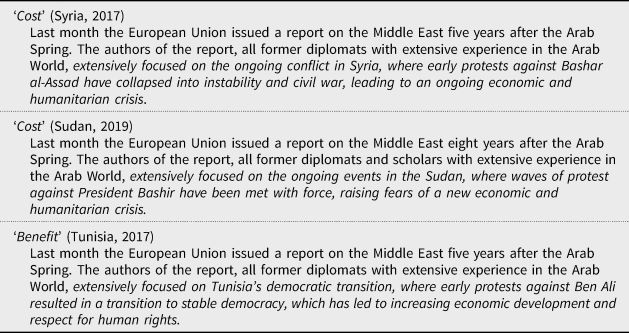
As noted, we conducted two separate iterations of this experiment, one in the spring of 2017, the second in the spring of 2019.Footnote 2 We randomly divided the 2017 student sample into three subgroups for the first session. One, the control (n = 121) received no informational prime. A second group (n = 117) received the ‘benefit’ treatment: a short vignette about protest, incumbent ouster and resulting democratization in Tunisia. A third group (n = 119) received the ‘cost’ treatment: a similar short vignette about anti-regime protests, regime resilience and repression in Syria. To ensure confidence in the primes, we chose to make them take the form of an assessment by a European Union report. Our expectation was that citing Arab sources would have tapped into different views by Egyptians regarding any such source – be it a news agency, a country or an organization – and could have probably contaminated results. On the other hand, according to a 2019 survey, 55% of Egyptians have a positive view of the European Union with only 12% having very or fairly negative views.Footnote 3
We repeated the experiment with a new student sample in March 2019, when the protests against Sudanese leader Omar al-Bashir were steadily growing, but were also being repressed with increasing intensity (but still before Bashir's removal on 11 April). We propose that this is valuable because, unlike the Tunisia and Syria primes, the ultimate result of the protest mobilization – in other words whether it would result in Bashir's ouster or not – was at the time of the experiment unclear. In this session, one group, the control (n = 168) received no informational prime. A second group (n = 168) received an updated version of the ‘cost’ treatment. To briefly restate our intuition, this treatment potentially allows us to identify if and how the act of protest itself, separate from its outcomes, shifts participants either towards revolutionary contention or away from it. The vignette treatments are listed in Table 1.
Vignette Treatments

Note: Italics are used here to highlight the text that is different in the different treatments.
Our dependent variables relate to respondents’ assessments of the costs and benefits of protest in their own country. The first three dependent variable questions focus on perceptions of Egypt's relative ranking among other Arab countries, a retrospective appraisal of the Arab Spring, and an assessment of protest's benefits and risks. We note that attitudinal questions may not well approximate ‘real world’ outcomes (Biggs Reference Biggs2015; Gaines et al. Reference Gaines, Kuklinski and Quirk2007; Levitt and List Reference Levitt and List2007). To attempt to add a meaningful behavioural component to our investigation, each respondent also completed the dynamic version of Paolo Crosetto and Antonio Filippin's (Reference Crosetto and Filippin2013) ‘Bomb Risk Elicitation Task’ (BRET) following the treatments. The BRET game presented respondents with 100 closed ‘boxes’, 99 of which contain a small monetary reward (the amount in each of these 99 boxes is the same). One box randomly contains a ‘bomb’ that, if collected, wipes out all monetary gains. Once the game starts, a box gets collected every second until the participant clicks ‘stop’ or all 100 boxes are collected. At that point it is revealed if the bomb was among the collected boxes and, if so, the respondent loses all their gains. The underlying assumption is that risk-tolerant individuals will collect more boxes (run a higher risk of selecting the ‘bomb’) while risk-averse individuals will collect fewer.
Results
Figure 1 plots difference-of-means tests for the three vignette primes (Tunisia, Syria and the Sudan) across the question designed to identify whether information about external protest would shift respondents’ opinions about the domestic situation in their own country.Footnote 4 Specifically, all respondents were asked: ‘As you know, some countries in the Arab World are facing difficult situations. For each of the following countries (Yemen, Bahrain, Egypt, Libya, Morocco, Iraq, Jordan, Syria, Algeria and Tunisia), please provide your opinion on their situation where 1 is “very bad” and 10 is “very good”’ (all variables have been normalized from 0 to 1).
The Domestic Situation in Egypt

Figure 1 reports the distribution of answers for the respective comparisons, with dashed black reference lines showing the group means. Neither the Tunisia nor Syria primes – designed to bring to mind cases where protests ejected an autocrat and triggered tentative democratization or failed to eject an autocrat who responded with repression – appear to produce a measurable shift in the rating of the domestic situation in Egypt v. the null control. The point estimate in the second experiment may imply that mention of the Sudanese protests drives down perceptions of the domestic situation in Egypt, but the magnitude is insufficient to rule out the possibility of no true difference (p = 0.119).
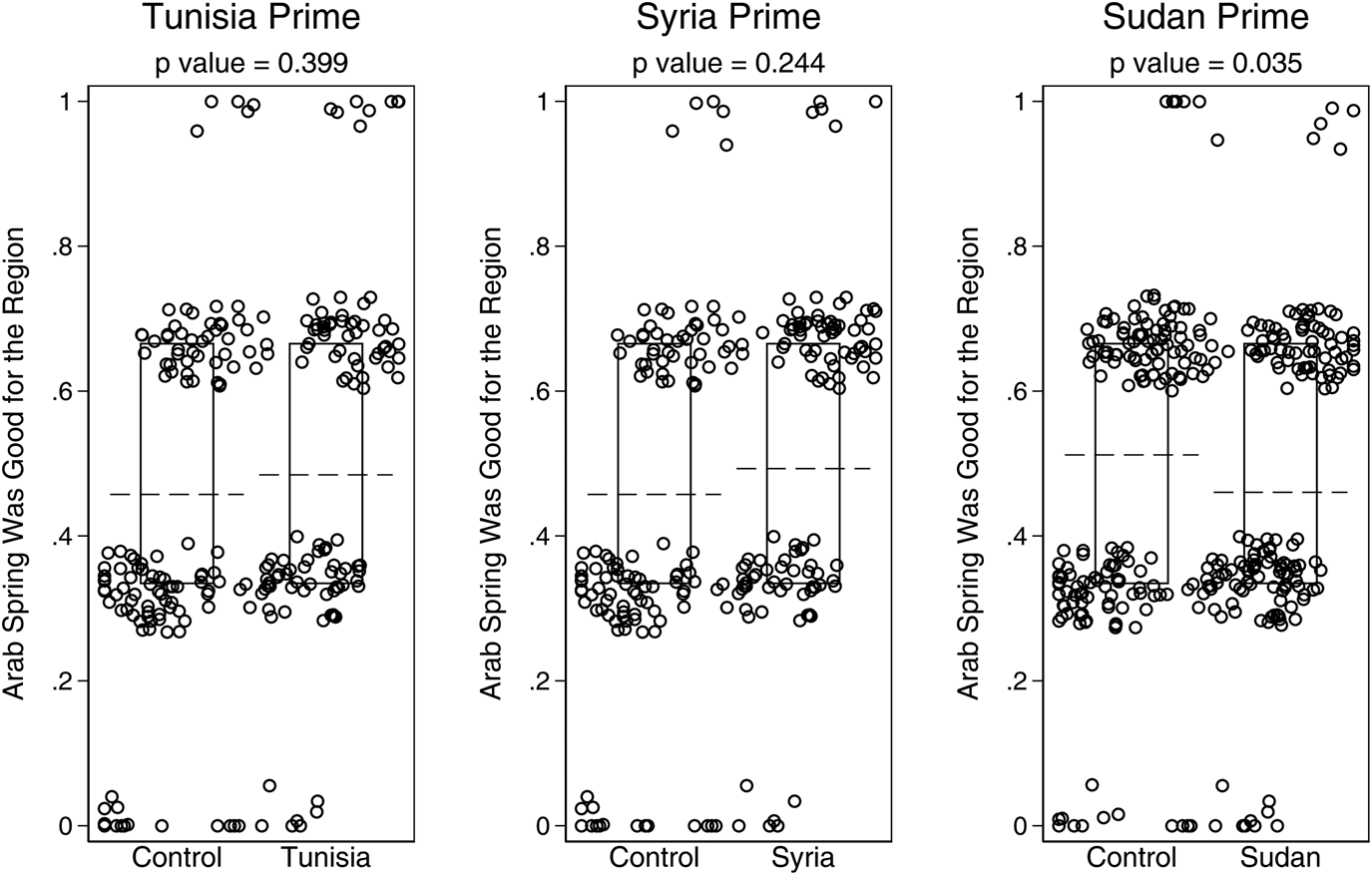
Figure 2 plots difference-of-means tests across a four-part Likert-scale question capturing retrospective judgements about the Arab Spring: ‘In your personal opinion, do you believe that the events of the Arab Spring were, in general, a good thing for the region?’
Retrospective Evaluation of the Arab Spring

Again, neither the Tunisia nor Syria primes exert enough influence over respondents to conclude that the true difference between the treatment and control group means is different from 0. However, the group mean of the Sudan treatment indicates that mention of these ongoing Sudan protests generally reduced respondents’ retrospective judgement of the benefits of the Arab Spring. In isolation, this is potentially consistent with H2: the diffusion of demobilization.
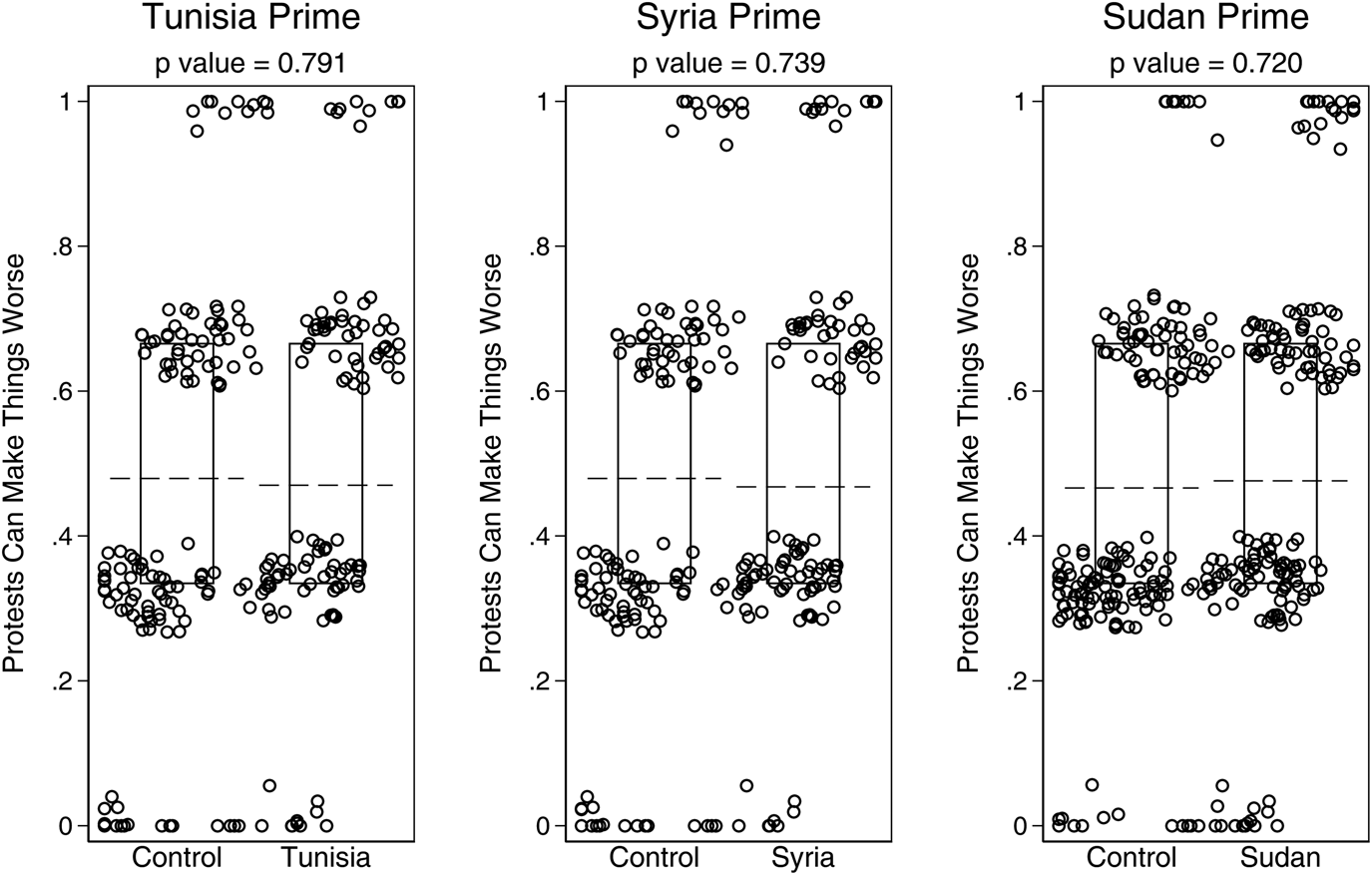
Figure 3 plots difference-of-means tests across a question capturing perceptions of the costs and benefits of protest. Specifically, all respondents were asked: ‘Some people say that things like peaceful street protests and strikes should be avoided because, in general, they rarely make things better and they sometimes make things worse for ordinary people. To what extent do you agree or disagree with this opinion?’ (strongly disagree/disagree/agree/strongly agree).Footnote 5 None of the treatment effects are reliably distinguishable from 0.
The Efficacy of Protest

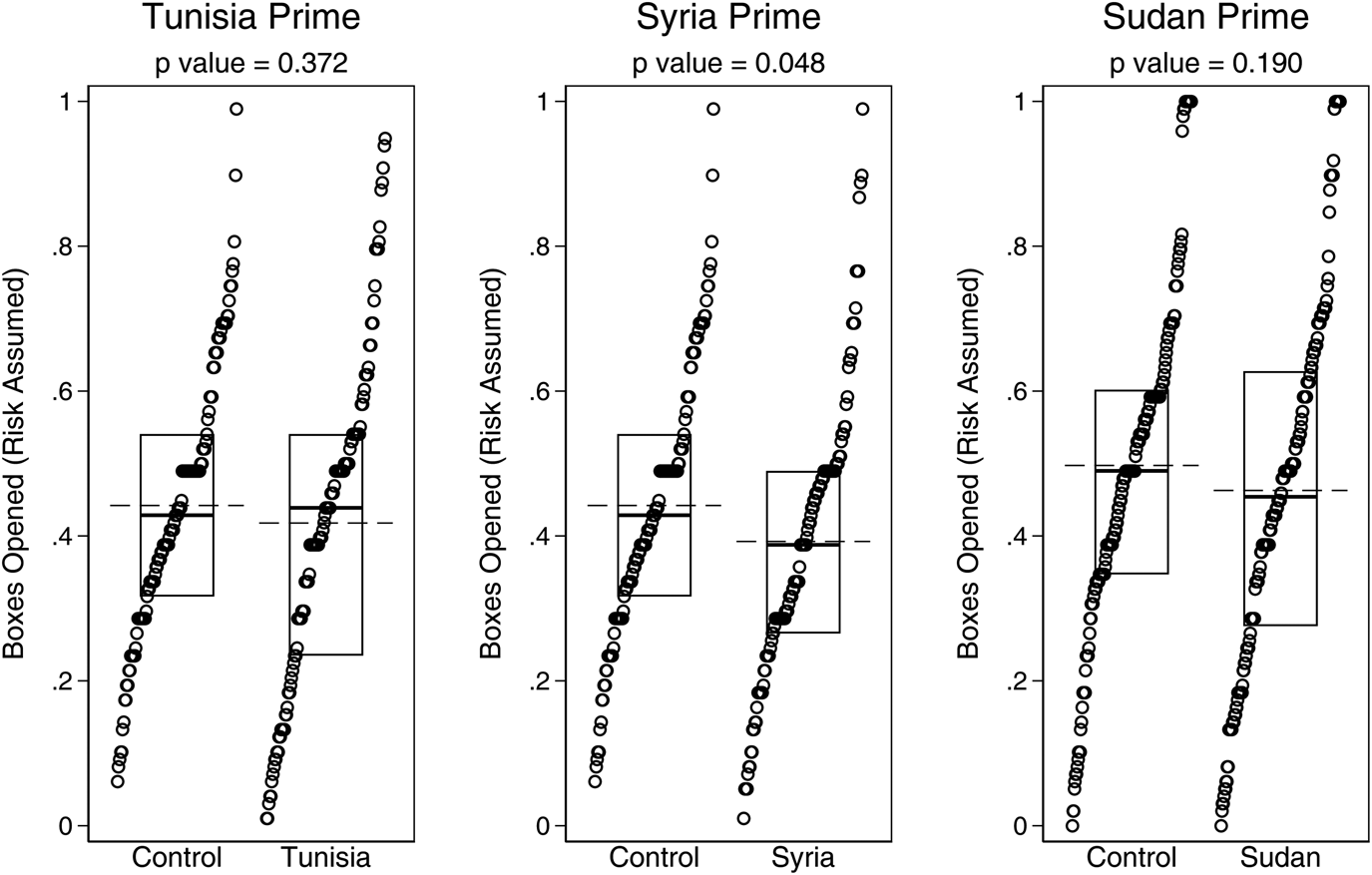
Our research design also captures behavioural outcomes. Figure 4 plots difference-of-means tests across a question designed to identify whether information about external protest would shift respondents’ willingness to assume risk, as measured through a computer game (the aforementioned BRET).
Risk Tolerance

While the Tunisia and Sudan primes display point estimates lower than the control groups, neither difference is strong enough to reject the null hypothesis. However, respondents in the Syria prime, on average, collected nearly five fewer boxes than those in the control (45.31 v. 40.46 in the raw results, which is enough to reject the null hypothesis at p < 0.05). Again, the logic of the BRET task is that, because the risk of picking the ‘bomb’ increases linearly with the number of boxes collected, those respondents exposed to the Syria prime display more risk aversion than those in the control condition. This result is consistent with H2: the diffusion of demobilization.
Discussion
Prompted by the events of the Arab Spring protests, we have attempted to evaluate experimentally the micro-level implications of a new and classic literature on the diffusion of ideas. We crafted three primes, across two experimental sessions, designed to bring to mind the case of Tunisia, where protestors ejected an autocrat and began an unsteady process of democratization; Syria, where protestors failed to eject an autocrat and were met with harsh repression and civil war; and the Sudan, where a protest wave mobilized – yet, at the time of the experiment, the ultimate outcome was uncertain. We find relatively muted effects: the treatment group can be reliably differentiated from the control for only two treatment–control comparisons. Both of these effects suggest scepticism towards more optimistic readings of the diffusion literature. This effect is not consistent across all possible tests, but it does manifest attitudinally, where exposure to information about the ongoing Sudanese protests caused respondents to view the Arab Spring's effects on the region more sceptically; and behaviourally, where exposure to information about the failed Syrian uprising caused respondents to lower their threshold of acceptable risk, as measured in a computer game.
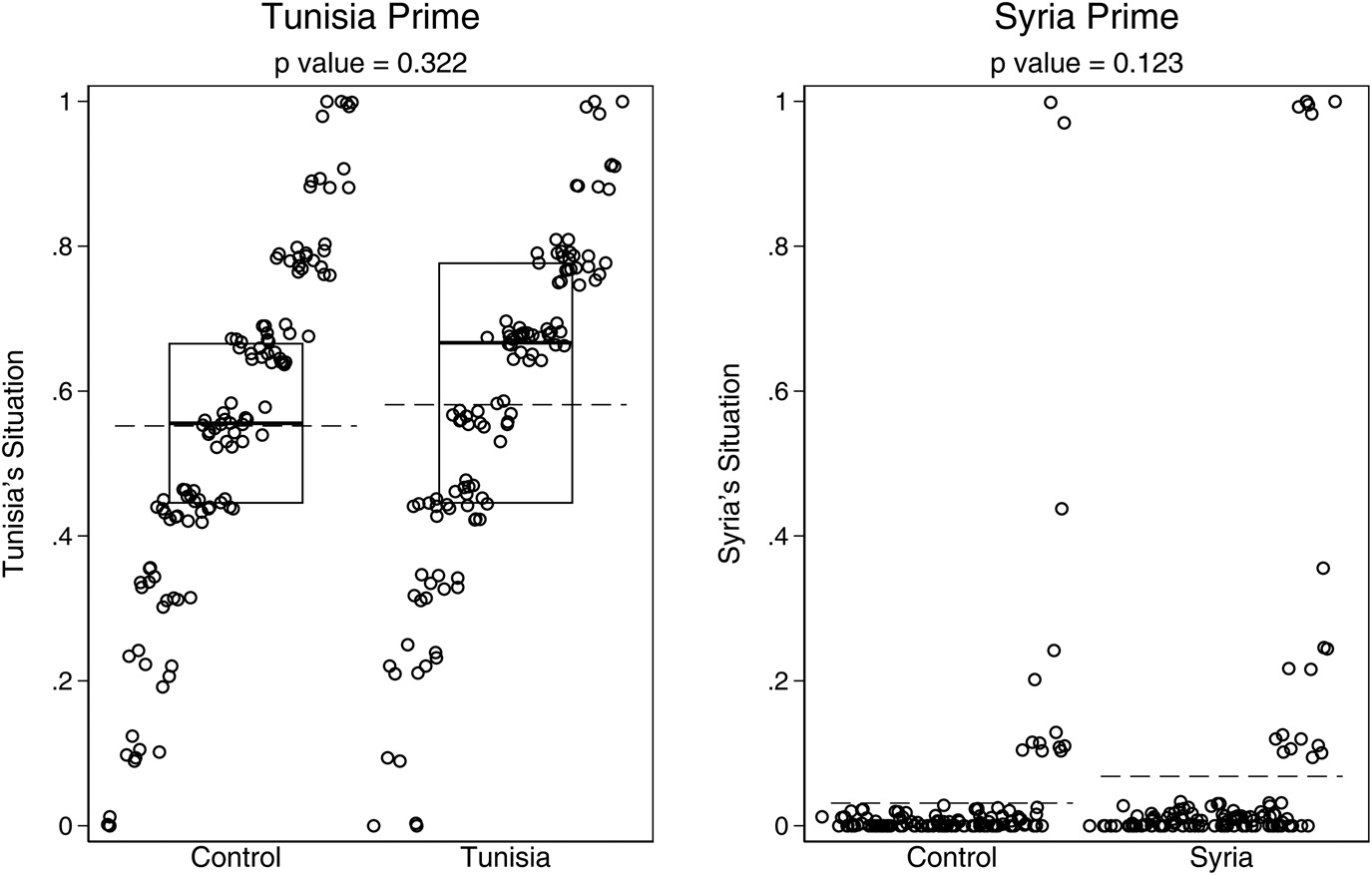
Before speculating further it is worth highlighting possible failures of the experimental design. Our experiment was reasonably powered, with sample sizes adequate for detecting ‘medium’ to ‘small’ effects per Cohen's d (Cohen Reference Cohen1988; Duflo et al. Reference Duflo, Glennerster and Kremer2007).Footnote 6 Only a small number of our respondents (six) failed post-treatment attention checks.Footnote 7 Outside of these mechanical failures, our primes, crafted by reference to an influential literature on the cross-national diffusion of protest, may have been insufficient. As discussed above, our priming manipulation was not necessarily designed to provide ‘new’ information to the respondents – we assume they were all fairly knowledgeable about current events – but rather to stimulate those ideas before answering questions about Egypt. Figure 1 showed little effect that primes were transferring into judgements about Egypt's domestic situation, for either good or ill. But we can refer to other answers to the same question (‘rank the following Arab countries …’) to identify whether the primes caused respondents to update their views about the countries they were just primed with. We do this in Figure 5.Footnote 8
Ratings of Tunisia and Syria

We can see that the primes did not necessarily cause people to update their views of Tunisia and Syria's domestic situation, respectively (for Syria in particular, there seems to have been a general consensus that the situation was dire, with little capacity to be made worse – ‘1’ was the worst available ranking). Again, our design did not presume to provide respondents with ‘new’ information about these countries, but rather make their underlying opinions about those countries more salient in a comparison vis-à-vis Egypt. One possibility, then, is that the respondents simply did not believe that the particular trajectories of Tunisia and Syria, and later the Sudan, were particularly relevant to Egypt at all.
Our initial intuition was that our students were more likely than the average Egyptian to protest, and thus a ‘most likely’ case to identify diffusion effects. But in another way our experiment may actually constitute a ‘hard case’. Specifically, Egyptians’ experiences since the Arab uprisings – successful early protest mobilization, disillusionment with an uneven democratic process, pro-military mobilization and increasing political violence – may mean they are simply saturated with the types of reactions this simple priming experiment was designed to provoke. It is also possible that students may feel less economic hardship than older generations or those with families to support – which has traditionally been a reason to protest in the country. Similarly, Egyptian university students in 2017–19 are more likely to have grown up in a climate marked by a declining interest in politics in the country, which could have made them less politically active than, say, their counterparts a decade earlier.Footnote 9
On the other hand, there were a series of actual protests that erupted in Egypt during the same rough timeframe as our experiments. Perhaps tellingly, they sprang from domestic sources. In September 2019 a long-time Egyptian actor and contractor levelled a series of corruption charges at the Egyptian government: charges which were subsequently spread on social media and prompted mobilizations. The latest wave, of September 2020, was occasioned by the Egyptian government's decision to enforce prohibitions against a decades-long illegal practice of building houses on agricultural land. These waves may imply that whereas Egyptians may have become less moved by the experiences of protests in neighbouring states, they still maintain the capacity to mobilize over more proximate grievances.
While the conclusions of our study should naturally be tempered by the generally ‘null’ results, future researchers may find it useful to consider possible trends in the data that, in aggregate, suggest ways to refine future investigations of how both contention and quiescence diffuses. H1 captured the basic idea of how diffusion drives revolutionary protest: receipt of information about a protest wave that has dislodged autocrats elsewhere makes one more open to protest at home. The point estimates for the Tunisia prime (the most obvious case of ‘protest success’ in the region) may have increased general perceptions that the Arab Spring was good for the region, but seems to have been unable to spur respondents to map that experience onto their own specific situation: the Tunisia prime improved perceptions of Egypt's domestic situation, reduced beliefs about protest efficacy, and reduced willingness to assume risk. Of course, none of these effects was strong enough for us to be confident in ruling out the null hypothesis, but future work may consider ways to refine and better test these implications.
H2 assesses a more pessimistic diffusion-based argument: that protestors’ failure to dislodge an autocrat, and in the process triggering significant repression, causes increasing quiescence in one's own country. Again, judging by the point estimates, the most obvious case of ‘failed’ protest – Syria – displays inconsistent outcomes; improving the retrospective evaluation of the Arab Spring's effect on the region was not predicted (although it was by H3). However, decreasing perceptions of the utility of protest and willingness to assume risk (and here strong enough to reject the null hypothesis) were in line.
We also sought to use the then-ongoing case of the Sudan to see if the process of protest itself – separate from its retrospective outcome – influenced attitudes in ways either more favourably or unfavourably towards mobilization. Here we found modest evidence that it was scepticism of protest that diffused: respondents had a less sanguine view of the Arab Spring's effect on the region. It is notable that respondents made this judgement without an indication that the protests had succeeded in dislodging an autocrat (as in Tunisia) or failed to do so (as in Syria). Instead, this result was seemingly driven by the simple emergence of mass mobilization.
Conclusion
This article reports the results of a series of original experiments to evaluate three individual-level implications of the large and influential literature on the diffusion of protest and quiescence. First, that exposing individuals to information about cases of incumbent-toppling protests in a second country (Tunisia) would increase their support for protest; second, that exposure to information about the failure to do so (Syria) would decrease their support for protest and, finally, the inverse of that hypothesis: that exposure to information about protest failure (Syria) would increase their support for protest via a ‘backfire effect’. A third prime, based on the ongoing Sudanese protest wave, looked for these effects in a situation where the process of protest could be separated from its ultimate success or failure.
Overall, our sample of Egyptian college students showed little consistent evidence that protests’ success, failure, or mere occurrence shapes how they assess their own country, how they retroactively view the Arab Spring, how effective they believe protest to be, and their tendency to assume risk. There was some evidence of scepticism towards protest in general, and particularly protests that failed to oust incumbents and ended up triggering repression. While the results provide no reason to discard the prominent and multifaceted diffusion hypotheses, our general lack of effects should be taken into account by future researchers.
Scholars who wish to design and test hypotheses related to the diffusion of protest and quiescence would benefit from reviewing our research design and results on these phenomena. Indeed, a possible area for future research – which could reconcile our results with the diffusion literature and the traces of which that we saw in the first waves of the Arab Spring – is whether diffusion is more likely to work in countries with no fresh experience of protests (just as many Arab countries were in 2011). In contexts with recent protest experiences, however, diffusion could become more constrained. In such cases, the dynamics of recent internal protests are likely to be a stronger determinant of the individual-level protest calculus than demonstrations in nearby states. Such an explanation was invoked to explain why Algeria, for example, was a clear exception to the first Arab Spring wave of 2011, given the bloody outcome of its first attempt at democratization in the early 1990s. Egypt – the site of our experiments – could also be viewed as a country where potential protestors were deterred by the outcomes of the earlier 2011 wave, including economic slowdown, instability and political violence. Our experiments may have simply reinforced the view that protests do not always lead to positive outcomes.
Finally, our results should be read with the following caveats. First, our question – and therefore also design – did not test for protest diffusion as ‘mere irrational imitation’. Instead we focused on how individuals might employ some rational calculus – either bounded or strict – when translating regional dynamics into their country's internal developments. Second, our sample engages only a specific subset of Egyptian students at one university and may not generalize to Egyptian university students, let alone all Egyptians. Last, our treatments may not have been powerful enough. Admittedly, in the design of the primes, we had to balance the ethical and practical difficulties associated with researching protest attitudes with the objective of rigorously testing the hypotheses. Such balance might have diluted our primes, creating a gap between the design and the real-world question. Different primes – perhaps in other contexts – may produce different results.
Supplementary material
To view the supplementary material for this article, please visit https://doi.org/10.1017/gov.2021.16.
Acknowledgements
Funding for this study was provided by a grant from the Office of the Executive Vice President for Research and Innovation at the University of Louisville, USA. We would like to thank Sarah Mansour and Engi Amin for their help in running the experimental sessions.