Do state judicial elections influence the public’s evaluation of US Supreme Court nominees? A number of excellent studies have addressed various factors the public uses to evaluate High Court nominees (Bartels and Johnston Reference Bartels and Johnston2012; Hoekstra and LaRowe Reference Hoekstra and LaRowe2013; Sen Reference Sen2017; Chen and Bryan Reference Chen and Bryan2018; Rogowski and Stone Reference Rogowski and Stone2021), but these studies tend to neglect the fact that people have different expectations about how accountable or independent judges ought to be. Expectancy theory argues that people have different expectations about judges and that these varying expectations underlie their support (or lack thereof) for courts (Gibson Reference Gibson2012). Applying the logic of this theory suggests that people’s exposure to their state judicial selection system may influence how they evaluate US Supreme Court nominees (i.e., what their expectations are). Given the relatively frequent selection and retention of state supreme court justices, state-level judicial selection systems can expose people to expectations about judges and judicial behavior that, in turn, may influence how they view US Supreme Court nominees. We argue that respondents who come from states that appoint their judges will evaluate High Court nominees based on legal concepts such as qualifications and judicial philosophy, while respondents who come from states that elect their judges will evaluate High Court nominees based on extralegal concepts such as partisanship and demographics.
The data largely support our expectations. Employing a conjoint experiment and making appropriate inferences therefrom (Leeper, Hobolt, and Tilley Reference Leeper, Hobolt and Tilley2020), we find that people from appointing states evaluate High Court nominees differently than people in electing states. Those from appointing states are more concerned with what we might call traditional legal factors, such as legal qualifications. People from electing states are less concerned with those factors and have a slight preference for features such as demographic characteristics and partisanship. While the results vary from characteristic to characteristic, our omnibus F-test confirms that state judicial selection systems shape how people evaluate US Supreme Court nominees.
These findings make at least three useful contributions. First, they suggest an empirical link between state institutions and the public’s views of federal officials, which is an understudied but important federalist feature. Second, and relatedly, the results speak to the consequences of state policies on the Supreme Court’s legitimacy. If state-level policies can influence the public’s evaluations of Supreme Court nominees, it seems reasonable to believe that those evaluations could spill over to the Court as a whole. That even a small portion of the Court’s legitimacy could be tied to state policies is important in our federal system. Third, the results provide further support for expectancy theory, the idea that people’s differing expectations of courts influence their views of judicial legitimacy and judicial behavior (Gibson Reference Gibson2012).
In what follows, we begin by explaining the factors commonly believed to influence the public’s evaluation of US Supreme Court nominees. We then theorize why state judicial selection methods might influence the way people view those nominees. Afterward, we turn to our data and measures, discuss our conjoint experiment, and examine our results. We conclude with a discussion of how these findings speak to contemporary concerns over the federal nomination and confirmation process and the Court’s legitimacy more broadly.
Public Evaluations of Supreme Court Nominees
Studies show that people often evaluate High Court nominees based on whether they agree with them politically or ideologically (Hoekstra and LaRowe Reference Hoekstra and LaRowe2013; Engst, Gschwend, and Sternberg Reference Engst, Gschwend and Sternberg2017; Sen Reference Sen2017; Badas and Stauffer Reference Badas and Stauffer2018). Chen and Bryan (Reference Chen and Bryan2018) argue that the most important factor predicting public support for a nominee is ideological agreement with him or her. Gimpel and Wolpert (Reference Gimpel and Wolpert1996) find that the public cues in on presidents, and public support for presidents influences evaluations of Supreme Court nominees (see also Gibson and Caldeira Reference Gibson and Caldeira2009a). According to Bartels and Johnston (Reference Bartels and Johnston2012, 108), a sizable portion of the public believes nominees “should be required to state their views on controversial issues” and that during the appointment process the president and Senate should consider “how the nominee might vote on controversial issues.” It should be no surprise, then, that 84% of Republican respondents polled nationwide supported the nomination of Brett Kavanaugh while only 13% of Democrats did,Footnote 1 or that 74% of Republicans supported Neil Gorsuch while only 21% of Democrats did.Footnote 2 Ideology and partisanship largely predict public evaluations of Supreme Court nominees.
For many Americans, the nominee’s demographic characteristics also matter. Consider the effects of race. Badas and Stauffer (Reference Badas and Stauffer2018) argue that racial identity led African Americans to support Clarence Thomas’s nomination even though the traditionally left-leaning voting bloc otherwise would have rejected him on policy grounds. Badas and Stauffer (Reference Badas and Stauffer2018) also argue that conservative Latinos supported the liberal Sonia Sotomayor because of their shared racial identity. Sex also appears to influence how the public evaluates High Court nominees. Badas and Stauffer (Reference Badas and Stauffer2018) claim that conservative women supported Elena Kagan despite their ideological differences with her. Kaslovsky, Rogowski, and Stone (Reference Bartels and Johnston2021) find similar effects in an experimental setting (but see Sen Reference Sen2017).
Studies also show that the public evaluates Supreme Court nominees based on their perceived legal qualifications. For example, Kaslovsky et al. (Reference Kaslovsky, Rogowski and Stone2021) find evidence that the public is more likely to support nominees with judicial experience and nominees who attended elite Ivy League schools. Hoekstra and LaRowe (Reference Hoekstra and LaRowe2013) likewise find that the public supports nominees who attended top law schools, enjoyed prior judicial experience, received high ratings from the American Bar Association, and were praised for their years of experience on the federal courts.Footnote 3
Although these studies are compelling, they tend not to recognize that people hold heterogeneous expectations about judges (but see Bartels and Johnston Reference Bartels and Johnston2012) and that these various expectations likely influence how they evaluate Supreme Court nominees. As we describe in the next section, some people are comfortable with judges stating their views on policies; others are less so. Some people believe it is appropriate for judges to accept campaign contributions; others believe it destroys a court’s legitimacy (Gibson Reference Gibson2012). People vary on other aspects of “proper” judging as well, but the point obtains: people have different expectations of judges. And if that is so, it seems reasonable to believe that they evaluate judges using heterogeneous criteria.
Judicial Selection Methods and Evaluations of Supreme Court Nominees
We believe exposure to state judicial selection methods can influence people’s expectations of judges and how they evaluate Supreme Court nominees. Our theoretical motivation stems, in part, from Gibson’s work on expectancy theory. Expectancy theory argues that people hold different views and expectations about how the ideal judge should behave and that those differing expectations influence their perceptions of judicial legitimacy. As Gibson (Reference Gibson2012, 11–12) notes, “When it comes to the expectations of the US Supreme Court, considerable disagreement exists among the American people” (see also Gibson and Caldeira Reference Gibson and Caldeira2009a). Importantly, these differing expectations influence how people perceive the Court. That is, support for the Court is not unidirectional; it can rise among some people and simultaneously drop among others, based on their expectations of appropriate judicial behavior.Footnote 4
Empirical evidence for expectancy theory comes from multiple sources. In one study, Gibson (Reference Gibson2012) found that 86% of survey respondents believed state judges should be able to make their policy views known, 60% thought it permissible for judicial candidates to attack their opponents, and 14% believed judges should not accept campaign contributions. These different responses show that people hold varying expectations of judges. (The same people can even hold different views at different points in time—particularly as their exposure to legitimacy-enhancing and legitimacy-reducing images changes.) Relatedly, Gibson and Caldeira (Reference Gibson and Caldeira2009a) find that the public evaluates Supreme Court nominees through two general frames: a judiciousness frame and an ideological frame. People who view the Court through the judiciousness frame focus on nominees’ qualifications. Those who view the Court through the ideological frame look to the nominees’ supposed policy positions. In a similar study, Bartels and Johnston (Reference Bartels and Johnston2012, 107) discover that people who see the Court in political terms prefer justices to be chosen on political grounds and that people who see the Court as impartial and law driven prefer neutral appointments. Respondents’ expectations of courts and judges differ, and those expectations influence how they evaluate nominees.
While the precise causes of people’s differing expectations of judges and courts are unclear, surely one factor must be their exposure to judicial elections and the symbolic messages that come with them. Judicial and legal symbols convey the image that courts are not political or biased institutions. They suggest that courts are different from political institutions and deserve greater respect and support (Gibson Reference Gibson, Bornstein and Tomkins2015). As Gibson, Lodge, and Woodson (Reference Gibson, Lodge and Woodson2014) find, judicial symbols can help mitigate a person’s short-term dissatisfaction with a Court decision. Gibson and Nelson (Reference Gibson and Nelson2016) extended these findings to observe that symbols can reduce the Court’s loss of institutional legitimacy. The symbols, both specific and suggestive, tied to judicial elections can lead people to expect different things from judges and courts.
What is important is that citizens’ expectations of courts can vary, both across individuals and within individuals over time. When they are exposed to judicial symbols that suggest courts are different from ordinary political actors, they tend to think more highly of courts and expect them to behave accordingly (Gibson et al. Reference Gibson, Lodge and Woodson2014; Gibson Reference Gibson, Bornstein and Tomkins2015; Gibson and Nelson Reference Gibson and Nelson2016). In contrast, when they are exposed to legitimacy-reducing symbols and images, they think less of courts (Gibson and Caldeira Reference Gibson and Caldeira2009b). Some people are exposed to positive symbols while others are exposed to neutral or negative symbols. And even among those exposed to the same symbols, they may react differently.
It seems reasonable to us to expect that people exposed to judicial elections—and all the positives and negatives that come along with them—might evaluate US Supreme Court nominees differently than people never (or rarely) exposed to judicial elections.Footnote 5 Judicial elections, after all, can sometimes expose the public to countersymbols that lead them to believe courts are like other political institutions (Cann and Yates Reference Cann and Yates2008; Gibson and Caldeira Reference Gibson and Caldeira2012). And even if, as is likely often the case, judicial elections do not expose people to negative images of courts, they still can portray the courts in a way that is different from the sanitized, traditional view. Exposure to such images can influence how citizens view judges and courts. Those who are not exposed to judicial elections might focus on traditional legal factors, while those exposed to judicial elections might focus more on political (or extralegal) characteristics.
Research supports the view that people who live in states that elect their judges are likely to hold different expectations of judges—or at least different views of them—than people who live in states that appoint their judges. Relying on some of his earlier nationwide analyses, Gibson (Reference Gibson2012, 52) finds that “in states without [judicial elections], citizens (presumably) have little direct experience with judicial campaigning, and they therefore find it objectionable when they are exposed to such activity.” He went on to note that “people without experience with voting for judges are considerably more put off by policy talk than people living in states electing their judges by popular vote” (52). Cann and Yates (Reference Cann and Yates2008, 313–15) find that “citizens in states using partisan elections to select judges have lower levels of diffuse support [for state courts] than citizens in states that appoint their judges.” Similarly, Benesh (Reference Benesh2006, 704) finds that “in partisan election states, respondents have less confidence in the courts; they are more likely to have only a little confidence; and less likely to have a great deal of confidence.” Wenzel, Bowler, and Lanoue (Reference Wenzel, Bowler and Lanoue2003, 200) find that “among more highly educated voters, partisan appointment systems are … associated with a lower level of support for local courts” (but see Wasmann, Lovrich, and Sheldon Reference Wasmann, Lovrich and Sheldon1986). Woodson (Reference Woodson2017) finds that in states with high amounts of election activity, the legitimacy of elected courts is lower than the legitimacy of appointed courts (but see Nelson Reference Nelson, Bonneau and Gann Hall2017).Footnote 6 These studies suggest that exposure to judicial elections can mold a person’s views of courts and judges. And while they do not directly examine our topic, they are highly suggestive.
Of course, for our argument to be plausible, individuals in states with judicial elections must be exposed to judicial campaigns and elections and the messages they convey. Are they? We believe so. People are often exposed to campaign messages or news coverage of political events even without seeking them out. The literature shows that even the least politically informed members of the public are exposed, via television ads and word of mouth, to basic political and campaign information. Decades of studies on the American voter show that low-informed voters can use ideology and partisanship to make their decisions (Sulfaro Reference Sulfaro1996). As Scheufele and Lewenstein (Reference Scheufele and Lewenstein2005, 660) tell us, people “rely on heuristics … such as ideological predispositions … in order to form judgments about issues.” Dahlberg and Harteveld (Reference Dahlberg and Harteveld2016) show that knowledge of the ideological locations of parties allows voters to impute candidates’ specific views on issues. Similarly, voters rely on party brands as heuristic cues about candidates’ ideologies (Downs Reference Downs1957; Popkin Reference Popkin1994; Butler and Powell Reference Butler and Powell2014). They may know little about the specific policy positions of individual candidates, but they can know about the positions of the parties more broadly—and vote based on that knowledge. Even low-informed members of the public are exposed to and learn broad concepts that can inform their understanding of politics and law, much the same way that exposure to legal symbols can lead to general beliefs about judicial independence and, as we believe, the same way judicial elections can set expectations about judicial behavior.
But even beyond this general support for our position, supplemental data suggest that people in electing states are more likely than people from appointing states to observe judges running for office. Using storyboards of TV ads captured by the Brennan Center for Justice, we coded the number of television advertisements aired in appointing states and electing states that were related to a judicial vacancy.Footnote 7 We gathered ads for the even-numbered years from 2000 to 2008 and for every year between 2010 and 2016 (inclusive). Figure 1 shows the number of television advertisements aired in electing and appointing states. It shows clearly that people in states with judicial elections are much more likely to be exposed to television ads—with judges asking for votes—than those who live in appointing states. People who live in states with judicial elections are exposed more regularly to ads about judges and judging than people who live in appointing states.
Number of television advertisements aired in state judicial races in the even numbered years from 2000 to 2008 and for every year between 2010 and 2016 (inclusive). Figures based on data collected by authors from the Brennan Center for Justice.

Similarly, examining just the judicial campaign television advertisements from the 2011–12, 2013–14, and 2015–16 election cycles, we find that television advertisements aired 162,170 times in electing states, which is more than 15 times the amount of advertisements aired in appointing states. To investigate further, we used Amazon Transcribe to transcribe the content of each television advertisement in these ads. At least one of the words “conservative,” “liberal,” “Republican,” and “Democrat” showed up in approximately 25% of the advertisements. Using structural topic modeling, we also estimated the most common topics addressed in the judicial campaign advertisements. The second-most common topic was ideology. Politics was also a common topic across the advertisements. These ads not only depict judges asking for votes; they often look like political ads.
Finally, and at the risk of belaboring the point, we considered people’s self-reported evaluations of judges. In 2006, the Annenberg Public Policy Center asked survey participants whether “judges who are appointed to office are more likely, less likely, or just as likely to be fair and impartial as judges who are elected” (emphasis removed). Respondents in appointing states were more likely than respondents in electing states to think that appointed judges are more fair and impartial (
 , two-tailed). In addition, using 2005 Annenberg Public Policy Center data, we estimated the relationship between whether a person lived in an appointing state and his or her “preferences for a political Supreme Court appointment process” à la Bartels and Johnston (Reference Bartels and Johnston2012). We found some evidence that people in electing states prefer an extralegal appointment process (
 , one-tailed).Footnote 8
Expectancy theory suggests that “experience with judicial campaigning” and “experience with voting for judges” lead to variation in the expectations people have for judges (Gibson Reference Gibson2012, 52). We have provided clear evidence of an increased likelihood of exposure to judicial campaigns and elections in states where judicial candidates run for office. Does our argument imply also that we should find a high level of citizen awareness or knowledge about which system one’s state of residence uses to select judges? It is not obvious to us that experience with judicial campaigns will always translate to explicit knowledge of one’s state judicial selection method. Studies suggest that Americans often do not know precise facts about their governmental institutions (Delli Carpini and Keeter Reference Carpini, Michael and Keeter1996). And literature in psychology suggests that events may influence our views implicitly without our explicit awareness.
Gibson (Reference Gibson2012) surveyed Kentuckians about their knowledge of their own legislature and judiciary. Self-reported knowledge was unsurprisingly high, with the percentage saying they are somewhat or very aware of these institutions exceeding 80%.Footnote 9 But actual knowledge was much lower, with only 24% correctly stating that their state justices were elected and 32.9% of respondents correctly stating that their state judges held fixed (not life) terms. (The survey did not ask informational questions about the Kentucky legislature.) Referencing earlier research in Gibson and Caldeira (Reference Gibson and Caldeira2009c), Gibson suggests that knowledge of state-level judicial institutions is lower than knowledge about the US Supreme Court.
Indeed, we are under no illusions that most people in each state can identify their state’s method of judicial selection. But research in psychology provides strong evidence in support of the “two minds” hypothesis. That is, psychologists believe that “people have an intuitive, unconscious mind and a reflective, conscious mind” (Hansford, Intawan, and Nicholson Reference Hansford, Intawan and Nicholson2018, 130). Events can influence our underlying views and attitudes without changing what we know or think, “especially if social desirability bias or a lack of self-awareness figure prominently” (130). Exposure to judicial campaigns and elections can influence our underlying attitudes toward judges without necessarily changing our knowledge of how judges are selected.
Data from Gibson (Reference Gibson2012) are consistent with the two-minds hypothesis. He finds that Kentuckians do a poor job of answering factual questions about their judiciary, but he finds also that they do a good job of sorting out fake names from the real names of judicial candidates running for an election in their district. In particular, he found that 64.7% of respondents recognized at least one of two names of real judicial candidates from their district, while only 20.9% of respondents believed that one of the two made-up names of judicial candidates were actual candidates from their district.
In the end, we argue that exposure to judicial campaigns and elections influence underlying beliefs about judges, even if people do a poor job recalling how their state judges are selected.Footnote 10 At the same time, these mechanisms are nuanced, and we do not expect that the differences arising from various exposures to judicial elections will be large in this single experiment. Rather, it is our expectation that the effects will be moderate, given the general positivity bias attached to courts. Expectations theory tells us that people are willing to tolerate different kinds of behavior among judges to different degrees, but they still expect them to be judges. And so while we expect differences between respondents in the different states, we do not expect those differences to be overwhelming.
Some readers may be interested in the difference between partisan and nonpartisan judicial elections. In our study, we differentiate between states with judicial elections and other states, but we do not differentiate between respondents in states with partisan and nonpartisan judicial elections. The central component of our theoretical argument is that some respondents are exposed to judicial campaigns, regardless of whether nominees run under a partisan flag or not. Of course, we acknowledge that adding partisanship to the electoral context may lead to even greater divergence in how people view judges, and we leave this important and interesting question to future research.
Taken together, we believe that state judicial selection methods can influence how people evaluate US Supreme Court nominees.Footnote 11 People in electing states observe judges running for office and asking for their votes. And the variation in state norms should lead to variation in expectations of judges, which is perhaps why “judicial campaigning … [is] objectionable” to people living in appointing states; and why people in electing states are “considerably [less] put off by [such] policy talk” (Gibson Reference Gibson2012, 52). We expect that respondents from states that appoint their judges will evaluate Supreme Court nominees using traditional legal factors more than respondents from states that elect their judges. Conversely, respondents from states that elect their judges will consider partisanship and demographic characteristics more than respondents from appointing states.
The Conjoint Experiment
To determine whether state selection methods influence how respondents evaluate US Supreme Court nominees, we performed a conjoint experiment. Whereas a traditional experiment isolates a causal effect by “treating” a randomly assigned subset of individuals and then comparing outcomes between the treated and untreated groups, a conjoint experiment presents respondents with multiple items to evaluate, which increases sample size in a cost-effective (yet appropriate) manner. The experiment varies a number of attributes being evaluated. In our context, an attribute is a nominee characteristic. Each attribute has a predetermined number of levels. For example, the levels of the attribute Sex are “male” and “female.” The levels of the attribute Nominee Religion could be “Christian,” “Jewish,” or “Not Religious.” Any number of attributes or characteristics may be specified. Typically, researchers create approximately 10 characteristics (e.g., Hainmueller, Hopkins, and Yamamoto Reference Hainmueller, Hopkins and Yamamoto2013), although they may include more (Bansak et al. Reference Bansak, Hainmueller, Hopkins and Yamamoto2021).
We surveyed 1,000 adult respondents using YouGov. (See sec. A of the appendix for more information on the survey and respondents.) We weighted survey responses by matching respondents’ 2016 presidential vote choice, sex, age, race, and education with the US general population (according to the American Community Survey). We provided each of our 1,000 respondents five pairs of possible (but fictional) nominees with randomly assigned attributes.Footnote 12 The attributes included the nominees’ judicial philosophy, age, race, sex, professional background, religion, law school, perceived ideology, and American Bar Association rating. We also informed respondents whether the nominee ever held elective office and the party of the nominating president. For each respondent, we randomized the order in which we presented these attributes. For our dependent variable, we asked participants to indicate their preference for nominees on a 5-point scale, with 5 representing a strong preference for the appointment of the nominee to the Court and 1 representing a strong preference against the appointment.
Because our hypothesis is that respondents who live in states that appoint their judges will focus more on legal qualifications and that respondents who live in states that elect their judges will focus more on extralegal attributes, we identified each survey respondent’s home state and the kind of judicial selection method his state employed to select state supreme court justices. As table 1 shows, respondents came from two broad kinds of judicial selection systems: elected systems and appointive systems. More specifically, we code nonpartisan and partisan judicial elections as “elections” and merit systems and legislative appointments as “appointing” systems.Footnote 13
Selection Systems for State Supreme Courts

Other features also might lead respondents to support or oppose particular judicial nominees. Because previous research emphasizes the importance of partisanship and ideology, we controlled for each. We included the Party of the Appointing President as either Democratic or Republican. The attribute immediately following the party of the appointing president was the Ideology of the nominee, which could be either liberal, moderate, or conservative. In order to increase the realism of the experiment and align it with the current political environment, Republican presidents nominated only moderates or conservatives. Democratic presidents nominated only moderates or liberals.
We also exposed respondents to various measures of the nominees’ legal qualifications. The American Bar Association (ABA) Standing Committee on the Federal Judiciary evaluates prospective judicial nominees and releases reports on those nominees’ qualifications. We included ABA Rating as well qualified, qualified, or not qualified. Our weighted randomization method favored increasingly qualified nominees, consistent with typical nominations. We also varied the nominees’ Legal Education to account for degrees at elite or nonelite law schools. Nominees could receive their law degrees from one of the following universities: Yale, Stanford, Harvard, Chicago, Columbia, Cornell, Vanderbilt, Iowa, Notre Dame, Arizona State, George Washington, North Carolina, Texas, Wisconsin, or Connecticut. Using weighted randomization, we randomly selected the university appearing in a profile, with higher-ranked universities appearing more often than lower-ranked universities.
Looking at the nominees’ judicial philosophy, we exposed respondents to nominees who espoused an Originalist interpretation of the Constitution and nominees who espoused a Living Constitution approach. We told some respondents that a nominee would “look to the intent of the framers to reach conclusions about the meaning of the Constitution” or that nominees “consider what the words in the Constitution meant at the time those words were crafted” (both of which could be considered originalism). We told other respondents that a nominee would “look to the evolving views and values of the American public when interpreting the Constitution,” which is the living constitution philosophy.Footnote 14
We next included nominee demographic characteristics. We varied the nominees’ Age from 40 to 65 years old. We also varied the nominees’ Sex between male or female. We varied the nominees’ Race to take on one of the following: white, black, Asian, Native American, or Hispanic. Considering the prevalence of nominees and current judges who are white, we assigned a 37.5% chance of being white, 25% chance of being black, 12.5% chance of being Asian, 12.5% chance of being Native American, and a 12.5% chance of being Hispanic. We next varied the nominees’ Religion, with nominees assigned equal probabilities of being Catholic, Lutheran, Methodist, nondenominational Christian, Jewish, or not religious.
Finally, we included whether the nominee Ever Held Elected Office and the nominee’s Current Position. Nominees were more likely to have not held office in the past (66% probability). In terms of current position, nominees were equally likely to be attorneys in private practice, attorneys for the United States, state supreme court justices, federal trial court judges, federal appellate court judges, or law professors.
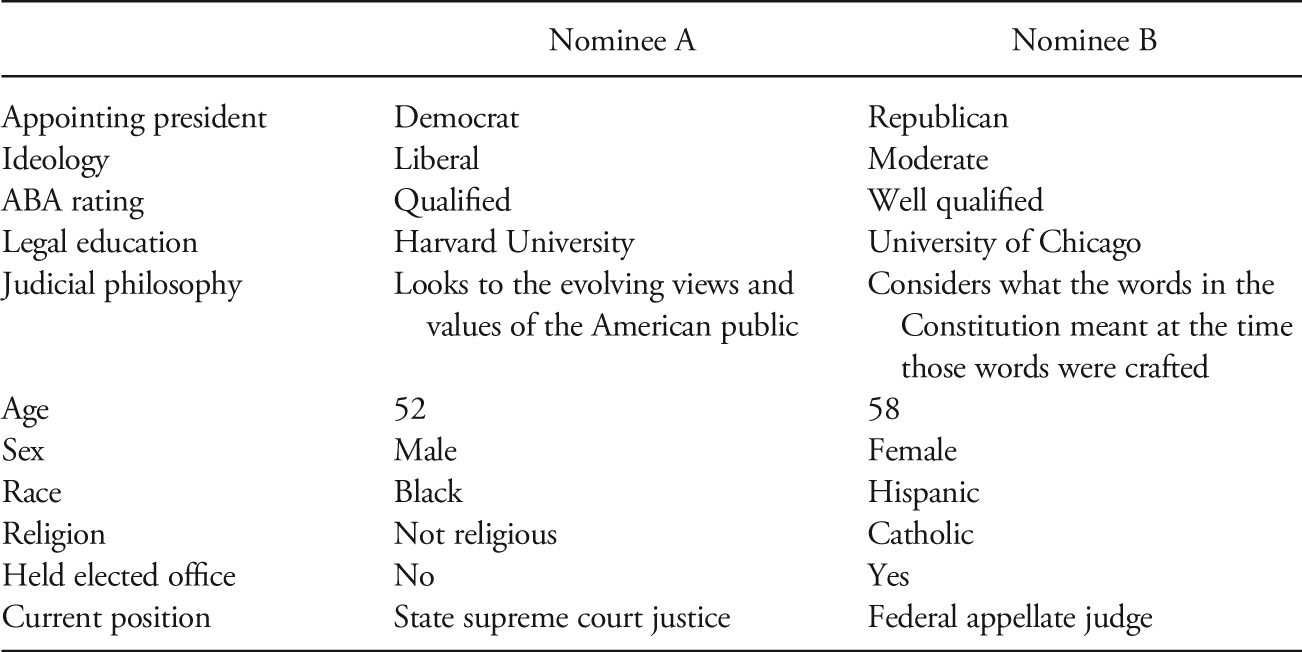
As table 2 shows, respondents saw the description (but no pictures) of two potential nominees and then scored each nominee on a 5-point scale. A respondent might evaluate a black male state supreme court justice who believes in a living constitution and a Hispanic female circuit court judge who believes in originalism. By varying these attributes across a large sample of respondents, the conjoint experiment allows us to determine which attributes respondents most prefer—and then examine whether there are systematic differences in preferences across respondents from different state judicial selection systems.Footnote 15
Example of Conjoint Experiment Profiles

To measure the causal effects of nominee characteristics, we calculate average marginal component effects, or AMCEs (Hainmueller et al. Reference Hainmueller, Hopkins and Yamamoto2013). The causal estimate is relative to the distribution of potential choice profiles. We specified our nonuniform profile assignment scheme (caused by both weighted randomization and profile combination restrictions) when estimating causal effects. We also weight respondents so AMCEs reflect average effects on a sample that is representative of the US population. AMCEs represent the average causal effect of the attribute on a nominee’s score. For example, an AMCE of 0.15 for the “female” level of the Sex attribute would suggest that respondents score females 0.15 points higher than males on the 5-point scale.
Results
Consistent with the recommendations of Leeper et al. (Reference Leeper, Hobolt and Tilley2020), we analyze our data in four steps. First, for each nominee attribute of interest, we analyze public preferences descriptively, reporting marginal means. Marginal means describe the magnitude of preferences for any given attribute level. They do not tell us, however, whether a shift from one attribute level to another causes a change in nominee evaluations. To assess such causal effects, our second test is to report AMCEs. Third, we test differences in AMCEs by subgroup (whether respondents are from states that appoint judges or from states that elect judges). Finally, after we analyze attributes and attribute levels individually, we perform an omnibus F-test. This nested model comparison is the key method for testing our hypothesis that judicial selection systems influence people’s evaluations of nominees. While statistical significance may vary from attribute to attribute, the F-test allows us to consider whether the inclusion of judicial selection system improves model fit overall, compared to a model that excludes this variable.
The Effects of Traditional Legal Factors
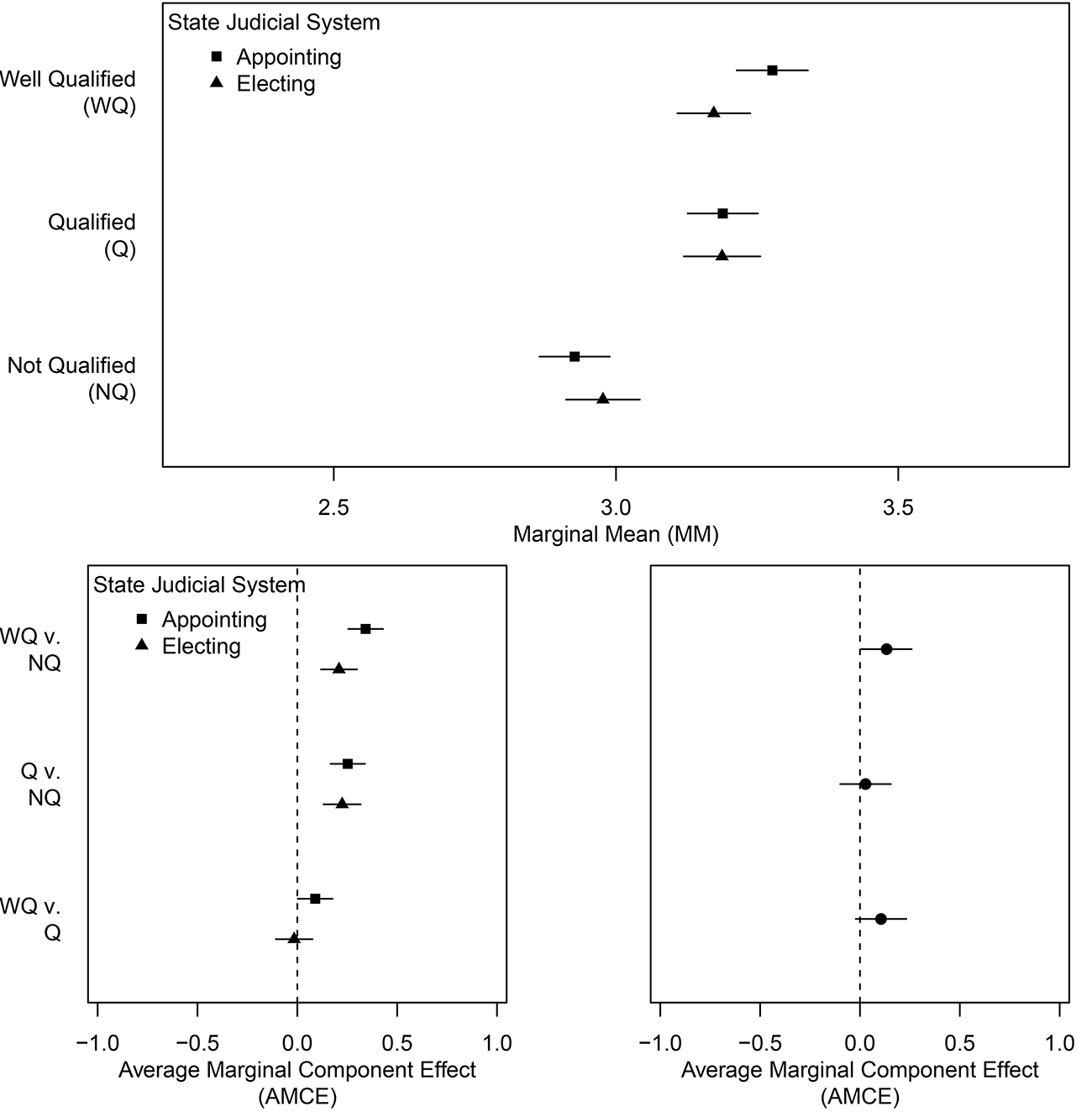
We begin by examining how our various respondents use legal qualifications (ABA ratings) to evaluate Supreme Court nominees. The plot in the top panel of figure 2 shows the marginal means in appointing and electing states for each possible ABA rating. Descriptively speaking, respondents do not vary when it comes to “qualified” nominees. Respondents from appointing states rate “not qualified” nominees lower than respondents from electing states (although this difference is not statistically significant) and “well qualified” nominees more favorably.
Top panel, marginal means of nominee evaluations based on ABA ratings for respondents from states that appoint their judges (squares) and for respondents from states that elect their judges (triangles). Horizontal lines, 95% confidence intervals. NQ = not qualified; Q = qualified; WQ = well qualified. Bottom left panel, average marginal component effects (AMCEs). Estimates the causal effect of a shift from one category to another category (pairwise comparison). Bottom right panel, difference in AMCEs (appointing − electing) for each type of pairwise comparison. Tests hypothesis that respondents in appointing states respond more strongly to ABA ratings than respondents in electing states.

Of greater interest to us are the causal effects of nominee quality on evaluations. The plot in the bottom left panel of figure 2 shows the changes in nominee score (AMCE) for each possible pairwise comparison for respondents from appointing and electing states. For all respondents, changing the nominee rating from not qualified to a better rating causes a statistically significant improvement in evaluations. Compared to an unqualified nominee, a well-qualified nominee is rated .34 points higher in appointing states and .21 points higher in electing states. A qualified nominee is rated .25 points higher in appointing states and .22 points higher in electing states. For respondents from appointing states, a shift from a qualified nominee (rating of 3.19) to a well-qualified nominee (rating of 3.28) also causes a positive shift in nominee evaluations.
Our ultimate goal, though, is to search for differences in evaluations between respondents in appointing and electing states. We can test this hypothesis by estimating whether differences in AMCEs across the two types of states are statistically significant. As shown in the bottom right panel of figure 2, we find this to be the case when looking at well-qualified nominees versus not-qualified nominees. Respondents in appointing states are more responsive to a strong shift in ABA ratings than are respondents in electing states (difference in AMCEs of .13). Respondents in electing and appointing states viewed well-qualified nominees the same as qualified nominees (
 ). They also displayed no differences when comparing qualified nominees to unqualified judges. But when it came to well-qualified nominees versus unqualified nominees, the respondents from appointing states preferred them more than respondents from electing states. This is largely what one would expect to observe if respondents from appointing states hold different expectations for judges than respondents from electing states.
Next, we consider the role of judicial philosophy. To be sure, judicial philosophy is not entirely a legal characteristic; it certainly has political overtones. Nevertheless, because we control for associated political characteristics (partisanship and ideology) in our conjoint experiment, we can capture the independent effect of judicial philosophy here, apart from political characteristics. Because conservatives tend to prefer originalism and liberals living constitutionalism, we break down the results by respondent party identification.
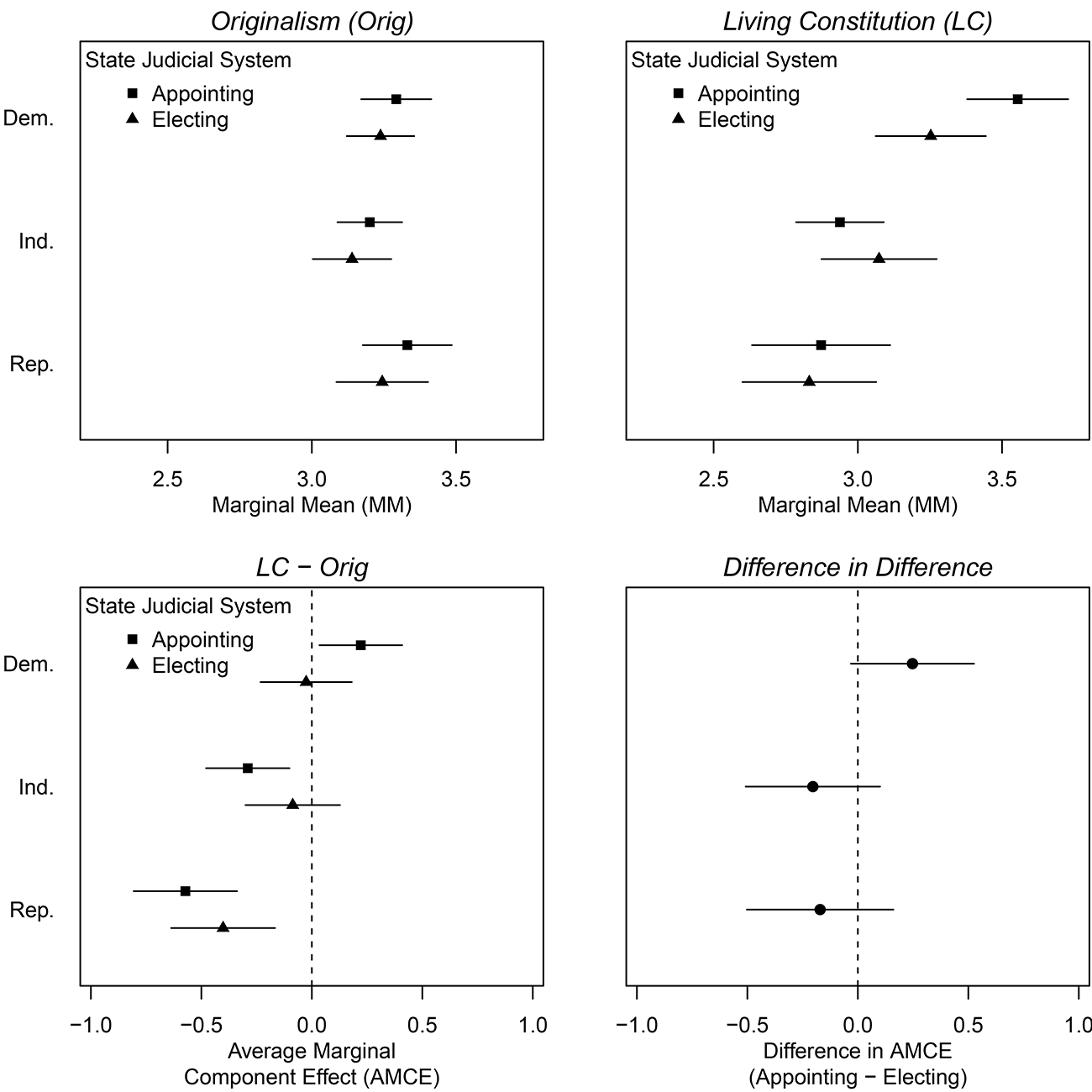
The top left panel of figure 3 displays the point estimates for nominees with originalist approaches, both in appointing (squares) and electing (triangles) states. Surprisingly, there is little variation by party identification or judicial selection system. In contrast, the top right panel of the figure—which focuses on living constitutionalism—displays strong variation. Democrats are more supportive of a living constitution philosophy than are independents and Republicans. More importantly, Democrats themselves are less supportive of this philosophy when they live in electing states. That is, whereas Democrats tend to lean toward a living constitution approach, being exposed to state judicial elections looks to reduce their preference for that approach.
Top panels, marginal means of nominee evaluations based on nominee judicial philosophies (originalism and living constitutionalism) and respondent party identification (Rep. = Republican; Ind. = independent; Dem. = Democratic) for respondents from states that appoint their judges (squares) and for respondents from states that elect their judges (triangles). Horizontal lines, 95% confidence intervals. Bottom left panel, average marginal component effects (AMCEs). Estimates the causal effect of a shift from originalism to living constitutionalism. Bottom right panel, difference in AMCEs (appointing − electing) by party identification. Tests hypothesis that respondents in appointing states respond more strongly to judicial philosophy than respondents in electing states.

Looking to causal effects, we see in the bottom left panel of figure 3 that a shift from originalism to living constitutionalism causes all Republicans to lose support for the nominee and independents in appointing states to decrease support also. It causes Democrats in appointing states to increase support. In general, judicial philosophy is less of an influence on nominee evaluations in electing states than it is in appointing states. Respondents from appointing states zero in more on philosophy than those from electing states. A direct comparison of AMCEs (bottom right panel of figure), though, fails to uncover statistically significant differences in the causal effects of judicial philosophy between respondents in electing and appointing states.Footnote 16
For analytical simplicity, we presented an analysis of two prominent judicial philosophies. The conjoint experiment, in contrast, included various additional judicial philosophies, all of which are listed in the appendix. To test our hypothesis that judicial philosophy and state judicial selection system interact to explain judge evaluations, we need a method to test the joint effect of these various philosophies. Researchers are “constantly faced with the fundamental problem of choosing amongst models” (Pesaran Reference Pesaran1974, 153). When dealing with nested models, the most common and natural solution is a nested model comparison. Adding additional complexity to a model should be discouraged without affirmative evidence that the additional complexity results in model (predictive) improvement (Hutchens Reference Hutchens2017).Footnote 17
Thus, we test whether the various judicial philosophies jointly interact with state judicial selection system to improve model fit. Here, the nested model includes the independent variables of respondent judicial philosophy, party identification, and their interaction. It also includes an interaction between judicial selection system and party identification. Critically, it excludes an interaction between judicial philosophy and judicial selection system. The full model, in contrast, interacts all three variables.Footnote 18 The F-test associated with our nested model comparison is statistically significant (
 ), confirming that the added complexity introduced by interacting state judicial selection system and judicial philosophy is appropriate because doing so improves our ability to predict judge evaluations.
The Effects of Extralegal Factors
We next consider the effects of political and demographic factors on the public’s evaluations of Supreme Court nominees. Figure 4 begins these analyses. The top left panel examines evaluations of male nominees, and the top right panel examines evaluations of female nominees. Interestingly, Democrats in electing states rate males less favorably than they do in appointing states. Democratic evaluations of women do not differ by state judicial selection system. While it may appear that Republicans’ evaluations of men and women differ by state judicial selection method, these differences are not statistically significant. In general, it appears that state-based variation in evaluations of nominees is driven, in large part, by Democratic respondents. Democratic respondents from electing states prefer female nominees over male nominees. Democrats from appointing states, however, do not evaluate Supreme Court nominees based on sex.
Top panels, marginal means of nominee evaluations based on nominee sex and respondent party identification (Rep. = Republican; Ind. = independent; Dem. = Democratic) for respondents from states that appoint their judges (squares) and for respondents from states that elect their judges (triangles). Horizontal lines, 95% confidence intervals. Bottom left panel, average marginal component effects (AMCEs). Estimates the causal effect of a shift from male to female. Bottom right panel, difference in AMCEs (appointing − electing) by party identification. Tests hypothesis that respondents in appointing states respond more strongly to nominee sex than respondents in electing states.

Moving to the bottom left panel of figure 4, we see statistically significant causal effects. In electing states, changing the sex of a nominee from male to female causes Democratic respondents to express a stronger preference. Holding all else equal, Democrats in electing states punish male nominees and advantage female nominees who are otherwise identical to each other. The causal effect does not exist in appointing states, however. Despite this finding, the differences in the AMCE estimates themselves are not statistically significant.
Moving on, figure 5 examines partisanship. The top left panel of the figure focuses on Republican nominees and the top right panel focuses on Democratic nominees. Of course, partisans tend to prefer copartisans, and independents are more moderate in their preferences. The data bear that out. Also, partisans tend to rank nominees of the other party lower in electing states, although these differences in evaluations are not always statistically significant. Looking at the causal effects in the bottom left panel, we find that changing nominee partisanship causes a change in evaluations. Again, the effect estimates are slightly larger for electing states. In contrast, our estimations of the difference in AMCEs between appointing and electing states are not statistically significant (see bottom right panel of figure).
Top panels, marginal means of nominee evaluations based on the party of the appointing president and respondent party identification (Rep. = Republican; Ind. = independent; Dem. = Democratic) for respondents from states that appoint their judges (squares) and for respondents from states that elect their judges (triangles). Horizontal lines, 95% confidence intervals. Bottom left panel, average marginal component effects (AMCEs). Estimates the causal effect of a shift from Republican to Democrat. Bottom right panel, difference in AMCEs (appointing − electing) by party identification. Tests hypothesis that respondents in appointing states respond more strongly to the party of the appointing president than do respondents in electing states.

It is surprising that the substantial role of party does not vary between appointing and electing states. When it comes to evaluating nominees, all respondents account for the party of the appointing president to similar degrees. This finding is actually consistent with previous research. For example, Sen (Reference Sen2017) argues that partisanship may be the most prominent predictor of public evaluations of nominees. What our data show, then, is that state variation in how judges are selected explains differences in how the public evaluates legal nominee characteristics. It is less helpful in explaining how the public evaluates extralegal nominee characteristics.
Finally, we employ an omnibus F-test in order to evaluate our broader hypothesis that judicial selection system structures the way in which respondents evaluate nominee characteristics. As Leeper et al. (Reference Leeper, Hobolt and Tilley2020, 218) state, the “[dis]similarity of subgroup preferences in conjoints is often characterized in an omnibus fashion … describing ‘patterns of support.’” They continue, “An appropriate test in such cases is one that evaluates whether a model of support that accounts for group differences better fits the data than a model of support with only conjoint features as predictors. This type of test is known as a ‘nested model comparison.’”
We compare two models using a nested model comparison. The nested model has on the right-hand side of the equation each of our 11 nominee attributes, state judicial selection system, and two-way interactions between respondent party identification and the following variables: Judicial Philosophy, Sex, Party of Appointing President, and State Judicial Selection System. The full model interacts each term of the nested model with State Judicial Selection System.Footnote 19 The associated F-test is statistically significant, confirming that state judicial selection system structures the way in which the public uses various nominee characteristics to evaluate nominees.
Taken together, these findings suggest that people from appointing states use nominee characteristics in their evaluations differently than people in electing states. Those from appointing states appear to be more concerned with what we might call traditional legal factors, such as legal qualifications and jurisprudential philosophy. Moreover, people from electing states appear to be slightly more concerned with things like demographic traits and partisanship and slightly less concerned with legal factors. While the results vary from characteristic to characteristic, our omnibus F-test confirms that state judicial selection system has a broad and statistically significant influence on how the public evaluates nominees.Footnote 20
Of course, one may argue that the causal relationship runs in a different direction. Perhaps people’s beliefs about judicial selection and judicial behavior precede their selection methods. People who believe in judicial independence, for example, might choose selection methods that enhance independence. And so what looks like an effect from exposure to selection methods is simply a manifestation of underlying beliefs that, themselves, led to those selection methods. While we cannot test this hypothesis, we doubt it undercuts our approach. First, most of the current state judicial selection methods were put in place decades ago and are not constantly reevaluated. Path dependence keeps many of these methods in place despite what some people may or may not want. It would be incorrect, in short, to claim that all our respondents who live in states with certain selection methods all favor those methods. Second, even if people’s beliefs precede their judicial selection methods (which they may on some level), exposure to those methods surely enhances their beliefs more than nonexposure would. So, even if exposure is not the sole driver, it would nevertheless be a significant one.
Conclusion
Justice Brandeis once argued for experimentation at the state level, declaring, “It is one of the happy incidents of the federal system that a single courageous state may, if its citizens choose, serve as a laboratory; and try novel social and economic experiments without risk to the rest of the country” (New State Ice Co. v. Liebmann, 285 U.S. 262, 311 [1932] [Brandeis, J., Dissenting]). States have implemented a number of different judicial selection methods. Our question here is whether those policies bleed over into how state citizens evaluate US Supreme Court nominees. The results suggest that exposure to state judicial selection methods exerts a small influence on people’s perceptions of High Court nominees. Individuals from appointing states—where judges do not “run” for their position—evaluate nominees based on legal qualifications and judicial philosophy. Individuals from electing states, who are used to seeing judges “run” for office, focus a little more on electioneering features and less on legal qualifications.
The findings raise questions about how the Court can protect its legitimacy. Because the Court lacks a direct electoral connection to voters, it is bereft of conventional arguments that link institutional legitimacy to popular sovereignty. Its main source of power, therefore, comes from its perceived legitimacy. The Court increases and protects its legitimacy primarily through the justices’ behaviors—by meeting the public’s expectations and by casting reasoned votes based on principle. Our findings, however, suggest that the Court’s legitimacy could be tied, at least in part, to state-level factors completely out of the justices’ control. For an institution that relies so heavily on voluntary acceptance of its decisions, this partial lack of control should be troubling.
The results also speak to the federal appointment process. Court watchers bemoan the current state of appointment politics. They claim that it has become too partisan and could negatively affect the public’s attitudes toward the Court in particular and federal courts generally. There is, of course, considerable merit to these concerns. Still, our results, and the results of some of the studies we cited above, suggest that a heightened political appointment process may not universally reduce support for the Court. People coming from states that employ judicial elections may be fine with the development. Indeed, in states with a long history of election rancor, these national developments might cause no public concern at all.
Future work should dissect how exposure to judicial elections can influence expectations and evaluations. Some scholars have suggested that the impact of state context is based on subconscious experience with state judicial selection systems (Hansford et al. Reference Hansford, Intawan and Nicholson2018). Scholars may want to ask specific knowledge questions about both the US Supreme Court and a respondent’s state judicial system to evaluate the extent to which evaluations are based on subconscious impressions or more explicit considerations.
Our analytical decision in this article to combine partisan and nonpartisan elections was grounded in theory. We expected that those who live in appointing states would think of courts and judges in sanitized, traditional legal terms. Those who live in electing states would have been exposed to, and likely think of judges in terms of, elections. That is, they would not recoil or react negatively to what might be considered extralegal factors. Of course, we acknowledge the possibility that people may develop different role expectations of judges in partisan and nonpartisan elections, and we think this, too, is an excellent topic for future research.
Scholars may also want to look beyond evaluations of nominees. Perhaps state-by-state variation also influences how people perceive precedent or how people react to reports of politicized decision-making. There are a number of ways in which scholars could move forward. At any rate, states have long been neglected in studies of national institutions. This is a mistake. Public evaluations of national institutions and national actors are tied, at least somewhat, to state institutions. People from states that elect their judges appear to evaluate Supreme Court nominees using slightly different metrics than people from states that appoint their judges.