


Introduction
Adolescence is a period of increased vulnerability to difficulties with both sleep and mental health. It is estimated that 75% of mental health problems have their onset prior to 25 years of age (Kessler et al., Reference Kessler, Amminger, Aguilar-Gaxiola, Alonso, Lee and Ustun2007). Meanwhile, a specific shift in circadian rhythm has been found to occur during adolescence that leads to a later sleep onset. This, in combination with social pressures to maintain previous sleep and wake patterns and psychological factors such as increased peer contact at night or anxiety about falling asleep, can combine powerfully to increase the risk of sleep disorders in adolescence (Becker et al., Reference Becker, Langberg and Byars2015; Carskadon, Reference Carskadon2011; Crowley et al., Reference Crowley, Wolfson, Tarokh and Carskadon2018; Harvey, Reference Harvey2011).
Insomnia is the sleep disorder that has received most attention in the research literature to date. This is defined in DSM-V as a chronic dissatisfaction with sleep quantity and/or quality that has a marked impact on functioning and wellbeing (American Psychiatric Association, 2013). It is often characterised by delayed sleep onset, waking after falling asleep, early morning waking and fatigue in the day.
Large-sample studies have reported rates of insomnia in adolescents and young adults of 20–30% (Hysing et al., Reference Hysing, Pallesen, Stormark, Lundervold and Sivertsen2013; Sivertsen et al., Reference Sivertsen, Vedaa, Harvey, Glozier, Pallesen, Aarø and Hysing2019), compared with an estimated 6–10% in adulthood (Qaseem et al., Reference Qaseem, Kansagara, Forciea, Cooke and Denberg2016). However, there is little research available regarding the rates of sleep difficulty in adolescents with existing mental health difficulties. Orchard et al. (Reference Orchard, Pass, Marshall and Reynolds2017) reported rates of 71% in adolescents with a diagnosis of depression, compared with 18% in those without a mental health difficulty. Furthermore, a recent analysis of national CORC data (Rollinson et al., Reference Rollinson, Clarke, Gee and Price2019) found that of 8596 8- to 18-year olds accessing mental health services in the UK, 53.4% reported experiencing sleep difficulties ‘often’ or ‘all of the time’ with rates highest between 15 and 18 years of age.
Furthermore, poor sleep in adolescents has been associated with a wide range of negative outcomes including but not restricted to: obesity (Sivertsen et al., Reference Sivertsen, Pallesen, Sand and Hysing2014b); low mood (Dahl and Harvey, Reference Dahl and Harvey2007; McGlinchey et al., Reference McGlinchey, Reyes-Portillo, Turner and Mufson2017; Sivertsen et al., Reference Sivertsen, Harvey, Lundervold and Hysing2014a), poor emotional regulation (Baum et al., Reference Baum, Desai, Field, Miller, Rausch and Beebe2014) and general self-regulation (Owens et al., Reference Owens, Dearth-Wesley, Lewin, Gioia and Whitaker2016); anxiety and internalising disorders (Babson et al., Reference Babson, Feldner, Connolly, Trainor and Leen-Feldner2010; Dahl and Harvey, Reference Dahl and Harvey2007; McMakin and Alfano, Reference McMakin and Alfano2015); hopelessness (Winsler et al., Reference Winsler, Deutsch, Vorona, Payne and Szklo-Coxe2015); suicidality (Chiu et al., Reference Chiu, Lee, Chen, Lai and Tu2018); self-harm (Bandel and Brausch, Reference Bandel and Brausch2020; Hysing et al., Reference Hysing, Sivertsen, Stormark and O’Connor2015; Liu et al., Reference Liu, Chen, Bo, Fan and Jia2017); and poor concentration and academic performance (Dewald et al., Reference Dewald, Meijer, Oort, Kerkhof and Bögels2010; O’Brien, Reference O’Brien2011). Conversely, good sleep has been found to be associated with improved physical and psychological wellbeing (Segura- Jiménez et al., Reference Segura-Jiménez, Carbonell-Baeza, Keating, Ruiz and Castro-Piñero2015).
Longitudinal studies have found that sleep difficulties tend to precede the onset of mental health problems in adolescents (Lovato and Gradisar, Reference Lovato and Gradisar2014; McMakin and Alfano, Reference McMakin and Alfano2015). There is also a widely accepted interactive effect, however, as once emotional difficulties are established, they are likely to have a detrimental impact on sleep, which is likely to result in a further worsening of emotional state (Alvaro et al., Reference Alvaro, Roberts and Harris2014; Blake et al., Reference Blake, Trinder and Allen2018; Harvey, Reference Harvey2011; Shanahan et al., Reference Shanahan, Copeland, Angold, Bondy and Costello2014). Given the pervasive association of sleep difficulties with poor mental health and well-being, together with the interactive nature of these relationships, a transdiagnostic model has been proposed (Becker et al., Reference Becker, Langberg and Byars2015; Blake et al., Reference Blake, Trinder and Allen2018; Harvey, Reference Harvey2016) that considers sleep a potential casual and likely moderating factor of many mental health presentations. An improvement in sleep might therefore have the potential to improve recovery for many of the young people seeking help from mental health services.
There is a strong evidence base regarding the effectiveness of cognitive behavioural therapy for insomnia (CBTi) in improving sleep quality for adults (Mitchell et al., Reference Mitchell, Gehrman, Perlis and Umscheid2012; Trauer et al., Reference Trauer, Qian, Doyle, Rajaratnam and Cunnington2015), with CBTi being recommended as a first-line treatment for insomnia by NICE (National Institute of Clinical Excellence) in the UK (NICE, 1999, 2020), as well as by regulating bodies across Europe and the USA (Qaseem et al., Reference Qaseem, Kansagara, Forciea, Cooke and Denberg2016; Riemann et al., Reference Riemann, Baglioni, Bassetti, Bjorvatn, Dolenc Groselj, Ellis and Hertenstein2017). While treatment protocols differ, core elements include information on sleep hygiene, stimulus control (pairing bed with sleep), sleep restriction (increasing homeostatic drive to sleep), relaxation and calming strategies, and cognitive therapy approaches to night-time worry and beliefs about sleep (Blake et al., Reference Blake, Sheeber, Youssef, Raniti and Allen2017a). There is now also a growing evidence base for the applicability of CBTi in adults with co-existing mental health difficulties. Studies tend to indicate a strong improvement in sleep quality and significant improvements in mental health symptoms (Freeman et al., Reference Freeman, Waite, Startup, Myers, Lister, McInerney and Foster2015; Gee et al., Reference Gee, Orchard, Clarke, Joy, Clarke and Reynolds2019; Luik et al., Reference Luik, Bostock, Chisnall, Kyle, Lidbetter, Bladwin and Espie2017; Taylor and Pruiksma, Reference Taylor and Pruiksma2014).
A similar picture is emerging in relation to adolescents. Following positive findings from several uncontrolled studies (Bei et al., Reference Bei, Byrne, Ivens, Waloszek, Woods, Dudgeon and Allen2013; Bootzin and Stevens, Reference Bootzin and Stevens2005; Roeser et al., Reference Roeser, Schwerdtle, Kübler and Schlarb2016; Schlarb et al., Reference Schlarb, Liddle and Hautzinger2011), three recent randomised controlled trials (Blake et al., Reference Blake, Snoep, Raniti, Schwartz, Waloszek, Simmons and Allen2017b; de Bruin et al., Reference de Bruin, Bögels, Oort and Meijer2018; Harvey et al., Reference Harvey, Hein, Dolsen, Dong, Rabe-Hesketh, Gumport and Smith2018) have reported a significant, positive impact of CBTi on sleep outcomes in adolescents in non-clinical samples. However, relatively few studies have explicitly aimed to recruit young people with co-morbid sleep and mental health difficulties. In the only randomised controlled trial we are aware of to have studied this population (Clarke et al., Reference Clarke, McGlinchey, Hein, Gullion, Dickerson, Leo and Harvey2015), 40 adolescents presenting with depression and insomnia were randomised to receive CBT for depression that incorporated either CBTi or sleep hygiene guidance, with significant improvements in sleep outcomes reported for both conditions. A case series analysis in the UK (Bradley et al., Reference Bradley, Freeman, Chadwick, Harvey, Mullins, Johns and Waite2018) trialled six sessions of individual CBTi, delivered by a clinical psychologist, to twelve 14- to 25-year-olds with insomnia being seen in secondary mental health services and assessed as being at risk of developing psychosis. They found large effect sizes on sleep and more modest but significant improvements in mental health, which were maintained at 1-month follow-up. Two further uncontrolled studies (Conroy et al., Reference Conroy, Czopp, Dore-Stites, Dopp, Armitage, Hoban and Arnedt2019; Palermo et al., Reference Palermo, Beals-Erickson, Bromberg, Law and Chen2017) have also reported significant benefits in sleep following either an individual or group intervention, respectively. The adolescents in these studies were not being seen in mental health services, but were selected as scoring highly on measures of depression or anxiety as well as insomnia.
A meta-analysis of CBTi with adolescents (Blake et al., Reference Blake, Sheeber, Youssef, Raniti and Allen2017a) concluded that the available studies, whilst lacking methodological rigour, suggested a marked and statistically significant improvement in sleep outcomes that were generally maintained at follow-up with a small positive effect size seen in the few studies that also considered psychological outcomes.
Given the high prevalence of sleep difficulties in adolescents, the strong association between sleep and mental health difficulties, and the potential effectiveness of a CBTi intervention to improve both sleep and well-being in adolescents with a wide range of mental health difficulties, we wanted to explore an effective and efficient means of delivering this intervention within a routine service setting. Espie (Reference Espie2009) has outlined a stepped care model in the implementation of CBTi, suggesting that for many with less complex or chronic insomnia, individual or small group work with a graduate psychologist may be an appropriate level of intervention provided there is recourse to individual therapy with a clinical psychologist if indicated.
In this case series, we explored the feasibility and clinical outcomes of a brief CBTi intervention delivered by a graduate psychologist, in improving sleep and mental health in a sample of young people accessing secondary mental health services and presenting with clinical levels of insomnia.
Method
Participants
Participants were 15 service users being seen within the Youth Mental Health service in the Norfolk and Suffolk NHS Foundation Trust (NSFT). This is a community-based, secondary care service that works with 14- to 25-year-olds with a range of severe and complex mental health presentations. Participants were recruited from a single team with a caseload of 276 young people. To meet referral criteria for secondary care, the young people will have been assessed to be at too high a risk to themselves or others to be safely managed within a primary care setting. A needs typing system is used to inform care pathways. The current sample showed similar presentations to the whole team caseload. The most frequent needs type in both the whole caseload and current sample was low mood/anxiety (32 and 40%, respectively), followed by emotional dysregulation (26 and 33%), post-traumatic stress disorder (10 and 13%), neurodevelopmental difficulties (10 and 7%) and brief interventions (10 and 7%). Therapies offered within the team include CBT, acceptance and commitment therapy (ACT) and family therapy. None of the current sample was receiving additional therapies whilst engaging in the sleep intervention but would have had ongoing contact with their care co-ordinator. All participants were referred by their care co-ordinator for the sleep intervention during a 6-month recruitment window (June 2018 to January 2019).
Referred service users were included in the service evaluation if they scored above the age related cut-off for clinical insomnia on the sleep measures outlined below, had experienced sleep difficulties for at least 2 months, were help-seeking in relation to these and were not taking sleeping medication (although low prescribing rates in the current service meant this did not result in any exclusions). In order to ensure appropriate clinical governance was in place for a graduate psychologist caseload, service users experiencing traumatic flashbacks that interfered with their sleep were screened in supervision and in liaison with their care co-ordinator to establish if further assessment was needed by a qualified clinician (R.R.) prior to starting sleep work with a graduate psychologist (none did in this sample). Service users were also not offered the intervention during a period of high and acute suicidal intent. Anyone experiencing active symptoms of psychosis was referred for further intervention with a qualified clinician experienced in working with psychosis and trained in the specific adaptations required for this client group.
Design
A service evaluation using an A–B case series design was used to compare measures at baseline, mid-intervention (session 3), end of intervention (session 6) and at 4 weeks following the end of the intervention. The intervention was delivered over six individual sessions.
Measures
Feasibility and accessibility
Feasibility and accessibility of the intervention was examined through referral and uptake rate, session attendance rate, intervention completion/attrition rate and measure completion rate. In addition, an adherence checklist covering the main components of the sleep intervention (outlined in Table 1) was completed by the graduate psychologist at the end of each session. A brief feedback form was also administered at the end of the intervention asking participants to rate (on a 0 to 10 scale, where 0 is low and 10 is high) the extent to which they found the intervention useful and interesting, and whether they would recommend it to a friend or family member.
Components of the intervention and frequency of use

Outcome measures
The Insomnia Severity Index (ISI; Bastien et al., Reference Bastien, Vallières and Morin2001) was the primary measure of sleep quality. It is a 7-item self-report questionnaire assessing the nature, severity and impact of insomnia. It has been shown to be a valid and reliable tool to detect insomnia in community, clinical and adolescent populations (Morin et al., Reference Morin, Belleville, Bélanger and Ivers2011). The recommended cut-off indicating clinical insomnia is ≥15 in over-18s (with ≥22 suggesting severe insomnia) and ≥9 for under-18s (Chung et al., Reference Chung, Kan and Yeung2011). Participants were also asked to keep a sleep diary, adapted from Espie (Reference Espie2006) for an adolescent population, between each session. Information obtained from this sleep diary (or retrospective report where a sleep diary was not completed) was used at baseline and end of treatment to calculate a sleep efficiency quotient (SEQ; Espie, Reference Espie2006; Reed and Sacco, Reference Reed and Sacco2016) reflecting the proportion of time in bed spent sleeping.
Age-appropriate routine outcome measures of psychological distress were used for under- and over-18s. The Revised Child Anxiety and Depression Scale (RCADS; Chorpita et al., Reference Chorpita, Yim, Moffitt, Umemoto and Francis2000) was used for under-18s. It is a 47-item self-report questionnaire with good reliability for use in both primary and secondary care (Chorpita et al., Reference Chorpita, Moffitt and Gray2005). The CORE outcome measure (CORE; Evans et al., Reference Evans, Mellor-Clark, Margison, Barkham, Audin and McGrath2000) was used with over-18s. This is a 34-item self-report questionnaire that provides a transdiagnostic measure of psychological distress, functioning and risk.
Level of functioning was monitored through the use of goal-based outcome measures (GBO; Law and Jacob, Reference Law and Jacob2013). Each participant selects up to three personally meaningful goals relating to the impact of sleep on their functioning, and progress towards each goal is rated out of 10. This is a well-established tool and outcome measure for use in clinical settings (Hurn et al., Reference Hurn, Kneebone and Cropley2006). A change of ≥2.45 points is thought to represent reliable change (Edbrooke-Childs et al., Reference Edbrooke-Childs, Jacob, Law, Deighton and Wolpert2015).
Procedure
All assessment and intervention sessions were carried out by a graduate psychologist (I.P.) receiving weekly supervision from a clinical psychologist (R.R.). All referrals were discussed in supervision prior to an initial assessment. A semi-structured assessment interview was completed at assessment which, along with the baseline measures, informed an individualised ‘Five P’ (Macneil et al., Reference Macneil, Hasty, Conus and Berk2012) formulation of the young person’s sleep difficulty. This was discussed in supervision before being shared with the participant, allowing the intervention to be tailored to address the specific factors thought to be maintaining their sleep difficulty.
Intervention
The sleep intervention was developed from existing approaches trialled with adults in the general population (Espie, Reference Espie2006; Harvey and Buysse, Reference Harvey and Buysse2017). It is based mainly on CBT approaches to sleep work and incorporates some ACT ideas and interventions, primarily around defusion (Harris, Reference Harris2009). The main components are listed in Table 1 alongside adherence data reflecting their rate of use. Following initial pilot work (n = 12) carried out ahead of the current study, adaptations were made to make the intervention suitable for an adolescent client group experiencing mental health difficulties and for delivery by a graduate psychologist: the resources were simplified and the language made more developmentally appropriate; increased emphasis was placed on the adolescent changes to circadian rhythms in the psychoeducation for young people and their families; an individualised formulation was incorporated into the protocol; and additional screening was included for service users experiencing traumatic flashbacks. The feedback from the pilot was that lower intensity sleep scheduling (going to bed when sleepy and adhering to a set wake-up time) was both sufficient to improve sleep and more acceptable to both the young person and their families. Cognitive strategies were also made appropriate for a graduate psychologist, with a focus on unhelpful beliefs about nightmares for instance (i.e. as an indication of madness) and using psychoeducation on sleep to help reduce avoidance of sleep as a means of avoiding nightmares. If nightmares persisted following the intervention, imagery rescripting was offered with a clinical psychologist (R.R.). (One young person required a single session of rescripting work before reporting a reduction in recurrent nightmares.)
Service users were offered up to six sessions with a follow-up 4 weeks after the end of treatment. They were typically seen in a clinic setting. Family members were invited to attend where appropriate.
Statistical analysis plan
Demographics of the sample will be considered, and then descriptive statistics used to report on measures of feasibility and accessibility. Clinical outcomes for individual participants will be examined by calculating if any change in scores indicates a reliable change and that symptoms have fallen below established clinical thresholds. Group level changes in scores over time will be investigated by calculating descriptive statistics, effect sizes and their 95% confidence intervals rather than p values, in accordance with the recommendation of Lancaster et al. (Reference Lancaster, Dodd and Williamson2004) for pilot studies.
Missing data will be treated as conservatively as possible by carrying forwards previous scores, thereby assuming no improvement or deterioration from previous assessment. Alternative strategies were considered but were thought to risk minimising some of the variation seen within this small sample. Where missing data is carried forwards, this is indicated on graphs and figures.
Ethical considerations
The study’s authors have abided by the Ethical Principles of Psychologists and Code of Conduct as set out by the BABCP and BPS. The study was considered a service evaluation as it was delivered as part of routine clinical service. The sleep intervention was introduced as part of a wider piece of work in developing the role of graduate psychologists and extending the availability of psychological interventions by using more time-limited, stand-alone pieces of work to complement input from care co-ordinators. The measures were drawn from the routine outcome measures recommended by the Trust. No changes were made to the planned care offered to service users (if they did not meet criteria for the service evaluation, they were still offered an intervention where appropriate). Participants had consented when entering the service to have routinely collected data used anonymously as part of service evaluation. The service evaluation was registered with and approved by the NSFT Research and Development department and as such, did not require full research ethics approval.
The intervention was delivered by a graduate psychologist working as part of a multi-disciplinary community mental health team. They had access to a duty worker and crisis support should any risk or safeguarding issue arise within a session. Risk and safeguarding issues were also monitored within weekly supervision with a clinical psychologist. Any adverse events were reported to the clinical supervisor and addressed in supervision.
Results
Demographic information
Of the 15 participants, eleven (73%) were female. Just over 93% (n = 14) were White British with one participant of mixed African and British ethnicity. The average age at baseline was 17.73 years (SD 2.81, range 14–23 years). This sample is broadly reflective of the service caseload (caseload of 276) where 66% are female and 77% White British with a mean age of 19.33 years (SD 3.1).
Level of social and occupational functioning of participants was mixed. While eight of the 13 participants reported full-time (n = 4) or part-time (n = 4) education or employment, the remaining seven had poor or no school attendance (n = 4) or were currently not in education, employment or training (n = 3). Most participants lived with their parents (n = 10) and the rest were living independently (n = 2) or with no fixed abode (n = 3).
Feasibility and accessibility
Rate of uptake
Over the 6-month referral period from June 2018 to January 2019, a total of 31 referrals were received. Of these, two were excluded at screening stage due to active psychosis or life circumstance requiring a delayed start (offered and accepted intervention at a later date). Of the 29 invited to assessment, eight did not attend. Five were excluded at assessment due to either the identification of a specific sleep disorder resulting in referral to a sleep clinic (delayed sleep phase disorder, n = 1), or because they were not help-seeking for their sleep difficulty (n = 4). Of the 16 offered intervention, only one disengaged (due to moving out of area). Fifteen service users were therefore included in the service evaluation (48.4% of total number referred).
The average number of sessions received by those engaged in the intervention was 5.53 (range 3–7). Average session length was 58.15 min. Of the 104 sessions offered, 21 were not attended, giving an overall attendance rate of 79%. Average duration of the intervention period was 7.5 weeks (ranging from 4 to 10 weeks).
Assessment completion rate and treatment of missing data
Overall, there was a good completion rate on baseline (100%), mid-treatment (91.11%) end of treatment (90%) and follow-up (80%) measures. Where data were missing, the most conservative estimate was taken with previous responses being carried over to later time points. Two participants (1 and 11) reported rapid improvements in their sleep and only needed three sessions. Their session 3 data were treated as ‘end of treatment’ data. One participant (P3) was missing the RCADS at follow-up. Two participants (P14 and P15) struggled to complete measures but attended all sessions of the intervention. They provided full assessment at baseline but only the ISI at session 3 and no other outcome measures. Previous scores were carried forward in order to avoid assuming either an improvement or deterioration in scores.
Twelve participants identified three goals related to the sleep work, two identified two goals, and one identified one goal.
Completion rate for sleep diaries was 46.44% with an average of 2.5 sleep diaries completed per participant. Only one participant completed a sleep diary for all (3) sessions received.
A Sleep Efficiency Quotient was calculated for all participants on the basis of their sleep diaries or retrospective self-report at baseline and end of treatment.
Therapy adherence
An overview of therapy adherence data is shown in Table 1. Seven of the 15 participants received all seven elements of the intervention. Fourteen received at least five elements. Increase in daytime activity was the least used intervention, with eight participants receiving this (although three of these participants covered behavioural activation in at least five of their six sessions). Cognitive work tended to occur towards the final three sessions (11 participants received cognitive work in session 6, two in session 2), while the sleep hygiene was more frequent in the first three sessions (14 participants covered sleep hygiene in session 2, compared with six in sessions 5 and 6). Relaxation strategies remained highly frequent throughout the course of the intervention.
Therapy usefulness
Thirteen of the 15 participants completed the 0 to 10 scaled feedback form at the end of treatment. The intervention was rated at a mean of 8.15 (SD = 1.6) for helpfulness, 7.85 (SD = 2) for being interesting and 9 (SD = 1.2) for being something they would recommend to a friend.
Clinical outcomes
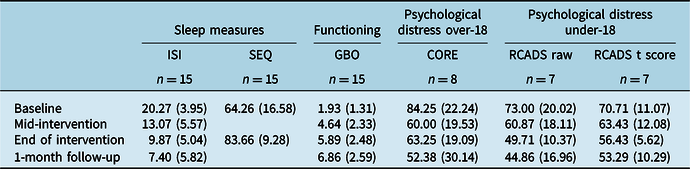
Table 2 displays the descriptive statistics for the measures of sleep, functioning and psychological distress.
Descriptive statistics (mean and standard deviation) for outcome measures

Insomnia
In order to provide a clearer picture of individual patient profiles, Fig. 1 shows individual ISI scores at baseline, end of intervention and follow-up. Participants 14 and 15 were not able to complete the ISI at all assessment points. Previous scores were therefore carried forward.
Individual ISI scores at baseline, end of intervention and follow-up (n = 15).

All fifteen participants (100%) met age-appropriate clinical threshold for insomnia at baseline. By session 3, 60% (n = 9) no longer scored as having clinical insomnia. This further increased to 73% (n = 11) at end of treatment and 80% (n = 12) at follow-up.
SEQ scores at baseline and end of treatment indicate that the percentage of total time in bed spent sleeping rose, on average, from 64 to 84%.
Functioning
Mean GBO scores met the criteria for reliable change (≥2.45) between baseline and all three assessment points. On an individual basis, 12 of the 15 participants showed reliable change on their GBO ratings between baseline and end of treatment (a further participant went on to achieve reliable change by follow-up). Two participants (P14 and P15) did not show any reliable change on their GBO measures.
Psychological wellbeing
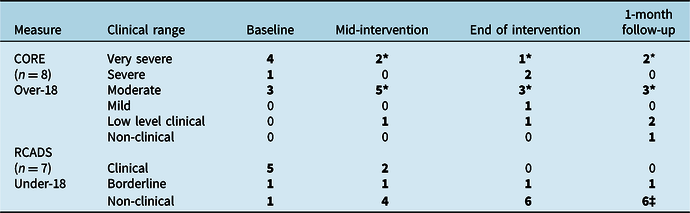
In order to better examine the change in clinical measures at an individual level, clinical ‘caseness’ was calculated for each participant at each assessment point.
Table 3 shows the number of participants scoring in the different clinical ranges of each measure of psychological distress across the course of the intervention. There appears to be a gradual reduction in severity of ratings across the over-18 scores, whilst all under-18 participants were no longer in the clinical range at 1-month follow-up.
Number of participants scoring at clinical threshold on measures of psychological distress

*CORE: missing data carried forwards from baseline in relation to participants 14 (moderate) and 15 (very severe). ‡RCADS: one participant was missing follow-up scores. These were carried forward from end of treatment.
Effect sizes and their 95% confidence intervals were calculated rather than p values reported, in accordance with the recommendation of Lancaster et al. (Reference Lancaster, Dodd and Williamson2004) for pilot studies. Following Bradley et al. (Reference Bradley, Freeman, Chadwick, Harvey, Mullins, Johns and Waite2018), effect size estimates (d) were calculated by dividing change scores by the standard deviation of the baseline scores. Tables 4 and 5 show the change scores, 95% confidence intervals and effect sizes (d) for the measures of sleep, functioning and psychological distress.
Change scores, 95% confidence intervals and effect sizes (d) for sleep outcome measures

Change scores, 95% confidence intervals and effect sizes (d) for functioning and measures of psychological distress

Discussion
Summary of findings
This was a small-scale service evaluation looking at the feasibility and clinical outcomes of six sessions of an adapted CBTi intervention delivered by a graduate psychologist within a secondary care Youth Mental Health service. To our knowledge, this is the first study to explore the impact of a low-intensity sleep intervention in young people with a wide range of existing moderate-severe mental health difficulties. The findings are promising in terms of the acceptability and feasibility of applying this intervention within a routine clinical setting, with high rates of uptake and completion of both the intervention and associated measures. Large effect sizes were found for sleep with most (80%) of participants no longer reaching clinical threshold for insomnia at follow-up and overall sleep efficiency improving from 64% at baseline to 84% at follow-up. Large effect sizes were also found for psychological distress and functioning with all under-18s no longer meeting threshold for clinical ‘caseness’ on the RCADS.
Limitations
The small sample (n = 15) and uncontrolled design make it difficult to be confident that the gains seen were specific to the intervention applied. A larger sample with more graduate psychologists trained to deliver the intervention, together with a longer period of baseline monitoring and follow-up and/or a randomised controlled trial would greatly improve confidence in, and the generalisability of, the findings. In addition, outcome measures were collected by the person delivering the intervention, adding an almost inevitable source of responder bias. A separate assessor, blind to intervention allocation, is also an important consideration for any further research. The large effect sizes reported are therefore being seen as encouraging, but likely to be inflated and so to be treated with caution.
Clinical implications
The response and completion rates are very encouraging with regard to the feasibility of this intervention. There were sufficient referrals from within the clinical team and of those who started the intervention, only one dropped out (due to moving out of the area). In line with Blake et al. (Reference Blake, Sheeber, Youssef, Raniti and Allen2017a), our impression was that the intervention provided people with a sense of agency over an area of their life that they experienced as a significant difficulty, and that gave them relatively quick returns, with positive repercussions in other aspects of their life.
The baseline mean scores for insomnia (20.27 on the ISI) were higher than anticipated, being two to five points higher than other published CBTi studies using this measure (Bradley et al., Reference Bradley, Freeman, Chadwick, Harvey, Mullins, Johns and Waite2018; Clarke et al., Reference Clarke, McGlinchey, Hein, Gullion, Dickerson, Leo and Harvey2015; Conroy et al., Reference Conroy, Czopp, Dore-Stites, Dopp, Armitage, Hoban and Arnedt2019; Freeman et al., Reference Freeman, Waite, Startup, Myers, Lister, McInerney and Foster2015; Freeman et al., Reference Freeman, Sheaves, Goodwin, Yu, Nickless, Harrison and Hinds2017; Palermo et al., Reference Palermo, Beals-Erickson, Bromberg, Law and Chen2017). This may be an indication that sleep difficulties are particularly acute in adolescents experiencing serious mental health difficulties but the small sample size makes it difficult to draw conclusions with confidence. Further research is certainly indicated into the prevalence and severity of sleep difficulties in this population.
The use of a graduate psychologist was a novel adaptation to an evidence-based intervention. The findings suggest that the intervention can be delivered to good effect by a graduate psychologist receiving regular supervision from a clinical psychologist. On reflection, this adaptation seemed to make it easier to provide a clearly focused intervention to young people with multiple, complex needs. There may also have been some advantage to the therapist being similar in age to the service users. Further qualitative accounts from service users would have added greatly to the study.
Whilst sleep was the primary outcome, it was encouraging to see gains also made and maintained at follow-up in relation to mental health and functioning. In line with other studies in this area (Bradley et al., Reference Bradley, Freeman, Chadwick, Harvey, Mullins, Johns and Waite2018; de Bruin et al., Reference de Bruin, Bögels, Oort and Meijer2018; Conroy et al., Reference Conroy, Czopp, Dore-Stites, Dopp, Armitage, Hoban and Arnedt2019; Palermo et al., Reference Palermo, Beals-Erickson, Bromberg, Law and Chen2017), the gains in clinical measures were present but the effect sizes were not as large as those seen in relation to sleep.
Conclusions
The study used an adapted brief CBTi intervention delivered by a graduate psychologist to people being seen within a secondary care Youth Mental Health service and experiencing clinically significant insomnia. The findings suggest that the intervention was feasible and acceptable with large effect sizes seen for sleep, psychological distress and functioning. This suggests the intervention has potential to be a highly cost-effective addition to routine clinical practice, making good use of often limited psychological resources and applicable to a wide range of mental health presentations. Confidence in these effect sizes is limited, however, by the small sample size, unblinded assessments and uncontrolled design. Further research into the prevalence of sleep difficulties in this population is indicated, together with better controlled studies employing multiple therapists across a wider sample.
Acknowledgements
None.
Financial support
The study received no specific grant from any funding agency, commercial or not-for-profit sectors.
Conflicts of interest
None.
Ethics statement
The study’s authors have abided by the Ethical Principles of Psychologists and Code of Conduct as set out by the BABCP and BPS.






Comments
No Comments have been published for this article.