Background
CHD is the most common congenital birth defect. Its incidence is approximately nine cases per thousand, of which two-thirds of cases are simple CHD. Reference Hirose, Ichida and Oshima1,Reference van der Linde, Konings and Slager2 The main intervention for this type of CHD is surgical treatment, so detailed heart imaging and an understanding of its pathophysiological changes are essential for the preparation of children before surgery. Due to professional restrictions, many parents of children with CHD do not understand this type of disease, which leads to poor knowledge of the condition and makes them feel anxiety during the treatment of their children. Reference Werner, El Louali, Fouilloux, Amedro and Ovaert3,Reference Vrijmoet-Wiersma, Ottenkamp, van Roozendaal, Grootenhuis and Koopman4 In recent years, the application of virtual reality technology in the medical field has become increasingly extensive. Studies have shown that virtual reality can play an active role in alleviating patientsʼ pain, reducing anxiety, relieving symptoms of autism and leading to recovery after stroke. Reference Demers, Chan Chun Kong and Levin5–Reference OʼConnor7 However, there have been no reports on the effects of the implementation of condition notification based on virtual reality technology on the parents of children with simple CHD. The authors of this article conducted a prospective randomised controlled study to evaluate the effectiveness of virtual reality technology-based preoperative notification in reducing the anxiety of parents of children with simple CHD.
Methods
This study was approved by the Ethics Committee of Fujian Medical University, China, and followed the Declaration of Helsinki. In addition, all patients signed a consent form before participating in the study.
Calculation of research sample size
The sample size was determined with SPSS 22. 0. Alpha value was set at 0.05 and a power of 0.90. Based on the calculation, the resulting minimum sample size was 54 patients (each group requires 27 participants), considering a 10% drop rate, we included 60 samples for the research.
Research design
A prospective randomised controlled study was performed at our cardiac centre in Fujian province, southeastern China. Clinical and family data of 60 children with simple CHD were collected from February 2020 to August 2020.
Inclusion criteria: (1) Echocardiography was diagnosed as simple CHD, and the heart deformity correction operation was performed at our heart centre. (2) The child’s main caregiver was their parents, and the parents had normal language communication and understanding skills. Exclusion criteria: (1) The parents of the child refused to sign the informed consent form (2) The parents of the child had a history of mental illness or mental illness.
Data collection
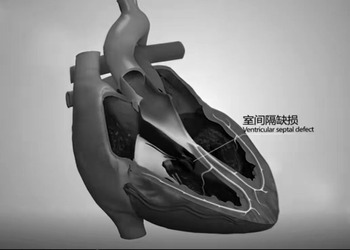
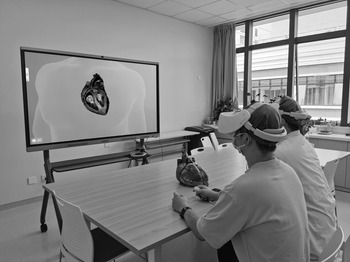
Researchers randomly divided eligible parents into virtual reality and control groups based on computer-generated random numbers. The researchers screened eligible parents for the study, and the social statistics of the participants and the clinical data of the patients were collected. In the virtual reality group, 3D anatomical images of children’s heart and pathophysiological changes were displayed for parents through virtual reality equipment (Fig 1), and their parents were informed of the children’s condition, treatment plan and possible risks, while the control group only provided paper materials and explanations, including children’s colour Doppler ultrasound report, informed consent and operation risk (Fig 2). The time of investigation was on the day of admission and after the condition notification. The state anxiety scale was used for the evaluation of anxiety. The team consisted of a cardiac surgeon, two cardiac surgery nurses and a volunteer who knew the local language. The translated Chinese version was used in the questionnaire. During the investigation, researchers could help participants understand the questions, but they could not induce or interfere with the answers to ensure the authenticity of the answers.
The location of VSD in the heart through VR technology.

The staff explaining the heart anatomy to the family members of the children through VR technology.

Research tool
State-Trait Anxiety Scale: The State-Trait Anxiety Inventory consists of two independent self-evaluation questionnaires, state anxiety inventory. State anxiety scale is widely used in preoperative anxiety measurement. State anxiety inventory includes a total of 20 questions, half of which are items describing positive emotions, and half are items describing negative emotions, mainly assessing participants’ immediate or a specific moment or situation of fear, tension, anxiety or neurotic experience or feeling, which can be used to evaluate the experience or feeling under stress. The four-point scoring method is adopted, 1 = not at all, 2 = some, 3 = moderate, 4 = very obvious and the reverse scoring method is used for items with positive emotions. The scores of state anxiety inventory are in the range of 20–80 points, and the scale scores are positively correlated with the subjects’ anxiety in this aspect. The degree of anxiety can be classified into 20–39 points for mild anxiety, 40–59 points for moderate anxiety and 60–80 points for severe anxiety. Reference Barnason, Zimmerman and Nieveen8 The internal consistency coefficient of STAI is between 0.86 and 0.95, and the retest reliability coefficient is between 0.65 and 0.7. Reference Julian9 The domestic norm is 39.91 ± 8.66 points.
Participant background questionnaire
The background questionnaire designed to improve the research would be provided to participants together with and state anxiety scale to fill in. The background questionnaire mainly understands the demographic information of the participant and some past illness information such as whether there is a mental illness or a history of mental illness.
Statistical analysis
Continuity data were expressed as mean ± standard deviation, and they were all tested for normal distribution, and they followed a normal distribution. The clinical parameters between the two groups were compared with the independent sample t-test. Using χ2 or Fisher test to classify variables. P-value < 0.05 was considered statistically significant. SPSS software package version 16.0 (SPSS Inc. [IBM Corporation]) was used for data analysis and management.
Results
A total of 60 subjects were included in this study. There were 30 cases in the virtual reality group, and 2 cases dropped out; 30 cases were included in the control group and 3 cases dropped out. Finally, a total of 55 family members of children with simple CHD were included. There was no difference in the loss of samples between the two groups.
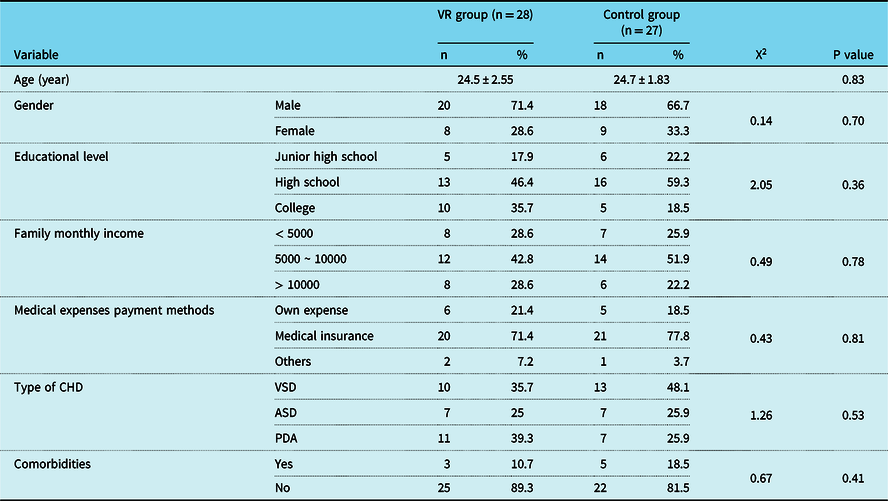
There was no significant difference between the two groups of participants in age, sex, educational level, family monthly income, medical expense payment methods, type of CHD or comorbidities (p > 0.05) (Table 1). The observational baseline measurements of the two groups of participants were comparable.
General characteristics of the study participants (n = 55)

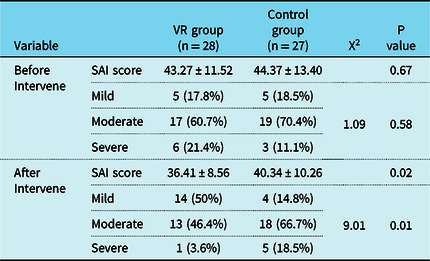
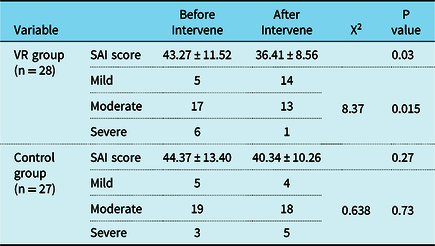
The virtual reality group and the control group had 82.1 and 81.5% moderate to severe anxiety before the explanation of the condition, respectively. There was no significant difference in state anxiety scale scores or anxiety between the two groups (p > 0.05). After the condition was explained, the proportions of moderate to severe anxiety in the virtual reality group and the control group were 50 and 85.2%, respectively. The difference between the two groups was statistically significant (p < 0.05); the state anxiety scale scores of participants in the virtual reality group were lower than those of participants in the control group, and the difference was statistically significant (p < 0.05) (Table 2). The state anxiety scale scores and anxiety levels of participants in the virtual reality group after condition notification were lower than those of participants in the virtual reality group before condition notification, and the difference was statistically significant (p < 0.01), the state anxiety scale scores and anxiety levels after the condition notification for participants in the control group were not significantly different from those of the participants before the condition notification (p > 0.05) (Table 3).
Comparison of SAI scores between the two groups before and after condition notification (mean ± SD) (n,%)

Comparison of SAI score of each group before and after condition notification (mean ± SD, n)

Discussion
Since congenital cardiac surgical interventions were introduced, cardiac surgical technology has become more advanced, and the cure rate of various CHDs has also increased significantly; in particular, the cure rate of simple CHD can even reach more than 95%. Reference Mavroudis, Lees and Idriss10,Reference Jacobs, Tchervenkov and Stellin11 Therefore, when diagnosing and treating children with simple CHD, the pressure on medical staff is not as great as imagined, but the situation is different for the families of the patient. Because of the lack of knowledge about CHDdisease, most people think that as long as the heart is involved, the risks and the mortality rate are extremely high. Reference Lotto, Jones, Seaton, Dhannapuneni, Guerrero and Lotto12,Reference Bishop, Gise, Donati, Shneider, Aylward and Cohen13 Studies have shown that parents of children with CHD suffer from increased levels of stress, anxiety and depression than parents of healthy children or children with other diseases, Reference Werner, El Louali, Fouilloux, Amedro and Ovaert3,Reference Woolf-King, Arnold, Weiss and Teitel14 mainly because they did not know the physical and physiological changes children with CHD experience, which made them unable to predict changes in their child’s condition and to obtain the corresponding care. Reference Fischer, Butz, Nicholson, Blankenship, Dyke and Cua15 Therefore, in the process of the condition notification, ensuring the parents have a clear understanding of the child’s condition and the risks of the operation plays an important role in reducing the anxiety levels of the children’s parents.
Virtual reality is a computer system that can be created and experienced. Virtual reality uses a computer to simulate a three-dimensional virtual environment to provide users with simulations of tactile, visual and auditory senses, allowing users to have an immersive experience, and enable them to observe illusions and objects in three-dimensional space in a timely and unlimited manner. Reference Van Houwelingen-Snippe, Ben Allouch and Van Rompay16,Reference Berg and Steinsbekk17 In recent years, the application of virtual reality technology in the medical field has become increasingly extensive, and most of the research on virtual reality has focused on “virtual reality exposure therapy.” Patients can experience a series of controlled, safe and planned exposures to frightening situations in the virtual world, thereby helping people overcome anxiety and fear in real life. Reference Freeman, Reeve and Robinson18–Reference Carl, Stein and Levihn-Coon20 For medical workers, virtual reality technology can be comparable to 3D printing technology, presenting the complete spatial structure of organs and enabling medical staff to have a more intuitive understanding of the patient’s anatomical structure and pathological changes, thereby guiding the formulation of treatment plans. Reference Humm, Harries, Stoyanov and Lovat21,Reference Ayerbe, Morales, Rojas and Cortés22 In this study, virtual reality technology was applied and presented to the parents of children with CHD. The 3D images of the hearts of the children with CHD were projected through virtual reality equipment. The pathophysiological changes of the children and the precautions taken during hospitalisation were explained. A comparison of the anxiety levels of parents of children using traditional written explanations was conducted in this study to explore whether virtual reality intervention might provide new possibilities for medical research.
In this study, we randomly divided parents into two groups. There was no significant difference in the provided general information between the two groups, and there was no significant difference in state anxiety scale scores between the two groups (p > 0.05) before the virtual reality intervention. This meant that there was comparability between the two groups, but through the table, we found that the proportions of parents with moderate to severe anxiety before the virtual reality intervention in the two groups were 82.1 and 81.5%, respectively. We could see that during the hospitalisation of the children, parents were actually in a period of stress, and for the parents of children with congenital heart disease, the pressure was even worse. the parents did not understand CHD and believed that their children were seriously ill and at risk of death at any time, even if their children had simple CHDs, such as atrial septal defects and ventricular septal defects. Wei and colleagues pointed out that during the hospitalisation of a child, parents would be stressed in many ways, such as stress over the unknown outcome of the operation and the effect of the operation on the child’s appearance. Reference Wei, Roscigno, Swanson, Black, Hudson-Barr and Hanson23 When the condition was explained, parents could have a clear understanding of their child’s disease, which had a significant effect on alleviating the parents’ anxiety. The state anxiety scale scores of the parents of the two groups decreased when compared with the time of admission, and the state anxiety scale scores of the parents in the virtual reality group were significantly lower than those of the parents in the control group, indicating that the explanation of the condition using virtual reality technology was easier for the parents of the patients to understand and accept. Scrimin’s study suggested that the anxiety level of the parents was negatively correlated with their educational level. Reference Scrimin, Haynes, Altoè, Bornstein and Axia24 This might be due to the improvement of the parents’ educational levels, and their abilities to understand the doctor’s daily explanation of the child’s condition could be further improved. Therefore, in the case that the education level of the patient’s parents could not be improved, the use of virtual reality equipment made the parents of children with CHD more knowledgeable about the condition, which helped to relieve their anxiety and obtain good doctor–patient communication.
Restrictions
There were still some limitations in this study: (1) the sample size was small; whether the survey results of older children’s parents would be different remain to be studied, and a larger sample size study should be carried out in the future. (2) As a single centre study, most of the subjects belonged to the southeast coastal areas of China, so the research results might have a regional bias.
Conclusion
Virtual reality technology applied to the condition notification for parents of children with CHD can effectively improve parents’ understanding of their children’s condition and reduce their anxiety levels. This technology is worthy of clinical application.
Acknowledgements
We highly acknowledge the contribution of the participating doctors: Qi-Liang Zhang, Ze-Wei Lin, Wang-Sheng Dai and Ling-Shan Yu. We hope humans eventually defeat COVID-19.
Financial support
No founding.
Competing interests
The authors declare that they have no competing interests.
Consent for publication
All authors read and approved the final manuscript and publication.
Authors’ contributions
Li-Wen Wang, Qiang Chen and Hua Cao designed the study, collected the clinical data, performed the statistical analysis, participated in the operation and drafted the manuscript. Jian-Feng Liu and Wen-Peng Xie participated in the operation and revised the article. All authors read and approved the final manuscript.
Ethical standards
This study was approved by the ethics committee of hospital and strictly adhered to the tenets of the Declaration of Helsinki. In addition, all participants signed an informed consent form before the study.