Introduction
Aglaopheniidae Marktanner-Turneretscher constitutes one of the most diverse and well-known families of benthic hydroids, comprising c. 250 known species (Bouillon et al. Reference Bouillon, Gravili, Pagès, Gili and Boero2006). The distinction at the genus level is based mainly on the gonosome typology, as the trophosome is relatively constant among genera. Its representatives are widely distributed from temperate to tropical waters and from shallow to deep regions. Within the family, there are some differences in the general distribution of different genera: Macrorhynchia is more common in tropical and subtropical waters, Aglaophenia in tropical, subtropical and temperate waters, Cladocarpus in Arctic and deep sea waters, and Lytocarpia in temperate, Arctic and sub-Antarctic waters. Nevertheless, despite their wide distribution, aglaopheniids have never been reported south of the Polar Front.
Members of the genus Aglaophenia are characterized by feather-like, branched or unbranched, monosiphonic or polysiphonic stems (cormoids); unbranched, pinnately arranged hydrocladia, arising from alternate apophyses provided with two lateral nematothecae and a median inferior one; hydrothecae only on hydrocladia, from cone to sac-shaped; each hydrotheca typically flanked by a pair of adnate, lateral nematothecae and with a partly to wholly adnate, median inferior nematotheca; reproductive structure, named corbula, enclosing gonophores within modified hydrocladia, bearing alternately inserted secondary ribs with nematothecae; corbula ribs from completely free to totally fused; fixed sporosacs or released swimming gonophores (modified from Bouillon et al. Reference Bouillon, Gravili, Pagès, Gili and Boero2006).
The effects of global climate change (anthropogenic impacts coupled with global warming) are pushing some species to change their distribution to maintain their thermal optimum. Thus, some species with warm affinity are extending their geographical distribution to areas where it would have been impossible for them to live (due to low temperatures) just a few decades ago (Hughes Reference Hughes2000). In general, most contributions concerning changes in fauna composition and distribution in marine ecosystems (within a perspective of global climate change) have been focused on plankton or nekton, while benthic communities have been practically neglected, above all those inconspicuous groups without commercial value (see González-Duarte et al. Reference González-Duarte, Megina and Piraino2014 and references therein). With a few exceptions (i.e. Puce et al. Reference Puce, Bavestrello, Di Camillo and Boero2009, González-Duarte et al. Reference González-Duarte, Megina and Piraino2014), long-term changes in the distribution of benthic hydroids are not well documented and there is still a need to establish a comprehensive baseline database to enable future comparisons among benthic hydroid assemblages.
The Antarctic shelf benthic communities are dominated by benthic suspension feeders. The top predators are generally restricted to slow-moving invertebrates (i.e. asteroids and nemerteans), whereas there is an almost complete lack of skeleton-crushing predators (i.e. fish and decapods). Their absence is explained by physiological constraints rather than oceanographic barriers (Aronson et al. Reference Aronson, Thatje, Clarke, Peck, Blake, Wilga and Seibel2007 and references therein). However, they are well-known in the deep shelf and slope (Arntz et al. Reference Arntz, Brey and Gallardo1994).
Some evidence of non-indigenous species in terrestrial Antarctic environments is known (Rogan-Finnemore Reference Rogan-Finnemore2008 and cited literature), but neither truly alien species nor changes in Antarctic benthic communities have been documented from the Southern Ocean. In recent years, some authors have hypothesized that the discovery of some decapod crustaceans species in the Antarctic continental slope could be evidence of recent invasions (e.g. Aronson et al. Reference Aronson, Thatje, Clarke, Peck, Blake, Wilga and Seibel2007 and references therein). However, as stated by the authors, some species could correspond to unreported endemics and the time they have been present in Antarctica remains unresolved (Aronson et al. Reference Aronson, Thatje, Clarke, Peck, Blake, Wilga and Seibel2007 p. 143).
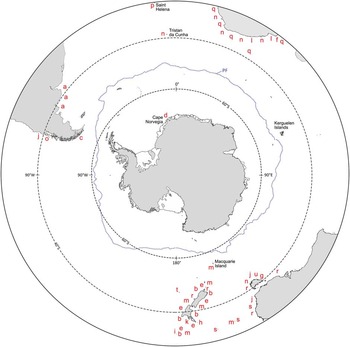
Despite being a widespread and speciose family, representatives of Aglaopheniidae were completely unknown from the Antarctic (see Fig. 1). Consequently, the present contribution represents the first evidence of the occurrence of the family Aglaopheniidae, and the first report of the genus for any Polar Region.
Distribution of the Aglaophenia species in the Antarctic, sub-Antarctic and nearby regions: a. A. acacia Allman, b. A. acanthocarpa Allman, c. A. antarctica Jäderholm, d. A. baggins sp. nov., e. A. ctenata (Totton), f. A. cupressina Lamouroux, g. A. decumbens Bale, h. A. difficilis Vervoort & Watson, i. A. digitulus Vervoort & Watson, j. A. divaricata (Busk), k. A. hystrix Vervoort & Watson, l. A. latecarinata Allman, m. A. laxa Allman, n. A. parvula Bale, o. A. patagonica d’Orbigny, p. A. picardi Svoboda, q. A. pluma (L.), r. A. plumosa Bale, s. A. sinuosa Bale, t. A. subspiralis Vervoort & Watson, u. A. tasmanica Bale. Dotted line indicates the mean position of the Antarctic Polar Front according to Moore et al. (Reference Moore, Abbott and Richman1999).

Materials and methods
The specimens were obtained during the German Antarctic expedition ANT XV/3 off Cape Norvegia, in the eastern end of the Weddell Sea in January 1998. The samples were collected with a Photo Sled and a TV Grab, at depths between 65 and 112 m, from two nearby sampling stations. Material was fixed on board with 4% formalin and later transferred to 70% ethanol. Holotype and paratypes are deposited in Museo Nacional de Ciencias Naturales (MNCN), Madrid, Spain. Additional material is kept in the Hydrozoan collection of the Department of Zoology, University of València (HCUV), Spain.
The material has been examined in detail, identified and illustrated by the authors, and a full description, including the reproductive structures, is provided. To assign a specific epithet to the specimens found, an exhaustive literature search of the species of Aglaophenia reported from the sub-Antarctic region and other close areas (i.e. South Africa, New Zealand and Tasmania) has been completed. As a result, a checklist of the species reported in those waters, their distribution and the corresponding contributor is provided in the supplemental material found at http://dx.doi.org/10.1017/S0954102017000049.
Material examined
Holotype, MNCN 2.03/448: ANT XV/3, Stn 48/33, 29 January 1998, 71°07.3'S 11°28.3'W, 65 m, one cormoid, 42 mm high, with corbulae; substrate unknown.
Paratype, MNCN 2.03/449: ANT XV/3, Stn 48/34, 29 January 1998, 71°07.2'S 11°28.3'W, 68–116 m, two cormoids, 43 and 45 mm high, with corbulae; substrate unknown.
Additional material (HCUV): ANT XV/3, Stn 48/34, 29 January 1998, 71°07.2'S 11°28.3'W, 68–116 m, one cormoid, 36 mm high; substrate unknown.
Results
Aglaophenia baggins sp. nov.
Diagnosis
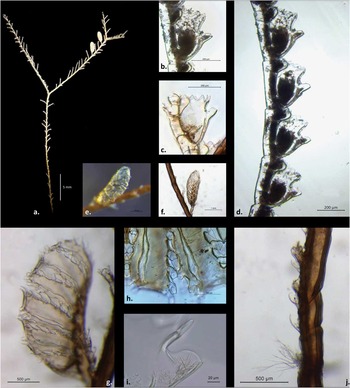
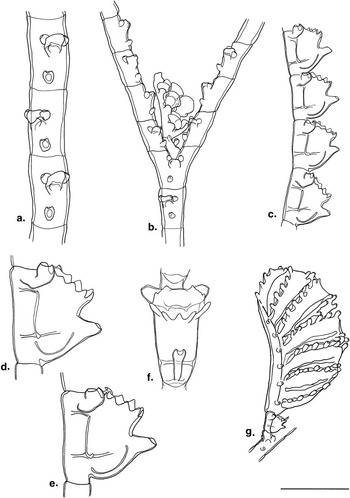
Stems erect, delicate, dichotomously branched, with short hydrocladia not very conspicuous (Fig. 2a). Hydrorhiza unknown. Presence of prosegment unknown. Hydrocauli monosiphonic, divided into short internodes, separated by inconspicuous nodes, more visible at basal portions of stems or after branching. Nodes straight and transversal, with the exception of those from basal part of the secondary stems, which remain parallel to those from the primary stem, and therefore resembling oblique, but gradually inclined along the stem until becoming perpendicular to the long axis of those second-order stems (Fig. 3b). Cauline apophyses, one per internode, alternately arranged in two rows along the hydrocauli, at an angle of c. 30°, giving rise to alternate hydrocladia (Fig. 3a). Each cauline internode provided with an apophysis with a ‘mamelon’ (also named pseudonematotheca), and three nematotheca (Fig. 3a). Mamelons facing the inner space delimited by the two rows of apophyses (Fig. 3a). Two of the nematothecae flanking the apophysis and the third one separated from the apophysis at the basal third of the segment (Fig. 3a).
Aglaophenia baggins sp. nov. a. Cormoid showing dichotomous branching. b. and c. Hydrothecae. d. Fragment of hydrocladium. Different views of the corbulae: e. top, f. underneath, g. lateral and h. detail of the corbulacostae. i. Detail of a mesial nematotheca carrying nematocysts. j. Prosegment.

Aglaophenia baggins sp. nov. a. Cauline internodes. b. Branching stem with developing corbula (hydrocladia not shown). c. Fragment of hydrocladium. d. and e. Hydrothecae in lateral view. f. Hydrotheca in frontal view. g. Corbula. Scale bars: 200 μm (d.–f.), 400 μm (c.), 500 μm (a.), 1 mm (b., g.).

Branching bifid and symmetrical (Figs 2a & 3b) between apophysis and inferior nematotheca, the former supporting a normal hydrocladia. No prosegments observed after branching.
Hydrocladia with transversal nodes delimiting short hydrothecate internodes, each with three nematothecae: one mesial inferior and two lateral (Fig. 3c). Cladial internodes, 259–289 μm in length, provided with two conspicuous perisarcal thickenings, one at the level of lateral nematothecae, the other as a continuation of the intrathecal septum (Fig. 3d–f).
Hydrotheca sac-shaped, short and broad, 299–362 μm in length and 181–219 μm in diameter at aperture (Figs 2b, c & 3d, e). Length/diameter ratio 1.52–1.77. Free part of abcauline wall slightly concave, with thick perisarc, 78–138 μm in length (including adcaulinar cusp), part adnate to nematotheca convex, located more outwards than distal free part, and forming a sort of swelling (Figs 2b & 3e). Hydrothecal rim directed downwards, provided with nine marginal cusps: four pairs of blunt, well developed, lateral cusps becoming shorter towards the internode, and a single abcaulinar one, slightly pointed outwards. Intrathecal septum thick but incomplete, located adcaudally at the basal fourth of the hydrotheca. Lateral nematotheca strongly bent upwards in the middle of its length, distally rounded and projecting outwards, reaching and slightly surpassing the hydrothecal rim. Mesial nematotheca tubular, adnate to hydrotheca for approximately two thirds of its length, and distinctly bent outwards at the distal part. Protruding part located in the middle of abcauline wall or slightly above. Mesial nematotheca with gutter-shaped aperture, never reaching hydrothecal rim, connected to the hydrothecal cavity distally.
Corbulae growing in substitution of hydrocladia. Male corbula ovoid, 1875–2270 μm in length and 825–923 μm in maximal diameter, and provided with six to seven corbulacostae, from mostly to completely unfused nematocladia. The former only fused in the middle of the nematocladium (i.e. unfused near the raquis and distally from its origin). Those completely unfused are centrally located along the axis of the corbula. Without secondary free ribs. Female corbula not seen.
Cnidome composed of microbasic mastigophores in two size classes: large (30.1±0.8 by 3.5±0.2 µm; n=18) and small (5.4±0.4 by 1.5 ± 0.1 µm; n=17).
Discussion
Taxonomic remarks
Despite the new species reported here being ascribed to the genus Aglaophenia with confidence, it is worth mentioning that recent studies (i.e. Moura et al. Reference Moura, Cunha, Porteiro and Rogers2012, Postaire et al. Reference Postaire, Magalon, Bourmaud, Gravier-Bonnet and Bruggemann2016) have shown the genus as polyphyletic and thus its systematics is in need of revision using multilocus molecular examination. Although the colonies were devoid of the basal section and the presence of prosegment cannot be completely validated, a prosegment-like internode was observed following a stem breakage, with an oblique distal node and an approximately transversal basal one (Fig. 2j). A single cormoid was observed bearing stolon-like structures (thickened hydrocaulus) developing from distal part of stem and giving rise to new cormoids (a similar structure was described in the seagrass epizooic A. harpago Schenck and A. picardi (Svoboda & Cornelius Reference Svoboda and Cornelius1991)). A developing corbula was located replacing the first hydrocladia of the secondary branch, in a stem bifurcation (Fig. 3b), but not replacing a branch itself as described in A. acacia (Svoboda & Cornelius Reference Svoboda and Cornelius1991).
Aglaophenia baggins sp. nov. shares the general appearance of the colony and the shape of the hydrotheca with both the cosmopolitan species A. pluma and the Atlantic/Mediterranean A. tubiformis Marktanner-Turneretscher, the latter considered conspecific with the former by Moura et al. (Reference Moura, Cunha, Porteiro and Rogers2012). However, A. baggins sp. nov. differs from both by the larger size of the hydrotheca, the presence of incompletely fused corbulacostae in the male corbula, and the size of the nematocysts (personal observation). Furthermore, A. tubiformis differs by the presence of symbiotic zooxanthellae. In addition, bifid colonies of A. pluma have been reallocated to other species of the genus (see Thorpe et al. Reference Thorpe, Ryland, Cornelius and Beradmore1992, Ansín Agís et al. Reference Ansín Agís, Ramil and Vervoort2001) and there is a general trend that considers A. pluma as an unbranched species. The presence of some incompletely fused corbulacostae have only been reported for A. lophocarpa Allman (as abnormal morphology by Svoboda & Cornelius (Reference Svoboda and Cornelius1991), but as a character variation by Ansín Agís et al. (Reference Ansín Agís, Ramil and Vervoort2001)) and A. tubulifera (Hincks), a species with a remarkably long mesial nematotheca, which distinguishes it easily from A. baggins sp. nov.
In relation to species reported in nearby areas (see Table S1 found at http://dx.doi.org/10.1017/S0954102017000049), A. acacia is easily distinguishable by the trifid branching pattern, deeper hydrothecae and larger corbulae. Aglaophenia antarctica (despite its name, a Patagonian species) has tubular hydrotheca, with the median nematotheca located distally and elongate lateral nematothecae. The other species are quickly discarded by some distinctive diagnostic traits: A. latecarinata by the presence of a keel at the abcauline hydrothecal wall, A. ctenata by its strong intrathecal septae, and A. difficilis and A. hystrix by the inconspicuous lateral cusps of the hydrotheca.
Even when A. baggins sp. nov. could be superficially considered close to the group of A. pluma-like species, the morphological peculiarities discussed above, as well as its location in an unexpected biogeographical region, allow us to describe it as a new species to science.
Ecology
The known bathymetric range of A. baggins sp. nov. extends from 65–116 m. In the absence of further information, and following the bathymetric groups established by Peña Cantero (Reference Peña Cantero2004), it could be considered for now as a species that inhabits the continental shelf excluding shallow waters and therefore avoids anchor ice (see Picken Reference Picken1985). Even when the frequency of ice scour disturbances decreases with depth (cf. Smale et al. Reference Smale, Brown, Barnes, Fraser and Clarke2008), living c. 100 m deep does not prevent ice abrasion completely. Modern ice scour reaches depths up to 500 m at least once every 230 years (Gutt et al. Reference Gutt, Starmans and Dieckmann1996). Furthermore, the eastern Weddell Sea is strongly disturbed by grounding icebergs (Gutt & Piepenburg Reference Gutt and Piepenburg2003). Therefore, if the species described here is well-established, either the actual bathymetric or geographical range could be considerably larger. Future sampling will allow a better understanding of its bathymetric distribution. Regarding the reproductive phenology, the colonies, which are provided with corbulae, were collected in January, coinciding with the summer.
Distribution
Aglaophenia baggins sp. nov. is only known from its type locality off the north of Cape Norvegia in the eastern end of the Weddell Sea. It constitutes not only a new record for the Weddell Sea fauna, but also the first report of the genus and the family for the entire Antarctic region.
Etymology
The specific epithet ‘baggins’ is dedicated to the hobbit characters of the Baggins family created by Professor J.R.R. Tolkien in his fiction, in reference to their tendency, unusual among hobbits, to venture away from their known habitat.
The presence of an Aglaophenia species in the Antarctic
The ecological and evolutionary adaptations of the Antarctic fauna to the coldest marine temperatures and most intense seasonality of food supply on Earth (see Peck et al. Reference Peck, Convey and Barnes2006) make the Antarctic communities particularly vulnerable to global warming and the concomitant invasion of species from lower latitudes (Barnes et al. Reference Barnes, Hodgson, Convey, Allen and Clarke2006 and references therein). This constitutes an excellent framework for understanding the impacts of climate change on marine systems (Aronson et al. Reference Aronson, Thatje, Clarke, Peck, Blake, Wilga and Seibel2007). In this sense, shallow water benthic hydrozoans, which are particularly sensitive to climatic changes (see Puce et al. Reference Puce, Bavestrello, Di Camillo and Boero2009), constitute a potential candidate to detect long-term changes in the community structure of benthic assemblages (e.g. González-Duarte et al. Reference González-Duarte, Megina and Piraino2014).
The High Antarctic has been considered as the least anthropogenically disturbed placed on Earth, but it is vulnerable to large-scale climatic changes (see Gutt & Piepenburg Reference Gutt and Piepenburg2003 and references therein). Recent studies report a considerable short-term increase of shallow water temperature in the Antarctic Peninsula and nearby waters over recent decades (Meredith & King Reference Meredith and King2005). Nevertheless, this increase dilutes with depth; the water temperature at 100 m was almost constant in the period studied by these authors. The great depth reached by the Antarctic continental shelf and the subsequent massive energy input necessary to warm this water volume, coupled with the Antarctic Circumpolar Current circulation, could explain this stability. In this sense, there are very few reports assuming changes in the benthic communities in Antarctic waters. However, those putative drifts are zoologically restricted to some species of litholid crustaceans and geographically limited to the continental slope of the Bellingshausen Sea, the Balleny Islands and the Antarctic Peninsula (García Raso et al. Reference García Raso, Manjón-Cabeza, Ramos and Olaso2005 and cited literature), the latter with a higher warming threat (see Kidawa & Janecki Reference Kidawa and Janecki2011 and references therein). A similar situation occurred for litholids from the sub-Antarctic Kerguelen region (Macpherson Reference Macpherson2004) and Arctic waters (Starikov et al. Reference Starikov, Spirifonov, Naumov and Zuev2015 and references therein). As stated above, some authors (e.g. Griffiths et al. Reference Griffiths, Whittle, Roberts, Belchier and Linse2013) consider that there is no real evidence for current ‘crab re-invasion’ (but see Basher & Costello Reference Basher and Costello2016 for a contrasting opinion). Therefore, no truly non-indigenous metazoan species have been documented from Antarctic marine waters.
The Antarctic benthic hydroid assemblages are rather peculiar in the sense that the diversity of genera that are otherwise distributed world wide and of speciose members of the superfamily Plumularioidea is low. Among the five families included in the taxon (Aglaopheniidae, Halopterididae, Kirchenpaueriidae, Plumulariidae and Schizotrichidae), only Kirchenpaueriidae and Schizotrichidae are well-known in Antarctic waters, each represented by a single but speciose genus (Oswaldella and Schizotricha, respectively). Therefore, although A. baggins sp. nov. is scarce and the real in situ abundance still has to be determined, finding an aglaopheniid in Antarctic waters was unexpected. A similar situation was reported for the genus Nemertesia and the family Plumulariidae, unknown in Antarctic waters until Peña Cantero (Reference Peña Cantero2008) reported a badly preserved specimen of Nemertesia off Deception and Livingston islands in the South Shetland Islands. The present finding is even more remarkable, as the material comes from the High Antarctic and was reproductive when sampled. Unlike the Arctic waters, where some species of Cladocarpus, Aglaophenopsis and Lytocarpia are known (Ronowicz et al. Reference Ronowicz, Kukliński and Mapstone2015), the aglaopheniids were previously unreported from the entire Antarctic region (i.e. south of the Polar Front) and the Kerguelen region (Fig. 1). In addition, the genus Aglaophenia has never been reported in polar waters. Thus, our knowledge about the distribution of its representatives should be re-evaluated.
The presence of this species of Aglaophenia in Antarctic waters may be explained by several factors that can be grouped into three broad scenarios: i) the material studied is a sampling artefact (i.e. contamination from previous samples), ii) A. baggins sp. nov. is a non-indigenous species that arrived to Antarctica either by its own means or by anthropogenic ways (i.e. global change (associated or not to global warming)) or iii) it was already there, but had gone unnoticed.
Cape Norvegia was the first area studied during the ANT XV/3 cruise; therefore, there is no possibility of contamination from previous sampling areas. Furthermore, some of the material came from a TV Grab, which is very accurate sampling gear (Eleftheriou & Moore Reference Eleftheriou and Moore2005). In addition, the presence of well-preserved colonies (with coenosarc and even reproductive structures) allow us to discard the sampling artefact hypothesis.
There is limited knowledge on the anthropogenic disturbance of marine benthic communities by research stations in Antarctica (see Stark et al. Reference Stark, Kim and Oliver2014 and references therein). The nearest inhabited research station is located 100 miles from the area where A. baggins sp. nov. was collected (see COMNAP 2016), which permits us to dismiss the hypothesis of the presence of a human-induced microhabitat that may have enhanced its settlement and survival. Fauna translocation by fouling is prevented by ice scrapping, and ballast water exchanges are only allowed by the Antarctic Treaty north of the continental shelf, although re-ballasting at sea could be an upcoming issue (Barnes & Conlan Reference Barnes and Conlan2007). Dispersion through plastic marine debris have also been considered as vectors of colonization in the Antarctic benthos (Barnes & Conlan Reference Barnes and Conlan2007 and references therein).
There is already some evidence of benthic hydrozoans extending geographical distribution, although their transmission vector is unknown. This is the case for the campanulariid Clytia hummelincki (Leloup) (Gravili et al. Reference Gravili, D’Ambrosio, Di Camillo, Renna, Bouillon and Boero2008) and the sertulariid Sertularia marginata (Kirchenpauer) (González-Duarte et al. Reference González-Duarte, Megina and Bethencourt2013) in Mediterranean waters. Additionally, the aglaopheniid Macrorhynchia philippina Kirchenpauer, which entered the Mediterranean via the Suez Canal, is now a common species in eastern Mediterranean waters (see Morri et al. Reference Morri, Puce, Bianchi, Bitar, Zibrowius and Bavestrello2009). Recently, Galea (Reference Galea2015) reported A. parvula and A. picardi in Tristan da Cunha and Saint Helena (South Atlantic), respectively (see Fig. 1). Whereas the former species is known from South Africa (see Fig. 1 and Table S1), A. picardi was previously unknown from the Southern Hemisphere, suggesting great dispersal capability, human-mediated translocation or lack of knowledge on the taxonomy and/or distribution of some benthic hydrozoans. If considering the first case, a significant number of shared species between different sub-Antarctic and nearby waters (c. 35–45°S) would be expected, but this is not the case; 17 of the 19 species are not shared between the major regions analysed (see Fig. 1 and Table S1).
Some similar and unexpected findings have been recently reported from Mediterranean waters with the description of two new pelagic cnidarians: Marivagia stellata Galil & Gershwin and Pelagia benovici Piraino, Aglieri, Scorrano & Boero (Galil et al. Reference Galil, Gershwin, Douek and Rinkevich2010, Piraino et al. Reference Piraino, Aglieri, Martell, Mazzoldi, Melli, Milisenda, Scorrano and Boero2014). The authors suggest that it is highly unlikely that those species remained unnoticed until their recent description due to their bloom potential and the great number of observers (scientist or not) in that region. None of these premises can be applied to A. baggins sp. nov. and the Weddell Sea.
Assuming that the real distribution and dispersal capabilities of most benthic hydroid species are still far from completely understood, the presence of A. baggins sp. nov could simply be explained by ‘it was already there, but never found’. Being a relict species of a warmer (i.e. interglacial) period that survived the last glaciation in an in situ refugium (see Barnes & Kuklinski Reference Barnes and Kuklinski2010), coupled with the low dispersal capability of pioneer species (Potthoff et al. Reference Potthoff, Johst and Gutt2006), would partially explain its putative low frequency and restricted distribution. Nonetheless, the previous complete absence of representatives of the family in Antarctic waters, the warmer water affinity of the genus (cf. Nutting Reference Nutting1900), the pronounced sampling effort in the eastern Weddell Sea, and the great taxonomic effort regarding Antarctic benthic hydrozoans (resulting in the description of many new species in recent years (see Xavier et al. Reference Xavier, Barbosa and Agustí2013)) prevent us from unequivocally considering the new species as an endemism from the Antarctic region that has gone unnoticed until now. Therefore, it cannot be completely dismissed that A. baggins sp. nov. could be a non-indigenous species that has recently reached the Antarctica and whose native distribution remains unknown.
Acknowledgements
The authors want to express their gratitude to the anonymous referees whose suggestions and constructive criticism improved the quality of the manuscript. The present project was supported by the Conselleria d’Educació, Investigació, Cultura i Esport, Generalitat Valenciana, Spain (ACIF/2011/062).
Author contributions
JJSA analysed the data. JJSA and ALPC conceived and designed the project, contributed reagents/materials/analysis tools and wrote the paper.
Supplementary Material
A supplemental table will be found at http://dx.doi.org/10.1017/S0954102017000049.