


Introduction
Women in secure psychiatric settings represent a distinct population that have differing treatment needs to men: they are more likely to receive a primary diagnosis of borderline personality disorder (BPD), to have fewer previous psychiatric admissions, and to be more likely than men to be convicted of arson (Long, Fulton and Hollin, 2008). Findings such as these indicate the need for gender specific treatment planning that address the relationship between trauma histories, clinical presentation and antisocial behaviour.
Long et al. (Reference Long, Fulton and Hollin2008) describe the development of “Best Practice Service for Women in Medium Secure Settings” using manualized gender specific CBT group treatment programmes for a population with both personality disorder and mental illness. Core group treatments include those that address areas central to the psychopathology of BPD, including relationship problems and emotional dysregulation (Linehan, Reference Linehan1993). Dialectical behaviour therapy (DBT), which has group coping skills training and individual treatment components, was developed for chronically suicidal people with BPD (Linehan, Reference Linehan1993).
This pilot study aims to evaluate the feasibility of cognitive behavioural group treatment adapted from DBT skills training for women with either a primary or secondary diagnosis of personality disorder (dual diagnosis) admitted to a medium secure setting. The evaluation will examine the characteristics of participants, difference between treatment completers and non-completers, resources utilized, and clinical benefits of this intervention in an everyday inpatient setting.
Method
Patient group
Forty-four women, with stable psychiatric symptoms participated: their mean age was 31.7 years, (SD 8.5) and their mean IQ was 84.41 (SD 15.32). Their primary diagnosis was Personality Disorder (emotionally unstable or with mixed features) (n = 31 [70.4%]) Schizophrenia and Schizoaffective disorder (n = 10 [22.7%] and Bipolar and Depressive disorder (n = 3; 6.8%). Personality Disorder was the secondary diagnosis for 10 patients (22.7%). All of the women were detained under Sections of the Mental Health Act 1983 and had a history of disturbed behaviour, self-harm, and emotional dysregulation. Index offences included major violence (n = 17; 38.7%), arson (n = 12; 27.3%), and grievous and actual bodily harm and assault (n = 10; 22.6%).
The setting
The study took place within two medium secure wards within the women's service of an independent, registered charitable trust hospital (St Andrews Healthcare, Northampton, UK).
Measures
All patients completed the Barratt Impulsiveness Scale (BIS 11; Patton, Stanford and Barratt, Reference Patton, Stanford and Barratt1995). Pre- and post-group measures were chosen to assess emotional regulation coping skills, symptomatology, self-efficacy, and behavioural disturbance.
Dealing with Feelings Questionnaire (DWFQ) is a 4-item ad hoc self-report measure that covers the ability to a) tolerate emotional distress, b) engage in activities to reduce negative mood, c) engage in pleasant activities on a daily basis, and d) to recognise changes in mood.
Coping Responses Inventory (CRI: Moos, Reference Moos1990). This 48-item questionnaire has 8 scales covering the use of cognitive and behavioural approach or avoidance strategies.
The Anxiety, Depression, Suicidality, Hostility, Guilt and Tension subscales of the Expanded Brief Psychiatric Rating Scale (BPRS-E; Lukoff, Nuechterlin and Ventura, Reference Lukoff, Nuechterlin and Ventura1986). Symptom constructs are rated on a 7-point scale from “not present” to “extremely severe”.
Generalized Self-Efficacy Scale (GSES; Jerusalem and Schwarzer, Reference Jerusalem, Schwarzer and Schwarzer1992). This 10-item scale assesses the strength of an individual's belief in his or her ability to respond to different situations and to deal with associated obstacles or setbacks.
The women were also monitored for risk behaviours grouped according to the categories of the Overt Aggression Scale (Yudofsky, Silver, Jackson, Endicott and Williams, Reference Yudofsky, Silver, Jackson, Endicott and Williams1986) in the 3 months before the commencement of the group and in the 3 months afterwards.
Group treatment
An individual orientation and information giving session preceded group work. A manualized cognitive behavioural group programme adapted from Linehan (Reference Linehan1993) was developed and delivered by an accredited cognitive behavioural therapist and a trained co-facilitator. Group content and materials were adapted to ensure comprehension by individuals of below average cognitive functioning. Weekly, 90-minute group sessions covered distress tolerance (7 sessions), emotional regulation (8 sessions), and reducing emotional vulnerability (2 sessions). Individual sessions addressed issues relating to skills practise. Post group, participants developed individual relapse prevention plans based on coping skills they had found helpful.
Results
Completers v. non completers
Twenty-nine (65.9%) women who completed 12 or more sessions were classified as treatment completers. Completers were older [mean age 33.4 years (SD 8.97) compared to 28.4 years (SD = 6.97); t(42) = 1.87, p < .05]; and less likely to be single [69% v. 100%; X2 = (4) p < .05]; to have a criminal record prior to index offence [86.1% v. 94.3%; t(42) = 2.77; p < .05]; and to have a primary diagnosis of personality disorder [65.5% v. 80%, t(42) = 2.19, p < .05]. Non-completers scored significantly higher on both the BPRS Hostility subscale, [t(21) = 2.90, p < .05], and on the BIS 11; [t (21) = 2.90, df = 21, p < .05]. There were no differences between the two groups in terms of diagnosis, IQ or risk behaviours in the 3 months prior to group attendance.
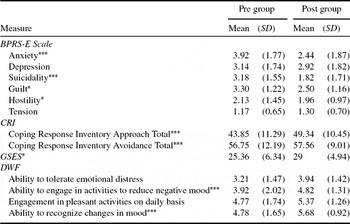
Following treatment, completers had lower scores on the BPRS-E subscales of Anxiety [t(24) = 1.86, p < .01], Suicidality [t (24) = 2.57, p < .0], Guilt [t (24) = 1.75, p < .05] and Hostility [t (24) = 1.52, p < .05]. The CRI Approach subscales that showed significant change were Positive Reappraisal [t (24) = 2.87, p < .01], and Problem Solving [t (24) = 3.21, p < .01]. The CRI Avoidance subscale Alternative Rewards also changed significantly post treatment [t (24) = 2.88, p < .01] (see Table 1).
Pre and post group psychometric assessment (N = 29)

*p < .05; ***p < .01.
A clinically significant change for completers was defined as a combination of more than half of all subjects showing positive change in psychometric scores and a highly significant (p < .01) change on that psychometric for the whole group. Clinically significant changes were observed for the CRI Subscales, Positive Reappraisal; Problem Solving and Alternative Rewards; the BPR subscales Anxiety and Suicidality; and DWF items of ability to engage in activities to reduce negative mood, and ability to recognize mood changes. For non-completers only scores on BPRS-E Hostility reduced [t (10) = 2.75, p < .05] while BPRS subscale Tension scores increased [t (10) = 1.96, p < .05].
Risk behaviour outcomes for completers and non-completers
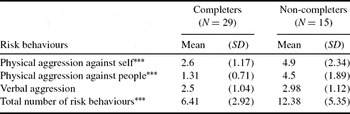
In the 3-month post-group period the mean number of risk behaviours was 6.41 (SD 2.92) for completers versus 12.38 (SD 5.35) for non-completers. There was a significant reduction in risk behaviours following treatment for completers. [t (21) = 3.1, p < .05] with self-injurious behaviours [t (21) = 2.89, p < .05], suicide attempts [t (21) = 2.92, p < .01] and physical assaults [t (21) = 3.21, p < .01] reducing. There was no change in risk behaviours for non-completers (see Table 2).
Completers vs non-completers: means and standard deviations of number of risk behaviours according to Overt Aggression Scale

***p < .01.
Discussion
The uptake and completion of treatment was favourable when compared to previous reports of group CBT with dual diagnosis patients (e.g. Oestrich, Austin and Lykke, Reference Oestrich, Austin and Lykke2007). This may reflect the use of a manual-based treatment which considered responsivity in its construction and delivery, and which was neither patronising, too slow nor too demanding (McMurran and McCulloch, Reference McMurran and McCulloch2007).
Clinically significant changes following treatment were evidenced for the majority of treatment completers on measures of suicidality, anxiety, coping skills and the ability to engage in activities to reduce negative mood and to recognize mood changes. Results suggest that an adapted coping skills component of DBT may benefit a proportion dual diagnosis in patients without concurrent individual therapy (Sambrook, Abba and Chadwick, Reference Sambrook, Abba and Chadwick2007). However, one-third of patients did not complete treatment nor improve. Issues for further investigation include judgements of psychiatric stability, readiness for treatment, and the possible adverse effects of group rather than individual therapy.
The lack of a control group in the current pilot study limits the robustness of the findings and the sample was not a representative cross-section of women in medium-secure settings. Nonetheless, the findings provide a basis for further research into the therapeutic potential of this type of treatment in secure settings for women with a history of behavioural disturbance and complex psychopathology.




Comments
No Comments have been published for this article.