Introduction: Survey Sciences and Metrology's Invention
Egyptian genius always seems to take pleasure in veiling from the world the principle of its lovely creations, concealing it from profane eyes, perhaps so as better to give them a divine origin, keep them pure and guard them from time's injuries. Thus one sees in use in Egypt, but without being able to understand the principle, a measurement system apparently crude but in fact the most exact of all known systems. (Mahmud Reference al-Falaki1873, 67)
Metrological equipment relies on material measures that somehow embody agreed standards used by a specific community to help make its world knowable in quantitative form. Instruments such as measuring rods, balance weights, and pendulum clocks, whether carefully guarded in sites of honor or deployed in the field, help reify joint values held together by their many different users. The making and use of these metrological devices have often been understood as unambiguous marks of modernization, as though shared measures accompany inevitable progressive rationalization (Kula Reference Kula1986, 10–22, 286–88). But notions of sacred tradition and historical precedent are wrapped up with such metrological matters as the choice of a standard based on bodily dimensions, or those of the planet, or of some other hallowed parameter (Alder Reference Alder and Wise1995; Günergun Reference Günergun, Günergun and Shigehisha1996, 215–19; Ashworth Reference Ashworth2004). Alongside the maintenance and reformation of communal measures, standards devices express and enable highly contested and equivocal projects in the reorganization of collective memory (Thompson Reference Thompson1991, 200–23).
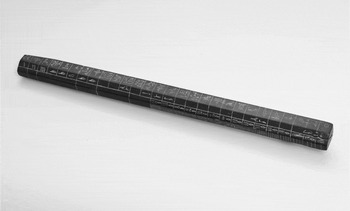
The remarkable lives of the instruments of peculiar interest here demonstrate unusually clearly how such mediations and values work. Made in pharaonic Egypt around 1300 BCE, towards the end of the Eighteenth Dynasty, they are two rods of precious Nubian hardwood, about 525mm in length, engraved in white with names of the gods and of those who commissioned the construction. The artefacts’ markings define bodily units: the digit, which divides each rod into 28 parts, and a sign for the palm, equivalent to four digits. An ibis hieroglyph at midpoint signals a length measure, symbolized by the sacred bird's foot. These objects apparently offer a metrological standard based on the cubit, conventionally the distance from elbow to fingertip. They embody the common Egyptian cubit (6 palms or two feet, about 450mm), and a longer, so-called royal cubit (7 palms, about 520mm), often used in land measures and state building projects (Moss and Porter Reference Moss, Porter and Malek1978, 663, 773–4; Pochan Reference Pochan1933, 286–7; Lorenzen Reference Lorenzen1966, 102–6; Hirsch Reference Hirsch2013, 141–5).
Both rods were made for very senior government officials: the older for Maya, royal treasurer and overseer of works under the pharaohs Tutankhamun (r1334-1325 BCE) and Horemheb (r1306-1292 BCE), the other for Horemheb's director of grain stores, Amenemopet, who later succeeded Maya as treasurer. Like so many metrological instruments, the rods were designed to last. Deposited by their donors at the great temples and tombs, the “houses of eternity” clustered around the pharaohs’ administrative center of Memphis (modern Saqqara), they carried these officers’ worth into the next world (van Dijk Reference Van Dijk and Thorndike Martin2012, 66; Bohleke Reference Bohleke2002; Monnier, Petit and Tardy Reference Monnier, Petit and Tardy2016, 6). The hieroglyphs show the measuring rods were principally intended as votive offerings, material signs of the integrity of these high administrators and royal servants, “whose word,” as the inscription on Maya's rod states, “is truth” (Pierret Reference Pierret1895).
Wooden rod of Maya, Louvre Museum, N 1538, Photo (C) Musée du Louvre, Dist. RMN-Grand Palais / Christian Decamps.

Yet metrology is perhaps an anachronistic term for such artefacts. The rods re-entered recorded history at the moment, the imperial meridian of the early nineteenth century, and at a place, the Egypt of Mehmet Ali Paşa (r1805-48), in which metrology was institutionalized in scientific and historical practices. European agents and their collaborators accumulated measures, assembled them in central depots and exhibitions, then projected them into past and alien cultures so as to justify a putatively universal science of value and government. Before then, in the eighteenth century “metrology” was still merely a synonym for elementary abstract geometry (Savérien Reference Savérien1753, 2:146). This changed with the 1780 text of the Paris mathematics teacher Aléxis Paucton, who in a work with the unprecedented title Métrologie summarized antiquarian scholarship on classical, biblical, and Egyptian monuments: in ancient cultures, “standards of weights and measures were preserved with great care in Temples and sanctified through Religion” (Paucton Reference Paucton1780, 223; Shalev Reference Shalev2002, 573). The Great Pyramid was reckoned a metrological monument commensurate with the dimensions of the Earth, embodying the ancient Egyptian cubit, backed up in 1781 in Paucton's Dissertation on the Pyramids of Egypt. Paucton's readers seemed at once convinced that metrological reform must be based firmly on these ancient eastern principles (Romé de l'Isle Reference Romé de l'Isle1789, xxxii-ix).
After the French Republic declared its meter commensurate with the planet's dimensions, the pre-eminent mathematical astronomer Pierre-Simon Laplace affirmed in his System of the World (1796) that “the relations that many measures of the highest antiquity have between themselves and with the length of the terrestrial circumference indicate not only that in very ancient times was this measurement known exactly, but that it served as the basis of a complete system of measures of which traces are recovered in Egypt and in Asia” (Laplace Reference Laplace1796, 1:99; Alder Reference Alder2002, 89–91). In a telling juxtaposition, it was in 1799 that the word orientaliste first appeared in French, initially as a name for specialists in eastern languages and civilizations. The same year saw the pre-eminent Paris orientalist Silvestre de Sacy, former administrator at the Paris Mint, translate the Mamluk historian al-Makrizi's important treatise on Islamic weights and measures (Silvestre de Sacy Reference Silvestre de Sacy1799; Décobert Reference Décobert1989, 57; Bret Reference Bret, Moulinier, Sallmann, Verna and Weill-Parot2005, 37–8; Said Reference Said1979, 127).
Metrology was born oriental. It was reinforced during the invasion of Egypt from 1798. French savants urged that the Egyptian metrological monuments at Memphis be surveyed “with all the precision of astronomical instruments . . . which have in recent times received such a great degree of perfection” (Galland Reference Galland1803, 243–44; Volney Reference Volney1787, 1:244-5). These engineer-surveyors depended on the accuracy of European workshops. Shipped with Bonaparte's so-called Army of the Orient were pendulum clocks and maritime chronometers, graphometers, and barometers, telescopes and an azimuth quadrant with lenses and a micrometer, six magnetic compasses and a similar number of dip circles (de la Jonquière 1899–Reference De la Jonquière1907, 1:664; Godlewska Reference Godlewska1988, 17–18; Laissus Reference Laissus1998, 34–41). Other equipment was dispatched from the state Weights and Measures service charged with administration of the metric system and its link with planetary dimensions. Bonaparte was advised to buy reliable levels for rapid surveys: “it will also be good to have some young men competent to use these instruments” (de la Jonquière 1899–Reference De la Jonquière1907, 1:327). Such survey apparatus was applied to traces of lost sciences. No doubt the French hardware was supposed to be a sign of the conquerors’ autonomy, even though it scarcely worked without considerable collaboration and improvisation. When damaged or lost, survey instruments were resupplied from workshops and forges set up in Cairo; the workshop director was also ordered to conduct a survey of Egyptian techniques and crafts (Bret Reference Bret and des Sociétés savantes1990, 504–6; Bret Reference Bret, Dewachter and Fouchard1994, 336; Laissus Reference Laissus1998, 172–7). Intense investment in such ambitiously accurate instrumental surveys has principally been studied through the Latin American programs of Alexander von Humboldt and his collaborators. Comparison with exactly contemporary Egyptian survey projects shows how politically crucial was the manufacture and use of such measurement apparatus in the forging of orientalism (Drouin Reference Drouin2001).
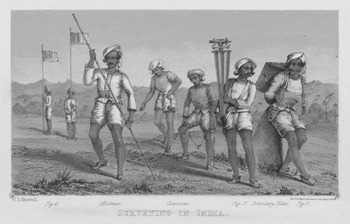
Similar developments in oriental metrology were evident among British administrators, instrument makers, and surveyors, as the East India Company extended its military and political control in the earlier nineteenth century. The term orientalist was used in eighteenth-century English both for writers from eastern lands and for western writers about eastern tongues and cultures. In Company headquarters at Calcutta, the new Asiatic Society founded in 1784 was designed to enlist oriental scholarship in the service of British rule in crucial collaborations and fraught exchanges with a range of other experts and informants (Raj Reference Raj2006, 107–34). As part of this regime, Company surveyors were much concerned with the reliable status of their hardware, the integrity of their connections with major instrument makers, and the commercial measurement systems of subject populations. Standards equipment mattered precisely because military engineers had so much to depend on indigenous experts during revenue surveys. Crucial were the amins (from the Arabic word for trustworthiness) who determined land areas in cultivation to produce an agreed account, a khasra, “known and appreciated by the inhabitants of the district, and performed by natives.” Revenue administrators called khasra work “measurement,” and firmly distinguished it from “that of survey which more properly belongs to the scientific portion of the operations” (Smyth and Thuillier Reference Smyth and Thuillier1851, 574–6; Davidson Reference Davidson1893, 195).
But amins’ measurements and engineers’ surveys were not easily separable. Collaboration in complex projects was both indispensable and productive of novel kinds of practice and hardware (Raj Reference Raj2006, 79–82). Making rapacious levies seem just depended on reconciling amins’ local values with survey apparatus (Appadurai Reference Appadurai, Breckenridge and van der Veer1993, 321–3; Bayly Reference Bayly1996, 151–4; Michael Reference Michael2007, 78–85). Some officers proposed getting rods and chains from local bazaars. Dozens of theodolites, prismatic compasses, and cases of mathematical instruments were obtained from London makers such as Edward Troughton, “whose instruments are of a quality so superior as to gain the confidence of every surveyor who has used them” (Phillimore Reference Phillimore1945–68, 4:149). Confidence counted, because these objects were themselves the sites of negotiation and repair. Instruments were supposed to mediate between the khasra made “by an inferior though intelligent class of natives, the only instrument used being a rod, rope or chain according to the primeval custom of the district,” and engineers’ surveys “performed on scientific principles with first rate instruments and by experienced Europeans and East Indians aided also by natives trained and educated for the purpose” (Smyth and Thuillier Reference Smyth and Thuillier1851, 575–6). In a manual coauthored by military surveyors with a Bengali mathematician, Radhanath Sikdar, it was explained that amins displayed extraordinary accuracy in surveys by eye and were well capable of using theodolites and magnetic compasses. But they were allegedly thus correspondingly cunning and corrupt, unless “watched and checked with an iron hand” (ibid., 599).
Standardized apparatus became part of the official utopian version of the iron hand's “stringent discipline” (ibid., 588). The surveyor's “first duty will be to apply for the standard linear measuring instrument in use. The local standard, if such a thing exists, after being very carefully measured several times over, its value in British feet and inches must be recorded” (ibid., 617). Instrumental measures were supposed to guarantee the systematic exploitative displacement of oriental patronage by commercial accountancy, commuting use rights into cash. The Company's view of revenue surveys conducted in the Deccan territories seized from the Mahratta Empire after 1818 was that “the very object is to eradicate the hand-to-mouth system which has so long prevailed with the agricultural classes and to create agricultural capital” (Papers 1917, 31). The only “means of ensuring accuracy and care on the part of our native measurers” was “the test of remeasurement made by the European officer” (ibid., 60). Body techniques and materials were crucial. According to an 1826 Deccan survey rulebook, each surveyor needed “a standard yard measure of wood” for regular calibration of chains, and, above all, a means of converting indigenous measurements. “Former measurements,” reported one Deccan administrator in 1824, “seem usually to have been made with a rod of five cubits and five clenched fists (equal to about 9 British feet)” (Phillimore Reference Phillimore1945–68, 3:172).
Guesswork about gestures was a worrying yet unavoidable basis for colonial rule. It was therefore politically and fiscally important, for programs of disciplined control over revenue and over labor, to establish a reliable history of primeval measurements linking European standards with oriental territories. And just as there were peculiarly close commercial and geopolitical links in the imperial meridian, involving major crises in Islamic regimes from Istanbul and Cairo to Delhi and Mysore, so there were diffusionist stories that traced deep Indian and Egyptian historical connections in the long history of measurement standards (Bayly Reference Bayly1989, 54–61; Jasanoff Reference Jasanoff2005).
This was exactly when the term metrology entered English, through the East India Company's Calcutta Mint administrator James Prinsep and the fiscal expert Patrick Kelly, who read Paucton's Métrologie with fascination. As in the case of Silvestre de Sacy, mint administration prompted interests in numismatics and the differential value of coinage, and nourished Prinsep's major achievements in oriental scholarship. He claimed his tabulation of primeval records would offer “a curious species of palaeographic chronometer” with which any ancient structure could be serially dated (Prinsep Reference Prinsep and Thomas1858, 2:39). Prinsep's comparable metrological work with Kelly was prompted by the predicament of imperial standards from 1817–19. The British state declared standards be recovered using the length of a seconds pendulum in the latitude of London not, as in France, by planetary dimensions. Pendulum trials were conducted in the capital by the Indian military survey veteran Henry Kater and checked against standard bars manufactured by Troughton for the Ordnance Survey (Simpson Reference Simpson, Godfrey, Anderson, Arthur Bennett and Francis Ryan1993, 183–7). Kater's ally the Anglo-Irish artillery officer Edward Sabine collated pendulum data from the Equator to the Arctic, getting around 39.11 inches for the length of the seconds pendulum at sea level and 45o latitude. “The transmission of our measures to those distant times when our manufactured scales shall have perished” was vital: “on its exact accomplishment depends the value to posterity of every attainment of the present age in which linear measure is concerned” (Sabine Reference Sabine1825, 359, 371; Sabine Reference Sabine1827a).
Sabine encouraged pendulum programs by the Company astronomers at Madras, where a Revenue Survey school trained Indian-European orphans in field methods and where Brahmin assistants staffed work with the Kater apparatus (Sabine Reference Sabine1825, 355; Goldingham Reference Goldingham1827, 3–5, 105–6; Phillimore Reference Phillimore1945–68, 3:254-5; Edney Reference Edney1997, 172–4; Sen Reference Sen2014, 89–90). But there were challenges to this transmission project, including evident variations between seconds pendulums’ lengths at the same latitude. Sabine was impressed by pendulum trials conducted atop the Savoy Alps in September 1821 by the eminent Turin astronomer Giovanni Plana and his colleagues, dispatched by the Piedmont government to complete a geodetic survey along what was called the “mean parallel” of 45o (Carlini Reference Carlini1823, appendix, 28–40; Sabine Reference Sabine1827b). Using precision microscopes to determine pendulum lengths, they showed geological irregularities could distort results significantly (Élie de Beaumont Reference Élie de Beaumont1873, cxvi-xxiii). Significant public cash was spent on making imperial and commercial standards, notably through trials run by Thomas Colby for the Irish Ordnance Survey from 1826 (Miller Reference Miller1986, 119–27; Waring Reference Waring2014, 84–100). “There are few more interesting epochs in the history of English science,” wrote an Indian Trigonometric Survey officer documenting this worldwide standards enterprise (Herschel Reference Herschel and Thomas Walker1879, 12).
In India, Prinsep conducted a census of as many different indigenous measurement systems as he could get, commissioned brass or copper models of each standard, then sent them to London in a calibration program completed by Kelly and Troughton in 1823. Results were published in 1832 with a title both eloquent and, for the British, startling: Oriental Metrology (Kelly Reference Kelly1832, iv-vi). According to Kelly, “measure in a commercial sense signifies the dimensions of any thing bought, sold or estimated” (Kelly Reference Kelly1821, xv; Ashworth Reference Ashworth1994, 422–3). Debates erupted about metrology's politics, focused on Kater's pendulums and the metal models shown at the Company's museum. Prinsep urged that standardization could “only be done in the gradual process of time by the growing intercommunion of the multitudes engaged in the internal traffic of the country” (Prinsep Reference Prinsep1834, 76). He explained variations in length measures between Egypt, Ethiopia, and India through Africans’ “broad hands” and “the ordinary delicate hand of a native of Asia” (ibid., 88). His opponent in the fights around Oriental metrology was a Bombay engineer Thomas Best Jervis, first working as revenue surveyor in the former Mahratta lands in the 1820s, then proposed in 1837 as director of the trigonometric survey of all India, who instead backed centralized imposition throughout the Orient of measurement standards based on pendulum lengths. It would be easy but wrong to see Prinsep as conservative, Jervis as rationalizer. The opposite, if anything, is the case. The devout evangelical Jervis found the basis for all length measurements in scripture and the ancient East. While he found the roots of true metrology in patriarchal standards of Biblical Egypt, “we are to look to India for the most unexceptionable evidence in support of a fact deducible from Holy Scripture” (Jervis Reference Jervis1836, v). A universal metrology of pendulum lengths had been developed in the Orient by divine inspiration, thence diffused worldwide. “The universality and simplicity of the scriptural scheme of metrology,” Jervis argued, would allow the legal imposition of this system throughout the empire (Jervis Reference Jervis1835a, xiii).
Oriental metrology's agenda was complex. Eastern lands, currently the alien home of imprecision and decline, nevertheless allegedly still bore material traces of past precision measures that European survey instruments could recover, then somehow reimpose on those lands’ subject populations (Said Reference Said1979, 83–6; Bret Reference Bret, Levallois and Moussa2006, 42–44). Novel metrologies could calibrate modern techniques against antiquity. At the Institute of France in 1821, the polytechnicien Charles Dupin, an economist who treated comparative measures of work as a universal standard of value, argued in a lecture on industrial development that it would take Britain's steam engines a mere 18 hours to build the Great Pyramid (Dupin Reference Dupin1825, 148–9; Vatin Reference Vatin1993, 30, 58–62; Tresch Reference Tresch2012, 339). Himself a veteran of Mediterranean schemes on the island of Corfu from 1808, Dupin saw Bonaparte's occupation of Egypt as a scientific and industrial “crusade” and drew calculated lessons about oriental tyranny's wastefulness (Dupin Reference Dupin1819, 135; Fox Reference Fox, North and Roche1985, 306–7). London journals commented on the political measures Dupin's comparison taught those who understood metrology's meanings (Chenevix Reference Chenevix1826, 91).
A decade later in Egypt, polytechniciens and other orientalist disciples of the visionary industrial reformer Henri Saint-Simon, engaged in what they also saw as a “peaceful crusade,” enthusiastically supported Mehmet Ali's startling (if abortive) proposal to demolish the Pyramid and use the rubble to build an irrigation dam across the Nile (Enfantin Reference Enfantin1865–78, 30: 212, 221–22; Picon Reference Picon2002, 157). For their charismatic leader Prosper Enfantin, this was an opportunity to direct “great masses of workers” and educate “a Napoleon of industry” (Enfantin Reference Enfantin1865–78, 29:126). The “regimented, graded, disciplined” Egyptian workforce would become “military regiments, commanded by engineers” with “compass and set-square at their sides” and “officers with the metre in their hand” (ibid., 9:15: emphasis in the original). Instrumental measurement systems seemed to offer ways not only of computing ancient and modern values but of disciplining and transforming them (Régnier Reference Régnier1989, 61–66; Tresch Reference Tresch2012, 220–1). But this was never a unidirectional enterprise. European analysts might use oriental achievements as a means of calibrating industrial and political strength, yet Egyptian and Indian protagonists challenged and changed what counted as scientific modernity.
In what follows, three moments in the forging of this value-laden repertoire are in question: fierce metrological and institutional debates in Restoration France, during which the pharaonic cubits were central to arguments about the status of survey instrumentation and its use; Jervis's program launched under Company raj for the restoration of an allegedly patriarchal and primordial metrology that would aid imperial policy and surveys in south Asia; and the economically fraught milieu of Egypt in the period of the construction of the Suez canal and imposition of European fiscal control, when questions of ancient and modern scientific expertise were at the heart of political enterprise. In all three moments, metrologists’ notion of a purified immortal value system was connected directly with fights about the authority and long-term historical meaning of scientific and technical hardware.
The Cubit Wars: Egypt and France, 1798–1828
Everywhere they went, European surveyors deployed their precision instruments: “there's so to speak not one block whose character we haven't recorded, fixed its position and studied its shape” (Bourguet Reference Bourguet and Bret1999, 33–34; Godlewska Reference Godlewska1995, 12; Forgeau Reference Forgeau, Bourguet, Lepetit, Nordman and Sinarellis1998, 45–47). In Egypt under French occupation, reliance on local expertise accompanied imposition of metrological standards, especially in surveys of property and revenue. Indigenous surveyors were subject to examination; Egyptian standards were traced to their historic origin (Bret Reference Bret, Moulinier, Sallmann, Verna and Weill-Parot2005, 187–91). Such survey equipment was often seen as armament. Leaders of the Egyptian survey, such as the mathematician and administrator Jean-Baptiste Fourier, urged “exact determination” and “guaranteed precision.” He explained in 1809 in a text presented to the French Emperor that “in distant provinces, whose submission was recent and uncertain, we were often obliged to replace our geometrical instruments with weapons, and in a sense to fight over the land we were to measure” (Fourier Reference Fourier1821, lxxxv-vi). The editor of the Description of Egypt, the eminent geographer and surveyor Edmé Jomard, echoed his master Fourier's sentiment: French savants “had learnt to contest the ground they had to measure” (Jomard Reference Jomard1840, 753–4). In Egypt preparing “the workplace and the instruments, the battlefield and the weapons,” Enfantin saw Mehmet Ali's proposed Nile barrage as “the finest battlefield that's been opened up to industry, worthy of the Pyramids that dominate it” (Enfantin Reference Enfantin1865–78, 9:206-7; Alleaume Reference Alleaume and Morsy1989, 124–6).
Field surveyors in insecure and embattled territory improvised. In 1791 the East India Company's senior geographer James Rennell calculated that caravan rates and magnetic compass bearings on Syrian desert routes linking the Mediterranean with the Persian Gulf showed “the hourly rate of the camel may be applied as a very useful scale to African geography, whensoever the use of watches shall be adopted by the native travellers employed, and with still greater advantage, of course, if Europeans are employed” (Rennell Reference Rennell1791, 140). In December 1799, the engineer Pierre-Simon Girard's surveyors used this compass and caravan method to measure the strategic Cairo-Suez route as yet uncontrolled by the French: “the camel's step is of a perfect regularity; it is a true animal pendulum clock” (Villiers du Terrage Reference Villiers du Terrage and de Villiers du Terrage1899, 234; Bret Reference Bret1998, 230; Bourguet Reference Bourguet and Bret1999, 29–30; Laissus, Reference Laissus1998, 318).
The inhabitants of the lands Europeans looted and surveyed were struck by these analytical obsessions. When surveyors used their lips and tongue to judge the kind of stone of which the relics were made, Egyptian workmen allegedly saw this as an atavistic pagan ritual. “It is impossible for them to conceive that a love of history might attract at such a distance,” wrote one French agent (Rifaud Reference Rifaud1830, 116–17). But Egyptian scholars could use their own traditions of astronomy and erudition to make sense of these projects. Pharaonic monuments played a major role in classical Arabic commentaries, as “standards for measuring curiosities,” clear signs of infidel rulers’ fate and the transience of creation (Colla Reference Colla2007, 79). Proper to the period of pagan ignorance (al-Jahiliyya), these were structures that could aid meditation on the defeat of the tyrannic oppressor or the superior antiquity of indigenous knowledge and skill (Dykstra Reference Dykstra1994, 57–9; Reid Reference Reid2002, 28–31). The Egyptian scholar ’Abd al-Rahman al-Jabarti, son of an expert Cairo astronomer whose house was stocked with impressive apparatus, waspishly recorded Europeans’ passion for “obscure details,” puzzling at the removal from the pyramids of “vast quantities of debris made up of bats’ droppings,” while admiring the instrument workshops and the savants’ “extraordinary and very well-made astronomical instruments, costly measuring instruments of marvellous design, covered in shiny brass” (Bosworth Reference Bosworth1977, 232; al-Jabarti Reference Al-Jabarti and Cuoq1979, 92; Ortega Reference Ortega and Bret1999, 101; Murphy Reference Murphy2010, 567–8; al-‘Adl Reference Al-’Adl, Hanna and Abbas2005; Stolz forthcoming, chap. 1). He reported that during the Cairo revolt against the French occupiers in October 1798 “a great number of precision instruments: extraordinary telescopes, astronomical apparatus, measurement equipment for engineering and mathematics” were destroyed as signs of European power (al-Jabarti Reference Al-Jabarti and Cuoq1979, 84). The contrasts were telling. Europeans made a sharp orientalist distinction between western precision and eastern laxity, the metrological theme reinforcing the value-laden distinction.
Just as East India Company surveyors tried to discriminate between measures generated through instrumental scrutiny and information collected from native informants, so in Parisian museums, institutes, and instrument shops, fights raged about oriental metrology's hardware and methods (Ludden Reference Ludden1993, 262). A contrast emerged between ambitious surveyors, who judged ancient materials fit principally for instrumental measurement; and learned antiquarians, who saw such traces as prompts for philological decryption. The difference was evident in the notorious controversy about the astral imagery at the Hathor temple at Dendera seen by Fourier's team, before its zodiac ceilings were brutally shipped to France in 1821. Surveyors and mathematicians such as Fourier treated the Dendera images as precise 4500-years-old astronomical charts, and were praised by Dupin for doing so (Buchwald and Josefowicz Reference Buchwald and Greco Josefowicz2010, 194–203, 327–30; Dhombres Reference Dhombres and Bret1999; Bret Reference Bret, Moulinier, Sallmann, Verna and Weill-Parot2005, 178–82, 196–9; Dupin Reference Dupin1819, 119–20).
Opposed were antiquarians such as the library professor Jean-Antoine Letronne, who reckoned the zodiacs much more recent Greco-Roman religious structures. Letronne argued that those field astronomers who imagined an ancient science of “an exactitude that we cannot surpass despite our theodolites, repeating circles and other precision instruments” had “fallen into one of those illusions that must often mislead when calculation is applied too soon to facts inimical to it” (Letronne Reference Letronne1845, 5–6, 21). An irony: instrumental metrologists often found extreme precision among the ancients, yet studious philologists insisted such scientific precision was entirely modern.
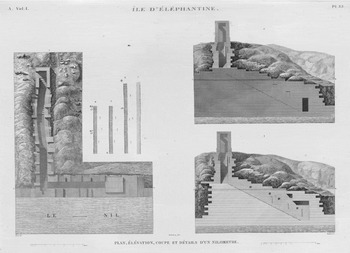
According to the surveyor Girard, who in 1799 painstakingly measured the scale of flood heights at the Elephantine nilometer at Aswan to derive a value for the ancient cubit, “the discovery of an ancient measurement standard renders erudition useless” (Girard Reference Girard1828, 37). During the Upper Egypt survey, Girard was notoriously impatient with colleagues who “bothered with hieroglyphs” rather than charting the river system (Villiers du Terrage Reference Villiers du Terrage and de Villiers du Terrage1899, 167). In contrast, the pre-eminent antiquarian Jean-François Champollion, protagonist of the Dendera controversy and decoder of hieroglyphics in 1822, ranked erudite reading above exact measures: “in Egypt, sculpture and painting were always nothing but true branches of writing. A statue was really only a simple sign, a true written character” (Champollion Reference Champollion1824, 10; Said, Reference Said1979, 140; Said Reference Said1994, 141–2).
Surveyors claimed instruments’ readings would obviate pedantry and reveal primordial values, since ancient Egyptian practices resembled modern European survey chains and theodolites, even though modern Egypt was a site of stasis or decline. In studies of the Egyptian hydraulic economy, Girard rated what he called “capitalist colonists” above indigenous farmers. Ingenious experiments on irrigation labor let him directly measure “the ordinary force of Egyptian men” (Girard Reference Girard1822b, 95). Such trials confirmed his view of the preservation of “the same agrarian measures” since ancient Egypt's great hydraulic achievements (Girard Reference Girard1822b, 198; Kalin Reference Kalin2006, 30–32). The issue became pressing during Mehmed Ali's strenuous campaigns in irrigation and canal building that often mobilized French engineers as expert managers (Crozet Reference Crozet2008, 30–32). During the abortive Nile barrage project, Enfantin regretted that Egypt's “pyramidal souvenirs are still too much alive” and that antiquarians had thus “halted with the pharaohs on the Nile” (Enfantin Reference Enfantin1865–78, 30:179). Instead, he argued, it was necessary “to add a character of hieroglyphic art to industrial construction” (Picon Reference Picon2002, 157). Socioeconomic development became identified with mastery of sophisticated instrumental measures. In a manner comparable with Dupin's lectures on pyramids and steam engines, Girard introduced accounts of measures of hydraulic efficiency to aid economic development (Girard Reference Girard and Smeaton1810). Similarly, Jomard returned from London in 1815 lauding artisans who by “perfecting mechanical instruments” had produced “a kind of uniformity,” launching schemes for industrial education and calculating devices with “twice the precision of the English one-foot rule” (Jomard Reference Jomard1815, 179, 189; Laissus Reference Laissus2004, 148–9; Dias Reference Dias, Bourguet, Lepetit, Nordman and Sinarellis1998, 172–3).
Elephantine nilometer, Description de l’Égypte, Antiquités: planches, vol. 1 (1822) plate 33. Plan drawn by Pierre-Simon Girard. By permission of University of Cambridge Library.

For Jomard and his colleagues, it was as if the great achievements of pharaonic sciences had been reincarnated in modern French forms (Laissus Reference Laissus2004, 179). In a long 1817 essay that won prestigious academic recognition from Humboldt and others, he argued such precision instruments could also allow a kind of time travel, lifting what he called the “veil” covering Egyptian mysteries: “from the proportions that shine from these monuments, the rules according to which they were erected can be derived” (Jomard Reference Jomard1817, 212). Even if European surveyors “had at their disposal improved instruments of which the Egyptians did not know,” yet the match between modern and ancient values could rely on pharaonic “land surveying, carried out over a long period with much precision” (ibid., 28). Current oriental culture would be reformed and past cultures redeemed, even surpassed (Bret Reference Bret2003, 7). Aiming to emulate, then displace, the Hellenistic achievements of Eratosthenes and Ptolemy, Jomard sought to “lay down the foundations of a new school of Alexandria which, setting off from a more advanced point, could one day efface the old one” (Jomard Reference Jomard1841, 6). In reports written for Mehmet Ali's régime and management of Egyptian trainees brought to Paris to study the sciences and engineering, Jomard and his allies stated that oriental peoples “could not be expected by any stretch of the imagination to reach the same level as their European rivals,” yet that Egyptian society could and must be modernized under the guidance of modern precision expertise (Silvera Reference Silvera1971, 309; Laissus Reference Laissus2004, 339–40; Mitchell Reference Mitchell1988, 34–43, Heyworth-Dunne Reference Heyworth-Dunne1938, 157–70). But to make all this work, it was crucial that instruments generate effective consensus on measured values. They didn't.
In the early years of Mehmet Ali's rule and of restored monarchy in France, something like a cubit war raged among surveyors and antiquarians. At stake was metrological history, relations between different versions of the ancient cubit. Strong political conflicts between the conservative religious establishment of the restored Bourbons and veterans of radical materialist ideologies of the Revolution helped nourish these contests. Rivals disputed whether modern instruments could reveal the character of ancient values and whether these measures resembled those of current instrumentation. Protagonists included the hydraulic engineer Girard and the mathematical surveyor Jomard (Laissus Reference Laissus2004, 181). An irrigation expert who found similar projects in ancient Egypt, Girard reckoned the nilometer gauge a primordially precise hydraulic metrological record, giving a royal cubit of seven palms as 527mm, a measure matching classical authority and his colleagues’ December 1799 survey of the Great Pyramid's base (Girard Reference Girard1822a, 34). Though some expedition colleagues wondered whether the nilometer might be Arabic, not ancient, Girard's measures suggested its immense age (Girard Reference Girard1822a, 94; Villiers du Terrage Reference Villiers du Terrage and de Villiers du Terrage1899, 172, Jollois Reference Jollois and Lefèvre-Pontalis1904, 102). Comparisons between flood marks gave a uniform rate of Nile river bed elevation and a nilometer date of 2960 BCE, the start of hydraulic agriculture: “the nilometer cubits’ use went back beyond the ages of history, and had become a sacred object for the multitude” (Girard Reference Girard1824; Buchwald and Josefowicz Reference Buchwald and Greco Josefowicz2010, 200–1). Like Prinsep, Girard explained metrological change through body technique. Displacement of the seven-palm royal cubit by a common cubit of six was due to shifts from measurements with forearm and fingers to a standard embodied in a rod. He compared the change to Revolutionary French metrication (Girard Reference Girard1822a, 25–27). Girard's corporeal and hydraulic history of precision instrumentation allegedly recovered Egyptian metrology.
The surveyor-geographer Jomard dissented, urging instead the cosmic geometry of Egyptian metrology (Dias Reference Dias, Bourguet, Lepetit, Nordman and Sinarellis1998, 160–1). Astronomers’ pyramid surveys were better than nilometer results because, like modern polytechniciens, ancient Egyptians were “well versed simultaneously in practical geometry and practical astronomy” (Jomard Reference Jomard1817, 37; Laissus Reference Laissus2004, 163–4). Jomard recalled his January 1798 pyramid measures with survey poles, giving an original cubit length of 462mm, much shorter than Girard's, and proving, after clambering up, the precise commensurability of the monument's oblique height with the mean latitude degree (Laissus Reference Laissus1998, 222, 326–7). Ancient Egyptians “possessed precise measures connected by a certain law”: cubits were derived from ancient measures of the Earth's dimensions (Jomard Reference Jomard1817, 2–3). Contradictions with classical literary authorities were dismissed as copyists’ errors. Even Paucton was wrong about Egyptian geometry (ibid., 20–27). Jomard claimed the astronomical match “is certainly very much better than that of most measures made in modern times” (ibid., 28). The ancient edifice “is a metrical monument, destined to preserve the unit of national measures” (ibid., 25). His pharaonic Egypt became a surveyors’ utopia “worthy of being imitated by modern peoples, and by France above all, to whom the learned world owes such a perfect measure of the Earth and system of measures” (ibid., 37).
The cubit war was fought on several fronts. For antiquarians such as Letronne, ferocious opponent of surveyors’ exaggerated quantitative claims, the clear conflict between Girard's and Jomard's cubit lengths, hydraulics versus geometry, bodily versus astral techniques, might indicate metrologists could not even agree among themselves. But more important was what the library director saw as oriental metrology's deluded presupposition that ancient culture had exact instrumentation to which modern precision instruments could give access:
When the little that remains to us of Egyptians’ astronomical science is studied, one is convinced it made little progress. . . . We'd like to find amongst them precision, the search for exactitude, that are characteristics of the modern mind. They are made to make measurements with the rigour we are able to apply, thanks to our repeating mural circles, our theodolites, armed with verniers and telescopes. It is but a small step to suppose they had a Board of Longitude in each of their colleges. Truly historical study makes these seductive dreams vanish. (Letronne [1838] Reference Letronne1863, 118–19; Godlewska Reference Godlewska1999, 298–9; Feyel Reference Feyel and Perrin-Saminadayar2001; Buchwald and Josefowicz Reference Buchwald and Greco Josefowicz2010, 327–30)
In question in oriental metrology's controversial reveries was thus a revisionist history of antiquity's glorious precision, resuscitated by European instruments, and applied to the modern east.
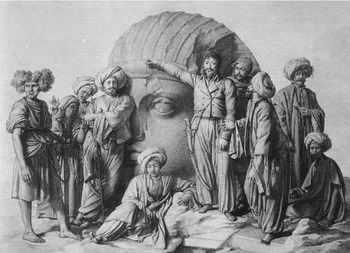
Such issues dominated the career of the pharaonic wooden measuring rods when they were recovered in excavations at Saqqara in the 1820s. Unlike Girard's nilometer calculations or the conflicted results of applying survey chains to the sides of pyramids, these seemed immediately accessible, mobile and robust, ancient Egyptian metrological instruments. In a manner increasingly common among antiquarians and mineralogists, proxies could be made of their inscriptions (Rudwick Reference Rudwick2005, 75–77). With more investment, the rods could even be shipped to Europe as learned loot. These years witnessed intense, sometimes violent, competition between European collectors’ gangs. Jomard told the aggressive Piedmontese entrepreneur Bernadino Drovetti, chief agent in Alexandria and close ally of Mehmet Ali, “it is sad to see learned Europe commit more ravages in Egypt than the Persians, the Arabs and the Turks” (Drovetti Reference Drovetti, Curto and Donatelli1988, 140–1). Yet Jomard and his colleagues demanded shipment of ever more relics. Commercial antiquities networks and exploitative employment systems spread up the Nile valley (Ridley Reference Ridley1999, 250–2; Jasanoff Reference Jasanoff2005, 226–33). In a memorandum commissioned by Mehmet Ali, Champollion appealed explicitly to privileged European interests in Egyptian antiquities, proposed joint control on excavation and demolition, and condemned the allegedly barbarous damage wreaked on the monuments by Egyptian fellahin (Champollion Reference Champollion and Hartleben1909a, 443–8). Within a few years, Mehmet Ali's government issued a decree, scarcely implemented, to protect remains and establish a “public exhibition” in Cairo, the Antiqakhana, with European concerns in antiquity collection given central significance (Colla Reference Colla2007, 98–104, 116–20; Reid Reference Reid2002, 54–57). Egypt was orientalized as a kind of grand exhibition, simultaneously antique and commercial, under European inspection (Mitchell Reference Mitchell1988, 15–33; Said Reference Said1994, 144–45).
Drovetti's team at Thebes in 1818 (from Forbin, Voyage dans le Levant, 1819). By permission of British Library.

The recovery of the measuring rods followed this pattern of plunder, polemic, and long-range mediation. Youseff Masarra, an antiquities dealer of Syrian origin attached to the French consulate, worked at Saqqara for a variety of European clients, then became Drovetti's Memphis agent (Balboni Reference Balboni1906, 1:307-8). In summer 1819 Jomard had already told Drovetti his collections should come to Paris, “the capital of arts,” expressing special interest in any antique measures he could get (Drovetti Reference Drovetti, Curto and Donatelli1988, 133–5). In 1821 Masarra located one wooden cubit, that later to be associated with Amenemopet. He passed it to Girolamo Segato, medical naturalist, mummification expert, and Egyptian mapmaker, who made drawings of the artefact, which his patron Drovetti then shipped to Jomard along with a plaster cast (Balboni Reference Balboni1906, 1:308). Over the next four years business and political networks linking Cairo and Alexandria with Livorno and Turin, Marseilles, and Paris, buzzed with interest in the wooden cubits. To make “the capital of arts” into a metrological center of calculation, reliable versions had to be assembled under the direct control of European savants. But reliability was fragile. Drovetti told his Marseilles business contact that amongst his collection “one on its own, the Egyptian cubit,” was worth more than “all those trinkets” collectors sought (Drovetti Reference Drovetti and Guichard2003, 298). Drovetti's plaster model shrank crossing the Mediterranean, and the paper on which Segato's drawings were engraved contracted too, damaging attempts to reconstruct oriental metrology from their evidence. The wooden rod itself could also diminish through shrinkage (Balboni Reference Balboni1906, 1:308; Champollion Reference Champollion and Hartleben1909b, 36–37; Lorenzen Reference Lorenzen1966, 102).
To French fury, after tortuous negotiations completed in spring 1823, the first wooden cubit and much of Drovetti's collection ended up in the Piedmontese capital of Turin, where its curator celebrated the arrival of “an example of a measure or a cubit of the ancient Egyptians equipped with various divisions and hieroglyphs” (Cordero di San Quintino Reference Cordero di San Quintino1823, 198; Curto, Reference Curto1976, 45–48, 92–96; Ridley Reference Ridley1999, 256–8). Inspecting the Turin collection a year later, Champollion reiterated that European philology, not oriental metrology, must guide collections’ disposition: “each object always bears an original inscription that indicates without doubt both its goal and destination. The Turin Museum, so classified, would for the first time present to learned Europe a methodical series of monuments” (Champollion Reference Champollion and Hartleben1909b, 18).
Orientalist methods assumed what counted was “presentation to learned Europe.” They believed that educating officials in new European sciences and stashing relics in new European museums would somehow reawaken Egypt. While a second wooden cubit, that of Maya, was recovered at Memphis, Parisian savants campaigned to build an Egyptian collection at the Louvre to rival Turin (Ridley Reference Ridley1999, 206–12). At exactly the same time, Drovetti collaborated with Mehmet Ali's government to send groups of Egyptian trainees to Paris under Jomard's direction to acquire European sciences (Heyworth-Dunne Reference Heyworth-Dunne1938, 157). Jomard urged France not to “renounce the honour that belongs to her of having been the first to extract the great works of Egypt from the dust and to have reawoken the genius of this colossal people buried under ruins for twenty centuries” (Jomard Reference Jomard1825, 225–7). By autumn 1826 Mehmet Ali's trainee delegates were in Paris, and in October 1827, all of Drovetti's second collection was sold to the French state (Ridley Reference Ridley1999, 272–4).
Jomard later reflected on Mehmet Ali's modernization strategy and Drovetti's role: “A prince, a man of genius, had grasped the helm of state. The French consul [Drovetti], who'd become his friend, his confidant, helped him in this enterprise. It was only necessary to continue the work of France. Sleeping germs, so to speak, were awoken; the Paris correspondents of M Drovetti supplied him with reform plans” (Jomard Reference Jomard and Bey1861, 17). Thus as ancient relics and Egyptian students traveled to Europe, it was imagined modernity would reach Egypt in exchange. Jomard explained to Drovetti that “objects of curiosity or erudition,” notably the wooden cubit, “must be sent separately.” Drovetti happily learnt the instrument might realize a good price (Drovetti Reference Drovetti, Curto and Donatelli1988, 321). Since it was “a piece of wood with incrustations of white paste,” he ordered his handlers at Marseilles docks to “make sure that if the cubit has to pass through water and vinegar, leave it in the hands of the ship's captain, who will give it back to you on leaving quarantine” (Drovetti Reference Drovetti and Guichard2003, 489). Having survived these strenuous mediations, the mobile wooden cubits fixed in Turin and at the Louvre took on new lives amidst oriental metrology's polemics (see fig. 4).
Wooden rod of Amenemopet, Egyptian Museum Turin, cat. No. 6347.

The European presence of the rods’ scaled images, and eventually the rods themselves, rekindled the cubit war. During 1822, orientalist news gripped the press. At the start of the year, the looted Denderah zodiac arrived in France; a new Asiatic Society with Silvestre de Sacy as president was founded in Paris during the spring; and at the Academy of Inscriptions in September, Champollion announced his decoding of hieroglyphics. Jomard delivered his first report on what became the Drovetti cubit at the very same moment. Decisive was the exactitude of the newly recovered devices, comparable with those of Paris instrument shops: “the delicate division of the instrument shows manifest intention on the artist's part to provide precise dimensions” (Jomard Reference Jomard1822, 13). Still lacking direct access to the rods, without sure command of hieroglyphs’ sense, the surveyor instead published a cubit diagram. His audience were to see a 520mm scale of 28 inches divided unequally, rather like the slide rules with which Jomard was so familiar, with three separate sections of total length 58mm at one end. “The instrument itself will answer this difficulty” (ibid., 8). Signs for cubit and palm seemed legible on the scale. The metrological genealogy looked clear. An older cubit of 462mm, making 24 inches or six palms, was later lengthened by three inches. “This precious fragment of antiquity must be considered as a kind of standard on which it was intended to preserve knowledge of the value of the ancient cubit and the ancient inch” (ibid., 9). These values matched the pyramids’ dimensions, published by Jomard back in 1817. Since these wooden cubits could not have been used to build the pyramids, it followed that the pyramids’ “goal was to consecrate the length of these [instruments] in almost indestructible great monuments” (ibid., 13).
Between 1822 and 1827 the cubit fight raged on two fronts (Laissus Reference Laissus2004, 235–6). At the Royal Academy of Sciences, the veteran hydraulic engineer Girard repeated that the primordial cubit was not 462mm but 527mm, a value derived from his nilometer surveys and more consistent with pyramid dimensions. He stressed the difference between reliance on derived measures from drawings and immediate encounter with ancient artefacts. The engineer pointedly reminded the savants that Jomard had never seen the nilometer scale, since it was flooded when he visited it, so had not mentioned it in his metrological work. Girard also referred to his own precise measures of the wooden rod at the Louvre: “when the proofs of a fact become superabundant, it almost always happens that they continue to accumulate” (Girard Reference Girard1828, 36–38). The oldest cubit was not the shorter length Jomard calculated from his proxies. Much more serious trouble erupted through vigorous campaigns against the engineers mounted by Royal Library antiquarians, including the aged curator Pascal Gosselin and the manuscript keeper Jacques-Joseph Champollion-Figeac, elder brother of the decoder of hieroglyphs. Gosselin simply denied Jomard's calculations. There was no classical textual precedent for a three-inch supplement to the cubit's length. Like his colleague and successor Letronne, the curator reckoned measures commensurate with planetary dimensions were established in Hellenistic Alexandria, not ancient Egypt (Gosselin Reference Gosselin1822). Since the pyramids were ruinous, their slopes barely accessible, no modern metrological survey in the field, however expertly equipped with up-to-date instruments, could count.
The Champollions’ attack on the engineers’ metrology proved decisive, at least in France. In May 1824 Champollion-Figeac used the brothers’ new Paris antiquities journal to publicize their view that the 28-inch cubit was ancient, and, more significantly, that it was deluded to treat the wooden rods like modern metrological instruments. “Too much authority has been granted to these measures, above all to their divisions.” They were “not real measures for public use, but only funerary monuments and simulacra of cubits,” probably from Eighteenth Dynasty Egypt. “They therefore cannot serve as a prototype to ground absolute and certain systems” (Champollion-Figeac Reference Champollion-Figeac1824, 290–1).
In June 1824 his younger brother crossed the Alps to Turin. Champollion read the signs on the Drovetti cubit, at once locating its funerary inscription and Amenemopet's name: “these cubits were never in use,” but simply recorded “the functions or professions of the deceased” (Champollion Reference Champollion and Hartleben1909a, 23–24). During summer 1824 Jomard sought to answer Champollion-Figeac's attack by getting the Turin cubit measured in situ. The Turin astronomer and polytechnicien Plana did the job using the same techniques used in his Alpine pendulum trials three years earlier, “with the minutest care and with the help of an instrument that renders the 200th part of a millimetre detectable.” It quickly emerged the cubit proxies were all wrong because of shrinkage: its extant divisions “differ from one another by several millimetres” (Champollion Reference Champollion and Hartleben1909b, 36–37; Carlini Reference Carlini1823, 31). The Turin group's precision instruments and epigraphic expertise showed the cubits must be tomb replicas, not precision instruments.
The cubit fights descended into chaos. One of Champollion's critics, Francesco Ricardi, conjectured in a prestigious astronomical journal that the 28 divisions of the Turin rod might simply be a Roman calendar for the month of February: no-one else agreed (Ricardi Reference Ricardi1824). Polemics intensified. When Jomard had Champollion blackballed from the Academy of Inscriptions, the philologist condemned this “little hypogeomicroscopic trick,” threatening that Jomard “has only yet seen me under the form of the kindly Osiris with the mask of an ibis or lamb. I am preparing for him a careful appearance of Osiris with a crocodile or hippo mask.” Champollion reckoned the pretended “high priest” Jomard was “nothing but a stranger to the Land of Egypt,” telling criticism of oriental metrology's claims (Champollion Reference Champollion and Hartleben1909b, 106). In late 1827 the Academy convened a committee including Jomard and Girard. Jomard insisted the rods’ intricate divisions into inches and palms “proclaim a common, useful measure, not a simple dedicatory or commemorative monument and purely votive simulacrum” (Jomard Reference Jomard1827, 13). Surely the primordial cubit had been lengthened in the course of Egyptian history, confirmed by precision surveys of “almost three hundred monuments of sculpture and architecture of which it was an exact factor,” as well as in the grids Egyptian “sculptors and draftsmen traced on the walls” (ibid., 8; Laissus Reference Laissus2004, 236–7). Above all, the commensurability between this cubit, the pyramids’ dimensions, and the size of the Earth proved the virtue of exact measures and of ancient eastern astronomy and surveying, just as Laplace had argued (Jomard Reference Jomard1827, 22).
The antiquarian Letronne urged a very recent date for such sciences; the philologist Champollion held the wooden rods were ancient, but ritual not scientific; the engineer Girard found metrology's roots in body techniques and water management; the geographer Jomard insisted on primeval astronomical precision. All these European protagonists agreed, at least, that oriental metrology's fate hinged on whether lost sciences’ values could be recovered through modern accurate instruments.
Patriarchal measures: India and Britain, 1819–1841
News of the cubit fights reached India in 1828 through the widely read Oriental Herald and Colonial Review, whose editor, the renegade journalist James Silk Buckingham, had traveled in the Levant before launching reformist campaigns against the East India Company in Calcutta and London and lucrative lecture tours on Egyptian antiquities (Buckingham Reference Buckingham1828). One of his readers was Thomas Best Jervis, then conducting revenue and topographical surveys of the Konkan coastal regions south of Bombay seized by force just a decade earlier during the Company's destruction of the Mahratta Empire (Jervis Reference Jervis1836, 336). Trained at the Company's new engineering academy at Addiscombe in Charles Hutton's mathematics and other textbooks of survey science, then assigned to the Ordnance Survey under Thomas Mudge, he started survey work in the southern Konkan the year after its conquest in 1819 and continued until the project was terminated in 1830 (Jervis W. P. Reference Jervis1898, 5, 25). Jervis returned to England in 1836 to publish his survey results, commission new instruments for a more ambitious Indian scientific program and was offered, abortively, the overall directorship of the Indian Trigonometric Survey (ibid., 194–202; Edney Reference Edney1997, 268–79). “A more moral, efficient and intelligent body of men could not be instanced than those which compose the Civil and Military services of the East India Company,” he told the British Association in 1838 (Jervis Reference Jervis1838a, 12). Just as Jomard had backed European industrial education as part of Egyptian modernization, so Jervis campaigned for comparable Indian training schemes. He much admired the education policy of Mehmet Ali, “the sagacious Pasha of Egypt,” and in 1839 met one of the Egyptian students sent to Europe for technical instruction in techniques of shipbuilding and engineering (Jervis W. P. Reference Jervis1898, 183).
Jervis's Egyptian knowledge was remarkable if selective. He read Girard's nilometer results, as well as those of Jomard and Gosselin on the pharaonic cubits reported in the Journal des savants (Jervis Reference Jervis1836, 335). He made sense of the Egyptian measuring rods by applying principles developed in his study, his surveys, and his prayers. Jervis insisted that “instruments usually employed in surveying and astronomical pursuits,” their limbs “graduated and subdivided with such minuteness and precision, and at the same time with such distinctness and accuracy,” were weapons in the “overthrow of credulity and speculation.” This was a profound religious truth (Jervis W. P. Reference Jervis1898, 107). Evangelical faith taught that primordial measures had first been revealed to the Chosen People, not derived from mere body technique or improvised experience. Thence true metrology reached Egypt and other oriental lands, including India. “Mathematical science was some five thousand years ago but little short of its present perfection” and “has declined with the decline of true religion” (Jervis Reference Jervis1835a, 88). Jervis's role model was Pharaoh's minister Joseph: “the land measure of the patriarch Joseph was the most scientific and ingenious that could have been derived even in these days of science, refinement and experience.” Tax rates varied aptly with Nile flood heights. The patriarch was an exemplary agricultural metrologist who built the nilometer as a “standard measure” to fix “the collection and amount of the revenues of Egypt” (Jervis Reference Jervis1835a, 49; Jervis Reference Jervis1840, 45). This tradition, affirmed by Mamluk historians, was then passed on to Jervis by his Bombay informant, the learned Parsi priest and astronomer Mulla Feroze (Jervis Reference Jervis1836, 305–6; Hinnells Reference Hinnells, Hinnells and Williams2008, 104).
Jervis reckoned a combination of European hardware, spiritual discipline, and a history of oriental metrology would restore this pharaonic fiscal utopia to contemporary British India. “The principle by which the lands were measured and the king's shares fixed by the patriarch Joseph in Egypt was seen at length to be the grand and essential procedure of a wise and upright policy, a sacred and universal law” (Jervis Reference Jervis1840, 44). He told the Company's Court of Directors that since Indian revenues were often paid in kind, metrological uncertainty “affects the aggregate revenue of India to an enormous amount.” He insisted “the actual state of the standard” was “an excellent criterion of the looseness or stability of any Government” (Jervis W. P. Reference Jervis1898, 40–41).
Jervis reckoned Company standards failed. The significantly titled Permanent Settlement in Bengal in 1793 made zemindars, the landowning class, exclusive proprietors responsible for tax payments (Guha Reference Guha1982, 92–96). Jervis loathed the Settlement's ignorance of metrological history (Jervis Reference Jervis1840, 3, 122). There were no such landed revenue officers before the Mughal period. The “inattention that has marked the British revenue officers’ proceedings to the first principle” must be corrected (ibid., 69). According to Jervis, bad standards led subject populations unaccountably to prefer Indian tyranny to British enlightenment. They found “something defective in the British revenue management which more than compensates for all the blessings of security, justice and happiness” (ibid., 105). The problem of social order was a problem of knowledge. In newly conquered lands “public servants of Government knew nothing of the country or its resources; we were at first absolutely at the mercy of the native civil, revenue and magisterial officers for everything” (Jervis W. P. Reference Jervis1898, 14).
Part of the solution to regaining first principles and recapturing authority lay in equipment exact enough to recover antiquity's measures. To establish a base line in 1823 he used long iron rods set between teak stakes and calibrated against “the standard scale in England,” so “there could be no serious error in total length” (Phillimore Reference Phillimore1945–68, 3:210). But his instrument supplies were slow, his barometers and thermometers broken, his theodolite's scale erroneous. “The country is undeniably very difficult to survey and was at my first entering it but recently conquered and very little known. I found it difficult to procure public instruments of any accuracy or utility” (Jervis W. P. Reference Jervis1898, 195–6). Crucial, he explained to the Company's directors, was instrument procurement. “Anything short of efficiency and accuracy” was a failure in “mathematical construction” which “betrays the incapacity of the artist as a geometer”; while “anything short of durability” was a sign of bad “mechanical construction” revealing “ignorance or negligence as a mechanic.” The Company must not rely on an exclusive supplier nor on a general tender. Connoisseurship was key: “one individual as we all know is famous for achromatic glasses and telescopes; another for the division of instruments; a third for magnetic apparatus. Why should I go to the fourth party who is inferior to all these?” With superior equipment, field surveyors could at last command authority over measurement standards and lay down fairer precedented revenue systems (Jervis Reference Jervis1837).
Revenue surveyors depicted by Walter Sherwill in 1850, in Smyth & Thuillier, Manual of Surveying for India (Reference Smyth and Thuillier1851), plate 5. By permission of Cambridge University Library.

Other surveyors, familiar with iron instruments’ link with discipline's iron hand, were unimpressed. They diagnosed Jervis's reliance on insubordinate “native subassistants” (Phillimore Reference Phillimore1945–68, 3:210). Jervis replied he was instilling order by eliciting innate tradition: “the poor heathen give us an eloquent example of duty accomplished” (Jervis W. P. Reference Jervis1898, 35). In 1820 he won some praise for his unusual avoidance of “the bayonet, attended with other acts of grosser personal violence” during survey labor recruitment (ibid., 12). His quest for tradition's roots was vital. He found traces of original Indian populations in mountain tribes such as the Todas in the Nilgiri Hills, where British authorities established a hill station in the 1820s and Jervis convalesced in 1833. The Todas’ “history points to a period of very remote antiquity, antecedent to the existing settlement and worship of India” (Jervis Reference Jervis1838a, 27–29; Walker Reference Walker and Hockings1997). It was in such peoples’ “eye and judgment” that Jervis claimed to find “a degree of precision and skill which would scarcely obtain credit with those who had not tried them.” So “former revenue officers” had “attained a far greater degree of exactness” than current Indian agents (Jervis Reference Jervis1840, 101).
He also obtained endorsements from some fellow revenue surveyors. William Tate, who worked on the Bombay survey until 1827, judged indigenous workers could “be brought to efficiency and skill in the various branches of surveying, even from the capacity of a chain measurer to that of an accurate observer with the theodolite” (Jervis Reference Jervis1898, 209). This argument did not sway senior Company administrators. Lord Auckland, Governor-General, reminded Jervis of the “precariousness of our dependence upon Europe for a perfectly regular supply of instruments and materials,” conceded that “we have natives at present very largely imployed on all our Survey operations and some of them in very responsible situations,” but insisted that that “they will be found to require a greater degree of European superintendence than Captain Tate seems to think necessary” (Auckland Reference Auckland1839; Phillimore Reference Phillimore1945–68, 3:392-3). For Jervis and his allies the key was a mix of innate traditional skill and systematic division of labor with survey hardware. “The Natives of India have more of a Mechanical disposition than Europeans, and would not feel so much degraded by having distinct minute portions of the work confided to their execution.” Mechanics and history would combine. As a model Jervis used the economic and military organization of Colby's Ordnance Survey in Ireland, urging its relevance to “great manufacturing establishments, public works and institutions” and especially to efficient land revenue measurement (Jervis W. P. Reference Jervis1898, 207–9; Andrews Reference Andrews2002, 69–70). Such minute systems of discipline could then rely on the primordial values embodied within Indian civilization and, as Jervis argued, descended from the most ancient spiritual principles.
Like that designed by Bonaparte's engineer-geographers, Jervis's oriental metrology thus showed the primeval origins of true values, yet simultaneously matched the most advanced survey techniques. He insisted common Indian measures still bore the marks of true ancient metrology, so should not be disrupted by Company imposition of arbitrary measures. Unlike the French surveyors in Egypt, however, the Company engineer rated pendulum measures above any astronomical observation, and found his privileged authority in Revelation. This had profound effects on the way he read the pharaonic measuring rods. Jervis’ first report on indigenous measures was exactly contemporary with the Egyptian cubit war. In 1829 he persuaded the Company to pay for 100 copies of the report “for distribution to natives” and another 200 to public officials (Jervis Reference Jervis1835b; Phillimore Reference Phillimore1945–68, 3:463). He issued lengthy publications on metrology's historical roots and contemporary meanings. He sent copies to the pendulum expert Henry Kater and to the astronomers’ doyen John Herschel, explaining his tracts were designed “to show the folly” of “the rejection of the native and the adoption of the British standards of weight and measure in this country. There are so few persons here who care or know much about these measures in which they legislate with undisputed authority for a hundred millions of souls” (Jervis Reference Jervis1835c). The Bombay governor, the Cambridge-trained mathematician and reformer Robert Grant, acknowledged these “very original speculations on the primeval standard of weights and measures have an immediately practical tendency,” but judged them general knowledge rather than matters of official administration (Jervis Reference Jervis1898, 43; Grant Reference Grant1835).
Yet Jervis aimed to change Indian administrative policy through metrological knowledge. He contested any imposition of arbitrary standards envisaged in metropolitan debates about the new imperial yard. Scriptural precedent and detailed instrumentation showed body technique was not and could not be the source of metrological legitimacy. He was incensed that in the Indian metrological census conducted by Prinsep and Kelly from 1821 “scarcely ten of all the Revenue Officers throughout India seemed to have entertained a moment's doubt that the cubit was always the natural length of the human forearm” (Jervis Reference Jervis1835a, 8). Prinsep, for example, had argued “there is this peculiarity in the linear systems, that the basis of all is the human fore-arm” (Prinsep Reference Prinsep1834, 87). Jervis dismissed, too, Paucton's arguments about primitive measures and planetary dimensions. There might perhaps be some commensurability between the original length standard and the Earth's dimensions, but this emerged from divinely validated laws governing pendulum motions, not the arbitrary conduct of French geodesy (Jervis Reference Jervis1835a, 85).
Jervis’ researches with the Indian measurement census and revenue surveys demonstrated the commensurability between every dimensional standard and a double cubit of just over 39 inches. This “primitive linear standard divided into 28 parts serves to explain the scientific principles to which the received and most ancient linear measures of India are to be referred” (Jervis Reference Jervis1836, 609). Jervis recognized the dramatic regional and historical variation in Indian length measures but all, he reckoned, were integral components of the 28-part primitive standard. “The hustu or cubit is everywhere equal to 19.55 inches English very nearly,” or 14 standard parts (ibid., 10). In Calcutta, Prinsep was well aware of Jervis's metrological program and like many Company servants subscribed to its publication (Prinsep Reference Prinsep1834, 76). The Mint director was understandably concerned with the progress of precision surveying and its standard lengths, and spent considerable energy seeking to determine the length of the ilahi guz, the yard imposed in the early seventeenth century under the Mughal emperor Akbar, for which “no data could be found with perfect accuracy” (ibid., 88). Company surveyors tried measuring the average size of marble slabs at the Taj Mahal and of dozens of different Indians’ fingerbreadths. They interviewed shipwrights and carpenters, and gathered samples of copper wire sent as counterparts of local versions of the Mughal yard. “Thinking so many discrepancies irreconcileable,” Prinsep reported, in 1825 the Company arbitrarily imposed a land survey guz of 33 inches (ibid., 89; Prinsep Reference Prinsep1832). Jervis saw how to cut through the confusion: an average of 33.5 inches for the Mughal guz would make it 24 parts of the primitive standard, while the rather shorter guz of western India would be just 20 parts (Jervis Reference Jervis1836, 14, 609). So it was, he argued, for every metrological problem.
It remained to provide a sacred genealogy for the primitive standard. Jervis found it in the match between ancient scriptural measures and his correspondent Kater's new pendulum program. Sabine's call for “transmission of standards to distant times” could be answered. As Sabine declared in 1825, the length of a pendulum beating seconds at sea level and 45o latitude was around 39.11 inches (Sabine Reference Sabine1825, 359; Jervis Reference Jervis1835a, 10–11). Jervis saw this tallied with Indian measurement censuses and, just as important, his ingenious readings of Old Testament accounts of the primitive cubit. Coincidence between Biblical scholarship, bazaar custom, and British experiments stemmed from “the Jewish or Patriarchal Standard” employed by Joseph in Egypt. Such a pendulum length precisely defined two cubits each of 19.55 inches (496.6mm). “The division of this pendulum” by later Eastern nations “furnished the various descriptions of linear measure adopted by artificers, merchants and land measurers . . . in India and indeed throughout all Asia” (Jervis Reference Jervis1836, 606–8). No arbitrary imposition was needed or legitimate. It was merely a question of showing oriental measures’ true original.
Jervis explained why this truth was no longer apparent, even to the Company's revenue officers. The problem was again unwonted dependence on native informants. Survey instruments and metrological models seemed more reliable than cunning priests. Jervis appealed to a familiar British story of Brahmin duplicity. Administrators such as James Mill in his History of British India (1817) and scholars such as John Bentley in 1825 argued, against some enlightenment British and French astronomical historians, that Sanskritic astronomical lore was not immemorially ancient, but of much more recent vintage, just like the supposedly millenially old but in fact Hellenistic astral carvings in the Nile valley at Dendera (Jervis Reference Jervis1838a, 11; Jervis Reference Jervis1836, 521–8). The aim was to circumvent Brahmin tradition and displace it with current European authority (Rocher and Rocher Reference Rocher and Rocher2012, 176–8; Bayly Reference Bayly1996, 255–6; Sen Reference Sen2014, 14–22; Trautmann Reference Trautmann1997, 99–130; Dodson Reference Dodson2007, 58–71).
Jervis echoed these views, arguing that the Surya siddhanta, the principal Sanskrit astronomy text, drew its numbers from Arabic sources and its doctrines ultimately from Ptolemaic astronomy (Jervis Reference Jervis1836, 285, 452). A jyotishi (astronomer) confirmed his judgment that Indian astral lore derived from the eastern Mediterranean (Jervis Reference Jervis1836, 445). Other antiquarians had been duped by “the wily Brahmin,” whose aim was “to aggrandize themselves in the eyes of the multitude by the fabrication of a plausible scheme of chronology and astronomy” (Jervis Reference Jervis1840, 13; Jervis Reference Jervis1835a, 72). So Jervis constructed a different history for oriental culture. It was likely that Egyptians entered India in very ancient times: “the institutions of Egypt would, so far as they affected the land, be communicated therefore to this extent likewise” (Jervis Reference Jervis1840, 19). This was when the ruler's power to tax farmers directly was established. It was quite deluded to trust modern indigenous informants whose aim was to invent a spurious tradition of zemindari rights. According to Jervis, ancient India was in fact Buddhist until at least the sixth century CE, a view he shared with authorities such as the surveyor-naturalist Francis Buchanan, who told the Asiatic Society that there were close links between ancient Egypt and India and evidence of the violent usurpation of Buddhism by Brahmin rule (Jervis Reference Jervis1836, 488–90; Buchanan Reference Buchanan1801, 250; Vicziany Reference Vicziany1986, 632). Jervis held that a new Brahmin tyranny had been established that “framed such institutions as were calculated to preserve their own authority and possessions inviolate” (Jervis Reference Jervis1840, 17).
Thus his analysis did not sit easily with simplistic distinctions between assertion and denial of Indian wisdom's antiquity during the Orientalist-Anglicist controversies of the 1830s (Moir and Zastoupil Reference Moir, Zastoupil, Moir and Zastoupil2013, 21–47; Dodson Reference Dodson2007, 78–86; Raj Reference Raj2006, 169–79). Jervis found resources in the Anglicist assault on Sanskrit tradition, judging it a recently invented politically corrupt tradition. But the pious and historicist surveyor found deep sources within Indian metrology for a culture coextensive with ancient revealed wisdom and corresponding in detail to the most advanced versions of modern precision instrumental measures. This made the results of the new surveys in Mehmet Ali's Egypt exceptionally important and challenging.
Familiar with recent French measures of the pyramids reported by Gosselin, Jomard, and Girard, Jervis offered a summary of surveys of the ancient monuments, finding reasonable commensurability between their dimensions and those of the ancient Egyptian and modern Indian cubits. He compared the pyramids’ solar orientation with those of Indian temples, and concluded tentatively that “they might nevertheless serve to perpetuate an astronomical fact or a standard of measure and become a faithful and imperishable umpire, where from the overflowing of the Nile some such impartial reference was as essential to the Prince in the collection of his just revenues as to the people in limiting their quota of assistance” (Jervis Reference Jervis1836, 295–7). The same combination of fiscal analysis and historical metrology applied to nilometer scales inaugurated by the patriarch Joseph and communicated to Jervis by his Parsi informant Mulla Feroze showed the ancient Egyptian cubit had never changed its length (ibid., 309).
These conclusions seemed dramatically challenged by the wooden cubits recovered by Drovetti's team during the 1820s, as they were by Girard's data from his survey of the Elephantine nilometer. “The misapplication of the term cubit to a linear measure differing so widely from any of the foregoing standards anciently used,” Jervis worried, “if correctly represented would materially invalidate those general conclusions which had been derived from other sources.” The Turin rod gave a 28-digit cubit of 20.6 inches, the Louvre rod 20.7 inches, and the Elephantine scale a cubit of 20.75 inches. It seemed hard for Jervis to reconcile these larger and incommensurable numbers with any integral fractions or multiples of his pendulum-based patriarchal cubit of 19.55 inches. Jervis painstakingly went over the French figures, including the results of Plana's micrometric re-measurements at Turin in 1824. He accepted that “the singular care with which the workmen have formed this instrument and its divisions, joined to the beauty of the Hieroglyphics cut into the wood obviously contribute to characterize it as some ancient standard of importance” (ibid., 336–8). It was therefore necessary to reinterpret the wooden rods’ dimensions so as to salvage his oriental metrology from the pharaonic threat of these “ancient standards.”
His solution was brutal. Jervis exploited the fact that the rods were divided between a section of 24 shorter digits or six short palms and a separate section composed of four longer digits or one long palm. This suggested the ancient standards embodied two separate cubits: a smaller six-palm cubit of 17.4 inches and a longer six-palm cubit of 18.2 inches. At this point, Jervis used the arguments of antiquarians such as Gosselin and Letronne. These rods were not ancient Egyptian artefacts at all, but in fact much more recent Greco-Roman implements. The Greek cubit was indeed 18.2 inches, the Roman 17.4 inches (Jervis Reference Jervis1836, 339–40). This was a potentially costly manoeuvre for a mathematical surveyor who had strenuously urged the existence of a primeval standard laid down by the patriarchs in Palestine, then Egypt. But it was a price worth paying if it preserved the integrity of his entire system of metrological history. He appealed, understandably, to the Paris fights about the Dendera zodiac, during which Letronne and Champollion had urged a very recent Roman date for the astral carvings, against the arguments of surveyors such as Fourier and Jomard. Jervis decided to side in this case with antiquarians’ erudition and, as in his denunciation of Sanskrit astronomy, opt for a massive updating of apparently ancient measures. “A more scrupulous reading of the curious measures brought to Egypt from Europe may prove them also to be of like date and origin,” he prophesied, the rods’ accuracy due not to revelation but to Roman imperial care (ibid., 341). His principal astronomical source, the Anglicist John Bentley, confirmed the Roman origin of the Dendera zodiac, and the great error committed by “visionary sceptics” misled by “the fabricated records of the Egyptian priests” (ibid., 522). The same errors had obviously been committed in readings of the Egyptian rods and their treatment by sensationalist journalists.
The results of Jervis's analysis during the 1820s and early 1830s were therefore seemingly paradoxical, yet entirely consistent with his visionary program. Champollion and his antiquarian colleagues judged the zodiac ceilings at Dendera to be recent religious Greco-Roman structures, and the wooden rods to be ancient ritual artefacts of no metrological significance. Jomard and his allies reckoned the Dendera relics and the Memphis measures all signs of ancient metrological sciences. But Jervis argued that both the zodiac and the measuring rods were Greco-Roman, insignificant to the profound spiritual meaning of patriarchal metrology.
This metrological interpretation apparently secure, arguments for a divinely inspired universal primeval standard proven against the threat of the Egyptian measures, Jervis sailed in 1835 to Britain with the aim of extending Indian surveys with new resources and equipment. His evangelical Bombay colleague, the Oxford-trained mathematician and teacher Arthur Orlebar, shared some of his views about the status and fate of Indian sciences (Sen Reference Sen2014, 137–50). Orlebar backed Jervis's plan to use oriental metrology to ground new Indian-based work in astronomy and surveying, including “the determination of the length of the seconds pendulum,” a project Orlebar explained was “subservient to the proposal now made by Captain Jervis for introducing a fixed standard of weights and measures into the country” (Jervis W. P. Reference Jervis1898, 198). Jervis told the Company directors that measures conducted with costly Kater and Bessel pendulums would enable Indian steam communication and valorize “the vast resources and capabilities of our Eastern possessions” (Jervis Reference Jervis1838c).
It was more than three frenetic years until 1839 when Jervis won prestigious support from eminent gentlemen of science such as Sabine, George Airy, Francis Beaufort, and John Herschel for an Indian program of pendulum and geomagnetic surveys. He toured London instrument shops and the field stations of Colby's Ordnance Survey. He was designated Indian surveyor-general, should the current chief, George Everest, leave his post (Jervis Reference Jervis1898, 201; Edney Reference Edney1997, 274–9). He lectured the British Association for the Advancement of Science on the virtues of survey geography, on Brahmins’ conspiracy to exaggerate their power and antiquity and on the means through which accurate instruments and strict division of labor could reform the metrology of a pious British empire (Jervis Reference Jervis1838a, 8, 29, 38–40; Jervis Reference Jervis1838d). He argued at the Royal Geographical Society about classical metrology, the Great Pyramid, and the fundamental value of Jewish length measures: “either we must suppose the earth to have altered in dimension, the situation of remarkable places to have changed, or the ancients to have been wholly devoid of intelligence; or we must resort to the conclusion that the misapprehension of these difficulties is rather to be sought for in our own want of patient consideration” (Jervis Reference Jervis1838e).
His work on the “Primitive Universal Standard” was what won Jervis a Fellowship of the Royal Society, nominated by Beaufort, Sabine and other protagonists of worldwide geomagnetic surveys, such as William Whewell, Edward Johnson, and James Clark Ross (Royal Society Reference Society1838). Jervis also joined a new Admiralty committee charged with maritime compass correction (Jervis Reference Jervis1898, 202–4). He even expected appointment to the new Royal Commission on Weights and Measures, in which he hoped the eminent Prussian astronomer Friedrich Bessel would collaborate with him on more exact pendulum trials than those of Kater (Jervis Reference Jervis1838b). But all to no avail. He did not join the Weights and Measures Commission, which in 1841 firmly rejected any use of pendulum standards for imperial measures (Simpson Reference Simpson, Godfrey, Anderson, Arthur Bennett and Francis Ryan1993, 189). He did not become Indian surveyor-general, nor was his metrological project ever adopted. In 1841 he left India forever (Phillimore Reference Phillimore1945–68, 4:450; Edney Reference Edney1997, 286–7). Patriarchal standards were not to be restored in the orient.
Modern Magic: Egypt and the World, 1859–1881
The apparent bathos of the cubit wars’ outcome certainly did not end the political and scientific significance of Egyptian measuring rods. Egyptologists, a term coined in mid-century, continued ingeniously to use the wooden relics to estimate ancient dimensions: “of all the measures of antiquity,” wrote one scholar, “without contradiction the most interesting are the cubits discovered over the last half-century in ancient Egypt” (Rodenbach Reference Rodenbach1868, 314). The eminent Berlin egyptologist and museum director Richard Lepsius, student of Letronne, client of Humboldt and of the Prussian state, who first surveyed Egyptian monuments in 1842–46, produced a version of length standards on the basis of a census of European museums’ pharaonic rods. Lepsius calibrated such measures as the Maya artefact at the Louvre and that of Amenemopet in Turin against the Elephantine nilometer, deriving a shorter cubit of 450mm and a royal cubit of 520mm (Lepsius Reference Lepsius1865, 14–18, 50–56). A comparable British Museum survey of proxies for Egyptian materials by the precocious archaeologist Flinders Petrie, soon committed to precision pyramid surveys in the field, concluded there was a royal cubit of around 520–525mm “approximately shown us on the ancient measuring rods” (Petrie Reference Petrie1877, 62). Further controversies long continued in Egyptology and pyramidology during the epoch of high imperialism and its massive investments in infrastructure and finance in the Levant. These were exchanges orientalist academies and museums assumed would only be resolved by European judgment and fieldwork (Petrie Reference Petrie1931, 15–21; Pochan Reference Pochan1933, 313–14; Gange Reference Gange2013, 196–200).
Salient was the work of Petrie's patron the Scottish Astronomer Royal, Charles Piazzi Smyth, who urged the divinely inspired commensurability of the Great Pyramid with celestial dimensions and an ancient geometrical cubit of 25 inches. Jervis had been elected to the Royal Society because he'd recovered the primitive universal standard, but Piazzi Smyth eventually resigned from that august body because it rejected his views (Brück and Brück Reference Brück and Brück1988, 174–80; Gange Reference Gange2013, 131–5). Piazzi Smyth and his allies continued the tradition that found resources for polemics about modern values of industry and empire in reviving the principles of oriental antiquity. In late 1864 the astronomer went to Egypt to survey the sacred metrological monument with the help of the veteran excavator ’Ali Gabri, who worked with Europeans at the Pyramids from 1837 and with Petrie there in 1881 (Petrie Reference Petrie1931, 21). Piazzi Smyth reckoned his Egyptian collaborator was “acquainted with all the Arab traditions about the pyramid,” then added the significant qualifier, “whatever they may be worth” (Smyth Reference Smyth1867, 1:154). Worth more, he reckoned, was his precise clinometer and a Troughton and Simms altazimuth instrument he told his Egyptian workforce was “a symbol of truth and justice” (ibid., 1:538).
Material equipment always mattered in oriental metrology. Piazzi Smyth noted surveyors’ “great appreciation of wood when used in the direction of its fibre, and that fibre straight, dry and well seasoned,” but became deeply suspicious of wooden apparatus in desert surveys (ibid., 1:281). When the oiled seasoned wooden rod designed “to keep a record of the length of the inches with which the Pyramid was measured” twisted by 1½ inches in dry heat, Piazzi Smyth improvised a 5-inch rod from basalt in the Pyramid's pavement, divided with his wife's diamond ring, ultimately calibrated back in Edinburgh against Kater's metrological standard (ibid., 1:274, 283, 294). Lacking any primordial measuring rods that laid out the Pyramid, but equipped with a modern basalt simulacrum, Piazzi Smyth taught morals about instrumental metrology. His equipment was better than those of “eastern workmen,” who have “no ideas of rigorous mechanics,” more virtuous than any European meter rule, yet less accurate than divinely guided Pyramid builders. The Edinburgh astronomer claimed modern Egyptians were incapable of technical mastery: “as to all the true scientific instruments they had previously seen produced, they looked on them as of no practical use whatever, and held them rather as signs of weakness in those employing them” (ibid., 1:299). And the metric system was a vile atheist “attempt to dethrone the primeval systems of weights and measures among all nations and make all mankind speak in the future in that new and artificial metrological language” (Smyth Reference Smyth1877, 214).
Significantly for these conflicts about antiquity's measures and oriental values, the first Turkish publication on the metric system had appeared in Cairo in 1836 in a translated French geometry textbook. The work was translated by an Istanbul-trained artillery officer Ibrahim Adham, Mehmed Ali's chief education administrator, keen Saint-Simonian reformer and head of Egypt's 1845 weights and measures commission (Crozet Reference Crozet2008, 72, 423–4; Régnier Reference Régnier1989, 101; Alleaume Reference Alleaume and Morsy1989, 126). Egyptian technical equipment and metrology were closely linked aspects of this development. Such projects encouraged others, such as Egyptian trainees in Europe, to adopt metric measures (Günergun Reference Günergun and Ihsanoglu1992, 298–9; Yerasimos Reference Yerasimos, Moulinier, Sallmann, Verna and Weill-Parot2005, 55–56). Examples included Ismail Mustafa al-Falaki and Mahmud Ahmad al-Falaki, who were, as their sobriquets indicate, professional astronomers. Trained at the new Cairo Polytechnic, in 1850 they were sent by the Egyptian state to Paris under Jomard's direction. Ismail worked at Paris Observatory and spent a year training at Jean Brunner's Paris workshop, which specialized in outstanding survey instruments such as standard metric rules: at the workshop “the Egyptian savant did not disdain even the humblest manual labour” (Zeki Reference Zeki1901, 7; Brenni Reference Brenni1996, 3–4). The Observatory director Urbain Leverrier feared Ismail in Cairo “will find it impossible to use the knowledge he will have acquired during his stay in Europe,” but Jomard remarked on “the great interest which would be presented to men of science by good observations made on the banks of the Nile” (Zeki Reference Zeki1901, 9; Jomard Reference Jomard1858).
Mahmud also worked at the Paris Observatory before launching a major European geomagnetic measurement program, notably in collaboration with Adolphe Quetelet at Brussels Observatory (Crozet Reference Crozet and Roussillon1995; Koenig Reference Koenig1859; Mahmud Reference al-Falaki1862, 169). He returned to Egypt in 1859 at state orders to conduct an ambitious revenue map survey, comparable politically and technically with Company projects in India and exactly contemporary with the launch of engineers’ schemes for the French-backed Suez Canal Company (Montel Reference Montel1998, 47–54; Bonin Reference Bonin2010, 59–66; Mitchell Reference Mitchell2002, 87). At the new government observatory at Abbasiyya just east of Cairo, accurate metrology was a major concern for these astronomers’ survey enterprises, political administration, and scientific antiquarianism. In early 1860 Brunner's firm supplied the Egyptian territorial surveys with a standard platinum rule. Ismail composed a lengthy memoir on its strenuous calibration trials (Ismail Reference al-Falaki1864, xii; Stolz, forthcoming, chap. 2). “Extreme precision is indispensable in this matter,” Leverrier told the French government, explaining the relation between these metrological calibrations and the politically and financially sensitive Suez Canal program (Leverrier Reference Leverrier1860). Ismail grumbled to Leverrier that his observatory staff was “four youngsters who, although they have good will, only know Arabic and a little mathematics.” It was crucial to link the Abbasiyya observatory and Europe, “useful to science in general and to Egypt in particular” (Ismail Reference al-Falaki1869).
These scientific and political enterprises were understood in Europe as aspects of Egyptian modernization, resuscitation of a previously dormant culture ripe for profitable development (Said Reference Said1979, 88–91). Jomard told the Academy of Sciences that, thanks to Mahmud's field surveys, “Egypt, regenerated in our own time, under the protection of our government, is readying itself to enter, in a way, the European scientific community.” This was a kind of “repayment to France for the aid it has received,” a timely remark during the commercially fraught Canal enterprise (Mahmud Reference al-Falaki1861, appendix, 22). Jomard's colleague, the astronomer and educator Hervé Faye, lauded the new observatory “near those pyramids that so powerfully recall the first social applications of astronomy,” affirming that, in contrast to the moment of Bonaparte's invasion, “the Arabs of today better understand modern magic, which is science itself; some Arabs today push science forward, thus showing that the race that transmitted to the West the science of antiquity has in no way degenerated” (Faye Reference Faye1861, 138; Crozet Reference Crozet2008, 172–3).
In response to European modernist redemption of the Egyptian past, Mahmud applied instrumental surveys to metrological antiquities, some of his work presented at the Egyptian Institute established in Alexandria in 1859 under French hegemony (Reid Reference Reid2002, 120–24). In March 1862, with engineers such as Ahmad Fayid, polytechnicien and veteran of the Egyptian weights and measures commission, Mahmud took his theodolites and survey chains to the pyramids, re-determined Jomard's measurements, and concluded that the structures were religious monuments with astral orientations, a result backed by impressive knowledge of ancient Egyptian culture and his production of updated almanacs (Mahmud Reference al-Falaki1862, 186; Crozet Reference Crozet2008, 193–5, 223–7). In a passage added to the Arabic version of his pyramid memoir, Mahmud combined his own instrument measures with arguments from French savants such as Gosselin to derive an authoritative value for the Roman foot of 296mm, a value he could then use in antiquarian survey projects sponsored by the state (Mahmud Reference al-Falaki1872, 126; Stolz, forthcoming, chap. 2).
At the Egyptian Institute two years later Piazzi Smyth learnt of Mahmud's pyramid work (Smyth Reference Smyth1867, 1:2-3). Discussions about the work continued with Smyth, with the Russian imperial observatory at Pulkovo, and with Quetelet in Brussels, as well as with Petrie, who met the Egyptian astronomer on board ship: “we had many talks over the theory of instruments” (Wagner Reference Wagner1864; Quetelet Reference Quetelet1866; Petrie Reference Petrie1931, 27). Piazzi Smyth was condescendingly dismissive, diagnosing Mahmud's essay's dependence “upon the tastes, predilections and perhaps patriotic fancies, rather mistakenly interpreted, of the author” (Smyth Reference Smyth1867, 3:253). This was a patriotic issue of history's reclamation and the legitimacy of Egyptian expertise, past and present.
Mahmud's metrological histories and surveys were part of pressing politics. The reformist bureaucracy of his master the Khedive Ismail (r.1863-79) sought to impose a system of plantation crops on all Egypt, drawing profit from sugar and cotton estates, dependent on property survey and hydraulic control over agrarian domains. Connections and comparisons with British Indian colonial politics and revenue surveys that had so preoccupied Jervis and his colleagues in the 1830s and 1840s were evident. By the later 1860s, with falling cotton prices, rural insurrection, and massively mounting public debt, crises of canal construction, agrarian management, and the status of Egyptian technique were all at stake (Cole Reference Cole1993, 84–89; Mitchell Reference Mitchell2002, 59–66). Metrological issues were central to this crisis in irrigation and state management. Mahmud attacked traditional rituals surrounding the use of the nilometer to predict and manage Nile irrigation. “It is necessary for our wise government, in the general interest, to put a stop to these irregularities” (Mahmud Reference al-Falaki1873, 91–2). In 1870 he was ordered to clear and rebuild the ancient nilometer formerly studied by Girard at Elephantine near Aswan. “After more than a thousand years of neglect and oblivion,” read Mahmud's inscription, “this nilometer has been completely cleared; the old divisions have been respected; a new cubit is adopted and put back into public use under the good ruler and regenerator Ismail” (Mahmud Reference al-Falaki1873, 94). Ultimately, he sought to correlate Aswan nilometer heights with meteorological data from the Abbasiyya observatory so as “to foresee a possible disaster and prepare the population against probable danger” (Mahmud Reference al-Falaki1882, 330). The hydraulic program allowed the astronomer to continue his metrological survey, determining the nilometer cubit as 530mm, close to Girard's original estimate (Mahmud Reference al-Falaki1873, 88). Mahmud also attacked reports by the Suez Canal engineer Eugène Tissot, who in a widely read guidebook issued for the Canal's opening in late 1869 had given an entirely spurious and inaccurate account of the nilometer and its measures (Tissot Reference Tissot1869, 141).
In summer 1872 the Egyptian government sent Mahmud to an Agricultural and Industrial Exhibition in Copenhagen to negotiate new northern European trade deals. En route, he stopped in Naples to examine eight metal scales recovered from Pompeii, carefully calibrating them against his own ivory rule, and deriving a Roman foot of 295.6mm (Adam Reference Adam1994, 40–41). The match with his earlier pyramid measures was “convincing proof of the exactness of the results of my researches” (Mahmud Reference al-Falaki1872, 131–2). Exact researches on Egyptian monuments and European museums were then gathered in a startling memoir at the end of the year. The government astronomer argued that the common cubit still in use in Egypt was obviously of Roman origin, since its length was just twice the Roman foot (Mahmud Reference al-Falaki1873, 71). There was simply no commensurability between pharaonic measures such as those derived from the nilometer and this more modern metrological system. Mahmud was consulted by the Ottoman government in 1872 during Turkey's plans to adopt the metric system (ibid., 77–78; Günergun Reference Günergun and Ihsanoglu1992, 338; Inalcik Reference Inalcik1983, 338). The Egyptian astronomer directly attacked French metrication for its failure to respect the material realities of commodity measurement. “In volume measures the Egyptians take into account the pressure of the grains against each other,” a principle entirely neglected in the idealized and impractical metric system (Mahmud Reference al-Falaki1873, 83). Surveys of Cairo markets confirmed the result obtained from museum artefacts and field sites: Egyptian metrology was continuous with the period of Roman conquest and had been systematically misinterpreted, its virtues slighted or ignored.
During the cubit wars of the imperial meridian and Egyptology surveys under regimes of high capitalism, oriental metrology was entangled with critical questions of authority over measurement, labor and history. By remaking standards’ origins, protagonists could use extant relics apparently to reorganize the past. The most exact instrumentation was mobilized to determine antique materials, rods, pyramids, or nilometers, but also to get at how those who seemingly made these monuments work and what tools they'd used. In his first Egyptian surveys of the early 1880s, Flinders Petrie, pyramidology's nemesis, urged that “there is nothing unprecedented and nothing impracticable in applying astronomical methods in the study of the remains of ancient times, since the object is to get behind the workers and to skirt the borders of their knowledge and abilities so as to find their range by means of using more comprehensive methods. Modern inquiry should never rest with saying that anything was exact, but always show what work was in fact tolerated by the ancient worker” (Petrie Reference Petrie1883, xiv; Drower Reference Drower2004, 24). Oriental metrology had turned into an historical sociology of skilled labour, analysis both of ancient competences and of current work.
Among the most dramatic metrological enterprises of high imperialism were the expeditions to observe the Transit of Venus, thus better to determine the Earth-Sun distance. European observatories sent expeditions to Hawai'i and Mauritius, Roorkee and Isfahan, often with the support of colonial and military infrastructure (Chauvin Reference Chauvin2004; Ratcliff Reference Ratcliff2008). The Abbasiyya astronomers Mahmud and Ismail worked with the Royal Greenwich Observatory astronomers that George Airy had sent to Cairo in late 1874 to observe the Venus transit (see fig. 6). The party's leader the senior artillery officer Charles Orde-Browne arranged for Mahmud to be trained beforehand on the team's transit model (Ratcliff Reference Ratcliff2008, 108; Crozet Reference Crozet and Roussillon1995, 297). Mahmud prepared a brief popular account of the event in Arabic for Egyptian readers, while Orde-Browne commented condescendingly on his astronomical colleague's abilities: “he is a very superior man, only he has an Egyptian propensity for somehow managing that things don't actually get done” (Orde-Browne Reference Orde-Browne1874). What neither Mahmud nor Airy knew, however, was that Orde-Browne was an avid disciple of Piazzi Smyth's antiquarian pyramidology and piously studied evidence that the great Egyptian monuments embodied true metrology (Orde-Browne Reference Orde-Browne1873). Piazzi Smyth reckoned the entire Transit project a waste, condemning the astronomers who “have yielded themselves up to luxurious enjoyments and are recounting their grand deeds in all London society” (Smyth Reference Smyth1875). The eminent Edinburgh astronomer roundly satirized the immense investment in a pointless exercise in modern surveying: “steam navigation, iron ships, electric telegraphs, exquisite telescopes, both reflecting and refracting, refined regulator clocks, and still more refined chronographs, transit instruments, equatorials, spectroscopes, altitude-azimuth circles, all these modern inventions and many others,” would be uselessly enlisted in this exercise of “the science of the modern world” (Smyth Reference Smyth1877, 55–56).
Venus Transit at Cairo, December 1874: Khedivial Observatory at Abbasiyya to the north and the Great Pyramid to the southwest (from Airy, Account of the Observations of the Transit of Venus, 1881, plate 8). By permission of Cambridge University Library.

The aim of this essay has been to use the long career of a group of ancient relics of measurement and construction to examine the timely and complex notion of “the science of the modern world” at a significant epoch of imperial enterprise and exploitation in India and in Egypt. The astronomer and surveyor Mahmud al-Falaki perceptively interpreted oriental metrology's hardware, ancient and modern, as devoted to guarding measurement systems from “time's injuries.” It was in that sense a ritual of purification and a political definition of antiquity's powers. Such enterprises cannot adequately be seen simply as the imposition of modern reason on a recalcitrant and ancient world.
Acknowledgments
Thanks for their invaluable help to Will Ashworth, Jed Buchwald, Jenny Bulstrode, William Carruthers, Josh Nall, Daniel Stolz, John Tresch, and to the staff of the Cambridge University Library, the Royal Geographical Society, the Royal Observatory Edinburgh, the British Library, the Observatoire de Paris, the Bibliothèque de l'Institut de France, and the Musée du Louvre.