Introduction
In Niger, breeding of small ruminants is the main economic activity for more than 6 million farmers. The health of their livestock is of paramount importance. At birth, the survival of newborns is essentially determined by the ingestion of colostrum (Berge et al., Reference Berge, Besser, Moore and Sischo2009). It provides nutrients and antibodies for the transitional protection against external aggressions, but also growth factors and hormones (Kuralkar and Kuralkar, Reference Kuralkar and Kuralkar2010). In ruminants, a high variability and rapid changes in the composition of colostrum over time, as well as inter-specific differences have been reported (Hadjipanayiotou, Reference Hadjipanayiotou1995; Abdel-Fattah et al., Reference Abdel-Fattah, Abd-Rabo, El-Dieb and El-Kashef2012; Hawken et al., Reference Hawken, Williman, Milton, Kelly, Nawak and Blachea2012). This variability may be related to factors such as nutrition (Kaewlamun et al., Reference Kaewlamun, Okouyi, Humblotd, Remy, Techakumphu, Duvaux-Ponter and Pontera2011), especially during the last week before parturition (Hawken et al., Reference Hawken, Williman, Milton, Kelly, Nawak and Blachea2012). In addition, it is known from the literature that colostrum production is abundant in cattle, and that it is possible to use it to improve the health status of small ruminants (Godden et al., Reference Godden, Haine, Konkol and Peterson2009; Machado-Neto et al., Reference Machado-Neto, Grigolo, Moretti, Kindlein and Pauletti2011). This study aimed at comparing data obtained from Azawak zebu colostrum with literature data. The comparison was performed by a meta-analytical approach. Zebu Azawak, whose females are known in Sahel for their good milking skills (Seydou, Reference Seydou1981) is native from North Niger (Joshi, Mclaughline and Phillips, Reference Joshi, Mclaughline and Phillips1957). This breed also spread in other countries, especially in the area of Menaka (Mali), Burkina Faso and North of Nigeria (Gouro and Yenikoye, Reference Gouro and Yenikoye1991). The zebu Azawak is an animal of medium size (1.3 m at the withers). In very good conditions and intensive breeding, Azawak cow can produce on average 12 litres of milk per day (Seydou, Reference Seydou1981). The dressing out percentage is 50–60 percent (Oumarou, Reference Oumarou2004).
A meta-analysis was performed. Meta-analysis is a statistical method that synthesizes data from studies on a particular subject where there are contrasting results. This statistical method shows the effect of treatment in cases where the studies taken individually do not lead to a conclusion because there are no statistically significant results. Meta-analysis seeks to gather an exhaustive list of conflicting data and to remove possible mistakes. In addition, it highlights study data by comparing them with those of trials referring to similar experiments as it is the case in the present study.
Materials and methods
Animals
Seven multiparous cows (mean age 8 ± 0.8 years) of Azawak zebu breed were used during calving between August 27 and September 10, 2009. Animals had lactation numbers between 2 and 4. Except one animal coming from a private farm in Niamey, four cows were from the Farm Station of Kirkissoye (FSK) in Niamey and two from the Sahelian experimental station of Toukounous (SSET) located 200 km North of Niamey (14°31 North and Longitude 3°18 East). They were vaccinated against Contagious Bovine Pleuropneumonia (CBPP). At FSK, farming was conducted in stables where the main diet consists of Echinochloa stagnina complemented, with wheat, cottonseed, cottonseed meal, peanut meal, brewer's spent grains and licks. Feed was done ad libitum. Animals of SSET were on pasture, dominated by grasses (Aristida mutabilis, Cenchrus biflorus, Eragrostis tremula, Schoenfeldia gracilis, Panicum laetum) and woody (Maerua crassifolia, Salvadora persica), according to Chaibou (Reference Chaibou2005). Pregnant and lactating females were supplemented with cotton seed (2 kg) during the dry season.
Colostrum collection
Colostral samples were taken in the first 5 h after calving by hand milking before calves suckled, collected in containers and packed in appropriate tubes, being stored in a freezer at −20 °C before analysis. The cold chain was never interrupted during this period. During the journey from Niamey to Liege, samples were taken in a thermos with ice.
Chemical analysis
Immunoglobulin (Ig) and lactoferrin (Lf) contents (g/l) in colostrum were measured at the Center of Rural Economy of Marloie (Belgium) by ELISA, following the manufacturer's recommendations (Bethyl® quantitative sandwich ELISA, USA). Dry matter (DM), crude ash, nitrogen-free extract (NFE), ether extract (EE) and total nitrogenous matter (TNM) were measured according to the methods of the Association of Official Analytical Chemists (AOAC, 2006). Calcium (Ca) and magnesium (Mg) were determined by atomic absorption, potassium (K) and sodium (Na) by flame emission and phosphorus (P) by spectrophotometry.
Meta-analytic data collection
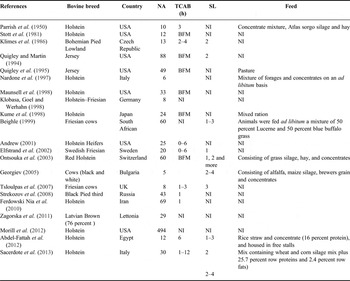
Meta-analytical means were calculated from data collected from the literature. Only studies on bovine colostrum were used, regardless of breed. Among the selected studies, those not providing complete information to allow meta-analytical calculation were excluded. In other words, all studies that do not indicate the number of animals used or in which average values are not accompanied by indicators of variation (standard deviation, standard error) were discarded. Twenty one references were identified in analytical databases (PubMed, Science Direct, Google scholar, Collection from University of Liege). Table 1 summarizes the materials (animals and experimental design) used by the authors during their studies. It refers to number of animals used, area or country, time of colostrum collection after birth, stage of lactation and feed.
List and characteristics of the 21 references identified in analytical databases.

BFM, before first milking; NA, number of animals; NI, no information; SL, stage of lactation; TCAB, time collection after birth.
Data analysis
Averages and standard deviations of data were calculated
Meta-analytical data were obtained according to the method proposed by Cucherat et al. (Reference Cucherat, Haugh, Gooch and Boissel2000), in which a literature general mean is obtained by the following formula:
 $$M = \displaystyle{{\sum {{M_i}{W_i}} } \over {\sum {{W_i}} }}\comma \;$$
where M i is the published mean related to author I, and
W i is the inverse of the variance of the mean associated with M i .
 $${W_i} = \displaystyle{{{n_i}} \over {s{^2_{{x_i}}}}}\comma \;$$
where n i is thenumber of animals used to obtain the published value M i , and S 2 the variance of the mean M i .
When the standard deviation (SD) was available, W i was calculated as n i /SD2.
When the standard error (SE) was available, W i was computed as 1/SE2.
Finally, the confidence intervals of the meta-analytic mean (CI) was estimated by:
 $$IC = \pm 1.96\sqrt {\displaystyle{1 \over {\sum {{w_i}} }}}\comma \;\sqrt {\displaystyle{1 \over {\sum {{w_i}} }}}$$
representing the synthetic SE from the literature.
The experimental and meta-analytic means were finally compared by the Student's t-test.
Results
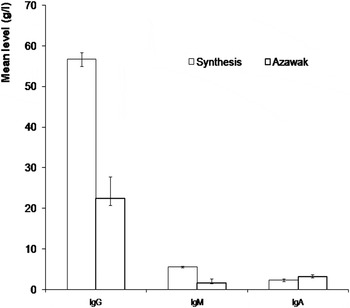
Figure 1 presents the mean levels ± standard error of immunoglobulins and lactoferrin in the colostrum of Azawak and other bovine breeds. The value for IgA, obtained in the current study was numerically higher than the mean value of the synthesized data. For IgG and IgM, the mean value of data obtained in the literature was significantly higher (P < 0.001) than the mean obtained for Azawak, while for lactoferrin the means were not significantly different (0.2 ± 0.1 g/l versus 0.03 ± 0.003 g/l).
The mean level concentration ± standard deviation (SD) of immunoglobulins in colostrum of Azawak cow (n = 7) and other bovine breeds (21 references).

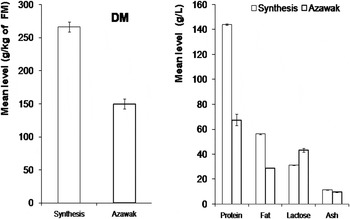
In the case of DM, the mean of data reported in literature was significantly higher (P < 0.001) than that of Azawak (Figure 2). For protein and fat, the mean levels found in the literature were also higher (P < 0.05) than those of Azawak zebu cows (Figure 2). In the case of lactose and ash, mean values of Azawak cows were higher (+12.2 g/kg DM; +1.3 g/kg DM; P < 0.001, respectively) than those from literature.
The mean level concentration ± standard deviation (SD) of dry matter and nutrients in colostrum of Azawak cow (n = 7) and other bovine breeds (21 references).

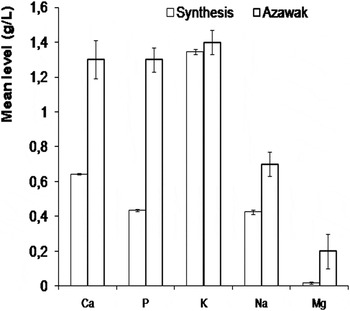
As far as soluble minerals are concerned, colostrum contents from Azawak for Ca, P, K, Na and Mg were significantly higher (+0.7 g/kg DM; +0.9 g/kg DM; +0.1 g/kg DM, +0.3 g/kg DM; +0.2 g/kg DM; P < 0.001, respectively) than the mean levels of literature data (Figure 3).
The mean level concentration ± standard deviation of soluble minerals in colostrum of Azawak cow and other bovine breeds.

Discussion
The meta-analysis showed that the average values of the synthesized data were significantly higher than that of Azawak zebu for immunoglobulins (IgG and IgM), DM, protein and ether extract. By contrast, IgA, lactose, ash and all soluble mineral contents observed in the Azawak colostrum were numerically or significantly higher than those reported in other breeds of cattle. These differences may be related to several factors. It is well known that nutrients, minerals and immunoglobulin in colostrum vary according to rank of lactation (Zarculas et al., Reference Zarcula, Cernescu, Mircu, Tulcan, Morvay, Simona Baul and Daniel2010; Abdou et al., Reference Abdou, Marichatou, Beckers, Dufrasne and Hornick2012), breed, nutritional status (Kaewlamun et al., Reference Kaewlamun, Okouyi, Humblotd, Remy, Techakumphu, Duvaux-Ponter and Pontera2011), climate (Westra and Wahyudi, Reference Westra and Wahyudi2009) and season (Abdel-Fattah et al., Reference Abdel-Fattah, Abd-Rabo, El-Dieb and El-Kashef2012).
At first sight, these variations may be related to pre-partum (pregnancy) management of cow. The antibody concentration may vary due to a period of abnormal dry, or non-stop milking before calving, or pathogen pressure. It was reported in literature (Brandon and Lascelles, Reference Brandon and Lascelles1975; Remond and Bonnefoy Reference Remond and Bonnefoy1997; Rastani et al., Reference Rastani, Grummer, Bertics, Gumen, Wiltbank, Mashek and Schwab2005) that cows which are milked during late pregnancy do not renew their secretory epithelium and are unable to concentrate their IgG1 secretion. According to Serieys (Reference Serieys1993), in cows, a minimum of 25 days of drying is necessary for a renewal of the mammary epithelium cells that are responsible for the transfer and accumulation of Ig in the udder.
The rank of lactation could probably not explain the results of this study because the two groups of animals were generally at a similar rank (2–4). However, it is possible to establish a relationship between breed and the effects observed. It is known from the literature (West, Reference West2003; Chaibou, Reference Chaibou2005) that breeds in tropical countries have a lower genetic merit than those in areas with temperate climates. The majority of breeds listed in this meta-analysis are from countries with temperate climates. This may explain the low level of some Ig in Azawak bovine colostrum (Nardone et al., Reference Nardone, Lacetera, Bernabucci and Ronchi1997; West, Reference West2003).
Environmental (Nardone et al., Reference Nardone, Lacetera, Bernabucci and Ronchi1997; West, Reference West2003) effects, particularly feed, could also explain the difference in Ig observed between Azawak cow and other breeds. Although Azawak cows are reared on farms, their maintenance requirements are provided through natural pasture and crop residues with low nutritional value and agro-industrial by-products. Breeding conditions are so precarious that the animals are hardly able to fulfil all of their performances. In addition, climatic factors could directly affect animal performance (West, Reference West2003) since they interfere with homeothermy. Prolonged hyperthermic stress causes a reduction in the secretion of many hormones (thyroxine, growth hormone, insulin, sex hormones and prolactin) involved in the metabolism (Wolfensohn, Flamenbaum and Berman, Reference Wolfensohn, Flamenbaum and Berman1988; Collier et al., Reference Collier, Miller, Hildebrandt, Torkelsson, White, Madsen, Vicini, Eppard and Lanza1991).
It appears that changes in these hormones are sensitive to change (high or low) in prevailing temperature. Thermal variation in Niger ranges from a minimum of 25 °C and a maximum of 45 °C and even 47 °C. It is possible that in the Azawak cow, the levels of some hormones involved in the mechanism of colostrum secretion were reduced. All these reasons indicated above could explain the differences observed between the composition of Azawak cow colostrum and that of other breeds used in the meta-analysis. Several studies (Hadjipanayiotou, Reference Hadjipanayiotou1995; Abdel-Fattah et al., Reference Abdel-Fattah, Abd-Rabo, El-Dieb and El-Kashef2012; Hawken et al., Reference Hawken, Williman, Milton, Kelly, Nawak and Blachea2012) have focused on changes in the chemical composition of cow colostrum after calving. Thus, the variations observed could be finally attributed to factors such as endocrine hormones alteration. It is known that oestrogens, especially 17-estradiol, the serum concentration of which increases during the dry period, achieve a peak just before parturition, and have an essential role in the development of new mammary epithelial cells (Derivaux Ectors and Beckers, Reference Derivaux, Ectors and Beckers1976; Tucker, Reference Tucker2000), which also possess receptors for IgG1 (Serieys, Reference Serieys1993). A study conducted by Sheldrake et al. (Reference Sheldrake, Husband, Watson and Cripps1984) showed that exogenous 17-estradiol and progesterone in non-pregnant dry cows induce a lobulo-alveolar development of the mammary gland. In a previous study, Delouis (Reference Delouis1978) found that rapid induction of parturition in cows in late gestation by administration of corticosteroids or a combination of steroids and estradiol may bring colostrum a best one.
Regarding the determination of immunoglobulins (IgG, IgA and IgM) and lactoferrin, some authors used the radial immunodiffusion technique while others applied the ELISA method, but from different manufacturers. For example, Elfstrand et al. (Reference Elfstrand, Lindmark-Manssom, Paulssona, Nybergc and Akesson2002) measured all individual colostrum samples through the IR technique (CombiFoss 5 000, Foss Electric A/S, and Hillerïod, Denmark). Nutrients (protein, fat, lactose and ash) and soluble minerals (Ca, P, K, Na and Mg) were analysed with methods similar to those used in the current study.
By contrast to other Ig whose levels from Azawak were lower than synthesized data, the average IgA concentration in the current study was similar to literature. There exist relationships between IgA production and the exposure of mucosas of the mother to external antibody. May be a high ambient infectious pressure existing in Niger could explain the proportionaly higher IgA levels when compared to IgG and IgM. The average concentration of lactoferrin in Azawak bovine colostrum was similar to that obtained in the colostrum of cattle breeds used in the meta-analysis.
Colostrum quality can also be influenced by diseases such as mastitis (Maunsell et al., Reference Maunsell, Morin, Constable, Hurley, McCoy, Kakoma and Isaacson1998) or/and dietary imbalance (e.g. vitamin E or selenium) during the dry period (Zarcula et al., Reference Zarcula, Cernescu, Mircu, Tulcan, Morvay, Simona Baul and Daniel2010). The differences observed between the Azawak cows and the mean of synthesis data from the literature can be also explained either by the fact that the Azawak cow would naturally tend to produce a rather poor colostrum dry matter, in order to bring out quickly water to his young. Colostrum sampling could also be performed too late relative to calving but it is not the case in this experiment. The distribution of means from the literature, although normal, was very narrow. However, the statistical test used in meta-analysis take into account this distribution. Colostrum of goat tends to be poorer in solids and immunoglobulins than cow (Hadjipanayiotou, Reference Hadjipanayiotou1995; Levieux et al., Reference Levieux, Masle, Geneix and Bowier2001; Machado-Neto et al., Reference Machado-Neto, Grigolo, Moretti, Kindlein and Pauletti2011). It can therefore be inferred that the kid could tolerate adequately the Azawak colostrum. However, there are some uncertainties with respect to the justification of using Azawak colostrum in goats, based only on the dry matter content. Further experiments should be performed in that senses.
Conclusion
The current study has shown that the level of antibodies and nutrients in Azawak colostrum is lower to those reported in the literature. By contrast, for IgA, lactose and soluble minerals, are at similar levels or significantly different in favour of Azawak cow. In conclusion, the colostrum from Azawak cows appears to be lower in most immunoglobulins, in fat and in protein than the values reported in the literature, but higher in lactose and minerals. This could be an adaptation to the Sahelian constraints. Administration of heterologous colostrum also has been yet experienced in pig with good results. This study was conducted to test the hypothesis that bovine colostrum seems to be a potential source for improving weight performance and health of other species such as lambs and kids. In conclusion, the results of this study show that bovine colostrum of Azawak can be used in other species such as goats and lambs.
Acknowledgements
This work was funded by the Belgian Technical Cooperation (BTC). The authors wish to acknowledge the organization. My thanks are also addressed to the laboratory team of Marloie (Belgium) for their collaboration.