The continuous controversies over Donald J. Trump’s road to the White House and presidency have no parallel in modern American politics. From news coverage of the 2016 presidential campaign and reports of 2017 inauguration attendees to analyses of presidential news conferences about the COVID-19 pandemic, a partisan lens appears to guide public perception of Trump (Faris et al. Reference Faris, Roberts, Etling, Bourassa, Zuckerman and Benkler2017; Ford Reference Ford2017; Gottfried et al. Reference Gottfried, Stocking, Grieco, Walker, Khuzam and Mitchell2019; Izadi Reference Izadi2020; Patterson Reference Patterson2016). In short, the American public filtered information about the Trump presidency based on its political orientation.
This article examines how public information about the 2019–2020 impeachment inquiry and trial into President Trump’s communications with Ukraine informed public opinion about the impeachment and acquittal. It evaluates original survey research that tested respondents’ views based on whether they knew certain well-publicized facts about the inquiry, such as testimony in the US House of Representatives about White House actions. Half of those surveyed were asked about their knowledge of these facts to establish a baseline of what respondents knew about the inquiry. The other half received the facts and then were asked to reconsider support or opposition to Trump’s impeachment and acquittal.
In both groups, respondents’ views about the impeachment process aligned closely with their party identification: Democrats largely supported the impeachment and opposed acquittal; Republicans did the opposite. Providing information about the inquiry made little difference in respondents’ views about impeachment. The analysis concludes that polarization in American politics has increased so significantly in the past two decades that common agreement on basic facts is now elusive. This finding complements recent scholarship about how political polarization diminishes public confidence in neutral or unbiased news coverage (Jurkowitz et al. Reference Jurkowitz, Mitchell, Shearer and Walker2020; Levendusky and Malhotra Reference Levendusky and Malhotra2016), and it raises significant concerns about maintaining an informed American public (Lauter Reference Lauter2020).
HOW DOES POLITICAL KNOWLEDGE INFLUENCE PUBLIC OPINION?
Recent scholarly literature on political knowledge presents more nuanced analyses of how Americans engage with information about elections and policies than earlier studies, which focused primarily on political behavior for voting (Fiorina Reference Fiorina1981; Key Reference Key1966). A groundbreaking 1990s survey of public knowledge about politics concluded that although Americans may not possess detailed information about political institutions and policy making, they demonstrate basic understanding of the constitutional system and policy concepts. More than half of survey respondents answered only four out of 10 questions correctly; however, the information that people did know included important principles of American constitutionalism, such as separation of powers and civil rights (Delli Carpini and Keeter Reference Delli Carpini and Keeter1996).
Nevertheless, what elites may expect constituents or the general public to view as “common knowledge” about American politics may be perceived quite differently in those groups (Rosenberg Reference Rosenberg2002). Hibbing and Theiss-Morse (Reference Hibbing and Theiss-Morse2002) found that Americans are less interested in political decision making than advocates of strong participatory democracy assume. Instead, people want neutral decision makers who will make decisions in the common interest so that the public does not have to devote time and energy to those concerns.
Given limited public attention to policy issues and disinclination to engage in participatory democracy, political elites—not surprisingly—are more attentive to specialized and vocal interests than public attitudes more generally. Druckman and Jacobs (Reference Druckman and Jacobs2015) found that elected officials focus on individuals and interest groups that are heavily engaged in the political process, often through campaign donations. Consequently, Washington policy making addresses special interests first and broader public concerns tangentially, if at all. Furthermore, when political elites use partisan politics to interpret policy conditions, citizens are likely to do the same (Bisgaard and Slothuus Reference Bisgaard and Slothuus2018).
For elected officials to be accountable to the public between elections, voters must be willing to acquire information and then use that knowledge to inform their votes to have an impact on elite governance (Sides Reference Sides2016; Wood and Porter Reference Wood and Porter2019). This need not require the public to invest extensive time and effort in following politics; as Lupia (Reference Lupia2016) wrote, information providers—including educators, journalists, and scholars—need to be attentive to the public’s prioritization of learning with practical relevance.
If, however, people are unwilling to accept political information that contradicts their political views (Nyhan and Reifler Reference Nyhan and Reifler2010)—or if they outright dismiss expert perspectives even when they receive factual information that validates those positions (Joslyn and Haider-Markel Reference Joslyn and Haider-Markel2014; Kuklinski et al. Reference Kuklinski, Quirk, Jerit, Schwieder and Rich2000; Merkley Reference Merkley2020)—then prospects for influencing elected officials are limited. To examine the malleability of public opinion, particularly receptiveness to information about elected officials and Washington governance, we present the results of an embedded quasi-experiment in a 2020 survey following the first impeachment and acquittal of then-President Trump.
To examine the malleability of public opinion, particularly receptiveness to information about elected officials and Washington governance, we present the results of an embedded quasi-experiment in a 2020 survey following the first impeachment and acquittal of then-President Trump.
RESEARCH DESIGN AND DATA
Using a unique survey, we assessed the degree to which likely voters closely followed the 2019–2020 impeachment process and whether information about the trial had the capacity to influence evaluations of the outcome. Accordingly, we crafted our survey to accomplish three goals. First, we sought to measure the level of knowledge that likely voters had about the impeachment process by asking about three facts related to the trial. Second, we aimed to establish whether raising individuals’ level of knowledge about the impeachment trial could influence their willingness to support or oppose removal. Third, we asked respondents to evaluate the veracity and importance of the three facts that we discussed.
To achieve these three goals, we embedded a one-group pre-test/post-test quasi-experiment in our survey. As shown in figure 1, respondents were asked a battery of pre-test questions—including whether they supported impeachment and conviction of the president—and then were assigned randomly to one of two groups. The first group reported what they knew about three important facts related to the impeachment trial. Specifically, the three questions were as follows:
-
1. Do you know whether the Senate opted to hear from witnesses during the impeachment trial, or did they vote to not hear witnesses?
-
2. The US Government Accountability Office (GAO) is an independent, nonpartisan agency that works for Congress. Often called the “congressional watchdog,” the GAO examines how taxpayer dollars are spent and provides Congress and federal agencies with objective, reliable information to help the government save money and work more efficiently. Do you know if the GAO concluded that Donald Trump had violated the law by withholding congressionally appropriated aid to Ukraine?
-
3. To the best of your knowledge, did any of Donald Trump’s political appointees publicly confirm that the aid to Ukraine was withheld for political reasons?
Research Design Summary
Note. Using a unique survey, we assess how likely voters followed the 2019–2020 impeachment process and whether information about the trial could influence their evaluation of the outcome.

Instead of being asked to report what they knew, the second group received the following three facts in the form of statements:
-
1. The Senate voted to not hear from witnesses during the trial. Of the 20 total impeachment trials that have occurred in the Senate, this is the first trial to not include witnesses.
-
2. The Government Accountability Office—a nonpartisan bureau that works for Congress—concluded that Donald Trump violated the law by withholding congressionally appropriated aid to Ukraine.
-
3. Three of Donald Trump’s political appointees—former Ambassador Gordon Sondland, former National Security Advisor John Bolton, and White House Chief of Staff Mick Mulvaney—have publicly confirmed that aid to Ukraine was withheld for political reasons.
By splitting the sample into two groups, we are able to assess what likely voters knew about the trial and whether raising the level of knowledge could have an appreciable impact on support or opposition for acquittal.
The final step in our research design asked respondents in each group to evaluate both the veracity and the importance of the three facts included in our survey. Specifically, for each fact, we asked respondents to indicate whether the fact was either (1) true, (2) false, (3) true but unimportant, or (4) both false and unimportant. Asking respondents to assess facts allowed us to gauge whether individuals actually believe information that is presented. If so, then we evaluated whether individuals think that the information is important. We subsequently assessed whether partisan polarization informs which facts American voters believe are true or important in evaluating whether Congress should remove a president from office.
We used survey data from Hofstra University’s March 2020 Kalikow School Poll to analyze our research questions (Burnett Reference Burnett2021). The survey—designed by the authors and executed by YouGov—collected data from 1,500 likely voters using YouGov’s proprietary panel of respondents. The survey oversampled suburban voters (i.e., 1,000 were suburban, 300 were urban, and 200 were rural residents); however, we applied the YouGov-supplied weights to ensure that the entire sample was representative of the likely voters. In total, YouGov surveyed 1,638 respondents, which it matched down to 1,500 using its proximity-matching methodology. The survey was in the field from March 5 through March 12, 2020. YouGov invited 5,158 likely voters to complete the survey, of which 3,121 respondents started the survey and 1,696 completed it. The eligibility rate was 56.6% and the response rate (RR3) was 58.1%.
RESULTS
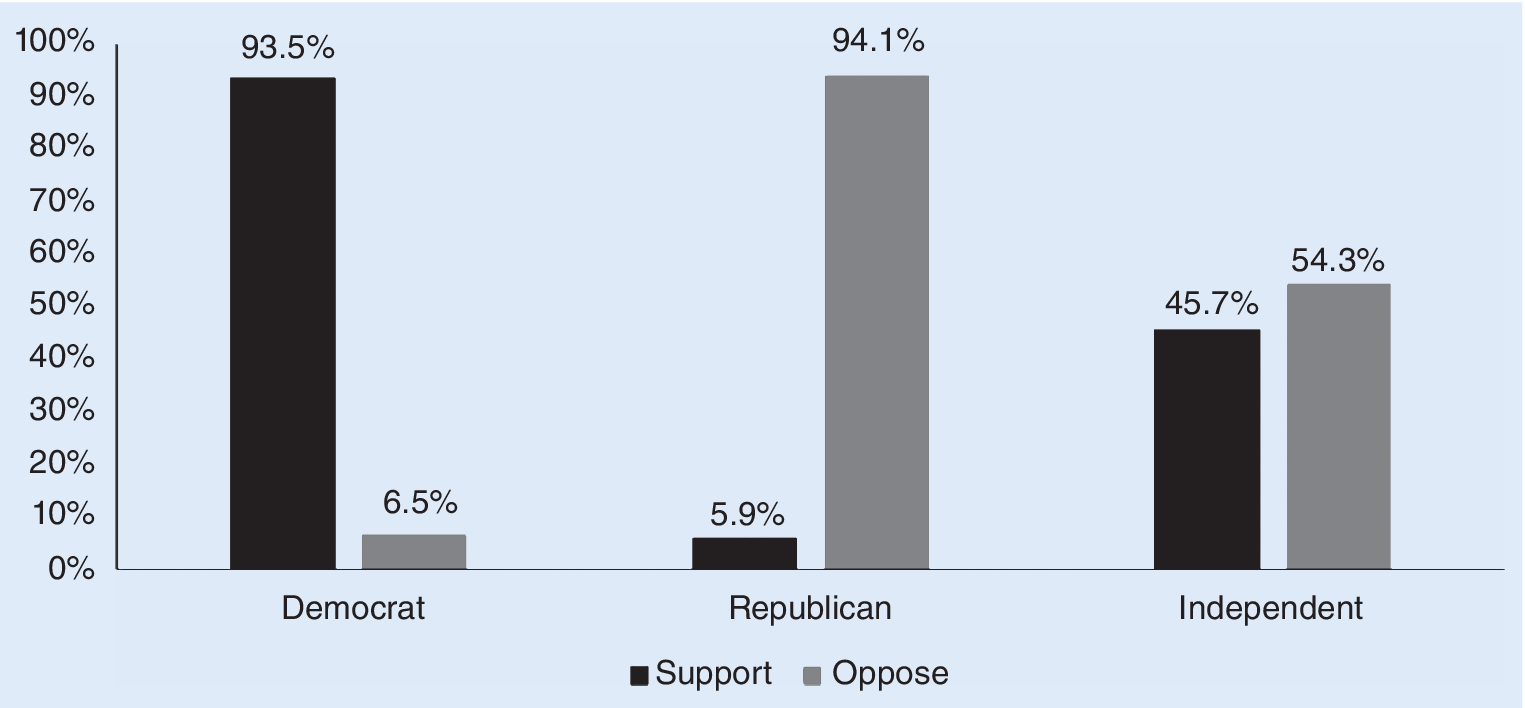
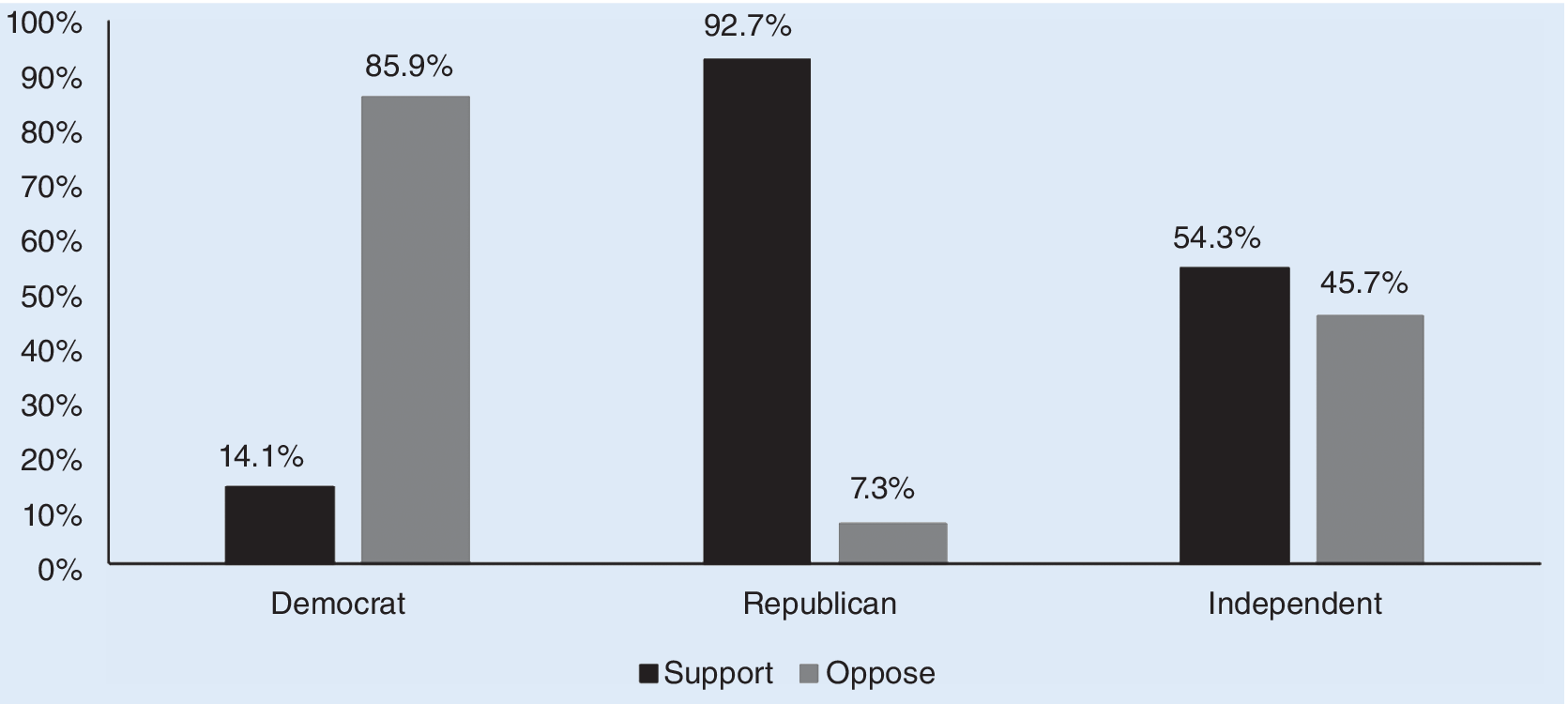
We begin by analyzing how respondents viewed both impeachment and acquittal of President Trump. Our sample was divided on the issue of whether the House of Representatives should have impeached Donald Trump (50.4% approved). By contrast, a slight majority (52%) approved of the Senate’s decision to acquit him. When we examine support for impeachment by party as shown in figure 2, the issue is—unsurprisingly—extremely polarizing, with both Democrats and Republicans viewing the decision by the House of Representatives as the opposite of one another. Independents, however, were slightly more likely (54.3%) to oppose impeachment. Support for acquittal, as shown in figure 3, varies more (14.1% of Democrats supported acquittal), but the issue remains highly partisan. Again, Independents were slightly more likely to side with the president on this issue (54.3% supported acquittal).
Support for Impeachment by Party
Note. When we examine support for impeachment by party, the issue is—unsurprisingly—extremely polarizing.

Support for Acquittal by Party
Note. Support for acquittal varies more, but the issue remains highly partisan.

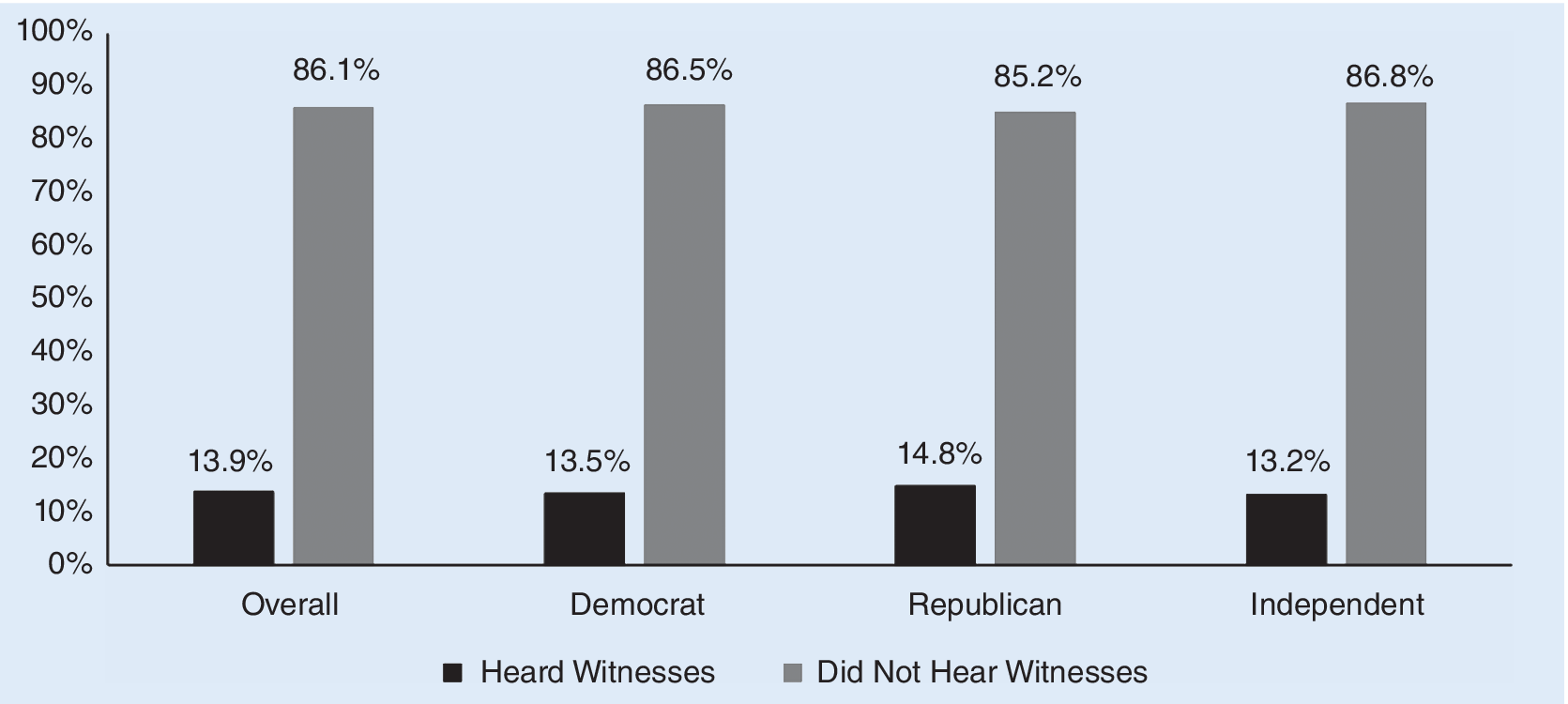
Next, we examine responses to three factual knowledge questions on our survey that half of the sample was randomly assigned to receive. The first question asked respondents to report whether the Senate opted to hear from witnesses during the trial. As shown in figure 4, an overwhelming majority of respondents knew that the Senate declined to hear from witnesses during the impeachment trial. Knowledge of this fact is essentially the same across partisan attachments.
Knowledge of Senate Declining to Hear Witnesses
Note. An overwhelming majority of respondents, across partisan attachments, knew that the Senate declined to hear from witnesses during the impeachment trial.

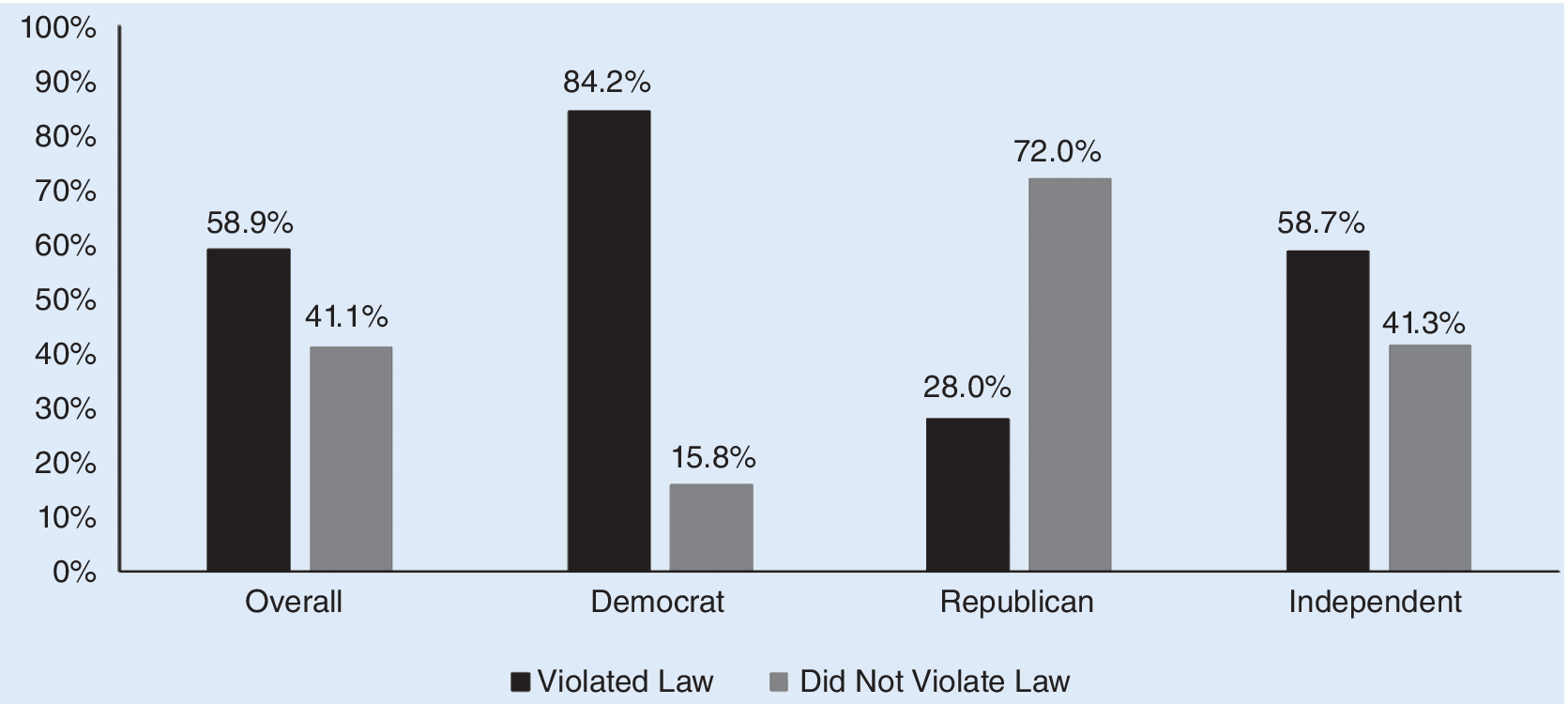
The next fact concerns the announcement by the GAO that by withholding aid to Ukraine, the president violated the law. News of the GAO’s determination broke just as the impeachment trial was getting underway (i.e., January 16, 2020). Thus, individuals closely following the trial likely would have learned about the GAO’s conclusion. Answers to this question, as shown in figure 5, vary significantly more than knowing that the Senate declined to hear from witnesses. Although a majority of respondents (58.9%) knew of the GAO’s determination, when we parsed responses by party, there were substantially different responses. Democrats were much more likely to respond correctly (84.2%), Republicans were substantially less likely to know the answer (28%), and Independents were similar to all respondents (58.7%).
Knowledge of GAO’s Determination of Trump Violating the Law
Note. A majority of respondents knew of the GAO’s determination that by withholding aid to Ukraine, the president violated the law; however, responses were substantially different when parsed by party affiliation.

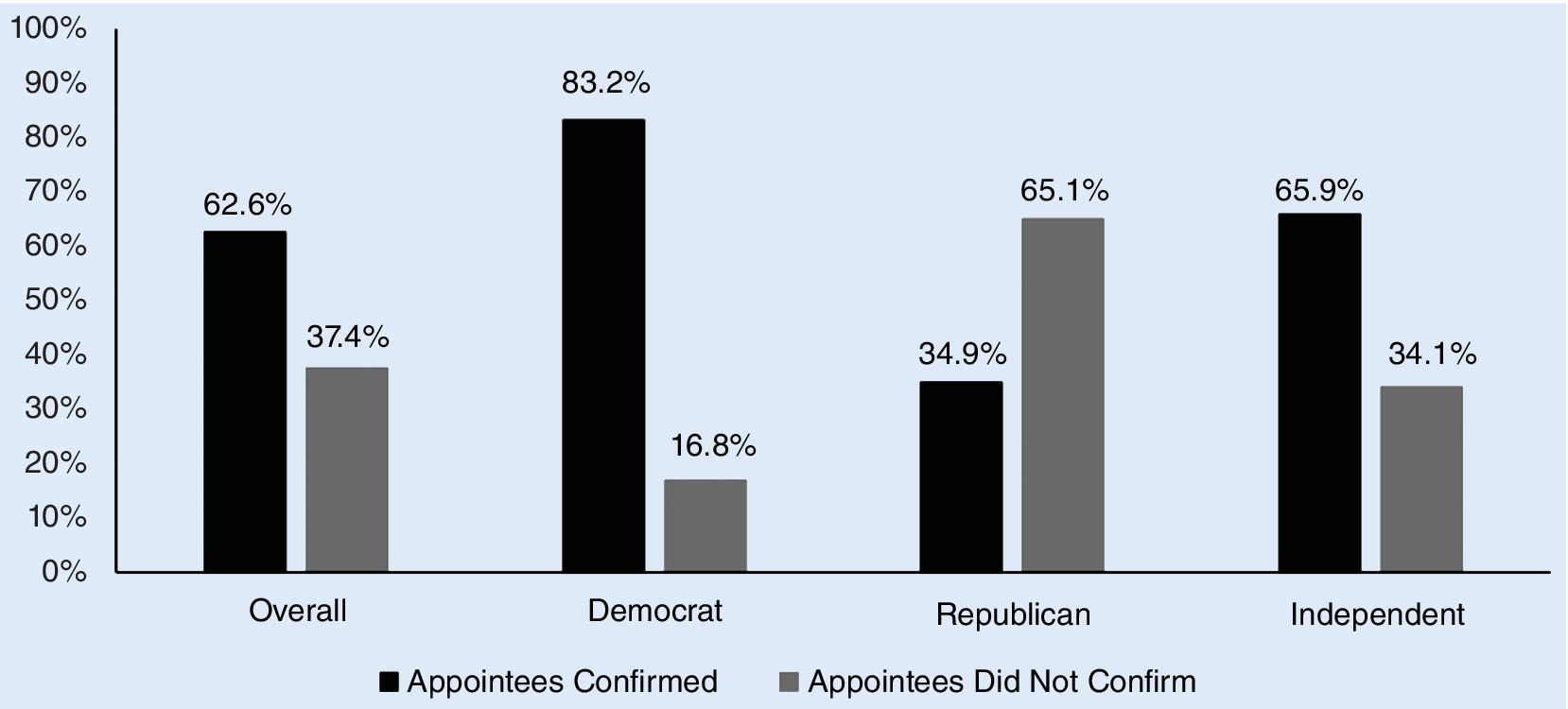
The third fact we asked about concerned whether respondents knew that at various times, three political appointees—Gary Sondland, John Bolton, and Mick Mulvaney—had confirmed that the reasoning behind President Trump’s decision to withhold aid to Ukraine was for political purposes. The question, however, asked them to report whether “at least one” political appointee confirmed these political motivations. Responses to this question—as shown in figure 6—were quite partisan. Independents largely followed the overall percentage of correct responses (65.9% and 62.6%, respectively). Democrats were substantially more likely to provide a correct answer (83.2%) and Republicans were less likely to answer the question correctly (34.9%).
Knowledge of Political Appointees Confirming Political Nature of Withholding Aid
Note. The survey found highly partisan responses to the question of whether political appointees confirmed there were political purposes behind the president’s decision to withhold aid to Ukraine.

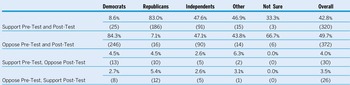
Whereas the survey asked half of the sample to report their knowledge of facts, the other half were informed of the correct answers to those questions in the form of factual statements and then were asked to report whether they still supported the Senate’s decision to acquit the president. Table 1 presents results of the pre- and post-test responses to support for acquittal by party identification.
Quasi-Experiment Results: Support for Senate Acquittal

Notes: Percentages reported are column percentages. Number of respondents is in parentheses. N=748.
The first two rows of table 1 represent individuals who did not change their answer from the pre-test to the post-test. The overwhelming majority of respondents—92.5%—reside in one of these categories. The bottom two rows represent individuals who changed their responses from the pre-test to the post-test. Although 7.5% of individuals did change their position, there unfortunately are no patterns in the data to suggest that our manipulation produced a predictable movement—for example, Democrats coalesce around opposing the acquittal and Republicans coalesce around supporting the acquittal.Footnote 1 Indeed, our quasi-experimental results suggest two takeaway points. First, most individuals had hardened positions on the Senate’s trial, in which 92.5% were simply immovable. Second, even for those individuals who did move positions, the lack of consistency suggests that the capacity of the Senate trial to push public opinion in a singular direction was likely small.
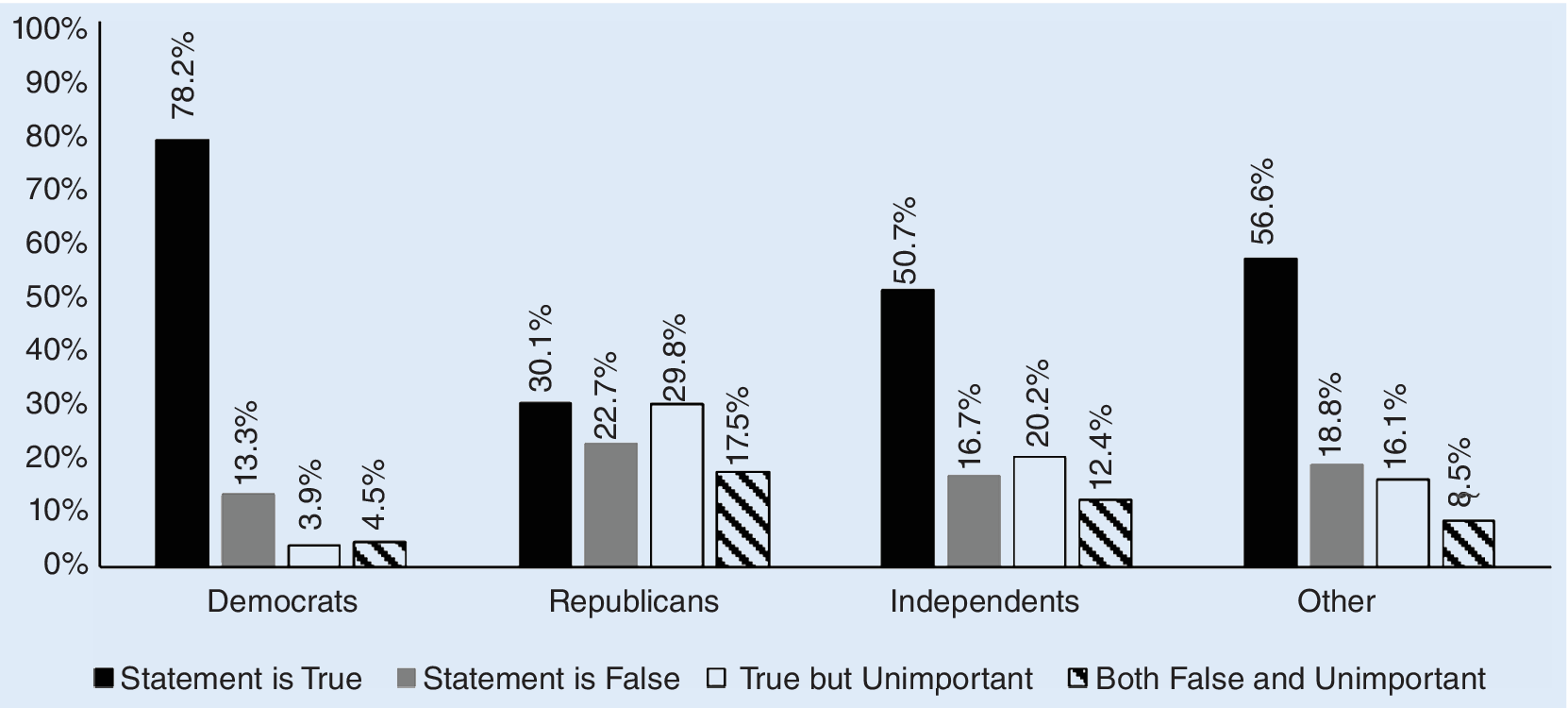
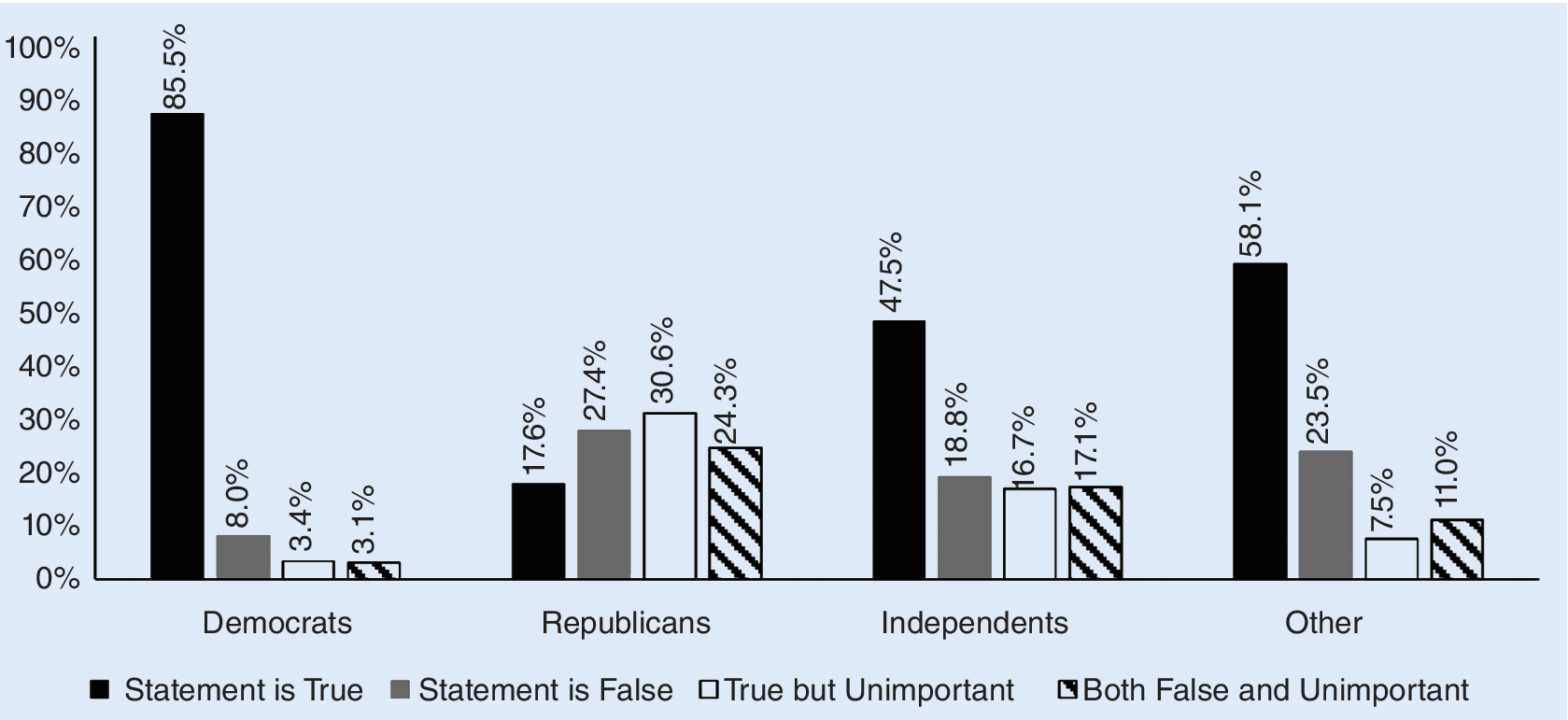
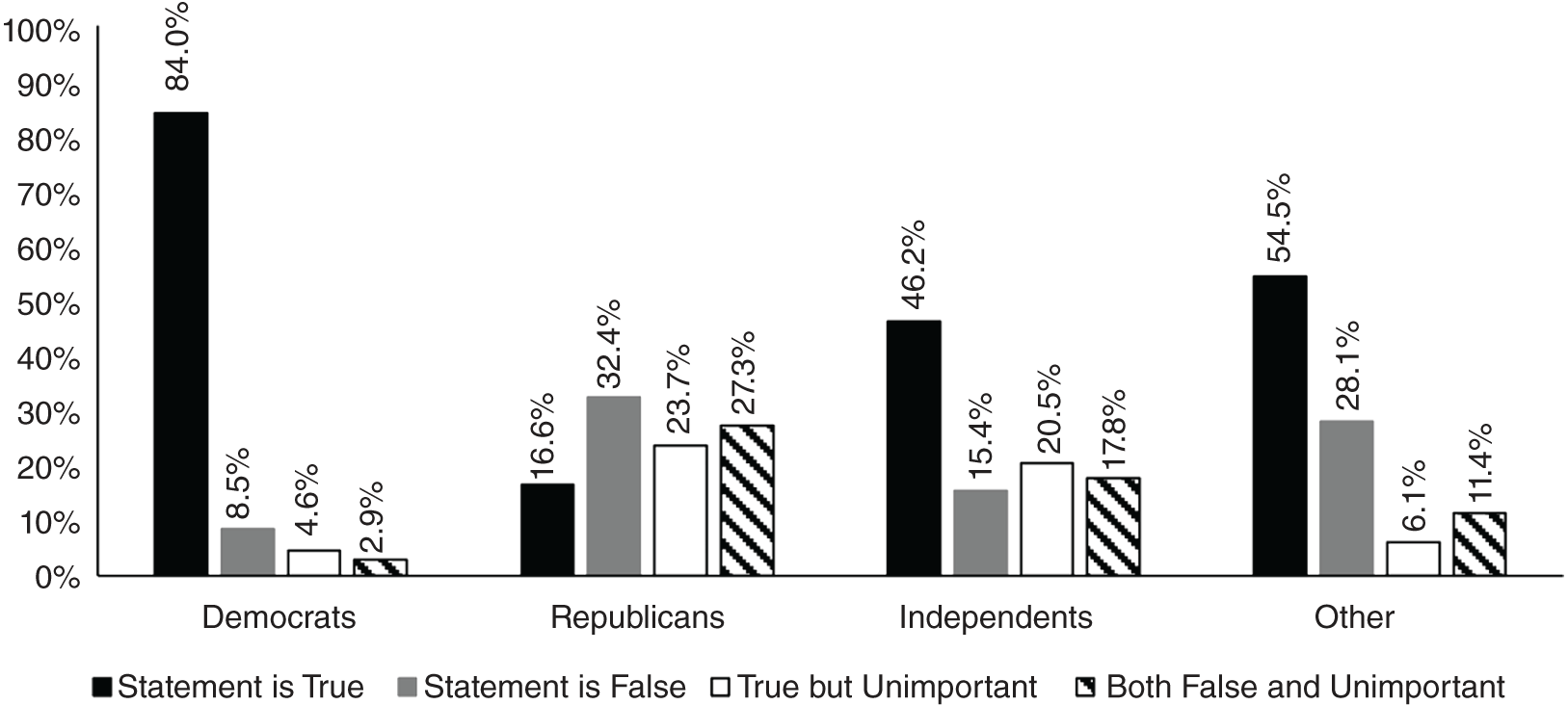
Given the state of polarization in American politics, our quasi-experimental results are perhaps unsurprising. One way that we sought to establish the degree to which polarization might impact our quasi-experiment was to ask respondents to assess the veracity and the importance of the three facts included in our survey. For each fact, we asked individuals to give their view with one of the following four options: (1) this statement is true, (2) this statement is false, (3) this statement is true but it is unimportant, and (4) this statement is both false and unimportant. Figures 7–9 present the results for each fact, in which a series of patterns emerge. First, Democrats overwhelmingly believed that the facts are true, with only a small percentage scattered in the other responses. Republicans, by contrast, were significantly less likely to believe that each fact is true. Whereas a majority of Republican respondents indicated that the Senate refusing to hear witnesses was factual (although 35% believed it was unimportant), more than half of them rejected the veracity of the other two facts. About 50% of Independents believed each fact, although a substantial percentage indicated that they did not believe they were true. Whereas Independents squarely reside between Democrats and Republicans, responses to these assessment questions indicated that Democrats and Republicans have fundamentally different views of the facts surrounding the impeachment trial.
Assessment of Factual Statement: Senate’s Decision Not to Hear Witnesses
Note. Democrats overwhelmingly believed the facts are true, whereas Republicans were significantly less likely to believe each fact is true.

Assessment of Factual Statement: GAO’s Determination of Illegal Action
Note. More than half of Republican respondents rejected the veracity of facts about the impeachment trial.

Assessment of Factual Statement: Appointees Confirmed Political Motivations
Note. Responses to these assessment questions indicated that Democrats and Republicans have fundamentally different views of the facts surrounding the impeachment trial.

DISCUSSION
Our results have several normative implications for the state of American politics. On the positive side, our survey shows that a majority of likely voters were able to correctly identify three facts about the impeachment trial of Donald Trump. This implies that—at least when a major political event occurs—the voting public is paying attention. In an era of echo chambers, misinformation, and heavy news consumption from social media, this is relatively good news for democracy, and it buttresses the scholarly literature on basic public knowledge about American politics.
The negative implications of our research likely outweigh the positive, however. First, the fact that performed best—that the Senate declined to call witnesses—likely rates the highest because people in both parties could look at it through their preferred lens: Democrats were aware that the Senate declined witnesses because it was a negative outcome for them; Republicans were aware because they viewed it as a positive outcome. Indeed, for the other two facts—that the GAO determined that the president had broken the law and that political appointees confirmed that aid to Ukraine was withheld for political reasons—party affiliation clearly predicted what respondents knew.
Second, even when respondents received information on three important facts, we observed no discernable movement in support of or opposition to the president’s acquittal. This indicates that the overwhelming majority of likely voters have hardened views of the impeachment trial and the president. This environment makes political persuasion difficult, if not impossible, and it questions the feasibility today of the foundation of democratic discourse—namely, that it is a marketplace of ideas.
Third, our results show that partisans see the world in different ways. Indeed, the voting public today does not share a collective set of facts. Our results demonstrate that current American politics is a landscape in which there is broad disagreement on what the truth is and whether that truth matters. The quasi-experiment reinforces Nyhan and Reifler’s (Reference Nyhan and Reifler2010) finding of a “backfire effect” with political information—namely, that people’s views on an issue harden when they receive facts that contradict their position.
Our results show that partisans see the world in different ways. Indeed, the voting public today does not share a collective set of facts.
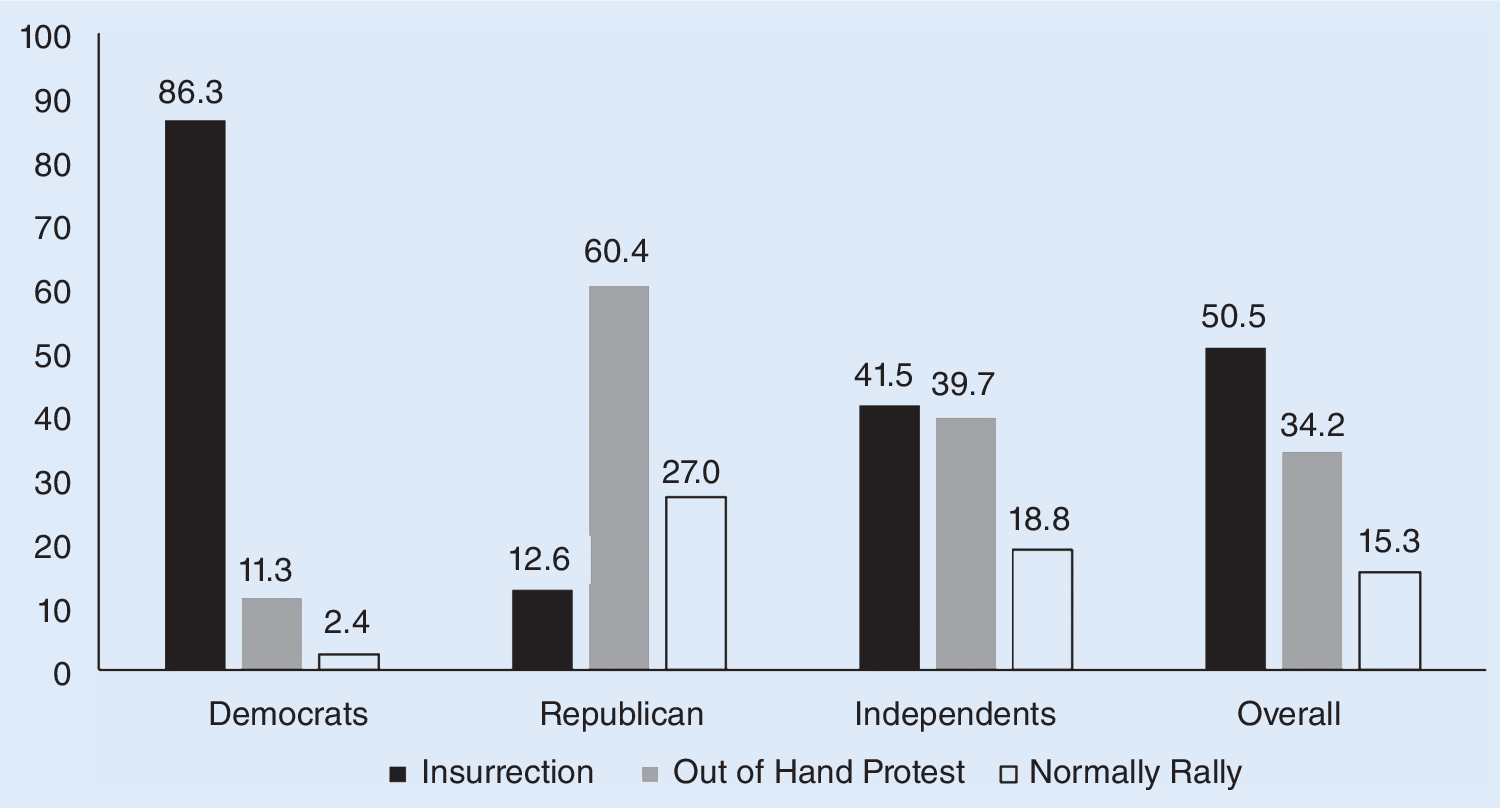
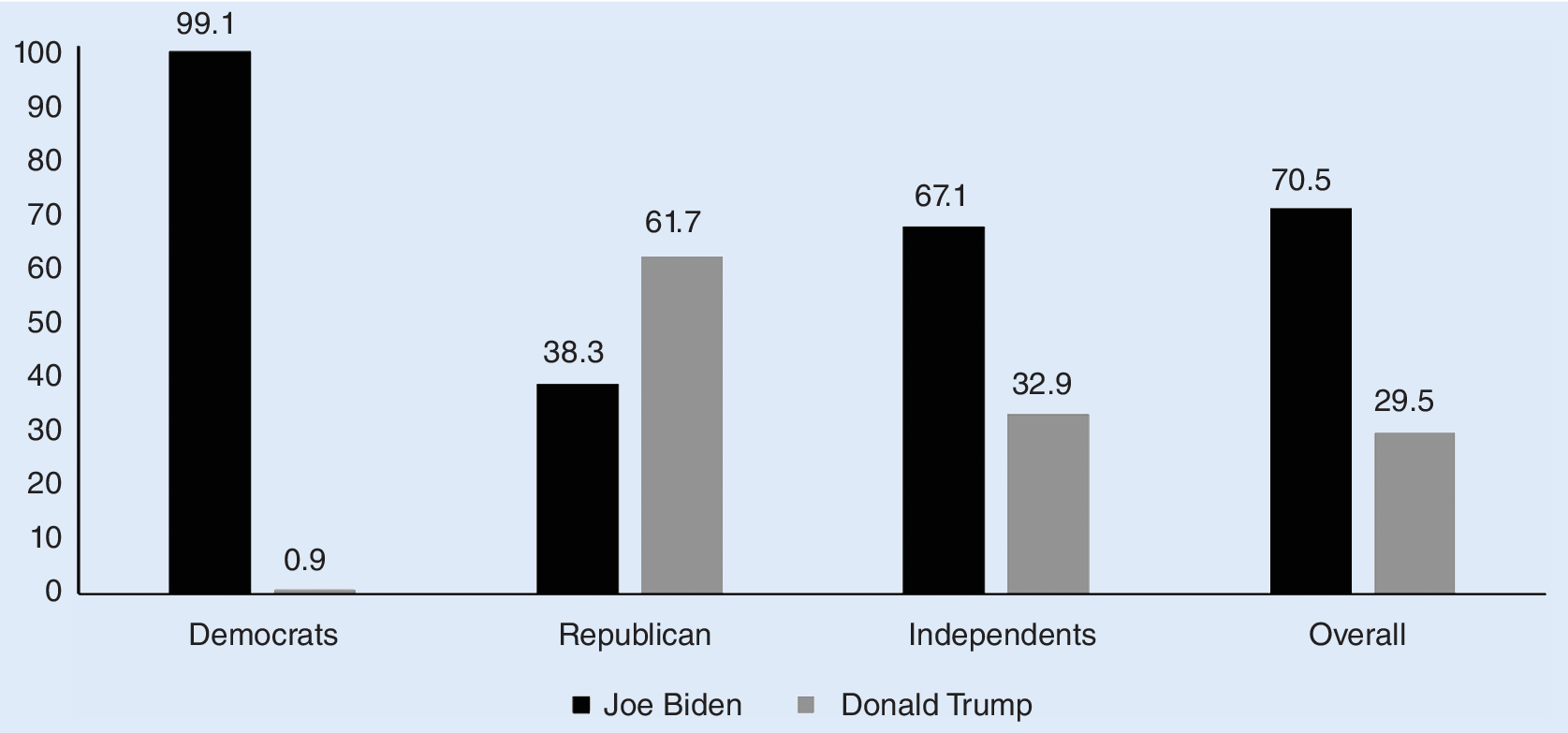
An April 2021 poll that we administered reinforced the consequence of viewing political outcomes through the lens of polarization. As shown in figures 10 and 11, views about the assault on the US Capitol on January 6, 2021, and beliefs about which candidate won the 2020 election also are subject to significant partisan filters. In American politics today, voters struggle to agree not only on somewhat more esoteric matters (e.g., the facts surrounding an impeachment trial) but also on more basic, foundational questions (e.g., who won the presidency).
View of the January 6, 2021, Assault on the Capitol in Washington, DC
Note. Views about the assault on the US Capitol on January 6, 2021, also were subject to significant partisan filters.

Who Won the 2020 Presidential Election?
Note. In American politics today, voters struggle to agree on basic, foundational questions, such as who won the presidency in 2020.

Who or what is responsible for such an outcome? Divergence among political elites (Zaller Reference Zaller1992) likely plays a role because most Republicans lined up with former President Trump’s position and most Democrats espoused the opposite opinions. Additionally, the advent and rising importance of social media—and therefore the ability to amplify exactly how split political elites were on the issues—and the hyper-pluralization of media sources in general would seem likely culprits in fostering an environment in which information is both received and perceived differently (Lee et al. Reference Lee, Choi, Kim and Kim2014; Spohr Reference Spohr2017; Tucker et al. Reference Tucker, Guess, Barberá and Vaccari2018) and even increases polarization (Bail et al. Reference Bail, Argyle, Brown and Bumpus2018).
Unfortunately, we cannot know the extent to which our data would have been different under another president. Given that polarization is deeply entrenched and the outcomes we observed follow a predictive pattern under polarization, there are reasons to expect we would have observed the opposite party results for a Democratic president—although we also suspect that Donald Trump may have been a particularly polarizing figure.
How, then, does the United States create a common public foundation of knowledge about American politics? The hardened political positions in our study indicate major obstacles to curricular and instructional design for nonpartisan civics information. Until elected officials and the public at large agree on the importance of common knowledge and recognize its legitimacy, party affiliation will guide public attitudes about American politics. Unfortunately, that will only increase political polarization and obstacles to democratic governance.
Until elected officials and the public at large agree on the importance of common knowledge and recognize its legitimacy, party affiliation will guide public attitudes about American politics.
DATA AVAILABILITY STATEMENT
Research documentation and data that support the findings of this study are openly available at the PS: Political Science & Politics Dataverse at https://doi.org/10.7910/DVN/145ZMF.