1 Introduction
The problems of the dynamics of finely dispersed particles in the near-Earth space (NES) have been actively discussed over the last two decades in connection with the problem of anthropogenic pollution of near space manmade micro-particles (MPs). One problem that is especially complicated is the problem of dynamics in NES of submicron particles whose motion is substantially influenced by the Earth’s gravitational field, such as light pressure, by electrodynamics forces caused by the interaction of the electric charge induced on MPs by the magnetic and electric fields of NES. A study is often carried out for two limiting variants: domination of a gravitational field or a magnetic field. Only the first case will be discussed here. Approaches to studying the second case for electric charge, which change during a motion, are considered for example in (Kolesnikov & Yakovlev Reference Kolesnikov and Yakovlev2018). Currently, the main method of studying the features of dynamics of submicron particles near planets with a magnetic field is the method of numerical simulation of MP motion in space taking into account the influence of the entire complex of perturbing forces (Kolesnikov & Chernov Reference Kolesnikov and Chernov2018).
Basic attention is given to the definition of characteristics of MPs, which are capable of be staying near the planets for a long time and the conditions of their injection. In particular, this research shows that particles with sizes of about 1–100 microns can remain for long periods of times in the orbit of NES. At the same time, the basic possibility of long time retention of man-made particles with submicron sizes in the Earth’s vicinity raises doubts because the results of numerical simulations of motion for particles with sizes of the order of 0.1–1 micron showed that the times of orbital existence for MPs with these sizes are, as a rule, essentially restricted by the disturbancing influence of sunlight pressure for an injection at high altitudes (Horanyi, Houpis & Mendis Reference Horanyi, Houpis and Mendis1988; Kolesnikov, Chernov & Yakovlev Reference Kolesnikov, Chernov and Yakovlev1999) or by resistance force of residual gas in the upper atmosphere for low circumterraneous orbits (Merzlyakov Reference Merzlyakov1996; Kolesnikov & Chernov Reference Kolesnikov and Chernov1997). The results of numerical simulations of motion for particles with sizes less than 0.1 micron in the Earth’s plasmasphere in (Kolesnikov Reference Kolesnikov2001; Kolesnikov & Chernov Reference Kolesnikov and Chernov2003) have shown that, unlike earlier considered particles with sizes of the order of 0.1–1 micron, the particles with sizes less than 0.1 micron (dozens of nanometers) are capable of remaining in NES for a long period of time under certain conditions as a result of the disturbance of the MP’s motion in the NES by the Lorentz force (from the side of Earth’s magnetic field) acting on the electric charge of MPs. Thus, these particles can be an important factor of man-made pollution in NES.
Nevertheless, some attempts have been undertaken to analytically study the properties of MP motion in NES in model formulations of the dynamical problem. These attempts are based on certain simplifying assumptions about the number of perturbing forces acting upon MPs, their character and the method of their determination. The analytical method is especially efficient in the case when the problem of MP dynamics in NES admits a canonical formulation in the form of a system of the Hamilton equations. In particular, conservation of the orbit form of a particle with constant charge moving in a central gravitational field in the presence of a small disturbance of the Lorentz force acting on a MP from the side of the dipole magnetic field was proved in (Vavilov & Kolesnikov Reference Vavilov and Kolesnikov1981) using the well-known methods of the so-called KAM theory (Arnold Reference Arnold1963; Mozer Reference Mozer1981). In Schaffer & Burns (Reference Schaffer and Burns1994), Howard (Reference Howard1999), Howard, Horanyi & Stewart (Reference Howard, Horanyi and Stewart1999), Howard, Dullin & Horanyi (Reference Howard, Dullin and Horanyi2000) and Dullin, Horanyi & Howard (Reference Dullin, Horanyi and Howard2002), the problem of disturbed motion of a charged MP in the central gravitational field is considered, where a more general Hamiltonian function also takes into account the action on MP motion in addition to the dipole magnetic field of the corotational electric field. It should be noted, however, that all the canonical formulations of the problem of MP motion in NES mentioned above are based on the assumption of constant electric charge of a MP. At the same time, as the results of numerical simulation of MP motion in NES showed (Juhasz & Horanyi Reference Juhasz and Horanyi1997; Kolesnikov Reference Kolesnikov2001), as a rule, the charge of a MP in the process of its orbital motion is changed substantially, this fact limits the applicability of model formulations with constant electric charge by only some special cases under the real physical conditions of NES.
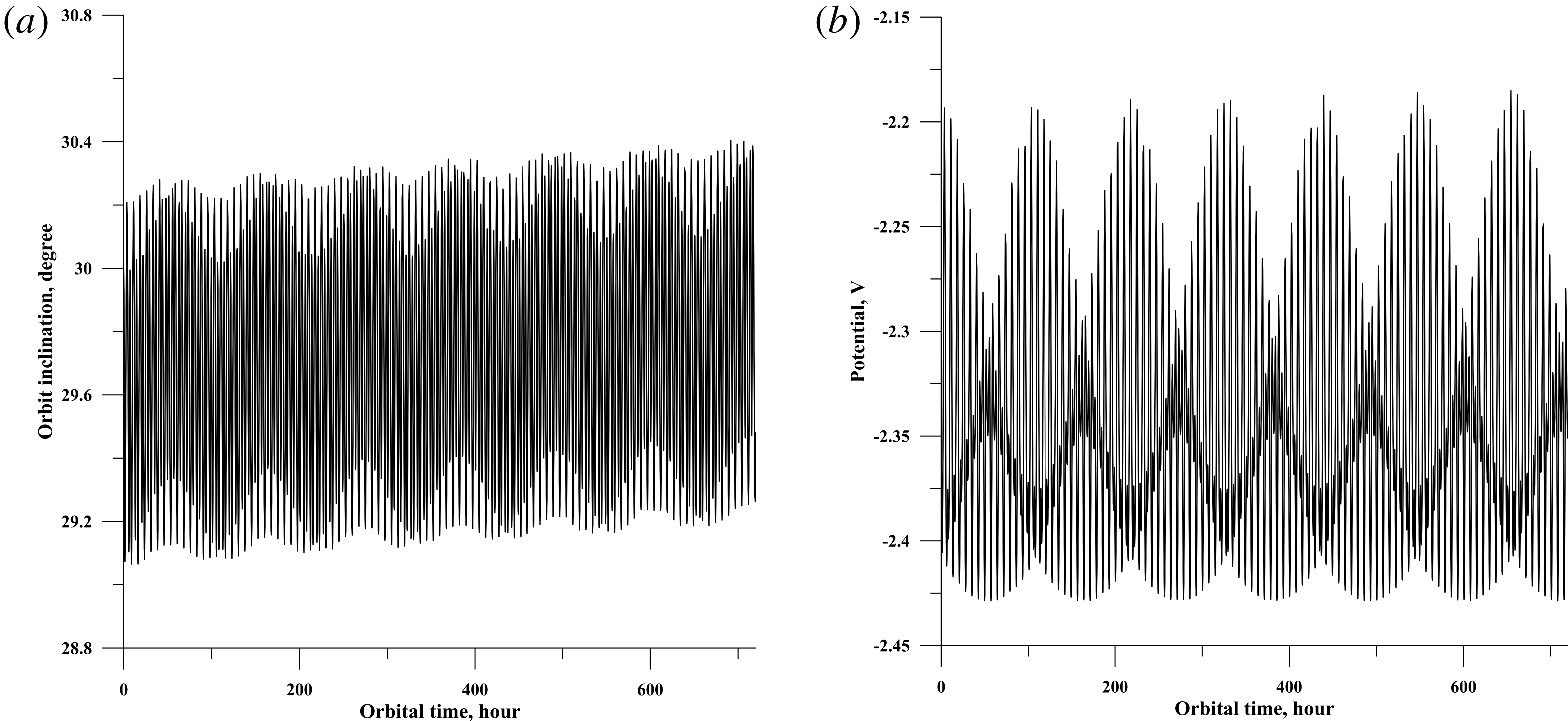
In our paper, (Yakovlev, Kolesnikov & Chernov Reference Yakovlev, Kolesnikov and Chernov2017), we offered an analytical model of a motion of particles with variable electric charge in superposition of the central gravitational field and a field of the central magnetic dipole and showed that the theory provides good agreement with the results of numerical simulation of the motion of MPs of space debris in the Earth’s plasmasphere in the time interval of 720 h (1 month). But, as our reviewers have pointed out, the question of the degree of influence of the forces that were not taken into account in our analytical model of dynamics of the specified microparticles was not sufficiently considered . Among the forces that were not taken into account in the analytical model, the most important is the component of the Lorentz force caused by the corotational electric field. In (Yakovlev, Kolesnikov & Chernov Reference Yakovlev, Kolesnikov and Chernov2018), we showed that the character of the influence of the corotational electric field on the motion of MPs in Earth’s plasmasphere have principal distinctions for equatorial and inclined orbits. In the first case, the action of the corotational electric field leads to monotonous growth of the mean values of the semimajor axis
 $a$
and eccentricity
 $e$
of MPs’ orbit. A non-zero initial angle of inclination causes oscillations of the semimajor axis, eccentricity and inclination angle
 $i$
, a monotonic increase in the mean value
 $i$
and the appearance of an additional frequency of the oscillations of the potential of the MP, which coincides with the frequency of oscillations
 $a$
,
 $i$
and
 $e$
(see figure 1(a,b) Yakovlev et al.
Reference Yakovlev, Kolesnikov and Chernov2018). These results have been obtained by numerical simulation of the motion of MPs from carbon with radii of the order of some hundredths of micrometers in orbit with a perigee altitude of about 9000 km in the time interval of 1 month. It was shown that the shadowing effect of a part of the orbit does not significantly change the behavior of the potential of the MPs, the eccentricity and the inclination angle of the orbit, and distorts the clear character of the behavior of the semimajor axis.
Dependencies of the inclination of the orbit (a) and the electric potential (b) of a carbon MP with a radius of 33 nanometers and non-equilibrium electric charges on time for the case of only two forces: the gravitational and the Lorentz force component due to the corotational electric field (without accounting for shading). Initial conditions correspond to an orbit of a particle without a charge with a perigee altitude of 9000 km, a velocity
 $5.449~\text{km}~\text{s}^{-1}$
, an angle of inclination of
 $30^{\circ }$
, a longitude of ascending node of
 $180^{\circ }$
and an ascending node-perigee angle of
 $270^{\circ }$
.

The aims of the present paper are an explanation of the obtained dependencies by means of analytical calculations and determination of the maximal interval for which the new analytical model works.
2 Main result
In (Yakovlev et al. Reference Yakovlev, Kolesnikov and Chernov2017), we made these assumptions:
(1) MPs’ electric charge
 $Q$
is quasi-equilibrium (this hypothesis was proved by us in Kolesnikov, Chernov & Yakovlev (Reference Kolesnikov, Chernov and Yakovlev2007); a similar result for altitudes of about 100 km was obtained in Klumov, Morfill & Popel (Reference Klumov, Morfill and Popel2005));
(2) the geometrical conditions
$\boldsymbol{B}\bot \unicode[STIX]{x1D735}Q$
and
$\boldsymbol{E}\Vert \unicode[STIX]{x1D735}Q$
(Kolesnikov et al.
Reference Kolesnikov, Chernov and Yakovlev2007) (i.e. the gradient of charge
$Q$
of a MP should be perpendicular to the vector
$\boldsymbol{B}$
of the magnetic field induction and parallel to the vector
$\boldsymbol{E}$
of electric field strength) are satisfied due to specific features of plasmaspatial distribution in the Earth’s plasmasphere. This distribution is known to be described by the model of two-component plasma (Hill & Wipple Reference Hill and Wipple1985);(3) MPs have radii of the order of some hundredths of micrometer;
(4) we can neglect the influence of solar pressure on MPs’ motion in the NES;
(5) we shall consider MPs from a material with a low photoemission yield, and therefore, we can also neglect the dynamic effect of a shadowing of a part of the MP’s orbit;
(6) we study the case of MPs’ motion on weakly oblong orbits (with eccentricities
${<}0.3{-}0.4$
), which are situated in the lower part of the plasmasphere with perigee altitudes of the order of the Earth’s radius.


If the simplifying assumptions that were made in Yakovlev et al. (Reference Yakovlev, Kolesnikov and Chernov2017) are true, the Hamiltonian function for the motion of a MP with a variable electric charge in the superposition of the central gravitational field and the Lorentz force acting on the electric charge of the MP from the side of the dipole magnetic field of the Earth and the corotational electric field in a spherical coordinate system
 $r,\unicode[STIX]{x1D717},\unicode[STIX]{x1D711}$
with the origin at the Earth’s center and the polar axis, which is passing through a southern magnetic pole, can be written as follows:
 $$\begin{eqnarray}H=\frac{1}{2m}\left[P_{r}^{2}+P_{\unicode[STIX]{x1D717}}^{2}+\frac{1}{r^{2}\sin ^{2}\unicode[STIX]{x1D717}}\left(P_{\unicode[STIX]{x1D711}}-\frac{Y_{2\unicode[STIX]{x1D711}}r\sin \unicode[STIX]{x1D717}}{c}\right)^{2}\right]-\frac{m\unicode[STIX]{x1D707}_{E}}{r}+Y_{1},\end{eqnarray}$$
where
 $\unicode[STIX]{x1D707}_{E}$
is the gravitational parameter of the Earth,
 $m$
is particle mass,
 $Y_{1}$
,
 $\boldsymbol{Y}_{2}$
are the scalar and vector generalized charge-field potentials and
 $P_{i}$
are components of the generalized momentum vector (Kolesnikov et al.
Reference Kolesnikov, Chernov and Yakovlev2007; Yakovlev et al.
Reference Yakovlev, Kolesnikov and Chernov2017).
We obtain the expressions for generalized potential
 $Y_{1}$
as were similarly made for
 $Y_{2\unicode[STIX]{x1D711}}$
in (Yakovlev et al.
Reference Yakovlev, Kolesnikov and Chernov2017). In dipolar coordinates
 $L,\unicode[STIX]{x1D6F7},M$
,
 $$\begin{eqnarray}Y_{1}=-Q_{0}h_{L}\int \left[1+\mathop{\sum }_{k=1}^{n}\unicode[STIX]{x1D709}_{k}\left(\frac{L-L_{0}}{L}\right)^{k}\right]E_{\text{cor}}\,\text{d}L.\end{eqnarray}$$
Here,
 $L$
is the parameter of the local magnetic shell,
 $Q_{0}$
is the charge for
 $L=L_{0}$
,
 $\unicode[STIX]{x1D709}_{k}$
are coefficients of polynomial
 $Q(L)$
(see the expression (3.3) in Yakovlev et al.
Reference Yakovlev, Kolesnikov and Chernov2017),
 $h_{i}$
are the Lamé coefficients for dipole coordinates,
 $R_{E}$
is the Earth’s radius,
 $E_{\text{cor}}=-CR_{E}/r^{2}$
is the intensity of the corotational electric field,
 $C=92~\text{kV}$
.
For the motion in only a gravitational field, the osculating orbit elements, as is known, remain constant over an infinite time interval. As shown in Yakovlev et al. (Reference Yakovlev, Kolesnikov and Chernov2017), an additional action of a dipole field leads to small fluctuations of the osculating elements within narrow intervals of values. Thus, on further analysis, we can consider the osculating elements as constants in the absence of the corotational electric field. Without loss of generality, for simplification of the final expressions, we restrict this study to the case of small eccentricity of an undisturbed elliptic Keplerian orbit and, accordingly, keep the first three members of the polynomial for a charged particle (see (3.3) in Yakovlev et al. Reference Yakovlev, Kolesnikov and Chernov2017). Then we obtain the expressions for the Hamiltonian function in spherical coordinates:
 $$\begin{eqnarray}H=H_{\text{magn}}+\frac{-Q_{0}CR_{E}\sin \unicode[STIX]{x1D717}}{\sqrt{1+3\cos ^{2}\unicode[STIX]{x1D717}}}\left[\frac{1+\unicode[STIX]{x1D709}_{1}+\unicode[STIX]{x1D709}_{2}}{r}-\frac{L_{0}R_{E}\sin ^{2}\unicode[STIX]{x1D717}(\unicode[STIX]{x1D709}_{1}+2\unicode[STIX]{x1D709}_{2})}{2r^{2}}+\frac{\unicode[STIX]{x1D709}_{2}L_{0}^{2}\sin ^{4}\unicode[STIX]{x1D717}R_{E}^{2}}{3r^{3}}\right],\end{eqnarray}$$
where
 $H_{\text{magn}}$
is the Hamiltonian function in the absence of the corotational electric field. In this case, the transfer to Delaunay variables
 $L_{D}$
,
 $G_{D}$
,
 $H_{D}$
,
 $l_{D}$
,
 $g_{D}$
,
 $h_{D}$
does not lead to simple decomposition of
 $H_{\text{cor}}=H_{0,\text{cor}}+H_{1,\text{cor}}+H_{2,\text{cor}}$
with
 $H_{0,\text{cor}}$
which depends only on
 $L_{D}$
. Therefore, for the general case (
 $\unicode[STIX]{x1D717}\neq \unicode[STIX]{x03C0}/2$
), there is no conservation of key parameters of the particle orbit even for zero-order decomposition of the Hamilton function in a small parameter. However, for
 $\unicode[STIX]{x1D717}=\unicode[STIX]{x03C0}/2$
, it is possible to introduce an effective parameter
 $\unicode[STIX]{x1D707}_{E,ef}=\unicode[STIX]{x1D707}_{E}+(Q_{0}CR_{E}/m)(1+\unicode[STIX]{x1D709}_{1}+\unicode[STIX]{x1D709}_{2})$
for the Hamilton function
 $H_{\text{cor}}$
, and it allows us to write down
 $H$
as a sum, which differs from the case of the absence of the corotational electric field by the addend, which is proportional
 $r^{-2}$
.
In other words, for the motion on an equatorial plane, the account of the corotational electric field leads to conservation of the semimajor axis, an eccentricity and angle of inclination in the zero order. The account of the addends that are proportional
 $r^{-3}$
and
 $r^{-4}$
leads to small fluctuations of the semimajor axis, an eccentricity and the drift of a perigee point in an orbit plane as earlier has been shown in Yakovlev et al. (Reference Yakovlev, Kolesnikov and Chernov2017) for disturbing the action of a magnetic field. It is possible to show that the addend, which is proportional
 $r^{-2}$
, is the cause of the existence of secular changes of orbit parameters by the method similar to one used for a general case.
For the general non-equatorial case, we consider a part of
 $H_{0,\text{cor}}$
that is caused by the corotational electric field as the basic perturbation
 $$\begin{eqnarray}H_{\text{dist}}=\frac{-Q_{0}CR_{E}\sin \unicode[STIX]{x1D717}}{\sqrt{1+3\cos ^{2}\unicode[STIX]{x1D717}}}\frac{1+\unicode[STIX]{x1D709}_{1}+\unicode[STIX]{x1D709}_{2}}{r}.\end{eqnarray}$$
In terms of Delaunay variables, we may write a canonical equation of disturbance motion in the form
 $$\begin{eqnarray}\left.\begin{array}{@{}c@{}}{\displaystyle \frac{\unicode[STIX]{x2202}G_{D}}{\unicode[STIX]{x2202}t}}={\displaystyle \frac{\unicode[STIX]{x2202}H_{\text{dist}}}{\unicode[STIX]{x2202}g_{D}}}\\ {\displaystyle \frac{\unicode[STIX]{x2202}g_{D}}{\unicode[STIX]{x2202}t}}=-{\displaystyle \frac{\unicode[STIX]{x2202}H_{\text{dist}}}{\unicode[STIX]{x2202}G_{D}}}\end{array}\right\}\left.\begin{array}{@{}c@{}}{\displaystyle \frac{\unicode[STIX]{x2202}H_{D}}{\unicode[STIX]{x2202}t}}={\displaystyle \frac{\unicode[STIX]{x2202}H_{\text{dist}}}{\unicode[STIX]{x2202}h_{D}}}\\ {\displaystyle \frac{\unicode[STIX]{x2202}h_{D}}{\unicode[STIX]{x2202}t}}=-{\displaystyle \frac{\unicode[STIX]{x2202}H_{\text{dist}}}{\unicode[STIX]{x2202}H_{D}}}.\end{array}\right\}\end{eqnarray}$$
Strictly speaking, however, the equations should be approximate. Because
 $H_{\text{dist}}$
does not depend on
 $h_{D}$
, the variable
 $H_{D}$
is constant. Consideration of the differential equation for
 $g_{D}$
allows us to show that for the first order, the average speed of its change over the orbital period
 $\unicode[STIX]{x0394}g_{D}/\unicode[STIX]{x0394}T$
is constant, in other words, there is a constant increase in the longitude of the perigee over the period
 $\unicode[STIX]{x0394}\unicode[STIX]{x1D714}$
. Using equalities that are true for undisturbed motion
 $r=a(1-\text{e}^{2})/(1+e\cos \unicode[STIX]{x1D708})$
and
 $\sin \unicode[STIX]{x1D717}=\sin \text{i}\sin (\unicode[STIX]{x1D708}+\unicode[STIX]{x1D714})$
, we obtain the expression for
 $\unicode[STIX]{x2202}H_{\text{dist}}/\unicode[STIX]{x2202}g_{D}$
by osculating variables
 $$\begin{eqnarray}\displaystyle & & \displaystyle \frac{2Q_{0}CR_{E}(1+\unicode[STIX]{x1D709}_{1}+\unicode[STIX]{x1D709}_{2})\sin 2(\unicode[STIX]{x1D708}+\unicode[STIX]{x1D714})}{[\cos ^{2}(\unicode[STIX]{x1D708}+\unicode[STIX]{x1D714})+\cos ^{2}\text{i}-\cos ^{2}(\unicode[STIX]{x1D708}+\unicode[STIX]{x1D714})\cos ^{2}\text{i}-\text{e}^{2}\cos ^{2}\text{i}+\text{e}^{2}\cos ^{2}(\unicode[STIX]{x1D708}+\unicode[STIX]{x1D714})\cos ^{2}\text{i}]a(1-\text{e}^{2})}\nonumber\\ \displaystyle & & \displaystyle \quad \times \,\frac{1-\cos ^{2}\text{i}+\text{e}^{2}\cos ^{2}\text{i}+\text{e}\cos \unicode[STIX]{x1D708}-\text{e}\cos \unicode[STIX]{x1D708}\cos ^{2}\text{i}+\text{e}^{3}\cos \unicode[STIX]{x1D708}\cos ^{2}\text{i}}{4-3\cos ^{2}(\unicode[STIX]{x1D708}+\unicode[STIX]{x1D714})-3\cos ^{2}\text{i}+3\cos ^{2}(\unicode[STIX]{x1D708}+\unicode[STIX]{x1D714})\cos ^{2}\text{i}+3\text{e}^{2}\cos ^{2}\text{i}-3\text{e}^{2}\cos ^{2}\text{i}\cos ^{2}(\unicode[STIX]{x1D708}+\unicode[STIX]{x1D714})}.\nonumber\\ \displaystyle & & \displaystyle\end{eqnarray}$$
Thus,
 $\unicode[STIX]{x2202}H_{\text{dist}}/\unicode[STIX]{x2202}g_{D}=\unicode[STIX]{x1D6FD}\sin 2(\unicode[STIX]{x1D708}+\unicode[STIX]{x1D714})$
. It is possible to show that the multiplier, which precedes the term of
 $\sin 2(\unicode[STIX]{x1D708}+\unicode[STIX]{x1D714})$
, is approximately constant. Thus, after the averaging over orbital period, it is clearly seen that there is the frequency of the vibration of a variable
 $G_{D}$
, which is connected with the existence of
 $\unicode[STIX]{x0394}\unicode[STIX]{x1D714}$
. Fluctuations of
 $G_{D}$
and the constancy of variable
 $H_{D}$
lead to fluctuations of the angle of orbit inclination with the same frequency. The semimajor axis and the eccentricity, which are connected with
 $L_{D},G_{D}$
, obviously have the same vibration frequency. Fluctuations of osculating variables are imposed on their slow increase as has been found for an equatorial case.
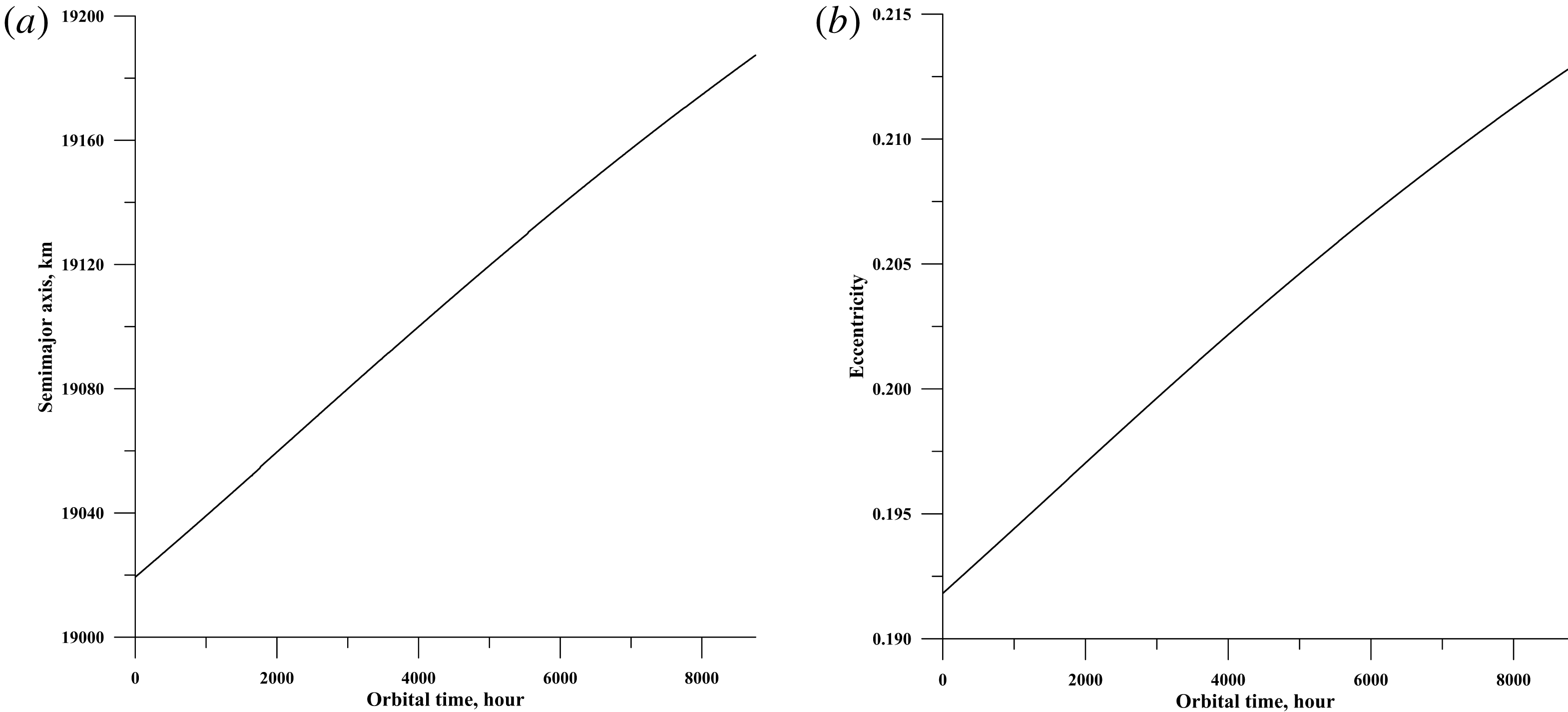
Dependencies of the semimajor axis (a) and the eccentricity (b) of the orbit of a carbon MP with a radius of 33 nanometers and non-equilibrium electric charges on time moving in the equatorial plane for the case of the action of only two forces: the gravitational and the Lorentz force component due to the corotational electric field. Initial conditions correspond to an orbit of a particle without a charge with a perigee altitude of 9000 km, a velocity
 $5.449~\text{km}~\text{s}^{-1}$
, an angle of inclination of
 $0^{\circ }$
, a longitude of ascending node of
 $180^{\circ }$
and an ascending node-perigee angle of
 $270^{\circ }$
.

To confirm the obtained analytical results, the numerical simulation of the motion of MPs with radii of the order of several hundredths of a micrometer in the Earth’s plasmasphere has been carried out. Under the simplifying assumptions for which the Hamilton function (2.3) is written, the simulation of MPs’ motion in the NES has been carried out on the basis of the numerical solution of the equations of MPs’ motion with a local equilibrium electric charge defined by the solution of the equation of the currents’ balance (see (3.2) in Yakovlev et al.
Reference Yakovlev, Kolesnikov and Chernov2017). As an example, in figure 2(a,b), we can see dependencies of the semimajor axis and the eccentricity of the orbit of the carbon MP with a radius of 33 nanometers on time. The MP was injected in the NES in a perigee of an elliptic orbit with a perigee altitude of 9000 km, initial velocity
 $5.449~~\text{km}~\text{s}^{-1}$
, an angle of inclination of
 $0^{\circ }$
, a longitude of ascending node of
 $180^{\circ }$
and ascending node-perigee angle of
 $270^{\circ }$
.
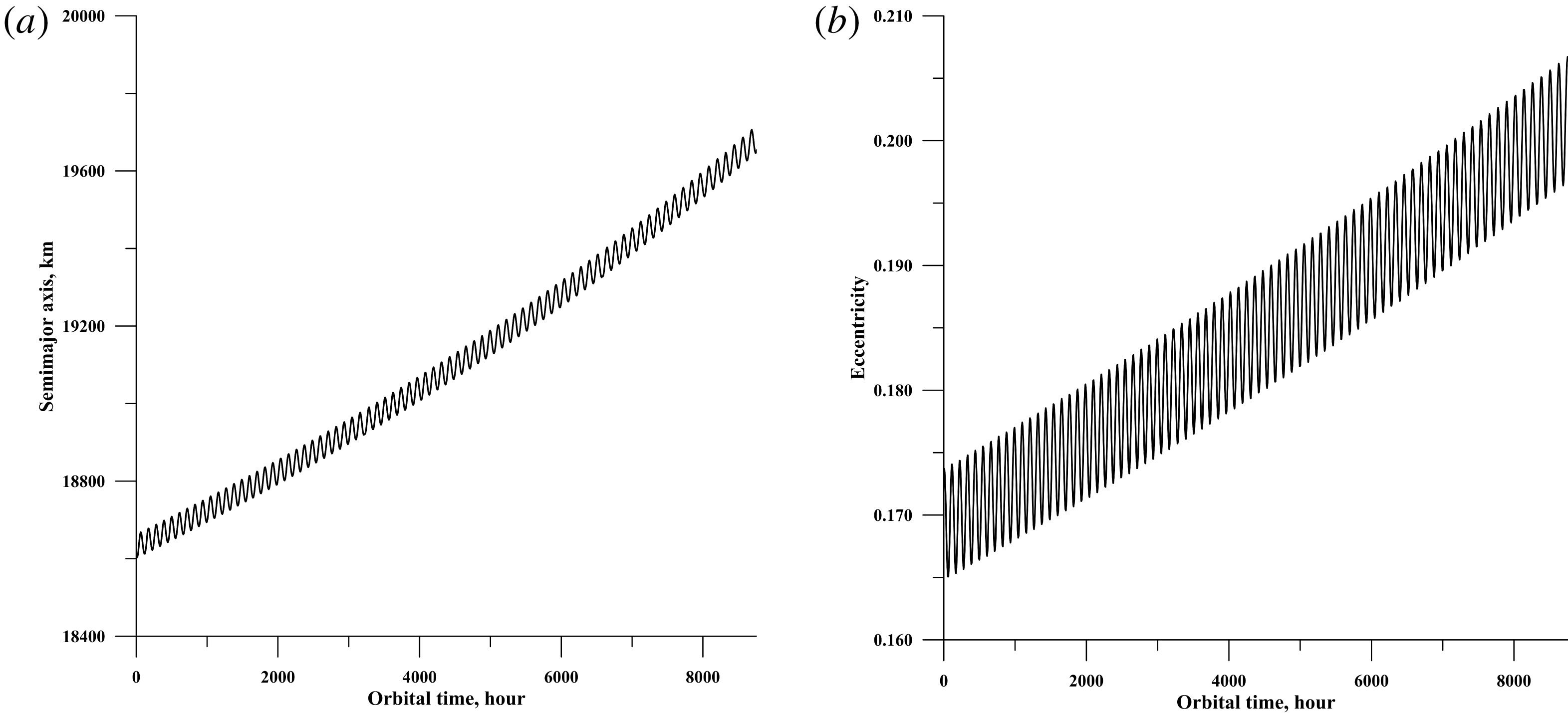
Dependencies of the semimajor axis (a) and the eccentricity (b) of a carbon MP with a radius of 33 nanometers and the non-equilibrium electric charges on time for the case of the action of only two forces: the gravitational and the Lorentz force component due to the corotational electric field (without accounting for shading). Initial conditions correspond to an orbit of a particle without a charge with a perigee altitude of 9000 km, a velocity
 $5.449~\text{km}~\text{s}^{-1}$
, an angle of inclination of
 $30^{\circ }$
, a longitude of ascending node of
 $180^{\circ }$
and an ascending node-perigee angle of
 $270^{\circ }$
.

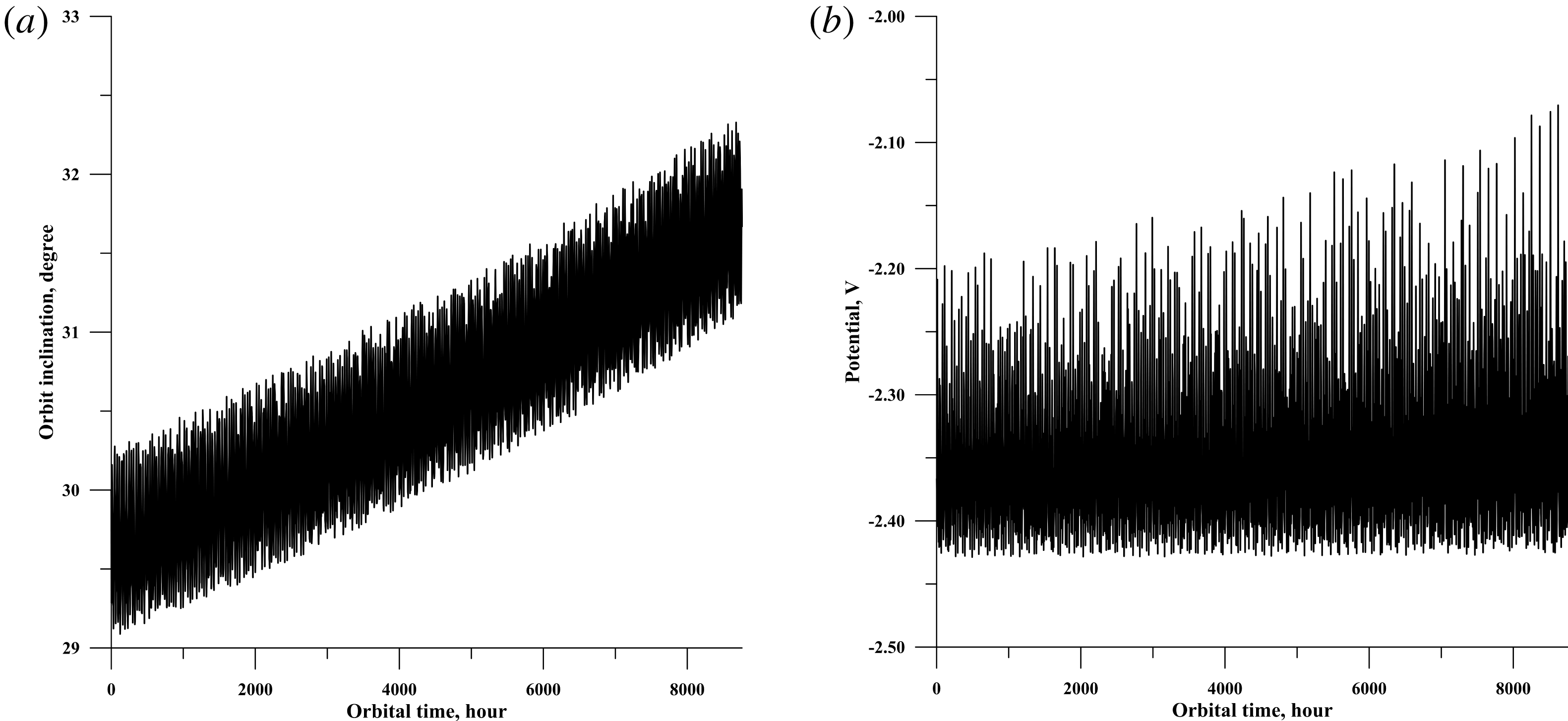
Dependencies of the inclination of the orbit (a) and the electric potential (b) of a carbon MP with a radius of 33 nanometers and non-equilibrium electric charges on time for the case of only two forces: the gravitational and the Lorentz force component due to the corotational electric field (without accounting for shading). Initial conditions correspond to an orbit of a particle without a charge with a perigee altitude of 9000 km, a velocity
 $5.449~\text{km}~\text{s}^{-1}$
, an angle of inclination of
 $30^{\circ }$
, a longitude of ascending node of
 $180^{\circ }$
and an ascending node-perigee angle of
 $270^{\circ }$
.

The simulation was carried out over a time interval of 1 year, and in this case, only two forces were taken into account: gravitational and the corotational electric field. The effect of the shadowing part of the orbit is not taken into account. As can be seen from the data in figure 2(a,b), in the case under consideration, the semimajor axis and the eccentricity of the orbit of the MP, as predicted, almost monotonously increase with time. The results of the calculations presented in figures 3(a,b) and 4(a,b), allow us to estimate the influence of the initial angle of inclination on the character of the orbital parameter change. A non-zero initial angle of inclination causes oscillations of the semimajor axis, eccentricity and inclination angle, a monotonic increase in the mean value
 $i$
and the appearance of an additional frequency of the oscillations of the potential of the MP, which coincides with the frequency of oscillations
 $a$
,
 $i$
and
 $e$
. Numerical calculations for other radii of a MP and initial conditions for its injection, which also satisfy the conditions of application of the model in question, give similar results.
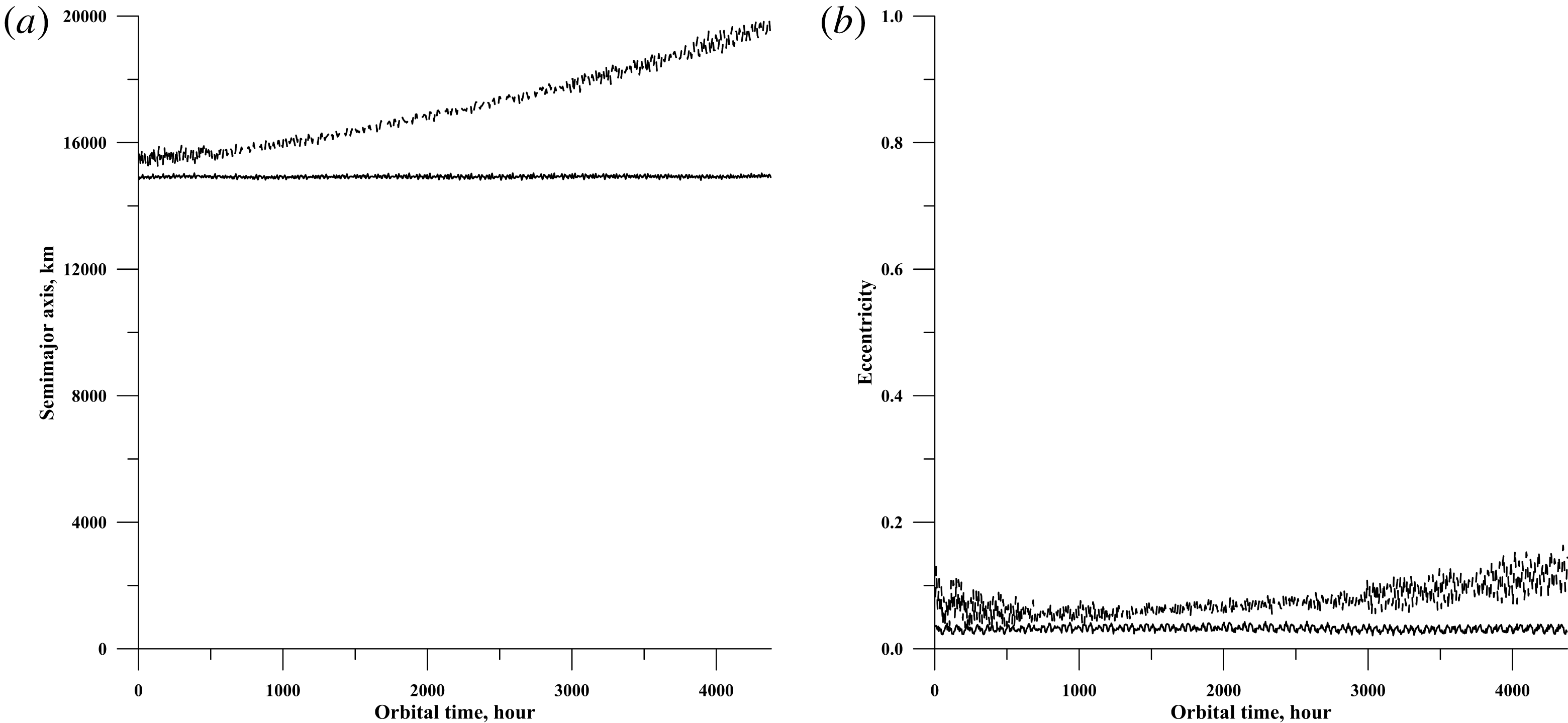
Finally, figure 5(a,b) allow to compare evolutions of the semimajor axis and the eccentricity for parameters mentioned above (figures 3 a,b and 4 a,b) for two ways of calculation: (1) the central field of gravitation and magnetic component of Lorentz force are acting on grain with the electric charge, which is assumed to be in equilibrium in every step of numerical integration of the system of equations of motion; (2) the full system of seven forces is acting on grain, and the system of equations of motion and the MP’s charging is numerically integrated. The full system of forces include the central gravitational field of the Earth; its perturbation caused by the polar compression of the Earth; magnetic component of Lorentz force; electrical component of Lorentz force caused by the corotational electric field and convection electric field; the force of solar pressure and the resistance force arising due to a flow of the background gas.
It is seen easily that the new analytical model describes very well the real motion of MPs over the time interval of 4000 h (about half a year).
Dependencies of the semimajor axis (a) and the eccentricity (b) of a carbon MP with a radius of 33 nanometers on time. Initial conditions correspond to an orbit of a particle without a charge with a perigee altitude of 9000 km, a velocity
 $5.449~\text{km}~\text{s}^{-1}$
, an angle of inclination of
 $30^{\circ }$
, a longitude of ascending node of
 $180^{\circ }$
and an ascending node-perigee angle of
 $270^{\circ }$
. Solid line for the case of two acting forces: the gravitational and the component of the Lorentz force due to the corotational electric field. Dashed line for a general case of seven forces and the charge, which is determined at every step of numerical integration of the system of equations of motion and the MP’s charging.

3 Conclusions
Under some simplifying assumptions for quasi-equilibrium electric charge, it is possible to write down the Hamilton function in the presence of an electric field of corotation.
Analytical and numerical studies have shown that the character of influence of the corotational electric field on the motion of MPs in the Earth’s plasmasphere have principal distinction for equatorial and inclined orbits. In the first case, the action of the corotational electric field leads to monotonous growth of the mean values of the semimajor axis and eccentricity of the MP orbit. A non-zero initial angle of inclination causes oscillations of the semimajor axis, eccentricity and inclination angle, a monotonic increase in the mean value
 $i$
and the appearance of an additional frequency of the oscillations of the potential of the MP, which coincides with the frequency of oscillations
 $a$
,
 $i$
and
 $e$
.
We have shown that the new analytical model describes real motion of microparticles on the time interval of 4000 h (about half a year) very well. However, for the long time intervals, it is not true because the particle leaves the plasmasphere and enters into a plasma sheet where the model of the surrounding plasma, which was used in Yakovlev et al. (Reference Yakovlev, Kolesnikov and Chernov2017), is not so true.
Acknowledgement
The work is supported by the Russian Foundation of Basic Research, Grant No. 18-01-00657 A.