

1 Introduction
The World Bank's (2015a, b) statistics on total fertility and life expectancy at birth show that the total fertility has declined by 50% between 1961 and 2013, while the life expectancy has increased by 34% in the same period, thus implying that almost all countries are experiencing the phenomenon of ‘aging’ or an increasing mean age of the population. Since 2.1 children per female is the minimum number of children to sustain the population, we note (see Table 1) that all high-income countries and Organization for Economic Co-operation and Development (OECD) countries are confronted with a declining native population. These developments are challenging especially for high-income countries and their social security and health care systems. In most developed countries, the pension system is organized as a pay-as-you-go (PAYG) pension system.Footnote 1 The normative justification for the existence of a PAYG pension system is based on the fact that a PAYG system is a mechanism through which an intergenerational externality can be internalized (Becker and Murphy, Reference Becker and Murphy1988; Peters, Reference Peters1995; Rangel, Reference Rangel2003; Boldrin and Montes, Reference Boldrin and Montes2005; Kaganovich and Meier, Reference Kaganovich and Meier2012; Kaganovich and Zilcha, Reference Kaganovich and Zilcha2012). The positive intergenerational externality accrues through the investments in human capital which does not only increase the children's human capital, but also the human capital of all succeeding generations. Another intertemporal externality, which is less recognized in the literature is the extent to which human capital positively influences the life expectancy (Cutler et al., Reference Cutler, Deaton and Lleras-Muney2006).

The pension benefits of PAYG systems depend usually positively on wages and size of the labor force and negatively on the length of the retirement period. While rising real wages as a result of growing labor productivity are evolving in favor of the pension benefits, the aging of the society counteracts this positive evolution. Consequently, concerned by the latter, many governments apply a number of policy measures to fight the problem of aging. For example, a government may offer incentives to increase the total fertility, the human capital of the population and/or the statutory retirement age.
In this paper, we restrict our analysis to the first two policy measures: (a) incentivizing the number of children, and (b) having a better educated workforce.
The main objectives of our research are to determine the economic and demographic consequences resulting from offering child allowances and providing an educational subsidy. We apply an overlapping generations (OLG) model (Diamond, Reference Diamond1965) which is extended by an endogenously determined life expectancy, endogenous fertility decisions and endogenous human capital building decisions, where parents solve a quality–quantity trade-off to determine the number of children and their educational level (Becker, Reference Becker1960). The driver of growth in our model is the human capital accumulation. Our model is similar to Peters (Reference Peters1995) who uses a general social welfare function to determine the conditions for optimal child allowances and educational subsidy with reference to US and German pension system. However, because of the generality of Peters’ (Reference Peters1995) model and the social welfare function, it is not clear whether children should be taxed or subsidized. Our model differs from Peters (Reference Peters1995) in that we consider: (a) a pure income-related PAYG pension system (Kolmar, Reference Kolmar1997), (b) a small open economy instead of a closed one, (c) no social welfare function and (d) the expected lifetime, which is assumed to be dependent on the human capital acquired in the early years of life. Hence, we model endogenous aging similar to Blackburn and Cipriani (Reference Blackburn and Cipriani2002). Nevertheless, we show that the presence of aging does not alter the general results derived by Peters (Reference Peters1995) who recommends subsidizing education, not providing child allowances and possibly taxing children. The coincidence of the results is not obvious since a longer expected retirement period decreases the pension benefits. These results are consistent with the results derived by Cremer et al. (Reference Cremer, Gahvari and Pestieau2011) who integrate the possibility that children have different abilities, which are partly stochastically determined. Our approach and results differ from Fanti and Gori (Reference Fanti and Gori2008a, Reference Fanti and Gorib) who (a) assume that parents take the expenditures for education and not the outcome of education as a measure for quality, and (b) conclude that human capital generates no growth-enhancing effect but only an income-level effect.
Besides the normative issues, our model exhibits a positive issue because it can partly replicate the structure of the demographic development of developed countries and hence complements the unified growth theory of Galor (Reference Galor, Aghion and Durlauf2005, Reference Galor2011).
The remainder of the paper is organized as follows: in Section 2, a review of the relevant literature is provided; in Section 3, the model of a small open economy is introduced; Sections 4 and 5 entail the analyses on the effects of child allowances and educational subsidies on the fertility rate, population and pensions, respectively. Section 6 examines the welfare effects generated by both policies. Finally, in Section 7, conclusion follows.
2 Literature review
A number of studies (including the aforementioned) have investigated the extent to which family policies are a desirable mean to enhance economic welfare. The point of departure is mostly the hypothesis that a demographic change caused by a decreasing fertility and an increasing life expectancy generates a negative impact for future generations and especially for the pension system. Some studies (Cigno, Reference Cigno1993; Michel and Pestieau, Reference Michel and Pestieau1993; Fanti and Gori, Reference Fanti and Gori2012) present a counter argument that a decreasing fertility rate results in a rising capital–labor ratio in a closed economy and hence increases the wage rates and under certain assumptions the pension payouts. However, in an open economy with no or small impact on international factor prices, such arguments do not hold. Kolmar (Reference Kolmar1997), Van Groezen et al. (Reference Van Groezen, Leers and Meijdam2003), Van Groezen and Meijdam (Reference Van Groezen and Meijdam2008) and Fenge and Meier (Reference Fenge and Meier2005, Reference Fenge and Meier2009) investigate and show the possibility that a child allowance or alternatively a child-related PAYG pension system for a small country, under certain conditions, is an appropriate means to enhance the fertility and the welfare simultaneously.Footnote 2 These studies have the following aspects in common: (a) they assume either the pension benefits depend on the number of children or child allowances are introduced; (b) they argue that both policy measures will increase the growth of the population and attract higher capital inflows thus making all individuals better off; and (c) they consider a fixed amount of goods and services bought for children as an indicator for the quality of a child, which in some sense is a restricted measure.Footnote 3
Moreover, while the aforementioned papers assume identical agents, some recent studies (Meier and Wrede, Reference Meier and Wrede2010; Cigno and Luporini, Reference Cigno and Luporini2011; Cremer et al., Reference Cremer, Gahvari and Pestieau2011) allow for heterogeneous agents and introduce stochastic processes, which determine the success of schooling and/or the success of giving birth to children. Meier and Wrede (Reference Meier and Wrede2010)Footnote 4 and Cigno and Luporini (Reference Cigno and Luporini2011) propose the introduction of a child-related PAYG pension system and child subsidies, respectively. These approaches nevertheless lead to ambiguous policy recommendations.
Another strand of literature on fertility and human capital accumulation includes Zhang (Reference Zhang1997, Reference Zhang2003, Reference Zhang2006) and Li and Zhang (Reference Li and Zhang2015). They assume that individuals are perfectly altruistic in the sense of Barro (Reference Barro1974) with respect to (w.r.t.) their offspring and that the human capital accumulation is associated with external economies of scale. The latter idea goes back to Lucas (Reference Lucas1988) who assumes that the private rate of return of human capital building is lower than the social rate of return. Hence, a government subsidy as an incentive to invest in human capital is desirable to internalize the positive external effect.
With respect to the problem of aging, Cipriani (Reference Cipriani2014) integrates fertility behavior and exogenous aging similar to Ehrlich and Lui (Reference Ehrlich and Lui1991) in a Diamond model and concludes that aging lowers pension payouts. In another study, Cipriani (Reference Cipriani2015) integrates human capital and endogenous longevity where the latter depends on human capital to examine child labor and child mortality. In contrast, Fanti and Gori (Reference Fanti and Gori2014) assume longevity is dependent on health care expenditures and conclude that under specific assumptions a child tax can be welfare enhancing.
3 The model
We begin with the human capital production function (Azariadis and Drazen, Reference Azariadis and Drazen1990; Azariadis, Reference Azariadis1993; De la Croix and Doepke, Reference De la Croix and Doepke2003, Reference De la Croix and Doepke2004; Cipriani, Reference Cipriani2015; Stauvermann and Kumar, Reference Stauvermann and Kumar2016) defined as:
 $$h_{t + 1} = \left\{ {\matrix{ {Bh_t q_t^\varepsilon, \; \; {\rm \; for\;} Bq_t^\varepsilon - 1 \gt 0,} \cr {h_t, \; \; \; {\rm for}\; Bq_t^\varepsilon - 1 \le 0,} \cr}} \right.$$
where B > 0, h 0 = 1 and ε ε (0, 1). The variable q t ≥ 0 represents parents' investments in the education per child. Since we focus on the effects caused by human capital accumulation, we assume  $B \gt 1/q_t^\varepsilon $ to ascertain the growth of human capital and to avoid the case of a low development trap, which results if the human capital remains constant (Cipriani, Reference Cipriani2015). Furthermore, in our model it does not matter if the school system is privately or publicly organized. Human capital generated by education plays two roles: first, it is the main source of economic growth as in Uzawa (Reference Uzawa1965), Lucas (Reference Lucas1988) or Azariadis and Drazen (Reference Azariadis and Drazen1990) among othersFootnote 5 and second, the human capital of children is interpreted as child quality in the sense of Becker (Reference Becker1960) and others (Galor and Weil, Reference Galor and Weil1999; De la Croix and Doepke, Reference De la Croix and Doepke2003, Reference De la Croix and Doepke2004; Stauvermann and Kumar, Reference Stauvermann and Kumar2016). Thus, our approach differs from Fanti and Gori (Reference Fanti and Gori2008a, Reference Fanti and Gorib) and Strulik (Reference Strulik2003, Reference Strulik2004a, Reference Strulikb) who assume that the aggregate expenditures for children represent their quality.
We use the structure of an OLG model of the Diamond (Reference Diamond1965) type where children do not make any decisions in their first period of life. In the second period, as parents, they supply labor which is inelastic, earn a labor income of  $\; \bar w_t $, give birth to a number of children n t who incur pure-child rearing costs of
 $e\bar w_t $ per child, pay for their education
 $\; q_t \bar w_t $, consume
 $c_t^1 \; $ units and save a part of their income s t. Additionally, they have to contribute to the pension system. In the third period of their life, they retire and consume their pension benefit and savings plus interest. The representative agent derives her utility from: (a) the consumption in both the periods, (b) the number of children (their quantity) and (c) the level of the children's human capital stock (their quality).
To incorporate the effects of an increasing life expectancy, we use the approach of Ehrlich and Lui (Reference Ehrlich and Lui1991) and intuition from Cutler et al. (Reference Cutler, Deaton and Lleras-Muney2006), so that the individuals enjoy the third period of life with probability ρ. The survival probability depends positively on the existing average human capital per capita  $\; \bar h_t, $ which is taken as given by the individuals.
With respect to the survival probability  $\; \rho = \rho (\bar h_t )$, we assume the following properties:
 $\; 0 \lt \underline{\rho} \le \rho (\bar h_t ) \le 1,\;\rho {\rm ^{\prime}(}\bar h_t {\rm )} \gt 0$,
 $\rho^{\prime \prime} ({\bar h}_t) \lt 0$,
 $\mathop {\lim} \limits_{\bar h_t \to \infty} \rho {\rm ^{\prime}(}\bar h_t {\rm )} = 0,\; \mathop {\lim} \limits_{\bar h_t \to \infty} \rho (\bar h_t ) = 1\; $ and
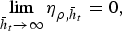 $\mathop {\lim} \limits_{\bar h_t \to \infty} \eta _{\rho, \bar h_t} = 0,\; $ where
 $\eta _{\rho, \bar h_t} = \rho {\rm ^{\prime}(}\bar h_t {\rm )(}\bar h_t {\rm /}\rho (\bar h_t ){\rm )}$.Footnote 6 The assumption that the survival probability converges to one if the human capital strives to infinity implies a biological maximum of lifetime (Blackburn and Cipriani, Reference Blackburn and Cipriani2002; Cipriani and Makris, Reference Cipriani and Makris2012; Cipriani, Reference Cipriani2014). The positive relationship between human capital and life expectancy implies a second positive intertemporal externality, which exists in addition to the usual positive intertemporal externality of human capital accumulation that causes the income levels to grow. This second externality results from human capital accumulation, which causes the survival probability of children and all succeeding generations to increase. However, parents do not consider this effect because their influence on the average human capital stock of all children is only marginal.
Given that the individual is alive in her third period of life, she does not work and lives from a pension benefit, savings s t and interest income. Following Cipriani (Reference Cipriani2014), we consider a perfectly competitive financial market with the risk-free interest factor $\; R_{t + 1} /\rho (\bar h_t )$. Subsequently, the consumption in the third period of life
 $c_{t + 1}^2$ of a representative agent becomes:
 $$c_{t + 1}^2 = P_{t + 1} + \displaystyle{{R_{t + 1} s_t} \over {\rho (\bar h_t )}}.$$
The pension benefit P t+1 is provided by the PAYG pension system where every worker has to contribute a constant share τ P of her labor income. To ensure the clarity of the model, we keep the pension system separate from child policies. The corresponding budget constraint of the PAYG system in per capita terms is then:
 $$P_t = \displaystyle{{\tau ^P \bar w_t n_{t - 1}} \over {\rho (\bar h_{t - 1} )}}.$$
Furthermore, it should be noted that the pension benefits adjust automatically to the contributions so that (3) is always fulfilled. The aim is to analyze the economic effects caused by two different child policies: child allowances and a subsidy for education. With respect to these two types of subsidies, we assume that the child allowance covers a fixed share s N of the pure-child rearing costs and that the educational subsidy covers a fixed share s H of the educational costs. The government levies a payroll tax τ t to finance the corresponding expenditures. In order to keep the government budget in balance, the following equation in per capita terms must hold:
 $$(s_N e + s_H q_t )\bar w_t n_t = \tau _t \bar w_t. $$
Different from the pension system, the payroll tax τ t adjusts automatically so that (4) is always satisfied. The pure-child rearing costs are assumed to be a fixed share e of the wage income. Additionally, the endogenously determined educational costs are expressed as a share of the wage income.
Using (4), we can derive the budget constraint of the representative agent in her second period of (working) life as:
 $$c_t^1 = \bar w_t (1 - \tau ^P - \tau _t - (q_t (1 - s_H ) + e(1 - s_N ))n_t ) - s_t. $$
It should be noted that we restrict the extent of the subsidies and social security policy by assuming τ P + τ t < 1.
To make our results comparable to the related literature, we assume that the utility of a representative agent born in period t − 1 is described by a commonly used log-linear function given as.
 $$U_t (c_t^1, \;c_{t + 1}^2, \;n_t, \;q_t ) = ln(c_t^1 ) + \rho (\overline {h_t} )\chi ln(c_{t + 1}^2 ) + \mu ln(n_t h_{t + 1} ).$$
The subjective discount factor and the preference parameter for the quantity of educated children are χ ∈ [0, 1] and μ ∈ [0, 1], respectively. The labor time is normalized to one. The representative agent maximizes her utility (6) w.r.t. the restrictions (1), (2) and (5). To derive a solution of the maximization problem, we insert (1), (2) and (5) in (6) and solve the following maximization problem:
 $$\eqalign{& \mathop {\max }\limits_{\left\{ {s_t,n_t,q_t} \right\}} U_t(s_t,n_t,q_t) = {\rm ln}({\bar w}_t(1 - \tau ^P - \tau _t - (q_t(1 - s_H) + e(1 - s_N))n_t) - s_t) \cr &\quad + \rho (\overline {h_t} )\chi {\rm ln}\left( {P_{t + 1} + \displaystyle{{R_{t + 1}s_t} \over {\rho ({\bar h}_t)}}} \right) + \mu {\rm ln}(n_tBh_tq_t^\varepsilon ).} $$
Differentiating (7) w.r.t. the savings, number of children and investments in education, we get the following three first-order conditions (FOCs).
 $$\displaystyle{1 \over {(\bar w_t (1 - \tau ^P - \tau _t - (q_t (1 - s_H ) + e(1 - s_N ))n_t ) - s_t )}} = \displaystyle{{\chi R_{t + 1}} \over {P_{t + 1} + (R_{t + 1} s_t /\rho (\bar h_t ))}}, $$
 $$\displaystyle{{\bar w_t (q_t (1 - s_H ) + e(1 - s_N ))} \over {(\bar w_t (1 - \tau ^P - \tau _t - (q_t (1 - s_H ) + e(1 - s_N ))n_t ) - s_t )}} = \displaystyle{\mu \over {n_t}}, $$
 $$\displaystyle{{\bar w_t (1 - s_H )n_t} \over {(\bar w_t (1 - \tau ^P - \tau _t - (q_t (1 - s_H ) + e(1 - s_N ))n_t ) - s_t )}} = \displaystyle{{\mu \varepsilon} \over {\; q_t}}. $$
Using the FOCs and the government budget constraints, we derive the optimal savings, number of children and investments in education. Henceforth, we assume that  $\; \bar w_t = h_t w$ and the interest factor R t = R, where R and w are determined on the international capital market and time invariant. Subsequently, the optimal investment in education becomes:
 $$q{^\ast} = \displaystyle{{e\varepsilon (1 - s_N )} \over {(1 - s_H )(1 - \varepsilon )}} \gt 0.$$
It should be noted that it is not necessary that q* < 1 because the number of children can take a sufficiently small value exceeding zero to get a meaningful solution. Consequently, by inserting (11) in (1) we get human capital stock per capita in period t + 1, and then dividing this by h t delivers the growth factor of human capital:
 $$G^h = \displaystyle{{h_{t + 1}} \over {h_t}} = B\left( {\displaystyle{{e\varepsilon (1 - s_N )} \over {(1 - s_H )(1 - \varepsilon )}}} \right)^\varepsilon. $$
The growth factor G h is constant as long as the educational subsidy and child allowance remain unchanged.
According to equation (3), we can rewrite the pension payout of an individual working in period t as  $P_{t + 1} = (\tau ^P wh_t G^h n_t /\rho (\bar h_t ))$. For the further analysis, we define: h t = h 1 (G h)t−1, where h 1 is taken as exogenously given value of human capital. The definition takes into account that the first generation, which should be considered regarding a change of a policy, is the working generation in period one and their human capital is determined by their parents in period 0. Accordingly, h 1 is given and cannot be affected by policy.
Using (12), the two budget constraints of the government ((3) and (4)) and the FOCs ((8)–(10)), the respective equilibrium values for the number of children and savings are:
 $$n_t^{\ast} = \displaystyle{{(1 - \tau ^P )(1 - s_H )R\mu (1 - \varepsilon )} \over \matrix{Re[(1 + \rho (\bar h_1 (G^h )^{t - 1} )\chi )(1 - s_H )(1 - s_N ) \,+ \hfill \cr \mu (1 - s_H (1 - \varepsilon ) - \varepsilon s_N )] - \mu G^h \tau ^P (1 - \varepsilon )(1 - s_H ) \hfill}}, $$
 $$s_t^{\ast} = \displaystyle{\matrix{(1 - \tau ^P )(1 - s_H )wh_1 (G^h )^{t - 1} [\rho (\bar h_1 (G^h )^{t - 1} ) \hfill \cr \chi Re(1 - s_N ) - \mu G^h \tau ^P (1 - \varepsilon )] \hfill} \over \matrix{Re[(1 + \rho (\bar h_1 (G^h )^{t - 1} )\chi )(1 - s_H )(1 - s_N ) \,+ \hfill \cr \mu (1 - s_H (1 - \varepsilon ) - \varepsilon s_N )] - \mu G^h \tau ^P (1 - \varepsilon )(1 - s_H ) \hfill}}. $$
Because of the assumption that all individuals are identical, the average human capital stock per capita always equals the individual human capital stock:  $\; \bar h_t = h_t, \; \forall t.$ It should be noted that a positive level of savings is always guaranteed as long as the contribution rate τ P is sufficiently small.Footnote 7
Using the growth factor (12), the optimal number of children (13) and the equation of the pension benefits (3), the equilibrium pension benefits are given by:
 $$P_{t + 1}^{\ast} = \displaystyle{{\tau ^P (1 - \varepsilon )(1 - \tau ^P )(1 - s_H )\mu Rwh_1 (G^h )^t} \over \matrix{\rho (h_1 (G^h )^{t - 1} )[Re[(1 + \rho (\bar h_1 (G^h )^{t - 1} )\chi )(1 - s_H )(1 - s_N ) \,+ \hfill \cr \mu (1 - s_H (1 - \varepsilon ) - \varepsilon s_N )] - \mu G^h \tau ^P (1 - \varepsilon )(1 - s_H )] \hfill}}. $$
Next, we rewrite the survival probability  $\rho _t = \rho (\bar h_t )$ by inserting the growth factor (12) as:
 $$\rho _t = \rho (\bar h_{t - 1} G^h ) = \rho \left( {\bar h_1 \left( {B\left( {\displaystyle{{\varepsilon (e - s_N )} \over {(1 - s_H )(1 - \varepsilon )}}} \right)^\varepsilon} \right)^{t - 1}} \right),\;\forall t \ge 1.$$
With the aforementioned assumptions and positive growth factor, three characteristics of the function follow directly:
 $$\mathop {\lim} \limits_{t \to \infty} \rho (\bar h_t ) = 1,$$
 $$\mathop {{\rm lim}}\limits_{t \to \infty} \rho {\rm ^{\prime}(}\bar h_t {\rm )} = 0,\;{\rm and}$$
 $$\mathop {{\rm lim}}\limits_{t \to \infty} \displaystyle{{\rho {\rm ^{\prime}(}\bar h_t {\rm )}} \over {\rho (\bar h_t )}}\bar h_t = 0.$$
To complete the description of the development path of the economy, we determine the total working population under two plausible scenarios, whilst excluding the pathological case of an ever increasing negative population growth rate: (a) the population growth is unbounded, and (b) a more realistic case where the growth rate of population is positive for over some period and then becomes negative after a certain point in time. Given the population size in period one, the total working population (henceforth population) is calculated using (13) as:
 $$N_{t + 1}^{\ast} = N_1 \mathop \prod \limits_{t = 1}^t \displaystyle{{(1 - \tau ^P )(1 - s_H )R\mu (1 - \varepsilon )} \over \matrix{R[(1 + \rho (\bar h_1 (G^h )^{t - 1} )\chi )(1 - s_H )(e - s_N ) \,+ \hfill \cr \mu (e(1 - s_H (1 - \varepsilon )) - \varepsilon s_N )] - \mu G^h \tau ^P (1 - \varepsilon )(1 - s_H ) \hfill}}. $$
With the initial value of human capital in period one and the chosen policy variables s H, s N and τ P, equations (12)–(16) and (18) are used to determine the whole development process of the economy. Moreover, the equilibrium values of the savings per capita, the number of children and hence the consumption pattern change disproportionally from period to period as long as the life expectancy is rising. If the survival probability reaches one then, the number of children remains unchanged, the savings grow in proportion to the wage income, and the human capital, the wage income and income per capita grow with the factor G h. This kind of evolution is plausible because of the assumption that international capital market determines the capital stock and hence the factor prices in the economy.
In the long run, because of (17), the number of children converges to a constant value:
 $$\mathop {\lim} \limits_{t \to \infty} n_t^{\ast} = \displaystyle{{(1 - \tau ^P )(1 - s_H )R\mu (1 - \varepsilon )} \over \matrix{R[(1 + \chi )(1 - s_H )(e - s_N ) \,+ \hfill \cr \mu (e(1 - s_H (1 - \varepsilon )) - \varepsilon s_N )] - \mu G^h \tau ^P (1 - \varepsilon )(1 - s_H ) \hfill}} \gt 0.$$
The right-hand side (RHS) of (19) can take any positive value. If the RHS is smaller than one, the population converges to zero in the very long run and if the RHS exceeds one, the population will grow unbounded.
4 Effects caused by a child allowance
In this section, we analyze the effects of a child allowance on the number of children, human capital, survival probability, fertility and pension benefits. Our interpretation of child allowances is broad and can include child tax benefits or a partly fertility-related pension program (Fenge and Meier, Reference Fenge and Meier2005; Meier and Wrede, Reference Meier and Wrede2010).
Proposition 1:
The introduction of a child allowance financed through a payroll tax reduces investments in human capital, the growth rate of human capital and subsequently the human capital of all succeeding periods.
Proof: Differentiating (11) and (12) w.r.t. the child allowance we get:
 $$\displaystyle{{\partial q{^\ast}} \over {\partial s_N}} = - \displaystyle{{\varepsilon e} \over {(1 - s_H )(1 - \varepsilon )}} \lt 0\quad {\rm and}\quad \; \displaystyle{{\partial G^h} \over {\partial s_N}} = - \displaystyle{\varepsilon \over {(1 - s_N )}}G^h \lt 0.$$
As noted, the introduction of or an increase in a child allowance affects the human capital of all unborn generations negatively.Footnote 8 Intuitively, if the government supports parents by providing a child allowance, the direct costs of child rearing and the disposable income decrease. Additionally, the relative costs of education increases and as a result, parents decrease the investments in education, which has not only a negative impact for the human capital of their children but also a negative impact on the human capital of all the succeeding generations. The argument behind this result is caused by the quantity–quality trade-off between the number of children and their level of education.Footnote 9 However, the relatively lower human capital stock has obviously a negative impact on the per capita income and the life expectancy, respectively.
Proposition 2:
The introduction of a child allowance decreases the longevity of all future generations.
Proof: Differentiating the survival probability (16) w.r.t. the child allowance, we get:
 $$\displaystyle{{\partial \rho _t} \over {\partial s_N}} = - (t - 1)\eta _{\rho, \bar h_t} \displaystyle{{\varepsilon \rho (\bar h_1 (G^h )^{t - 1} )} \over {(e - s_N )}} \le 0,\; \;\forall t \ge 1.$$
The expression  $\eta _{\rho, \bar h_t} $ represents the elasticity of the survival probability w.r.t. the average human capital stock per capita in period t. Given our assumptions on the survival probability above, the elasticity is positive, smaller than one, monotonically decreasing and converging to zero in the long run. The argument is clear: the child allowance reduces the accumulation of human capital and hence the acquisition of new knowledge which results from research and development activities, the latter is necessary to increase the expected lifetime. However, the negative effect on the life expectancy is not everlasting because the child allowance shifts the increase of the life expectancy and hence the demography into the future. Formally, we know from (17) that the elasticity of the survival probability w.r.t. human capital
 $\; \eta _{\rho, \bar h_{t\;}} $ strives to zero in the very long run. This implies that the derivative in (21) will become zero in the long run. Therefore, an important question is whether a child allowance is an appropriate policy tool to increase the fertility rate and hence the demographic development of an economy.Footnote 10 In this regard, proposition 3 is in order.
Proposition 3:
The introduction of a child allowance increases the number of children in the short run and the long run, respectively.
The respective derivative is given by:
 $$\displaystyle{{\partial n_t^{\ast}} \over {\partial s_N}} = \underbrace {\left. {\displaystyle{{\partial n_t^{\ast}} \over {\partial s_N}}} \right \vert _{\rho \left( {\bar h_t} \right) = {\rm const}.}} _ + - \displaystyle{{(t - 1)\varepsilon} \over {1 - s_N}} \underbrace {\displaystyle{{\partial n_t^{\ast}} \over {\partial \rho _t}} \rho (\bar h_t )}_ - \underbrace {\eta _{\rho _t, h_t}} _ + \gt 0.$$
The intuition behind the proposition is as follows: the negative impact of a child allowance on the investments in education is caused by the fact that the marginal costs of an additional unit of human capital for all children are equal to  $(1 - s_H )\bar w_t n_t $. These marginal costs are independent from the child allowance. The marginal costs of an additional child are
 $\bar w_t (q_t (1 - s_H ) + e(1 - s_N ))\; $ and depend negatively on the child allowance. This means it becomes relatively cheaper to get an additional child than to invest in human capital. The result is that an increasing child allowance raises the number of children. This intuition explains the first summand of (22). Concerning the second summand, because of the negative impact of the child allowance on the investments in human capital, the growth factor declines and this leads to a lower human capital stock of all succeeding generations. A lower human capital stock results in a relatively lower life expectancy, which in turn increases the number of children. The negative relationship between life expectancy and number of children results from the fact that a lower survival probability reduces the savings and thus a bigger share of income is available for the descendants (Stauvermann and Kumar, Reference Stauvermann and Kumar2016). This holds even when the disposable income is relatively low because of an increased payroll tax, which is needed to finance the allowance.
Although some empirical studies (Bjorklund, Reference Bjorklund2006; Beenstock, Reference Beenstock2007; Toledano et al., Reference Toledano, Frish, Zussman and Gottlieb2011; Laroque and Salanié, Reference Laroque and Salanié2014) deliver ambiguous results, we argue that the relationship between child allowance and number of children is slightly positive. The main reason why policymakers may want to enhance the fertility rate, besides sometimes nationalistic or racist reasons, is because the pension benefits are positively dependent on the demographic structure of a society or the total fertility rate.
Proposition 4.1:
An introduction of a child allowance increases the pension benefits in the short run provided the elasticity of the optimal number of children w.r.t. the child allowance is sufficiently high.
Proposition 4.2:
An introduction of a child allowance lowers the pension benefits in the long run.
Proof: Differentiating (15) w.r.t. the child allowance yields:
 $$\eqalign{& \displaystyle{{dP_{t + 1}} \over {ds_N}} = \displaystyle{{P_{t + 1}} \over {s_N}} \left( {\underbrace {\left. {\eta _{n_t, s_N}} \right \vert _{\rho (\bar h_t ) = {\rm const}.}} _ + + \underbrace {(t - 1)\eta _{\rho _t, \bar h_t} (1 - \eta _{n_t, \rho _t} ) - t}_{ + / -} \displaystyle{{\varepsilon s_N} \over {(1 - s_N )}}} \right) \cr & \quad \lt 0,\,\; \forall t \ge \bar t,} $$
where
 $$\bar t \gt \displaystyle{{(\left. {\eta _{n_t, s_N}} \right \vert _{\rho (\bar h_t ) = {\rm const}.} )(1 - s_N ) - \varepsilon s_N \eta _{\rho, \bar h_t} (1 - \eta _{n_t, \rho _t} )} \over {\varepsilon s_N (1 + (1 - \eta _{n_t, \rho _t} )\eta _{\rho, \bar h_t} )}}.$$
The first term in the bracket, which represents the effect of the child allowance on the number of children while holding the life expectancy constant, is positive. The second summand in the bracket represent two effects. The derivative (23) measures the change of the pension benefit with and without a child allowance. On the one hand, the child allowance decreases the life expectancy in succeeding periods which increases the number of children and hence the pension benefits. On the other hand, the child allowance lowers the growth of human capital and thus the pension benefits. The old generation of period one is not affected and the life expectancy of the working generation do not change. In period two, the direction of change in pension benefits is not clear. This ambiguity arises because although the number of workers has increased, these workers have received relatively lesser education than when there was no policy change (status quo). In (23), the term  $\eta _{\rho _t, \bar h_t} $ which is multiplied with t − 1 becomes zero in period two. Therefore, the overall effect of the working generation in period one resulting from less human capital per worker in period two and an increase in the number of workers is not clear. The pension benefits only increase if
 $\left. {\eta _{n_1, s_N}} \right\vert_{\rho \left( {\bar h_1} \right) = {\rm const}.} \gt (\varepsilon s_N /(1 - s_N ))$ holds. All generations born in period one and later are additionally affected with a relatively low life expectancy, which induce them to have more children. However, depending on the (realistic) parameters chosen from period one onwards, the pension benefits can be relatively higher than the amount in the status quo. Nevertheless, in the long run, the negative growth effect is stronger than the two positive effects as noted from the following:
 $$\eqalign{& \mathop {\lim} \limits_{t \to \infty} \displaystyle{{dP_{t + 1}} \over {ds_N}} = P_{t + 1} \left[ {\displaystyle{\matrix{[Re((1 + \chi )(1 - s_H ) + \mu \varepsilon ) \,- \hfill \cr \mu (\varepsilon /(1 - s_N ))G^h \tau ^P (1 - \varepsilon )(1 - s_H )] \hfill} \over \matrix{Re[(1 + \chi )(1 - s_H )(1 - s_N ) + \mu (1 - s_H (1 - \varepsilon ) - \varepsilon s_N )] \hfill \cr -\, \mu G^h \tau ^P (1 - \varepsilon )(1 - s_H ) \hfill}}} \right. \cr & \left. {\quad - \mathop {{\rm lim}}\limits_{t \to \infty} \displaystyle{{t\varepsilon} \over {(1 - s_N )}}} \right].} $$
In the long run, the life expectancy reaches its maximum of one and the elasticity of the life expectancy w.r.t. human capital becomes zero. If this is the case, the fertility rate will become constant and only the negative growth effect increases from one period to another. Moreover, because the difference between the pension benefit with a child allowance (government intervention) and the pension benefit without a child allowance becomes negative, the pension benefits in the long run will be lower with the government intervention. However, the pension benefit will not become zero (Stauvermann and Kumar, Reference Stauvermann and Kumar2016).
5 The effects caused by an educational subsidy
The second child policy we investigate is an educational subsidy which can be made available in different ways such as offering of public schools, scholarships, cash payments under the condition that the money is spent on education, among others. Regarding the human capital accumulation, the following proposition is in order.
Proposition 5:
The introduction of an educational subsidy financed through a payroll tax increases the investments in human capital, the growth rate of human capital and subsequently the human capital in all succeeding periods.
Proof: The validity of proposition 5 is confirmed by differentiating (11) and (12) w.r.t. the educational subsidy as follows:
 $$\displaystyle{{\partial q{^\ast}} \over {\partial s_H}} = \displaystyle{{\varepsilon e} \over {(1 - s_H )(1 - \varepsilon )}} \gt 0\quad {\rm and}\quad \; \displaystyle{{\partial G^h} \over {\partial s_H}} = \displaystyle{\varepsilon \over {(1 - s_H )}}G^h \gt 0.$$
Unlike a child allowance, educational subsidy works in the opposite direction. An educational subsidy reduces the costs of education and thus increases the relative costs of rearing children. If the government supports education financially or offers public education to reduce the parents' expenditures for education, then the parents increase the educational efforts which lead to an improvement of the growth rate of human capital.
Proposition 6:
The introduction of an educational subsidy will increase the longevity of all further generations.
Proof: Differentiating the survival probability (16) w.r.t. the educational subsidy, gives us:
 $$\displaystyle{{\partial \rho _t} \over {\partial s_H}} = (t - 1)\eta _{\rho, \bar h_t} \displaystyle{{\varepsilon \rho (\bar h_1 (G^h )^{t - 1} )} \over {(1 - s_H )}} \ge 0,\;\forall t \ge 1.$$
An educational subsidy induces parents to invest more in the education of their children which in turn improves the stock of knowledge. Assuming that more knowledge leads to an increase of the survival probability, the latter will be higher with an inducement of an educational subsidy. As long as the elasticity of the survival probability w.r.t. the human capital exceeds zero, all generations experience a longer lifetime. However, as mentioned above, it is plausible that elasticity strives to zero in the very long run.
The extent to which the fertility behavior is affected by an educational subsidy is captured in the following proposition.
Proposition 7:
The introduction of an educational subsidy leads to a decline of the number of children.
Proof: The derivative of the number of children (13) w.r.t. the educational subsidy is:
 $$\displaystyle{{\partial n_t^{\ast}} \over {\partial s_H}} = \underbrace {\left. {\displaystyle{{\partial n_t^{\ast}} \over {\partial s_H}}} \right \vert _{\rho (\bar h_t ) = {\rm const}.}} _ - + \displaystyle{{(t - 1)\varepsilon n_t^{\ast}} \over {1 - s_H}} \underbrace {\displaystyle{{\partial n_t^{\ast}} \over {\partial \rho _t}} \rho \left( {\bar h_t} \right)}_ - \underbrace {\eta _{\rho, \bar h_t}} _ + \lt 0.$$
The sign of the first summand of the RHS of (27) is negative and will converge to zero in the very long run. This effect is caused by the change of the relative costs of education and pure-child rearing. The second summand is also negative and the intuition is opposite to that of the second summand of derivative (22). Thus, the overall effect is that the number of children declines.
Next, we examine the extent to which the PAYG pension can be affected by an educational subsidy.
Proposition 8:
The introduction of an educational subsidy leads in the long run to higher pension benefits.
Proof: Differentiating the pension benefits w.r.t. the educational subsidy, we get:
 $$\displaystyle{{dP_{t + 1}} \over {ds_H}} = \displaystyle{{P_{t + 1}} \over {s_H}} \left( {\underbrace {\left. {\eta _{n_t, s_H}} \right \vert _{\rho (\bar h_t ) = {\rm const}.}} _ - + \underbrace {(t - 1)\eta _{\rho _t, \bar h_t} (\eta _{n_t, \rho _t} - 1) + t}_{ + / -} \displaystyle{{\varepsilon s_H} \over {(1 - s_H )}}} \right),\;\forall t \gt \overline{\overline t} $$
where
 $$\overline{\overline t} = \displaystyle{{ - (\left. {\eta _{n_t, s_H}} \right \vert _{\rho (\bar h_t ) = {\rm const}.} )(1 - s_H ) + \eta _{\rho _t, \bar h_t} (\eta _{n_t, \rho _t} - 1)\varepsilon s_H} \over {(\eta _{\rho _t, \bar h_t} (\eta _{n_t, \rho _t} - 1) + 1)\varepsilon s_H}}. $$
Two main opposing effects are induced by an educational subsidy w.r.t. the pension benefits. On the one hand, the number of children declines and on the other, the growth rate of human capital rises. The rise in the human capital increases the labor income and the survival probability. Regarding the pension benefits, the subsequent increase in income causes a positive effect, while the subsequent increase in the survival probability causes a negative effect. In the long run, the former effect exceeds the latter. In the best-case scenario, the pension benefits increase in the period after the subsidy is introduced. This will be the case if  $\; \left\vert {\left. {\eta _{n_1, s_H}} \right\vert_{\rho (\bar h_1 ) = {\rm const}.}} \right\vert \lt (\varepsilon s_H /(1 - s_H ))$. The elasticity represents the impact on the number of children due to the educational subsidy holding the life expectancy constant. The latter positive effect denoted by RHS of the inequality represents the effect of the educational subsidy on the accumulation of human capital. Nevertheless, since in the long run the positive effect on the human capital will exceed the negative effect on the fertility rate, the pension benefits will be higher with the introduction of an educational subsidy.
6 Welfare effects
As highlighted from Propositions 4.1 and 4.2, a child allowance or a corresponding child-related PAYG pension system is not suitable to increase the pension benefits in the long run. In a broader sense, we note that the growth rate of human capital declines (Proposition 1) and the life expectancy is reduced as a consequence of the introduction of a child allowance (Proposition 2). The only positive effect generated by a child allowance is the increase of the number of children (Proposition 3). However, this positive effect does not outweigh the negative effects caused by the decrease of the life expectancy and the growth rate of human capital. Especially, the latter induce a negative income effect, which is growing in time. Subsequently, we argue that at least some generations are made worse off, which is somewhat consistent with Peters’ (Reference Peters1995) and therefore we also conclude that instead of child allowance, a child tax is desirable.
On the other hand, the (positive) welfare effect of an educational subsidy is just the opposite of the (negative) welfare result caused by a child allowance. Hence, Proposition 9 is order:
Proposition 9:
The introduction of an educational subsidy leads to an A-Pareto improvement. Footnote 11
Proof: The old generation in introductory period 1 remains entirely unaffected by the policy measure. The working generation in period one does not experience a positive effect through a rising labor income or an increase of their life expectancy. The increase of its pension benefits is dependent on the sign of the RHS of (28). In any case, the working generation receives the educational subsidy and has to pay the corresponding tax to finance it. It is only sure, that this generation enjoys a higher level of human capital of its children. The generation born in period 1 and all other unborn generations enjoy a higher income, a higher level of their children's human capital and a longer life expectancy. Because of the fact that all generations have identical utility functions, we can conclude that all succeeding generations will experience an increase in utility as long as the first (parent) generation benefits from the subsidy. Thus, inserting (12)–(16) in the utility function (7) of the working generation in period one and differentiating w.r.t. the educational subsidy, and then setting t = 1 and the subsidy to zero s H = 0, we get:Footnote 12
 $$\eqalign{& \left. {\displaystyle{{dU(c_1^{1{\ast}}, c_2^{2{\ast}}, n_1^{\ast}, q{^\ast})} \over {ds_H}}} \right \vert _{s_H = 0} \cr & \quad = \displaystyle{{\mu \varepsilon (1 - \varepsilon )\varepsilon [R\mu s_N e + \tau ^P ((1 + \rho (\bar h_1 )\chi )G^h )]} \over {Re[1 + \mu + \rho (\bar h_t )\chi - (1 + \rho (\bar h_t )\chi + \mu \varepsilon )s_N ] - \mu G^h \tau ^P (1 - \varepsilon )}} \gt 0.} $$
Decomposing the effect of educational subsidy on utility, we note that the consumption in both periods of life declines, because of the increased payroll tax. Additionally, the number of children decreases, while there is an increase in the human capital investments. The latter effect outweighs the negative effects when the educational subsidy is introduced. Hence, we conclude that an educational subsidy does not only support a PAYG pension system in the long run, but it can enhance the welfare of all generations.
7 Conclusions
We use an OLG modeling framework where parents decide on the number and the extent of education of their children. One major assumption is that parents interpret the quality of children based on the level of education or the amount of human capital of the children. Additionally, we assume the longevity depends positively on the human capital, which is accumulated before the working period begins. Using this framework, we consider a child allowance as a policy to increase the number of children and the pension benefits of a PAYG pension system. In contradiction to the results derived from some previous studies in which only the number of children and not their human capital enter the utility function of the parents (Kolmar, Reference Kolmar1997; Van Groezen et al., Reference Van Groezen, Leers and Meijdam2003; Fenge and Meier, Reference Fenge and Meier2005), we conclude that child allowances do not enhance the welfare in the sense of Pareto in a growing economy. Furthermore, we show that the pension benefits decrease when child allowances are introduced. The child allowances increase the number of children and do not provide any positive welfare effect for future generations in the long run. Since the pure-child raising costs are the price for giving birth of a child and determine the investments in education, lowering the price of an additional child therefore leads at best to more children, less education and hence undermines human capital per capita. Consequently, all subsequent generations have lower incomes, lower pension benefits, a lower life expectancy and a lower level of utility. In this regard, to circumvent these negative effects, the idea that children may be taxed instead of being subsidized is worth considering (Peters, Reference Peters1995; Cremer et al., Reference Cremer, Gahvari and Pestieau2011; Fanti and Gori, Reference Fanti and Gori2013). Given that child allowances will not deliver welfare enhancing outcomes, it becomes pertinent for governments around the world to reduce huge spending in the form of child allowance to increase fertility whilst keeping the existing PAYG pension systems in balance. If pursued nevertheless, the outcome as shown from the model will be the disappointing in the long run. However, in the short run, it is possible that the pension benefits increase for a certain number of periods as long as the population growth effect overcompensates the decreasing human capital growth effect. This could be an explanation why so many developed countries provide some form of child rearing support.Footnote 13
Furthermore, we consider the effects of an educational subsidy, which can be in the form of public schooling and the like. In contrast to a child allowance, we derive that subsidizing education will increase the pension benefits, decrease the number of children in the long run and increase the utility of all generations. In light of these assessments, we support the idea that governments should provide educational subsidies instead of child allowances.



