Introduction
Although in various countries political parties have experienced different problems of late and risk losing their dominant position in the political arena, they continue to be the main institutions by which to form legislative and executive bodies. Especially in Turkey, where civil society is weak, the pre-eminent role of political parties is still easily observable. The changing structure of the Turkish party system over the last few years also offers an interesting case to study the relations between democracy and political parties. The rule of the Justice and Development Party (AKP) government, uninterrupted since 2002, has revitalised debates on predominant party systems among political scientists focusing on Turkish political issues.
The dominant party system is an uncommon type of party system. The basic criteria for dominant party systems are that, first, there must be a competitive struggle between at least two parties, and, second, the political system should be dominated by a single major party that stays in power for a long period. The Liberal Democrat Party government in Japan, the Social Democrats in Sweden, and the Christian Democrats in Italy are commonly cited as examples of dominant party systems. The labelling of these regimes as ‘uncommon democracies’Reference Pempel 1 or ‘démocraties hors normes’Reference Bouissou and Lazar 2 points to the dilemma between the running of a democratic system and the existence of a dominant party. The dominance of one party within a political system risks harming the plurality in which democratic institutions are rooted. The erosion of the constitutional distinction between the state and the party in power, the atrophy of opposition movements, and the degeneration of the system of checks and balances are some of the main problems that jeopardise democracy under a dominant party system. Bribery and corruption are not exclusive to predominant party systems; however, their effects become much more damaging when one party controls everything.
This article argues that the effects of high-level corruption scandals on the future of a dominant party depend on the existence of the rule of law system based on the separation of powers. In other words, in a working democracy, corruption scandals prepare for the end of a predominant party system even if one party or a coalition may control the system. On the contrary, weakness of the rule of law based on the separation of powers helps the dominant party to sweep its faults under the carpet. The article studies two examples from a comparative perspective to concretise its theoretical claims: the Christian Democrat Party (Democrazia Cristiana) in Italy and the Justice and Development Party (Adalet ve Kalkınma Partisi) in Turkey. Three reasons have been decisive for this choice. First, in both cases the political party system can be classified as a predominant party system. Second, the dominant parties in both cases faced big corruption scandals. Third, these corruption scandals ended the 35-year dominance of the Christian Democrats in 1992 while the Justice and Development Party continues to dominate the Turkish political system. Therefore, the comparison between the Italian and Turkish cases can help grasp the causal link between a dominant party and corruption, and the effects of high-level corruption scandals on the future of a dominant party.
The next section tries to provide a theoretical clarification of the concepts of predominant party systems and corruption. The section after discusses whether the Turkish and Italian party systems can be classified as predominant and looks at the characteristics of these systems. The final section seeks to draw out similarities and differences between the two systems and the effects of corruption on them.
Conceptual Clarifications
Before analysing the Turkish case and comparing it with the Italian case, it is necessary to clarify the conceptual framework. The conditions under which a predominant party system functions will be examined to determine on which points our cases fit this framework. Then, corruption will be defined and studied as a derivative consequence of predominant party systems.
Definition of Predominant Party System
Although DuvergerReference Duverger 3 and AlmondReference Almond 4 introduced the concept of a dominant party system, it is Sartori who is most often cited on the subject. In fact, because of the connotations of the term ‘domination,’ Sartori (Ref. Reference Sartori5, p. 195) prefers the term ‘predominant’ for a party system where one political party dominates the political system by means of regular and fair elections within a pluralistic party system. Having a dominant party is not enough to have a predominant party system. This party has to compete with others in almost equal conditions. While there are no legal or political obstacles to the transfer of governmental power from one party to another, one party prevails in elections. The first criterion of the dominant party, then, is that it has the plurality in the parliament. This situation creates a basis for a dominant bargaining position and weakens the opposition. However, since every single party government by definition has the majority of seats in the parliament, this criterion is not sufficient in itself. While it is difficult to stipulate a precise time span for the establishment of a predominant party system, for Sartori ‘three consecutive absolute majorities can be a sufficient indication, provided that the electorate appears stabilised, that the absolute majority threshold is clearly surpassed and/or that the interval is wide’ (Ref. Reference Sartori5, p. 199).
Pempel (Ref. Reference Pempel1, p. 4) adds the criterion that in a predominant party system a party must be able to enact public policies, which support its dominance. The government’s decisions and initiatives must be supported by the bureaucratic apparatus. In other words, policies fixed by the government should be implemented by civil servants. As Suttner reminds us, though, civil servants, especially older ones, tend to believe in working according to professional codes and maintaining continuity with the past (Ref. Reference Suttner6, p. 279). The Turkish case constitutes an interesting example of political penetration of all branches of bureaucracy. The level of this political penetration influences the level of domination of a particular party. We suggest that an increase of this type of domination can end with the emergence of one ‘hegemonic party’ or an ‘authoritarian dominant party’. These two classifications are very useful for outlining the risks to democracy specific to predominant party systems. Sartori classifies the ‘hegemonic party’ as being part of a non-competitive system because
the hegemonic party neither allows for a formal nor a de facto competition for power. Other parties are permitted to exist, but as second class, licensed parties; for they are not permitted to compete with the hegemonic party in antagonistic terms and on an equal basis. Not only does alternation not occur in fact; it cannot occur, since the possibility of a rotation in power is not even envisaged. The implication is that the hegemonic party will remain in power whether it is liked or not. (Ref. Reference Sartori5, p. 230)
Bogaards emphasises the extra-democratic means used by the dominant party and the practical impossibility of power alternation (Ref. Reference Bogaards7, p. 178).
Starting with Sartori’s and Pempel’s definitions, we can summarise the characteristics of a predominant system in four points. First, the party must have a plurality to legislate. Second, the party must have a dominant bargaining position which hampers the opposition’s ability to influence political decision-making. Third, the party must govern continuously for a long time, at least three consecutive election periods. Fourth, the party must have an important level of penetration within the bureaucratic apparatus.
These are the main points that will help us to determine whether the Turkish political arena has been transformed into a predominant party system. Pempel explains the process of how a party starts to dominate the political system as a cycle of dominance made up of four components. First, existing, long-term actors are incapable of finding solutions to economic and social crises in society. Widespread dissatisfaction with established political parties prepares the ground for new political actors. A newly established political party obtains a majority in parliament. Second, the governing party uses governmental resources to maintain its support and protect its majority. ‘Pork barrel’ programmes establish patronage ties and help expand initial support by including new groups. Third, symbolic messages convey the image of a successful party and delegitimise the opposition. If the dominant party succeeds in delegitimising the opposition, voters will not see the other political parties as an alternative (Ref. Reference Pempel1, p. 346). Finally, there is a balance forged between ideological rigidity and flexibility. On the one hand, the dominant party has to maintain support from its ideological origins. On the other, it has to secure the support of the median voter. This balance is the only way to become a catch-all party, a requirement to remain dominant.
Every stage of the establishment of the circle of dominance can be studied separately and plentiful examples of each can be found in the Turkish or Italian cases. However, this article will focus on the problem of corruption in particular. In Pempel’s circle of dominance, the dominant party uses pork barrel programmes and feeds patronage ties to conserve its dominance. At this stage, corruption arises as a real problem not only for the political system but also for social cohesion.
Corruption
The history of corruption dates back to ancient times. Corrupt acts can be found in all types of governments, but it is not always easy to define or depict these acts. The main reason for this difficulty arises from the fact that political culture and moral rules have a direct relation with corrupt practices. In spite of this difficulty, some definitions can be helpful for understanding what we are looking for.
Numerous reports and studies use the short and classic definition given by Senturia according to which political corruption means ‘the misuse of public power for private profit’.Reference Senturia 8 In fact, this short definition encapsulates the two sides of a corrupt act, which are the public and the private. Corruption signifies the establishment of a clandestine market between public and private actors. This market offers private actors the possibility of using public resources in exchange for payments (in cash or in different forms) made to public actors for themselves or for the network to which they belong. This means that the public servant abuses his or her public power in the decision-making process. If the limits of public power are well defined and public opinion holds it accountable, corruption is less possible. On the contrary, any level of corruption will be possible and even plausible when public officers hold discretionary powers. The selection of the best bid during a public tendering process or the fixing of credit assignments are some examples of the role of public officers being highly influential (Ref. Reference Meny9, pp. 12–13). The equation proposed by Babu is very illustrative: ‘Corruption=Monopoly+Discretion – Accountability’ (Ref. Reference Babu10, p. 5).
The intensity or types of corruption differ from one country to another. It is possible to say that these differences come from the country’s experience of democratisation, the development of bureaucracy, or the political culture. Beyond the differences in practice, it is necessary to underline that corruption deeply damages democratic systems. Private interests become prominent. Because of illicit payments or embezzling, the rule of law loses its meaning. Society is also morally influenced by the propagation of corruption.
On the other hand, an escalation of corruption has been seen in the last few decades. Scandals in different countries bring to light organised networks of corruption.
The question remains, though, why scandals are so frequently reported today. It is [sic] because morals [sic] standards have changed? It is because volatility is higher, which includes fierce campaigning, including the exposure of scandals in order to disqualify the opponent [sic]? In other words, are there more scandalous acts in politics nowadays than in former days [sic] or are these kinds of acts simply more often disclosed than before? (Ref. Reference Meny9, p. 13)
Finding a scientific answer to these questions is not easy, as indicated by Meny. All the same, it is evident that corruption has become a global problem. Although the neoliberals were predicting that the decline of the state would bring a solution to all economic problems related to state regulation, structural transformations such as privatisation have created a new clandestine market.
As Meny underlined, the personalisation of social relations becomes more and more visible (Ref. Reference Meny9, p. 16). In order to benefit from public works, citizens need to find someone to pay or with whom to establish personal connections. The same personalisation has spread into the private sector. This situation has created a new kind of politician, who behaves like an entrepreneur. Such politicians look for personal gain in every decision-making process. The problem is that corrupt acts in this process become accepted as a normal and clever way to become successful and rich. Under these conditions, the moral cost of corruption is gradually devalued (Ref. Reference Meny9, p. 16).
Two important questions need to be answered briefly with respect to this point. First, what is the relation between corruption and predominant party systems? Second, what are the repercussions of corruption on democracy? As we have explained in the previous section, the dominant party has a monopoly in the legislative and executive branches. This monopoly creates an environment in which discretion in decision-making processes can easily flourish. In countries where the rule of law is not deeply rooted, the accountability of the dominant party is especially weak. This means that the three conditions of corruption (monopoly of power, discretion and absence of accountability) are met in predominant party systems. Moreover, the pork barrel programmes used by the party to protect its dominance feed the culture of corruption. This does not mean that corruption can find favourable ground in predominant party systems only; it merely means that the hyper concentration of power increases the level of discretion and decreases the level of accountability. Therefore, we can say that corruption can be a derivative consequence of predominant party systems.
As for the second question, we must remember that democracy involves not only elections. The principle of the rule of law, the opposite of discretionary power, is one of the major components of democracy. In a corrupt system, since a clandestine market has been created, public officers operate above the law. Additionally, when corrupt acts become known and accepted by ordinary people, the civic link between elected officials and citizens is damaged (Ref. Reference Meny9, p. 18). In other words, corruption threatens the ethos of democracy.
Now that the predominant party system and its relations with the concept of corruption have been briefly defined, it is time to turn to the Turkish and Italian cases and determine their similarities and differences.
Italy versus Turkey: Similarities and Differences
Italian Christian Democrats (CD): a Classic Example of a Dominant Party
Italy between 1948 and 1992 is an example of a predominant party system, often cited in political science manuals. For this reason, the establishment of a predominant party system in Italy will be discussed very briefly. Our focus will be on the relations between the predominant party system, corruption and democratic practices.
For 50 years, the Christian Democrats (CD) were the dominant party in the Italian system; their share of the vote never dropped below 35% from 1948 to 1992 (Ref. Reference Bull and Newell11, p. 46). The prime ministers from 1945 to 1981 were members of the CD and their ministers occupied important posts in every government of the post-war period (Ref. Reference Furlong12, p. 58). Although the Christian Democrats had a high number of seats, they were not alone in government; they had to form coalitions with smaller parties of the centre. The Liberals (PLI), the Republicans (PRI), Social Democrats (PSDI) and the Socialist Party (after 1963) were all coalition partners of the CD. Nevertheless, the CD held the dominant position in every government and in the bureaucratic apparatus. Thus, the Italian party system is cited as an example of a predominant party system in the political science literature.
How did the CD obtain and protect its dominant position? In the introduction to his study, Pempel outlines that the post-war crisis environment and the transition to democracy had prepared the ground for one-party dominance. It is true that CD entered its first elections (in 1948) in an environment of democratic transition. However, it would be misleading to claim that there is a direct connection between democratic transition and the establishment of a predominant party system. For example, di Palma reminds us that a political party was able to obtain a dominant position in only two out of the five democracies that were reconstituted just after the Second World War – Japan, Italy, Austria, West Germany and France (Ref. Reference Di Palma13, p. 162). Therefore, the reasons for this must be found elsewhere. Bull and Newell cite four main reasons that led to the rise of the CD as the dominant party (Ref. Reference Bull and Newell11, pp. 40–41). First, due to its elastic ideology, it could reach a wide spectrum of voters. The resistance workers of the north as well as the landed proprietors who had been supportive of Mussolini were able to find a future for themselves under this umbrella. Second, two important forces supported the CD. The rise of the Communist Party was perceived as a real danger by the Catholic Church and the US government (Ref. Reference Furlong12, pp. 60–61). While the Church encouraged Catholic Action members to vote for the CD, the American government was threatening to cut off economic aid, should the communists win the election. Third, the leader of the CD, Alcide de Gasperi, was a talented leader, able to convince some communists and socialists that the CD represented a progressive force in Italy. Last, the inability of the communists to use the strength they had from their involvement in the resistance movement and to take immediate action against the social, economic and political problems of Italian society strengthened the CD’s hand.
A party having a majority in one election is one thing, but maintaining its dominant position is a completely different thing, and even more difficult in democratic systems. Democratic systems are based on fair and open competition between political parties, although the dominant party inevitably tends to limit the powers of the opposition party. In other words, ‘there is an inevitable tension between achieving dominance and creating democracy’ (Ref. Reference Pempel1, p. 341). Thus, it is necessary to explore the conditions and strategies that help the ruling party maintain its position. For the Italian case, the Cold War political environment provided an advantageous position for the CD. The second half of the 1940s and the beginning of the 1950s were the peak points of the Soviet threat. The CD, closely linked to the US, represented capitalist and pro-western values, in opposition to communism. Thus, they could present themselves as guarantors of post-war reforms and delegitimise the extreme left and right. In this delegitimising process, De Gasperi was a central figure. He underscored the centrality of the CD ‘as the protector and keystone of Italian democracy’ (Ref. Reference Pempel1, p. 346).
On the other hand, the power of the CD was not only based on American support or on anti-communist discourse. On the contrary, to maintain its position, the CD found an efficient balance between political rigidity and flexibility. This means that from the beginning of the 1950s onwards, the CD as a moderate party opted for a strategy of cooperation with those on the extremes of the political spectrum and to create an open political market. It used the Soviet threat but did not completely close the door to socialist and communist political participation. Some demonstrations organised by left-wing parties also played an important role in persuading the CD to find ways to cooperate with the socialists. Directly or indirectly, the CD was pushed into forming a coalition with the socialists. Di Palma defines this process of political exchange as garantismo (Ref. Reference Di Palma13, p. 177). In this way, the CD offered other political players opportunities for proportional representation and procedural guarantees protecting them as opposition movements. This garantismo helped those on the political extremes to join the democratic game. At the same time, this cooperation was also used by the CD as a tool for maintaining its hegemony because the leaders of the CD were the masters of the government (Ref. Reference Di Palma13, p. 178).
Financial networks supported this cooperation strategy. The ruling party had the authority to distribute state financial resources to major industries or to firms in the form of pork barrel programmes. The CD played this card of redistribution well. In the redistribution stage, they were open to all socio-economic groups and tried to set up a system of benefit for all partners. They showed considerable flexibility in accepting actors from different ideological backgrounds. This ‘organised clientelism’ (Ref. Reference Pempel1, p. 355) established loyalty to the CD among various groups and regions. When a sector or an enterprise experienced financial problems, the state bought it out at a nice profit. On the other hand, profitable sectors were sold to the private business community (Ref. Reference Pempel1, p. 355). Thus, it is clear that the business world, protected by the government, supported the CD, a factor that helped the ruling party to maintain its dominance. On the other hand, it was almost impossible to benefit fairly from public resources without having connections with party members. What do these clientelist relations mean ethically?
In fact, this ‘regulated redistributive particracy (partitocracy)’ was largely accepted as normal by Italian society. However, the line between clientelism and corruption has been interpreted differently by different political scientists. There are some theoretical differences between these two phenomena that can be cited (Ref. Reference Caciaglia and Jun’lchi14, p. 581). First, the former involves the aim of obtaining personal enrichment while clientelist practices tend to be about guaranteeing votes for a political party. Second, corrupt acts are clandestine, while clientelist relations are not usually illegal. On the other hand, it is not easy to draw a clear line between corruption and clientelism in practice. Since clientelist relations had been around for a long time in Italian political life, corruption was easily covered up. In this environment the material gains of politicians had not been questioned for a long time.
A big corruption scandal broke in 1992 and deeply affected the Italian political system. The process of the investigation and the subsequent trial, known generally by the name mani pulite, was followed by the entire world; a lot of researchers analysed this process. For the purpose of this article, the course of the events will be summarised in a few sentences. The focus will be on the relation between the predominant party system and corruption. In the beginning of 1992, a middle-ranking politician from the Socialist Party was caught taking a bribe for a cleaning contract. It was the starting point of the Tangentopoli. At that moment, nobody knew where the investigations would eventually reach. However, Antonio di Pietro and other young judges did not stop pursuing the investigation. The turning point of the investigation was the trial of the financier Sergio Cusani, which was broadcast on television. This trial showed how the links of corruption were deep and interconnected. Every state contract was connected to a network of bribery. Politicians from the CD as well as from other coalition partners were fully linked to these illegal networks. During the trials, the testimony of the participants showed the level to which the politicians had sunk, as they defined what they did as normal and fair. The following testimony by the chief of the Public Aid Institute is very illustrative with respect to the ethical perception.
Only during the trial I understood that it had been something illegal. Before, I had never realised it. I didn’t understand. Everything was functioning like that. The system seemed normal. And me, I was a part of it. (Ref. Reference Barbacetto15, p. 22)
For the purpose of this article, the operation mani pulite is important in three respects. First, the scale of corruption was at a very high level in Italy in comparison with France or Spain where there were also trials concerning important political figures. By the end of 1993, 251 members of parliament and four former heads of government had been the subjects of judicial proceedings (Ref. Reference Pujas16, p. 43). It is possible to connect this high level of corruption to a clientelistic political culture. However, I believe that this explanation is overly simplistic. Corruption also has systemic roots. Since the end of the Second World War, the same political party had dominated the political system. The recklessness of Italian politicians came from this predominant party system. This does not mean that corruption is a defect of a predominant party system. However, the long-standing domination of one party (even within a coalition) facilitates the establishment of corruption networks, as was the case in Italy. In addition, the CD, as the main partner in the coalition, played the game well and shared the proverbial cake with its partners. The weakness of the opposition was also an important factor in the continuation of corruption.
Second, the Tangentopoli led to the fall of the government. In the first election after the Tangentopoli, Berlusconi’s Forza Italia won a decisive victory and the dominance of the CD ended. In fact, the 1994 parliamentary election campaign has been seen as the first election of the so-called ‘Second Italian Republic’ (Ref. Reference Parker17, p. 47). Interestingly, in the same period, in another part of the world, another predominant party system was experiencing a similar problem. Corruption scandals shook Japan’s LDP government between 1988 and 1993. Unlike the Italian case, the LDP returned to government after just 11 months. Changes in the election system in the beginning of the 1990s (Ref. Reference Di Virgilio and Kato18) and the fall of communist systems certainly had different influences on the transformations of these predominant systems. However, the Italian case in particular shows that the disclosure of corruption plays a fundamental role in the breaking of a circle of dominance.
Third, although the CD dominated the entire political system, the Tangentopoli showed that the Italian juridical system had autonomy from political power. This autonomy derives from the separation of powers and constitutes a sine qua non component of a liberal democracy. The question is how the juridical system protected its independence within a predominant party system. Nelken cites three fundamental features that make the juridical system independent and powerful in Italy (Ref. Reference Nelken19, pp. 194–197). First, the appointment of judges and prosecutors is only possible after passing fair, objective and difficult examinations in the requisite field. In other words, it is based on a meritocratic evaluation. These appointment procedures prevent intervention by the government. Then, prosecutors are as independent as judges. This means that prosecutors also ‘benefit from the same guarantee of independence as judges, nor are answerable to a Ministry of Justice’ (Ref. Reference Nelken19, p. 195). Finally, prosecutors do not have any discretionary power. In other words, they have to open a case for all offences reported. Moreover, ‘failure to prosecute is itself a crime’ (Ref. Reference Nelken19, p. 196). This juridical structure was a barrier against political oppression during Tangentopoli. In addition to this structural power, the judges used the media to block any possible political intervention. By using the media, they shared some details concerning networks of corruption with the public. Thus, the independence of the media also helped the judges to continue the trials.
In sum, the Italian party system is an interesting case by which to illustrate how a political party can continue to dominate the political system and to explain latent risks such as clientelism or corruption, which can lead to the downfall of a dominant party. It also represents an informative case to emphasise the importance of the separation of powers for the survival of a democratic system. To compare the Italian and Turkish system, it is necessary also to review the political party system in Turkey.
Has the Party System Transformed into a Predominant Party System with the AKP?
The establishment of the Turkish multiparty system dates back to 1946. Three consecutive victories for the Democrat Party in the 1950s led Sartori to cite this party as an example of a dominant party. The Justice Party, which was the continuation of the Democrat Party in the 1970s, and the Motherland Party, established after the military coup d’état in 1980, dominated the party system for a while. However, it is difficult to say whether the temporary dominance of these parties transformed the political system into a predominant party system. Apart from these periods, the Turkish party system was largely fragmented and functioned through coalitions. This was especially true between 1991 and 2002 when the short-lived coalitions were incapable of finding solutions to problems, especially deep economic crises (Ref. Reference Sayarı20). In other words, Turkish politics was undergoing a crisis period during which voters no longer put trust in the older parties. This situation certainly reminds us of the first component of the dominance cycle. The entry of the AKP onto the electoral scene in 2001 offered an alternative to the older political parties. The AKP was founded by members of a number of existing conservative parties after the closure of the Virtue Party, which had been accused of violating the secularist articles of the constitution. Although it was a new political party with a young leader, it used networks and channels organised at the local level by the Virtue Party. This helped the new party to manage a successful political campaign all around Turkey.
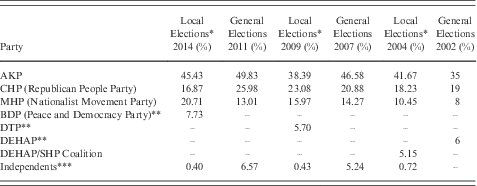
The 2002 elections were a real shock, in particular for secular Turkish citizens. The AKP gained approximately 35% of the votes and obtained the right to form a government alone. In the 2007 general elections, the AKP increased its share of the vote. Finally, on 12 June 2011, the AKP obtained the largest share of the vote for a third time. The results were the same for local elections and constitutional referendums. Table 1 shows the election results since 2002.
Local and general elections results.

* Local elections percentages are based on the provincial council results.
** BDP succeeded the Democratic Society Party (DTP) in 2008, which had been the successor of the Democratic People’s Party (DEHAP). The BDP dissolved itself in June 2014 and joined with the Peoples’ Democratic Party (HDP).
*** Because of the election threshold, DTP and its successor parties preferred to be represented by the way of independents.
Since the 2002 general elections, the AKP has maintained a leading position within the Turkish political system. This means that the vote share and the time span conditions of a predominant party have been met. The same table also shows that there is an important point spread between the AKP and the other parties. It is obvious that even the most powerful opposition party has not enough bargaining power on political issues. Another significant result of the 2011 general elections is the disappearance of smaller right-wing parties, other than the MHP (Ref. Reference Çarkoğlu21, p. 58). When we look at the legislative process in the Turkish parliament, we can easily observe that the opposition carries no weight since the number of AKP seats is sufficient to implement any laws it wishes. The latest debates over the internal security bill, which had been criticised by other political parties as well as human rights associations, demonstrated once again that the will of the AKP was a decisive force. Only when the AKP wants to introduce constitutional reforms does it need some support from the opposition. The results of two constitutional referendums make clear that Erdoğan and his government have played this game well and obtained the result they desired. In addition, when we analyse the results of local elections, it is obvious that the AKP appeals to all parts of Turkey. Although the governing party was faced with a series of corruption scandals, involving Prime Minister Erdoğan, just a few months before the most recent local elections, the AKP received 45.4% of the vote in a striking illustration of how dominant the AKP is in Turkish society.
The criteria cited so far are related to the three principles explained by Sartori. Our fourth criterion is the level of penetration within the bureaucratic apparatus. Replacing civil servants according to party allegiances is not an AKP invention in Turkey. However, the changes are much bigger than with previous governments. The large amount of time that the government has been in power certainly has facilitated this transformation. It is no easy task to uncover all the patronage ties at work. This is an important issue that should be studied in detail in a future work. Here, some examples are given from three important sectors of the state apparatus, namely education, foreign affairs and the judiciary.
The national education system offers governments basic tools to build the society that they want to manage. Although the AKP is a young political party, its founding ideology is rooted in the Turkish–Islamic synthesis proposed by the 1980 military coup d’état against the rise of left-wing forces in the political arena. Since 1980, this Turkish–Islamic synthesis has been injected into the younger generations by the way teachers are trained and the way the curriculum is designed. In other words, the AKP government has been the beneficiary of a previous ideological investment. However, the meritocratic principles in the education system have prevented the government from making discretionary appointments. For this reason, especially after its second term, the government used its majority in the parliament and worked towards changing this in law. The teachers’ trade union has criticised the appointment of teachers or administrators without any qualifications. For example, a directive promulgated in April 2009 removed the need for candidates to take written and oral examinations in order to become school directors. Since that time, the provincial director of national education has been the only authority in this matter (Ref. 22). In addition, more objective performance criteria for appointment in different public institutions have been recently removed. This allows the AKP to place its members in the positions they want. This represents a concrete example of the establishment of patronage ties in the most powerful ideological instrument.
Another striking example of this practice is the most recent change concerning the appointment of ambassadors. The ministry of foreign affairs used to be the most prestigious public institution. It was said that a career in foreign affairs was only for the best of the best. The difficult examinations that candidates must pass in order to obtain a post and the years of institutional apprenticeship required were a guarantee that protected state interests. However, the recent change has made it possible to nominate someone from outside the ministry as an ambassador. This example is very illustrative, it explains how the AKP government and the state apparatus are deeply interconnected.
This interconnection is also visible within the juridical institutions, which have to be, in theory, independent. The prosecutors of important cases have been chosen from among friends of the AKP. In fact, the good relations between the government and high-ranking officials of the judiciary reached their peak with the constitutional referendum in 2010. The judiciary was largely dominated by the Gülen movement, which was one of the main supporters of the AKP until last year. However, the intraparty conflicts, especially between the Gülen movement and Erdoğan have transformed this interconnection into a problematic issue.
In Turkish political life, the relations between the private sector and the government were never transparent. However, when the AKP came to power and opted for a neoliberalist economic policy, new opportunities appeared. Privatisation in important sectors and large construction/infrastructure projects within the framework of urban transformation also brought the question of who/which firms would undertake these projects. An important study has recently looked at these relations (Ref. 23). The first version of this study covers 393 construction/infrastructure projects, 433 firms and 45 public institutions. It demonstrates how almost all public contracts have been assigned to firms close to AKP members and especially close to Erdoğan’s family.
The fact that the AKP put their ‘friends’ in important positions and gives projects to firms of their ‘friends’ has long been known. However, what were the limits of these friendships? When the Gülen movement began to make public a number of tape recordings incriminating the government in a corruption scandal, and its prosecutors started juridical investigations, the Turkish public was shocked by the level of friendship and by the names included in the bribery networks. In the first round, 91 people were detained in the investigation. The son of the minister of the interior (Muammer Güler), the son of the minister of the economy (Zafer Çağlayan) and the son of the minister of the environment and urban planning (Erdoğan Bayraktar) were among the detainees. The mayor of the district of Fatih, the real estate businessman Ali Ağaoğlu, the general manager of Halkbank (a public bank) and the Iranian businessman Reza Zarrab were accused of being implicated in bribery and money laundering networks. The amount of money confiscated by the police was huge (Ref. 24). During the investigations, US$4.5 million was found at the General Manager of Halkbank’s residence and US$750,000 in the personal safe of the son of the minister of the interior. The above-mentioned ministers had all resigned by the end of December. The public statement made by one of them (Erdoğan Bayraktar) was very interesting because he asked for Erdoğan’s resignation, claiming that he had done everything with the Prime Minister’s approval (Ref. 25).
A second wave of arrests was planned, but the police were unable to carry them out. The list of names also included the son of Prime Minister Erdoğan (Ref. 26). Tape recordings of phone calls between Erdoğan and his son circulated on the internet. In these tape recordings, it seemed Erdoğan was telling his son to hide huge sums of money on 17 December, just after the first police operation. During that period, everyday a new tape recording was put on the internet. Although Erdoğan claimed that the records were ‘fabrications’, a YouTube clip containing the calls has been viewed more than four million times (Ref. Reference Bar’el27). The opposition parties called for the government to resign. However, the reaction of the AKP government was the complete opposite (Ref. 28). Erdoğan’s speeches hardened more and more. He claimed that all of these tapes were part of a conspiracy against his government ahead of the local elections in March and the August presidential election. Erdoğan not only talked, he also acted. Just one day after the first wave of arrests, the heads of the operations were removed from their posts. This was just the beginning. Within a week, the regulations concerning the rights of law enforcement officers were changed in such a way that the security forces would have to inform their seniors of their actions at all times (Ref. 29). Senior officers had to report to their administrative heads, which effectively spelled the death of the operation. Several police officers working on this investigation and prosecutors who tried to continue the legal process were removed from their positions (Ref. 30). All of these positions have been filled by people close to Erdoğan. At the end, Erdoğan positioned himself as a hero fighting the so-called ‘parallel state’ controlled by the Gulenists. Meanwhile, in January 2015, the Turkish Parliament voted down the trial of four ex-ministers before Turkey’s Supreme Council court (Ref. 31). It is clear that there was a power struggle between members of the Gülen movement and Erdoğan’s entourage. It is almost impossible to predict the future of this power struggle. 32 However, there is one thing that we must accept, the corruption scandal beginning on 17 December showed that the judiciary was largely far from being independent.
A Tentative Comparison
Looking at dominant party literature, the Italian party system from the Second World War until 1992 and the Turkish party system can be classified as predominant party systems. The first similarity between the CD in Italy and the AKP in Turkey is that they both benefited from existing conditions in the establishment of their cycle of dominance. The Second World War in Italy and the social and economic chronic instability in Turkey created a political crisis. Since the existing political parties could not find solutions to these crises, the Italian and Turkish populations were ready to try what had not been tried.
In this political environment, the inability of opposition parties is the second similarity. However, it is necessary to always remember the limits of such comparisons because the inabilities of the opposition parties stemmed from different reasons. The inability of the communist opposition in Italy was largely fed by the Cold War environment. On the contrary, the opposition parties in Turkey were suffering the consequences of their political inadequacy. The main opposition party, the CHP, was far removed from the public and had been accused of being an elitist party. Whatever the reasons for the opposition’s weakness, the CD in Italy and the AKP in Turkey were seen by a significant portion of the population as the only alternative to their problems.
Third, the CD used the international context, favourable to its ruling, to its advantage. As for the Turkish case, it can be said that the EU played a positive role in the AKP’s accession to power and especially during its first term in power. The AKP, whose leader promised the removal of military tutelage and the democratisation of the political system, was perceived by the Western powers as a model in the Middle East. The progressive relations between the EU and the AKP led liberal democrats to support this party, especially in the period before the 2007 elections.
The fourth similarity concerns the clientelistic ties between the government and the private sector. The private sector is ready to pay a certain amount of commission to continue to be able to work with public authorities, and public officers perceive these commissions as something to which they are entitled. Nevertheless, in this respect, there are big differences between the two countries.
When the corruption scandals in Italy revealed the extent of the network of corruption and the names involved, the judiciary system pursued the case, and the media followed up the scandal. It meant the end of 40 years of a predominant party system. The end of the predominant party system did not mean the end of corruption. Berlusconi’s government has also been criticised for using public resources for its own ends. However, this is beyond the scope of this article. As for the Turkish case, the investigation was closed down. What is important for our research is to understand which mechanism can intervene in the case of an important malfunctioning even if one party dominates the political system. The independence of the judiciary system and its power in Italy were able to stop the dominant party from exceeding legal limits. However, in Turkey, the judiciary has become more and more dependent on the executive power. In this process, contrary to Suttner’s predictions, the civil servants could not protect their autonomy vis-à-vis the political authority. The penetration of the AKP especially within the judiciary and the police department constituted a tool to obstruct all investigations against the AKP ruling. The judges and prosecutors of important cases have been chosen from among the names known as being close to the AKP. The direct intervention by the ruling party during the last corruption scandal and the verdict of non-prosecution for the majority of those accused show that the separation of powers does not exist anymore in Turkey.
In Place of a Conclusion
Democracy flourishes on the basis of plurality. This plurality needs to be sustained by regulations protecting minorities and opposition movements. The separation of powers and the rule of law are safeguards for the democratic system. The predominant party system contains some features that threaten the essence of democracy. One of these features is the weakness of the opposition party. If this weakness comes from the invisible barriers put up by the dominant party, achieving plurality becomes impossible. Another threat to democracy appears if the dominant party dominates not only the legislative and executive branches, but also the judiciary. This would result in the end of the separation of powers. The penetration of the dominant party within all branches of the bureaucratic apparatus, and the loss of their autonomy make the situation worse. Another threat involves the increase in the discretionary power of political leaders in a predominant party system. These discretionary powers and the absence of transparency allow them to obtain personal gains related to their public office. The emergence of corruption scandals damages trust relationships between the representatives and the public.
Given this, what is the answer to the question in the title? If the political system continues to be based on the separation of powers and if the rule of law is protected, the corruption scandals should lead to the downfall of the dominant party and its partners. An independent judiciary system will seek to identify corrupt politicians and the media to make them known to the public. In the next election, the people will probably not vote for them. The Italian case is very illustrative in this context. On the contrary, if the dominant party also controls the judiciary system, it is probable that the dominant party will use all of its powers to control overlapping corruption networks. The media will be silent because they will come under explicit pressure from the dominant party. The Turkish case fits this model well. In such a case, is it possible to talk about democracy? There is no separation of powers, no rule of law, no independent media. I believe that this signals the emergence of the ‘hegemonic party’ or ‘authoritarian dominant party’. Thus, this is the beginning of a de-democratisation period for Turkey.
Gülçin Balamir Coşkun received her MA degree from Université Paris 1 Panthéon-Sorbonne. She gained her PhD degree from Istanbul University with a thesis on ‘The Analysis of Sovereignty Concept in the Framework of European Constitutional Order’ in 2007. She works as an assistant professor at Istanbul Kemerburgaz University. Her research areas are democratic theory, political violence and the democratisation of the Turkish political system. She has recently edited a book, Guardians or Oppressors – Civil Military Relations and Democratisation in the Mediterranean Region (London: CSP), with Amany Salaheldin Soliman.