1. Introduction
In Spanish, nasals exhibit a three-way place-of-articulation contrast in syllable-initial environments. As shown by the examples listed below, [m], [n] and [ɲ] may occur both in word-initial (1a–c) and word-medial (2a–c) onsets (data taken from Harris Reference Harris, Aronoff, Oehrle, Kelley and Stephens1984).Footnote 2
- (1)
(a) [má.
 a] ‘kill.3sg.pres’
(b) [ná.
a] ‘cream’(c) [ɲá.
a] ‘death’
- (2)
(a) [ká.ma] ‘bed’
(b) [ká.na] ‘grey hair’
(c) [ká.ɲa] ‘reed’
Nevertheless, this three-way contrast is neutralised in all coda positions on the surface. Traditional descriptions of Spanish claim that coda nasals undergo neutralisation by categorical place assimilation in preconsonantal environments (Harris Reference Harris, Aronoff, Oehrle, Kelley and Stephens1984; Baković Reference Baković, Fox, Williams and Kaiser2000; see Ramsammy Reference Ramsammy2012 for full discussion); but nasals occurring in (non-preconsonantal) stem-final and word-final contexts are subject to different, dialect-specific, neutralisation processes.
(3) Alveolarising Spanish
Velarising Spanish
(a) [pan]
(b) [paŋ] /pan/ ‘bread’
(c) [pa.ná.θo]
(d) [pa.ná.θo] /pan-aθ-o/ ‘bread.aug’
(e) [pa.ná.θi.mo]
(f) [pa.ŋá.θi.mo] /pan#aθim-o/ ‘unleavened bread’
As shown in (3a–b), place-neutralisation applies transparently in word-final environments: ‘alveolarising’ dialects of Spanish (AS) permit only the coronal nasal, [n], to surface in this context, and ‘velarising’ dialects of Spanish (VS) allow only a dorsal [ŋ] (see Terrell Reference Terrell1975, Núñez-Cedeño Reference Núñez-Cedeño1980, Harris Reference Harris, Aronoff, Oehrle, Kelley and Stephens1984, Trigo Reference Trigo1988). According to Harris, this pattern arises through the assignment of a dialect-specific default place-of-articulation feature to any nasal syllabified into word-final coda position: epenthesis of [coronal] in AS yields a pattern of word-final nasal coronalisation, whereas epenthesis of [dorsal] in VS yields a pattern of word-final velarisation. Nevertheless, as illustrated by the examples in (3d) and (3f) above, neutralisation ‘overapplies’ in VS to stem-final nasals before word-level suffixes and to word-final nasals preceding vowel-initial words. We see from the examples in (3b, d) that word-final coda [ŋ] alternates with stem-final syllable-initial [n] in VS dialects: stem-final onset nasals thus fail to participate in place contrasts both in AS and in VS. Thus, neither dialect permits any nasal other than [n] to occur in stem-finally before derivative suffixes such as augmentative /-aθo/ (see (3c–d) above) on the surface (Bermúdez-Otero Reference Bermúdez-Otero2007). However, comparison of (3d) and (3f) reveals that resyllabification across word boundaries does not condition an [ŋ]∼[n] alternation in VS: word-final dorsal nasals retain their [dorsal] place-specification when resyllabified into onset position before a vowel-initial word.
These data present a number of challenges for morpho-phonological theory. Firstly, as noted by Baković (Reference Baković, Fox, Williams and Kaiser2000), we must account for the choice of [ŋ] as the output of nasal place neutralisation in VS dialects. Assuming that [dorsal] place is highly marked, Baković contends that no language may select a [dorsal] output to place neutralisation. Accordingly, ‘non-alveolarising’ dialects of Spanish are argued to neutralise nasal place contrasts to a place-underspecified nasal, [N], in word-final environments (see also Piñeros Reference Piñeros2007).Footnote 3 Under Baković's model, mappings involving nasal debuccalisation (e.g. /pan/ → [paN]) fulfil the demands of a markedness constraint, the NasalCodaCondition (NasCodaCond), which penalises place-specified nasal codas in the output. Mappings such as /pan-aθ-o/ → *[pa.Ná.θo], by contrast, are prohibited by a highly-ranked constraint (Onset) requiring that onset consonants should have place. This occurs at the cost of violating a lower-ranked Output–Output (OO) correspondence constraint, SA-Ident-Place, requiring stem uniformity in affixed and unaffixed output forms. Nevertheless, as discussed later in this paper, the results from articulatory experiments are at odds with this analysis. Whereas positing neutralisation to [N] satisfies allegedly universal place-markedness requirements, this analysis cannot account for the fact that word-final nasals produced by speakers of Velarising Spanish consistently display dorso-velar occlusion.Footnote 4
A second challenge for Baković's analysis concerns the fact that the data presented in (3) are problematic from the viewpoint of OO-correspondence theory. The overapplication of velarisation in syllable-initial position before vowel-initial words as in (3f) might, on the one hand, be explained with recourse to remote identity requirements between place-neutralised stems in their citation form (e.g. [paŋ]) and their correspondents in the phrasal domain (e.g. [pa.ŋá.θi.mo]). Yet on the other hand, levelling from the citation form cannot account for the coronality of stem-final nasals in examples like [pa.ná.θo]. As discussed in Section 4 below, an OO-correspondence analysis must stipulate that the constraint excluding [ŋ] from onsets is dominated by a ‘word-identity’ OO-constraint requiring identity between words in (prepausal) citation form and their correspondents in the phrasal domain. Furthermore, the constraint banning [σŋ must dominate the ‘stem-identity’ OO-constraint – i.e. a constraint requiring paradigm uniformity between stems in different morphological environments – in order to prevent ill-formed outputs with word-medial nasal velarisation (e.g. *[pa.ŋá.θo]) from being selected. Without this stipulation, OO-correspondence predicts, by factorial typology, the potential existence of a dialect of Spanish in which word-final prepausal and word-medial syllable-initial nasals velarise (hence, [paŋ] and *[pa.ŋá.θo]) whilst word-final prevocalic nasals undergo coronalisation (hence, *[pa.ná.θi.mo]). This pattern is not just incorrect for Spanish, but universally impossible: opacity within words always implies opacity across word boundaries, but not vice versa (Bermúdez-Otero Reference Bermúdez-Otero, Van Oostendorp, Ewen, Hume and Rice2011: 2024). Thus, stipulating the ranking of word-identity constraints above stem-identity constraints innately in Universal Grammar in order to prevent factorial typology from predicting impossible languages is an undesirable retreat from the principle of free ranking; particularly if an alternative approach can derive the facts from first principles.
Furthermore, a serious problem for developing a theoretical account of word-final place neutralisation in Spanish is that all existing analyses are based on impressionistic transcriptions of dialect patterns. Whilst there is general agreement that the output to neutralisation is [n] in AS, the fact that impressionistic data do not fully reflect articulatory reality has prompted the various reinterpretations of the VS pattern mentioned above. In particular, it is the central role that universal place markedness generalisations play in Optimality Theory that has led to the claim that velarising dialects of Spanish do not neutralise nasal place contrasts by [dorsal]-epenthesis in word-final environments. However, empirical corroboration for this claim is entirely lacking.
In this regard, previous studies using articulatory instrumentation have yielded crucial insights about many different phenomena cross-linguistically which have often produced surprising results from the viewpoint of theoretical phonology. For example, electropalatographic (EPG) studies on /s/-palatalisation in English reveal that there are categorical differences between forms like confe ss and confe ssion, whereas the outcome of this process in /-s#ʃ-/ and /-ʃ#s-/ sequences spanning a word boundary is best described in terms of continuous gestural overlap (Zsiga Reference Zsiga, Connell and Arvaniti1994, Nolan, Holst & Kühnert Reference Nolan, Holst and Kühnert1996, Pouplier, Hoole & Scobbie Reference Pouplier, Hoole and Scobbie2011). Similarly, EPG studies on /l/-darkening in English (e.g. Hardcastle & Barry Reference Hardcastle and Barry1989, Scobbie & Wrench Reference Scobbie and Wrench2003, Scobbie & Pouplier Reference Scobbie and Pouplier2010) and in Catalan (Recasens, Pallarès & Fontdevila Reference Recasens, Dolors Pallarès and Fontdevila1998, Recasens Reference Recasens2004) reveal fine-grained patters of variation that are dependent upon a complex interaction of speaker idiosyncrasies, dialectal factors and phonological contextual factors. For Spanish, Kochetov & Colantoni's (Reference Kochetov and Colantoni2011a, Reference Kochetov and Colantonib) work on nasal place assimilation in external sandhi contexts in Argentinian and Cuban dialects reveal effects that challenge many assumptions of traditional phonological descriptions (for Peninsular Spanish, see also Honorof Reference Honorof1999, Ramsammy Reference Ramsammy2012). Likewise, Kochetov & Pouplier's (Reference Kochetov and Pouplier2008) study on Korean reveals that a number of place assimilation processes that have typically been viewed as categorical in fact display interesting trends of context-specific and speaker-specific variability. Crucially, these studies highlight the need for theoretical work to be based on new, carefully collected empirical data rather than relying on impressionistic transcriptions.
Accordingly, this paper contributes to the discussion of the Spanish nasal alternations in a number of ways. Firstly, I report the findings of an articulatory experiment using which confirm, paceBaković (Reference Baković, Fox, Williams and Kaiser2000), that place-neutralised nasals in word-final prevocalic and phrase-final prepausal contexts are consistently realised with dorso-velar contact in VS.Footnote 5 By contrast, speakers of alveolarising dialects articulate nasals with linguo-palatal contact in the alveolar region in these neutralisation environments. These findings therefore support the view that AS assigns a [coronal] default place-of-articulation feature to word-final nasal codas, whereas the unmarked, epenthetic default feature in VS is [dorsal].
Secondly, I present a reanalysis of Velarising Spanish which dispenses with Output–Output correspondence as a means of generating phonological opacity in a constraint-based grammar. By contrast, the analysis presented in Section 4 accounts for both the overapplication of place neutralisation in word-medial onset environments before derivational suffixes and the opaque generation of [ŋ] in word-final prevocalic position by assuming a cyclic derivation. Crucially, whereas these operations cannot be straightforwardly explained by a model of phonology assuming strictly parallel computation, the facts of VS are entirely predictable under the cycle. Firstly, the overapplication of place neutralisation in presuffixal contexts obtains because underlying nasal place contrasts neutralise to [n] stem-finally in the first cycle. The stem-based word-level morphology then attaches to the output of the stem-level cycle yielding a pattern of presuffixal nasal coronalisation. Secondly, the opaque generation of syllable-initial dorsal nasals at the phrase level follows predictably from the local assignment of a [dorsal] place feature specification to word-final nasals in the word-level cycle. This analysis therefore succeeds in accounting for both the paradigmatic and non-paradigmatic opacity in VS without necessitating stipulative correspondence relationships between stem↔stem + affix and lexical↔phrasal surface forms.
The paper is organised as follows. Section 2 provides an outline of the experimental setup and data collection procedure. The EPG results are then discussed in Section 3. I present data from two AS speakers and two VS speakers which confirm that prevocalic and prepausal place-neutralised nasals are realised with alveolar linguo-palatal contact in AS and with dorso-velar contact in VS. Based on the empirical evidence, I present the reanalysis of the opaque neutralisation processes in Velarising Spanish in Section 4. Section 5 concludes the paper.
2. Experimentation
Electropalatography (EPG) was used to measure the articulatory realisation of place-neutralised nasals in AS and VS dialects of Spanish. In order to test whether place-neutralised nasals are realised with oral place-of-articulation targets – or whether they may be phonetically placeless in VS, as Baković (Reference Baković, Fox, Williams and Kaiser2000: Section 3) suggests – data were collected from nasal realisations in word-final prevocalic and phrase-final prepausal positions.
2.1 Participants
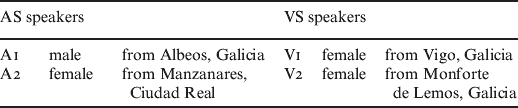
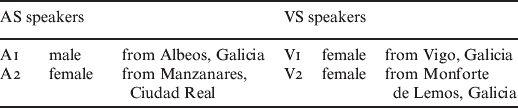
Two speakers of AS (speakers A1 and A2) and two speakers of VS (V1 and V2) participated in the experiment: all were naïve as to the purpose of the study (see Table 1). Each of the four participants is a native speaker of a peninsular variety of Spanish. At the time of the experiment, speaker A1 was a postgraduate student at the University of Manchester and speaker V1 was employed as a lecturer in the Department of Linguistics and English Language at the University of Manchester. Speakers A2 and V2 were both employed as Spanish Language teachers in the Department of Spanish and Latin American studies.
Participants recruited for the experiment.
2.2 Experimental setup
Participants were fitted for individual, custom-made Articulate-style electropalates (Articulate Instruments Ltd.) which contain 62 electrodes arranged in eight rows (see Figures 1–3 below). In comparison to Reading-model palates used in some EPG experiments (see Hardcastle et al. Reference Hardcastle and Barry1989, Jones & Hardcastle Reference Jones and Hardcastle1995, Gibbon & Nicolaidis Reference Gibbon, Nicolaidis, Hardcastle and Hewlett1999, Scobbie, Wood & Wrench Reference Scobbie, Wood and Wrench2004), the row 1 electrodes on the Articulate palates are positioned closer to the upper incisors; this allows for denti-alveolar and alveolar articulations to be distinguished more easily. Furthermore, the electrodes in row 8 are positioned closer to the posterior edge of the palate on Articulate palates than on Reading palates (see Recasens et al. Reference Recasens, Farnetani, Fontdevila and Pallarès1993: 217). Articulate palates are therefore more suitable for studying contact patterns in velar articulations.
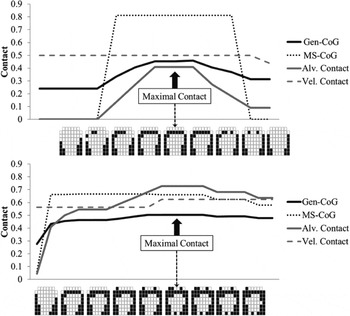
Palatograms and measurement values extracted from a realisation of word-final prevocalic [n] (top) and phrase-final [n] (bottom) produced by speaker A2.

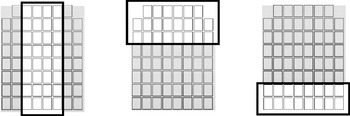
Measurement regions for MS-CoG (left), Alveolar Contact (centre) and Velar Contact (right). Grey shading marks the electrodes that were excluded for the calculation of each measurement.

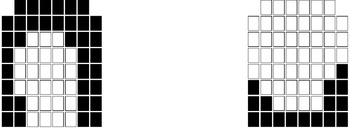
Contact patterns at the midpoint of a realisation of [ ] (left) and a realisation of [k] (right) extracted from productions of napolitano ‘Napolitan’ and jamaicano ‘Jamaican’ produced by A1. Gen-CoG: [] = 0.569, [k] = 0.164; MS-CoG: [] = 0.854, [k] = 0.063; TAC: [] = 0.864, [k] = 0.00; TVC: [] = 0.5, [k] = 0.75.

Prior to participating in the experiment, speakers wore the pseudo-palates for an acclimatisation period of an hour. All speakers had taken part in a number of pilot experiments using EPG; this meant that they had gained a minimum of five hours' previous experience of speaking whilst wearing a pseudo-palate before taking part in the experiment reported on here (see McAuliffe, Robb & Murdoch Reference McAuliffe, Robb and Murdoch2007).
2.3 Recordings
Simultaneous acoustic and EPG data were recorded using the WinEPG system equipped with a Samson CO1 Studio Condenser Microphone and the Articulate Assistant Advanced software package (Wrench Reference Wrench2003–2008: version 2.11, Articulate Instruments Ltd.). Recordings were carried out in a sound-attenuated studio in the Phonetics Laboratory at the University of Manchester. Audio data were sampled at 44.1 kHz and EPG data were sampled at 200 Hz.
2.4 Stimuli
Speakers read a set of prepared sentences which had been pre-programmed into Articulate Assistant Advanced. Participants were instructed to commence speaking each utterance upon viewing an on-screen prompt. Each test item consisted of a nonce word embedded in a carrier sentence: these were constructed in order to test the realisation of nasal consonants in (i) word-final prevocalic position, and (ii) absolute phrase-final prepausal position.
All target nonce words employed in this study had the form /CVCéN/ (e.g. 〈ditén〉).Footnote 6 Phrase-final nasal realisations were tested by embedding test words in a carrier phrase such as Les envió ese ditén ‘s/he sent them that ditén’. Likewise, word-final prevocalic nasal realisations were tested using a carrier phrase of the form Les envió ese ditén azul ‘s/he sent them that blue ditén’. Extra phonological material in the test words (i.e. the initial /CVC-/ sequence) was supplied by a random combination of any two of the coronal and labial obstruents of Peninsular Spanish (i.e. {p, b, f, t, d, θ, s}) and one of the five phonemic monophthongs (i.e. {i, u, e, o, a}).
Stimuli using nonce words, rather than lexical words, were used in this study for a number of reasons (see Romero Reference Romero1996 for an EMMA study employing similar stimuli). Firstly, the recoverability of acoustic cues to nasal place-of-articulation varies according to the quality of the preceding vowel (Olive, Greenwood & Coleman Reference Olive, Greenwood and Coleman1993: Section 7.1.2; Ramsammy Reference Ramsammy and Herschensohn2011). In the interest of minimising any effects of VN coarticulation, all nasal realisations in this study were tested in the context of a preceding stressed [é]. This also allows word-accentuation effects to be controlled for where we might expect nasals to be articulated less robustly in the context of unstressed vowels than in the context of a stressed vowel. Furthermore, lexical words terminating in /-éN/ in Peninsular Spanish do not occur with equal frequency; the use of nonce words therefore minimises the likelihood that the articulatory patterns will be influenced by word-frequency effects. Nonce words also permit effects of segmental frequency to be controlled for: as described above, the nonce words used in this study were constructed by randomly varying the non-target segments in the /CVCéN/ template. Nonce-word stimuli also offer the possibility of testing the productivity of phonological processes where the surface realisation of lexical words may conceivably reflect the morphologisation of a historically active phonological process. Thus, although the use of ‘lab-speech’ stimuli is not uncontroversial, studying the articulatory correlates to neutralisation processes with EPG cannot be achieved straightforwardly through the elicitation of spontaneous speech (see Xu Reference Xu2010, but see also Nicolaidis Reference Nicolaidis2001). The stimuli used in this experiment, by contrast, permitted data to be collected for a controlled number of repetitions of the target sequences, whilst simultaneously controlling for possible effects of word-frequency, segmental frequency and word-accentuation.
In addition to varying the segmental content of the nonce words, the form of the carrier phrase was also varied systematically in order to reduce the effects of ‘list reading’ (see Appendix A for a full list of carrier phrases used).Footnote 7 Furthermore, distracter sentences were also included in the stimuli in order to divert speakers' attention away from the purpose of the experiment. Nonce words in the distracter sentences had the form /CVCél/; as with the target sentences, these occurred either in phrase-medial position before azul, or in absolute phrase-final position. Each participant read 30 repetitions of the four nonce-word sequences – i.e. /-éN#a-/, /-éN##/, /-él#a-/, /-él##/ – in a fully randomised order, yielding a total corpus of 240 target sentences from the four speakers.
2.5 Measurements
EPG contact patterns were quantified by ‘Centre-of-Gravity’ measurements and weighted linguo-palatal contact measurements for the alveolar and velar regions (see Appendix B for details of the calculation of these measurements). As shown in Figure 1, EPG measurements were taken at the point of maximal linguo-palatal contact from all nasal realisations. In word-final prevocalic environments, contact maxima typically occur at or around the temporal midpoint of the nasal realisation. In phrase-final contexts, by contrast, speakers often tended to slide the tongue away from the target position of the phrase-final nasal rather than releasing the linguo-palatal occlusion cleanly at the offset of voicing. The lack of clean release therefore made it difficult to determine the gestural boundaries of nasal realisations in many phrase-final tokens. For this reason, EPG measurements were extracted from /-éN##/ tokens from contact maxima before the offset of periodic voicing. These data therefore quantify the location and magnitude of linguo-palatal contact at the articulatory locus of each nasal production (see also Figure 3 below).
2.5.1 Centre-of-Gravity (CoG)
Centre-of-Gravity (henceforth, CoG) measurements quantify the concentration of activated electrodes over a pre-defined palatal region (see, amongst others, Hardcastle et al. Reference Hardcastle and Barry1989, Hardcastle, Gibbon & Nicolaidis Reference Hardcastle, Gibbon and Nicolaidis1991, Gibbon, Hardcastle & Nicolaidis Reference Gibbon, Hardcastle and Nicolaidis1993, Liker & Gibbon Reference Liker and Gibbon2008, Simonsen, Moen & Cowen Reference Simonsen, Moen and Cowen2008). Two different CoG measurements were extracted from the experimental tokens in this study. General Centre-of-Gravity (henceforth, Gen-CoG) is a calculation of the electrode excitation over the whole palate. By contrast, Midsagittal Centre-of-Gravity (MS-CoG, hereafter) is calculated over the four central columns of electrodes (see Figure 2).
CoG values are high where a given tongue configuration causes the excitation of the anterior (denti-alveolar and alveolo-palatal) electrodes, whereas activation of posterior electrodes in the post-palatal and palato-velar regions produces a lower CoG value.
As shown in Figure 3, alveolar and denti-alveolar articulations like [] have high levels of contact in the anterior region of the palate. However, the positioning of the tongue in alveolar articulations also causes the electrodes along the periphery of the palate to be activated across the alveolar, palatal and velar zones. This produces an effect on Gen-CoG values which, in some cases, can cause the anteriority of a particular tongue configuration to be underestimated (Simonsen et al. Reference Simonsen, Moen and Cowen2008: 390ff.). Thus, in order to control for potential effects of this type, contact anteriority in the nasal realisations was also measured with MS-CoG which, as indicated in Figure 2, excludes the 30 electrodes on the periphery of the palate (see Gibbon et al. Reference Gibbon, Hardcastle and Nicolaidis1993: 266ff.).
2.5.2 Total Alveolar Contact
The Total Alveolar Contact (henceforth, TAC) response variable quantifies the amount of linguo-palatal contact in the first three rows of the palate (see Figure 2). This is a useful measurement in that it captures the robustness of anterior palatal contact in a more fine-grained way than CoG measurements. Whereas Gen-CoG and MS-CoG provide a metric which allows alveolar articulations to be clearly distinguished from velar articulations, these measurements supply relatively little information about the degree of lingual occlusion across the palate. By contrast, TAC can easily capture whether a given realisation of an alveolar sound is more or less occluded than another token realisation of the same sound. As discussed in Section 3 below, this is useful in the case of AS [n]-realisations which tend to be less occluded in word-medial prevocalic position than in absolute phrase-final position (see Section 3.1.3 for discussion).
2.5.3 Total Velar Contact
Total Velar Contact (henceforth, TVC) quantifies the amount of linguo-palatal contact in the two posterior rows of the palate (see Figure 2). As already mentioned, row 8 electrodes are placed in a more posterior position on the Articulate-model palates used in this study than on Reading-model palates. Thus, in the same way that TAC provides a useful metric for measuring occlusive magnitude in the alveolar region of the palate, TVC permits differences in the magnitude of velar articulations to be captured more accurately than with CoG measurements alone. Drawing such comparisons is informative in the case of VS where, as with AS [n]-realisations, phrase-final [ŋ] is marginally more occluded than word-final prevocalic [ŋ] (see Section 3.1.4).
3. Results
3.1 Default realisations
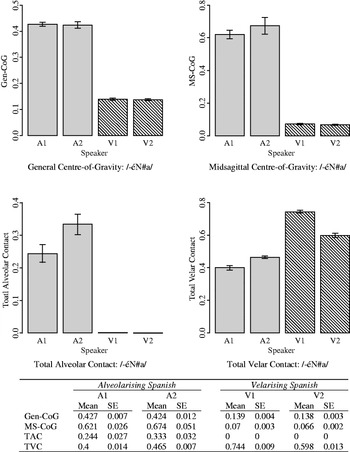
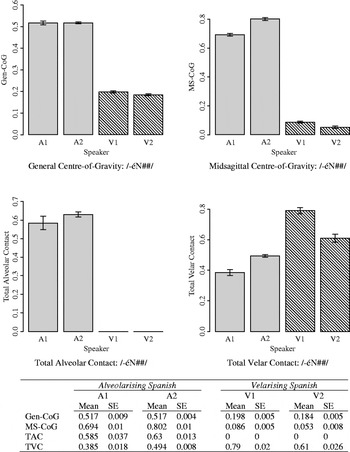
Figures 4–5 below show the mean values for Gen-CoG, MS-CoG, TAC and TVC calculated over the 30 repetitions of the /-éN#a-/ sequence and 30 repetitions of the /-éN##/ sequence for each of the four speakers. In both phonological contexts, a clear difference between the values extracted from tokens produced by AS speakers and those produced by VS speakers obtains across all of the response variables. The significance of these effects is confirmed by a series of two-way ANOVAs calculated on the pooled data in which Speaker (A1∼A2∼V1∼V2) and Phonological Context (/-éN#a-/∼/-éN##/) were independent variables.
Mean values and standard errors for the four contact measurements in word-final prevocalic nasal realisations.

Mean values and standard errors for the four contact measurements in word-final prepausal nasal realisations.

3.1.1 General CoG
Comparison of Gen-CoG values confirms that AS speakers produce nasals with high levels of anterior palatal contact both in the word-final prevocalic environment and the phrase-final prepausal environment. By contrast, Gen-CoG is low for the VS speakers in both test contexts. Analysis of variance (ANOVA) reveals significant main effects of Speaker (F (3,230) = 1324.73, p < .001) and Phonological Context (F (1,230) = 218.55, p < .001) and a significant interaction (F (3,230) = 5.56, p < .01). Post-hoc comparisons using Tukey's HSD (honestly significant difference) reveal no significant differences between nasal realisations produced by A1 and A2 in /-éN#a-/ and /-éN##/ contexts. Inter-speaker comparisons for the two VS speakers also fail to reach significance. By contrast, intra-speaker comparisons of Gen-CoG values for V1 and V2 are significant: /-éN#a-/V1∼/-éN##/V1p < .001; /-éN#a-/V2∼/-éN##/V2p < .001. All other comparisons are significant at the .01 level.
From these results, we can infer, firstly, that word-final place-neutralised nasals in AS and VS have very different articulatory targets. Whereas Gen-CoG values are consistently high for A1 and A2, the low values for speakers V1 and V2 indicate that neither of these speakers realises place-neutralised nasals with linguo-alveolar constriction. Nevertheless, these measurements alone do not provide a fail-safe metric for determining the precise place-of-articulation of word-final nasals in VS. Whereas the non-significance of V1∼V2 comparisons suggests that the articulatory realisation of place-neutralised nasals is the same for both speakers in both phonological contexts, the intra-speaker differences in Gen-CoG values suggest that place-neutralised nasals may have a distinct articulatory response in word-final prevocalic and phrase-final prepausal contexts.
As shown in Figures 4 and 5, mean Gen-CoG values for V1 and V2 reach c. 0.14 in word-final prevocalic contexts, yet mean values occur between 0.18 and 0.2 in phrase-final contexts. This difference indicates that phrase-final nasals in VS may have a more fronted realisation than word-medial prevocalic nasals. However, it is difficult to determine whether this difference arises because nasals in /-éN#a-/ and /-éN##/ contexts have distinct articulatory targets, or whether the lower Gen-CoG values in /-éN#a-/ realisations may arise through coarticulation of the word-final nasal with the following [a]. As discussed in Sections 3.1.3 and 3.1.4 below, analysis of the total contact response values for the alveolar and velar regions suggests that [a] does exert some coarticulatory influence on preceding nasals. However, comparison of Gen-CoG measurements with MS-CoG measurements also indicates that phonological environment exerts only minimal effects on the midsagittal occlusion of word-final nasals in VS.
3.1.2 Midsagittal CoG
As previously stated, MS-CoG measurements are calculated over the four central columns of electrodes on the pseudo-palate. Comparison of MS-CoG values with Gen-CoG values therefore provides a useful indication of whether a given articulation involves full midsagittal or partial (peripheral) occlusion. As with the Gen-CoG values, a two-way ANOVA performed on MS-CoG responses also yields significant main effects of Speaker and Context, and a significant interaction. Post-hoc intra-speaker comparisons reveal no statistically significant differences between /-éN#a-/ and /-éN##/ realisations for speaker A1; and unlike Gen-CoG, /-éN#a-/∼/-éN##/ comparisons on MS-CoG are also insignificant for V1 and V2. Moreover, a significant effect of Context obtains for Speaker A2 (p < .001) that does not arise in the tests on Gen-CoG – mean values for MS-CoG for this speaker are 0.674 for word-medial prevocalic nasal realisations and 0.802 for phrase-final nasal realisations (see Figures 4 and 5). Recall from Section 2.5.1 that Gen-CoG, which is calculated over the whole palate, sometimes underestimates the anteriority of alveolar sounds. Thus, the results from MS-CoG measurements are particularly interesting here: despite the fact that word-final prevocalic and prepausal place-neutralised nasals are always produced with linguo-alveolar closure, the MS-CoG data confirm that word-final [n] has a significantly more advanced articulation phrase-finally than phrase-medially for speaker A2. Contextual comparisons of MS-CoG values extracted from [n]-realisations produced by A1, however, fail to reach significance.
Furthermore, inter-speaker tests reveal no significant differences between speakers V1 and V2 in either phonological environment; likewise, differences in values extracted from /-éN#a-/ realisations produced by speakers A1 and A2 are insignificant. However, comparison of /-éN##/ realisations from the two alveolarising speakers reveals a significant effect (p < .01): this effect obtains because MS-CoG values are greater in phrase-final environments for speaker A2 (MS-CoG mean = 0.802) than for speaker A1 (MS-CoG mean = 0.517).
These results therefore allow for interesting generalisations to be drawn about the contextual variability of place-neutralised nasals in the two dialects. Whereas Gen-CoG comparisons indicate that word-final prevocalic nasal realisations in VS are different from phrase-final nasal realisations, no such effect emerges from MS-CoG comparisons. This means that contextual variability in midsagittal contact is negligible in the VS tokens: the significant effect of Context on Gen-CoG must therefore obtain because of differences in peripheral contact.
Additionally, whereas variance in Gen-CoG values extracted from AS tokens is non-significant, tests on MS-CoG values indicate that the linguo-alveolar occlusion target is not identical in the two environments for speaker A2. This finding is also confirmed by comparison of phrase-final tokens produced by A2 with those produced by A1. Thus, although it is clear that /-éN#a-/ and /-éN##/ are different for A2, we cannot reliably say whether this pattern reflects a difference in place-of-articulation – i.e. the anteriority of the closure – or closure magnitude – i.e. whether phrase-final nasals are more robustly occluded than word-final prevocalic nasals. Nevertheless, tests on the measurements of total contact in the alveolar and velar palatal regions reveal that Phonological Context does indeed affect the occlusive magnitude of place-neutralised nasals, especially for AS speakers.
3.1.3 Total Alveolar Contact
Tests on TAC responses provide further confirmation of the difference between AS and VS speakers. Observe in Figures 4 and 5 that TAC values are high for A1 and A2 both in word-final phrase-medial and in absolute phrase-final environments. By contrast TAC is at floor level for both velarising speakers in both phonological contexts. A two-way ANOVA confirms the highly significant effects of Speaker (F (3,230) = 339.94, p < 0.001) and Context (F (1,230) = 123.73, p < .001) and a highly significant interaction (F (3,230) = 42.37, p < .001). Post-hoc tests reveal no significant differences between /-éN#a-/ and /-éN##/ productions for V1 and V2; nevertheless, an interesting effect obtains for the alveolarising speakers. Inter-speaker comparisons on nasal realisations produced by A1 and A2 are not robustly significant in either phonological context (i.e. /-éN#a-/A1∼/-éN#a-/A2p > .01; /-éN##/A1∼/-éN##/A2p > .05). However, intra-speaker comparisons of /-éN#a-/ and /-éN##/ productions are highly significant both for A1 and for A2. As shown in Figures 4 and 5, TAC measurement values are far greater in absolute phrase-final environments than in word-final prevocalic environments for both speakers.
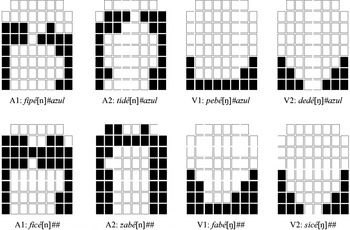
This finding is interesting because it confirms the robustness of the effect of Phonological Context on MS-CoG values in tokens produced by A2. Furthermore, whereas /-éN#a-/∼/-éN##/ comparisons for speaker A1 show no significant effect for MS-CoG, TAC is significantly affected by Phonological Context. These comparisons therefore reveal a finer granularity of contextual variation than the CoG measurements alone: linguo-alveolar contact in phrase-final [n]-realisations is consistently greater than in word-final prevocalic [n]-realisations (see Figure 6).
Typical linguo-palatal contact patterns for each speaker in AS -é[n]#a- and VS -é[ŋ]#a- productions (top), and AS -é[n]## and VS -é[ŋ]# productions (bottom).

Observe here that word-final prevocalic nasals tend to be realised with incomplete midsagittal closure for both AS speakers. By contrast, the phrase-final tokens in Figure 6 display complete contact across at least one row of electrodes (row 3 for speaker A1, row 2 for speaker A2). Furthermore, we may also note that both phrase-final tokens are articulated with the tongue in a more fronted position than in the word-final prevocalic tokens. Midsagittal electrodes in rows 3–4 are activated in the [-én#a-] context for A1, whereas the [-én##] token exhibits midsagittal contact in rows 2–4; likewise, the [-én#a-] token produced by A2 shows activation of midsagittal electrodes in rows 2–3, whereas the [-én##] token has a more denti-alveolar articulation with midsagittal contact in rows 1–2. Thus, the phrase-final fronting effect is more robust for speaker A2 than for A1: it is likely that the denti-alveolarity of phrase-final nasal realisations, compared to the more central alveolarity of word-final prevocalic nasal realisations, contributes to the significant effect of Phonological Context on MS-CoG for A2. Yet since /-éN#a-/∼/-éN##/ comparisons for MS-CoG do not reach significance for A1, the fronting effect is more marginal for this speaker. It is therefore most likely that the significant difference between TAC measurements in [-éN#a-] and [-éN##] environments for A1 reflects the fact that there are differences in the occlusive magnitude of [n] in the two environments as well as the small differences in tongue anteriority, as illustrated by Figure 6.
3.1.4 Total Velar Contact
Tests on TVC measurements reveal a significant main effect of Speaker (F (3,230) = 213.03, p < .001); however, no significant effect of Context (F (1,230) = 1.31, n.s.) and no significant interaction with Speaker obtains (F (3,230) = 1.31, n.s.). Post-hoc testing confirms that all intra-speaker comparisons (i.e. /-éN#a-/∼/-éN##/) are insignificant. By contrast, inter-speaker comparisons are significant for /-éN##/ realisations produced both by AS speakers (/-éN##/A1∼/-éN##/A2p < .001) and for VS speakers (/-éN##/V1∼/-éN##/V2p < .001). As shown in Figure 5 above, these effects arise because /-éN##/ realisations produced by A2 have greater activation of the velar electrodes than realisations produced by A1; and dorso-velar contact is greater for V1 in /-éN##/ contexts than for V2. Moreover, inter-speaker comparisons performed on word-final prevocalic tokens yield a significant effect for VS (/-éN#a-/V1∼/-éN#a-/V2p < .001) but not for AS (/-éN#a-/A1∼/-éN#a-/A2p > .05). As indicated in Figure 4 above, word-final prevocalic nasals produced by V1 display greater activation of the velar electrodes than those produced by V2. This difference is also visible in the contact patterns shown in Figure 6: observe here that both [ŋ]-realisations produced by V2 display incomplete midsagittal closure, whereas all electrodes across row 8 are activated in V1's [ŋ]-productions. Nevertheless, comparison of /-éN#a-/ realisations from V2 with those from A1 and A2 are significant (p < .001 for both comparisons). Thus, although dorso-velar contact is less robust in /-éN#a-/ sequences for speaker V2 than for speaker V1, word-final prevocalic nasal realisations are more robustly velar for V2 than for A1 or A2.
From these results, we may confidently conclude that neither speakers of Alveolarising Spanish nor speakers of Velarising Spanish produce phonetically placeless nasals in word-final prevocalic and phrase-final prepausal environments. Place-neutralised nasals in these contexts are realised with linguo-alveolar contact in AS; and crucially, VS speakers produce nasals with consistent dorso-velar occlusion. Furthermore, whereas AS [-én#a-] realisations differ in occlusive magnitude from [-én##] realisations in a statistically significant way, TVC measurements extracted from VS [-éŋ#a-] and [-éŋ##] productions display relatively little variability.Footnote 8 Visual inspection of contact patterns such as those shown in Figure 6 does suggest that [ŋ]-realisations in VS are sensitive to a similar, if much less robust, contextual weakening effect in word-final prevocalic contexts.Footnote 9 Nevertheless, tests on TVC show that these differences are insignificant; recall, furthermore, that no significant differences between [-éŋ#a-] and [-éŋ##] realisations emerge from intra-speaker comparisons of MS-CoG and TAC values. The non-significance of intra-speaker variability in the two phonological contexts for VS speakers therefore confirms an important finding: although there are speaker-particular differences in the realisation of place-neutralised [ŋ] between the two velarising speakers, the individual speaker patterns are stable and consistent.
3.2 Summary
The experimental results reveal that the articulatory realisation of word-final place-neutralised nasals is significantly different in Alveolarising Spanish and Velarising Spanish dialects. These results are in agreement with the findings of previous work into the realisation of place-neutralised nasals in Spanish. Ramsammy (Reference Ramsammy and Herschensohn2011) presents acoustic data showing that word-final nasals produced by VS speakers bear the acoustic signature of velarity in prevocalic environments; by contrast, word-final prevocalic nasals produced by AS speakers bear the acoustic signature of alveolarity. The articulatory data therefore confirm the evidence from acoustic experimentation: word-final prevocalic and prepausal nasals are consistently produced with a dorso-velar articulation target in velarising dialects of Spanish, whereas AS speakers produce alveolar [n] in these contexts.
Nevertheless, differences in the phonetic realisation of place-neutralised nasals in prevocalic and prepausal environments do occur for each of the four speakers. These differences contribute to the significant interactions between Speaker and Phonological Context for Gen-CoG, MS-CoG and TAC in the tests reported on above. Most notably, word-final prevocalic nasals are often articulated with less robust closure than phrase-final prepausal nasals. This effect is most salient in AS (recall that TAC is significantly affected by Context, whereas TVC is not); yet the cause of the effect remains unclear. Thus, determining whether this result occurs because of intervocalic gestural undershoot (see Scobbie & Pouplier Reference Scobbie and Pouplier2010 on word-final prevocalic /l/ in English) or because of some type of phrase-final reinforcement effect requires additional research.
Despite the fact that the cause of the contextual differences in the occlusive magnitude of word-final [n] and [ŋ] remains elusive, the experimental results nevertheless constitute firm empirical proof that word-final nasals in VS have a dorso-velar occlusion target in prevocalic and prepausal contexts. Accordingly, whilst the AS neutralisation pattern can be straightforwardly captured by the (uncontroversial) assignment of a [coronal] feature value to word-final nasal codas, analysis of the Velarising Spanish pattern is problematic for models of phonology which are reluctant to view [dorsal] as a plausible output to place neutralisation. By contrast, permitting [dorsal] to act as the dialect-specific default place feature for Velarising Spanish (Rice Reference Rice1996, Reference Rice and de Lacy2007; Lombardi Reference Lombardi2002; Nevins & Plaster Reference Nevins and Plaster2008; Ramsammy Reference Ramsammy and Herschensohn2011) makes it possible for the word-final velarisation pattern to be accounted for in a model of phonology that assumes a transparent link between phonological output structures and phonetic implementation.
In the following sections, I discuss a re-analysis of VS in which nasal place contrasts are neutralised in word-final nasal codas by the epenthesis of a default [dorsal] place feature. Sections 4.2 and 4.3 present a comparison of two approaches to modelling place neutralisation in VS. Firstly, I show that the overapplication of place neutralisation in word-medial presuffixal nasals and resyllabified word-final prevocalic nasals can be accounted for in parallel by Optimality Theory (OT) by assuming the classic architecture and OO-correspondence constraints. This analysis, as discussed, relies on the stipulation that OO-constraints which enforce the levelling of word-final [ŋ] to derived onsets at the phrase level (i.e. ‘word-identity’ constraints) should critically outrank other OO-constraints (i.e. ‘stem-identity’ constraints) requiring paradigm uniformity between place-neutralised nasals in word-medial presuffixal position and word-final prevocalic and prepausal environments.
Secondly, I present an alternative analysis of the velarisation pattern couched in Stratal OT assuming a cyclic derivation. This analysis makes three fundamental claims about the phonological status of [ŋ] in Velarising Spanish:
- (4)
(a) Velarisation applies at the word level.
(b) Stem-final nasals are immune to velarisation.
(c) All surface opacity – both paradigmatic and non-paradigmatic – is the result of the application of phonological processes in different derivational cycles.
Statements (4a–b) express the fact that the application of velarisation is restricted. Under the analysis presented below, [dorsal]-insertion applies to word-final nasal codas at the word level. Yet in Stratal OT, underlying phonological structures must first pass through the stem-level grammar before word-level processes can apply. In Spanish, no nasal phone other than [n] is permitted to occur stem-finally: thus, any underlying /ŋ/ is a target for neutralisation to [n] in the stem-level grammar. Well-formed stems like 〚Stmpan〛 then become visible to the word-level grammar: [dorsal]-epenthesis subsequently causes word-final nasals to velarise to [ŋ] (hence, 〚Wrdpaŋ〛).
Nevertheless, where stem-based word-level affixes (e.g. augmentative /-aθo/) attach to stems like 〚Stmpan〛, the stem-final nasal is removed from the word-final environment. Given that [dorsal]-epenthesis targets only word-final nasal codas, the stem-final nasal in /pan-aθ-o/ does not velarise (hence, 〚Wrdpanaθo〛).
Outputs of the word level then receive a third pass through Gen and Eval at the phrase level. Here, any word-final [ŋ] generated at the word level maps faithfully to [ŋ]. Likewise, all feature values associated with word-medial nasals receive faithful mappings in the output. Statement (4c) therefore captures the fact that place neutralisation overapplies in words like [panáθo] because the stem-level grammar permits no place-feature other than [coronal] to be associated with stem-final nasals in the output. Furthermore, place-neutralisation overapplies in derived onsets at the phrase level because of the local assignment of a [dorsal] default to domain-final nasals at the word level. Accordingly, the locality of opaque patterns is entirely predictable under the cycle: transparently velarised prepausal nasals in citation forms and opaquely velarised word-final prevocalic nasals both bear a [dorsal] place specification because they occupy the same position at the word level. By contrast, opaquely alveolarised stem-final prevocalic nasals do not resemble their correspondents in citation forms: this is because Velarising Spanish does not enforce remote identity between presuffixal nasals which place-neutralise to [n] domain-finally at the stem level and nasals which velarise to [ŋ] domain-finally at the word level. Thus, as we shall see presently, Stratal OT attains a greater level of descriptive adequacy in accounting for paradigmatic and non-paradigmatic opacity than the classic OT architecture in its current formulation.
4. Analysis
4.1 Theoretical implications
The results discussed in Section 3 present numerous challenges to the previous theoretical treatments of nasal velarisation in Spanish. Above all, the articulatory data casts considerable doubt on the claim that word-final nasals undergo neutralisation to [N] in VS dialects. Whilst an analysis of VS based on nasal debuccalisation is attractive for theories of phonology which attempt to account for all neutralisation behaviour on the basis of a static and allegedly ‘universal’ place markedness hierarchy, this approach has crucial flaws. In fact, given that word-final nasals are velar for both VS speakers who participated in this study, there is only one hope for salvaging the analysis of word-final neutralisation based on categorical debuccalisation. Specifically, adhering to this analysis would require us posit a phonetic implementation process that assigns – in a non-variable, exceptionless fashion – a dorso-velar occlusion target to segments that are place underspecified in the output of the categorical phonology (see de Lacy Reference de Lacy2006: Section 2.2.1.1.1). By contrast, rather than committing to the view that some place feature or other is universally favoured in neutralisation contexts owing to its maximally unmarked status, the current data from Spanish present us with evidence that the relative markedness of place features is determined on a language-particular basis.Footnote 10 Specifically, whereas [dorsal] is marked and sensitive to neutralisation in AS dialects, [ŋ] is the maximally unmarked nasal in VS dialects.
Yet even this is a peculiarity of [ŋ] in VS since all other [dorsal] phones are prohibited from occurring in word-final coda positions.Footnote 11 Thus, the [dorsal] non-nasals are sensitive to different markedness restrictions from [ŋ] in the phonological system of VS: whereas only [coronal] non-nasals may occur word-finally, only the [dorsal] nasal is permitted in this environment.Footnote 12 This implies that language-specific markedness hierarchies for place-of-articulation features cannot be determined independently of manner classes. Whereas non-nasal phones are subject to a particular set of restrictions in VS, nasals are subject to a distinct set of restrictions which are specific to the nasal class. As will be discussed presently, these considerations have important consequences for the development of a descriptively adequate analysis of the VS nasal alternations.
However, the far-reaching implications for phonological theory in general of assuming a static and allegedly universal place-markedness hierarchy shall concern us only minimally here. Instead, the following discussion focuses on the specific questions identified in Section 1 for the analysis of the VS alternations, namely how the overapplication of nasal place neutralisation in stem-final presuffixal contexts and in word-final prevocalic contexts can be accounted for theoretically. Section 4.2 sets out the problem assuming the classic OT architecture and illustrates that OO-correspondence runs into difficulties in accounting for the coronalisation of word-medial presuffixal nasals in VS. The subsequent sections present a Stratal OT analysis of the VS data: I demonstrate here that the opaque operations that present such a challenge for the parallel theory can be straightforwardly accounted for in a cyclic model. Section 4.3.1 provides a brief overview of Stratal OT; the analysis of the nasal alternations assuming a cyclic derivation is then presented in Sections 4.3.2–4.3.4.
4.2 VS overapplication in classic OT
Assuming the classic, monostratal architecture, Baković (Reference Baković, Fox, Williams and Kaiser2000) provides an analysis of ‘non-alveolarising’ Spanish in which the output of word-final nasal place neutralisation is the placeless nasal, [N]. Final nasal debuccalisation, as mentioned previously, is driven by a positional markedness constraint, the Nasal Coda Condition, requiring the surface underspecification of nasal codas. Yet nasal debuccalisation does not obtain in word-medial onsets in this model: the coronalisation of stem-final presuffixal nasals is conditioned by the high ranking of a constraint prohibiting non-coronal consonants in the output and a further constraint, Onset, militating against place-underspecified onsets.Footnote 13 Under the assumption that word-final nasal codas are placeless, mappings such as /pan-aθ-o/ → [pa.ná.θo] (see (5b) below) thus violate a low-ranked OO-correspondence constraint, SA-Ident-Place, requiring stem uniformity in affixed and unaffixed output forms.
In light of the current data, however, it is clear that the superordinate ranking of a constraint specifically tailored to force the debuccalisation of word-final nasal codas is incapable of generating well-formed surface structures for VS.Footnote 14 As a starting point for reworking the parallel analysis, let us suppose that the VS grammar has a top-ranked markedness constraint favouring nasal codas specified for [dorsal] place in the output.
(5) DorNasCoda: Assign one violation mark for every syllable-final nasal that is not specified for [dorsal] place in the output.
Incorporating this reformulation of NasCodaCond into the ranking proposed by Baković allows the phonology to generate [dorsal] nasals word-finally. Nevertheless, as illustrated by the tableau in (6), this model fails to supply the correct surface form in phrasal contexts where word-final nasals resyllabify into onset position across a word boundary.
(6) Nasal allophony in Velarising Spanish (adapted from Baković Reference Baković, Fox, Williams and Kaiser2000)
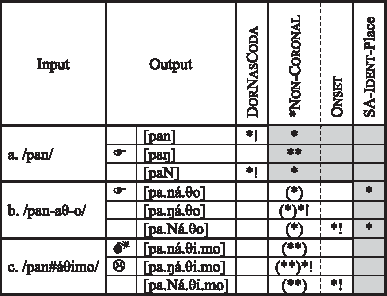
Observe, firstly, that this model correctly generates the VS pattern with word-final prepausal nasal velarisation and word-medial presuffixal nasal coronalisation. In the word-final coda environment (6a), the demands of DorNasCoda prevent any nasal other than [ŋ] from being selected, whereas in the word-medial syllable-initial environment (6b), *Non-Coronal and Onset are decisive in selecting the candidate with a presuffixal [n]. Nevertheless, the model fails to generate the correct surface representation in (6c). For input /pan#áθimo/, resyllabification across the word boundary removes the word-final nasal from coda position: all of the candidates in (6c) satisfy the demands of DorNasCoda by virtue of the fact that grammatical word-final /-n/ occupies an onset position in the output. Candidate *[pa.ná.θi.mo] is therefore selected erroneously owing to the demands of *Non-Coronal and Onset.
The critical problem with the model in (6) is that the high-ranking markedness constraints prevent the generation of syllable-initial [ŋ] both word-medially (see (6b)) and in [NV] sequences spanning a word boundary in the phrasal domain. Here we must bear in mind that promotion of the bottom-ranked OO-constraint cannot cause the correct output to be selected for input (6c): this is because SA-Ident-Place penalises only non-identical correspondences between a citation form and a stem + affix structure. There is therefore no other option for the parallel model than to introduce a further, top-ranked OO-constraint requiring featural identity between nasal-final stems in their citation form (e.g. [paŋ]) and their correspondents in the phrasal domain (i.e. [pa.ŋá.θi.mo]).Footnote 15
(7) OO-Ident-Place(Phrasal): Assign one violation mark for every consonant in a phrasal output whose correspondent in the citation form output differs for place-of-articulation features. (Require featural identity for [place] between consonants in citation form outputs and their correspondents in the phrasal output.)
(8) Nasal allophony in Velarising Spanish assuming phrasal OO-correspondence
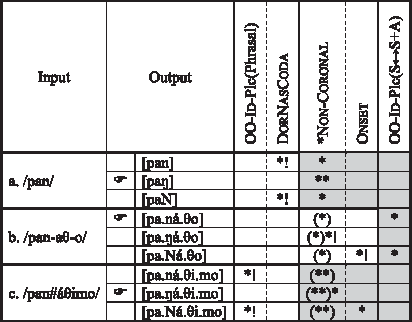
From the ranking proposed in (8), we see that the parallel model is capable of deriving the correct structures for VS provided that a superordinate phrasal OO-correspondence constraint enforces the identical mapping of word-final coda nasals in citation forms and word-final prevocalic onset nasals across word boundaries. The top ranking of OO-Ident-Place(Phrasal) relative to the low ranking of OO-Ident-Place(S↔S + A) is therefore absolutely necessary for the correct generation of the alternation between word-final [ŋ] and stem-final presuffixal [n] in VS: under any ranking other than OO-Ident-Place(Phrasal)≫OO-Ident-Place(S↔S + A), velarisation overapplies erroneously in word-medial presuffixal contexts.
But this is an entirely arbitrary stipulation. Hayes (Reference Hayes, Dekkers, van der Leeuw and van de Weijer2000), in his discussion of [l]∼[ł] alternations in English, observes that OO-identity with citation forms is never enforced more rigidly on affixed stem forms than on whole words. This observation leads to the proposal that constraints driving OO-correspondence operations in phrasal environments universally dominate constraints requiring OO-identity in word-internal environments (where phonological opacity is morphologically-induced). Without this stipulation, the theory of OO-correspondence predicts, by factorial typology, the potential existence of a dialect of Velarising Spanish with presuffixal nasal velarisation and word-final prevocalic nasal coronalisation: thus, /pan/ → [paŋ], /pan-aθ-o/ → *[pa.ŋá.θo], and /pan#áθimo/ → *[pa.ná.θi.mo] under the ranking OO-Ident-Place(S↔S + A)≫OO-Ident-Place(Phrasal). As Bermúdez-Otero (Reference Bermúdez-Otero, Van Oostendorp, Ewen, Hume and Rice2011: Section 9) points out, resorting to an innate Universal Grammar stipulation, in violation of the principle of free re-ranking, is an undesirable brute-force solution to this problem; and it is one which the stratal analysis neatly avoids (see Section 4.3.4 below).
Yet in addition to avoiding the problem of this factorial typological gap, the foremost advantage of assuming a stratal grammar is that computation of the correct surface forms for VS is not critically dependent upon the superordinate ranking of phrasal OO-identity constraints relative to the low-ranking of OO-constraints requiring paradigm uniformity under specific morphological conditions. Stratal OT requires no special OO-constraints for the generation of opaque patterns: as discussed in the following sections, the effect of the proposed dominance relationship of OO-Ident(Phrasal)≫ OO-Ident(Morphological) emerges predictably from general architectural principles, and not from arbitrary stipulations, under the cyclic model.
4.3 Cyclic derivation of the VS nasal alternations
4.3.1 Stratal OT
In brief, Stratal OT is a constraint-based model of grammar which integrates the concept of the phonological cycle into the classic OT architecture.Footnote 16 Drawing upon the wealth of research carried out in the Lexical Phonology and Morphology programme (Kiparsky Reference Kiparsky and Yang1982, Mohanan Reference Mohanan1986), the central insight of this model is that evaluation of phonological output structures applies recursively, to increasingly expansive morphosyntactic domains. Thus, whereas classic OT requires all phonological input structures to be evaluated in parallel by a single pass through Gen and Eval, Stratal OT dispenses with this requirement. In the most restrictive version of the theory, as proposed by Bermúdez-Otero (Reference Bermúdez-Otero2007, forthcoming a, b), the grammar comprises only three derivational levels, namely the stem level, the word level and the phrase level (SL, WL, PL, respectively). Each phonological level contains a stratum-specific OT grammar (i.e. a stratum-specific permutation of Con); all phonological material that is visible to the grammar in each derivational stratum is therefore a potential target for the phonological processes that apply within that stratum (hence, Stratal OT does not impose the Strict Cyclicity condition, see Kiparsky Reference Kiparsky and Yang1982, Reference Kiparsky2000).
The theory makes reference to three core morphological constituents: root, stem and word. As detailed in the works already cited, Bermúdez-Otero considers roots to be uninflectable base units which do not define their own cyclic domain. Stems, by contrast, are free to undergo inflection and may be targets for phonological processes at the stem level.Footnote 17 Words are fully inflected units and trigger phonological operations in the second, word-level stratum; finally, the phrase-level phonology corresponds to the post-lexical stratum of Lexical Phonology and thus applies in maximal domains.
4.3.2 Stem-level operations
To recap, the generalisation that we must account for in proposing a reanalysis of Velarising Spanish is that place-neutralised nasals surface specified for [dorsal] place in word-final contexts, yet they bear a [coronal] feature value in word-medial presuffixal contexts. Before any analysis of the [paŋ]∼[pa.ná.θo]∼[pa.ŋá.θi.mo] alternations can be attempted, a number of additional factors concerning the inflection of Spanish nominals must be brought into consideration.
In the ensuing discussion, I follow Bermúdez-Otero (forthcoming a) in assuming that Spanish nominals are lexically stored as stems composed of a root and a theme suffix. Under this analysis, all nominal stems belong to one of four inflectional classes: o-stems take a thematic suffix in /-o/ (e.g. /pas√-oTh/ ‘step’) whereas a-stems take a thematic suffix in /-a/ (e.g. /pas√-aTh/ ‘raisin’). Unlike these classes, however, the third class of e-stem nominals comprises two sub-categories: the most frequent of these, which I shall refer to as type-A e-stems, have two lexically listed theme allomorphs (e.g. /pan√-{e, Ø}Th/ ‘bread’), whereas type-B e-stems may only take a thematic suffix in /-e/ (e.g. /pein√-eTh/ ‘comb’). The fourth, ‘athematic’ class consists of all words which do not take a theme suffix; these are often non-nativised xenonyms or neologisms: e.g. /klip/ ‘paper clip’ (singular [klip], plural [klips], *[klí.pes]).
Type-A e-stems therefore display stem-allomorphy. In the singular, the phonology selects whether a given stem should surface with the zero theme allomorph, [-Ø], or the alternative suffix in [-e], in accordance with principles of phonotactic well-formedness.Footnote 18 Only stems terminating in one of a select subset of sounds, namely [θ, d, s, n, l, ⁾], take the zero allomorph; the [-e] allomorph occurs in all other cases where selection of the zero suffix would generate an illicit stem structure terminating in a consonant other than [θ, d, s, n, l, ⁾] (see (9) and (10) below).
With these observations in place, we are now in a position to construct the stem-level grammar for VS. In modelling the derivation, I assume the following constraints.
- (9)
(a) Ident-Place: Assign one violation mark for every unfaithful mapping of an input place feature value in the output.
(b) HavePlace: Assign one violation mark for every consonant in the output lacking a place feature specification (no place-underspecified segments).
(c) Max-V: Assign one violation mark for every vowel in the input that does not have a correspondent in the output (no vowel-deletion).
(d) Dep-V: Assign one violation mark for every vowel in the output that does not have a correspondent in the input (no vowel-epenthesis).
(e) Final-C: Assign one violation mark for every vowel in the output that occurs at the right-edge of the domain (outputs must be consonant-final).
(f) *[nas, lab]: Assign one violation mark for every nasal consonant bearing a [labial] place feature specification in the output (*[m]).
(g) *[nas, cor]: Assign one violation mark for every nasal consonant bearing a [coronal] place feature specification in the output (*[n]).
(h) *[nas, pal]: Assign one violation mark for every nasal consonant bearing a [palatal] place feature specification in the output (*[ɲ]).Footnote 19
(i) *[nas, dor]: Assign one violation mark for every nasal consonant bearing a [dorsal] place feature specification in the output. (*[ŋ]).
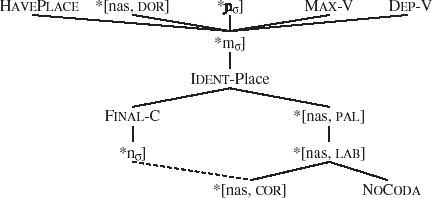
As demonstrated by the tableau in (10), the goal of the stem-level phonology is to map any input form supplied from the lexicon onto a phonotactically well-formed output structure. Inputs (10a, b) are both type-A e-stems: (10a) is the underlying form of VS [paŋ] whereas (10b) is a hypothetical form (henceforth indicated by †). In accordance with Richness of the Base, Stratal OT imposes no restrictions on the lexicon: we must therefore assume that forms like †/paŋ-{e, Ø}/ are potential inputs to the stem-level grammar.
(10)
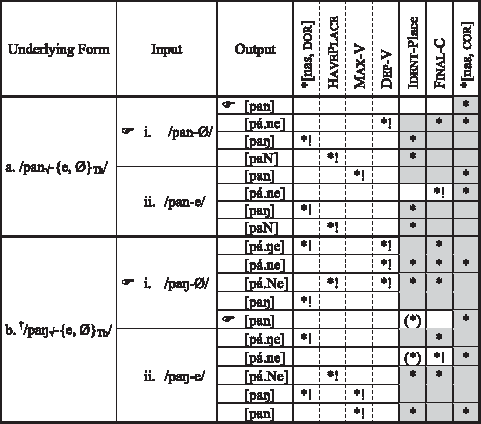
In (10a), Gen supplies a set of output candidates both for input (10a–i), in which the theme allomorph is phonologically null, and for input (10a–ii), in which the theme allomorph is /-e/. The top-ranked markedness constraints, *[nas, dor] and HavePlace, eliminate any output candidates containing a [dorsal] or a place-underspecified nasal; moreover, the top-ranked faithfulness constraints eliminate any candidates exhibiting vowel-deletion (e.g. */pan-e/ → [pan]) or vowel-epenthesis (e.g. /pan-Ø/ → *[pá.ne]). The lower-ranked constraints are therefore decisive in selecting the winning output: */pan-e/ → [pá.ne] loses to /pan-Ø/ → [pan] because of its violation of Final-C.
In a similar manner, output forms generated from both †/paŋ-Ø/ and †/paŋ-e/ are submitted to Eval in (10b). The top-ranked constraints eliminate all output mappings except for (i) †/paŋ-Ø/ → [pan] and (ii) †/paŋ-e/ → *[pá.ne]; observe here that the high-ranking of *[nas, dor] prohibits the faithful mapping of any underlying /ŋ/ in the output of the stem level. Accordingly, all remaining output candidates incur violations of Ident-Place; as in example (10a), the demands of Final-C condition the selection of [pan] as the winning output form.
From these examples, we see that selection of the zero theme allomorph is dependent upon the maximal satisfaction of phonological constraints at the stem level. For the underlying structures /pan-{e, Ø}/ and †/paŋ-{e, Ø}/, no mapping in which the [-e] theme suffix occurs in the input is more harmonic than when the theme-suffix is phonologically zero. Nevertheless, as demonstrated in (11) below, not all type-A e-stems containing nasal-final roots behave in this manner.
(11)
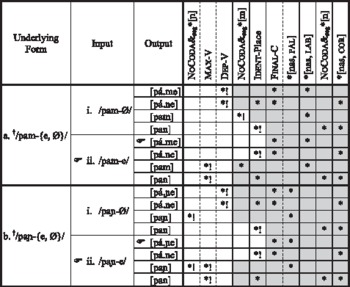
The tableau in (11) illustrates the derivation of hypothetical type-A e-stems formed upon a root terminating in /-m/ and a root terminating in /-ɲ/. As in the examples presented in (10), each underlying representation provides two input forms for computation; output candidates are generated both for input-(i) and for input-(ii) in each example. Observe that a number of additional constraints are included in this ranking:
- (12)
(a) NoCoda: Assign one violation mark for every segment in the output that occupies a coda position (bottom-ranked – omitted from the tableaux).
(b) NoCoda&seg*[m]: Assign one violation mark for every [labial] nasal consonant in the output that occupies a coda position (*mσ]).
(c) NoCoda&seg*[n]: Assign one violation mark for every [coronal] nasal consonant in the output that occupies a coda position (*nσ]).
(d) NoCoda&seg*[ɲ]: Assign one violation mark for every [palatal] nasal in the output that occupies a coda position (*ɲσ]).
(e) NoCoda&seg*[ŋ]: Assign one violation mark for every [dorsal] nasal consonant in the output that occupies a coda position (*ŋσ]).
Local conjunction of NoCoda and the place-markedness constraints given in (9) yields a family of positional markedness constraints targeting place-specified nasal codas.Footnote 20 As shown in (11), superordinate NoCoda&seg*[ɲ] is required to eliminate ill-formed output structures such as *[paɲ]; likewise, high-ranking NoCoda&seg*[m] militates against the generation of surface forms like *[pam]. NoCoda&seg*[n], by contrast, is low-ranked: this captures the fact that stems terminating in [-n] are well-formed in all dialects of Spanish.Footnote 21 Note, however, that the high ranking of NoCoda&seg*[ɲ] and NoCoda&seg*[m] in (11) is not ad hoc: in agreement with the Universal Conjoined Constraint Ranking Hypothesis (Spaelti Reference Spaelti1997: 143ff.; see also Itô & Mester Reference Itô and Mester2003), the dominance of the locally conjoined constraints is motivated by the high ranking of the context-free place-markedness constraints, *[nas, pal] and *[nas, lab], relative to bottom-ranked *[nas, cor]. Thus, if *[nas, pal]≫*[nas, lab]≫*[nas, cor], then NoCoda&seg*[ɲ]≫NoCoda&seg*[m]≫NoCoda&seg*[n].Footnote 22
Under this ranking permutation, output evaluation proceeds as follows. Any candidates exhibiting syllable-final [m] or [ɲ] are immediately eliminated by the positional markedness constraints on [labial] and [palatal] nasal codas; output forms containing [ŋ] or [N] are eliminated by the additional high-ranking markedness constraints, *[nas, dor] and HavePlace (omitted from the tableau in this instance). Furthermore, mappings involving vowel-deletion or vowel-epenthesis are prevented by the high-ranking faithfulness constraints. The requirements of low-ranking Ident-Place then force the selection of maximally faithful [pá.me] (11a–ii) and [pá.ɲe] (11b–ii).
The outcome of (11) is that the stem-level grammar permits a minimal contrast between prevocalic [m] and [ɲ] in type-A e-stems on the surface, whereas no nasal other than [n] is permitted in stem-final position. Underlying stem structures formed upon nasal-final roots map faithfully where the root-final nasal is /-m, -n, -ɲ/: stems resembling /pan-{e, Ø}/ select the zero theme allomorph since the low-ranking of contextual and context-free restrictions on [n] renders outputs like [pan] maximally harmonic; yet stems such as /pam-{e, Ø}/ and /paɲ-{e, Ø}/ require the [-e] theme allomorph on the surface since [m] and [ɲ] are prohibited domain-finally in Spanish.Footnote 23 By contrast, underlying stem structures containing any nasal phone other than /m, n, ɲ/ receive unfaithful mappings: the ranking permutation given in (10) and (11) thus enforces the strict neutralisation of all other nasal consonants to [n] stem-finally (recall (10b)).
4.3.3 Word-level operations
The output structures generated by the stem-level phonology therefore contain no nasal phones other than [m, n, ɲ]. Type-A e-stems terminating in [-n] take the zero theme suffix and enter the word level with a stem-final nasal coda; stem structures containing /m/ and /ɲ/-final roots, by contrast, select the [-e] theme allomorph, since [m] and [ɲ] are impermissible domain-finally (in the lexical strata).
The requirements of the word-level phonology are as follows. Through a re-ranking of the same constraints which are available in the stem-level grammar, the word-level grammar must first ensure that any [n]-final stems which undergo derivational affixation should receive faithful mappings (e.g. 〚Wrd〚Stmpan-{e, Ø}〛-aθ-o〛 → [pa.ná.θo]) in the output of the second cycle.Footnote 24 Secondly, all nasal consonants surfacing in prevocalic position in the stem-level output must map to fully faithful output correspondents at the word level (e.g. 〚Wrd〚Stmkan-a〛〛 → [ká.na]). Thirdly, any [n]-final stems which do not undergo suffixation must surface with a [dorsal] place feature specification (e.g. [paŋ]). These mappings are illustrated in (13):
(13)
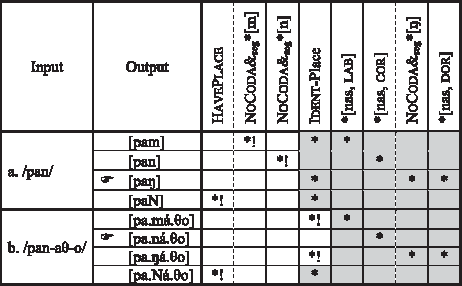
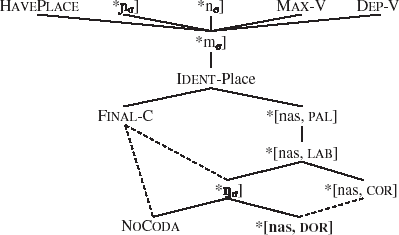
In the ranking hierarchy presented in (13), the VS pattern of word-final nasal velarisation obtains under two conditions. Firstly, the constraints that penalise [dorsal] nasals in the output are demoted relative to the constraints which militate against [labial], [coronal] and [palatal] nasals. Accordingly, NoCoda&seg*[ŋ] is low-ranked at the word level; by necessity, it dominates the basic markedness constraints, *[nas, dor] and NoCoda. Secondly, observe that all other constraints which impose restrictions on nasals in the output occupy the same position in the word-level hierarchy as in the stem-level hierarchy.
We see from (14) and (15) below that the demotion of *[nas, dor] and NoCoda&seg*[ŋ] is crucial for the selection of the correct output form for inputs containing a stem-final [-n]. In (13a), the demands of superordinate HavePlace require that the output mapping of /pan/ should be specified for place on the surface; hence the candidate with word-final nasal debuccalisation, *[paN], is immediately eliminated. Nasal codas specified for [labial] place are penalised by NoCoda&seg*[m], such that candidates like *[pam] are also eliminated. High-ranking NoCoda&seg*[n] further prevents a faithful mapping of any stem-final [-n] generated by the stem-level cycle into coda position at the word level. Accordingly, since NoCoda&seg*[ŋ] and *[nas, dor] are crucially bottom-ranked in the word-level hierarchy, the candidate with word-final velarisation, [paŋ]), is selected as the winner.
(14) VS stem-level ranking hierarchy
(15) VS word-level ranking hierarchy
However, in example (13b), nasal velarisation fails to obtain. Given that NoCoda&seg*[n] militates only against syllable-final [n], all output candidates in (13b) satisfy the demands of this constraint. Any output form exhibiting debuccalisation (e.g. *[pa.Ná.θo]) is penalised by HavePlace: in this instance, it is the demands of Ident-Place which remove the candidates with word-medial velarisation and word-medial labialisation (i.e. *[pa.ŋá.θo] and *[pa.má.θo]) from the running.
The ranking permutation given in (15) therefore yields the correct surface structures for VS. The occurrence of the [dorsal] nasal on the surface is restricted: [ŋ] may only surface in word-final coda position; elsewhere (in prevocalic environments), the stem-final [coronal] nasal generated by the stem-level grammar maps faithfully in the output of the word-level cycle. The final goal for the phonology, therefore, is to ensure that word-final [dorsal] nasals generated in the word stratum receive faithful mappings when resyllabified into onset position across word boundaries at the phrase level.
4.3.4 Phrase-level operations
At the phrase level, all phonological material contained within the utterance (broadly defined) is visible to the grammar. In order for the correct surface representations to emerge at the end of phonological computation, the phrase-level grammar must therefore implement the following mappings.
(16) Phrase-level mappings required for VS
(a) [wlpaŋ##] → [plpaŋ##]
(b) [wlpa.ná.θo] → [plpa.ná.θo]
(c) [wlpaŋ] [wlá.θi.mo] → [plpa.ŋá.θi.mo]
Observe here that the correct generation of (16a) obtains straightforwardly if the phrase-level constraint ranking enforces the preservation of the [dorsal] place feature associated with the word-final nasal codas in the input. Furthermore, the grammar need only preserve the input features of any nasal syllabified into onset position following resyllabification across word boundaries in order for the correct surface forms shown in (16b, c) to be generated. We therefore require the phrase-level grammar to prevent the generation of any (non-preconsonantal) nasal coda other than ŋσ] and to prevent unfaithful mappings of nasals in prevocalic position. As shown in (17) below, these mappings obtain if we assume that the phrase-level ranking permutation is an identical copy of the word-level grammar.
(17)
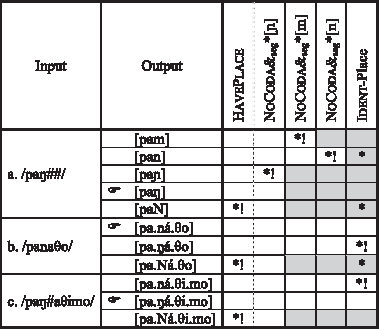
Evaluation of input (17a) proceeds in the same manner as in the word-level cycle: the high-ranked markedness constraints prevent the generation of any surface form other than the fully faithful candidate in the word-final environment, whereas Ident-Place removes the candidate with word-medial nasal velarisation in (17b). The critical point, however, is that where resyllabification causes a word-final [ŋ] to occur in onset position before a vowel-initial word, there is no phonotactic repair: stem-final nasals that undergo velarisation at the word level are faithfully preserved at the phrase level, both in phrase-medial syllable-initial and absolute phrase-final contexts.
At this point, the merits of assuming a cyclic derivation of the VS nasal alternations are apparent. We see from the preceding analysis that Stratal OT accounts for the paradigmatic and non-paradigmatic opacity in Velarising Spanish without requiring the creation of special OO-constraints. Furthermore, this model makes highly restrictive predictions about the scope of velarisation in VS. Recall from Section 4.2 that parallel OT must stipulate that phrasal OO-identity constraints dominate morphological OO-identity constraints in order to generate the VS pattern correctly. However (paceHayes Reference Hayes, Dekkers, van der Leeuw and van de Weijer2000), the opposite ranking of the OO-correspondence constraints permitted by factorial typology – i.e. OO-Ident(Morphological)≫OO-Ident(Phrasal) – predicts the existence of an unattested dialect of VS in which stem-final nasals velarise in citation forms and in presuffixal contexts (i.e. /pan/ → [paŋ], /pan-áθo/ → *[pa.ŋá.θo]). In addition to forcing the erroneous overapplication of velarisation in stem-final presuffixal environments, satisfaction of the top-ranked morphological OO-constraint also conditions the violation of the lower ranked constraints under this grammar: thus, velarisation incorrectly underapplies in word-final prevocalic contexts yielding *[n] where word-final nasal codas resyllabify into onset position across a word boundary (i.e. /pan#áθimo/ →*[pa.ná.θi.mo]). Yet Stratal OT does not predict the existence of such a dialect because it does not rely on the stipulative ranking of OO-constraints to generate the VS pattern. On the contrary, the VS facts fall out predictably from the stratal architecture: the velarisation of word-final prevocalic nasals in the phrase stratum applies because of the local assignment of a word-final [dorsal] default feature value to word-final nasal codas in the preceding, word-level stratum. Furthermore, since domain-final [dorsal]-insertion applies at the word level, nasal place neutralisation does not generate [ŋ] in the stem-level cycle. In permitting different rankings of constraints in the stem-level and word-level grammars, the stratal model generates a pattern of neutralisation to [coronal] in stem-final environments and a pattern of neutralisation to [dorsal] in word-final environments; opaque phonological operations therefore arise predictably from the fact that different morphosyntactic structures are sensitive to different, stratum-specific grammatical restrictions in Stratal OT.
5. Conclusions
Traditional analyses of Spanish nasal place neutralisation have claimed that the realisation of word-final nasals differs on a dialect-particular basis. These analyses are typically based on a set of impressionistic observations which, in line with programme-specific theoretical agenda, receive rather different interpretations. This paper has submitted the claims of these accounts to empirical testing and has proposed a reanalysis of word-final nasal place neutralisation in Velarising Spanish that is firmly grounded in phonetic reality.
The results from experiments using electropalatography reveal that the realisation of word-final nasals in prevocalic and prepausal environments does indeed differ in alveolarising and velarising dialects of Spanish. EPG data confirm that speakers of Alveolarising Spanish realise word-final nasals with occlusion in the alveolar region; word-final nasal realisations produced by velarising speakers, by contrast, consistently active electrodes in the posterior, velar region. The current data therefore agree with the findings of previous work which shows that final nasal realisations produced by AS and VS speakers exhibit robust acoustic differences (Ramsammy Reference Ramsammy and Herschensohn2011). Crucially, velarising speakers produce word-final nasals which bear both the acoustic and articulatory signatures of dorso-velar occlusion.
This finding poses a challenge for theories which assume that a fixed, universal hierarchy restricts the occurrence of allegedly marked place features cross-linguistically. Thus, whereas Harris (Reference Harris, Aronoff, Oehrle, Kelley and Stephens1984) accounts for the Spanish velarisation pattern by assuming that neutralisation assigns a [dorsal] default feature value word-finally, Baković (Reference Baković, Fox, Williams and Kaiser2000) and de Lacy (2006) contest this point on the basis of the assumption that [dorsal] is universally marked. Nevertheless, the current data reveal that the relative markedness of place features cannot be determined without consideration of manner-of-articulation classes: this is to say that the natural classes of nasals and non-nasals are sensitive to different markedness restrictions; furthermore, the hierarchical organisation of these restrictions is, crucially, language-specific (see Rice Reference Rice1996).
In light of these findings, this paper has presented two new analyses of Velarising Spanish couched in different versions of OT. Building on Baković's (Reference Baković, Fox, Williams and Kaiser2000) account, we have noted that classic OT is capable of generating the transparent VS pattern provided that a top-ranked positional markedness constraint (DorNasCoda) enforces the assignment of a [dorsal] default value to nasals syllabified into coda position in the output (hence, /pan/ → [paŋ]). By contrast, modelling the opaque operations which are responsible for the generation of [coronal] nasals in stem-final presuffixal onsets and the generation of [dorsal] nasals in word-final prevocalic onsets is problematic for the classic theory. In assuming a strictly parallel computation, classic OT cannot generate the correct surface forms for VS without relying on a stipulative ranking (paceHayes Reference Hayes, Dekkers, van der Leeuw and van de Weijer2000) in which phrasal OO-correspondence constraints dominate other OO-constraints requiring paradigm uniformity in different morphological environments. On the one hand, the superordinate ranking of OO-Ident(Phrasal) is necessary to enforce remote identity between citation forms like [paŋ] and corresponding output structures in the phrasal domain. On the other hand, levelling from the citation form cannot account for the presence of place-neutralised nasals in presuffixal contexts which surface specified for [coronal] place. The bottom ranking of the morphological OO-Ident constraint is therefore absolutely necessary in order to permit higher ranked constraints to favour mappings of morphologically complex inputs like /pan-aθ-o/ which violate paradigm uniformity in the output (hence, [paŋ]↮[pa.ná.θo]). As noted, however, this is problematic from the viewpoint of factorial typology. Since OO-Ident(Phrasal)≫OO-Ident(Morphological) is critical for generating the VS pattern, the opposite ranking of these constraints creates a language exhibiting a neutralisation pattern that is entirely unknown in the cross-dialectal phonology of Spanish. The parallel model is therefore not sufficiently restrictive to preclude the existence of this unattested variant of Velarising Spanish.
In contrast to the classic OT analysis, however, the Stratal OT analysis presented in Section 4.3 does not run into these problems. Under this model, the stem-level grammar permits only a subset of stem structures in the output. Type-A e-stems formed on roots terminating in /-m/ or /-ɲ/ select an [-e] theme allomorph in the output of the stem level: this mapping obtains because the stem-level grammar forbids the generation of output structures terminating in [m] or [ɲ]. By contrast, all other stem structures are sensitive to neutralisation under the stem-level ranking shown in (14): type-A e-stems formed on roots terminating in any nasal phone other than /-m/ or /-ɲ/ therefore surface with a stem-final [-n].
At the word level, stem-level output forms such as [SLpan] then undergo velarisation (i.e. 〚Wrdpan〛 → [wlpaŋ]): this occurs through the demotion of the constraints which militate against [ŋ] at the stem level. Yet where the concatenation of word-level suffixes removes the stem-final [-n] generated at the stem level from the domain-final environment, velarisation does not obtain (hence, [pa.ná.θo]). Accordingly, the stem-level default value, [coronal], is opaquely preserved in word-medial environments in Velarising Spanish.
However, resyllabification of word-final nasals in prevocalic contexts does not cause the [ŋ] generated by the word-level grammar to coronalise to [n] at the phrase level. This effect obtains because the phrasal ranking enforces the faithful mapping of all nasals present in the input. Stratal OT therefore captures the overapplication of velarisation at the phrase level, not through the stipulative superordinate ranking of an OO-constraint requiring remote faithfulness between lexical and phrasal outputs, but rather by requiring local surface identity between nasals which have undergone place neutralisation in the preceding strata and their correspondents in the output of the phrasal stratum.
The cyclic analysis of Velarising Spanish presented in this paper therefore provides an elegant solution to problems that classic OT runs into in accounting for opaque operations. Rather than relying on stipulative rankings and unnecessary computational machinery to generate opaque patterns, the cyclic model predicts the occurrence of opacity by permitting different phonological processes to target phonological structures in different morphosyntactic domains. Accordingly, assuming a parallel OT framework for the sake of adhering to classic architectural conventions does little to advance our understanding of the nature of opacity in phonology: Stratal OT, by contrast, assumes a highly restrictive architecture and simultaneously makes empirically verifiable predictions about the occurrence of opaque patterns in language that the parallel theory cannot rival.
APPENDIX A Carrier phrases used in the experiment
Word-final prevocalic nasal realisations were tested using the following 10 carrier phrases ending in azul. Word-final prepausal nasal realisations were tested using the same set of carrier phrases but with the nonce word in phrase-final position.
Les dio ese __ (azul). ‘S/he gave them that (blue) __.’
Les donó ese __ (azul). ‘S/he donated that (blue) __ to them.’
Les entregó ese __ (azul). ‘S/he handed them that (blue) __.’
Les envió ese __ (azul). ‘S/he sent them that (blue) __.’
Les legó ese __ (azul). ‘S/he bequeathed them that (blue) __.’
Les llevó ese __ (azul). ‘S/he brought them that (blue) __.’
Les mandó ese __ (azul). ‘S/he sent them that (blue) __.’
Les pasó ese __ (azul). ‘S/he passed them that (blue) __.’
Les regaló ese __ (azul). ‘S/he sent them that (blue) __.’
Les vendió ese __ (azul). ‘S/he sold them that (blue) __.’
APPENDIX B Calculation of EPG analysis variables
Gen-CoG and MS-CoG were calculated as follows:
 $$\hskip-11pt{\scale99%{\lpar 1 \times R_{\setnum{8}} \rpar \plus \lpar 2 \times R_{\setnum{7}} \rpar \plus \lpar 3 \times R_{\setnum{6}} \rpar \plus \lpar 4 \times R_{\setnum{5}} \rpar \plus \lpar 5 \times R_{\setnum{4}} \rpar \plus \lpar 6 \times R_{\setnum{3}} \rpar \plus \lpar 7 \times R_{\setnum{2}} \rpar \plus \lpar 8 \times R_{\setnum{1}} \rpar } \over {R_{\setnum{8}} \plus R_{\setnum{7}} \plus R_{\setnum{6}} \plus R_{\setnum{5}} \plus R_{\setnum{4}} \plus R_{\setnum{3}} \plus R_{\setnum{2}} \plus R_{\setnum{1}} }}$$
where R is the number of activated electrodes in the horizontal palatal rows (i.e. a maximum of 8 for Gen-CoG and a maximum of 4 for MS-CoG).
The weighted contact analysis variables, TAC and TVC, were calculated as follows:
 $${\scale99%{{\rm Number\ of\ activated\ electrodes\ in\ the\ measurement\ zone}} \over {{\rm Total\ number\ of\ electrodes\ in\ the\ measurement\ zone}}}$$
As shown in Figure 2 in the main body of the paper, the TAC zone comprises all electrodes in rows 1–3 (hence, a total of 22 electrodes), and the TVC zone comprises all electrodes in rows 7–8 (hence, a total of 16 electrodes).