INTRODUCTION
It is generally agreed that drought is the largest cause of maize yield loss in the tropics (Edmeades et al. Reference Edmeades, Bolaños, Lafitte, Rajaram, Pfeiffer, Fischer and Baker1989). In dry environments, mass selection of individual plants within populations is made difficult by soil gradients and large genotype×season and genotype×location interactions (Jackson et al. Reference Jackson, Robertson, Cooper and Hammer1996). Given the low heritability of grain yield under drought conditions, it is difficult to make genetic progress by selecting for it per se. Therefore, the use of secondary traits has been suggested (Edmeades et al. Reference Edmeades, Bolaños, Chapman, Edmeades, Bänziger, Mickelson and Peña-Valdivia1997; Bänziger et al. Reference Bänziger, Edmeades, Beck and Bellon2000). Secondary traits are plant characteristics other than grain yield that provide additional information about how the plant performs under a given environment (Lafitte et al. Reference Lafitte, Blum, Atlin, Fischer, Lafitte, Fukai, Atlin and Hardy2003). Ideally, a secondary trait should be genetically associated with grain yield under drought, genetically variable and highly heritable. It should also be easy, cheap and fast to observe or measure non-destructively, stable over the measurement period and not associated with yield loss under unstressed conditions (Edmeades et al. Reference Edmeades, Bolaños, Chapman, Edmeades, Bänziger, Mickelson and Peña-Valdivia1997; Lafitte et al. Reference Lafitte, Blum, Atlin, Fischer, Lafitte, Fukai, Atlin and Hardy2003). The use of secondary traits improves the selection response by focusing on direct effects of drought and avoiding confounding factors such as additional stresses (e.g. soil fertility, micronutrient deficiency and pathogens) that also determine final grain yield (Monneveux & Ribaut Reference Monneveux, Ribaut and Ribaut2006).
Barrenness, anthesis-silking interval (ASI), leaf senescence and leaf rolling were proposed by Bolaños & Edmeades (Reference Bolaños and Edmeades1993a) and Edmeades et al. (Reference Edmeades, Bolaños, Chapman, Lafitte and Bänziger1999) as secondary traits to improve yield in drought-prone environments. Under drought, their heritability remains high whereas heritability of yield usually decreases (Bolaños & Edmeades Reference Bolaños and Edmeades1996) and their genetic correlation with grain yield generally increases (Bänziger & Lafitte Reference Bänziger and Lafitte1997). Selection based on these traits has been very effective. Several publications document selection gains under a range of environmental conditions using this approach. For example, Edmeades et al. (Reference Edmeades, Bolaños, Chapman, Lafitte and Bänziger1999) observed an increase in grain yield under drought of 0·26 t/ha (12·6% per cycle) in La Posta Sequía (LPS) and Pool 26 Sequía, and 0·08 t/ha (3·8% per cycle) for Tuxpeño Sequía. Selection under drought based on these traits was associated with an increase of yield 0·16 t/ha (14·3% per cycle) in Drought Tolerant Population 1 (DTP1) and 0·08 t/ha (3·8% per cycle) in Drought Tolerant Population 2 (DTP2) (Monneveux et al. Reference Monneveux, Sanchez, Beck and Edmeades2006). Yield gains under drought were generally associated with increases in ears per plant, kernel number and harvest index, and reductions in ASI (Chapman & Edmeades Reference Chapman and Edmeades1999; Edmeades et al. Reference Edmeades, Bolaños, Chapman, Lafitte and Bänziger1999; Monneveux et al. Reference Monneveux, Sanchez, Beck and Edmeades2006). However, continued selection for specific secondary traits not only changes their average value, but it also modifies their underlying genetic correlation with yield in improved populations (McMillan et al. Reference McMillan, Fairfull, Friars and Quinton1995). Relationships between secondary traits and yield consequently require re-evaluation over time (Edmeades et al. Reference Edmeades, Bolaños, Chapman, Edmeades, Bänziger, Mickelson and Peña-Valdivia1997). In the present study, field experiments were carried out during two seasons to study the relationship between yield and secondary traits within hybrids generated from elite lines of cycle 7 of DTP and cycle 9 of LPS. The relationship was investigated between grain yield and long-established secondary traits used in the selection process (i.e. ears per plant, grains per ear, ASI, senescence and leaf rolling) and new putative secondary traits more directly involved in carbon partitioning under drought. Intraplant competition for C products was evaluated by measuring tassel dry weight and number of branches per tassel at anthesis and by quantifying the effect of detasselling at female flowering. Carbon partitioning to roots was estimated by measuring final root mass by the way of root electrical capacitance measurements (Chloupek Reference Chloupek1972). The feasibility of gene pyramiding for drought tolerance was also studied by comparing three-way hybrids involving one or two DTP lines.
MATERIALS AND METHODS
Development of LPS and DTP source germplasm populations
LPS population is a white dent, Tuxpeño-related synthetic, well adapted to the lowland tropics and producing tall vigorous-growing plants. It has been improved for drought tolerance using recurrent selection. Cycles C1 and C2 were developed by full-sib selection in which only inter-family selection was used. Cycles C3 through C6 were developed using a modified full-sib selection in which both inter- and intra-family selection were practised. Superior families were selected on the basis of grain yield, ASI, plant height, lodging and disease reaction. Details of the selection schemes have been described by Pandey et al. (Reference Pandey, Diallo, Islam and Deutsch1986).
The selection carried out on DTPs has been described by Edmeades et al. (Reference Edmeades, Bolaños, Chapman, Lafitte and Bänziger1999) and Monneveux et al. (Reference Monneveux, Sanchez, Beck and Edmeades2006). Following its formation from 14 sources in 1987, DTP1 underwent four cycles of mild half-sib selection, followed by S1 recurrent selection. After evaluation at Tlaltizapán CIMMYT Station (18°41′N, 99°10′W, 940 m asl), ten superior S1 progenies were recombined and advanced to F2 to form TL89DTP1 C5. This was then crossed with 25 other drought-tolerant sources (from Mexico, Southern Africa, Thailand, USA, and CIMMYT's conventional breeding programme) to form DTP2. Initially, components were recombined during three cycles of half-sib recombination under mild selection pressure, followed by one cycle of S1 recurrent selection under drought and heat. Recombination of the best 40 families from C4 was by grain colour to form DTP2-Y C5 and DTP2-W C5, where Y denotes yellow germplasm and W white. The best 200 S1 families from each colour fraction of DTP1 C7 were evaluated under two levels of drought stress in Tlaltizapán. The superior 60 families in each colour class were recombined to form DTP-Y C8 and DTP-W C8, and 200 S1 progenies were generated and tested under well-watered and drought conditions. Selection was for increased grain yield and ears per plant, and for reduced leaf senescence and ASI. Recombination was of the superior 40 S1 families from each population, and a new set of S1 progenies of each was formed. Cycle balanced bulks of C9 were created from a similar number of seeds from each S1 family.
Generation of DTP and LPS drought-tolerant lines and hybrids
In the 1999/2000 winter season, 500, 500 and 700 lines were extracted from DTP-W C9, DTP-Y C9 and LPS C7, respectively. In 1999 wet season, these lines were evaluated for low N tolerance and for resistance to diseases in Poza Rica CIMMYT Station (20°32′N, 97°27′W, 50 m asl). Hundred and fifty lines were selected from each population and evaluated under drought stress and well-watered conditions in 2000/2001 winter season in Tlaltizapán CIMMYT Station. Fifty S1 lines were selected from each population and selfed in summer 2000 and winter 2000/01 to obtain a total of 140 S3 lines in each population. The obtained S3 lines of DTP-W C9 and DTP-Y C9 were evaluated during the summer season 2001 in the ‘Ernest W. Sprague’ CIMMYT experimental station at Agua Fria (20o27′N, 97o38′W, 60 m asl) for resistance to lodging and diseases. The 80 best lines from each group were crossed by tropical testers (CML 448, heterotic group A, and CML 449, heterotic group B, for DTP-W C9 S3 lines, and CMS 02450, heterotic group A, and CML 451, heterotic group B, for DTP-Y C9 S3 lines) to create a set of 320 single hybrids (80 hybrids for each group and each tester). These hybrids were evaluated in winter 2001/02 under drought, low N and well-watered conditions in Tlaltizapán CIMMYT station. The best single hybrids (34 DTP-W and 22 DTP-Y) were crossed in summer 2002, either by tropical testers or by tolerant DTP lines, to form 490 DTP-W and 200 DTP-Y three-ways hybrids. To avoid consanguinity, the tester used in the formation of the single hybrid and the tester used to form the three-ways hybrids belonged to different heterotic groups, while the DTP lines in the formation of the single hybrid and those used to form the three-ways hybrids belonged to different families. The 140 LPS S3 lines developed in winter 2000/01 were crossed in summer 2002 with two testers, CML 448 and CML 449, which originated from the Tuxpeño-based Population 21 and having heterotic patterns A and B, respectively, to create 130 single hybrids. The 130 LPS single hybrids were evaluated under drought stress during the winter cycle 2002/03 and the 690 DTP three-ways hybrids under low N and optimal conditions during the summer cycle 2003. The 40 DTP-W and 50 DTP-Y three-ways hybrids, having performed better under both low N and optimal conditions, and the 40 most drought tolerant LPS single hybrids were evaluated during the winter season 2003/04 under drought and well-watered conditions. A selection of hybrids having performed better was evaluated again in 2004/05, using as susceptible checks the hybrids having yielded less under drought conditions in 2002/03.
Experimental conditions
The evaluation was conducted at CIMMYT's experimental station in Tlaltizapán, Mexico during the dry (winter) seasons of 2003/04 (Year 1) and 2004/05 (Year 2). The soil is a calcareous vertisol (Isothermic Udic Pellustert) 1·3–1·8 m deep, with a pH of 7·6. Total water holding capacity in the top 1 m of soil is 265 mm, of which about 100 mm is available to the crop (Bolaños & Edmeades Reference Bolaños and Edmeades1993a). Air vapour pressure varied between 1·0 and 1·2 kPa. Daily minimum and maximum temperatures averaged 12 and 32°C, respectively. The average daily photosynthetically active radiation (PAR) increased from 9·0 to 13·0 MJ/m2/day and Penman ETo increased from 4·0 to 9·0 mm/day during the growing season. For each set of hybrids, trials under severe drought and well-watered conditions were established separately using an alpha (0,1) lattice design, with two replications in Year 1 and three replications in Year 2. Experiment plots were sown in two rows 5 m in length and 0·75 m apart. Plots were overplanted and thinned to a distance between plants in the row of 0·25 m in Year 1 and 0·20 m in Year 2, to give established plant densities of 5·55 and 6·67 plants/m2, respectively. High population density is considered to increase drought stress by increasing mutual shading and competition of plants (Vasal et al. Reference Vasal, Cordova, Beck, Edmeades, Edmeades, Bänziger, Mickelson and Peña-Valdivia1997; Bruce et al. Reference Bruce, Edmeades and Barker2002). All trials were irrigated by sprinkler before soil preparation to destroy volunteer seeds, and after sowing to ensure uniform emergence. Well-watered trials were irrigated by furrow irrigation throughout their life cycle at intervals of approximately 2 weeks. Plots receiving the drought treatment were also irrigated every 2 weeks until 30 days before anthesis, when water was withdrawn. One additional irrigation was applied 17–19 days after 50% anthesis (Bänziger et al. Reference Bänziger, Edmeades, Beck and Bellon2000). Nitrogen fertilization was applied at two dates (before sowing and at the V6 stage), using a dose of 75 kg/ha ammonium sulphate (NH4)2SO4. All trials received 60 kg/ha triple superphosphate (0·46 P2O5), applied prior to sowing. No potassium was applied since previous tests have shown no response to this element on these soils. The experiments were kept free from weeds, insects and diseases. Seeds were treated before sowing with a mixture of one insecticide and two fungicides. The insecticide used was thiodicarb (dimethyl N,NV-[thiobis[(methylimino)carbonyloxy]]-bis-[ethanimidothioate]) and the fungicides were fludioxonil (4-(2,2-difluoro-1,3-benzodioxol-4-yl)-1H-pyrrole-3-carbonitrile), and metalaxyl (methyl N-(2,6-dimethylphenyl)-N-(methoxyacetyl)-DL-alaninate). A herbicide treatment was applied during pre-emergence at the rate of 2·2 kg/ha atrazine (6-chloro-N-ethyl-NV-(1-methylethyl)-1,3,5-triazine-2,4-diamine) and 1·7 kg/ha s-metolachlor (2-chloro-N-(2-ethyl-6-methylphenyl)-N-[(1S)-2-methoxy-1-methylethyl] acetamide). After seedling emergence, herbicide application and hand-weeding was also performed as required. Plants were also treated to control fall armyworm [Spodoptera frugiperda (J. E. Smith)] with permethrin [(3-phenoxyphenyl)-methyl 3-(2,2-dichloroethenyl)-2,2-dimethylcyclopropanecarboxylate] granules. Bird damage was minimized by a group of persons specially assigned to bird-catch patrolling tasks.
Measurements
Yield, yield components and flowering traits were measured both under well-watered and drought conditions, while secondary traits and physiological parameters related to C partitioning were assessed under drought conditions only. Days to anthesis (DA) and days to silking (DS) were recorded from a well-bordered group of 40 plants in each plot. A plant was considered as having reached anthesis or silking if at least one extruded anther or one silk was visible. ASI was calculated as DS−DA. Plant aspect at anthesis was scored on a scale from 1 (good) to 5 (bad). Senescence during grain filling was estimated by three different methods, i.e. by visual notation, by counting the number of green leaves below the ear and by estimating chlorophyll concentration. Visual notation was carried out 2 and 4 weeks after anthesis, according to Bänziger et al. (Reference Bänziger, Edmeades, Beck and Bellon2000). The number of green leaves (with no more than 0·25 of the area yellowed) below the primary ear was noted 4 weeks after anthesis on the same plants, according to Binford & Blackmer (Reference Binford and Blackmer1993). In vivo chlorophyll concentration was measured of the ear leaf of ten plants per plot using a portable chlorophyll meter (SPAD-502, Minolta, Tokyo, Japan) and expressed in arbitrary absorbance (or SPAD) values (Dwyer et al. Reference Dwyer, Tollenaar and Houwing1991). Chlorophyll concentration was assessed 2, 4 and 6 weeks after male flowering. Leaf rolling (LR) was assessed 2 weeks after anthesis and scored on a scale from 1 (unrolled) to 5 (completely rolled), according to Bänziger et al. (Reference Bänziger, Edmeades, Beck and Bellon2000). In the first season, root mass was estimated 2 weeks after anthesis by electrical capacitance measurements, according to Chloupek (Reference Chloupek1972). Root capacitance was measured on four plants per plot using a BK Precision 810A hand-held capacitance meter (Maxtec International Corp., Chicago, IL), operating at a frequency of 1 kHz in the range between 200 pF and 2 μF (van Beem et al. Reference van Beem, Smith and Zobel1998). High soil moisture content being essential for an accurate capacitance reading (Dalton Reference Dalton1995), measurements were carried out early in the morning following the last irrigation. Specific area of the ear leaf was assessed in Year 2 at anthesis. Ten leaves per plot were cut early in the morning (before rolling) and immediately transported to the laboratory. Leaf area was measured using a LiCOR Portable Area Meter (Li-3000, LiCor Inc., Lincoln, NE, USA) fixed to a transparent Belt Conveyor Accessory (Li-3050 A/4). Leaves were dried in a forced oven at 80°C for at least 48 h and weighed (leaf dry weight, LDW) to estimate the specific leaf area, SLA=LA/LDW. In all trials, tassels were cut on ten plants per plot at anthesis. Number of branches per tassel was counted then tassels were dried in a forced oven at 80°C for 48 h and weighed to determine tassel dry weight.
In Year 2 and in the DTP-W trial, tassels were cut prior male flowering on eight well-bordered plants per plot in the drought treatment. At harvest these plants, as well as eight non-detasselled plants, well-bordered and randomly chosen, were harvested separately. Ear number and ear weight was determined for each plant and the difference of grain yield between detasselled and non-detasselled plants was calculated after ear shelling.
Plant height was measured at maturity, as the distance between the ground surface and the node bearing the flag leaf. Plant height was recorded on ten plants per plot and averaged. Each plot was hand-harvested. Ears were counted (an ear was defined as having one or more grains on it) and the number of ears per plant was calculated. Ear aspect was scored on a scale from 1 (bad) to 5 (good). Ears were air dried, weighed and shelled. Ear and grain weight per plot allowed calculation of the ratio of grain weight to ear weight. Grain weight per plot was used to calculate grain yield per hectare. Mean grain weight was determined and the number of grains per ear was calculated from grain yield and mean grain weight. All weights were expressed on a dry weight basis. To compare the intensity of stress in each set of hybrids and each season, a drought intensity index (DII) was calculated, according to Ramírez-Vallejo & Kelly (Reference Ramírez-Vallejo and Kelly1998), as DII=(1−Xd/Xw), where Xd is the mean experiment yield of all genotypes grown under stress, and Xw is the mean experiment yield of all genotypes grown under well-watered conditions. To test the usefulness of the selection strategy and measure the yield stability across seasons, the mean yield of two sets of genotypes of similar size within each group of hybrids (DTP-W, DTP-Y and LPS), established on the basis of their contrasted yield under drought in Year 1, were compared. The two sets were also compared in Year 2 for yield components and secondary traits. In order to better understand the heterotic mechanism underlying drought tolerance in maize, three-way hybrids that had only one drought-tolerant line in their linage were compared with those having two drought-tolerant lines.
Statistical analysis
Data were subjected to analysis of variance (ANOVA), considering entries as fixed, and replicates, plots and incomplete blocks within replicates as random factors. Analyses were made using SAS, version 8.1 (SAS Institute 1987). A one-way ANOVA (Student's t-test) was used to establish differences between pairs of entries. Phenotypic correlations were used to determine the relationships among traits, within each environment and across environments.
RESULTS
In Year 1, grain yield under drought varied from 1·81 to 3·74 t/ha in DTP-W, 1·58 to 3·88 t/ha in DTP-Y and 1·29 and 4·11 t/ha in LPS. DII was similar in DTP-W, DTP-Y and LPS (0·60, 0·59 and 0·59, respectively). In Year 2, grain yield under drought varied from 1·85 to 3·17 t/ha in DTP-W, 1·93 to 3·80 t/ha in DTP-Y and 1·34 and 3·92 t/ha in LPS. DII was similar in DTP-W, DTP-Y and LPS (0·57, 0·57 and 0·58, respectively) and slightly lower than in Year 1. Grain yield under drought did not correlate significantly to grain yield under well-watered conditions (data not shown).
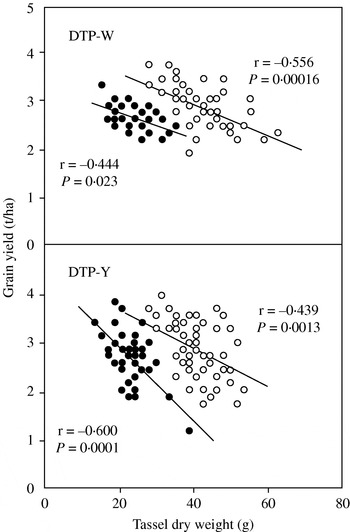
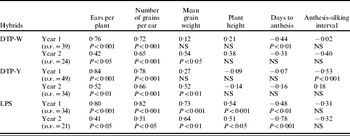
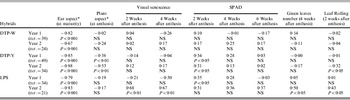
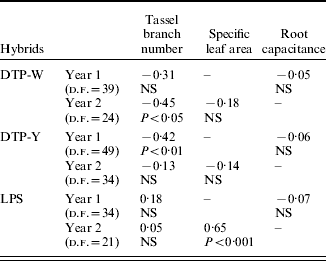
Under drought conditions, grain yield was strongly positively correlated to ear number per plant and grain number per ear in the three sets of hybrids and two seasons (Table 1). Grain yield correlated positively to mean grain weight in all experiments of Year 2, whereas in Year 1 it was only significant for the LPS hybrids. There was a significant positive correlation between grain yield and plant height in both years in LPS hybrids, but not in DTP hybrids. Grain yield was significantly negatively correlated with DA in LPS hybrids. In DTP-W hybrids, the effect of earliness was only significant in Year 1 (r=−0·44, P=0·004). The relationship between ASI and grain yield was not significant in DTP-W and LPS hybrids, being only negatively significant in the DTP-Y hybrids during Year 1 (r=−0·53, P<0·001). While the visual aspect of ears at maturity strongly correlated to yield, the visual aspect of plants at anthesis correlated to yield only in the DTP-Y hybrids (Table 2). Visual notation of senescence was generally not associated to grain yield, except in LPS hybrids. In this set of hybrids, the number of green leaves below the ear (GLN) also significantly correlated with yield. Grain yield was poorly explained by the chlorophyll content (SPAD). The SPAD value, assessed 2 weeks after anthesis (SPAD1), was significantly positively correlated in both years in the DTP-Y hybrids only (Table 2). There was no consistent correlation of leaf rolling with grain yield. In Year 2, there was a weak negative correlation in DTP-Y hybrids and a weak positive correlation in LPS hybrids (Table 2). Grain yield was negatively associated with the number of branches per tassel in DTP hybrids (Table 3). This effect was not observed in LPS hybrids. A highly significant association between yield and tassel dry weight was found for both DTP-W and DTP-Y hybrids (Fig. 1). The trend for LPS hybrids was similar but not significant. The specific leaf area in LPS hybrids showed a highly significant positive correlation to yield. This effect was not observed in DTP hybrids. No correlation was found between root capacitance and grain yield.
Correlation between tassel dry weight and grain yield under drought conditions in DTP-W and DTP-Y hybrids in Year 1 (open circles) and Year 2 (black circles). Hybrids were grown under managed drought conditions and the tassel from five plants of each plot was removed before male flowering. Values for grain yield represents the average of three replicates of plots containing 52 well bordered plants. Each dot represents a given genotype with its mean trait values after statistical analysis. Regression lines and correlation values for Years 1 and 2 are given.

Correlation between grain yield and agronomical traits in DTP and LPS hybrids. DTP-W and LPS hybrids were white-grained while DTP-Y had yellow germplasm. Yield trials were performed as described in the Materials and Methods section. Linear correlation coefficients and ranges of statistical significance for Years 1 and 2 are given. For each trial, the degrees of freedom (d.f.) are also given

NS, not significant.
Correlation between grain yield and secondary traits used in the selection process, in DTP and LPS hybrids. See also legend of Table 1

NS, not significant.
* Ear and plant aspect were scored on a 1–5 scale with the lower value being the better. This explains the negative correlation with yield.
Correlation between grain yield and new secondary traits in DTP and LPS hybrids. See also legend of Table 1
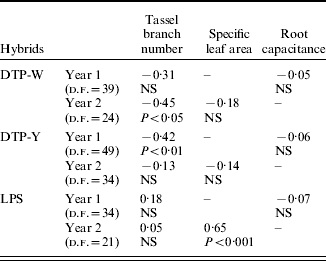
–, not assessed
NS, not significant.
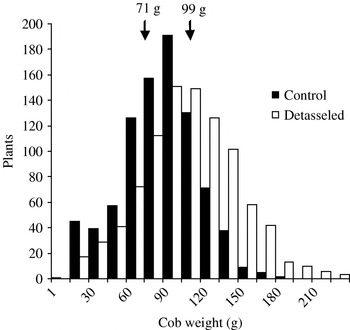
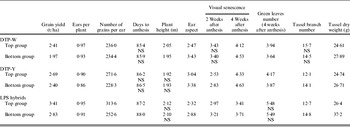
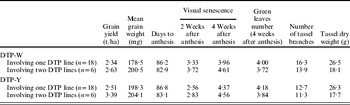
The hybrids selected as more drought-tolerant in Year 1 yielded significantly more than their counterparts in Year 2 (Table 4). The top groups of hybrids had significantly higher numbers of ears per plant and grain per ear, better ear aspect and lower tassel dry weight. In some cases they also had delayed senescence and fewer green leaves below the ear. Anthesis occurred earlier in LPS hybrids of the top group than in those of the bottom group. DTP hybrids of the top group had higher ears per plant and grains per ear than DTP hybrids of the bottom group. In both years, DTP three-ways hybrids including two DTP parental lines yielded significantly more than those including only one DTP parental line (Table 5). Hybrids of the first group also flowered earlier, had lower ASI and higher grain weight. They senesced earlier but had lower number of branches per tassel and lower tassel weight. Removal of tassels carried out in DTP-W hybrids in the drought treatment resulted in a 31% increase of ear weight (P<0·001) (Fig. 2) and an 8% increase of ear number per plant (P<0·001), leading to a 39% increase of yield (P<0·001) (data not shown).
Effect of detasselling on grain yield in DTPW three-ways hybrids under drought conditions in Year 2. Growing tassels were cut manually prior male flowering. Detasselled and non-detasselled control plants were harvested separately and ear weight was determined individually per plant. The histogram presents the distribution of measured ear weights of 960 plants for each type of treatment (n=960). Arrows denote the average ear weight from control (71 g) and detasselled plants (99 g).

Average trait values of the most tolerant (top group) and least tolerant (bottom group) DTP and LPS hybrid. Only traits that showed significant differences between the two groups in the three sets of hybrids are presented

All pairs of mean values between bottom and top groups were found to be significantly different (P<0·05) according to a one-way ANOVA (Student's t-test) with the exception of those pairs marked as non significant (NS). Each subgroup contained at least eight genotypes (d.f.>7).
Comparison between DTP hybrids involving one DTP line and two DTP lines. For with germplasm, besides the different DTP-W lines, the most frequent lines were CML 449 and CML 450. For yellow germplasm, besides the different DTP-Y lines, the most frequent lines were CML 451 and CML 287. Only traits that showed differences between the two groups in the two sets of hybrids are presented

All pairs of mean values within white or yellow hybrids were found to be significantly different (P<0·05) according to a one-way ANOVA (Student's t-test). The number of genotypes in each subgroup used for this comparison is given (n=6–18).
DISCUSSION
Yield and yield components under drought and well-watered conditions
Comparison, for a given year, of grain yield and DII between the different trials confirmed that the three sets of hybrids experienced similar stress intensity. Despite the higher plant population density in Year 2, which is said to increase drought stress in maize (Bruce et al. Reference Bruce, Edmeades and Barker2002; Monneveux et al. Reference Monneveux, Zaidi and Sanchez2005), DII was slightly lower in that experiment, possibly as a consequence of a higher drought tolerance in the hybrids tested, due to the selection applied during the Year 1. Better performance under drought was poorly explained by drought escape in DTP hybrids, particularly in Year 2. Conversely, grain yield under drought was correlated to earliness in LPS hybrids in both Years. LPS hybrids were, on average, slightly later than DTP hybrids, as a consequence of their lowland tropical origin (Pandey et al. Reference Pandey, Diallo, Islam and Deutsch1986). Early LPS hybrids were able to escape drought stress and rising temperatures more than their later-flowering counterparts (Edmeades et al. Reference Edmeades, Bolaños, Chapman, Lafitte and Bänziger1999). Grain yield under drought was generally not associated with yield under well-watered conditions. This result is in good agreement with CIMMYT's experience with tropical maize, showing that genetic correlations between yield in unstressed and stressed environments are generally positive, but not significant when stress reduces yield by more than 50% (Edmeades et al. Reference Edmeades, Bolaños, Chapman, Lafitte and Bänziger1999). It confirmed that selection for drought tolerance carried out in the LPS (Edmeades et al. Reference Edmeades, Bolaños, Chapman, Lafitte and Bänziger1999) and DTP (Monneveux et al. Reference Monneveux, Sanchez, Beck and Edmeades2006) source populations and the further selection of lines and hybrids led to hybrids that remained competitive even under non-limiting water conditions. The significant yield difference observed between the most and less drought tolerant DTP and LPS hybrids indicated that the use of a selection index involving ASI, ears per plant, grains per ear, senescence and leaf rolling, successfully used in the improvement of the source populations (Edmeades et al. Reference Edmeades, Bolaños, Chapman, Lafitte and Bänziger1999; Monneveux et al. Reference Monneveux, Sanchez, Beck and Edmeades2006), also allowed to select for drought tolerance among elite hybrids. Three-ways DTP hybrids involving two DTP lines in their pedigree performed significantly better under drought than those involving only one DTP line, probably because of an accumulation of drought tolerance alleles present in DTP lines (Ribaut et al. Reference Ribaut, Edmeades, Perotti, Hoisington, Ribaut and Poland2000). LPS single hybrids involving CML 449 as tropical tester yielded significantly more (P<0·05) than those using CML 448. CML 449 is known as more drought-tolerant than CML 448 (Monneveux, unpublished).
Relationship between grain yield and its components
Within DTP and LPS hybrids, grain yield was found to be associated with number of grains per ear and number of ears per plant, as expected (Monneveux et al. Reference Monneveux, Sanchez, Beck and Edmeades2006). Surprisingly, grain yield was also found to be associated with grain weight in both Years in LPS hybrids and in Year 2 in DTP hybrids (see Table 1). Grain yield under drought was found by many authors to be highly correlated with grain number per unit area or per ear, rather than with mean grain weight (Bolaños & Edmeades Reference Bolaños and Edmeades1996; Andrade et al. Reference Andrade, Vega, Uhart, Cirilo, Cantarero and Valentinuz1999; Edmeades et al. Reference Edmeades, Bolaños, Chapman, Lafitte and Bänziger1999). A first explanation can be a reduction, due to selection, in the variation of the number of grains per ear and number of ears per plant. It can also be an effect of the higher plant population density used in Year 2. Under high plant population density, competition for assimilates occurs mainly during the last stages of grain filling (Poneleit & Egli Reference Poneleit and Egli1979), which leads to an association between final grain weight and yield (Monneveux et al. Reference Monneveux, Zaidi and Sanchez2005). Interestingly, the association between grain yield and mean grain weight was stronger in LPS hybrids (which had a slightly higher kernel weight) than in DTP hybrids. It is also noticeable that higher yield in hybrids involving two DTP parental lines, compared to those involving only one DTP line, was associated with significantly higher mean grain weight. All these results, taken together, suggest that grain weight, poorly associated with yield at the beginning of the selection process, has to be taken more and more into account as drought tolerance is improved.
Conventional secondary traits: the end of a success story?
No association was found between grain yield under drought and ASI, except in DTP hybrids in Year 1 (see Table 1). ASI has probably been the secondary trait with the most utility and use for drought tolerance improvement (Bolaños & Edmeades Reference Bolaños and Edmeades1996). This trait is highly heritable (Bolaños & Edmeades Reference Bolaños and Edmeades1996) and was regularly found to be correlated with yield (Chapman & Edmeades Reference Chapman and Edmeades1999; Monneveux et al. Reference Monneveux, Sanchez, Beck and Edmeades2006). The lack of correlation with yield in the present study can be explained in a number of ways. Byrne et al. (Reference Byrne, Bolaños, Edmeades and Eaton1995) have previously postulated that if breeders have reduced ASI sufficiently in elite germplasm, further gains from reduction of its value may be less likely. Recurrent selection for drought tolerance decreased the ASI by 1·3 days per cycle in LPS (Edmeades et al. Reference Edmeades, Bolaños, Chapman, Lafitte and Bänziger1999), and 0·6 and 0·2 days per cycle in DTP1 and DTP2, respectively (Monneveux et al. Reference Monneveux, Sanchez, Beck and Edmeades2006). Due to the exponential relationship between ASI and grain yield (Bolaños & Edmeades Reference Bolaños and Edmeades1996), a high variation in anthesis-silking interval is expected to correspond to a low variation in grain yield when ASI is high (either because of the severity of drought or of the germplasm susceptibility). A 30% reduction of ASI without yield increase was reported in these conditions by Chapman & Edmeades (Reference Chapman and Edmeades1999). Conversely, when ASI is low, consistent yield differences correspond to very low variations of this trait that are much more difficult to detect. Another hypothesis for the lack of correlation between yield and ASI is that yield and grain number are not only related to the overall flux of carbohydrate to the ear (as silk growth and ASI), but also to low ovary water potential (Westgate & Boyer Reference Westgate and Boyer1986) or impaired conversion of sucrose in the developing spikelet (Zinselmeier et al. Reference Zinselmeier, Lauer and Boyer1995), two traits that have not been submitted to direct selection. The fact that the relationship between grain abortion and ASI becomes weaker as this last trait decreases (Monneveux et al. Reference Monneveux, Sanchez, Beck and Edmeades2006) tends to confirm this hypothesis.
In the present study, the correlations between grain yield and either senescence or leaf rolling were weak or not significant (see Table 2). Delayed senescence during grain filling has been considered as positively related to yield under drought and proposed as secondary trait in breeding for drought in maize (Bänziger et al. Reference Bänziger, Edmeades, Beck and Bellon2000). Senescence may result in a reduction of radiation interception and photosynthesis (Wolfe et al. Reference Wolfe, Henderson, Hsiao and Alvino1988). However, senescence can also be the consequence of an increased sink demand (Chapman & Edmeades Reference Chapman and Edmeades1999). It has been also postulated by Smart et al. (Reference Smart, Hosken, Thomas, Greaves, Blair and Schuch1995) and Hauck et al. (Reference Hauck, Gay, Macduff, Griffiths and Thomas1997) that leaf greenness does not always reflect metabolic activity. No change in senescence was noted with recurrent selection for drought tolerance in LPS (Chapman & Edmeades Reference Chapman and Edmeades1999) and DTP (Monneveux et al. Reference Monneveux, Sanchez, Beck and Edmeades2006) source populations. These results suggest that differences in leaf senescence can be used for rough selection in drought susceptible germplasm, but may be less and less efficient as the drought tolerance improves through the selection process.
Leaf rolling is generally considered to have negative effects on yield, by reducing light interception. Leaf rolling has been associated with maize cultivars having lower leaf water potential (Sobrado Reference Sobrado1987). No association was found, however, by Bolaños et al. (Reference Bolaños, Edmeades and Martinez1993) between leaf rolling score and predawn leaf water potential. Moreover, Ackerson (Reference Ackerson1983) noted that leaf rolling occurred at a higher leaf water potential in a drought-tolerant latente maize hybrid than in a normal commercial hybrid, suggesting that leaf rolling is associated more to dehydration avoidance than to tolerance per se. No change was found in leaf rolling with recurrent selection for drought tolerance in DTP source populations (Monneveux et al. Reference Monneveux, Sanchez, Beck and Edmeades2006). In addition, leaf rolling could be associated to structural characteristics of leaves. In the present study, for example, a significant negative association was found in the three sets of hybrids between leaf rolling and specific leaf area (r=0·517, P<0·01; r=0·577, P<0·01; and r=0·833, P<0·001, in DTP-W, DTP-Y and LPS hybrids, respectively). A similar association was also reported in wheat (Araus et al. Reference Araus, Reynolds and Acevedo1993).
Partitioning and remobilization: competency of roots and tassels with growing ear
The ‘hidden half’ of the plant has, in general, received limited attention. Little is known, in maize, about the role of roots in drought tolerance and the competing effects of root growth on ear growth. Camacho & Caraballo (Reference Camacho and Caraballo1994) reported a significant correlation between root dry weight and total dry matter production under drought conditions in maize hybrids, but no information was available concerning the association with grain yield. Conversely, Bolaños et al. (Reference Bolaños, Edmeades and Martinez1993) reported a 35% reduction in root biomass in the top 0·5 m of soil and an increase in ear growth under drought in one tropical maize population that underwent selection for increased drought tolerance. Recurrent full-sib selection for high root capacitance in the population Pool 16 Sequía led to larger plants that flowered later and had increased root ramification, but did not yield more (Edmeades et al. Reference Edmeades, Bolaños, Chapman, Lafitte and Bänziger1999). A study using recombinant inbred lines (RILs) from a B73×Mo17 population differing in root traits showed that the class of lines with reduced adventitious and lateral root development yielded better under drought conditions that the class with more vigorous root development (T. C. Barker & I. Saab, unpublished data, cited by Bruce et al. Reference Bruce, Edmeades and Barker2002). In the present study, no clear association was found between root capacitance measurements and grain yield (see Table 3). Studies of water extraction patterns by maize show that little water is removed below 0·7 m soil depth (Mugo et al. Reference Mugo, Smith, Bänziger, Setter, Edmeades and Elings1998) and suggest that deep or extensive root systems do not represent a clear advantage under drought in maize. Moreover, increased root growth comes at carbon cost to the plant, perhaps at a time when C flux to reproductive organs is already limiting sink size (Edmeades et al. Reference Edmeades, Bolaños, Chapman, Lafitte and Bänziger1999).
The competition between male and female reproductive organs is probably better understood. It has been postulated that a dominance relation exists between ears and tassels, and that the strength of this relation differs between genotypes (Bechoux et al. Reference Bechoux, Bernier and Lejeune2000). This dominance relation in maize is mainly related to its monoecial floral organization and protandry which favour the development of male inflorescence, assuring pollen production and dispersion at the expense of ear and silk development (Bolaños & Edmeades Reference Bolaños and Edmeades1993b). In the present study, detasselling led to an important increase of yield under drought conditions (see Fig. 2). Detasselling effects on ear development have been empirically known for many years and several authors (Hunter et al. Reference Hunter, Daynard, Hume, Tanner, Curtis and Kannenberg1969; Mosterd & Marais Reference Mosterd and Marais1982; Magalhães et al. Reference Magalhães, Durães, de Oliveira and Gama1999) have reported yield increases consecutive on panicle removal just before female flowering. Lambert & Johnson (Reference Lambert and Johnson1978) demonstrated yield enhancing effects of detasselling and tassel branch removal, with detasselled and debranched plants having 5 and 2% yield increase over the control. Positive effects of detasselling on grain yield were much higher in the present study. The competency between panicle and ear increases under high plant population densities (Fischer et al. Reference Fischer, Edmeades and Johnson1987) and under drought stress (Geraldi et al. Reference Geraldi, Mirando Filho and Vencosvsky1985). Effects of detasselling were also found to depend on genotype (Sangoi & Salvador Reference Sangoi and Salvador1998). Hunter et al. (Reference Hunter, Daynard, Hume, Tanner, Curtis and Kannenberg1969) suggested that the positive response of grain yield to detasselling is largely due to suppression of shading and better interception of light by the upper leaves, which have the higher contribution to grain production (Wilhelm et al. Reference Wilhelm, Johnson and Schepers1995). Mickelson et al. (Reference Mickelson, Stuber, Senior and Kaeppler2002) reported a significant correlation between tassel branch number and leaf angle and suggested that both traits played a major role in the penetration of light into the canopy. Recurrent selection for drought tolerance based on ears per plant, grains per ear, ASI, senescence and leaf rolling was found to reduce branch number by 2·6% (Bolaños et al. Reference Bolaños, Edmeades and Martinez1993) to 5·9% (Chapman & Edmeades Reference Chapman and Edmeades1999) per cycle. Recurrent selection in DTP source populations reduced tassel weight by 2·2% per cycle (Monneveux et al. Reference Monneveux, Sanchez, Beck and Edmeades2006). Selection based on prolificacy was also found to reduce tassel length (de Leon & Coors Reference de Leon and Coors2002), thus confirming the competition between reproductive organs. In the present study, tassel weight was negatively associated with yield in DTP hybrids (see Fig. 1), but not in LPS hybrids, although a higher difference in tassel weight between tolerant and susceptible hybrids (see Table 4). This weaker competition between reproductive organs in LPS hybrids needs further investigation to clarify if it is related either to photosynthetic activity or to higher re-mobilization from vegetative organs. Nevertheless, reduced tassel size appears as a relevant breeding objective for further selection in DTP germplasm. This trait is highly heritable and can be easily selected (de Farias Neto & Miranda Filho Reference de Farias Neto and Miranda Filho2000). Significant correlation between number of branches per tassel and tassel weight was reported by Berke & Rocheford (Reference Berke and Rocheford1999). The non-significant or weak correlations observed between these traits in DTP sources populations (Monneveux et al. Reference Monneveux, Sanchez, Beck and Edmeades2006) and in DTP and LPS hybrids in the present study suggest, however, that selection for reduced tassel weight may be performed without decreasing tassel branches number and pollen production at the same rate. The use of two DTP lines in forming three-ways hybrids has revealed to be an effective way to reduce tassel weight and favour ear and silk development in this type of germplasm.
Consequences for further progress for drought tolerance in maize
The use of a selection index based on barrenness, ASI, leaf senescence and leaf rolling (Bolaños & Edmeades Reference Bolaños and Edmeades1993a) has been very successful in the past (Edmeades et al. Reference Edmeades, Bolaños, Chapman, Lafitte and Bänziger1999; Monneveux et al. Reference Monneveux, Sanchez, Beck and Edmeades2006). However, continued selection for specific traits after several breeding cycles results in improvements of their value, but also a reduction of their genetic variation (Edmeades et al. Reference Edmeades, Bolaños, Chapman, Lafitte and Bänziger1999; Monneveux et al. Reference Monneveux, Sanchez, Beck and Edmeades2006). As a consequence, most of the classical secondary traits did not correlate to grain yield within the most tolerant hybrids (see Tables 1 and 2). As far as the association between secondary traits and yield has been lost through selection, it is therefore very important to investigate new secondary traits, allowing an adjustment of the selection index. There are several possible strategies for achieving a more efficient manipulation of C availability for the growing grain.
One way is to modify carbon partitioning among the different sinks. The present results on plant height, leaf rolling, leaf area, leaf thickness, chlorophyll content and leaf senescence (see Tables 1–5) indicate that rather than selecting for a favourable trait variant in source tissues, it might be more promising to manipulate the sink organs. The data suggest that some progress is still possible by decreasing the tassel size but not the root size (see Table 3). It appears that in tropical maize, a smaller tassel can increase considerably yield under drought (up to 39%, see Figs 1 and 2). It has yet to be investigated if the detasselling effect is due to reduced evapotranspiratory loss of water through the tassel or due to an increased availability of C products for the growing ear.
A second way is to manipulate the number of harvestable sinks. The increase of ear number obtained through selection for drought (Edmeades et al. Reference Edmeades, Bolaños, Chapman, Lafitte and Bänziger1999) and the positive association between grain abortion and potential grain number (Monneveux et al. Reference Monneveux, Sanchez, Beck and Edmeades2006) suggest that it is better to increase the number of ears per plant rather than the size of individual ears. More ears represent alternative sinks, while more grains per ear increases competition between neighbouring grains and leads to increased abortion during water stress.
A third way is to increase the capacity of grains to import sugars for their growth. In the present study, grain yield correlated more to grain number and size and less to ASI (see Table 1). Silk growth reflects the availability of carbon during the flowering stage of development, while grain growth or abortion occurs 2 weeks thereafter. Any secondary trait that closely relates to grain growth may better reflect drought tolerance than ASI. Indeed, mean grain weight, previously not included as a secondary trait for drought, was strongly correlated to yield in our studies (see Table 1). The exact causes of grain abortion in maize might be related to sucrose–starch metabolism (Zinselmeier et al. Reference Zinselmeier, Jeong and Boyer1999), but the regulatory mechanisms are still insufficiently known and merit further investigation (Tiessen et al. Reference Tiessen, Lunn, Geigenberger and Ribaut2006).
Optimal choice of crossing combinations
Additional progress in drought tolerance in maize may also depend considerably on the crossing schemes. The strategy of improving abiotic stress tolerance via direct selection of S2 to S7 families is mainly based on the assumption that inbred line performance is indicative of hybrid performance. However, Lafitte & Edmeades (Reference Lafitte and Edmeades1995) reported that the correlation between S2per se and topcross yield under low N was only 0·22, while Betrán et al. (Reference Betrán, Bänziger, Beck, Edmeades, Bänziger, Mickelson and Peña-Valdivia1997) found correlations of around 0·4 between S3per se and topcross performance for some drought tolerance secondary traits. More information is needed concerning the relationship between inbred lines and hybrids performances under drought. A practical implication of the mentioned findings is that the choice of parental lines is critical in the further development of drought tolerant hybrids. In the present study, DTP three-ways hybrids including two DTP parental lines yielded more than those including only one DTP parental line (see Table 5). However, the use of lines from the same source populations is expected to reduce heterosis gains in the resulting hybrids. Breeding theory says that it is desirable to widen the genetic base to allow pyramiding of drought tolerance genes from diverse origins (Betrán et al. Reference Betrán, Ribaut, Beck and de León2003). The constitution of new drought elite populations has been initiated by crossing DTP and LPS lines. Preliminary observations suggest that a synthetic population involving both DTP-W and LPS germplasm is more drought tolerant than the parental populations. In addition to the implementation of innovative (e.g. more efficient and cost-effective) phenotyping strategies for the screening of lines per se under stress, more efforts are needed to determine the best cross combinations of the presently available inbred lines for making hybrids with the maximum expression of stress tolerance. The reported differences in the correlation strengths between yield and certain secondary traits among the DTP-Y, DTP-W and LPS hybrids will help us to plan some of the necessary crosses to improve this germplasm in the near future.
We are grateful to Pedro Chepetla, Aristeo Vasquez, Javier Cajero, Alberto Carreño, Miguel Hereria and Gaudencio Roman (CIMMYT Tlaltizapán Experimental Station) for their helpful contribution in field experiments. A.T. would like to thank the Deutsche Forschungsgemeinschaft (DFG Ti-497) and CONACYT for funding.