Introduction
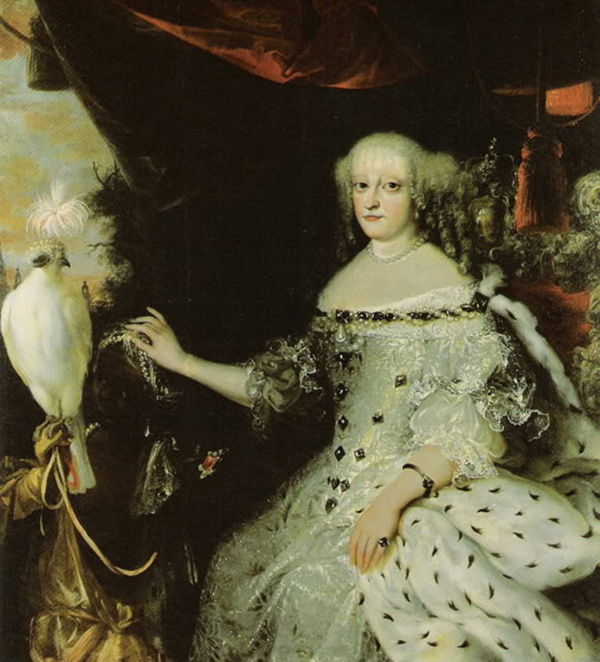
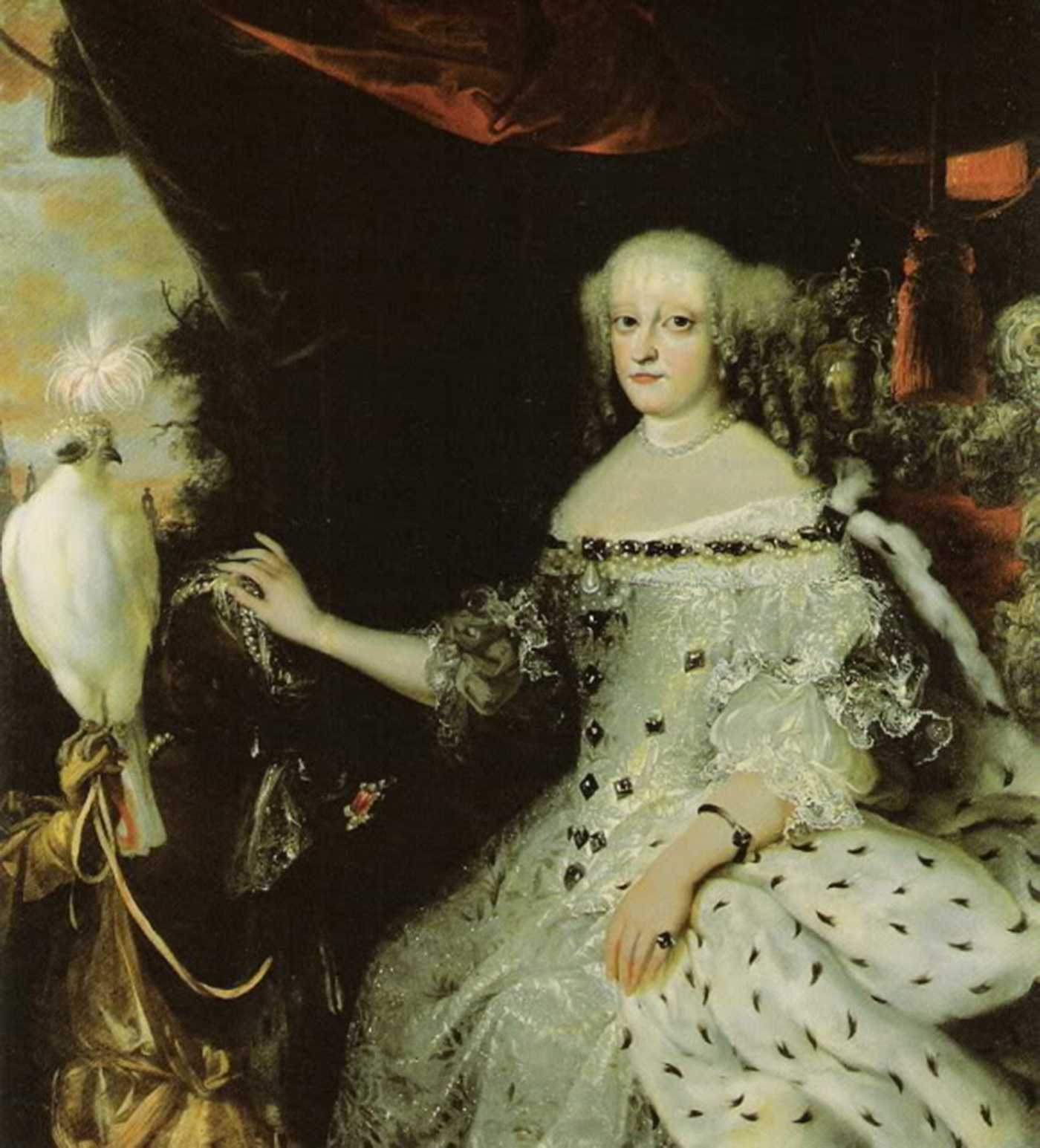
It happens to any of us that when we read a book on a new topic all the details seem important and we underline and gloss the new singularities, which we would ignore if it were a matter already known. The same is true when we come across customs of remote people, for as anthropologist Kirsten Hastrup notes, they surprise us and we record their singularities.Footnote 1 At the beginning of the seventeenth century, trade in prestigious black domestic servants (Morianer) for royal and upper-class homes in Denmark-Norway played a singular role in the Scandinavian history and imagination. In a portrait (Figure 1) hanging at the Museum of National History at Frederiksborg Castle, Queen Sophie Amalie is pictured together with an exotic white cockatoo and with her right hand posed delicately but firmly over the head of a young black man. The young man is a hofMorian, a precious enslaved servant, so popular at European royal courts at the time. The portrait, painted by Abraham Wüchters in 1667, illustrates a hegemonic version of the colonial encounter: conquering the exotic.
Portrait of Queen Sophie Amalie. Painted by Abraham Wüchters in 1667. Courtesy of the Museum of National History at Frederiksborg Castle (inv. nr. A 4605).
Who were the page boys called Mohr or Morian, so popular among the upper classes in early modern Denmark? In the language of the time a man of dark skin was a sortemand Footnote 2 and black servants were called Morianer.Footnote 3 The presence of Morians in Denmark was a by-product of the colonial enterprise in Southern Asia and Africa. The term was used collectively for all people with dark skin of African, Indian, and Southeast Asian origin. In the case of the latter it was a result of the Danish East India Company's (Ostindisk Kompagni) activities in Tranquebar. A quote from Kancelliets brevbøger (chancellery's letter book) testifies about the presence of Morians in the country: “A royal missive to Otte Marsvin asking him to send the Morian, he has had at home, to return [to the royal court].”Footnote 4
In recent years, historiography has taken an increasing interest in the first colonial encounter in Tranquebar.Footnote 5 The enrolment of soerte mennesker (black Tamils), free and enslaved, by Claus Rytter to sail from Tranquebar to Copenhagen on Den Forgyldte Sol (The Gilded Sun) in the 1640s introduces questions of cultural interactions, difference, and social inequality in a time of historical change in Denmark-Norway. Early seventeenth-century slave trade and the presence of Morians in the streets of Copenhagen has been largely neglected in Danish historiography. The debate in Denmark has been centred on the transatlantic triangle route and African slave trade to the Caribbean, in spite of the fact that the first Morians—people of colour—in Denmark were from South Asia.Footnote 6 A polyphonic, interdisciplinary approach to the colonial encounter can afford new clues to a better knowledge of the period. In this perspective, Hans Hansen Skonning's Geographia historica Orientalis (1641) presents an important source on cultural encounter with the non-European Other.Footnote 7
The article investigates the Danish trade of Morians in Denmark in the seventeenth century, tracing this practice to the first contacts of the East India Company with the Tamil population of Tranquebar. Secondly, it describes the employment of domestic servants in the metropolis and the ways Morians have been represented in Danish-Norwegian literature and art of the period. Finally Skonning's Geographia invites the reader to follow seventeenth-century Lutheran ideology of human differences in Nordic countries.
The Danish Overseas Companies on the Asian Route
The Danish practice of slavery was linked to commercial activity in the colonies in Asia, Africa, and the Caribbean. Trade and management of the colonies was carried out by the overseas companies, corporations created with the support of the Crown. Two of the overseas routes operated by these companies involved trade with enslaved persons: the route between the coast of Guinea and the islands in the Caribbean (1660–1845), supplying slaves to the plantations, and the Asian route (1616–1830), supplying domestic servants to aristocratic homes.
The historiography of the colonial period has primarily focused on the foundation of the companiesFootnote 8 and the triangular trade.Footnote 9 The Danish presence in Tranquebar in the first half of the seventeenth century and the associated slave trade has been practically tiptoed around by the historians.Footnote 10 Both the focus on the large-scale African slavery, common in the international historiography on slavery, and the interest in the activities of the more successful eighteenth-century Asiatisk Kompagni (Danish Asia Company) have influenced the postponement of the study of the activities of the East India Company.Footnote 11 This oversight has been attributed, in part, to the commercial failure of the company.Footnote 12 Most of the contemporary historiography turned indifferent towards the question of slave trade in Asia and the presence of Morians in the country, reducing their social impact to a footnote or an anecdote.Footnote 13
In the Danish archives there are two sources of information about slave trading in expeditions to Tranquebar: official documents and travel literature. Most of the archives of the first two Danish trading companies have not survived.Footnote 14 On the one hand, there are published chancellery books (Kancelliets brevbøger) and unpublished material including Admiral Ove Giedde's archive for the period 1616–1650 (box B244), Captain Claus Rytter's accounts for the period 1639–1650 (box 245), and documents of the Captain and Governor of Tranquebar Wilhelm Leyel from 1639–1648 (box 246). On the other hand, there is travel literature, including the description of Admiral Ove Giedde's navigation to IndiaFootnote 15 and a diary of gunner Jon Olafsson's navigation to Tranquebar with the East India Company second fleet in 1622.Footnote 16 After the pioneering example of a Danish sailor Christiern Smeding (1558)Footnote 17 a number of Danish employees of the Dutch East India Company (VOC) published their accounts of travel. In 1669, Adam Olearius edited two separate diaries of sailors Jürgen Andersen (1644–1650) and Volquard Iversen (1655–1668).Footnote 18 In 1670, a diary of the sailor Mourits Christensen was published.Footnote 19 In 1672, Frederik Bolling and J. P. Cortemünde (Kerteminde) published their individual descriptions of their navigation to IndiaFootnote 20 and in 1684 the story of Jens Mortensen Svejgaard, an accountant employed by the VOC, was published.Footnote 21 Besides being a historical record, these stories provide descriptions of the customs of Asia and the Dutch and Indian trading routes and they make isolated references to the slave trade.
The East India Company was the first joint stock company in Denmark, created on 17 March 1616 at the initiative of two Dutch merchants, Jan de Willum and Herman Rosenkrantz, to whom Christian IV granted the privilege of trading with Asia. It involved national potentates in addition to the participation of King Christian IV as the largest shareholder. According to the octroi (1616, Art. 28), it was not a slave company; its goal was to import spices and oriental products. Based in Tranquebar, the Danish trade network included small establishments in Macassar, Bantam, Masulipatam, and Pondichery, where the Danes traded gold, diamonds, spices (ginger, nutmeg, cloves, and pepper), Chinese silk, tin, and nitrate. The first diplomatic expedition, consisting of six ships—three chartered by the king and three by the company—sailed from Copenhagen in 1618, led by the young Admiral Ove Giedde. Despite initial disappointment in Ceylon, the intended destination, part of the expedition, with Roland Crappé commanding, went to the Coromandel Coast, where they reached an agreement with the Nayak of Tanjour, Ragunatha, to create a trading post in the place of Tharangampadi, which the Danish called Tranquebar, a place located in a fertile and densely populated rice-growing region. The company got permission to build the fort of Dansborg in exchange for an annual payment in rent.Footnote 22
The Employment of Domestic Servants in the Colony of Tranquebar
There was no specific Danish legislation regulating the legal status of domestic servants in Tranquebar in the first half of the seventeenth century. Slave ownership and trade was justified in light of the spirit of the times. In principle, the Danes adapted to the local and European customs in the region, within the limits of common sense, although proper treatment was required, including providing for the basic needs (food and clothing).Footnote 23 At the beginning of the seventeenth century, the slave trade in Asia was concentrated along two routes: Indian traffic to Europe, and inter-Asian traffic. Danes and other Europeans participated in both. The main reason for the inter-Asian slave trade was the economic demands of Europeans.Footnote 24 For the Portuguese, Dutch, and British purchasing slaves was cheaper than hiring from the local labour force. The participation of the Danes in the slave trade was a function of demand and economic necessity. Danish sailors employed at the VOC were familiar with the routes crisscrossing the Indian Ocean. In his travel log, Danish sailor Jürgen Andersen (1669) wrote that he sailed to Mocca and the Persian Gulf on the VOC ship Nassau with a cargo of 120 enslaved persons. In Geographia historica Orientalis (1641) Hans Hansen Skonning describes how enslaved “Kaffirs,” or African slaves, were being trafficked between Mozambique and India. Remarkably, Skonning described the slave trade before the start of the slave-trading activities by the West India and Guinea Company (Vestindisk-Guineisk Kompagni, established in 1671), reproducing information from Jan Huyghen van Linschoten's Reysgheschrift.Footnote 25 A copy of van Linschoten's Reysgheschrift was part of the inventory of the expedition of Admiral Ove Giedde to Ceylon.Footnote 26
On the east coast of India, there were two main areas where slave trading took place: one to the north, in the Arakan-Bengal-Orissa area, with a Muslim majority, and the other to the south, in Coromandel, populated by Hindu Tamil groups. The Arakan-Bengal-Orissa area was the main exporting region for slaves purchased by the PortugueseFootnote 27 and the DutchFootnote 28 and transported to their factories and producing centres. The Danes had no production that demanded large-scale slave labour, so the East India Company did not, in principle, take an active part in this cheap labour piracy in the Bay of Bengal during the first half of the seventeenth century. However, the Danes from Dansborg sold soldiers captured in the conflict with the army of the rajah of the neighbouring kingdom of Bengal that took place during the government of Berndt Pessart (1636–1643). These actions were justified on moral and political grounds and by the necessity (debt).Footnote 29
The other region, Coromandel, occupies a strategic position in the maritime traffic of South Asia. It was an important provisioning point for the ships participating in the inter-Asian trade. The earliest evidence of European slave trade off the Tamil coast corresponds to the arrival of the Dutch in the first half of the seventeenth century.Footnote 30 The export of slaves from Coromandel to Batavia was important in 1620–1630,Footnote 31 and it rebounded in 1640 and 1650 and around 1686.Footnote 32
Bondage servitude and enslavement was a practice used by poor Asians to overcome life challenges.Footnote 33 The lower castes of Hindu society entered into domestic forced labour as payment for a debt, or as prisoners of war. As the peasants were subjected to a harsh system of feudal taxation they were often forced to sell themselves into slavery when harvests failed.Footnote 34 In Geographia historica Orientalis Skonning paraphrases van Linschoten's Reysgheschrift to say that the slave trade is a part of the wild nature of people who kill, eat, or sell the slave of war.Footnote 35 Yet, we must not forget that the practice of slavery still held sway in Europe in the seventeenth century, as Article 24 of the 1641 bilateral agreement between Portugal and Sweden prohibiting mutual enslavement exemplifies.Footnote 36
Yet, Tranquebar's position as a centre of slave trade during the East India Company's period remains unclear, as does the Danes' attitude and participation in this development. A Dutch Dagh-register (daily journal) from Batavia has registered that in April 1629 an East India Company ship made a stopover in Batavia, on the sail route between Macassar and Tranquebar. The ship was commanded by Roland Crappé. Among the twenty-six prisoners Crappé transported from Macassar was a merchant called Antoni Poulo. The register notes how Crappé volunteered to be a guarantor for Poulo's freedom after Poulo exchanged himself for a “swarte vrow en de haer kindt” (a black woman and her child) to pay his debt.Footnote 37 Most governors were involved in the slave trade. Governor Berndt Pessart had personal slaves,Footnote 38 and Bredsdorff records a cargo of 114 slaves pertaining to W. Leyel.Footnote 39 Governor W. Leyel, of Dutch origin, collaborated in slave traffic with his compatriots from the VOC, partly to use the profits to repay his debt of 156,000 thalers (rigsdaler) he owed to the Nayak of Tanjore.Footnote 40
The slave trade continued as part of trading activity until the end of the seventeenth century.Footnote 41 By 1698, Tranquebar's governor, Claus Vogdt, allowed the company to make internal trips to Atchin in Sumatra to buy slaves before returning to Copenhagen.Footnote 42 Gérald Duverdier, using missionary sources, states that the “Danish colony was in fact a slave market” in the eighteenth century.Footnote 43 Only in 1753 was the slave trade officially prohibited in Tranquebar.Footnote 44
Despite initial distrust of the local population, social interactions between the Danes and locals developed and resulted in working relations and mixed marriages.Footnote 45 Some of the Danes lived in free relations with indigenous women. The government eventually enforced regulation of this cohabitation. One of such cases was Pastor Niels Andersen Udbyneder, who was forced to get married to his partner, Monica.Footnote 46 Mixed marriages were beneficial for both partners. In Batavia, these unions offered an escape from poverty for the local women, and an access to the woman's local networks for the European men.Footnote 47 A case in point is Herman Clausen, the head of the Danish office in Bantam, who was married to Maria Lopez, a baptized local woman. Clausen made his fortune as a free merchant partly thanks to the connections he was able to establish with his wife's relatives.Footnote 48
Slaves were also labouring in Tranquebar. The Danish governors relied on the working capacity of the Tamils, free and enslaved, who were employed as translators, construction workers, local police, and even as sailors.Footnote 49 Ove Giedde did not hesitate to use the Tamil workforce to repair the ship Elephanten in Ceylon.Footnote 50 At the beginning of the Danish presence in Tranquebar, Nayak's Indian soldiers, called talliarer (pl.), collaborated with Danish troops in the patrolling of Dansborg.Footnote 51 Moreover, in 1676, the Tranquebar garrison was mostly composed of black Indo-Portuguese soldiers, called topaz.Footnote 52 These topaz were considered of high status because they had access to guns. Between 1640 and 1643, Claus Rytter employed soerte tieneris (coloured servants) as members of the crew on the ship Den Forgyldte Sol in its voyages between Tranquebar and Bantam. Claus Rytter recorded in his accounts the monthly salaries paid in thalers (rigsdaler) to these employees.Footnote 53 Out of a total amount of 924 rigsdaler in wages paid to the twenty-seven soerti (black) local workers in the period 1641–1643, Tamil workers Rafael, Jouvan, and Arrei received a total payment of 54 rigsdaler 3 mark each, Abdol received for 1641 and 1642 a total payment of 15 rigsdaler 2 mark, and Frantzescho received for 1641 9 rigsdaler 3 mark.Footnote 54 The ship's records from 1643 relating to the long route to Denmark via Madagascar and Pernambuco (Brazil) indicate that Francisco, Manuel, and Antonio, Tamil crew members, received a monthly salary, a Bengali gingang (cotton garment), shirts, and a travel blanket from Maslupatam.Footnote 55 Rytter's account shows a difference in treatment given to the Tamil employees and an enslaved man called Bras. He is listed without his last name, in contrast to the record of the Tamil employees: “Francisco Lafer travels enlisted as a cook, Antonio de Marese travels enlisted as a sailor, Bras as an assistant cook.”Footnote 56 Their names suggest they were baptized Indo-Portuguese, probably Tamils.
Claus Rytter paid forty thalers in India for Bras; he acquired him for Christian IV in 1643. “On March 21, 1643 I purchased on behalf of Hermand Clausen for his Majesty the black slave who has to sail with us to Denmark working as an assistant cook on the boat and on the recommendation of Hermand Clausen I have paid 40 thaler”.Footnote 57 At present I do not know what happened to Braes, if he died during the travel or whether he ended his life in Europe. According to Slange Den Forgyldte Sol was shipwrecked on the English coast on its way home from India in 1644.Footnote 58 All its wares were given to Albert Baltser Berndts, one of Christian IV's main suppliers. Forty thalers was the price of a healthy young male on the Bantam market according to the sailor Mourids Christensen. Market prices varied from trading place to trading place. In Coromandel a male cost twenty thaler but between forty and sixty thaler in Bantam. A “beautiful” woman in Coromandel cost ten to twelve thaler and twenty to thirty in Bantam, the same price as a middle-aged man (gammell karl).Footnote 59
The Employment of Morians in Denmark
Danish law did not regulate the Morians as a specific ethnic group—as it did in case of the Jews, Gypsies, Catholics, or Swedes.Footnote 60 Morians were employed as domestic servants, and their presence required administrative assimilation. As a worker the Morian was regarded as a personal servant, but it is unclear if Morians had the legal rights of a servant: the right to a wage and the right to voluntary terminate their employment.Footnote 61 The records show that Morians were loaned between members of the aristocracy.Footnote 62 Most Morians lived with their owners in countryside mansions, where they performed domestic and other duties. An illustration of their tasks and dependencies is provided in the commandments made by Christian IV to the local governors, recorded in the register of the chancellery from 1621 to 1623. In a missive from 1 May 1623 Christian IV urged Otte Brahe Pedersen, bailiff of Koldinghus, “to show the Indian the place where the pearls are in the Varde [i.e., Varde å, or river], so that they may be found.” The Indian, presumably a Morian brought by the expedition of Ove Giedde, is given the Christian name of Peder. He was supervised by Peder Hansen, mayor of the town of Skamstrup, who received a salary of 3½ silver thaler (rigsdaler). It should be noted that nothing is said about the servant's wages. The Morian was clearly under the surveillance of Peder Hansen, but nowhere is it stated that he belonged to the mayor. Peder's owner was surely the king, and we have to understand the relationship under seventeenth-century conditions. The mayor is receiving a compensation from the king for “taking care” of the Morian, who was working for the crown (the state) as a fisherman. Moreover, we have an idea of the harsh conditions Peder was working under because in a missive of 7 October 1623, it is communicated to the new governor, Gunde Langue, that the “Indian” has died and “it behoves us to now use local farmers to continue with the pearl activity.”Footnote 63
The discordance between the social practice of slavery and the lack of an adequate administrative and religious law could not be more evident than in the case of the Morians imported by the captains of the East India Company. Christian IV opposed them bringing Asian servants on their ships, a practice popularized by sailors of the VOC repatriated to Amsterdam. He feared that this practice could jeopardize Danish trading affairs in India.Footnote 64 Despite his opposition, the first sortemænd from Asia came to Copenhagen as early as 1622 on Ove Giedde's ship returning from Tranquebar. These were the Tamils Cathi and Mari, given to the schoolteacher Anders Christensen for their conversion to Christianity.Footnote 65
In religious matters, the Morians were living in an administrative limbo before Christian V's ordinance of 21 March 1693 on weddings and baptisms in the country, which prohibited extramarital residence and required baptism of all children.Footnote 66 H. D. Lind offers two brief notes with information about the baptism of Morians in Copenhagen's Holmen Kirke in the period of Christian IV. The ethnic criterion is evident in the baptismal record of Knud, “a child of Morian Ulrik Christian” (“Ulrik Christian Morian”), and his second son, now referred to as “the Indian Ulrik Christian” (“Ulrik Christian Indianer”). The relationship of ownership is evident in the baptismal record of Frans Panirs, “Morian of Ernst Pricker,” baptized on 28 November. Pricker was a captain of the Fortuna, a ship sailing the Asian route. Inside Holmen church, founded by Christian IV, a baptismal font from 1649 decorated with ethnic motifs still remains. The font, made of wrought iron, enamel, and gold, rests on four Morian feet and four busts of Morian galleon faces alternating with the coat of arms of Christian IV which decorate the outside of the vessel.Footnote 67
The Morians were not in control of their own bodies and destiny, and their fate remained in the hands of their masters, the monarch, or a provincial authority. In Denmark the Morians were treated as a precious commodity that needed to be taken care of—in the accounts of Frederik III the maintenance expenses of the Morian courtiers included food and appropriate clothing—but ultimately they were regarded as personal possessions. Following the fashion of other European courts at the time, Danish monarchs found it appropriate and desirable to own an exotic page.Footnote 68 The Morian pages were under the supervision of a footman from the royal palace, who was obliged to give him or her food and clothes. In 1683, Christian V ordered his footman to buy a pair of shoes for a Morian page named Hercules. A footman was also charged with taking care of him in case of illness (“Valet Voscam for supervision of the little morian, called Hercules, one and a half years 20 rigsdaler and attentions when he had measles 4 r., total 24 r.)”Footnote 69
Besides serving as page boys, Morians were also employed as valets, mascots, ladies of the court, and specialist workers. At present it is difficult to estimate how many Morians were imported to Denmark, but they were popular and fashionable among the upper classes in the seventeenth century. During absolutism, Morians began to play an intermediary role as a gift given by the monarch to his loyal nobility.Footnote 70An entry in the royal chamber accounts from 1680 shows that Morians were used in royal gift policy in payment for services rendered to the country and reads: “Major Hechman was given a morian as gift by Christian V.”Footnote 71 The majority of them remain anonymous and only some—Cathi, Mari, Peder, Bras, Knud, Hercules—are known by their names, as recorded in administrative papers.
The Morian in Danish Literature and Art
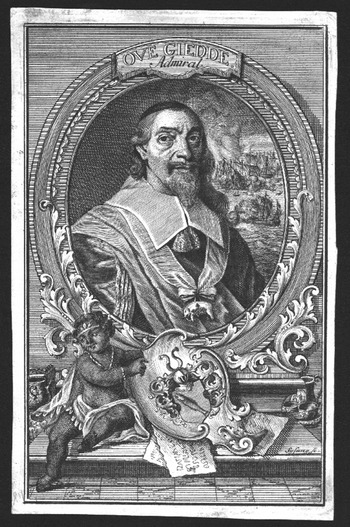
A taste for literature, theatre, fashion, porcelain, and portraits was common to the European upper classes in the seventeenth century.Footnote 72 In all these forms and artefacts Morians are referenced in a direct or indirect way. The former has a biographical connotation in one of Ove Giedde's portraits (1648). The Morian figure, which is engraved on the base of the portrait frame (Figure 2) is probably an idealized image of a Tamil Morian. A clear reference to black slaves is visible in a seventeenth-century chair that decorates the entrance to room 42 in the Museum of National History at Frederiksborg Castle (Inv. nr. B2009). The piece, which was acquired by the museum in 1910 from the antiquarian Moritz, is of unknown origin. The chair has two distinct parts: the upper part of the backrest is decorated with two heads of black slaves, easily identified by their gold collars, and in the lower part, the front legs are decorated with white angels with blue eyes. It is an object which explicitly shows subordinated otherness.
Portrait of Ove Giedde. Etching by A. Haelwegh. Original painted by A. Wüchters, before 1650. Reproduced with permission from Det Kongelige Biblotek (The Royal Library).

The chair operates with two distinctive categories of white and black. This language of distinction was familiar and operational in a wider society in Denmark and Tranquebar. In the outpost it was a common way in which Danish officials distinguished themselves from the native inhabitants. Already on 17 March, 1632, Mads Rasmussen, army chaplain of the ship Perlen, wrote in his journal that he celebrated his first mass in Dansborg for his countrymen and two hundred “mænd sorte indianer” (black Indians)—note the emphasis on racial difference, repeated in 1670 when the octroi described the frigate Faeroe’s encounter with the two hundred “huide og sorte” (white and black) men of the fortress.Footnote 73
Skin colour is also reflected upon in Baroque literature. In a poem by Søren Terkelsen, Denne holder med de soerte (This supports the blacks; 1650), the poet praises his beloved white-skinned but dark-eyed woman. The poet does not reject the physical traits that deviate from the Nordic standard, although they are accepted by default: “Naar de hvid'er ‘alle borte, holder jeg mig til de sorte” (When there are no whites, I'll take blacks) to end with a comment on the beauty of his beloved: “du est kjon / dog den eg, kiønnest / skjøn est du / dog dend eg, skiønest” (you are beautiful, but not the most beautiful). Blackness of the skin was sometimes associated with sin, which could be removed only by divine intervention, as is the message of Michaelis Severini's popular song of 1625: “En blaamænd omskifte Huden sin. Alting vaar aff til modstand, Hjælpn aff en naade din” (A black slave changed his skin. All resistance disappears with Your help). The social boundaries delimiting race were impassable for the Morian. In the biblical poem Hexameron (1661), the poet Anders Arrebo writes the following: “Baadsmands viis sin Troje gennembløder. Dog som en Morian ej gjerne sig bespejler (Det giør hans Ansict vidt, hans skønhed Hannem fejler)” (The boatswain shows his soaked shirt but, as a Morian, he does not want to look into the mirror [because his face looks white and this makes him look ugly]).Footnote 74
Moorish, Indian and African references were incorporated into art exhibited and spectacles performed at North European courts. Courtly masquerades featured costumes and characters inspired by Asia and Africa. In a play performed at Whitehall, Ann of Denmark (1574–1619), Christian IV's sister married to England's Jacob I, played “The Masque of Blackness,” a court masque written by Ben Jonson and with costumes designed by Inigo Jones.Footnote 75 Morians, dwarves, and Sami were also incorporated into court scenery as fashionable curiosities and “living art.”
The African motifs in Karl van Mander III's art, including A Morian with a Turban and Armor, in possession of the National Gallery of Denmark, and his cycle of paintings based on Heliodorus' Aethiopica,Footnote 76 as well as paintings of prominent African visitorsFootnote 77 represent the exotic glamour of early modern Danish art. Paintings by the Dutchman Albert Echkout depicting the peoples of colonial Brazil—Afro-Brazilian women, Tupinamba and Tapuya Indians, blacks and mulattoes—are on display at the National Museum in Copenhagen.Footnote 78 The figure of the exotic Morian, popularized by the portraits of the Turkish court by the Danish painter and traveller Melchior Lorck (1527–1588), gained a foothold as a motif in portraits of European aristocracy.
Paintings of black page boys were popular in the seventeenth century. Prominent people were portrayed in proud poses and flanked by one or two coloured servants in idealized and recognizably European scenes. Danish portraits representing black domestics in servile and even naïve poses follow European conventions of the time. Ann of Denmark was painted with her black page boy by the Flemish painter Paul von Sommer (1576–1621).Footnote 79 The richness of the motifs enhanced the splendour of the court not only as a curiosity but as a way to reaffirm the royal power.Footnote 80
The masters of the genre were Karl van Mander III (1606–1670) and Abraham Wüchters (1608–1682), Flemish painters working in the service of the Danish court. The royal portrait of Prince Jørgen, painted by Abraham Wüchters around 1660, hangs in the National History Museum at Frederiksborg (inv. nr. 2402). It includes the figure of a Morian with boyish features behind his master. Small reproductions of these paintings decorated the houses of the petty provincial bourgeois.Footnote 81 The fashion of having portraits done with the Morian as a symbol of prestige was specially adopted by the members of the royal administration. The characters in Double Portrait of Hannibal Sehested and His Wife Christiane (Gavnø Castle) by Karl van Mander III are portrayed in a hunting scene with horses and accompanied by black pages wearing turbans and a pearl in the ear. In Family Portrait of Eiler Holck with Wife, Children, and Servants (Holckenhavn Castle), Abraham Wüchters immortalized Kronborg's governor. Dressed as a Roman emperor, he is accompanied by his wife, his daughter, a Danish female servant, and a kneeling black servant. In a gesture of power, the governor extends his right hand over her head.
In some cases, Morians became involuntary protagonists of political decisions at the highest level. In a picture hanging in Rosenborg Palace (inv. nr. 1042) representing Christian V meeting with members of the supreme court, probably in 1683, the painter included at the bottom of the picture a figure of a Morian looking at the group. One can speculate if the composition is an allusion to the issue of the socially invisible Morians in the context of the new legal code issued by Christian V that year.Footnote 82
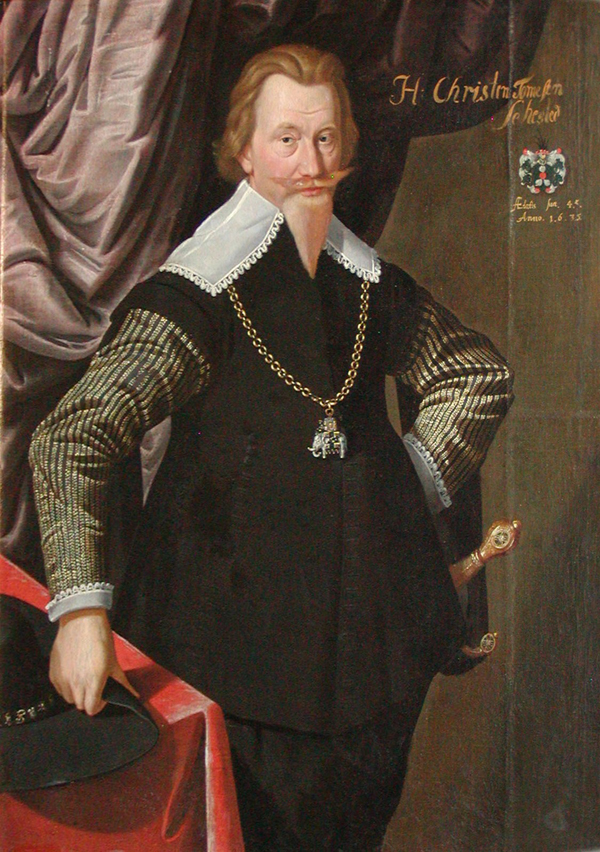
Morians also became popular in decorative arts. The oldest porcelain figurine of a Morian preserved in the Rosenborg Palace catalogue is dated to 1610. With the arrival of Sophie Amalie von Brandenburg, wife of Frederik III, to the court in the mid-seventeenth century the prestigious porcelain factory in Dresden becomes the main supplier of porcelain figurines of Morians. These pieces of porcelain, which become part of the circuit of gifts exchanged between the nobility, are accompanied by other stylized objects incorporating Morians. The figure of a Morian is also incorporated in the imagery and symbolism of the royal Order of the Elephant (Elefantordenen). The much debated pendant features a black man sitting at the head of an elephant (Figure 3).Footnote 83 The origin of elephant figure is not clear but it is likely that it was inspired by the Danish colonial project in Asia.Footnote 84
Chancellor Christen Thomesen Sehested with the Order of the Elephant, oil on canvas painted by Johan Timm in 1635. National History Museum at Frederiksborg Castle (inv. nr. A7773). Reproduced with permission from the museum.

Morians and the Ideology of Slavery in Seventeenth-Century Denmark
Slavery was a product of the times, but there was no discussion of slavery in Denmark at the beginning of the colonial enterprise that could parallel discussions on Native American freedom in Mexico and Peru conducted by Spanish intellectuals a century before.Footnote 85 The Morians who arrived in Denmark represent the maximum expression of mercantilism: a luxury consumer product imported to satisfy the desires of the upper classes. What draws our attention to the Morians is their reduction to luxury objects obtained through a sale-purchase transaction. Labour conditions were also harsh for the commoners in the hierarchically organized Denmark, as exemplified by the vornedskab servitude, which bound the peasant to the owner of the land estates,Footnote 86 workhouses, and the use of forced labour at the shipyard of Bremerholm.Footnote 87
Current research admits that Danish literature from the first half of the seventeenth century generally lacked the necessary depth and insight to engage with an intercultural dialogue. However, the seventeenth-century Danes were well aware of ethnic and cultural differences. The term “ethnic” first appeared as an entry in the dictionary of Christiern Pedersen in 1550. It was then used in the sense of non-Christian by the theologian Niels Hemmingsen in his private collection of Protestant sermons Postilla (the original in Danish is from 1562, the English version is from 1570). In accordance with H. H. Skonning, K. Smeding, and J. Olofsson's Lutheran worldview, the negative living environment of the non-Christian—its coexistence with the devil—was nothing more than a reflection of the non-Christian ignorance and inability to find God. The Cosmography of Sebastian Münster (1544) was an antecedent of the moralising cosmography of Northern Europe. Human differences are described from the point of view of religion.
Skonning's Geographia moves the notion of homeland as the centre of the world to a religious plane. In the introductory chapter, Skonning transfers the Lutheran conception of human orders to his cosmography. He distinguishes between a first Christian circle, characterized by the belief in “den sande kundskab om den levende Gud” (the true message of the living God), and a second outer circle, which is of plural composition. The second circle is composed of not only non-Christians—Jews, Turks (Muslims and Muscovites), and “pagans,” but also of believers in the Virgin, that is, Catholics. He acknowledges the universal legitimacy to seek eternal life, but argues that the inhabitants of the second circle moved astray from this goal by worshipping false gods. He assumes that the erroneous beliefs of the pagans were due to their ignorance, agreeing on this point with the idea of universal principles proposed by another roughly contemporary Danish thinker, Niels Hemmingsen.Footnote 88 In De lege naturae (1562) Hemmingsen argued that God has planted his seed in all human beings and only ignorance prevents the heathen from finding the spark of God in his soul.Footnote 89
The reference to the ignorance of pagans is important in the context of the ideology of slavery. Whenever the subject of slavery appeared in Geographia it was seen as a consequence of ignorance. It is interesting to observe how Skonning operates with the language of a religious conception of human life when he calls the inhabitants of the second circle “unilluminated peoples.”Footnote 90 For Skonning and Hemmingsen the religious culture is a corollary of difference created by the deviation of sinners, such as “Turks and ethnics.”Footnote 91 Those who are outside the Christian circle seek on their own the kingdom of heaven but miss their way because they fail to conform to the rules of civilised society. Failure to obey is the cause of their illnesses—degeneration that makes them into slaves of flesh and blood. In Lutheranism, obedience was key to the development of social virtues. In Der große Katechismus (Luther's Large Catechism, 1529), Luther develops a map of social orders that organize Christian personal relationships: Hausregiment (the house), Weltregiment (the state), and Geislichtregiment (the church and school), and whose respective authorities (parents, the government, priests and teachers) the Christian has an obligation to serve, honour, and obey. Skonning did not intend to theorize about slavery, but he engaged with the subject nonetheless by reproducing Lutheran ideas of human differences and morality based on the recognition of God and obedience.
In theory and practice, the attitude of the Danish upper classes towards the Morians oscillated between paternalism of the officialsFootnote 92 and curiosity of the illustrious man.Footnote 93 The case of the two Tamils, Cathi and Mari, brought to Copenhagen by Giedde is a good example of this attitude. They were baptized and entrusted to the school teacher Anders Christensen and the Rector of the Church of Our Lady. The religious expectations and ideas about ignorance and obedience shaped this cultural encounter and social experiment. Ultimately the effort of turning Cathi and Mari into proper Protestant subjects failed. We are told that the baptized Morians did not feel well in Denmark, because they could not take root in the country. The same happened to the Greenlanders brought by the 1605–1607 polar expedition commissioned by Christian IV.Footnote 94 In 1628, six years after Cathi and Mari arrived in Copenhagen, the church requested the withdrawal of its care of the two Morians. In the clothes, the tasks, and the upper class social environment there is violence and sovereign power over the Morian, and I hope that new sources and perspectives will allow researchers to start considering the Morians' awareness of themselves.Footnote 95
Conclusion
The streets of the residential neighbourhood of Nyboder in Copenhagen, built in 1631 on the initiative of Christian IV for the sailors of the royal fleet, have names that suggest the realities of the time: Elefantgade (Elephant Street), Kamelgade (Camel Street), and Nellikegade (Clove Street). In this social environment, Morians were another luxury commodity, as valuable as pepper, indigo, cotton, coffee, and tea imported to the metropolis by the trading companies. The Morians became prestigious and valuable gifts first brought from Asia via the trading post in Tranquebar to be sold, gifted, and exchanged between the upper classes, a fashion that ran parallel to the colonial enterprise of the seventeenth and the following centuries. That the destination of this trade was Copenhagen and not Amsterdam or London implies that the origins of the Danish slave trade should be moved in time and space to the Tranquebar of the first half of the seventeenth century.
Nordic historical thought about racial differences predates the entry into the triangular slave trade in 1660. The first half of the seventeenth century was a seminal period for developing the ideology of slavery in Denmark. Skonning's Geographia distilled Lutheran ideological representations and constructed qualitative differences based on faith and obedience, and considered the supposed innate ignorance of the natives as a condition of enslavement.
Besides the narrative of slavery, the consulted material on Tranquebar speaks about the colonial encounter between people with disparate cultural backgrounds and expectations.Footnote 96 Servitude was a European as well as an Asian tradition. Already in the seventeenth century, Tamil workers were employed by Danish colonial administration and ruling classes, while others were subjected to mistreatment as enslaved people. We can identify a continuity in attitudes that justified the cultural encounter in pragmatic terms. Take for example female servant Christiane Amalie: On 12 October 1697, a Black woman, Morinde Christiane Amalie “who has served Her Majesty the Queen … got a salary to return home to India, is conceded by grace 100 r.” Footnote 97
Acknowledgements
I would like to thank Esther Fihl.