Introduction
Borderline personality disorder (BPD) is a serious mental illness characterized by behavioural and emotional dysregulation, marked impairment in psychosocial functioning and high risk of mortality (Black et al. Reference Black, Blum, Pfohl and Hale2004; Leichsenring et al. Reference Leichsenring, Leibing, Kruse, New and Leweke2011). BPD is associated with a range of long-term negative sequelae, including relationship dysfunction (Daley et al. Reference Daley, Burge and Hammen2000), unemployment (Skodol et al. Reference Skodol, Gunderson, McGlashan, Dyck, Stout, Bender, Grilo, Shea, Zanarini and Morey2002), high levels of treatment utilization (Bender et al. Reference Bender, Dolan, Skodol, Sanislow, Dyck, McGlashan, Shea, Zanarini, Oldham and Gunderson2001) and imprisonment (Black et al. Reference Black, Gunter, Allen, Blum, Arndt, Wenman and Sieleni2007). Consequently, BPD can have a devastating impact on individuals, their families, and health and social services.
BPD diagnosis in childhood and adolescence (i.e. prior to the age of 19 years) remains controversial (Chanen & McCutcheon, Reference Chanen and McCutcheon2008; Miller et al. Reference Miller, Muehlenkamp and Jacobson2008). Recent reports indicate that clinicians are reluctant to diagnose BPD in younger individuals (Griffiths, Reference Griffiths2011; Laurenssen et al. Reference Laurenssen, Hutsebaut, Feenstra, Van Busschbach and Luyten2013). Nevertheless, BPD is unlikely to appear de novo in early adulthood, but may be considered as the continuation of precursor symptoms that first emerge during childhood or early adolescence (Crowell et al. Reference Crowell, Beauchaine and Linehan2009; Winsper et al. Reference Winsper, Zanarini and Wolke2012). Importantly, the early identification of BPD symptoms may help shed light on aetiological processes (Crowell et al. Reference Crowell, Beauchaine and Linehan2009), inform early intervention programmes (Chanen et al. Reference Chanen, Jovev, McCutcheon, Jackson and McGorry2008b ) and ensure that young people with personality pathology receive appropriate treatment (Paris, Reference Paris2013).
Predictive validity reflects the degree to which BPD in childhood or adolescence transitions into adult BPD, and is prognostic of future impairment (Van Os et al. Reference Van Os, Linscott, Myin-Germeys, Delespaul and Krabbendam2009). Ascertaining the predictive validity of BPD by considering both diagnostic and psychosocial outcomes is important in view of concerns regarding the lack of diagnostic stability during this developmental phase (Meijer et al. Reference Meijer, Goedhart and Treffers1998). Furthermore, identifying influences on the stability of BPD across early development may help highlight important risk and protective factors, deepening our understanding of the continuity and discontinuity of BPD trajectories across the lifespan.
Previous narrative reviews have examined aspects of the predictive validity of adolescent BPD as part of a broader evaluation of the construct. Bondurant et al. (Reference Bondurant, Greenfield and Tse2004) reported that the diagnostic stability of adolescent BPD was relatively low, though very few studies were identified (Bernstein et al. Reference Bernstein, Cohen, Velez, Schwab-Stone, Siever and Shinsato1993; Garnet et al. Reference Garnet, Levy, Mattanah, Edell and McGlashan1994; Mattanah et al. Reference Mattanah, Becker, Levy, Edell and McGlashan1995). Miller et al. (Reference Miller, Muehlenkamp and Jacobson2008) reported low to moderate diagnostic and dimensional stability, though again only a limited number of studies were available (Bernstein et al. Reference Bernstein, Cohen, Velez, Schwab-Stone, Siever and Shinsato1993; Garnet et al. Reference Garnet, Levy, Mattanah, Edell and McGlashan1994; Meijer et al. Reference Meijer, Goedhart and Treffers1998; Grilo et al. Reference Grilo, Becker, Edell and McGlashan2001; Chanen et al. Reference Chanen, Jackson, McGorry, Allot, Clarkson and Yuen2004). Chanen et al. (Reference Chanen, Jovev, McCutcheon, Jackson and McGorry2008b ) considered BPD in youth (i.e. aged 15–24 years) and reported that mean-level BPD traits were moderately stable, though the authors highlighted the lack of BPD specific data. They also presented evidence from a small number of studies indicating that young people with BPD may experience poorer outcomes (i.e. increased risk of Axis I disorders, social impairment).
Since these reviews, a number of empirical studies have been published. As far as we are aware, however, there are no extant reviews examining this topic using systematic review procedures. Due to the contentious nature of BPD diagnosis in younger individuals, systematic reviews are now required to provide rigorous evidence to inform clinical policy and practice (Hammersley, Reference Hammersley2001). The main aim of the current review was to examine the predictive validity of BPD in childhood and adolescence. There were four research questions:
-
(1) Is BPD diagnosis stable in this age group?
-
(2) Do BPD symptoms demonstrate mean-level stability in this age group (i.e. do individual BPD scores remain stable over time)?
-
(3) Do BPD symptoms demonstrate rank-order stability in this age group (i.e. do individuals retain their relative placement in the group)?
-
(4) Does BPD pathology in this age group predict subsequent problems in diverse spheres of functioning?
Method
Prior to formulating the protocol, C.W. and J.E. conducted a pilot search to ensure that a systematic review in the area had not been published (Sayers, Reference Sayers2007). We used PRISMA (Preferred Reporting Items for Systematic Reviews and Meta-Analyses) guidelines (Moher et al. Reference Moher, Liberati, Tetzlaff and Altman2009) as a framework for the review.
Search strategy
We searched MEDLINE, EMBASE, Psych INFO and PubMed databases to identify studies reporting on BPD in children and adolescents published between 1980 and January 2014. We chose 1980 as the earliest date for inclusion to parallel when BPD was first conceptualized in the Diagnostic and Statistical Manual (APA, 1980). The search terms (borderline* OR ‘emotionally unstable personality disorder’ OR BPD) AND (adolescen* OR child* OR young* OR youth* OR teen* OR student*) were entered. Reference lists of included studies were inspected for relevant titles. We also examined reference lists of relevant narrative reviews as a cross-check (Bondurant et al. Reference Bondurant, Greenfield and Tse2004; Chanen & McCutcheon, Reference Chanen and McCutcheon2008; Miller et al. Reference Miller, Muehlenkamp and Jacobson2008).
Inclusion and exclusion criteria
Inclusion criteria were:
-
(1) Primary research published in a peer-reviewed journal;
-
(2) Participants were under 19 years of age at index assessment. If all participants were at the extreme end of the age range, i.e. 18 years old, the study was excluded. Studies encompassing an age range predominantly comprising under-18-year-olds were included, e.g. 9–19 years (19 years was the maximum);
-
(3) The study was published in English;
-
(4) There was information on clinical or psychosocial outcomes;
-
(5) Studies with any assessment of BPD were included (we placed no restrictions regarding the methods used to diagnose BPD as we anticipated a paucity of available studies).
Studies were excluded if:
-
(1) BPD was not the exclusive focus of the study (e.g. associations pertained to all cluster B personality disorders);
-
(2) The sample was primarily defined in terms of another psychopathology (e.g. all participants were self-harmers, only some of whom had BPD);
-
(3) They were treatment trials.
Screening procedure
If a title appeared potentially eligible but no abstract was available, the full-text article was retrieved. C.W. and S.T.L. independently scanned 100% of the abstracts to identify articles for full-text retrieval. Full-text articles were read by C.W. to assess for inclusion in the review. S.M. independently reviewed 50% of the full-text articles for inclusion as a reliability check.
Data collection and quality assessment
A data extraction form was developed prior to review. It included author details, country of study, sample characteristics, study design, BPD assessment tool, and information on outcomes. It also included a quality assessment tool based on Cochrane Collaboration guidelines (Higgins & Altman, Reference Higgins, Altman, Higgins and Green2008). This tool is designed to rate the risk of bias (i.e. systematic error) in each study. We assessed: the quality domains of selection bias (selection of sample, blinding of index assessment); performance bias (events during the study potentially impacting on predictive validity); attrition bias; detection bias (blinding of outcome assessments); and reporting bias (indication of selective reporting).
Data synthesis
Data were not suitable for quantitative synthesis, and thus are qualitatively synthesized within the review.
Results
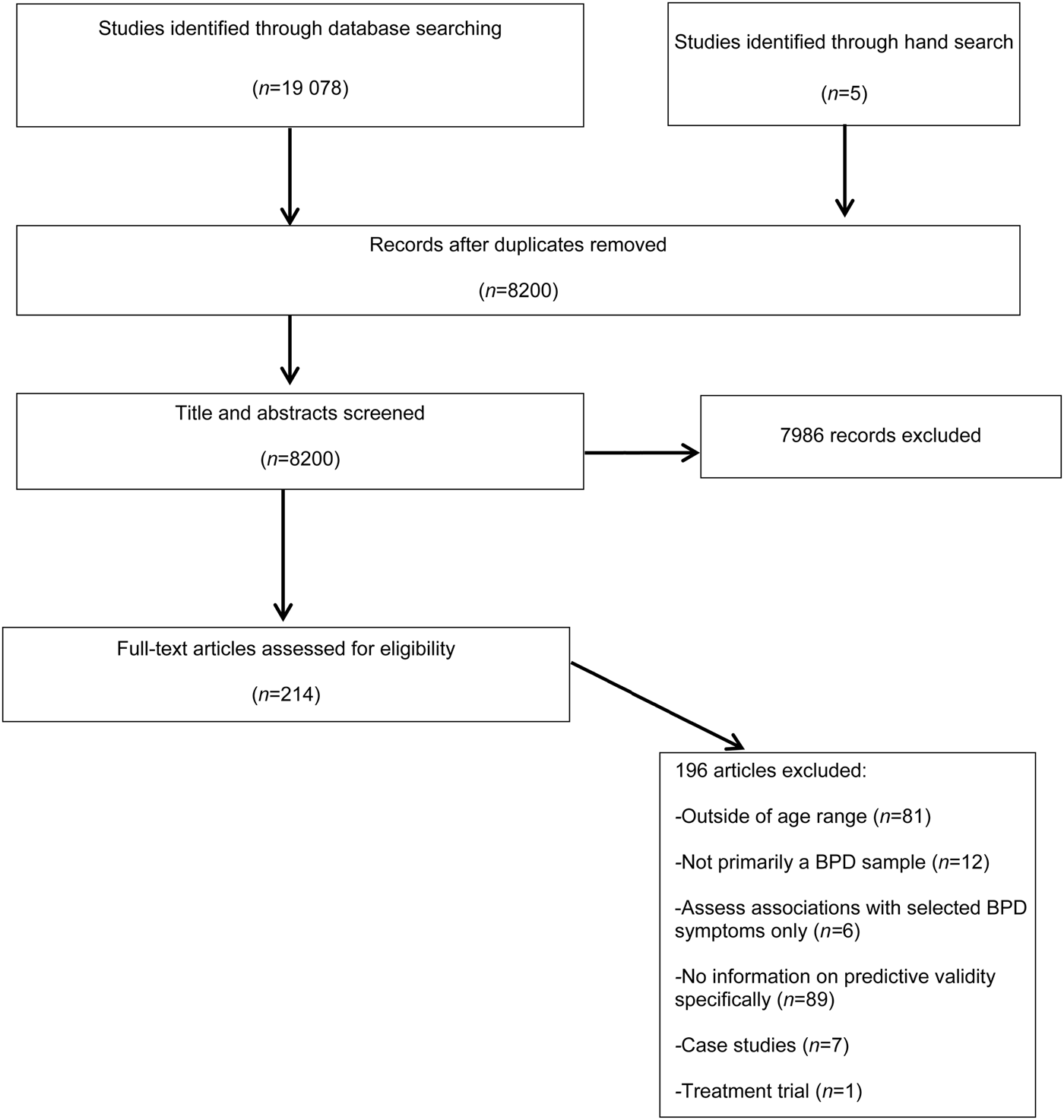
Of the 8200 (database search = 8195; hand search = 5) abstracts scanned, 214 were selected for full-text retrieval. There was a high level of agreement between raters on articles to be selected for full-text retrieval (>80%). The authors met to discuss discrepancies, which were largely due to uncertainty regarding sample characteristics or age. If there was doubt over whether an abstract should be included for full-text retrieval, the decision was made to include. Of the 214 full-text articles, 18 were identified providing outcome data (Fig. 1). The 50% reliability check indicated a high level of agreement between raters on articles to be included in the review (>80%). The most common reasons for exclusion were: the sample was over 18 years of age; BPD was conflated with another mental disorder; there were no data on clinical or psychosocial outcomes. Studies comprised a mix of clinical and non-clinical populations, and ranged in duration from 1 to 20 years (Table 1).
Flowchart outlining the search and selection strategy. BPD, Borderline personality disorder.

Details of studies reporting on clinical and psychosocial outcomes of BPD in childhood and adolescence

BPD, Borderline personality disorder; n.a., not applicable; MZ, monozygotic; DZ, dizygotic; IPDE-BOR, International Personality Disorders Examination, Borderline Scale.
a ‘Borderline’ diagnosis includes sections on: fluctuation in functioning; anxiety; thought content and processes; relationships with others; lack of control; associated symptoms.
b ‘Borderline’ diagnosis includes sections on: disturbed interpersonal relationships; disturbed sense of reality; excessive intense anxiety; excessive and severe impulsive behaviour; neurotic-like symptoms; uneven distorted development.
Quality assessment
Quality assessment indicated that most studies had a high risk of bias (systematic error) in one or more domains, i.e. selection, performance, attrition, detection or reporting (Table 2). This suggests that aspects of the study design could have led to an under- or overestimation of effects, rather than implying that the studies are of low quality (for further explanation, see Discussion). In general, clinical studies had a high risk of bias in more domains than non-clinical studies. All but four studies (Bernstein et al. Reference Bernstein, Cohen, Velez, Schwab-Stone, Siever and Shinsato1993; Chen et al. Reference Chen, Cohen, Johnson, Kasen, Sneed and Crawford2004; Cohen et al. Reference Cohen, Chen, Crawford, Brook and Gordon2007; Winograd et al. Reference Winograd, Cohen and Chen2008) were of high risk in sample selection bias. Three studies were of high risk in baseline assessment bias (Meijer et al. Reference Meijer, Goedhart and Treffers1998; Biskin et al. Reference Biskin, Paris, Renaud, Raz and Zelkowitz2011; Stepp et al. Reference Stepp, Whalen, Scott, Zalewski, Loeber and Hipwell2014). Nine studies (Wenning, Reference Wenning1990; Lofgren et al. Reference Lofgren, Bemporad, King, Lindem and O'Driscoll1991; Garnet et al. Reference Garnet, Levy, Mattanah, Edell and McGlashan1994; Mattanah et al. Reference Mattanah, Becker, Levy, Edell and McGlashan1995; Meijer et al. Reference Meijer, Goedhart and Treffers1998; Grilo et al. Reference Grilo, Becker, Edell and McGlashan2001; Chanen et al. Reference Chanen, Jackson, McGorry, Allot, Clarkson and Yuen2004; Zelkowitz et al. Reference Zelkowitz, Paris, Guzder, Feldman, Roy and Rosval2007; Biskin et al. Reference Biskin, Paris, Renaud, Raz and Zelkowitz2011) were of high risk in performance bias. All studies excepting Bernstein et al. (Reference Bernstein, Cohen, Velez, Schwab-Stone, Siever and Shinsato1993) and Chanen et al. (Reference Chanen, Jackson, McGorry, Allot, Clarkson and Yuen2004) were of high risk in attrition bias. Two studies were of high risk (Wenning, Reference Wenning1990; Biskin et al. Reference Biskin, Paris, Renaud, Raz and Zelkowitz2011) and seven unclear risk (Crick et al. Reference Crick, Murray-Close and Woods2005; Cohen et al. Reference Cohen, Chen, Crawford, Brook and Gordon2007; Winograd et al. Reference Winograd, Cohen and Chen2008; Bornovalova et al. Reference Bornovalova, Hicks, Iacono and McGue2009, Reference Bornovalova, Hicks, Iacono and McGue2013; Jovev et al. Reference Jovev, Whittle, Yücel, Simmons, Allen and Chanen2014; Stepp et al. Reference Stepp, Whalen, Scott, Zalewski, Loeber and Hipwell2014) in detection bias. One study was of high risk in reporting bias (Wenning, Reference Wenning1990).
Quality assessment of studies included in the review

BPD, Borderline personality disorder.
The stability of BPD in childhood and adolescence
Diagnostic stability
Ten studies examined the diagnostic stability of BPD. Eight utilized clinical (Wenning, Reference Wenning1990; Lofgren et al. Reference Lofgren, Bemporad, King, Lindem and O'Driscoll1991; Garnet et al. Reference Garnet, Levy, Mattanah, Edell and McGlashan1994; Mattanah et al. Reference Mattanah, Becker, Levy, Edell and McGlashan1995; Meijer et al. Reference Meijer, Goedhart and Treffers1998; Chanen et al. Reference Chanen, Jackson, McGorry, Allot, Clarkson and Yuen2004; Zelkowitz et al. Reference Zelkowitz, Paris, Guzder, Feldman, Roy and Rosval2007; Biskin et al. Reference Biskin, Paris, Renaud, Raz and Zelkowitz2011) and two non-clinical populations (Bernstein et al. Reference Bernstein, Cohen, Velez, Schwab-Stone, Siever and Shinsato1993; Winograd et al. Reference Winograd, Cohen and Chen2008). Overall, the diagnostic stability across studies (from 2 to 20 years) ranged from 14 to 40%.
Clinical populations
Wenning (Reference Wenning1990) followed up children retrospectively diagnosed with borderline personality over a 10-year period. Of the original 57 children, 28 (20 ‘angry–impulsive’, eight ‘borderline psychotic’) were identified for follow-up assessment. At follow-up 90% of children with ‘angry–impulsive’ borderline disorder, and 75% with ‘borderline psychotic’ disorder received a personality disorder diagnosis. Of the ‘angry–impulsive’ types, the most common (75%) diagnosis was BPD and/or antisocial personality disorder (ASPD).
Over a period of 10–20 years, Lofgren et al. (Reference Lofgren, Bemporad, King, Lindem and O'Driscoll1991) followed-up 6- to 10-year-olds diagnosed as ‘borderline’ according to criteria (see Table 1) defined by Bemporad et al. (Reference Bemporad, Smith, Hanson and Cicchetti1982). Of an original 32, 19 were located in adolescence or adulthood for repeat assessment. Of these, three were diagnosed with BPD (16%) and 16 (84%) received an Axis II personality disorder diagnosis. Of note, many of the diagnosed personality disorders were male-typical (e.g. antisocial, schizoid), probably reflecting the male bias in the sample.
Two studies from the same research group examined the stability of BPD diagnosis in adolescent in-patients from the Yale Psychiatric Institute (Garnet et al. Reference Garnet, Levy, Mattanah, Edell and McGlashan1994; Mattanah et al. Reference Mattanah, Becker, Levy, Edell and McGlashan1995). In the first, 33% of patients with BPD at index assessment met diagnostic criteria for BPD 2 years later (Garnet et al. Reference Garnet, Levy, Mattanah, Edell and McGlashan1994). In the second, 23% of individuals with BPD at baseline met diagnostic criteria 2 years later (Mattanah et al. Reference Mattanah, Becker, Levy, Edell and McGlashan1995). In another hospital study, 14% of adolescents diagnosed with BPD at baseline retained the diagnosis 3 years later (Meijer et al. Reference Meijer, Goedhart and Treffers1998). A number of the adolescents diagnosed with BPD at index hospitalization, while no longer carrying a BPD diagnosis, continued to demonstrate subclinical levels of disturbance.
Chanen et al. (Reference Chanen, Jackson, McGorry, Allot, Clarkson and Yuen2004) found that BPD diagnosis remained stable in 40% of adolescent out-patients diagnosed 2 years previously. The stability of global personality disorder (i.e. any personality disorder diagnosis) was 74%.
Zelkowitz et al. (Reference Zelkowitz, Paris, Guzder, Feldman, Roy and Rosval2007) followed 59 adolescents who had received psychiatric day treatment in childhood. Of the children diagnosed with borderline pathology, 14% retained the diagnosis 5 years later. Significant group differences between borderline and non-borderline children were maintained on the interpersonal and cognitive domains of the Diagnostic Interview for Borderlines. Finally, Biskin et al. (Reference Biskin, Paris, Renaud, Raz and Zelkowitz2011) assessed outcomes of adolescent females who had been referred to a treatment programme for BPD. Of the young women who were diagnosed in adolescence, 35% retained the diagnosis 4 years later.
Non-clinical populations
In the first of two studies with the Children in the Community cohort, Bernstein et al. (Reference Bernstein, Cohen, Velez, Schwab-Stone, Siever and Shinsato1993) reported that 29% of adolescents with ‘moderate’ (dichotomized 1 s.d. above the mean) and 24% of adolescents with ‘severe’ (dichotomized 2 s.d.s above the mean) BPD symptoms retained the diagnosis after 2 years. In the second study, Winograd et al. (Reference Winograd, Cohen and Chen2008) reported that extreme BPD symptoms (2 s.d.s above the mean) in adolescence were associated with nine-fold increased risk of BPD 20 years later.
Mean-level stability
Seven studies examined mean-level stability of BPD symptoms. Two utilized clinical (Grilo et al. Reference Grilo, Becker, Edell and McGlashan2001; Chanen et al. Reference Chanen, Jackson, McGorry, Allot, Clarkson and Yuen2004) and five non-clinical populations (Crick et al. Reference Crick, Murray-Close and Woods2005; Winograd et al. Reference Winograd, Cohen and Chen2008; Bornovalova et al. Reference Bornovalova, Hicks, Iacono and McGue2009; Jovev et al. Reference Jovev, Whittle, Yücel, Simmons, Allen and Chanen2014; Stepp et al. Reference Stepp, Whalen, Scott, Zalewski, Loeber and Hipwell2014). Mean-level stability ranged from 0.16 to 0.59 over durations of 1–20 years.
Clinical populations
Chanen et al. (Reference Chanen, Jackson, McGorry, Allot, Clarkson and Yuen2004) reported a mean-level stability of intraclass correlation (ICC) = 0.54 in adolescent out-patients. It was indicated by t tests that BPD symptoms did not significantly decrease over time (p = 0.115). Grilo et al. (Reference Grilo, Becker, Edell and McGlashan2001) found that mean-level stability of BPD symptoms in adolescent in-patients was ICC = 0.16. It was indicated by t tests that BPD symptom scores significantly decreased over time (t = 2.23, p < 0.05).
Non-clinical populations
Crick et al. (Reference Crick, Murray-Close and Woods2005) assessed the stability of BPD symptoms over 1 year (autumn year 1; spring year 2; autumn year 2) in a sample of schoolchildren. Correlations between the three time-points ranged from 0.47 to 0.56. In another study with schoolchildren, Jovev et al. (Reference Jovev, Whittle, Yücel, Simmons, Allen and Chanen2014) found that mean BPD symptoms significantly decreased over 2 years (time 1: mean = 1.67; time 2: mean = 1.30). Low effortful control (i.e. poor self-regulation), however, significantly predicted an increase in BPD symptoms (β = −0.18, t = −2.32, p = 0.002).
Stepp et al. (Reference Stepp, Whalen, Scott, Zalewski, Loeber and Hipwell2014) examined the stability of BPD symptoms in a community sample of girls across four time-points (14, 15, 16 and 17 years). All correlations were significant (p < 0.05) and were higher between shorter durations: 14–15 years (r = 0.55); 15–16 years (r = 0.59); 16–17 years (r = 0.58); 14–16 years (r = 0.48); 15–17 years (r = 0.52); and 14–17 years (r = 0.42).
In a long-term community study, Winograd et al. (Reference Winograd, Cohen and Chen2008) found that BPD symptoms at 13.7 and 33.2 years were correlated (r = 0.39). The stability of BPD symptoms from mid to early adolescence was r = 0.516. BPD symptoms declined on average by β = −0.032 (s.e. = 0.002) per year, equating to approximately two-thirds of a standard deviation over the 20-year period. In another long-term study, Bornovalova et al. (Reference Bornovalova, Hicks, Iacono and McGue2009) examined mean-level stability of BPD symptoms in a large sample of female twins over multiple assessment points (14, 17, 20 and 24 years). A decline in mean-level BPD traits was observed over the 10-year period from mid adolescence to early adulthood. There was no meaningful change from 14 years (mean = 41.26) to 17 years (mean = 40.86) of age; a moderate change from 14 to 20 years (mean = 37.2) of age; and a large change from 14 to 24 years (mean = 35.19) of age.
Rank-order stability
Two studies assessed the rank-order stability of BPD symptoms (Chanen et al. Reference Chanen, Jackson, McGorry, Allot, Clarkson and Yuen2004; Bornovalova et al. Reference Bornovalova, Hicks, Iacono and McGue2009). Chanen et al. (Reference Chanen, Jackson, McGorry, Allot, Clarkson and Yuen2004) reported a rank-order stability of 0.54. Bornovalova et al. (Reference Bornovalova, Hicks, Iacono and McGue2009) reported rank-order stability ranging from 0.53 to 0.73 across four time-points.
Other clinical and psychosocial outcomes of BPD in childhood and adolescence
Education and employment
Clinical populations
During follow-up, Lofgren et al. (Reference Lofgren, Bemporad, King, Lindem and O'Driscoll1991) found that none of the adolescents/adults previously diagnosed as borderline in childhood was self-supporting or living independently. Only 26% were attending school or working (mostly in unskilled or semi-skilled labour). Zelkowitz et al. (Reference Zelkowitz, Paris, Guzder, Feldman, Roy and Rosval2007) found that adolescents previously diagnosed with borderline pathology in childhood were significantly more likely than non-borderline psychiatric controls to have changed schools due to behaviour problems. Biskin et al. (Reference Biskin, Paris, Renaud, Raz and Zelkowitz2011) reported that women previously diagnosed with BPD in adolescence were less likely to be employed (42%) than psychiatric controls (63%). Of note, those who had remitted (20/31) were only slightly more likely to be in employment than those still carrying the BPD diagnosis (45% v. 36%).
Non-clinical populations
Winograd et al. (Reference Winograd, Cohen and Chen2008) found that educational attainment reported at 33 years of age was negatively associated with BPD symptoms in adolescence (β = −0.522; s.e. = 0.074, p < 0.01). Similarly, BPD symptoms in adolescence negatively predicted occupational (ranging from unskilled labour to full professional status) level (β = −0.818, s.e. = 0.176, p < 0.01). Findings remained significant following adjustment for Axis I disorders during early adolescence.
BPD symptoms in early adolescence also significantly predicted reliance on public assistance [odds ratio (OR) 2.90, 95% confidence interval (CI) 1.37–6.16], though the association became non-significant following adjustment for Axis I disorders in adolescence (OR 1.99, 95% CI 0.85–4.69).
Social functioning
Clinical populations
Lofgren et al. (Reference Lofgren, Bemporad, King, Lindem and O'Driscoll1991) found that children diagnosed with borderline pathology had very poor levels of social functioning in adolescence/adulthood. Just one out of 19 subjects had married over the 20-year period. Only 26% reported satisfying relationships with their families, and even fewer (16%), with peers. Of the subjects, 47% described a complete absence of friendships or social life, while 37% reported ‘only highly tumultuous relationships’. Zelkowitz et al. (Reference Zelkowitz, Paris, Guzder, Feldman, Roy and Rosval2007) reported that borderline diagnosis 5–7 years previously significantly increased odds of peer problems in adolescence (χ2 = 7.25, p < 0.01). In contrast, Biskin et al. (Reference Biskin, Paris, Renaud, Raz and Zelkowitz2011) did not find a significant group difference on the Social Adjustment Scale Self Report between those formally diagnosed with BPD versus those formerly diagnosed with disruptive behaviour disorder.
Community studies
Chen et al. (Reference Chen, Cohen, Johnson, Kasen, Sneed and Crawford2004) investigated the association between adolescent BPD and subsequent partner conflict during the transition into adulthood. Narrative descriptions of partner conflict over the previous 10 years were gathered in mid-adulthood. Multilevel growth models indicated that BPD symptoms in adolescence were independently (after controlling for Axis I disorders and other personality disorders) associated with sustained elevations in partner conflict over the 10-year period. Winograd et al. (Reference Winograd, Cohen and Chen2008) demonstrated that BPD symptoms in mid-adolescence were associated with lower levels of perceived social support over the subsequent 20 years (β = −0.162, s.e. = 0.026), and this association remained unaltered following adjustment for Axis I disorders. While BPD symptoms in mid-adolescence were also associated with poorer relationship quality, the association did not quite reach statistical significance (β = −0.059, s.e. = 0.033, p = 0.075).
Psychiatric disorders
Clinical populations
Wenning (Reference Wenning1990) found that approximately two-thirds of the children who met criteria for BPD at age 8 years had affective conditions at 16–18 years of age. Over half were diagnosed with chronic affective conditions (e.g. cyclothymia, dysthymia), and almost half had experienced recurrent major depression during their post-discharge years. Over one-third had experienced episodes of generalized anxiety disorder, which commonly co-existed or overlapped with depressive episodes. Lofgren et al. (Reference Lofgren, Bemporad, King, Lindem and O'Driscoll1991) reported that 31.6% of borderline children reassessed 10–20 years later were substance abusers. Zelkowitz et al. (Reference Zelkowitz, Paris, Guzder, Feldman, Roy and Rosval2007) found that adolescents with borderline pathology in childhood had significantly higher scores on several indices of the Child Behavior Checklist including the withdrawn (64 v. 55.8, p < 0.05), anxious/depressed (63.5 v. 57.3, p < 0.05), thought problems (64.3 v. 58.6, p < 0.05), internalizing (63 v. 53.8, p < 0.05) and aggression (65.2 v. 59, p < 0.05) subscales.
Non-clinical populations
Cohen et al. (Reference Cohen, Chen, Crawford, Brook and Gordon2007) reported that BPD in adolescence was associated with a six-fold increased risk of substance use disorder 9 years later (OR 6.19, 95% CI 1.10–34.92).
Service utilization
Clinical samples
Biskin et al. (Reference Biskin, Paris, Renaud, Raz and Zelkowitz2011) found that 20-year-olds who had received a BPD diagnosis at age 15 years were more likely to be in current treatment than clinical controls previously diagnosed with disruptive behaviour disorders (BPD = 42%, non-BPD = 19%). Women with persistent BPD (i.e. diagnosis at both 15 and 20 years) were especially likely to be in current treatment (73%, p < 0.01). Similarly, Zelkowitz et al. (Reference Zelkowitz, Paris, Guzder, Feldman, Roy and Rosval2007) found that adolescents who had been diagnosed with childhood borderline pathology were more likely to have received psychiatric treatment since discharge in comparison with the clinical control group, though this difference did not reach statistical significance (59% v. 48%).
Non-clinical samples
Winograd et al. (Reference Winograd, Cohen and Chen2008) reported an association between BPD symptoms in adolescence and mental health service utilization in adulthood, though this association did not quite reach statistical significance (OR 1.44, 95% CI 0.98–2.11, p = 0.059).
Life satisfaction
Winograd et al. (Reference Winograd, Cohen and Chen2008) found that early adolescent borderline symptoms predicted lower life satisfaction across two decades (β = −0.181, s.e. = 0.026). The association remained after controlling for Axis I disorders in adolescence.
Discussion
As far as we are aware this is the first systematic review assessing short- and long-term (1–20 years) outcomes of BPD in childhood and adolescence. We investigated the predictive validity of BPD by examining multi-dimensional outcomes of the syndrome. Below we evaluate the findings regarding the stability, and clinical and psychosocial outcomes of BPD in childhood and adolescence.
Studies reporting on diagnostic stability
Before summarizing findings and contextualizing within the adult literature, a consideration of methodological limitations and potential impact on stability estimates is warranted.
First, very high rates of attrition were incurred in most studies (Table 2). Attrition analysis has indicated that retention difficulty may be related to personality pathology at follow-up (Allott et al. Reference Allott, Chanen and Yuen2006); thus those most likely to be diagnosed may be lost from the study prior to re-assessment. It is notable that the study with the lowest rate of attrition reported the highest level of diagnostic stability (Chanen et al. Reference Chanen, Jackson, McGorry, Allot, Clarkson and Yuen2004). Second (and related to attrition), large differences in follow-up period (i.e. 2–20 years) could have partly accounted for variations in diagnostic stability. Generally, shorter studies (e.g. Biskin et al. Reference Biskin, Paris, Renaud, Raz and Zelkowitz2011; Chanen et al. Reference Chanen, Jackson, McGorry, Allot, Clarkson and Yuen2004) yielded higher stability figures. Third, a number of studies were biased in their sampling, utilizing a heavy proportion of male patients (Lofgren et al. Reference Lofgren, Bemporad, King, Lindem and O'Driscoll1991; Zelkowitz et al. Reference Zelkowitz, Paris, Guzder, Feldman, Roy and Rosval2007). This contradicts the clinical picture in adulthood, in which there are typically a higher proportion of female patients (Skodol & Bender, Reference Skodol and Bender2003). Furthermore, gender may influence the trajectory of personality disorder development (Paris, Reference Paris1997). Of note, Lofgren et al. (Reference Lofgren, Bemporad, King, Lindem and O'Driscoll1991) recruited a predominately (74%) male sample, a large proportion of whom were diagnosed with male preponderance personality disorders at follow-up. Fourth, measurement error could lead to an underestimation of diagnostic stability. Moderate levels of inter-rater and test–retest reliability for categorical diagnosis have been reported (Chanen et al. Reference Chanen, Jackson, McGorry, Allot, Clarkson and Yuen2004). This problem may be compounded by the quality of assessment tools, and inconsistency in tools between baseline and follow-up (Lofgren et al. Reference Lofgren, Bemporad, King, Lindem and O'Driscoll1991). While some studies used semi-structured interviews, others relied on screening questionnaires or self-created measures rather than established tools (Bernstein et al. Reference Bernstein, Cohen, Velez, Schwab-Stone, Siever and Shinsato1993). Some studies (Wenning, Reference Wenning1990; Lofgren et al. Reference Lofgren, Bemporad, King, Lindem and O'Driscoll1991) used broad non-validated criteria for childhood borderline pathology at baseline potentially yielding associations with global personality disorders, rather than BPD specifically. Fifth, many studies recruited hospitalized adolescents (e.g. Meijer et al. Reference Meijer, Goedhart and Treffers1998) or out-patients receiving specific BPD treatments (Biskin et al. Reference Biskin, Paris, Renaud, Raz and Zelkowitz2011), which could have potentially reduced diagnostic stability. Finally, it has been noted that dichotomous (i.e. present/not present) classification of personality disorders may artificially widen the gap between those who are just above threshold and those at subclinical levels (i.e. 4/5 symptoms). Some patients demonstrated subclinical levels of BPD at follow-up, but were no longer diagnosed with BPD (Meijer et al. Reference Meijer, Goedhart and Treffers1998).
Accepting these limitations, studies with child and adolescent populations indicate, at best, moderate levels of diagnostic stability, ranging from 14 to 40%. These figures demonstrate considerable overlap with reported stability for adult BPD populations, ranging from 25 to 67% (Pope et al. Reference Pope, Jonas, Hudson, Cohen and Gunderson1983; Barasch et al. Reference Barasch, Frances, Hurt, Clarkin and Cohen1985; Kullgren et al. Reference Kullgren, Renberg and Jacobsson1986; Paris et al. Reference Paris, Brown and Nowlis1987). Rates of global personality disorder stability appear much higher, ranging from 74 to 86% (Wenning, Reference Wenning1990; Lofgren et al. Reference Lofgren, Bemporad, King, Lindem and O'Driscoll1991; Chanen et al. Reference Chanen, Jackson, McGorry, Allot, Clarkson and Yuen2004). This suggests that while lower-order individual differences may change, the broad construct of personality disorder may endure for the majority of individuals (Chanen et al. Reference Chanen, Jackson, McGorry, Allot, Clarkson and Yuen2004).
Studies reporting on mean-level and rank-order stability
Moderate to high levels (Cohen, Reference Cohen1988) of mean-level stability were observed across studies (correlations ranging from 0.39 to 0.59). These figures are comparable with those reported in both clinical (Ferro et al. Reference Ferro, Klein, Schwartz, Kasch and Leader1998) and community (Johnson et al. Reference Johnson, Williams, Goetz, Rabkin, Lipsitz and Remien1997; Lenzenweger, Reference Lenzenweger1999) adult studies. A low level of dimensional stability (ICC = 0.16) was reported in one study (Grilo et al. Reference Grilo, Becker, Edell and McGlashan2001). The authors suggest that this may have been due to an effective in-patient treatment programme, though it is perhaps more likely that the low levels of stability were attributable to very high levels of attrition in this study. Common to findings regarding individual personality dimensions (e.g. negative affect), studies suggest that BPD symptom levels may decrease with advancing age (Bernstein et al. Reference Bernstein, Cohen, Velez, Schwab-Stone, Siever and Shinsato1993; Grilo et al. Reference Grilo, Becker, Edell and McGlashan2001; Winograd et al. Reference Winograd, Cohen and Chen2008; Bornovalova et al. Reference Bornovalova, Hicks, Iacono and McGue2009; Jovev et al. Reference Jovev, Whittle, Yücel, Simmons, Allen and Chanen2014). This highlights mid to late adolescence as a relatively high-risk period for BPD (Stepp et al. Reference Stepp, Whalen, Scott, Zalewski, Loeber and Hipwell2014), and is congruent with previous research demonstrating that personality disorder traits peak in mid-adolescence then follow a linear decline through early to mid-adulthood (Johnson et al. Reference Johnson, Cohen, Kasen, Skodol, Hamagami and Brook2000). Rank-order associations demonstrated the highest levels of stability, ranging from 0.53 to 0.73. This is consistent with the normative personality literature, which indicates that mean-level traits change over time, while rank-order stability remains relatively stable (Roberts & DelVecchio, Reference Roberts and DelVecchio2000).
Studies reporting on other clinical and psychosocial outcomes of BPD
We also assessed the prognostic implications of borderline pathology in terms of long-term psychosocial functioning. It has been suggested by the World Health Organization that functional status may be a better indicator of healthcare needs than symptoms or diagnoses alone (Reed et al. Reference Reed, Lux, Bufka, Trask, Peterson, Stark, Threats, Jacobson and Hawley2005). Furthermore, studies indicate that even when individuals with BPD achieve remission, long-term functioning may continue to be suboptimal (Biskin et al. Reference Biskin, Paris, Renaud, Raz and Zelkowitz2011). Collectively the evidence suggests that BPD in childhood and adolescence is predictive of impairment in interpersonal, academic, occupational and financial domains, even when psychiatric co-morbidity is accounted for (Winograd et al. Reference Winograd, Cohen and Chen2008).
Limitations
Despite our comprehensive search, we identified relatively few studies pertaining to the predictive validity of BPD in childhood and adolescence. Furthermore, studies varied greatly in duration; thus there were insufficient data to provide a quantitative synthesis of the findings. Most of the identified studies were at high risk of bias across one or more domains, which could have led to an underestimation of stability estimates and degree of functional impairment. In particular, our quality assessment indicated that many studies were at high risk of performance and attrition bias. Attrition bias may be especially salient as reports suggest that personality disorder is associated with follow-up contact difficulty (Allott et al. Reference Allott, Chanen and Yuen2006). Considering the importance placed on the predictive validity of psychiatric disorders (Van Os et al. Reference Van Os, Linscott, Myin-Germeys, Delespaul and Krabbendam2009), our review highlights the need for more high-quality studies in this area. In particular, future studies should utilize validated assessment tools, conduct frequent and repeated assessment of BPD and concomitant psychopathologies, and examine a wide range of psychosocial outcomes, including risk exposures, e.g. bullying (Wolke et al. Reference Wolke, Schreier, Zanarini and Winsper2012).
Clinical and research implications
Congruent with the theory of homotypic (i.e. prediction of a disorder by the same disorder) and heterotypic (i.e. prediction of a disorder by a different disorder) continuity (Crowell et al. Reference Crowell, Beauchaine and Linehan2009), there are probably three groups of youngsters with borderline pathology. These are: those who maintain the diagnosis; those who remit (though they may relapse again); and those who demonstrate heterotypic continuity, i.e. they remain unwell but mental health problems evolve into a different diagnosis (Mattanah et al. Reference Mattanah, Becker, Levy, Edell and McGlashan1995). Indeed, we found that children and adolescents who had been diagnosed with borderline pathology were more likely to suffer from subsequent psychopathology including substance abuse problems (Lofgren et al. Reference Lofgren, Bemporad, King, Lindem and O'Driscoll1991; Cohen et al. Reference Cohen, Chen, Crawford, Brook and Gordon2007), affective disorders (Wenning, Reference Wenning1990; Zelkowitz et al. Reference Zelkowitz, Paris, Guzder, Feldman, Roy and Rosval2007) and a range of personality disorders (Wenning, Reference Wenning1990; Lofgren et al. Reference Lofgren, Bemporad, King, Lindem and O'Driscoll1991). An important area of future research will be a deeper understanding of the determinants of persistence of borderline psychopathology over time (Fossati et al. Reference Fossati, Gratz, Maffei and Borroni2013). As has been reported within the adult literature (Zanarini et al. Reference Zanarini, Frankenburg, Hennen, Reich and Silk2006), childhood sexual abuse (Biskin et al. Reference Biskin, Paris, Renaud, Raz and Zelkowitz2011) and temperament (Jovev et al. Reference Jovev, Whittle, Yücel, Simmons, Allen and Chanen2014) may predict the stability of BPD across childhood and adolescence. Expanding our understanding of both high-risk (e.g. temperamental predisposition) and protective (e.g. secure attachment) factors could inform future intervention and prevention programmes, promoting more adaptive pathways. Dimensional measures may be especially useful for this endeavour as they allow for the identification of subclinical levels of BPD, enabling early intervention for high-risk individuals who do not quite meet criteria for BPD diagnosis (Chanen et al. Reference Chanen, Jovev, McCutcheon, Jackson and McGorry2008b ).
Our findings of low to moderate stability of BPD diagnosis in childhood and adolescence are congruent with those reported in adult populations. The slightly lower figures probably reflect developmental stage. As has been observed in the context of conduct disorder and subsequent ASPD, not all children demonstrating conduct problems will manifest ASPD in adulthood (Moffitt & Caspi, Reference Moffitt and Caspi2001). Nevertheless, the importance of clinically recognizing conduct disorder in young people is accepted, and specific diagnostic tools are available (World Health Organization, 1992; APA, 2013). Equivalent tools for young people with BPD are not currently available (Chanen & Thompson, Reference Chanen and Thompson2014). Considering the high levels of long-term distress and functional impairment associated with BPD in childhood and adolescence, a similar recognition of this disorder appears warranted. Early intervention may be indicated, especially if treatments are potentially more benign and effective at the earlier phases of the disorder (Chanen & Kaess, Reference Chanen and Kaess2012). Indeed, recent studies indicate that a range of psychological interventions (i.e. emotion-regulation training, cognitive analytic therapy and mentalization-based treatment) may be effective in reducing BPD symptoms in adolescents (Chanen et al. Reference Chanen, Jackson, McCutcheon, Jovev, Dudgeon, Yuen, Germano, Nistico, McDougall and Weinstein2008a ; Rossouw & Fonagy, Reference Rossouw and Fonagy2012; Schuppert et al. Reference Schuppert, Timmerman, Bloo, van Gemert, Wiersema, Minderaa, Emmelkamp and Nauta2012).
Acknowledgements
C.W. receives funding from the West Midlands Strategic Health Authority and Research and Innovation Division and the Birmingham and Solihull Mental Health Foundation Trust. S.P.S. receives funding from the National Institute for Health Research (NIHR) Collaborations for Leadership in Applied Health Research and Care West Midlands (CLAHRC-WM) initiative.
Declaration of Interest
None.