INTRODUCTION
A current question in research on early language development is when and how children acquire the grammatical categories of the language they are learning. In many languages, nouns constitute, with verbs, one of the two central categories in linguistic systems. From the lexical point of view, nouns are expressions of reference, as they generally denote perceptible entities such as animate individuals and inanimate objects, although they also include some more abstract entities. For cognitive and pragmatic reasons, these words are produced early by children, who show an initial ‘noun bias’ in many languages, such as English, French, Italian, etc. (e.g. Bates, Dale & Thal, Reference Bates, Dale, Thal, Fletcher and MacWhinney1995; Caselli, Casadio & Bates, Reference Caselli, Casadio and Bates1999; Gentner & Boroditsky, Reference Gentner, Boroditsky, Bowerman and Levinson2001; Bassano, Eme & Champaud, Reference Bassano, Eme and Champaud2005). In this paper, we address the question of the grammatical development of the noun category by investigating the process of noun grammaticalization in young French children's spontaneous productions. ‘Noun grammaticalization’ refers here to children's acquisition of the grammatical properties of the noun class in the language they are learning. We focus on the development of the determiner use constraint, i.e. the requirement for obligatory determiners before nouns, because it is the most central grammatical property of the noun class in French. The study has two related aims: to investigate when and in what form nominal determiners are first used, and to examine the role of some factors expected to influence this process, namely prosodic and lexical factors.
Noun grammaticalization and the determiner use constraint
In a number of languages, the determiner use constraint is a central grammatical property of the noun class. From this perspective, French is prototypical. Nouns are usually preceded by obligatory determiners, which are marked for gender (in singular forms) and number. Unlike Germanic languages, which allow a relatively wide range of bare nouns, including mass nouns and plural nouns in non-referential contexts, Romance languages tend to require determiners more regularly, and French is the most restrictive Romance language in that respect.
A general issue underlying the investigation of the noun grammaticalization process and the determiner use constraint is the nature of the grammatical knowledge in young children. Among the different acquisition theories in Universal Grammar approaches, the strong versions of the Continuity Hypothesis propose that young children are equipped with some abstract knowledge of grammatical categories, which is similar to adults' knowledge, from the very beginning of language development. In that view, young children's immature performance results from external factors related to limitations on their memory and processing capacities, or to genetic maturation in peripheral aspects of linguistic competence. Valian's (Reference Valian1986) analysis of syntactic categories in speech samples from six children ranging in age from 2 ; 0 to 2 ; 5 globally corresponded to this approach. With respect to determiners and nouns in particular, this study claimed to have found positive evidence for adult-like syntactic categories in children's early multiword speech by relying on the overall absence of formal errors. Criteria for attributing the syntactic category of determiner to young children were based on diagnostics exploiting distributional regularities, such as the absence of determiner positioning errors, the absence of two or more incorrectly sequenced determiners and the absence of a determiner used alone.
A contrasting view is put forth by functionalist and constructivist approaches, which propose that grammatical categories are gradually constructed by children and arise from interactions between endogenous predispositions and stimulation from the input encountered in their experience (Tomasello, Reference Tomasello2000). With respect to noun grammaticalization, support for gradualist models comes from studies showing the limited productivity of children's early determiner use. Questioning Valian's (Reference Valian1986) criteria for the determiner category, Pine and colleagues (Pine & Martindale, Reference Pine and Martindale1996; Pine & Lieven, Reference Pine and Lieven1997) investigated the extent to which children used different determiner types in their early multiword corpora. Analyses of data from eleven children from 1 ; 0 to 3 ; 0 showed little evidence of overlap (mostly assessed by the number of different noun types with which the child used both English articles, definite the and indefinite a), and little evidence that children ‘know anything about the relationship between the different determiner types’ (Pine & Lieven, Reference Pine and Lieven1997: 135). These findings argue in favor of the view that the development of an adult-like determiner category may be a gradual process that requires children to build up syntactic knowledge on an item-by-item basis.
Recently, a good number of studies have investigated the emergence and development of nominal determiners in the early speech of children learning languages other than English. Although they were conducted within different frameworks, most in line with Universal Grammar (Lleó & Demuth, Reference Lleó, Demuth, Greenhill, Littlefield and Tano1999; Lleó, Reference Lleó, Weissenborn and Höhle2001; Kupisch, Müller & Cantone, Reference Kupisch, Müller and Cantone2002; Van der Velde, Reference Van der Velde2004; Guasti, De Lange, Gavarro & Caprin, Reference Guasti, De Lange, Gavarro, Caprin, van Kampen and Baauw2004; Hulk, Reference Hulk, Prévost and Paradis2004; Kupisch, Reference Kupisch, Gülzow and Gagarina2007; Demuth & Tremblay, Reference Demuth and Tremblay2008), yet some also within constructivist approaches (Bassano, Reference Bassano2000; Veneziano & Sinclair, Reference Veneziano and Sinclair2000; Bassano & Eme, Reference Bassano, Eme, Almgren, Barreña, Ezeizabarrena, Idiazabal and MacWhinney2001), these studies addressed similar questions and showed comparable results. Analyzing the emergence of noun grammaticalization, they showed how children use transitional procedures in the course of the developmental process, such as omitting grammatical morphemes, or producing a filler in place of the grammatical morpheme, and they looked for reasons why functional morphemes emerge gradually.
It has long been known that young children typically omit determiners from their spontaneous speech during the earliest stages of language development. However, the reasons for these omissions are unclear. A number of studies have now shown that children may be sensitive to the distributional properties of the input language from an early age, and that they are sensitive to grammatical morphemes even before they produce them (Gerken & McIntosh, Reference Gerken and McIntosh1993; Golinkoff, Hirsh-Pasek & Schweisguth, Reference Golinkoff, Hirsh-Pasek, Schweisguth, Weissenborn and Höhle2001; Höhle, Weissenborn, Kiefer, Schulz & Schmitz, Reference Höhle, Weissenborn, Kiefer, Schulz and Schmitz2004; Gerken, Wilson & Lewis, Reference Gerken, Wilson and Lewis2005). This evidence suggests that young children's failure to produce grammatical morphemes does not reflect an inability to detect and process these markers. Cross-linguistic studies of children's early spontaneous productions contrasting Germanic and Romance languages shed light on this question by showing that the timing in determiner omission and appearance varies across languages. Lleó & Demuth (Reference Lleó, Demuth, Greenhill, Littlefield and Tano1999) and Lleó (Reference Lleó, Weissenborn and Höhle2001) observed that Spanish-learning children produce proto-articles at an earlier age than German-learning children. Guasti et al. (Reference Guasti, De Lange, Gavarro, Caprin, van Kampen and Baauw2004) found that Catalan- and Italian-speaking children reach a high level of article use (75%) earlier than Dutch-speaking children, who show higher omission of articles. Congruent findings showing an earlier development for Romance languages were reported by Van der Velde (Reference Van der Velde2004), who compared spontaneous and elicited productions of French- and Dutch-speaking children, and by Kupisch (Kupisch et al., Reference Kupisch, Müller and Cantone2002; Kupisch, Reference Kupisch, Gülzow and Gagarina2007), who compared spontaneous longitudinal and cross-sectional data of French- and Italian-speaking children with those of German-speaking children.
Several reasons can account for such cross-linguistic variations between Germanic and Romance languages. Prosodic accounts were first advanced by Lleó & Demuth (Reference Lleó, Demuth, Greenhill, Littlefield and Tano1999), who proposed that the relative timing of the emergence of articles is determined in part by the prosodic organization of children's lexical words, combined with how articles are prosodified in a given language. As noted by various other studies (Lleó, Reference Lleó, Weissenborn and Höhle2001; Guasti et al., Reference Guasti, De Lange, Gavarro, Caprin, van Kampen and Baauw2004; Kupisch, Reference Kupisch, Gülzow and Gagarina2007), most Romance articles form a Prosodic Phrase with the following noun, while Germanic languages display mismatches between prosody and syntax, and inconsistencies in the prosodification of articles. Another type of account appeals to cross-linguistic variation in the syntax and semantics of nouns (Guasti et al., Reference Guasti, De Lange, Gavarro, Caprin, van Kampen and Baauw2004; Kupisch, Reference Kupisch, Gülzow and Gagarina2007). Germanic and Romance languages vary in the way they allow bare plural and mass nouns, particularly in relation to non-specific (existential or generic) entities. This cross-linguistic variation has been explained by assuming that the syntax of nouns is governed by the Nominal mapping parameter (Chierchia, Reference Chierchia1998), a parameter that constrains the mapping between the syntactic category Noun and the corresponding semantic type. Finally, the influence of the input frequency of bare nouns has been examined in some studies, with mixed results. Guasti et al. (Reference Guasti, De Lange, Gavarro, Caprin, van Kampen and Baauw2004) observed that the rate of bare nouns in caregiver's speech to children was globally the same in the three languages under study and concluded that children's omission is not input-driven, at least in a superficial sense. Similarly, although she found a significant contrast in the token frequency of bare nouns between Romance languages (French and Italian) and German, Kupisch (Reference Kupisch, Gülzow and Gagarina2007) emphasized that token frequency alone is insufficient to account for cross-linguistic differences in the rate of determiner acquisition. In summary, what emerges from studies contrasting Germanic and Romance languages is that prosody plays an important role in the earliest stages of determiner acquisition and that variation in the syntax and semantics of nouns also plays a role, whereas the impact of input frequency is less clear.
A phenomenon that is related to determiner omission is the production of proto-grammatical morphemes. Several studies, following Peters & Menn's (Reference Peters and Menn1993) analyses, have reported on how children incorporate unglossable syllables (the so-called fillers) into their early utterances in quite an array of languages and have stressed the role of these elements in emerging grammars. Although the nature of the initial knowledge implied by the use of phonological or syntactic fillers is debated, there is general agreement that fillers represent a step on the way to grammatical morphemes (e.g. Bottari, Cipriani & Chilosi, Reference Bottari, Cipriani and Chilosi1993/94; Bassano, Reference Bassano2000; Veneziano & Sinclair, Reference Veneziano and Sinclair2000; Kilani-Schoch & Dressler, Reference Kilani-Schoch and Dressler2001; Lleó, Reference Lleó, Weissenborn and Höhle2001; Peters, Reference Peters2001). With respect to French, Veneziano & Sinclair (Reference Veneziano and Sinclair2000) conducted a longitudinal fine-grained study of one monolingual child within a constructivist framework. They proposed that fillers (called ‘Prefixed Additional Elements’) used before nouns and verbs showed a change in function, reflecting the passage from a pre-morphological period to a proto-morphological period. In the first period (around 1 ; 7–1 ; 9 for the child under study), the production of fillers seemed to result from the organization of ‘phonoprosodic’ regularities of the language rather than being constrained by structural rules; later on, the fillers started to present some of the structural characteristics of French free grammatical morphemes.
French was the focus of another longitudinal case study on the development of nouns and verbs in one monolingual child from 1 ; 2 to 2 ; 6 (Bassano, Reference Bassano2000). This study showed that determiners were not produced until 1 ; 6, remained very infrequent until 2 ; 0 but experienced an explosion from 2 ; 3 on, so that the child's so-called ‘strict grammaticalization index’ (which measured the child's ability to use an adult-like determiner in obligatory contexts) reached the 0·95 value at around 2 ; 5–2 ; 6. However, the child also showed an early production of prenominal fillers, which were used even in the first sessions and reached their maximum at around 1 ; 6–1 ; 8, decreasing thereafter (see also Bassano & Eme, Reference Bassano, Eme, Almgren, Barreña, Ezeizabarrena, Idiazabal and MacWhinney2001, for congruent results from cross-sectional data).
To sum up, cross-linguistic research focusing on French suggests that noun grammaticalization emerges early in French (as compared to Germanic languages, in particular), resulting in the early use of prenominal fillers and determiners. Further research is needed to specify the course of the noun grammaticalization process in French, including quantitative and qualitative analyses of how both kinds of pre- or proto-grammatical and grammatical elements appear, develop and are related, as well as analyses of the factors likely to influence this process.
Examining determiner use in French
Our present study investigated the development of the noun determiner use constraint in French children's spontaneous speech, using cross-sectional analyses of data from three large groups with mean ages of 1 ; 8, 2 ; 6 and 3 ; 3 (twenty children in each). Our first aim was to document when and in what forms nominal determiners are first used, taking into account the properties of the French system and analyzing transitional procedures, such as determiner omission and filler use, as well as later diversification processes in canonical determiner use. Our second aim was to explore two types of factors affecting the development of the noun determiner use constraint: prosodic and lexical influences. We start with a brief description of the French system of determiners before presenting our hypotheses concerning prosodic and lexical influences.
Determiners in French
French has a rich system of basic determiners, including articles, demonstratives and possessives. Given that they express semantic and discourse distinctions and are marked for gender and/or number, determiners are very diversified. Gender categories are masculine and feminine, and number categories are singular and plural. All determiners are marked for gender in the singular, but not in the plural. They include definite articles, which consist of simple forms (singular le, la, l' and plural les ‘the’), along with contractions of a preposition and a definite article (au, aux ‘to the’, du, des ‘of the’), indefinite articles (singular un, une ‘a’ and plural des ‘Ø, some’) and partitive articles used for mass nouns (singular du, de la, de l' and plural des). Due to homophonies, this system of articles results in nine different phonological forms. Determiners also include three demonstratives (ce, cette ‘this’, ces ‘these’) and fifteen possessives, which vary according to possessor (e.g. mon, ma, mes ‘my’; ton, ta, tes ‘your’, etc.). With respect to simple prosodic properties, French determiners are proclitics which tend to be prosodified with the following noun.
Nouns must be necessarily preceded by one of these basic determiners, except in certain cases. This constraint is in part related to the poorness of nominal morphology, since only certain nouns are themselves marked for gender and the written -s plural marker is not pronounced in spoken language. However, determiners are not used before proper names or nouns used as proper names in particular contexts, within certain verbal-nominal expressions (e.g. avoir faim ‘to be hungry’), after some prepositions (e.g. sans argent ‘without money’) and in predicative and vocative constructions. Some other determiners, which we refer to as ‘complementary determiners’, can be combined with the basic ones (e.g. tous les enfants ‘all the children’, les autres enfants ‘the other children’). Moreover, some adjectives may be interposed between the determiner and the noun (le petit chat ‘the little cat’) to form a noun phrase, but most often adjectives are post-nominal.
Prosodic influences and the noun length effect hypothesis
The analysis of prosodic influences on determiner use or non-use is in line with research on prosodic bootstrapping in infants' detection of syntactic properties. The impact of the rhythmic production constraints on determiner omission was first suggested by various studies using data from stress-based languages with predominant trochaic patterns, such as English, Dutch and German (Allen & Hawkins, Reference Allen, Hawkins, Yeni-Komshian, Kavanagh and Ferguson1980; Gerken & McIntosh, Reference Gerken and McIntosh1993; Gerken, Reference Gerken1994; Wijnen, Krikhaar & den Os, Reference Wijnen, Krikhaar and den Os1994). Under this proposal, stressed or strong syllables and the unstressed or weak syllable that follows them form trochaic feet which play an important role in determining which syllables will be retained or omitted in children's early speech. Young children between the ages of 1 ; 6 and 2 ; 6 often omit weak syllables from words and phrases, especially those that are word-initial and those that precede primary stress.
However, it is less clear how rhythmic constraints can influence determiner use and non-use in a language such as French, which is classified as a syllable-based rather than a stress-based language. Moreover, French prefers iambic patterns as a result of phrase- or word-final accent. The accent is realized mainly by increased duration rather than heightened pitch or amplitude (Vihman, DePaolis & Davis, Reference Vihman, DePaolis and Davis1998; Nazzi, Iakimova, Bertoncini, Frédonie & Alcantara, Reference Nazzi, Iakimova, Bertoncini, Frédonie and Alcantara2006). To account for the acquisition of grammatical morphology cross-linguistically, Demuth and colleagues have developed a model of prosodic constraints which appeals to different levels of prosodic structures, including phonological words and phrases, and shows how early words may be constrained at these different levels of structure (Demuth, Reference Demuth, Weissenborn and Höhle2001; Lleó & Demuth, Reference Lleó, Demuth, Greenhill, Littlefield and Tano1999; Demuth & Johnson, Reference Demuth and Johnson2003). With respect to French, a recent study (Demuth & Tremblay, Reference Demuth and Tremblay2008) examined the spontaneous production of determiners by two French-speaking children aged 1 ; 5 to 2 ; 5 and found that determiners were produced earlier with monosyllabic words, and later with disyllabic and trisyllabic words. According to the authors, this suggests that French-speaking children's early determiners are prosodically licensed as part of a binary foot, with determiners appearing more consistently only once prosodic representations become more complex.
In the present study, we explored prosodic factors influencing determiner use in French children from three age groups by examining the noun length effect hypothesis. Combining the preference for a binary foot and the French preference for an iambic pattern, our prediction was that young French-learning children should at first tend to use determiners or fillers more often with monosyllabic nouns than with multisyllabic ones. The hypothesis was that it should be easier for children to produce prenominal elements before monosyllabic nouns than before disyllabic nouns because the former combination results in an iambic foot, which is the predominant prosodic pattern in French, while with disyllabic nouns the foot constraint is already satisfied.
Lexical influences and the animacy effect hypothesis
The analysis of lexical influences on grammaticalization processes is in line with research that is typically conducted within the functionalist and constructivist perspectives. The general assumption is that linguistic categories emerge and develop as cognitive and other language skills, such as lexical skills, develop. A number of works on early language have shown that lexical development and the emergence of grammar are interdependent and show powerful non-linear relationships, accounted for by the ‘critical mass hypothesis’ in particular (e.g. Marchman & Bates, Reference Marchman and Bates1994; Bates & Goodman, Reference Bates, Goodman and MacWhinney1999; Caselli, Casadio & Bates, Reference Caselli, Casadio and Bates1999). Results supporting the critical mass hypothesis have also been found in the naturalistic longitudinal study of one French child mentioned above (Bassano, Reference Bassano2000). This study showed temporal relationships between the quantitative development of noun and verb lexicons and the grammatical development of the noun and verb classes. For both word classes, bursts of grammaticalization (assessed through determiner use for nouns and through modal/auxiliary use for verbs) occurred shortly after increases in lexical production. In addition, noun determiner use was analyzed in order to determine whether the grammaticalization process may have been influenced by the lexical or semantic properties of nouns, such as animacy. These analyses showed a slight but significant effect of animacy for the child under study. Omission was proportionally more frequent with animate than with inanimate nouns, whereas filler or determiner use was proportionally more frequent with inanimate than with animate nouns. This result suggested that inanimate nouns, especially concrete object nouns, could be the better candidates for triggering determiner use, a conception that we wanted to further explore here.
Consideration of animacy could lead to opposite predictions. On the one hand, animate entities are more salient perceptually, and children should pay more attention to grammar with animate entities than with inanimate ones. On the other hand, animate entities, especially human beings, have higher values on the Animacy Continuum, as well as on the Individuation Continuum (Gentner & Boroditsky, Reference Gentner, Boroditsky, Bowerman and Levinson2001). Due to this position, they are unmarked in many respects, for example they are highly likely to be agents or subjects, and they are most likely to be inevitably individuated. In that sense, animate entities can be seen as inherently more determined than inanimate entities, so that they could need grammatical determination to a lesser extent (as an extreme case, proper names generally do not need determiners). From this point of view, children should preferentially use determiners with common nouns that are inanimate rather than animate. This tendency was previously obtained in the longitudinal data from one child (Bassano, Reference Bassano2000). However, in this study, the animacy effect hypothesis was examined globally, taking the child's corpus from 1 ; 2 to 2 ; 6 as a whole (with analyses conducted on pooled data). The design of the present study should allow us to analyze separately three main points in the time course of lexical effects and show possible changes in the impact of these influences on children's development.
METHOD
Participants
The database (cf. Bassano et al., Reference Bassano, Eme and Champaud2005) consisted of corpora from monolingual French children in three age groups. Each age group consisted of twenty children: ten girls and ten boys (half of the children were followed longitudinally across the three age points, but this aspect is not part of the present study). For the youngest group, the mean age was 1 ; 8.12 (range: 1 ; 6.18 to 1 ; 9.10) and the mean MLU was 1·58 (range: 1·24 to 2·08). For the second group, the mean age was 2 ; 5.27 (range: 2 ; 4.10 to 2 ; 7.11) and the mean MLU was 2·83 (range: 2·07 to 3·65). Finally, for the third group, the mean age was 3 ; 2.24 (range: 3 ; 1.15 to 3 ; 4.00) and the mean MLU was 5·01 (range: 3·53 to 8·93). The children belonged to middle-class families in Rouen, a mid-size French city. All were attending nursery school either full-time or part-time.
Data collection and sampling
Data were obtained using a spontaneous speech sampling method. Each child was individually video-recorded with his or her mother and two female experimenters during a semi-structured session half an hour long. A series of play situations using puzzles, book reading, bricks, etc., was initiated, as well as everyday activities such as eating. Transcriptions were made in accordance with the CHAT format (MacWhinney, Reference MacWhinney2000) and stored on computer. Children's verbal productions were fully transcribed (orthographically and eventually phonetically) with information about the situations, contexts and gestures, as well as with the other participants' productions.
For each child's session, coding and analysis were conducted on samples that comprised a constant number of 120 utterances. As explained in detail elsewhere (Bassano et al., Reference Bassano, Eme and Champaud2005), this method makes it possible to carry out studies on a large number of children and allows for maximal (also quantitative) comparability across participants and ages. Samples were all the more naturally and representatively constituted. They comprised all the utterances (excluding vocalizations and completely incomprehensible productions) in long and uninterrupted discourse sequences (usually two to three sequences) taken from the session. As far as possible, the sequences were selected in such a way as to equate the contexts and situations across children, and were balanced in terms of naming and everyday activities.
Data coding
For the purposes of the study, specific codes were designed for the analysis of several dimensions of noun production. These codes were applied to each noun in every utterance in all sixty samples. They concerned the nouns' morphosyntactic properties, lexical properties and length.
Morphosyntactic properties
A first set of codes indicated the different grammatical noun use patterns found in the children's productions. Following previous analyses (Bassano, Reference Bassano2000; Bassano & Eme, Reference Bassano, Eme, Almgren, Barreña, Ezeizabarrena, Idiazabal and MacWhinney2001), four patterns were distinguished (see examples in Appendix 1). The first pattern, called ‘correct determiner-less nouns’, corresponded to cases in which a determiner is not required in adult language (e.g. with proper nouns or names used as proper nouns, within verbal-nominal expressions, or in vocative constructions). The other three patterns were in contexts where a determiner is required in adult language. The ‘determiner omission’ pattern corresponded to cases in which an obligatory determiner was lacking in children's productions. The ‘filler use’ pattern consisted in producing the noun with a preceding monosyllabic item, probably a place holder for a determiner lacking in specification, for example, [a] chat ‘/fill/ cat’, [ø] gâteau ‘/fill/ cake’. Finally, the ‘determiner use’ pattern corresponded to the production of an adult-like and well-formed determiner, for example, un gâteau ‘a cake’, le chat ‘the cat’, une tour ‘a tower’.
The identification of the different noun use patterns in young children's productions raised several difficulties, in which we adopted the following methodological choices. A first difficulty concerned word segmentation. Because our purpose was to investigate the emergence and development of the determiner use constraint, we coded both of the prenominal elements we considered to be proto-grammatical or grammatical free morphemes – fillers and determiners – as separate items distinct from the following noun (just as determiners would be coded in adult productions). Another main difficulty concerned the distinction between fillers and determiners, for which we used the following criteria. A prenominal element produced by the child was coded as a determiner rather than as a filler, provided that: (i) the phonological realization conformed to that of the adult-like determiner and the context was roughly appropriate (or at least not inappropriate); and (ii) at least two different determiner types (as identified above) were produced by the child in the sample (e.g. un gâteau and le chat), or, if only one type was present, it was produced with at least two different nouns (e.g. un gâteau and un chat). A final difficulty was to determine when a prenominal filler was a place holder for a determiner rather than another element of the utterance, such as the copula (e.g. [e] chat could be un/le/les chat(s) or est chat ‘is cat’). In such cases, the decision was made on the basis of the probability of appearance of one or the other part of speech in the context, but this choice could be in part arbitrary and lead to some over- or underestimation of fillers considered as proto-determiners.
Lexical properties
A second set of codes indicated the noun's lexical subclass. We distinguished between common nouns used to designate animates (e.g. bébé ‘baby’, chat ‘cat’), common nouns used to designate inanimates (e.g. pomme ‘apple’, histoire ‘story’) and proper nouns used to designate animates or, in some cases, inanimates (e.g. Claire, Paris). Common and proper animate nouns included actual humans and animals, as well as symbolic representations of animates in pictures and toys.
Length properties
The third main set of codes indicated the number of syllables in the noun. We distinguished between monosyllabic nouns (e.g. chat, pomme), disyllabic nouns (e.g. bébé, gateau) and nouns with three or more syllables (e.g. chocolat). This analysis was conducted in two different ways: (i) according to the child's actual production (e.g. if the child said cola for chocolat ‘chocolate’, the noun was coded as having two syllables); and (ii) according to the presumed adult production (e.g. cola counted as chocolat, three syllables). In the analyses below, we used the first way of coding, that is, according to the child's actual production. In addition, because the main purpose of this analysis was to determine the possible effect of the noun syllable frame on determiner use, we included any short adjectives that might be interposed between the determiner and the noun in the syllable count (e.g. for the utterance c'est le p'tit chat ‘it's the little cat’, the group p'tit chat was taken into account for length assessment and coded as a disyllable).
The coding was done independently by two persons, always including the first author (initial agreement of about 90%), and discussed until complete agreement was reached. A program designed by the last author was used to process the data.
RESULTS
In this section, we first present an overall analysis of the characteristics of noun production in the three age groups, then three main sets of analyses on the development of the noun determiner use constraint, the effect of noun length on determiner use and the effect of animacy on determiner use.
Noun production
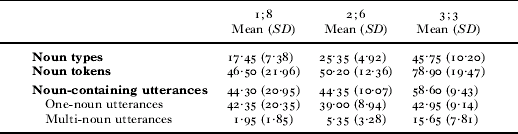
Noun production (see Table 1) was first measured by mean numbers of noun types and tokens produced in the samples for each of the three age groups. Noun types increased significantly from 1 ; 8 to 2 ; 6 (t(38)=−3·98, p<0·001), and from 2 ; 6 to 3 ; 3 (t(38)=−8·06, p<0·001). Noun tokens did not change markedly from 1 ; 8 to 2 ; 6, but increased significantly from 2 ; 6 to 3 ; 3 (t(38)=−5·57, p<0·001). Additional information about noun production was provided by an analysis of mean numbers of noun-containing utterances. Noun-containing utterances, which made up 37% of all the children's utterances at 1 ; 8 and 2 ; 6, and 49% at 3 ; 3, did not change markedly from 1 ; 8 to 2 ; 6 but increased significantly from 2 ; 6 to 3 ; 3 (t(38)=−4·62, p<0·001). They mostly consisted of one-noun utterances, which greatly predominated over multi-noun utterances in all three age groups. However, multi-noun utterances increased across ages with respect to mean numbers (significant increase from 1 ; 8 to 2 ; 6 (t(38)=−4·04, p<0·001), and from 2 ; 6 to 3 ; 3 (t(38)=−5·44, p<0·001)), as well as with respect to proportions (from 4% to 12% to 27% of all noun-containing utterances). Utterances containing at least two nouns were produced by 65% of the children at 1 ; 8, by 95% at 2 ; 6 and by all the children at 3 ; 3 (the maximum number of nouns per utterance being three at 1 ; 8, four at 2 ; 6 and nine at 3 ; 3).
Frequencies of nouns and noun-containing utterances at 1 ; 8, 2 ; 6 and 3 ; 3 (means and standard deviations calculated for samples of 120 utterances per child)
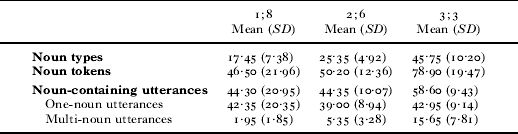
In summary, the total number of nouns produced by children did not increase from 1 ; 8 to 2 ; 6, but did increase from 2 ; 6 to 3 ; 3. Although one-noun utterances dominated the children's production in all three age groups, the increase in and expansion of multi-noun utterances throughout the whole period was noticeable.
Development of the noun determiner use constraint
Changes in grammatical patterns of noun use
Figure 1 shows the frequencies of the four patterns of noun use in percentages of tokens for each age group. Correct determiner-less patterns, which applied to more than one-fourth of all nouns at 1 ; 8 (28%), did not change markedly across ages (however, raw numbers showed a significant increase in the oldest group (t(38)=−3·70, p<0·001). Determiner omissions were predominant at 1 ; 8 (44% of nouns) and dropped off sharply over time (raw numbers showed a significant decrease from 1 ; 8 to 2 ; 6 (t(38)=4·18, p<0·001), as well as from 2 ; 6 to 3 ; 3 (t(38)=3·46, p<0·001)). In contrast to the omission pattern, the filler use and determiner use patterns were both likely to indicate noun grammaticalization, although they referred to different steps of the process. Fillers and determiners were used with similar frequencies at 1 ; 8 (about 14% of nouns each). However, they showed reverse developmental changes. Fillers decreased over time, while determiners underwent a striking increase (for fillers, effects on raw numbers were significant from 1 ; 8 to 2 ; 6 (t(38)=2·23, p=0·032), and for determiners from 1 ; 8 to 2 ; 6 (t(38)=−6·06, p<0·001), as well as from 2 ; 6 to 3 ; 3 (t(38)=−5·45, p<0·001)).
Percentages of grammatical patterns of noun use at 1 ; 8, 2 ; 6 and 3 ; 3.

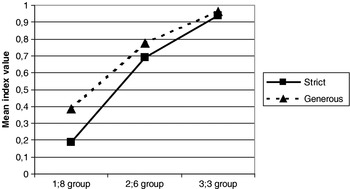
From these analyses, it was possible to derive a synthetic index of noun grammaticalization, shown in Figure 2. This index, which measures children's ability to use a noun determiner in obligatory contexts, was calculated according to two possible versions: a strict measure, which took into account true determiners only (corresponding to the proportion of nouns used with a determiner relative to nouns requiring a determiner in adult language), and a more generous measure, which took both determiners and fillers into account (corresponding to the proportion of nouns used with a determiner or filler relative to nouns requiring a determiner). As shown in Figure 2, both versions of the index increased substantially with age, in particular from 1 ; 8 to 2 ; 6, but also from 2 ; 6 to 3 ; 3. For the strict version, the mean value was 0·19 at 1 ; 8 (SD=0·13, range 0·00 to 0·44), 0·69 at 2 ; 6 (SD=0·26, range 0·12 to 0·96) and 0·94 at 3 ; 3 (SD=0·09, range 0·60 to 1·00). For the generous version, the mean was 0·38 at 1 ; 8 (SD=0·22, range 0·08 to 0·72), 0·78 at 2 ; 6 (SD=0·19, range 0·32 to 0·98) and 0·96 at 3 ; 3 (SD=0·04, range 0·98 to 1·00). All age effects were significant (from 1 ; 8 to 2 ; 6, strict version (t(38)=−7·72, p<0·001), generous version (t(38)=−6·04, p<0·001); from 2 ; 6 to 3 ; 3, strict version (t(38)=−4·10, p<0·001), generous version (t(38)=−4·20, p<0·001)). The difference between the strict and generous versions diminished with age, highlighting the frequency of fillers in the youngest group and their decrease thereafter. A relatively high degree of variation (as measured by SD and range) was found in the generous index at 1 ; 8, and, more importantly, in the strict index at 2 ; 6. These results indicate that inter-individual differences concerned the use of fillers and determiners by the youngest children, and they specifically concerned the use of determiners at 2 ; 6.
Strict and generous indices of noun grammaticalization.

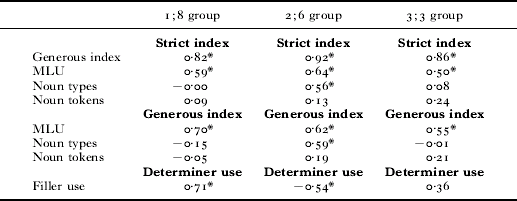
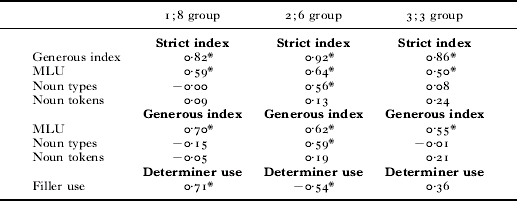
Further analyses, shown in Table 2, examined the within-age correlations of children's strict and generous indices of noun grammaticalization with the general index of grammatical development (MLU), and with indices of lexical production of nouns. At all three ages, the strict and generous indices were highly inter-correlated, and both indices were correlated with MLU values. This was not surprising since determiners (and fillers) contribute to utterance length. By contrast, they were poorly correlated with the indices of lexical production, that is, numbers of noun types and noun tokens. The sole correlation found was between the noun grammaticalization indices and the number of noun types in the 2 ; 6 group. This result indicates that a relation between noun grammaticalization and lexical production appeared only when a certain level of language development was reached, that is, not at 1 ; 8 but at 2 ; 6 (the absence of any correlation at 3 ; 3 is probably due to the ceiling values of the grammaticalization indices). In addition, Table 2 shows the within-age correlations between the two patterns indicating noun grammaticalization, that is, filler use and determiner use. At 1 ; 8, filler use and determiner use were positively and strongly correlated, whereas they were negatively correlated at 2 ; 6 (at 3 ; 3, the two patterns were not correlated, probably because of the small number of fillers produced at this age).
Correlations between noun grammaticalization indices and other grammatical and lexical indices
* p<0·05.
Prenominal filler and determiner uses
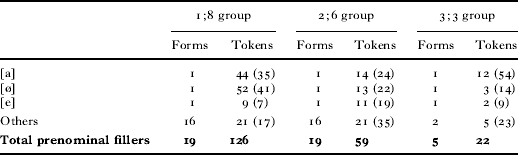
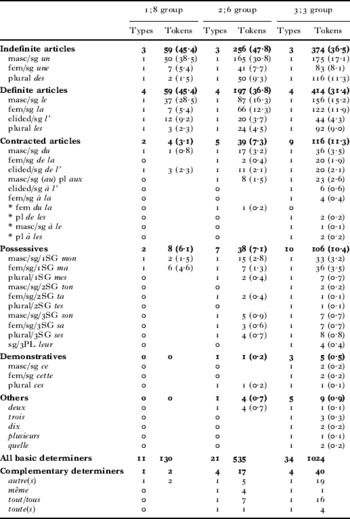
More specific and qualitative analyses were conducted on the types of fillers and determiners produced by children in the three age groups (see Tables 3 and 4).
Prenominal fillers used by the children at 1 ; 8, 2 ; 6 and 3 ; 3: main phonological forms with number of tokens (and %)
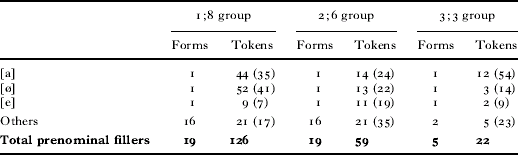
note: Other prenominal fillers were: at 1 ; 8: [n], [z], [le], [l], [mm], [i], [øm], [pa], [anø], [sa], [ma], [ta], [dø], [jø], [mu], [to]
at 2 ; 6: [n], [z], [le], [l], [mm], [i], [øn], [li], [y], [lo], [na], [laø], [ao], [de], [di], [ky]
at 3 ; 3: [n], [z].
Determiners used by the children at 1 ; 8, 2 ; 6 and 3 ; 3: types and numbers of tokens (with %) for each type, for basic and complementary determiners

With respect to fillers (Table 3), the decrease in the overall number of tokens was not associated with a decrease in the number of different forms for the two youngest groups, who had the same overall number of filler forms (19), while such a decrease was clearly apparent in the oldest group (5 forms). At 1 ; 8, all children used fillers, with an average 2·55 filler forms per child (range 1–8). At 2 ; 6, a large majority (85%) still used fillers (average 1·95, range 1–7). At 3 ; 3, only a minority (25%) used fillers, showing a clearly more restricted use at this age (average 0·55, range 0–4). However, the majority of tokens represented a few different forms in all three age groups; the most frequently used fillers were [a], [ø] and [e] with some variants (altogether, 83% of filler tokens at 1 ; 8, 65% at 2 ; 6 and 77% at 3 ; 3).
With respect to determiners (Table 4), the increase in the overall number of tokens was clearly associated with an increase in the overall number of types from 1 ; 8 (11 types) to 2 ; 6 (21 types) to 3 ; 3 (34 types). Analyses of individual children's production showed a striking increase in the use of determiner types from 1 ; 8 (average 2·10 determiner types per child, range 0–6) to 2 ; 6 (average 7·85, range 2–12) and then to 3 ; 3 (average 13·2, range 9–19).
At 1 ; 8, a large majority of the children (16 out of 20) were considered to use determiners according to the criteria mentioned above: most of these children (85%) produced at least two determiner types, and the other children produced only one determiner type, but they used it with at least two different nouns (e.g. un gateau, un chat). At this age, 77% of tokens consisted of three types of determiners. Children mostly used the indefinite masculine singular article un ‘a’ (39%), the definite masculine singular article le ‘the’ (29%) and the elided form l' which does not differentiate between masculine and feminine forms (9%). The feminine definite la and indefinite une forms were rarely used (around 5% each), and the other determiners constituted from 0% to 4% of the determiner tokens.
At 2 ; 6, children used determiners in a clearly more stable way. According to our criteria, they all used determiners, since they all used at least two different determiner types. At this age, children frequently used the indefinite (31% of determiner tokens) and definite (16%) masculine singular articles, like the youngest children, but they also used indefinite and definite articles in their feminine (8% and 12%) and plural (9% and 5%) forms relatively frequently. In contrast, the gender-undifferentiated elided form l' occurred less frequently. Children also started to use contracted forms of the definite article (du ‘of the’, au ‘to the’), and some possessive determiners.
At 3 ; 3, determiner use continued to increase. All the children used various determiner types with two or more different nouns. At this age, the indefinite (17%) and definite (15%) masculine singular articles still tended to predominate, while use of the feminine, plural and contracted forms of the articles increased. Some erroneous forms in which the preposition and definite article were not contracted (such as *à les for aux, *de les for des, *à le for au) were produced. In producing these erroneous forms, children made it clear that they had identified two morphemes before the noun. In addition, children at this age were able to produce a wide range of possessive and demonstrative determiners, as well as complementary determiners (autre ‘other’, même ‘same’, tout/toute/tous ‘whole, all’).
Lexical overlap in determiner use
Further analyses of children's ability in determiner use investigated the extent to which their productions showed some evidence of lexical overlap, conceived of as an indicator that they had some knowledge of the relationships between the different determiners. We analyzed whether samples from the three age groups contained contrasting determiner use, that is, whether they contained a given noun type produced with different determiner types (e.g. un chat/le chat). We found that only three contrasting uses were produced at 1 ; 8 (all three by the same child), whereas 45 contrasts were produced at 2 ; 6 (by 14 different children) and 118 at 3 ; 3 (by 19 different children). As a result of the richness of the determiner system in French, an increasingly wide variety of contrasts was observed at 2 ; 6 and 3 ; 3 (24 and 49 types, respectively). The definite/indefinite masculine singular contrast le/un (e.g. le gâteau/un gateau) was the most frequently produced. However, children from the two oldest groups also produced definite/indefinite contrasts using the feminine singular (la/une, e.g. la feuille/une feuille) and plural (les/des, e.g. les couleurs/des couleurs) forms of the articles. In addition, they produced noun phrases contrasting each of the definite and indefinite articles le, un la and une with the plural (e.g. le rond/des ronds) and contracted (e.g. un savon/du savon) forms of the articles, as well as with other determiners, such as possessives (e.g. la maison/ma maison). They also produced various other contrasts including other determiner types and forms.
From the same perspective, we wondered whether children's samples from the three age groups contained contrasting uses of a given noun type correctly produced without a determiner, on the one hand, and produced with a determiner when required, on the other hand (e.g. c'est maman/c'est la maman du lapin; il fait dodo/il fait un gros dodo). Two main kinds of nouns were candidates for these analyses: (i) common nouns that can be correctly produced without determiners because they are used as proper names, in particular when they refer to people closely related to the speaker; and (ii) common nouns that can be correctly produced without determiners because they are used in specific expressions or constructions or in prepositional complements. With respect to the first category, we found only one contrastive use of a given noun produced without and with a determiner at 1 ; 8, while 8 were produced at 2 ; 6 (by 8 different children) and 11 at 3 ; 3 (by 10 different children). With respect to the second category, we also found only one contrastive use of a given noun produced without and with a determiner at 1 ; 8, while 15 were produced at 2 ; 6 (by 8 different children) and 28 at 3 ; 3 (by 11 different children).
These analyses suggest that, whereas children showed very little evidence of lexical overlap in the youngest group, they did produce a number of correct contrasting uses of a given noun with different determiners, as well as with and without a determiner in both older groups.
Effects of noun length on children's determiner use
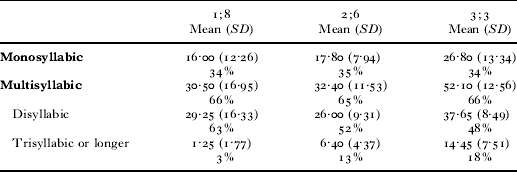
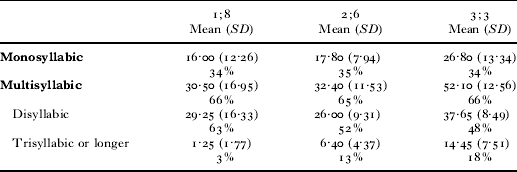
Table 5 gives an initial analysis of noun length, which shows the distribution of monosyllabic and multisyllabic noun tokens in each of the three age groups. The main result of this analysis was that multisyllabic noun tokens were found to be much more frequent than monosyllabic noun tokens in each of the three age groups. As early as 1 ; 8, children produced multisyllabic nouns twice as frequently as monosyllabic nouns, and quite similar proportions were found at 2 ; 6 and 3 ; 3. In all three age groups, multisyllabic noun tokens mostly included disyllabic nouns, although trisyllabic nouns increased with age. Age effects from 1 ; 8 to 2 ; 6 were significant only for trisyllabic nouns (t(38)=−4·88, p<0·001). From 2 ; 6 to 3 ; 3, they were significant for all categories: monosyllabic (t(38)=−2·59, p=0·013), multisyllabic (t(38)=−5·17, p<0·001), disyllabic (t(38)=−4·14, p<0·001) and trisyllabic (t(38)=−4·14, p<0·001).
Frequencies of monosyllabic and multisyllabic noun tokens at 1 ; 8, 2 ; 6 and 3 ; 3 (means, standard deviations and percentages, calculated for samples of 120 utterances per child)
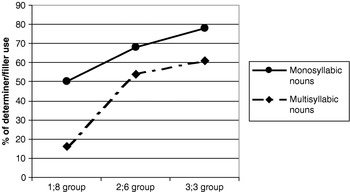
We then examined the possible role of noun length in the grammaticalization process. In this analysis, shown in Table 6 and in Figure 3, all multisyllabic nouns were grouped together, and filler use and determiner use were grouped together, because they are both indicators of grammaticalization.
Percentages of monosyllabic nouns vs. multisyllabic nouns produced with a filler or determiner at 1 ; 8, 2 ; 6 and 3 ; 3, respectively.

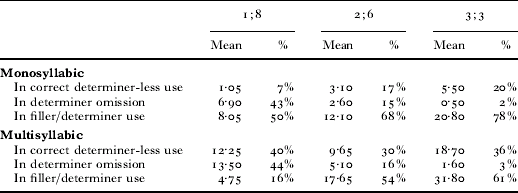
Frequencies of monosyllabic and multisyllabic nouns produced in correct determiner-less use, determiner omission and filler/determiner use at 1 ; 8, 2 ; 6 and 3 ; 3 (mean raw numbers and percentages)
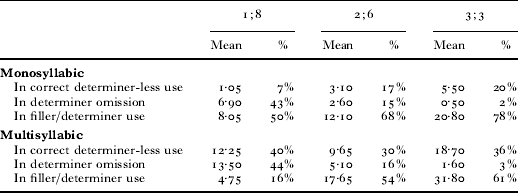
The raw numbers shown in Table 6 indicate that at 1 ; 8 multisyllabic nouns were more frequent than monosyllabic nouns in correct determiner-less uses (t(19)=−5·64, p<0·001) and in determiner omissions (t(19)=−2·76, p=0·012). In contrast, the reverse configuration was observed for filler/determiner use, which occurred more frequently with monosyllabic than with multisyllabic nouns, although the difference was not significant. In the 2 ; 6 group, multisyllabic nouns were more frequent than monosyllabic nouns in correct determiner-less uses (t(19)=−5·01, p<0·001), in determiner omissions (t(19)=−2·19, p=0·041) and in filler/determiner uses (t(19)=−2·33, p=0·031). Similar results were obtained in the 3 ; 3 group, with more frequent multisyllabic than monosyllabic nouns in correct determiner-less uses (t(19)=−4·52, p<0·001), in determiner omissions (t(19)=−2·53, p=0·020) and in filler/determiner uses (t(19)=−5·67, p<0·001). This analysis emphasizes that the filler/determiner use pattern in the 1 ; 8 group was the only configuration where monosyllabic nouns tended to be more frequent than multisyllabic ones.
Table 6 also shows the percentages of monosyllabic and multisyllabic nouns produced in each of the three patterns. Figure 3 focuses on the central comparison between the percentage of monosyllabic nouns vs. multisyllabic nouns used with a filler or determiner. This analysis clearly shows that, whereas multisyllabic nouns were overall more frequent than monosyllabic nouns in the three age groups, filler or determiner uses occurred proportionally more frequently with monosyllabic nouns than with multisyllabic nouns. The effect was particularly clear-cut at 1 ; 8 and strongly reduced at 2 ; 6 and 3 ; 3. This result was in agreement with the hypothesis that there is a noun length effect in the youngest children.
To verify the extent to which the general pattern was observed in individual children, we examined the noun use configurations in the productions of each child. Using analyses on raw numbers, we found that at 1 ; 8 a slight majority of children (twelve out of twenty) used more fillers or determiners with monosyllabic than multisyllabic nouns, while a minority of children did so in the oldest groups (eight at 2 ; 6 and one at 3 ; 3). Moreover, a very small minority of children at all three ages produced monosyllabic nouns more frequently than multisyllabic nouns in correct determiner-less uses (none at 1 ; 8, three at 2 ; 6 and one at 3 ; 3), as well as in determiner omissions (four at 1 ; 8, two at 2 ; 6 and three at 3 ; 3). Thus, the general mean tendencies were reflected in children's individual patterns in each age group, with a majority of children – but not all – producing more monosyllabic than multisyllabic nouns only in the filler/determiner use pattern at 1 ; 8.
Effects of animacy on children's determiner use
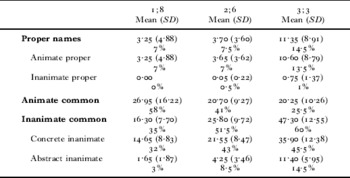
Table 7 presents an initial analysis of noun lexical properties; it shows the frequencies of the main subclasses of nouns in the three age groups: proper names, including animate and inanimate proper names; animate common nouns; and inanimate common nouns, including concrete and abstract inanimate nouns. Proper names, almost all of which designated animates, were infrequent in all three age groups, although they increased somewhat in the oldest group (significant age effect from 2 ; 6 to 3 ; 3 (t(38)=−3·56, p=0·001)). With respect to animate and inanimate common nouns, the main developmental result was that animate common nouns decreased while inanimate common nouns, and especially the most predominant concrete nouns, increased markedly. Age effects were significant for inanimate common nouns globally (from 1 ; 8 to 2 ; 6 (t(38)=−3·43, p=0·001), from 2 ; 6 to 3 ; 3 (t(38)=−6·06, p<0·001), as well as separately for concrete inanimate nouns (from 1 ; 8 to 2 ; 6 (t(38)=−2·52, p=0·016), from 2 ; 6 to 3 ; 3 (t(38)=−4·28, p<0·001)) and abstract inanimate nouns (from 1 ; 8 to 2 ; 6 (t(38)=−2·95, p=0·005), from 2 ; 6 to 3 ; 3 (t(38)=−4·64, p<0·001)). As a consequence of these tendencies, animate common nouns were significantly more frequent than inanimate common nouns at 1 ; 8 (t(19)=−2·88, p=0·009). At 2 ; 6, inanimate common nouns were more frequent than animate common nouns, but the difference was not significant, and at 3 ; 3 inanimate common nouns were significantly more frequent than animate common nouns (t(19)=−7·93, p<0·001).
Frequencies of proper name, animate common noun and inanimate common noun tokens at 1 ; 8, 2 ; 6 and 3 ; 3 (means, standard deviations and percentages, calculated for samples of 120 utterances per child)

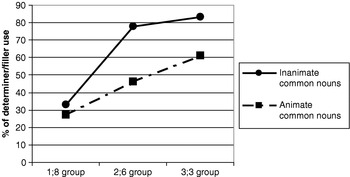
We then examined the possible role lexical subclass plays in the noun grammaticalization process. This analysis is presented in Table 8 and in Figure 4.
Percentages of animate common nouns vs. inanimate common nouns produced with a filler or determiner at 1 ; 8, 2 ; 6 and 3 ; 3, respectively.

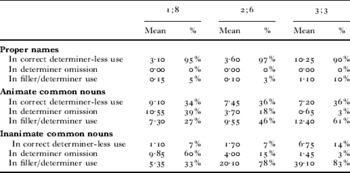
Frequencies of proper names, animate common nouns and inanimate common nouns produced in correct determiner-less use, determiner omission and filler/determiner use at 1 ; 8, 2 ; 6 and 3 ; 3 (mean raw numbers and percentages)

The raw numbers shown in Table 8 first indicate that proper names almost always corresponded to correct determiner-less uses in all three age groups, a result that was not surprising since proper names are quite usually used without determiner in French. More interestingly, animate and inanimate common nouns (excluding proper names) show the following tendencies. In the 1 ; 8 group, animate common nouns were much more frequent than inanimate common nouns in correct determiner-less use (t(19)=−4·21, p<0·001), while no significant difference was found in determiner omission nor in filler/determiner use. In the 2 ; 6 group, animate common nouns were still much more frequent than inanimate ones in correct determiner-less use (t(19)=−3·89, p<0·001), and no significant difference was found in determiner omission. By contrast, filler/determiner uses occurred much more frequently with inanimate common nouns than with animate ones (t(19)=−4·06, p<0·001). Finally, in the 3 ; 3 group, as in the 2 ; 6 group, the most striking effect concerned filler/determiner use, which occurred much more frequently with inanimate nouns than with animate ones (t(19)=−11·89, p<0·001). Focusing on the central comparison between the percentages of animate common nouns vs. inanimate common nouns used with a filler or determiner, Figure 4 shows that filler/determiner use was clearly proportionally more frequent with inanimate common nouns than with animate common nouns in the 2 ; 6 and 3 ; 3 groups only. These analyses indicate that the effect predicted by our lexical hypothesis – a preferential use of determiners with inanimate nouns – was not observed at 1 ; 8, whereas it clearly did apply at 2 ; 6 and 3 ; 3, when filler/determiner use occurred much more frequently with inanimate common nouns than with animate ones.
As in the above analyses of noun length effects, we examined whether the general pattern of animacy effects was reflected in the productions of individual children. Analyses conducted on raw numbers indicated that at 1 ; 8 about half of the children used more fillers or determiners with inanimate than with animate common nouns (9 out of 20), whereas a very large majority of children did so in the older groups (17 at 2 ; 6 and 20 at 3 ; 3). By contrast, a minority of children used inanimate more frequently than animate common nouns in correct determiner-less contexts (1 at 1 ; 8, 2 at 2 ; 6 and 8 at 3 ; 3) and about half of the children did so in determiner omission contexts (9 at 1 ; 8, 11 at 2 ; 6 and 11 at 3 ; 3). Thus, the general mean tendencies were reflected in children's individual patterns in each age group, with a very large majority of children producing more inanimate than animate common nouns only in the filler/determiner use pattern in the 2 ; 6 and 3 ; 3 groups.
DISCUSSION
In this study, we investigated the development of the determiner use constraint in French and explored some prosodic and lexical influences likely to play a role in this process by analyzing spontaneous speech samples from children aged 1 ; 8, 2 ; 6 and 3 ; 3.
Development of the noun determiner use constraint: a gradual construction?
Overall picture
The overall developmental picture arising from the analyses of our cross-sectional data shows that noun grammaticalization emerges by 1 ; 8, is greatly improved by 2 ; 6 and is completed by 3 ; 3. At 1 ; 8, children frequently omitted obligatory determiners, but they used fillers or determiners (with the same frequency) in almost 40% of obligatory contexts on average. At 2 ; 6, they used determiners or (much less frequently) fillers in more than 75% of obligatory contexts. At 3 ; 3, they used determiners or (very infrequently) fillers in about 95% of obligatory contexts. Overall, this picture fits the patterns observed in the previous longitudinal study of one child from 1 ; 2 to 2 ; 6 (Bassano, Reference Bassano2000), which indicated that, around 1 ; 8, the child used fillers or (less frequently) determiners in 40% of obligatory contexts. At around 2 ; 6, this child used determiners or (very infrequently) fillers in about 95% of obligatory contexts, a score that was higher than the average score of the 2 ; 6 group in the present study but that corresponded to the score of the more advanced children from this age group. Thus, our analyses of cross-sectional data highlight inter-individual variation in the timing of the developmental process and make it possible to place an individual child's performance in relation to other children.
The cross-sectional data obtained in this study also enable us to show structural aspects of noun grammaticalization at each main age point, in particular with respect to the relationships between filler and determiner uses, as well as between different determiner uses. At 1 ; 8, although a certain number of prenominal fillers were produced by the group, the large majority of tokens mainly consisted of three types ([a], [ø] and [e]). Similarly, three determiner types accounted for most uses, namely the indefinite and definite articles in their masculine singular and elided forms (un, le, l'). The main forms un and le, in particular, are phonetically close to the most frequent filler forms, suggesting that the frontier between determiners and fillers is fuzzy. In line with this view, several other results showed structural similarities between the production of fillers and determiners at this age. Children used fillers and determiners with the same overall token frequency. There was a strong positive correlation between filler and determiner use – generally, the more fillers a child used, the more determiners he or she used – suggesting that the production of fillers supports the production of determiners. Specific analyses of determiners showed that although at this age half of the children were able to use a given determiner with two different nouns, they did so infrequently. Moreover, they were not able to use a given noun type with different determiner types, an analysis which suggested that they had a limited notion of the relationships between determiner types.
At 2 ; 6, the relationship between fillers and determiners was quite different from that found in the youngest children. The 2 ; 6 group used determiners much more frequently than fillers. Unlike in the youngest children, the correlation between filler and determiner use at 2 ; 6 was negative, which suggests that the relation between fillers and determiners had changed from a supportive to a competitive one. Determiners were much more diversified than in the youngest group. Not only did the 2 ; 6 group use determiner tokens much more frequently than the 1 ; 8 group, but they also produced three to four times as many different determiner types. They now used the feminine and plural forms, as well as the contracted forms of the articles, in addition to the masculine singular forms. All the children frequently used a given determiner with a range of different nouns, and most of them produced a given noun with two different determiner types. Thus, it can be supposed that at 2 ; 6 a good number of children had determiners that functioned at least in part like an adult-like category. However, the noun grammaticalization process was not completed for all children at this age, since they showed considerable inter-individual variability in the determiner use constraint; this was apparent in the strict index of noun grammaticalization. Some children were almost at the ceiling (like the child in the above-mentioned longitudinal study), whereas other children were still at the average 1 ; 8 level. By contrast, noun grammaticalization was complete at 3 ; 3 for almost all children, since determiners were used in about 95% of obligatory contexts, with little variability. Fillers had become very infrequent, with respect to tokens as well as types. At this age, almost all of the different forms of the system of determiners could be found in children's productions, and almost all of the children frequently produced a given noun with different determiner types.
Another result emerging from the data was that correct determiner-less nouns represented a relatively important proportion of all the nouns produced by children in the three age groups (around 28% overall). This result may be surprising at first glance, given that French is considered to be a restrictive language with respect to obligatory determiner use. It can be explained, however, by the fact that overall about 35% of the correct determiner-less nouns were proper names (25% at 1 ; 8, 30% at 2 ; 6 and 40% at 3 ; 3) and 45% were common nouns used as proper names (65% at 1 ; 8, 55% at 2 ; 6 and 30% at 3 ; 3). Finally, 20% were common nouns used in specific constructions or in prepositional complements (10% at 1 ; 8, 15% at 2 ; 6 and 30% at 3 ; 3). One further question is the extent to which these data corresponded to the structure of the target adult language. To have an idea of the frequency of bare nouns in adult language, we examined the utterances addressed by mothers to children during thirty sessions (ten in each age group). Although they are still preliminary, the results shed light on the characteristics of the target language. Overall, 70% of the nouns in mothers' input to children were used with determiners, while 30% were bare nouns. The latter frequency is similar to the one found for correct bare nouns in children's productions. Among bare nouns, 50% were proper names and 17% common nouns used as proper names, while 30% were used in specific constructions and in prepositional complements. Thus, common nouns that were used as proper names formed a category of bare nouns that was clearly overused by children, particularly at younger ages.
Transitional procedures and increasing diversity
So far we have summarized the main contributions of the study concerning the development of the determiner use constraint in French. We would now like to discuss in more detail two central features of this process and the extent to which they argue in favor of the proposal that children's development of grammatical categories reflects a gradual construction process.
The first feature consists in using transitional procedures that prepare for the production of true determiners. Our present data confirm the analyses conducted in various longitudinal case studies of French children (Bassano, Reference Bassano2000; Veneziano & Sinclair, Reference Veneziano and Sinclair2000; Kilani-Schoch & Dressler, Reference Kilani-Schoch and Dressler2001), all of which indicate that grammaticalization processes in children learning French most often start early with the production of fillers that are ‘place holders’ for grammatical morphemes but do not have the appropriate morphological properties (e.g. unlike French determiners, prenominal fillers are not marked for gender and number). Fillers that can be considered as pre- or proto-grammatical morphemes have been observed in a number of languages, but they seem to be produced earlier and more frequently in languages that have many proclitics, such as French, Italian and Spanish (Lleó, Reference Lleó, Weissenborn and Höhle2001; Peters, Reference Peters2001; Bassano, Laaha, Maillochon & Dressler, Reference Bassano, Laaha, Maillochon and Dressler2004). For example, Lleó's (Reference Lleó, Weissenborn and Höhle2001) study comparing the development of articles in data from three Spanish and four German children found that the first proto-articles appeared at about 1 ; 4 in Spanish, whereas they appeared at about 1 ; 8 in German, and were very infrequent during the first two or three months. This difference in developmental courses was related to differences in the prosodic structures of the articles in the target languages: Spanish articles tend to be proclitics, which are prosodically attached to the following noun, whereas German ones may be enclitics to a preceding preposition or verb. These results suggest that prosodic properties of languages may favor the emergence of grammaticalization through precursors of grammatical morphemes.
The existence of precursors indicates that grammatical morphemes develop gradually in a broad sense which is compatible with both the constructivist and the above-mentioned generativist approaches. One further question that is the subject of debate concerns the nature of the knowledge implied by the use of fillers. In contrast to the view that it is constrained by structural rules (Bottari et al., Reference Bottari, Cipriani and Chilosi1993/94; Lleó & Demuth, Reference Lleó, Demuth, Greenhill, Littlefield and Tano1999), the longitudinal study of one child by Veneziano & Sinclair (Reference Veneziano and Sinclair2000) has suggested that, during a first pre-morphological period around 1 ; 7–1 ; 9, filler use reflects ‘phonoprosodic regularities of the language rather than being constrained by structural rules relative to syntactic slots or to the class of the word they precede’ (p. 462). Our present data were not designed to address this issue specifically. The fact that children from the 1 ; 8 group tended to use fillers and determiners more frequently with monosyllabic than multisyllabic nouns (an effect likely to reflect the role of prosodic constraints, as discussed in more detail below) seems to be in line with the idea that the use of fillers by the youngest children is at least partly related to phonoprosodic regularities. However, our analyses do not argue against the possibility that structural rules also operate. Rather, and above all, they emphasize the positive priming role that fillers seem to play in the first stages of noun grammaticalization.
The second feature that we want to discuss in more detail is children's increasing diversity in determiner use. This increasing diversity is apparent at two levels. Firstly, it is manifested in content. At 1 ; 8, the children used few types of determiners, mostly consisting of indefinite and definite articles in their masculine singular forms. At 2 ; 6, the feminine, plural and contracted forms of the articles could be consistently found in children's productions, and at 3 ; 3 almost the whole determiner system was available. These results indicate that definite and indefinite articles emerge in parallel in children's early productions, whereas masculine singular references have a clear advantage over feminine and plural ones. These trends fit observations from longitudinal studies which have examined the order of appearance of determiners in bilingual (as compared to monolingual) French-learning children (Kupisch et al., Reference Kupisch, Müller and Cantone2002; Hulk, Reference Hulk, Prévost and Paradis2004; for further discussion on these issues, see also Karmiloff-Smith, Reference Karmiloff-Smith1979; and Salazar Orvig, Hassan, Leber-Marin, Marcos, Morgenstern & Parès, Reference Salazar Orvig, Hassan, Leber-Marin, Marcos, Morgenstern and Parès2005).
Secondly, and more importantly for gradualist hypotheses of grammatical development, increasing diversity concerns the contexts in which determiners are used. Our analyses indicate that children aged 1 ; 8 did not show any evidence of lexical overlap in the contexts in which they used determiners. Apart from very few exceptions, they did not use a particular noun type with different determiner types, neither did they correctly use a particular noun type with and without a determiner. These results are consistent with those of studies showing that the productivity of determiner use in young English-learning children is limited (Pine & Martindale, Reference Pine and Martindale1996; Pine & Lieven, Reference Pine and Lieven1997). In particular, Pine & Lieven's (Reference Pine and Lieven1997) analyses found little overlap in the contexts in which definite and indefinite articles were used by the eleven children under study from 1 ; 0 to 3 ; 0. However, our present results for French seem more optimistic. Whereas the 1 ; 8 group did not show any diversity in the types of determiners used with particular noun types, the 2 ; 6 group presented a striking contrast with the youngest children, with many of them showing relatively frequent overlap in the contexts in which they used different determiners (although children at 2 ; 6 exhibited less variety and frequency in contrasting determiner uses than at 3 ; 3). The differences between the studies may be related to methodological issues, namely that Pine and Lieven did not look at developmental changes in their data and they used criteria of overlap restricted to definite and indefinite articles. However, it may also be the case that increasing diversity is favored in languages with a rich system of determiners, like French, which allows a wide range of contrasting uses based on variations in gender and number. Be that as it may, the congruent view emerging from these analyses of overlap in determiner use is that the youngest children do not seem to show evidence for full knowledge of grammatical categories, which may be progressively constructed from item-based learning, as proposed by gradualist models (Tomasello, Reference Tomasello2000). It is clear, however, that more research is needed to understand how children access generalizations in determiner use, calling for analyses of other dimensions in overlapping contexts, particularly in controlled experimental situations.
What is the role of prosodic and lexical factors in noun grammaticalization?
Prosodic influences
The question regarding the role of prosodic factors in the development of the determiner use constraint in French is controversial because French is not described as a stress-based language, but rather as a syllable-based language in which accent is phrase-final as well as word-final and is mostly due to increased duration. We explored prosodic factors affecting the determiner use constraint by examining whether children were influenced by the length of the nouns that they produced and whether they used fillers/determiners differentially with monosyllabic and with multisyllabic nouns.
As a first result, these analyses of noun length showed that, overall, a great majority of the noun tokens produced by the children in all age groups were multisyllabic (66% at 1 ; 8, 65% at 2 ; 6, 66% at 3 ; 3), mostly disyllabic (63% at 1 ; 8, 52% at 2 ; 6, 48% at 3 ; 3). Overall, this finding agrees with some studies conducted from a cross-linguistic perspective, which indicate that, whereas young children acquiring English tend to prefer monosyllables, children acquiring French tend to produce longer words (Vihman et al., Reference Vihman, DePaolis and Davis1998; Demuth & Tremblay, Reference Demuth and Tremblay2008), a tendency that is also found in children acquiring Spanish (Demuth, Reference Demuth, Weissenborn and Höhle2001; Lleó, Reference Lleó, Weissenborn and Höhle2001). However, an accepted view is that French children produce monosyllabic as well as disyllabic word types, and that a large number of French children's target words are monosyllabic (almost half, according to Demuth & Johnson, Reference Demuth and Johnson2003, reported in Demuth & Tremblay, Reference Demuth and Tremblay2008).
In order to verify our results, several further analyses were conducted on the data. Firstly, because our initial analysis took into account the short adjectives that may be interposed between the determiner and the noun, we assessed noun length in the stricter sense, excluding the interposed prenominal adjectives. Multisyllabic nouns in the strictest sense were rather less frequent than in our initial evaluation, but the revised proportions remained very high (65% at 1 ; 8, 62% at 2 ; 6, 63% at 3 ; 3). Secondly, because our initial analysis was conducted according to the children's actual productions, we also assessed noun length based on the presumed adult production (that is, children's attempted words). Multisyllabic nouns according to the adult production were a little more frequent than in our initial evaluation, but the proportions remained similar (68% at 1 ; 8, 66% at 2 ; 6, 66% at 3 ; 3). Thirdly, because all the previous analyses were based on noun token frequencies, we wanted to verify whether the above tendencies also existed with respect to types (this evaluation was based on the adult presumed production). We found high proportions of multisyllabic noun types (63% at 1 ; 8, 61% at 2 ; 6, 63% at 3 ; 3), with disyllables predominating (60% at 1 ; 8, 51% at 2 ; 6, 46% at 3 ; 3). Finally, in order to directly evaluate the distribution of monosyllabic and multisyllabic nouns in the target language, we analyzed noun length in our input data. We found on average 36% monosyllabic and 64% multisyllabic nouns (with 42% dissyllabic), a distribution that is close to the frequencies observed in the children. Thus, it is clear that, as early as 1 ; 8, multisyllabic nouns predominated over monosyllabic ones in the speech of our sample of French children, and that they also predominated in the input.
The differences in proportions of monosyllabic and multisyllabic words between Demuth & Johnson's (Reference Demuth and Johnson2003) study and our present one could be accounted for by various methodological reasons. Demuth & Johnson's (Reference Demuth and Johnson2003) study examined longitudinal diary data collected by Deville (Reference Deville1891) on one child and analyzed all kinds of words attempted and produced by the child from 1 ; 1 to 1 ; 8 (not only nouns, as we did), with respect to types only (and not tokens, as we mostly did). With respect to the input, Demuth & Johnson's (Reference Demuth and Johnson2003) study examined all open-class lexical items (using token analyses) in French child-directed speech coming from the CHILDES database. Focusing specifically on nouns, our present study provides a more accurate evaluation of the length of this category of words, which clearly seems to be more often multisyllabic than monosyllabic words in French.
The analyses of the effects of noun length on determiner use or non-use showed that the filler/determiner use pattern occurred more frequently with monosyllabic nouns than with multisyllabic ones in the 1 ; 8 group, supporting the noun length effect hypothesis at 1 ; 8 and not in older children. A likely explanation of this phenomenon, applying the prosodic constraint hypotheses to cross-linguistic differences (Vihman et al., Reference Vihman, DePaolis and Davis1998; Demuth, Reference Demuth, Weissenborn and Höhle2001; Demuth & Tremblay, Reference Demuth and Tremblay2008), could be that young children are influenced by a preference for a binary foot combined with the iambic pattern of French. The iambic pattern results in fewer fillers/determiners before disyllabic nouns (which already present an unaccented syllable followed by an accented syllable) than before monosyllabic nouns (which present just one accented syllable). In using fillers/determiners before monosyllabic nouns, young French children produce disyllabic iambic noun phrases, which correspond to the predominant pattern in the language they are learning. This interpretation is compatible with the result that the large majority of multisyllabic nouns produced at 1 ; 8 in our data were used without determiners, either in correct determiner-less patterns (40%) or in omission patterns (44%), while a minority (16%) were used with fillers or determiners. This was no more the case in the oldest group, where children were likely to have more complex prosodic representations, as suggested by Demuth & Tremblay's (Reference Demuth and Tremblay2008) proposal.
Of course, there may be other interpretations of our French data. First, according to the perspective proposed by Wijnen et al.'s (Reference Wijnen, Krikhaar and den Os1994) study on two Dutch-learning children, the youngest French children might use fillers or determiners more often before monosyllabic than before multisyllabic nouns because of rhythmic production constraints reflecting a universal ‘trochaic bias’, following the requirement for a rhythmic alternation between weak and strong syllables (Allen & Hawkins, Reference Allen, Hawkins, Yeni-Komshian, Kavanagh and Ferguson1980). However, this proposal is not incompatible with the iambic prosodic constraint that we proposed. Another interpretation might relate the noun length effect to a limitation on young children's speech production capacities, which disadvantages multisyllabic nouns. This explanation cannot be excluded on the basis of our data analysis. However, arguments against this view were provided in Demuth & Tremblay's (Reference Demuth and Tremblay2008) study, which showed that the children's outputs were not simply governed by ‘length effects’ limiting them to a small number of syllables.
Lexical influences
The question of lexical influences on the development of the noun determiner use constraint was suggested by the line of research which emphasizes the existence of interdependencies between lexical and grammatical developments during the first stages of language acquisition (Marchman & Bates, Reference Marchman and Bates1994; Bates & Goodman, Reference Bates, Goodman and MacWhinney1999; Caselli et al., Reference Caselli, Casadio and Bates1999; Bassano, Reference Bassano2000; Bassano et al., Reference Bassano, Laaha, Maillochon and Dressler2004; Devescovi, Caselli, Marchione, Pasqualetti, Reilly & Bates, Reference Devescovi, Caselli, Marchione, Pasqualetti, Reilly and Bates2005). Analyses of how the lexical/semantic status of nouns might influence determiner use or non-use were designed specifically to verify the animacy effects hypothesis, predicting a preferential use of determiners with inanimate nouns (Bassano, Reference Bassano2000).
The basis for this analysis was a distinction between animate and inanimate common nouns (excluding proper names). As already discussed in a previous study (Bassano et al., Reference Bassano, Eme and Champaud2005), animate common nouns were clearly more frequent than inanimate common nouns at 1 ; 8 and decreased with age. Inanimate common nouns increased with age and were clearly more frequent than animate common nouns at 3 ; 3. In order to estimate the distribution of noun lexical classes in the target language, we analyzed our input data, finding on average 26% animate common nouns and 59% inanimate common nouns (15% of nouns were proper names). This distribution fits perfectly the frequencies observed in children's productions from the age of 3 ; 3 on.
The animacy effects predicted by our lexical hypothesis were not observed in the 1 ; 8 group, who did not use fillers or determiners clearly more frequently with inanimate than with animate nouns. However, at this age, correct determiner-less uses were much more frequent with animate than inanimate nouns. In contrast, animacy effects predicted by our lexical hypothesis were clearly found at 2 ; 6 and 3 ; 3, when filler or determiner uses were much more frequent with inanimate than animate nouns. This result might be partly due to the increase in the use of inanimate nouns with age. However, the contrast between animate and inanimate nouns with respect to filler/determiner uses was apparent in comparisons of both percentages and raw frequencies. The increase in inanimate use did not affect all patterns, since animates remained more frequent in correct determiner-less contexts in the oldest groups. Finally, a higher frequency of animate common nouns in correct determiner-less uses as compared to the one for inanimate nouns was also observed in our input data (23% animate vs. 14% inanimate common nouns were produced in correct determiner-less uses).
Thus, analyses of our cross-sectional data partly support the lexical hypothesis, since they show a privileged relationship between filler/determiner use and inanimate nouns. However, we must specify that this relationship is not apparent in the youngest children. Only at 2 ; 6 do we have evidence that the idea has emerged that inanimate nouns are more likely to take a determiner than animate nouns. By contrast, animate nouns are often associated with correct determiner-less uses (a relationship that is already present in the youngest children's data). The privileged association of animate nouns with the absence of a determiner, on the one hand, and of inanimate nouns with the use of a determiner, on the other hand, could be a general property of languages. It is in agreement with other characteristics of animate and inanimate nouns. For instance, animate entities are more likely to be individuated and to play the role of agent or subject than inanimate entities, which are more likely to play the role of object. Interestingly, the qualitative relationship between lexical properties of nouns (animacy effects) and grammaticalization becomes apparent at the developmental point where correlations between children's lexical stock of nouns (number of noun types) and grammaticalization are found (at 2 ; 6). Thus, quantitative and qualitative relations between lexical and grammatical noun development emerge in a consistent way, and this picture argues in favor of lexicalist theories of grammar, which emphasize the links between the lexicon and grammar.
CONCLUSION
Our study investigated the development of the constraint on determiner use in French, conceived of as a central indicator of noun grammaticalization. We adopted a relatively large perspective calling for analyses of both precursors and full grammatical morphemes, as well as analyses of prosodic and lexical influences. These analyses suggest that noun grammaticalization is a gradual process in French children. This process involves the use of transitional structures, such as early prenominal fillers, as well as increasing diversity in the content and contexts of determiner use. It is influenced by both prosodic factors, such as noun length effects, and lexical factors, such as animacy effects. However, the role of these factors varies over time. Prosodic influences predominate in the first steps of the developmental process, when monosyllabic nouns are more likely to take a filler or determiner. Lexical influences emerge and predominate in later stages, when inanimate nouns are more likely to take a filler or determiner. Further research should investigate other dimensions of the grammaticalization process, such as the development of the syntactic functions of nouns. It should also take a cross-linguistic perspective directly contrasting the noun grammaticalization process in French vs. Germanic languages – such as Dutch or German – which may present different patterns of noun determiner uses, as well as different prosodic, lexical and syntactic constraints.
Appendix 1. Examples of the different noun use patterns in the three age groups
An alphabetical transcription is adopted for all examples. For the French filler syllables, the following conventions are used: [a] is written /a/, [ø] is written /eu/, [e] is written /é/, [y] is written /u/, [i] is written /i/. Incorrect determiner omissions are indicated by *.
Correct determiner-less nouns
1 ; 8: Antoine; merci Claire ‘thank you Claire’; c'est maman ‘it's mummy’
2 ; 6: il est propre, Spot ‘he is clean, Spot’; oui j'ai soif ‘yes I am thirsty’; petit canard tu vas tomber dans l'eau ‘little duck you are going to fall into the water’
3 ; 3: joyeux anniversaire, bébé! ‘happy birthday, baby!’; je m'étais fait mal ‘I had hurt myself’
Determiner omission
1 ; 8: *—poupée ‘doll’; oh *—éyon! ‘oh pencil!’; là-bas *—lapin ‘there rabbit’; est *—chat ‘is cat’; a veux *—gateau ‘I want cake’
2 ; 6: *—chien rose ‘pink dog’; t'as vu *—petit chien? ‘you have seen little dog?’; je veux ranger —* ballon ‘I want to put away ball’
3 ; 3: j'ai vu *—pétacle [spectacle] à l'école ‘I saw show at school’
Prenominal filler use
1 ; 8: /eu/chat ‘/fill/ cat’; /é/ chaise ‘/fill/ chair’; /a/tête ‘/fill/ head’; /eum/point ‘/fill/ point’; /é/calin /eu/ bébé ‘/fill/ caress /fill/ baby’; c'est /a/chat ‘it's /fill/ cat’
2 ; 6: ici l'a /eu/ coussin ‘here /fill/ is /fill/ cushion’; /u/queue ‘/fill/ tail’; ça /a/poisson ‘that /fill/ fish’; /i/pointe ici ‘/fill/ point here’; donne /a/serviette ‘give /fill/ towel’
3 ; 3: ça c'est /é/photo, c'est moi là ‘that's /fill/ photo, it's me here’
Adult-like prenominal determiner use
1 ; 8: unchat ‘a cat’; unlapin ‘a rabbit’; c'est unchat ‘it's a cat’; ça, c'est unstylo ‘that, it's a pen’; desfraises ‘strawberries’; lechat ‘the cat’; lachaise ‘the chair’; l'autre fois ‘the other time’
2 ; 6: il trouve unos ‘he finds a bone’; oui, c'est unetomate ‘yes, it is a tomato’; vais chercher desfeuilles ‘go to look for papers’; ça pique lesyeux ‘it stings the eyes’; ça va faire dubruit ‘it will make some noise’; connaît pas ça monpère ‘does not know that, my father’; je veux mapoupée ‘I want my doll’
3 ; 3: après je vais te donner lasurprise ‘after, I am going give you the surprise’; y' avait legrand méchant loup dans monlit! ‘there was the big bad wolf in my bed!’; on faisait dubruit avec lesfeuilles ‘we were making some noise with the leaves’; on joue auxescargots ‘we play to the snails’; ils sont cassés, sesboutons! ‘they are broken, his buttons!’; y'a touslesoiseaux, là ‘there are all the birds, there’; cetteplaque, elle est fermée ‘This plate, it is closed’