Obesity is a chronic and non-communicable condition that involves the accumulation of adipose tissue in compromising level to the physical health of individuals. According to the World Health Organization (2015), more than 1.9 billion adults, 18 years and older, were overweight in 2014, of these over 600 million were obese. The World Health Organization considers obesity a major public health problem, launching campaigns to control and prevent its increase, as well as far-reaching measures to combat its harmful consequences.
Although obesity is a major public health concern in developed countries, this scenario has expanded in recent decades. Developing countries also suffer from the rising epidemic of this chronic disease, being a foremost concern for health officials that take broad measures to stop its accelerated growth. For example, it is predicted in emerging economies like Brazil that the general population will present more non-communicable diseases, being ranked as the fifth country in the world with more obesity-associated burden in 2025 (Damaso, Reference Damaso2003). Recent data of 2012 indicate that 50.8% of Brazilian adults are overweight, with an overall share of 17.5% obesity (Ministério da Saúde do Brasil, 2013). In comparison with previous survey (Ministério da Saúde do Brasil, 2007), there was an increase of almost 20% of overweight for adults and an additional 50% of respondents were considered in the level of obesity during the period.
In addition to medical problems such as cardiovascular and metabolic diseases, psychological and social consequences of obesity are relevant: with frequent emotional problems, low self-esteem, difficulties in social interaction, segregation, professional disability and stigma. It was forecast in the study Global Burden of Disease (Murray & Lopez, Reference Murray and Lopez1996) that major depression would be one of the disease with the highest burden to the world population in the year 2020, just behind cardiovascular diseases. The burden among obese individuals is twofold: major depressive disorder is associated frequently with cardiovascular and metabolic diseases of overweight. These problems become even more serious when obese individuals fail to adhere to a healthy lifestyle, being subjected to restrictive diets, weight-loss drugs and surgical procedures to control or reduce excessive weight.
Epidemiological studies in population samples indicate that approximately one-sixth of the population will present at least one depressive episode in lifetime (Bromet et al., Reference Bromet, Andrade, Hwang, Sampson, Alonso, de Girolamo and Kessler2011). Furthermore, community studies have documented the co-occurrence of obesity and depression: the likelihood of major depression among obese individual is almost five times higher when compared with the population of body mass index (BMI) in the normal range (Onyike, Crum, Lee, Lyketsos, & Eaton, Reference Onyike, Crum, Lee, Lyketsos and Eaton2003; Scott, McGee, Wells, & Oakley-Browne, Reference Scott, McGee, Wells and Oakley Browne2008). Studies conducted with clinical samples of morbid obesity (BMI > 40 kg/m2) show that depressive disorder is one of the most common psychiatric comorbidities, both in the pre- and the post-surgical period (Alciati, Gesuele, Rizzi, Sarzi-Puttini, & Foschi, Reference Alciati, Gesuele, Rizzi, Sarzi-Puttini and Foschi2011; Duarte-Guerra, Coêlho, Santo, & Wang, Reference Duarte-Guerra, Coelho, Santo and Wang2015; Mühlhans, Horbach, & de Zwaan, Reference Mühlhans, Horbach and de Zwaan2009).
To the extent that depressive disorder is a frequent psychiatric disorder in obese patients, the existence of a screening instrument for detecting depressive symptoms quickly may allow their use on a large scale, facilitating early referral to appropriate treatment. For the sake of comparability and reproducibility in different populations and clinical settings, psychometric studies should be conducted to verify the reliability and validity of the instrument to measure the underlying construct of depressive symptoms in the target population, in accordance with international criteria. In operational criteria of the DSM-IV-TR (American Psychiatric Association, 2000), a major depressive episode is defined by depressive mood and/or loss of pleasure or interest in normally enjoyable activities for a minimum period of two weeks. Furthermore, the individual must meet four accessory symptoms including: sleep disturbances, appetite and/or energy changes, guilt feelings, and suicidal ideation, among other symptoms.
The research objectives were: (a) to describe the psychometric performance of the Montgomery-Åsberg Rating Scale (MADRS) to identify depressive symptoms in obese patients; (b) to estimate the reliability of MADRS; and (c) to investigate the criterion validity of the MADRS, by estimating the best cut-off point for detecting major depressive episode in comparison to international diagnostic criteria.
Methods
Sampling
The sample was recruited consecutively from the waiting list of obese patients who were undergoing bariatric surgery in the outpatient unit of the Clinics Hospital of the University of São Paulo Medical School. This service is the largest bariatric center of Brazil and Latin America, where around 200 operations are performed annually. The multidisciplinary team of treatment consists of surgeon, endocrinologist, psychologist, nurse and dietitian. The preferred surgical procedure in this gastroplastic service is the technique of Roux-en-Y.
Patients admitted to the bariatric surgery program must meet the following criteria: (a) class III obesity (BMI ≥ 40 kg/m²) or a BMI ≥ 35 kg/m² with severe medical comorbidities; (b) be aged 18 years or more; and (c) be able to understand the risks and benefits of bariatric surgery. Eligible patients are included in a waiting list, which is sorted according to the patient’s date of admission and clinical severity. Preoperative evaluations include lab workup, medical assessment, nutritional and psychological monitoring. Severe mental disorders such as psychosis and intellectual reduction are additional conditions that contraindicate bariatric surgery. Supplementary exclusion criteria of this validation study were: patients with language difficulties and previous gastroplastic surgery.
The administrative office of the bariatric clinic provided a list of 500 patients, whose names were released sequentially to the researchers in blocks of 100. The first contact with participants was conducted by telephone. The research assistants explained to patients the research objectives and invited them to set an appointment for detailed interview. Among the contacted patients, 63 individuals refused to participate during the telephone contact. Among the contacted patients who agreed to participate, 63 patients were non-eligible: 37 reported difficulty with mobility due to overweight or geographical distance and 26 were excluded from the final sample after assessment at the clinic. The reasons for exclusion were: severe psychiatric illness (one psychosis and one intellectual disability), previous bariatric surgery (five) and inability to complete the interviews (19). The final sample consisted of 374 individuals, with a participation rate of 74.8%. The interviews took place between November 2010 and March 2012 at the outpatient unit and patients were face-to-face interviewed in a single meeting. Independent interviewers, who were blind to participants’ SCID-I psychiatric diagnosis, applied the MADRS. The duration of the interviews ranged from 60 to 90 minutes for the SCID-I and ranged from 10 to 40 minutes for the MADRS.
Instruments
Montgomery-Åsberg Depression Rating Scale - MADRS (Montgomery & Åsberg, Reference Montgomery and Asberg1979). This scale consists of 10 items covering mood and vegetative domains of depression and the clinical interviewer should score the intensity of depressive symptoms: between 0–6 for each item evaluated, with the possible total scores ranging between 0 and 60. The total score allows classifying the patients in following levels of severity of depression: normal or absent 0–6; mild 7–19; moderate 20–34; and severe 35–60 (Herrmann, Black, Lawrence, Szekely, & Szalai, Reference Herrmann, Black, Lawrence, Szekely and Szalai1998). This tool was validated in Brazilian-Portuguese language for psychiatric patients (Dratcu, Costa Ribeiro, & Calil, Reference Dratcu, da Costa Ribeiro and Calil1987). The present study used an interview to anchor the scores, the Structured Interview Guide for Montgomery-Åsberg Depression Rating Scale - SIGMA (Williams & Kobak, Reference Williams and Kobak2008). The interviewers calibrated the MADRS’ score in two meetings, with discussion of the scoring system and role-playing of the scale administration.
Structured Clinical Interview for DSM-IV Axis I - SCID-I (First, Spitzer, Gibbon, & Williams, Reference First, Spitzer, Gibbon and Williams2002). This semi-structured interview is widely adopted as the gold standard for diagnosis of most mental disorders categories listed in the classification of the DSM-IV (American Psychiatric Association, 2000). After screening for the presence of psychopathology, the interviewer should investigate whether respondents meet the criteria for affective disorders (section A, B), psychotic disorders (C, D), substance use disorders (E), disorders of anxiety (F), somatoform disorders (G), eating disorders (H) and adjustment disorders (I). Appropriate evidence of reliability and validity has been reported in several samples of patients (Del-Ben, Rodrigues, & Zuardi, Reference Del-Ben, Rodrigues and Zuardi1996). We used the patient version of SCID-I, which allow recording disorders for both current and lifetime period. The sections of psychotic disorders and somatoform disorders were not assessed to shorten the time of application.
Six clinical psychologists with previous experience in obesity and bariatric surgery were trained in 3-day standard course of SCID-I, followed by a 60 hours of calibration practice. Random pairs of researchers assessed the first 15 patients, in order to estimate the between-rater agreement. The kappa coefficient for lifetime psychiatric disorders was k = .81.
Statistical analysis
First, descriptive analysis with a mean (M) and standard deviation (SD) of the MADRS score was performed for the total sample and by gender. The reliability of the MADRS was calculated using the Cronbach's alpha coefficient of internal consistency.
Following, the signal detection analysis determined the best cut-off point, adopting the diagnosis of DSM-IV major depressive disorder as the gold standard. The sensitivity, specificity, positive predictive value (PPV), and negative predictive value (NPV) of all possible thresholds were calculated. The best cut-off point was determined as the threshold with the best tradeoff between sensitivity and specificity. The Receiver Operating Characteristic (ROC) curve was built from rates of sensitivity and false positive data (1 - specificity), which also allowed us to estimate the area under the ROC curve (AUC) for estimating the accuracy for detecting performance MADRS depressive symptoms.
All analyses were performed using SPSS software, version 18.0 (IBM Inc., 2009); the level of statistical significance was set at 0.05, for two-tailed tests.
Ethical aspects
The Ethics Committee of the University of São Paulo Medical School approved the study. Participants were assured that information provided for research would not influence their schedule or eligibility for surgery. All participants have signed an informed consent.
Results
For the final sample, 374 patients participated in this study, being 79.9% women (n = 299) and 20.1% men (n = 75), with mean BMI 47.0 kg/m2 (SD = 7.1), and mean age 43.3 years (SD = 11.6). The Cronbach’s alpha coefficient of internal consistency of the MADRS was .93, showing substantial consistency of the MADRS and the ability of their items to assess homogeneously the target construct.
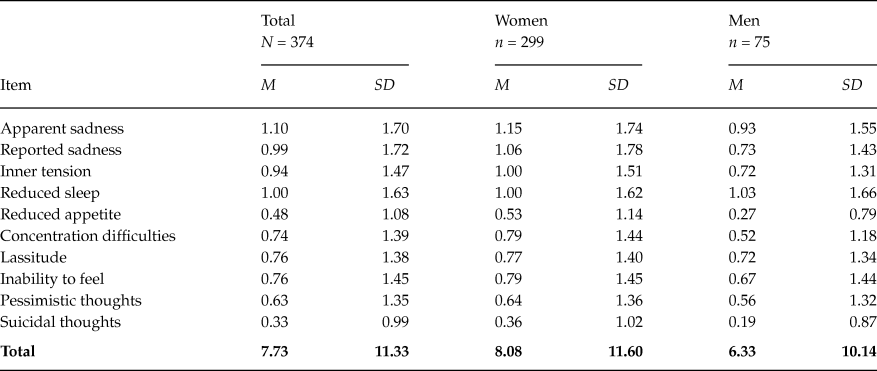
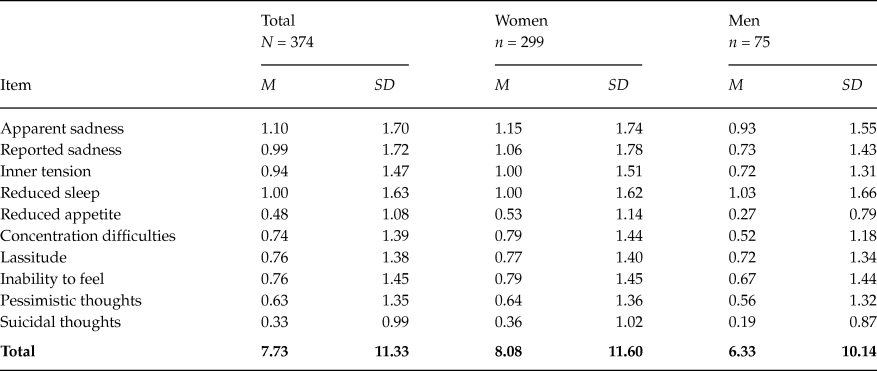
Table 1 shows the endorsement rate of depressive symptoms in obese patients in MADRS, in terms of mean (M) and standard deviation (SD). For the total sample, the mean total score placed the group in the severity level of “mild” depression (M t = 7.72; SD = 11.33). Regarding individual items, most of participants scored around 1.0 or lower. The most frequent endorsed symptoms were “apparent sadness”, followed by “reduction of sleep”, “reported sadness” and “inner tension”. Moreover, the less frequent symptoms were “suicide” and “decreased appetite”. Although women have endorsed more symptoms and displayed higher mean total score than men (M w = 8.08 versus M m = 6.33; p = .23), this difference was not statistically significant after the analysis of variance (ANOVA) to compare the total and item scores. These results indicated that the MADRS can detect cases of mild depression by the total scores strategy. While women are more easily classified above the threshold of depression > 7, men are below the threshold.
Mean (M) and standard deviation (SD) of the Montgomery-Åsberg Depression Rating Scale for obese patients, total sample and by gender
Among the participants, 27.5% (n = 103) met the criteria of major depressive episode according to the DSM-IV. The contingency table 2 x 2 was constructed for all possible cut-offs for MADRS, taking as comparison the gold standard SCID-I. These tables allowed estimating the number of true positive and negative cases, and the false positive and false negative cases for each cut-off point. The contingency tables allowed determining following indicators: sensitivity, specificity, positive predictive value (PPV) and negative predictive value (NPV). Table 2 shows the range of cut-off points with acceptable or appropriate performance and the best cut-off point was set as 13/14. This threshold was determined by the tradeoff between the maximum performance of sensitivity and specificity. For this cut-off, the sensitivity was 85% and specificity was 81%. The resulting PPV was 70% and the NPV 91%, showing that this cut-off point is capable of detecting around 90% of cases of depression in comparison with the gold standard SCID-I.
Sensitivity, specificity, positive and negative predictive values and best cut-off point for score of the Montgomery-Åsberg Depression Rating Scale among obese patients (n = 374)

* Tradeoff between sensitivity and specificity.
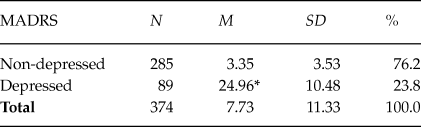
Among the 103 patients classified as depressed by structured interview SCID-I, the new 13/14 MADRS threshold failed to detect 16 subjects. Using this threshold, patients who rated below this point was considered non-depressed and those that scored above were considered depressed (Table 3), with an average score significantly higher than non-depressed obese (M d = 24.96 versus M nd = 3.35, p < .0001). According to the new threshold estimated by the gold standard, the severity level of depression detected among obese patients would be classified as of “moderate” intensity.
Mean (M) and standard deviation (SD) of the Montgomery-Åsberg Depression Rating Scale for non-depressed and depressed obese patients, in accordance with the 13/14 threshold

* ANOVA F = 8.95; p < .0001.
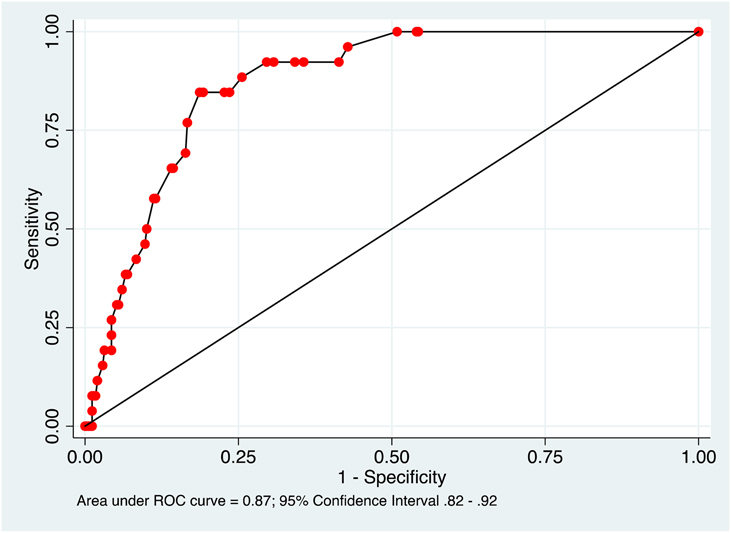
Following, the sensitivity and proportion of false positive (1 - specificity) were used to build the ROC curve. These indicators were plotted in comparison with the category of DSM-IV depressive disorders as yielded by SCID-I (Figure 1). The calculation of the area under the ROC curve (AUC) showed that the accuracy or performance of the MADRS was satisfactory (AUC = .87; CI95% .82 – .92), as the scale could properly identify the vast majority of cases of depression.
Receiver Operating Characteristic Curve of the Montgomery-Åsberg Depression Rating Scale.

Discussion
Despite conspicuous literature linking obesity and depressive disorders, there are not psychometric studies investigating the applicability of MADRS in severely obese patients. The present study demonstrated that the MADRS presents suitable psychometric characteristics, with good internal consistency and appropriate validity to identify depressive disorders among pre-operative obese patients who were waiting for surgical procedures. The scale has shown to be able to detect approximately nearly 90% of cases of depression with the final threshold of 13/14. The mean score of 7.7 marginally detected possible cases of “mild depression”, but the subjects who scored above the best cut-off point had a severity level that was compatible with “moderate depression”. This differential performance qualifies MADRS as a versatile and efficient tool to screen quickly and to refer the case of obese patients with depression to treatment in various settings, for example, in its pre-surgical period. Its psychometric performance was considered robust, with good sensitivity and specificity, and there was no statistically significant influence of gender. The psychometric properties of the scale are also strengthened by its positive acceptance by the user, being a cost-effective tool for rapid implementation and easy to understand.
In general, satisfactory reliability can be confirmed by the majority of similar studies investigating MADRS, with the reported Cronbach’s alpha coefficient close to .80 (Bunevicius et al., Reference Bunevicius, Staniute, Brozaitiene, Pommer, Pop, Montgomery and Bunevicius2012; Muller-Thomsen, Arlt, Mann, Mass, & Ganzeret Reference Muller-Thomsen, Arlt, Mann, Mass and Ganzer2005; Mundt et al., Reference Mundt, Katzelnick, Kennedy, Eisfeld, Bouffard and Greist2006;). Since the reliability assurance is a premise to investigate the validity of the construct being assessed, it is safe to assume that the favorable psychometric performance can be partly attributed to the consistency of the MADRS, indicating homogeneity of the items that make up the scale to measure the same target construct.
Introduced in 1979, the MADRS scale is widely used in several clinical populations (Bunevicius et al., Reference Bunevicius, Staniute, Brozaitiene, Pommer, Pop, Montgomery and Bunevicius2012; Leentjens, Verhey, Lousberg, Spitsbergen, & Wilmink, Reference Leentjens, Verhey, Lousberg, Spitsbergen and Wilmink2000; Magnil, Gunnarsson & Bjorkelund, Reference Magnil, Gunnarsson and Bjorkelund2011; Portugal et al., Reference Portugal, Coutinho, Almeida, Barca, Knapskog, Engedal and Laks2012; Sarro, 2004) being applied in many follow-up studies and clinical trials (Zimmerman, Chelminski, & Posternak, Reference Zimmerman, Chelminski and Posternak2004). Nevertheless, researchers still inquire about which cut-off should be adopted for their sample. The cut-off point may vary depending on the characteristics of the disease and respondents, the objective and the methodology of the investigation.
Taking into account the characteristics of the population under investigation, the score of some MADRS items should be interpreted with caution, wherein their improper use can alter the performance of the scale for the planned purpose – i.e., how large is the tolerable number of cases of false positives or false negatives. Specifically, the low score of the symptom endorsement of “decreased appetite” in obese patients indicates that this symptom has little utility in assessing people who present overeating behavior, even in depressed state. This item can reduce the total score and decrease the identification of active cases of depression among obese. Similarly, the symptom of “suicidal ideation” was observed so infrequently among men, which can cause differential between-sex performance when applying the MADRS, although ANOVA results showed that there is no difference between sex for total mean score. Some depressed men were unable to be detected as depressed in agreed-upon threshold and different cut-off points may be necessary for each sex. It is suggested that future studies with MADRS incorporate a thorough analysis in relation to differential item functioning by Item Response Theory and review the need to include all items in specific populations.
The mean total scores in our study were able to identify cases of “mild” depression, but would detect only 56% of true positive cases, especially obese women in the study. However, examining the psychometric parameters of MADRS for the region between 5–9, we observe that the scale has detected cases of depression with substantial sensitivity, identifying more than 90% of probable cases. Further, the specificity of approximately 70% along with lower PPV can be of little help to identify those active cases. Notwithstanding, the sensitivity of the MADRS has reduced slightly in the region between 10 and 14, but still present acceptable performance that was accompanied by considerable improvement of its specificity. In the cut-off point of 13/14, we achieved an increase in PPV without substantial loss in NPV. These results indicate that the threshold of > 7 proposed by Herrmann et al. (Reference Herrmann, Black, Lawrence, Szekely and Szalai1998), may be too sensitive and it is recommended for population screening studies of probable cases of “mild” depression. If a researcher needs to ensure the specificity of detecting cases of depression, the adopted threshold should be higher. While the threshold 6/7 identified cases of “mild” depression, we observed that cases of depressed obese were classified at a level of “moderate” depression as we raise the threshold to 13/14. Therefore, careful psychometric studies are essential to help the researcher to establish the best cut-off point according to their research objectives.
In comparison to studies that investigated the criterion validity of the MADRS (Bunevicius et al, Reference Bunevicius, Staniute, Brozaitiene, Pommer, Pop, Montgomery and Bunevicius2012; Leentjens et al., Reference Leentjens, Verhey, Lousberg, Spitsbergen and Wilmink2000; Magnil et al., Reference Magnil, Gunnarsson and Bjorkelund2011; Mottram, Wilson, & Copeland, Reference Mottram, Wilson and Copeland2000; Muller-Thomsen et al., Reference Muller-Thomsen, Arlt, Mann, Mass and Ganzer2005; Portugal et al., Reference Portugal, Coutinho, Almeida, Barca, Knapskog, Engedal and Laks2012; Riedel et al., Reference Riedel, Moller, Obermeier, Schennach-Wolff, Bauer, Adli and Seemuller2010; Reijnders, Lousberg, & Leentjens, Reference Reijnders, Lousberg and Leentjens2010), three studies reported the best cut-off of 13/14 (Magnil et al., Reference Magnil, Gunnarsson and Bjorkelund2011; Muller-Thomsen et al., Reference Muller-Thomsen, Arlt, Mann, Mass and Ganzer2005; Reijnders et al., Reference Reijnders, Lousberg and Leentjens2010). The thresholds ranged from 6 to 21, and the study Riedel et al. (Reference Riedel, Moller, Obermeier, Schennach-Wolff, Bauer, Adli and Seemuller2010) reported the cut-off point of 6/7 for bipolar patients and Mottram et al., (Reference Mottram, Wilson and Copeland2000) of 20/21 for geriatric sample. Interestingly, the results of the obese population were similar to validation data from patients with cognitive impairments such as Alzheimer’s disease and Parkinson’s disease (Muller-Thomsen et al., Reference Muller-Thomsen, Arlt, Mann, Mass and Ganzer2005; Reijnders et al., Reference Reijnders, Lousberg and Leentjens2010). In a psychometric study with elderly patients (Yoon et al., Reference Yoon, Choi, Yu, Ha, Ryu and Park2012), the authors suggested an association between high BMI and cognitive decline. More studies are needed to confirm this potential association.
Some characteristics of medical conditions can hamper the implementation of definite psychometric instruments. The easy applicability of a short scale as MADRS has the advantage of serving as a standardized instrument for use in various clinical settings (Bunevicius et al., Reference Bunevicius, Staniute, Brozaitiene, Pommer, Pop, Montgomery and Bunevicius2012; Leentjens et al., Reference Leentjens, Verhey, Lousberg, Spitsbergen and Wilmink2000; Magnil et al., Reference Magnil, Gunnarsson and Bjorkelund2011; Portugal et al., Reference Portugal, Coutinho, Almeida, Barca, Knapskog, Engedal and Laks2012; Sarro et al., Reference Sarro, Duenas, Ramirez, Arranz, Martinez, Sanchez and San2004) saving the time of busy professionals in conducting lengthy interviews. Although several studies validating psychometric scales have adopted the MADRS as the comparison tool (Mottram et al., Reference Mottram, Wilson and Copeland2000; Portugal et al., Reference Portugal, Coutinho, Almeida, Barca, Knapskog, Engedal and Laks2012), there is limited evidence on psychometric performance of the MADRS. The format of the observer scale of MADRS has the advantage of allowing comprehensive comparisons of depressive symptoms in different clinical populations, such as individuals with cognitive impairments, with limited understanding, clinical diseases that obstruct the use of self-administration scales. The usefulness of a validated scale to assess depressive symptoms in clinical samples is unquestionable when one in four patients present clinical depression (Hedman et al., Reference Hedman, Ljotsson, Kaldo, Hesser, El Alaoui, Kraepelien and Lindefors2014; Muller-Thomsen et al., Reference Muller-Thomsen, Arlt, Mann, Mass and Ganzer2005; Mundt et al., Reference Mundt, Katzelnick, Kennedy, Eisfeld, Bouffard and Greist2006; Portugal et al., Reference Portugal, Coutinho, Almeida, Barca, Knapskog, Engedal and Laks2012). In our study of diagnostic evaluation of bariatric obese patients (Duarte-Guerra et al., Reference Duarte-Guerra, Coelho, Santo and Wang2015), one in five participants met the diagnostic criteria for a current depressive episode according to DSM-IV system, confirming the relevance of psychiatric disorders among medical patients.
Most studies have indicated that the MADRS can detect approximately 90% of cases of depression, which ranged from 80% to 96% (Kang et al., Reference Kang, Stewart, Kim, Jang, Kim, Bae and Yoon2013; Mottram et al., Reference Mottram, Wilson and Copeland2000; Portugal et al., Reference Portugal, Coutinho, Almeida, Barca, Knapskog, Engedal and Laks2012; Reijnders et al., Reference Reijnders, Lousberg and Leentjens2010; Riedel et al., Reference Riedel, Moller, Obermeier, Schennach-Wolff, Bauer, Adli and Seemuller2010). However, some methodological differences may explain the different rates of depressive symptoms observed in various populations. For example, the method of data collection might have affected their performance: while some studies have completed telephone interview (Mundt et al., Reference Mundt, Katzelnick, Kennedy, Eisfeld, Bouffard and Greist2006), other studies have taken personal interviews. The advantages of each method of collection over self-report inventories should not be stated, since formal comparisons were not tested. Anyway, the frequency of depressive symptoms may change in accordance to the methodology of data collection.
Some obese population characteristics should be taken into consideration in the interpretation of psychometric scales. Besides the physical difficulties to undergo extensive interviews due to overweight, bariatric patients tend to mask their emotional and physical symptoms (de Zwaan, Reference de Zwaan2012), fearing that an unfavorable diagnosis could disturb the schedule of their surgical procedure, generating many cases of false negatives with underestimate of psychiatric disorders. Many patients may have not disclosed problems being afraid of negative results of the assessment, which might lead to the disapproval or delay of surgery. Conversely, exaggerating their symptoms could serve to by-pass their ranking in the waiting list, resulting in cases of false positives. Thus, a structured observer scale as MADRS, conducted by an experienced interviewer reduces the possibility of distortion of symptom detection. Probably, this type of instrument is superior over self-report scales (Wang & Gorenstein, Reference Wang and Gorenstein2013). In a recent study that applied the Beck Depression-II in obese patients (Hayden Brown, Brennan, & O'Brien, Reference Hayden, Brown, Brennan and O'Brien2012), they observed a significant proportion of false positive cases and low rate of self-reported depressive symptoms. Some clinical samples with special requirements may be adapted to meet the specific needs of each population - in our case, class III obese patients waiting for surgery. Thus, an observer scale with proper demonstration of criterion validity as the MADRS is recommended for use among obese people in the pre-surgical period.
Some limitations of this study should be considered before generalizing the data of this investigation for obese population. All participants in the sample were recruited from the same university hospital, raising doubts about the representativeness of the profile of obese participants who agreed to participate in the interview. Although the evaluations are carried out independently of the preoperative screening and surgical approval process, it is possible that patients have omitted, underestimated or exaggerated their symptoms, fearing interference in the schedule of surgery, distorting the actual frequency of psychiatric symptoms - known as “impression management” in the literature (de Zwaan, Reference de Zwaan2012). Possibly, clinical comorbidities associated with obesity and the medication used by this population may confuse the symptoms reported, for example, “fatigue” is often reported by physically compromised patients and can easily be interpreted as a depressive symptom. Finally, the cross-sectional design of this study limits the scope of the results, is desirable following-up patients in both the pre and post-surgical phase with longitudinal design to strengthen the information on the stability and sensitivity to change of MADRS in obese population.
Our study evaluated the psychometric performance of the MADRS scale in pre-surgical patients, adopting a semi-structured interview SCID-I as the gold standard. Our findings showed that the MADRS scale is an effective tool in bariatric pre-operative evaluation, with accurate and robust psychometric properties, in relation to both reliability and validity. The systematic detection of depressive psychopathology with structured and validated instruments (Mechanick et al., Reference Mechanick, Youdim, Jones, Garvey, Hurley, McMahon and Brethauer2013) during the pre-surgical evaluation can contribute to a better prognosis in the postoperative period. The recommendation of incorporating effective evaluation of individuals with overweight and obesity in clinical practice guidelines can improve the surgical indication of obese patients and reduce their disease burden during the follow-up period.