INTRODUCTION
The striped dolphin (Stenella coeruleoalba) is widely distributed in temperate to tropical seas worldwide and is the most common cetacean species in the Mediterranean, found in offshore water from Gibraltar to the Levant Basin and the Aegean Sea (Jefferson et al., Reference Jefferson, Leatherwood and Webber1993; Notarbartolo di Sciara & Birkun, Reference Notarbartolo di Sciara and Birkun2010). There are also some stranding and live sightings records in the Marmara Sea (Öztürk et al., Reference Öztürk, Dede and Komut1999; Altuğ et al., Reference Altuğ, Aktan, Oral, Topaloğlu, Dede, Keskin, İşinibilir, Çardak and Çiftçi2011). The Mediterranean subpopulation is classified by IUCN as vulnerable (Aguilar & Gaspari, Reference Aguilar and Gaspari2012). The species is typically oceanic, inhabiting deep waters beyond the continental shelf (Notarbartolo di Sciara et al., Reference Notarbartolo di Sciara, Venturino, Zanardelli, Bearzi, Borsani and Cavalloni1993; Forcada et al., Reference Forcada, Aguilar, Hammond, Pastor and Aguilar1994; Gannier, Reference Gannier2005), where it feeds primarily on mesopelagic fish and cephalopods, and crustaceans to a lesser extent (Würtz & Marrale, Reference Würtz and Marrale1993). In addition, they are recorded in shallow waters and feeding on demersal or coastal fish species (Frantzis et al., Reference Frantzis, Alexiadou, Paximadis, Politi, Gannier and Corsini-Foka2003; Spitz et al., Reference Spitz, Richard, Meynier, Pusineri and Ridoux2006; Santos et al., Reference Santos, Pierce, Learmonth, Reid, Sacau, Patterson and Ross2008). But typically, prey organisms are small-sized, pelagic, schooling and vertically migrating species (Ringelstein et al., Reference Ringelstein, Pusinieri, Hassani, Meynier, Nicolas and Ridoux2006; Meissner et al., Reference Meissner, Macleod, Richard, Ridoux and Pierce2012).
The diet of the striped dolphin is well documented in the western and central Mediterranean Sea (Pulcini et al., Reference Pulcini, Carlini and Wurtz1992; Bello, Reference Bello1993; Würtz & Marrale, Reference Würtz and Marrale1993; Blanco et al., Reference Blanco, Anzar and Raga1995; Alessandri et al., Reference Alessandri, Affronte and Scaravelli2001; Meissner et al., Reference Meissner, Macleod, Richard, Ridoux and Pierce2012). But there is a scarcity of knowledge in the eastern basin, where the only existing study is that of Öztürk et al. (Reference Öztürk, Salman, Öztürk and Tonay2007), who examined cephalopod remains in the stomachs of three by-caught striped dolphins.
Although cetaceans have been under legal protection in Turkey since 1983, they still face the threat of being by-caught in various fishing gears, such as driftnets in the Aegean and the Mediterranean Sea. There have been several incidents of striped dolphin by-catches in the swordfish driftnet fishery in the Turkish waters before (Öztürk et al., Reference Öztürk, Öztürk and Dede2001; Akyol et al., Reference Akyol, Erdem, Ünal and Ceyhan2005; Dede, Reference Dede2008) until this particular fishery method was banned in 2006.
The aim of this study is to better understand feeding preferences of striped dolphins with more samples in the Turkish coastal waters of the eastern Mediterranean Sea.
MATERIALS AND METHODS
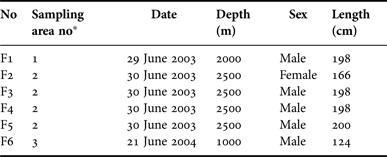
The samples were collected in the Turkish coast of the eastern Mediterranean Sea (Dede, Reference Dede2008), between Fethiye and Kalkan (Figure 1), in June 2003 and 2004. Six striped dolphins accidentally entangled in the swordfish driftnets were examined (Table 1). The distance from the coast was 7–9 nautical miles. The four animals from sampling area 2 were caught by the same driftnet. All the animals were measured and the stomachs were sampled and stored in a freezer at −20°C. Samples were thawed in the laboratory, the contents removed, washed and sieved in a 200 µm mesh size sieve and stored in 70% ethanol. Prey remains consisted principally of beaks of cephalopods (lower beaks were used for species identification), otoliths and dentaries of bony fish (e.g. Supplementary Figure S1 – Dentaries of Sudis hyalina) and crustaceans, which were identified using reference materials and published guides (Clarke, Reference Clarke1962, Reference Clarke1986; Mangold & Fioroni, Reference Mangold and Fioroni1966; Schmidt, Reference Schmidt1968; Wolff, Reference Wolff1984; Kocataş et al., Reference Kocataş, Katağan, Uçal and Benli1991; Lu & Ickeringill, Reference Lu and Ickeringill2002; Campana, Reference Campana2004; Tuset et al., Reference Tuset, Lombarte and Assis2008; Agiadi et al., Reference Agiadi, Triantaphyllou, Girone, Karakitsios and Dermitzakis2010). It was assumed that the number of prey fish was equal to half the number of the otoliths. For the beaks of cephalopods, lower rostral length (LRL) was measured and estimated mantle length (ML) was calculated as defined by Wolff (Reference Wolff1984), Clarke (Reference Clarke1986), Lu & Ickeringill (Reference Lu and Ickeringill2002) and Öztürk et al. (Reference Öztürk, Salman, Öztürk and Tonay2007).
Sampling areas in the eastern Mediterranean Sea. Numbers indicate the specimens listed in Table 1.

RESULTS
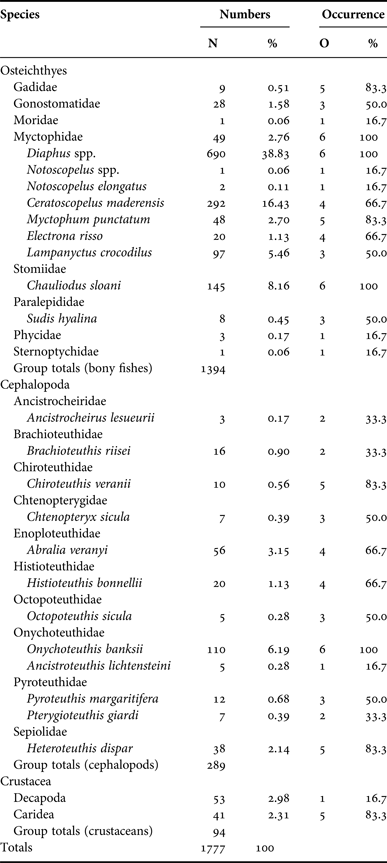
The occurrence of cephalopods, crustaceans and fish found in six striped dolphin stomachs are presented in Table 2. In total, 29 taxa were identified to species or family level and 1777 individual food items were counted.
Food items found in six striped dolphin stomachs from the eastern Mediterranean Sea.
N, total number of each prey in the stomachs; O, number of stomachs in which the prey species was found.
Bony fish
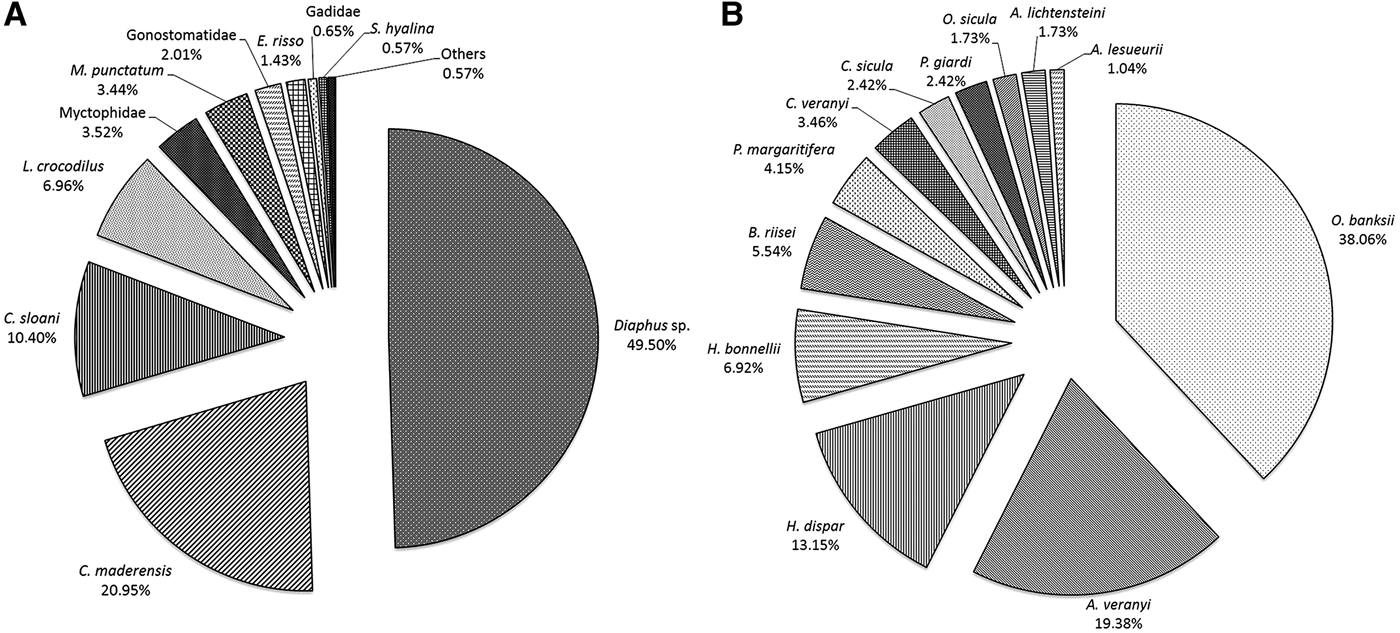
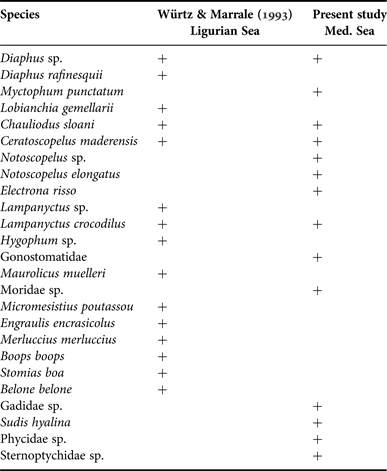
A total of 1394 bony fish belonging to eight families and nine species were identified in six stomachs. The major family was Myctophidae (lantern fish), representing 86.01% of the total number of fishes and 67.48% of the total number of all organisms. Diaphus spp. and Ceratoscopelus maderensis were the most predominant fishes, comprising 70.45% of the total number of fishes (Figure 2A), and 55.26% of total preys (Table 2). But only Diaphus spp. and Chauliodus sloani were found in all stomachs, representing 59.90% of the total number of the fishes (Figure 2A), and 46.99% of the total prey (Table 2). Myctophum punctatum, Notoscopelus elongatus, Electrona risso, Sudis hyalina, Moridae sp., Phycidae sp. and Sternoptychidae sp. were reported for the first time in the stomach contents of striped dolphins in the Mediterranean Sea.
Proportions of species found in the stomachs: (A) bony fishes; (B) cephalopods.
Although a great majority of its stomach contents included luminous deep-sea fish (Myctophidae, Gonostomatidae etc.) in the eastern Mediterranean (98.5%), epipelagic species were not found in the stomach contents (Table 2).
Cephalopods
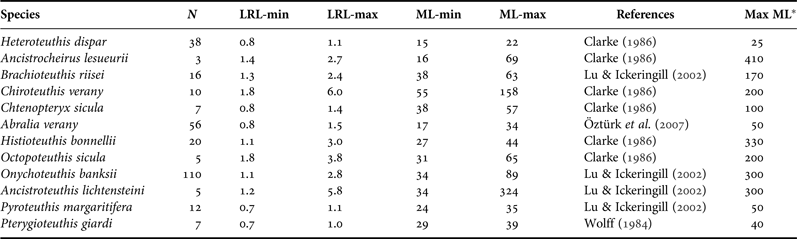
In six stomachs 289 cephalopod lower beaks were present. Twelve species belonging to 10 families were identified. The species found in the stomach were pelagic and mesopelagic luminous cephalopods. As the only cephalopod species spotted in all stomach content analyses, Onychoteuthis banksii represented 38.06% of the total number of cephalopods (Figure 2B) and 6.19% of the total number of all organisms (Table 2). Pterygioteuthis giardi and Chtenopteryx sicula were reported for the first time in the stomach contents of striped dolphins in the Mediterranean. Table 3 shows the distribution of mantle length of cephalopod species which has been estimated from the lower beaks found in the stomachs of the striped dolphins. The MLs of O. banksii and Abralia verany, the most abundant cephalopod species in the stomachs with 110 and 56 individuals, ranged between 39–89 mm and 17–34 mm respectively.
Estimated mantle length (mm) of cephalopods based on LRL measurements in the striped dolphins stomach contents.
N, number of lower beaks in stomach; LRL, measured lower rostral length; ML, estimated mantle length; Max ML, maximum mantle length.
* Jereb & Roper (Reference Jereb and Roper2010).
Crustaceans
In six stomachs 94 crustaceans were present, but only order Decapoda (2.98%) and suborder Caridea (2.31%) were identified.
DISCUSSION
There are very limited data on the cetacean diet in the eastern Mediterranean Sea and our results present new data to better understand the feeding ecology of striped dolphins in the study area, although by-caught dolphins in the same location may not be good enough representatives of the eastern Mediterranean population. Moreover, one should keep in mind that the stomach contents may not represent the population's diet as a whole due to the small sample size, as specified by Pierce & Boyle (Reference Pierce and Boyle1991). However, our samples came from by-caught dolphins and not from stranded individuals as in most of the western Mediterranean studies. This makes the results significant in terms of exposing the effective diet of striped dolphins in the study area.
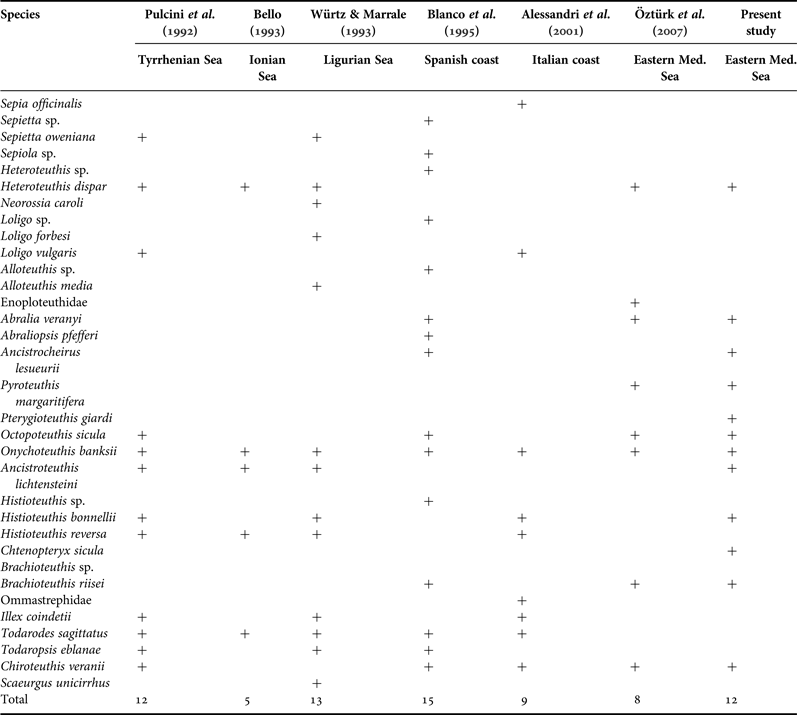
We compared the bony fishes and cephalopod species found in our dolphins to those reported previously from the Mediterranean Sea (Tables 4 & 5). The diet of the striped dolphins in the western Mediterranean Sea not only consists of luminous deep-sea fish but also relied on epipelagic species such as Engraulis encrasicolus and Belone belone, and demersal fish like Boops boops and Merluccius merluccius (Würtz & Marrale, Reference Würtz and Marrale1993). In contrast to the western Mediterranean Sea the small-sized mesopelagic and bathypelagic fish species, such as Diaphus spp. and Ceratoscopelus maderensis from Myctophidae, were the most important food source for the striped dolphins in the Eastern Mediterranean Sea. This difference can be explained by the proximity of our study area to the deepest part of the Mediterranean Sea (>4000 m). Likewise, Myctophidae species are also the dominant prey items of striped dolphins off the coasts of Japan and South Africa and in the oceanic waters of the north-east Atlantic (Frederick & Archer, Reference Frederick, Archer, Perrin, Würsig and Thewissen2009). However, bony fish species Myctophum punctatum, Notoscopelus elongatus, Electrona risso, Sudis hyalina, Moridae sp., Phycidae sp. and Sternoptychidae sp. were reported for the first time in the stomach contents of striped dolphins in the Mediterranean Sea. The discovery of such new fish species indicates that further stomach content studies are needed to fully describe the diet of this population in the Mediterranean Sea.
Fish species found in the diet of striped dolphins in the eastern Mediterranean Sea.
Cephalopod species found in the diet of striped dolphins in the Mediterranean Sea.
Concerning the diversity of cephalopods in our study area, Salman (Reference Salman2009) reported that there are 54 cephalopod species in the eastern Mediterranean Sea. Our study discovered 12 of these 54 species in the stomachs of six striped dolphins. Seven of these 12 species were previously mentioned by Öztürk et al. (Reference Öztürk, Salman, Öztürk and Tonay2007) in a similar study from the same region. Onychoteuthis banksii and A. veranyi were the most common prey cephalopods, which agree well with Öztürk et al. (Reference Öztürk, Salman, Öztürk and Tonay2007). The cephalopod species in our study mostly overlapped with those in the other study of the eastern Mediterranean Sea. A regional comparison of striped dolphins' diet between the eastern and western Mediterranean demonstrated that they choose to enter shallower waters and littoral regions in the western Mediterranean for feeding, as demersal species are specifically distributed in the littoral region in the western Mediterranean, such as Sepia officinalis, Sepiola spp., Sepietta oweniana, Loligo forbesi, L. vulgaris and Alloteuthis media, along with benthic octopod species such as Scaeurgus unicirrhus, which is not distributed in the eastern Mediterranean (Pulcini et al., Reference Pulcini, Carlini and Wurtz1992; Würtz & Marrale, Reference Würtz and Marrale1993; Blanco et al., Reference Blanco, Anzar and Raga1995; Alessandri et al., Reference Alessandri, Affronte and Scaravelli2001). While the eastern Mediterranean diet usually contained mesopelagic luminous cephalopod species, the number of cephalopod species found in the stomach contents was less than that of the western Mediterranean (Bello, Reference Bello1993; Öztürk et al., Reference Öztürk, Salman, Öztürk and Tonay2007). The cephalopod species which were found both in Turkish coastal waters and in other parts of the Mediterranean, such as H. dispar, A. veranyi and O. banksii, were distributed throughout the Mediterranean and fed on by striped dolphins. Pterygioteuthis giardi and Chtenopteryx sicula were reported for the first time by this study in the stomach contents of striped dolphins in the Mediterranean Sea.
Estimated mantle length (ML) results for O. banksii and A. veranyi were consistent with those of the individuals of this species distributed in the Mediterranean Sea (Salman, Reference Salman2009; Jereb & Roper, Reference Jereb and Roper2010). This fact suggests that some of the cephalopod species found in the stomach contents of cetaceans may well indicate the composition of their major population in the region as mentioned by Öztürk et al. (Reference Öztürk, Salman, Öztürk and Tonay2007). If we compare MLs with the maximum mantle length records of the cephalopod species (Jereb & Roper, Reference Jereb and Roper2010), it can be surmised that the striped dolphins predominantly preferred medium-length individuals to minimum and maximum length. However, the maximum ML record of Ancistroteuthis lichtensteini was outperformed. Regarding the fish species, Diaphus spp. and Ceratoscopelus maderensis, the most abundant fish species in the stomachs, are small fish in size that range between 70–90 mm (Fisher et al., Reference Fisher, Schneider and Bauchot1987). Furthermore, the maximum size of Myctophidae species tends to be smaller in the Mediterranean than the Atlantic (Olivar et al., Reference Olivar, Moli and Bernal2013). For instance; if 53 mm-long Diapus holti weighs 2.66 g (Battaglia et al., Reference Battaglia, Malara, Romeo and Andaloro2010), 699 of them obtained from the stomachs would weigh approximately 1.86 kg. If an 86 mm-long O. banksii weighs 13.4 g (Lu & Ickeringill, Reference Lu and Ickeringill2002), 110 of them obtained from the stomachs would weigh 1.47 kg. Therefore, although bony fish are dominant in the stomachs in terms of number, all these inferences also indicate that cephalopods are equally important in the diet of striped dolphins, as previously mentioned by Würtz & Marrale (Reference Würtz and Marrale1993).
There is little information, however, on the feeding behaviour of these dolphins, thus it is also likely that they feed mostly on non-commercial species and during the night, utilizing the diurnal migration of prey fish and cephalopods. The striped dolphins may dive from 200 to 700 m for feeding and their foraging is known to occur around dusk or early night when prey migrates closer to the surface (Frederick & Archer, Reference Frederick, Archer, Perrin, Würsig and Thewissen2009). More stomach content analyses seem necessary for comparison of seasonal or spatial prey preferences of striped dolphins.
The region, especially the deep-sea area of Rhodes in the south of the study area, is an important habitat for cetaceans, particularly for the sperm whale (Physeter macrocephalus) whose main diet is deep-sea cephalopods, and was recommended as a High Sea Marine Protected Area (Öztürk, Reference Öztürk2009; Öztürk et al., Reference Öztürk, Tonay and Dede2013). This region and the surrounding area are known to be one of the few deep-sea environments in the Mediterranean where striped dolphins and Risso's dolphins (Grampus griseus) are also known to occur (Boisseau et al., Reference Boisseau, Lacey, Lewis, Moscrop, Danbolt and McLanaghan2010; Dede et al., Reference Dede, Saad, Fakhri and Öztürk2012). Therefore, it is of high importance to establish conservation strategies for the feeding areas of the above-mentioned cetaceans.
Supplementary material
To view supplementary material for this article, please visit http://dx.doi.org/10.1017/S0025315415001538.
ACKNOWLEDGEMENTS
We thank fishermen in Fethiye region for their help in the field; Onur Gönülal, Hakkı Bayar and Mert Keçeci for their help in the laboratory; Dr Murat Bilecenoğlu for his help in identifying dentaries of Sudis hyalina and editing the manuscript; Dr Bülent Topaloğlu for identifying crustaceans; and Professor Dr Bayram Öztürk and Dr Ayaka A. Öztürk for their encouragement and support.
FINANCIAL SUPPORT
This study was supported by Istanbul University, Scientific Research Projects (BAP 105/15052003).