

Aging is no doubt one of the most significant demographic changes in the world today. The proportion of the world’s population over 60 years will nearly double, from 12% to 22%, between 2015 and 2050 (http://www.who.int). Age-related decline across multiple domains severely reduces quality of life. Specifically, decline in language comprehension, as one of humans’ core competencies, can have a pronounced impact.
Beyond single word recognition, language comprehension relies on the integration of small semantic blocks into larger coherent representations (Hagoort, Baggio, & Willems, Reference Hagoort, Baggio, Willems and Gazzaniga2009). Although older adults accumulate larger vocabulary and more language expertise than younger adults (Park & Reuter-Lorenz, Reference Park and Reuter-Lorenz2009), it remains unclear whether semantic integration declines in aging. On the one hand, older adults have an advantage over younger adults in building discourse-level mental representations, a skill that relies on semantic integration (Madden & Dijkstra, Reference Madden and Dijkstra2010), and they show preserved semantic integration during spoken language comprehension at normal speech rates (reviewed in Diaz, Rizio, & Zhuang, Reference Diaz, Rizio and Zhuang2016). On the other hand, cumulative evidence has also shown that semantic integration performance declines with age (reviewed in Wlotko, Lee, & Federmeier, Reference Wlotko, Lee and Federmeier2010).
Behavioral studies have shown that older adults have lower accuracy and longer response times than younger adults on sentence comprehension tasks (Federmeier, Kutas, & Schul, Reference Federmeier, Kutas and Schul2010; Wlotko et al., Reference Wlotko, Lee and Federmeier2010). Event-related potentials (ERPs) have also been used to capture the rapid process of semantic integration. When the semantic integration demand increases, a larger negative deflection appears and peaks at about 400 ms (N400) after the critical word onset (Hagoort, Hald, Bastiaansen, & Petersson, Reference Hagoort, Hald, Bastiaansen and Petersson2004; Kutas & Hillyard, Reference Kutas and Hillyard1980). In addition, the N400 effect is largely reduced in older adults compared to younger adults (Federmeier et al., Reference Federmeier, Kutas and Schul2010; Wlotko & Federmeier, Reference Wlotko and Federmeier2012; Xu, Hou, Zhao, Zhu, & Yang, Reference Xu, Hou, Zhao, Zhu and Yang2017), and the reduced N400 effect has been shown to be correlated with age among older adults (Faustmann, Murdoch, Finnigan, & Copland, Reference Faustmann, Murdoch, Finnigan and Copland2007). With age, the increasing difficulty of semantic integration also often induces a late positive component (LPC) that is observed after the N400, starting at about 550 ms (Federmeier et al., Reference Federmeier, Kutas and Schul2010). The N400-LPC effect in aging has been found not only in Indo-European languages but also during Chinese sentence reading (Xu et al., Reference Xu, Hou, Zhao, Zhu and Yang2017). Moreover, Peelle, Troiani, Wingfield, and Grossman (Reference Peelle, Troiani, Wingfield and Grossman2010) showed that when working memory demand increased, the task performance declined more than among those in the less demanding condition in aging.
The studies have raised the question of whether the age-related decline was due to diminished semantic processing per se or due to confounding factors such as working memory, one of the most prominent functions that declines in aging (Bopp & Verhaeghen, Reference Bopp and Verhaeghen2005; Park & Reuter-Lorenz, Reference Park and Reuter-Lorenz2009). Previous comprehension studies have employed sentences heavily dependent on semantic memory (Federmeier et al., Reference Federmeier, Kutas and Schul2010), or have commonly compared complex sentences versus simple sentences to reveal the semantic integration process, especially in functional magnetic resonance imaging studies (Grossman et al., Reference Grossman, Cooke, DeVita, Chen, Moore, Detre and Ge2002; Peelle et al., Reference Peelle, Troiani, Wingfield and Grossman2010, Reference Peelle, Chandrasekaran, Powers, Smith and Grossman2013). Given that the comprehension of complex sentences relies on working memory more than does the comprehension of simple sentences, the results of earlier studies must be interpreted in light of the possibility that there was a confounding effect of working memory. Critically, previous studies have confirmed that individual differences in working memory are closely associated with the N400 effect (Federmeier et al., Reference Federmeier, Kutas and Schul2010; Federmeier, McLennan, De Ochoa, & Kutas, Reference Federmeier, McLennan, De Ochoa and Kutas2002; Gunter, Jackson, & Mulder, Reference Gunter, Jackson and Mulder1995; Salisbury, Reference Salisbury2004) in older adults. In addition, complex sentences usually are syntactically complex sentences that require more syntactic processing than simple sentences do. Thus, studying this type of contrast cannot answer the question of whether semantic integration decline can be separated from working memory decline in aging.
Therefore, an important question is whether the semantic integration decline in aging can solely be explained by working memory. Theoretically, semantic integration and working memory are strongly related but also separable. On the one hand, the processing and storage in working memory varies among individuals, which in turn can account for qualitative and quantitative differences among younger and older adults in language comprehension (Just & Carpenter, Reference Just and Carpenter1992). The ambiguous nature of language comprehension also requires the reader to select appropriate and inhibit inappropriate candidates, constraining comprehension (Hasher & Zacks, Reference Hasher, Zacks and Bower1988). On the other hand, although the selection and inhibition involved in semantic integration are key components of the executive control part of working memory (Baddeley, Reference Baddeley1992), semantic integration is thought to be different from executive control processes (Hagoort et al., Reference Hagoort, Baggio, Willems and Gazzaniga2009). Research has shown isolated activation for semantic integration, independent of executive control processes in younger adults (Zhu et al., Reference Zhu, Feng, Zhang, Li, Li and Wang2013). In addition, it has been found that working memory impacts the use of animacy but not of semantic integration related to world knowledge (Nakano, Saron, & Swaab, Reference Nakano, Saron and Swaab2010).
One way to determine the separation of semantic integration and working memory in aging would be to control for working memory, but most studies have not done this. One exception showed that the effect of chronological age on offline behavioral measurement of sentence comprehension was not significant after controlling for working memory decline (DeCaro, Peelle, Grossman, & Wingfield, Reference DeCaro, Peelle, Grossman and Wingfield2016). However, it remains an open question whether there is age-related decline during online reading after controlling for working memory.
The aim of the present study was to isolate age-related decline in semantic integration from decline in working memory. We recruited 43 younger and 43 older adults, constituting a much larger sample than in previous studies (typically <20 in each group). This is a key strength, as a larger sample size can raise the reproducibility (Hu et al., Reference Hu, Wang, Guo, Song, Sui and Peng2016). The semantic integration task required participants to read congruent (“Honey is sweet”) and incongruent (“Honey is dusky”) sentences. Simple sentences do not involve complex syntactic structure and do not require the reader to maintain the semantic information in working memory, thus minimizing demands on working memory resources.
Furthermore, to clarify the working memory contribution in semantic integration decline during aging, the group comparison of the semantic integration effect was performed with and without controlling for working memory. Specifically, we planned to statistically control for any group differences in demographics or related cognitive functions. Then, in order to address the research question, working memory was added as an additional control variable. If there was evidence of age-related decline in semantic integration after controlling for working memory, then we could conclude that semantic integration decline is independent of working memory. By contrast, if there was no evidence of age-related decline in semantic integration after controlling for working memory, then we would conclude that declines in working memory explain declines in semantic integration.
Method
Participants
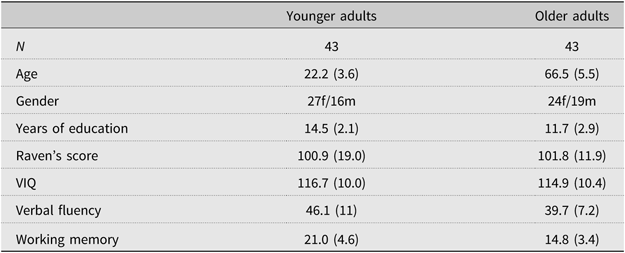
The present study recruited 86 Chinese speakers, of whom 43 were younger adults (14 male, 27 female, mean ± SD, 22.2 ± 3.6 years) and 43 were older adults (19 male, 24 female, 66.5 ± 5.5 years). The two groups had comparable gender ratios (χ2 = 0.43, p = .51). Younger adults had more years of education (14.5 ± 2.1 years) than older adults (11.7 ± 2.9 years), t (84) = 5.16, p < .001. Written informed consent was obtained from each participant. By self-report, participants had normal or corrected-to-normal visual acuity and no history of psychiatric problems. Table 1 presents the demographic characteristics of participants.
Demographic characteristics and neuropsychological functioning of the younger and older adults
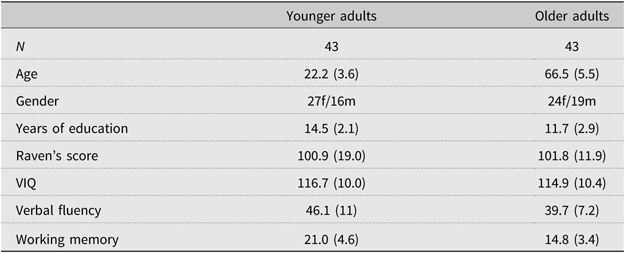
Note: Standard deviation in parenthesis. VIQ, verbal intelligence quotient.
Neuropsychological tests
To confirm the cognitive health status of the older participants, we administered the Beijing version of the Montreal Cognitive Assessment to the older adults to test short-term memory recall, visuospatial skill, executive functioning, language, orientation, attention, concentration, and working memory. The older participants in this study were cognitively healthy, as indicated by a mean score on the Montreal Cognitive Assessment of 26.9 (SD = 2.7, range = 25–30). Raven’s Standard Progressive Matrices (Zhang & Wang, Reference Zhang and Wang1985) also revealed no significant difference in basic cognitive ability between the younger adults (101.8 ± 11.9) and older adults (100.9 ± 19), t (84) = 0.27, p = .79.
Furthermore, we evaluated all participants’ language competence, assessed in terms of verbal intelligence (Gong, Reference Gong1992) and verbal fluency. The Wechsler verbal intelligence quotient was comparable between the younger (116.7 ± 10.0) and older (114.9 ± 10.4) adults, t (84) = 0.84, p = .41. Verbal fluency was assessed by asking the participants to generate the names of as many animals or tools as possible in 1 min. The total number of animals and tools generated by the younger adults (46.1 ± 11.0) was significantly higher than the number generated by the older adults (39.7 ± 7.2), t (84) = 3.2, p = .002.
Finally, during the working memory test, participants were requested to recall the last word of each sentence of a sentence block. Following the digit span test in the Wechsler verbal intelligence scale, the number of sentences in each block varied from 3 to 8, and each sentence had 5–13 Chinese characters. To aid the detection of individual differences and to better interpret correlations between the score and the ERP effect, the individual’s working memory span was defined as the total number of remembered vocabulary words (Friedman & Miyake, Reference Friedman and Miyake2005; Zhu, Hou, & Yang, Reference Zhu, Hou and Yang2018). The result showed that the average score of the younger adults (21.0 ± 4.6) was significantly higher than that of the older adults (14.8 ± 3.4), t (84) = 7.03, p < .001.
Stimuli
Congruent (CON) and incongruent (INCON) sentences were constructed. To shorten the sentence presentation, each sentence was three words long. For the CON condition, we constructed 160 congruent short sentences, with the critical word (CW) appearing at the end of each sentence (e.g., 蜂蜜很甘甜/Honey is sweet). For the INCON condition, the CW from the congruent sentence was replaced with a word (e.g., 昏暗/dusky) that semantically violated the context. The word frequency (Cai & Brysbaert, Reference Cai and Brysbaert2010; 1.85 ± 0.66 and 1.72 ± 0.68 for CON and INCON, respectively), t (159) = 1.51, p = .13, and number of strokes (18.1 ± 4.30 and 18.4 ± 4.60 for CON and INCON, respectively), t (159) = 0.56, p = .58, of the CW were matched between the CON and INCON conditions. The stimuli were equally distributed in different conditions, and counterbalanced across conditions and participants. The familiarity of the CON sentences was rated by another 16 younger adults, using a scale from 1 (fully unfamiliar) to 5 (fully familiar). The mean rating was 4.33 (SD = 0.40). To make sure the older adults were also familiar with the sentences, they were asked to rate the sentences using a scale from 1 (fully unfamiliar) to 5 (fully familiar) after the EEG recording. The mean rating was 4.23 (SD = 0.24).
Procedure
All stimuli were presented using E-Prime software (2.0). For each trial, after a 300-ms cross fixation, the sentence was presented word by word. Each word was presented at the center of the screen for 500 ms followed by a 100-ms blank screen. Then a question mark was presented for a period of 3000 ms, during which the participants were asked to judge if the sentence was semantically acceptable or not. A 1000-ms intertrial interval was used. The participants were asked to blink as little as possible during the reading.
EEG recording and preprocessing
EEG data were collected from a standard 64-channelcap (10/20 system; Neuroscan, the United States). The EEG was recorded continuously with a 70 Hz low-pass filter sampled at 500 Hz, with a 10 s constant time. All electrode impedances were kept below 5 kΩ before recording. The EEG data were rereferenced offline to the average of the two mastoids, and then filtered with a 0.1–30 Hz bandpass filter. Critical epochs ranged from –200 ms to 1000 ms relative to the onset of the target word, with –200 ms to 0 ms serving as the baseline. The artifact rejection criterion was ± 90 μV, with fewer than 5% of trials being rejected. Then, the ERP data were averaged for each participant and each condition for correct trials only.
Statistics
Based on methods used in previous studies (Hagoort, Reference Hagoort2008; Kutas & Federmeier, Reference Kutas and Federmeier2011) as well as visual inspection, we calculated peak latency and amplitude for the N400 and LPC time windows, as well as onset latency for N400 effect. The time windows for examining the N400 effect in the younger and the older adults were 300–500 ms and 350–550 ms, respectively (Federmeier et al., Reference Federmeier, Kutas and Schul2010). The time window for the LPC was 700–900 ms. Onset latency for the N400 effect was assessed by determining the point in time at which 50% of the peak amplitude was exceeded by a difference wave between conditions (INCON–CON), using Jackknife correction (Miller, Patterson, & Ulrich, Reference Miller, Patterson and Ulrich1998). The electrodes were grouped as left and right hemisphere and anterior and posterior regions (F1, F3, F5, FC1, FC3, FC5, for left anterior; F2, F4, F6, FC2, FC4, FC6 for right anterior; P1, P3, P5, CP1, CP3, CP5 for left posterior; and P2, P4, P6, CP2, CP4, CP6 for right posterior).
Four analyses of covariance (ANCOVAs) were conducted. First, a 2 (Condition: CON, INCON) × 2 (Group: Younger, Older) × 2 (Hemisphere: Left, Right) × 2 (Region: Anterior, Posterior) ANCOVA was used to predict average amplitude, with years of education and verbal fluency as control variables. Second, this ANCOVA was repeated, adding working memory as an additional covariate. Third, a 2 (Hemisphere: Left, Right) × 2 (Region: Anterior, Posterior) ANCOVA was used to predict peak latency, with years of education and verbal fluency as control variables. Fourth, this ANCOVA was repeated, adding working memory as an additional control variable. We planned to conduct simple main effect tests with the Bonferroni correction for multiple comparisons if we found any significant Group × Condition interactions. The Greenhouse–Geisser correction was applied when evaluating effects with more than one degree of freedom to protect against Type I errors due to sphericity violations. Finally, we evaluated the correlations between N400 amplitude and accuracy, and between P600 amplitude and accuracy, to test the significance of ERP effects.
Results
Behavioral results
Table 2 presents the response accuracy in the two conditions for both groups. After controlling for years of education and verbal fluency, there was no significant Condition effect, F (1, 82) = 0.71, p = .40, Group effect, F (1, 82) = 2.51, p = .12, or Condition × Group interaction, F (1, 82) = 2.72, p = .10, on accuracy. However, after controlling for working memory, a significant Condition × Group interaction emerged, F (1, 81) = 3.90, p = .05, ηp2 = .05, but there was still no Condition, F (1, 81) = 1.39, p = .24, or Group effect, F (1, 81) = 1.04, p = .31. Simple main effects tests revealed that the younger adults were more accurate than the older adults in the INCON condition (p = .04, ηp2 = .05) but not the CON condition (p = .85). Within each group, the condition effect was significant in younger adults (p < .001, ηp2 = .21) but not in older adults (p = .15).
Younger adults’ and older adults’ mean percent accuracy in semantic integration of congruent (CON) and incongruent (INCON) sentences

Note: Standard deviation in parenthesis.
Latency
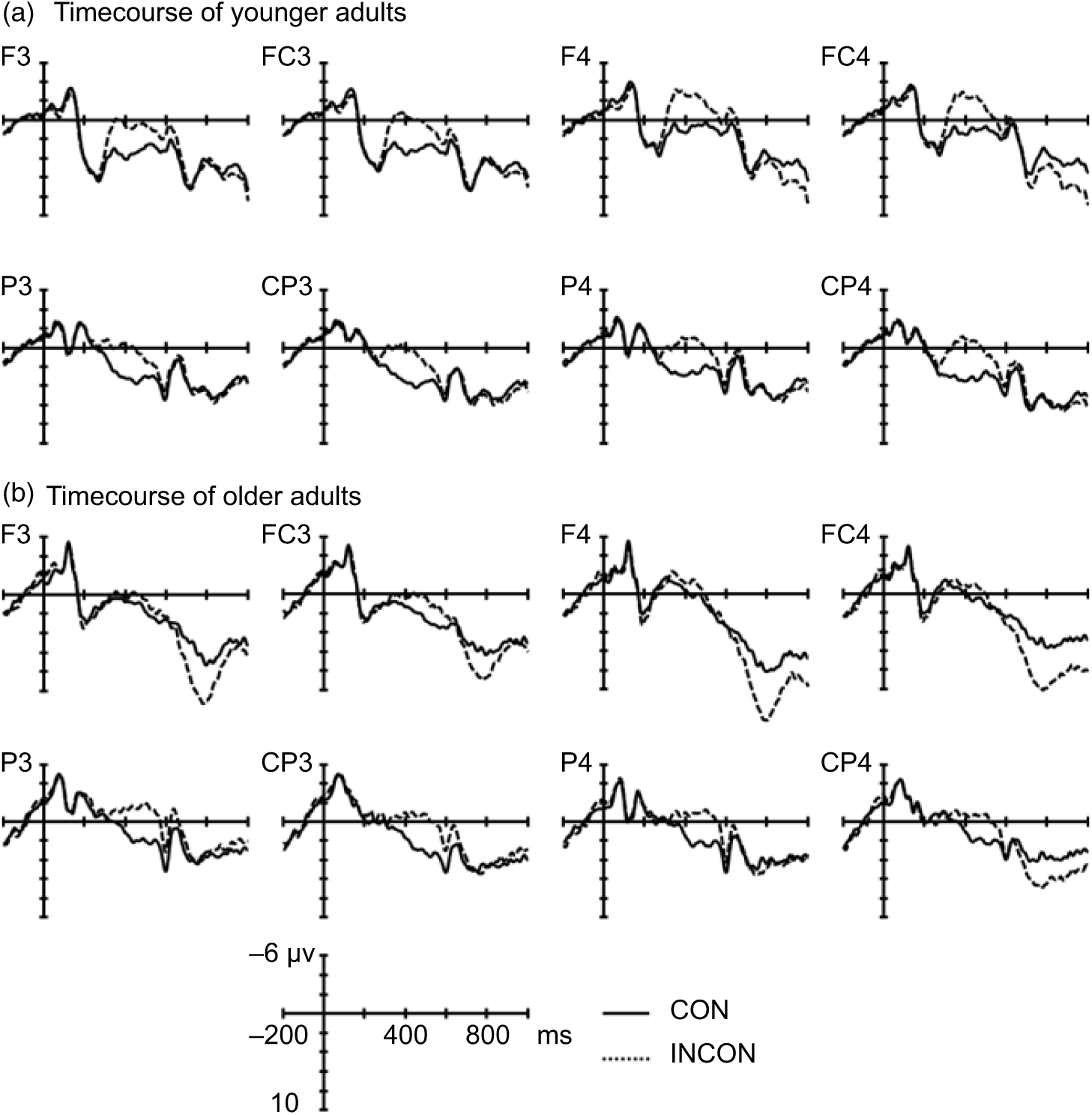
Figure 1 presents the time course of each condition of the two groups in representative electrodes. For the N400 effect, a trend of earlier peak latency in the younger adults (418 ± 47 ms) than the older adults (438 ± 45 ms), F (1, 82) = 2.92, p = .09, ηp2 = .03, and a significant Region × Hemisphere interaction, F (1, 82) = 5.57, p = .02, ηp2 = .06, were found after controlling for years of education and verbal fluency. When working memory was controlled for, there was no main effect for Group, F (1, 81) = 2.42, p = .12. For the peak latency of the LPC, there was no significant main effect of Group (younger adults 715 ± 47 ms, older adults 727 ± 45 ms) and no interactions (ps > .12).
Grand averages for incongruent and congruent conditions in representative electrodes for (a) younger adults and (b) older adults.
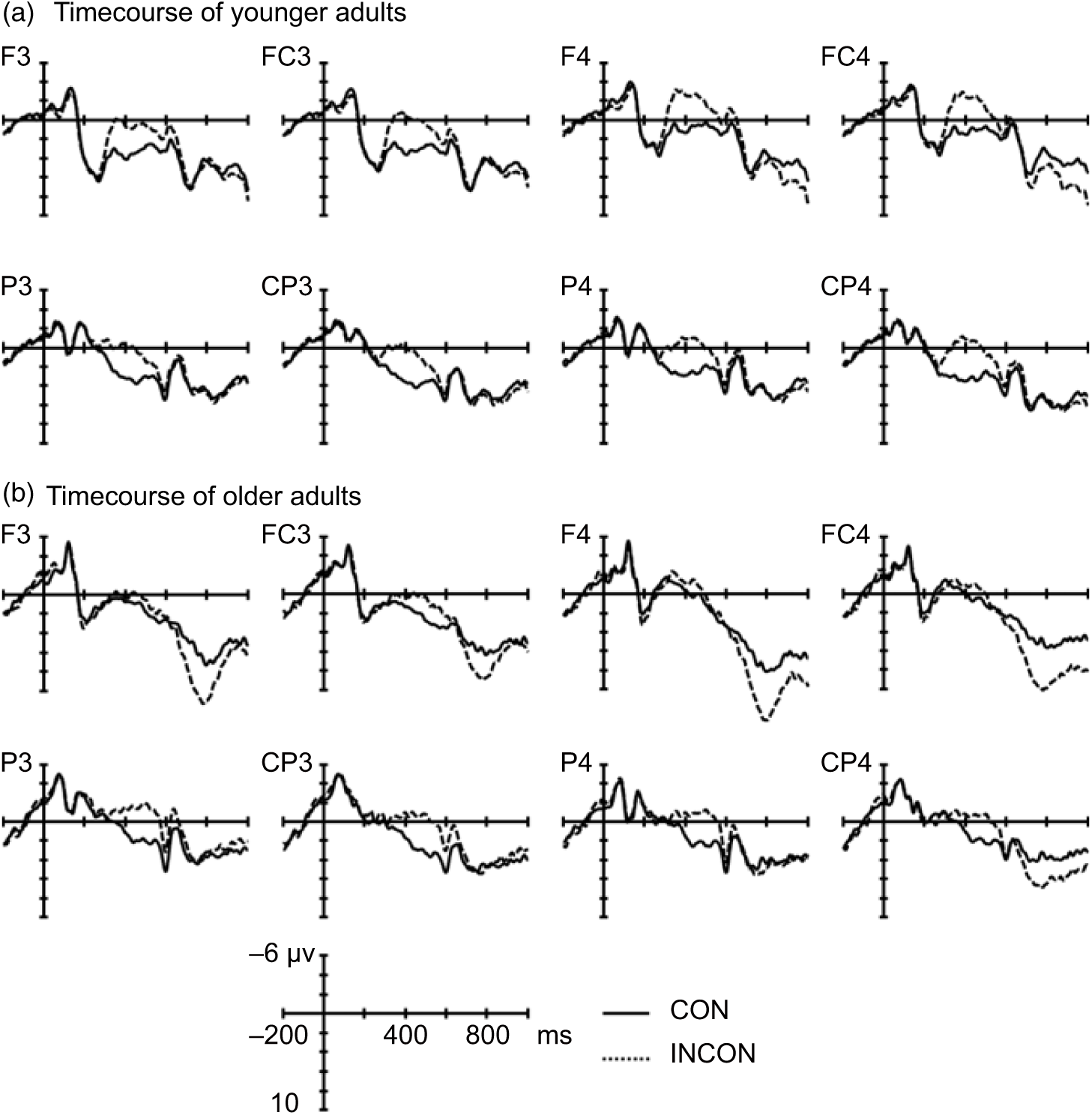
The mean of the onset latency was 307.25 (SD = 0.27) and 405.30 (SD = 0.27) for younger and older adults, respectively. Repeated ANOVA revealed that there was a significant Group effect, F (1, 84) = 63983, p < .001, with slower onset latency in the older adults than in the younger adults. There was a significant Region × Group interaction, F (1, 84) = 3216, p < .001; in both anterior and posterior regions, older adults showed slower onset latency than younger adults (ps < .001). When working memory was controlled for, the results showed significantly later onset latency in the older adults than in the younger, F (1, 81) = 48329.01, p < .001, in the anterior regions than in the posterior, F (1, 81) = 71.69, p < .001, and in the left hemisphere than in the right hemisphere, F (1, 84) = 37.94, p < .001. The Region × Group interaction was significant, F (1, 84) = 2514.46, p < .001. Follow-up analyses showed that latency in the anterior region was significantly later than in the posterior region in both younger and older adults (ps < .001), and latency in the older adults occurred significantly later than in the younger adults in both anterior and posterior regions (ps < .001). A significant effect was also observed for the Hemisphere × Group interaction, F (1, 84) = 1482.79, p < .001, the Hemisphere × Region interaction, F (1, 84) = 32.35, p < .001, and the Region × Group × Hemisphere interaction, F (1, 84) = 2241.18, p < .001, showing significantly later onset in the older than in the younger adults in the left anterior, right anterior, left posterior, and right posterior regions (ps < .001).
Amplitude change
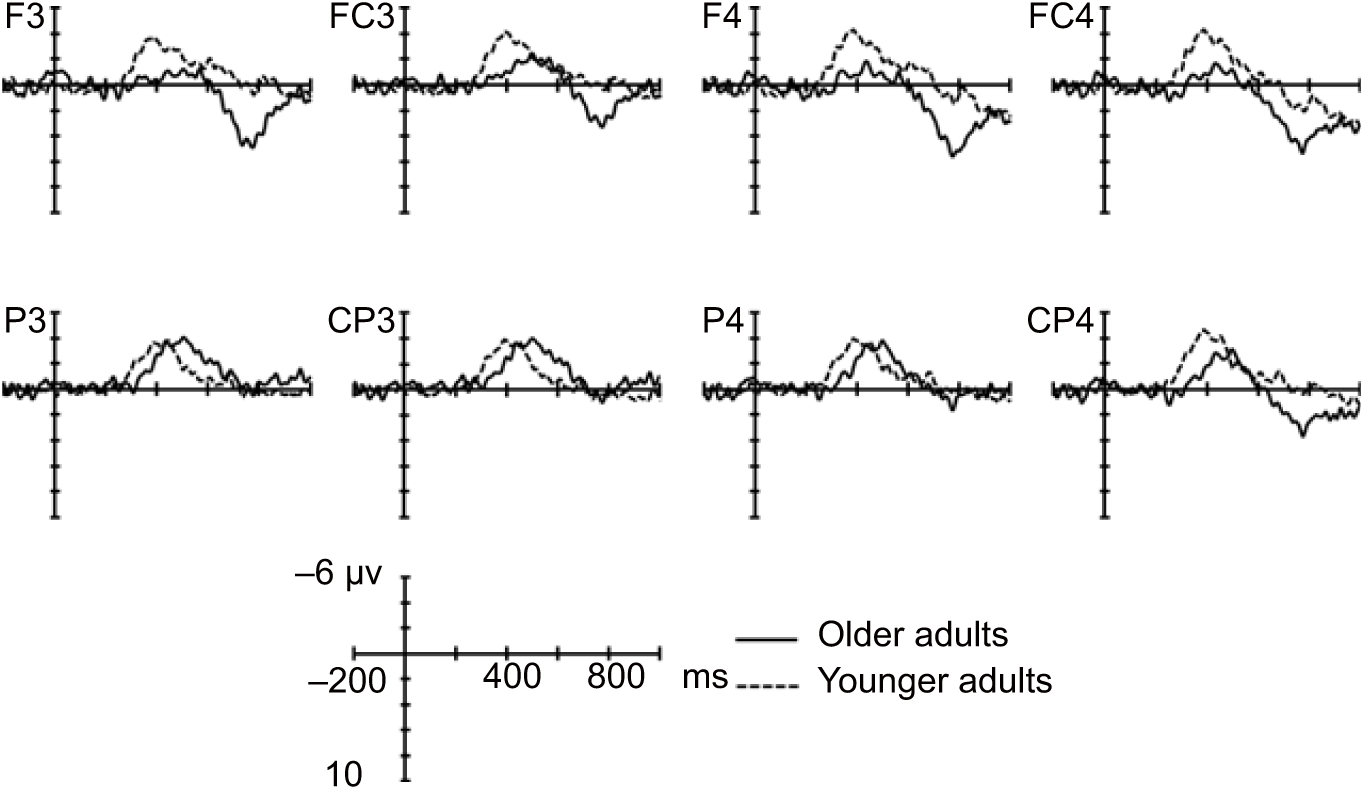
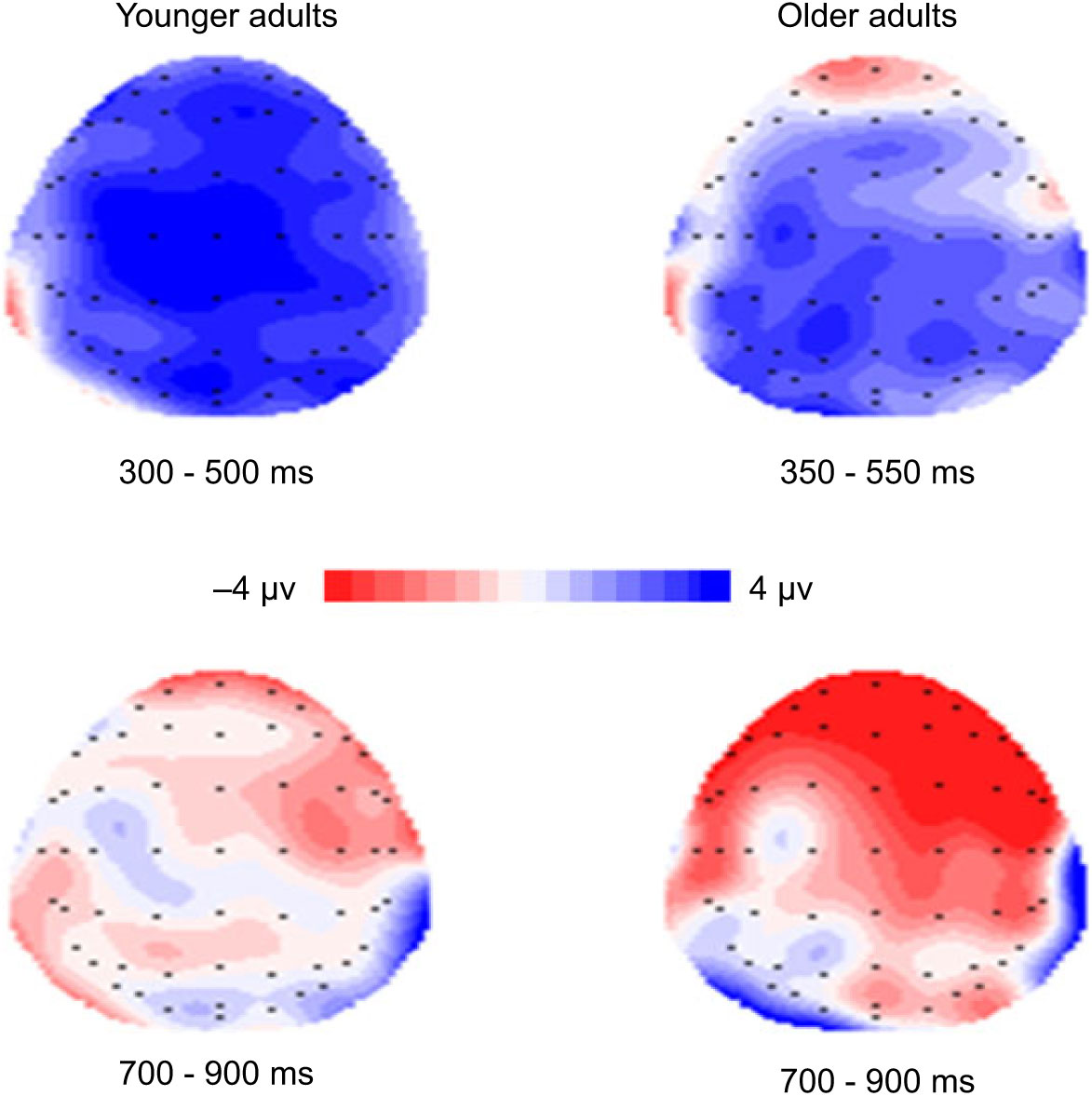
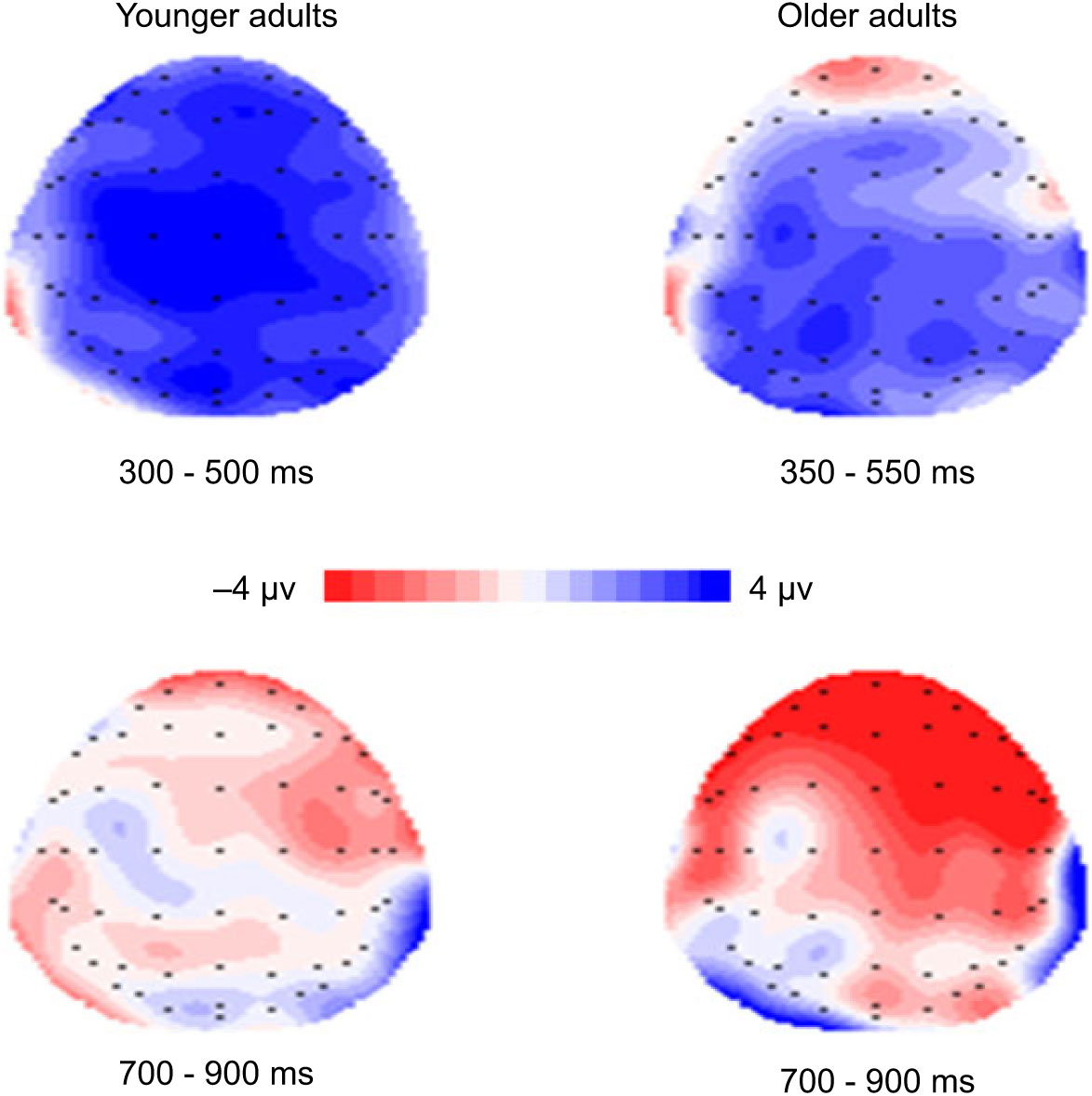
Figures 2 and 3 present the condition difference in time course and distribution, respectively. For the N400, after controlling for years of education and verbal fluency, the results showed significantly larger amplitude in the INCON than CON condition, F (1, 82) = 7.04, p = .01, ηp2 = .08, and more negative amplitude in the older adults than in the younger adults, F (1, 82) = 3.99, p = .05, ηp2 = .05. A significant effect was also observed for the Group × Condition interaction, F (1, 82) = 5.74, p = .02, ηp2 = .07, and the Group × Condition × Region interaction, F (1, 82) = 8.14, p = .005, ηp2 = .09. Simple main effect tests revealed a significant N400 effect in both the anterior (p < .001, ηp2 = .25) and the posterior regions (p < .001, ηp2 = .40) in younger adults, but only in the posterior region in older adults (p < .001, ηp2 = .29).
Different waves between conditions (incongruent vs. congruent) for younger and older adults. Younger adults presented significant N400 effects in both anterior and posterior electrodes. Older adults presented a delayed and significant N400 effect in the posterior electrodes and a significant P600 effect in the anterior electrodes.

N400 effect and late positive component effect distribution in both younger and older adults. N400 effect was whole-brain distributed in the younger adults while restricted to the posterior regions in the older adults (top panel). P600 effect was significant in the anterior region in the older adults but not in the younger adults (bottom panel).
When working memory was controlled for, the amplitude of N400 was larger in the INCON than in the CON condition, F (1, 81) = 4.24, p = .04, ηp2 = .05. There was still a Group × Condition × Region interaction, F (1, 81) = 6.27, p = .01, ηp2 = .07, showing a significant N400 effect in both the anterior (p < .001, ηp2 = .20) and posterior regions (p < .001, ηp2 = .33) in the younger adults, but only in the posterior region in the older adults (p < .001, ηp2 = .29).
For the LPC, after controlling for years of education and verbal fluency, a marginally significant effect for the Condition × Group interaction, F (1, 82) = 3.61, p = .06, ηp2 = .04, a marginally significant Condition × Group interaction, F (1, 82) = 3.61, p = .06, ηp2 = .04, and a marginally significant Group × Condition × Region interaction, F (1, 82) = 3.64, p = .06, ηp2 = .04, were found. Simple effects tests revealed a significant LPC effect in the anterior region in the older adults (p = .002, ηp2 = .11) but not the younger adults.
When working memory was controlled for, a significant Condition × Region interaction, F (1, 81) = 4.72, p = .03, ηp2 = .06, and a marginally significant Group × Condition × Region interaction, F (1, 81) = 3.04, p = .08, ηp2 = .04, were found. Simple effects tests revealed a significant LPC effect in the anterior region in the older adults (p = .004, ηp2 = .10, but not the younger adults.
It is interesting to note that the larger N400 effect was associated with higher accuracy in the INCON condition compared to the CON condition for the younger adults (r = –.38, p = .01) but not for the older adults (r = .001, p = .99). There was a trend toward a difference between the correlation coefficients (Fisher’s Z = 1.78, p = .08). For the P600 effect in the anterior region, no correlation with accuracy was found in either group (ps > .90).
Discussion
Previous studies found that age-related decline in semantic integration was closely associated with decline in working memory, but it was unclear whether these two types of decline were independent of one another. The present study addressed this question by examining age-related decline in semantic integration while controlling for decline in working memory, in a large sample of younger and older adults. Unlike earlier studies, we minimized the working memory demand by employing simple rather than semantically complex sentences to assess semantic integration. Behavioral and ERP data showed that age-related declines in semantic processing are independent of declines in working memory. These results shed light on understanding language comprehension decline during aging.
The most important findings were those that documented the independence of semantic integration and working memory. After controlling for working memory, two pieces of evidence documented a clear advantage for younger adults relative to older adults in terms of semantic integration.
First, the behavioral assessment of accuracy during the semantic integration task showed that for the younger adults, accuracy was higher when reading incongruent sentences than congruent sentences (Zhu et al., Reference Zhu, Zhang, Wang, Xiao, Huang and Chen2009, Reference Zhu, Hagoort, Zhang, Feng, Chen, Bastiaansen and Wang2012), but this difference was not found in older adults. One may argue that the older adults may intend to interpret the incongruent sentence in a different way so that the rejection rate (i.e., accuracy) was reduced. Such an explanation is in line with the inhibitory deficit account (Hasher & Zacks, Reference Hasher, Zacks and Bower1988), which proposes that in advance of the aging breakdown the inhibitory function, and thus irrelevant information, was allowed to enter into working memory. If that is true for the older adults, then the interpretation effort during sentence reading should be reflected in the brain response, as typically such effort is associated with a larger brain response (Gazzaley, Cooney, Rissman, & D’Esposito, Reference Gazzaley, Cooney, Rissman and D’Esposito2005). However, as shown in the ERP results, the INCON sentences induced a smaller N400 effect and not a larger N400 amplitude in older adults compared to younger adults. Therefore, the decline of semantic integration could not be purely explained by different interpretations or inhibitory deficit.
Second, the amplitude difference of the N400 effect between the older and younger adults further confirmed the behavioral decline of semantic integration during aging. While a significant N400 effect was found in both the anterior and posterior regions in the younger adults, the N400 effect was restricted to the posterior region in the older adults. In contrast, the N400 effect difference is more likely capturing the intrinsic semantic integration ability decline in aging. The alteration of accuracy and the N400 effect suggests that the older adults showed reduced sensitivity in discriminating semantic congruency during sentence comprehension, consistent with recent findings (Faustmann et al., Reference Faustmann, Murdoch, Finnigan and Copland2007; Wlotko et al., Reference Wlotko, Lee and Federmeier2010; Xu et al., Reference Xu, Hou, Zhao, Zhu and Yang2017). Moreover, a significant N400–accuracy correlation in the INCON condition was only found in the younger adults, not the older adults. Consistent with the amplitude change pattern, the N400 is sensitive to semantic congruency, and this sensitivity was declined in the older adults. Such a reduced semantic integration effect could be explained by reduced brain functional response or brain shrinkage as observed in previous studies (Diaz et al., Reference Diaz, Rizio and Zhuang2016; Grossman et al., Reference Grossman, Cooke, DeVita, Chen, Moore, Detre and Ge2002; Peelle et al., Reference Peelle, Troiani, Wingfield and Grossman2010; Tremblay, Dick, & Small, Reference Tremblay, Dick and Small2013; Zhu et al., Reference Zhu, Yang, Li, Zhou, Liu, Zhang and Chen2017), or inefficient information transmission across the language network (Diaz et al., Reference Diaz, Rizio and Zhuang2016; Fedorenko & Thompson-Schill, Reference Fedorenko and Thompson-Schill2014).
Taken together, the results suggest that age-related semantic integration decline co-occurs with working memory decline, but functions independently of working memory. The isolated semantic integration decline in the present results fit well with theoretical assumptions (Hagoort et al., Reference Hagoort, Baggio, Willems and Gazzaniga2009) and empirical evidence of isolated activation for semantic integration in a previous functional magnetic resonance imaging study (Zhu et al., Reference Zhu, Feng, Zhang, Li, Li and Wang2013) and an ERP study (Nakano et al., Reference Nakano, Saron and Swaab2010). Alternatively, evidence of different connection patterns across a set of brain regions shared by semantic integration and working memory could also support the independence of the two processes (Fedorenko & Thompson-Schill, Reference Fedorenko and Thompson-Schill2014). The inconsistency between the present study and the extant literature may be due to the difference in stimuli. Because the comprehension of complex sentences relies on working memory more than simple sentences do, it is easier to find a working memory effect on comprehension decline in studies that used complex sentences (DeCaro et al., Reference DeCaro, Peelle, Grossman and Wingfield2016; James, Krishnan, & Aydelott, Reference James, Krishnan and Aydelott2014). Therefore, the results of other studies may be confounded by working memory.
Controlling for working memory provides evidence that informs current controversies regarding the peak latency of the N400 effect. While some studies have found delayed peak latency of the N400 effect (Federmeier, Van Petten, Schwartz, & Kutas, Reference Federmeier, Van Petten, Schwartz and Kutas2003; Gunter et al., Reference Gunter, Jackson and Mulder1995; Wlotko & Federmeier, Reference Wlotko and Federmeier2012; Xu et al., Reference Xu, Hou, Zhao, Zhu and Yang2017), other studies have not (Faustmann et al., Reference Faustmann, Murdoch, Finnigan and Copland2007; Federmeier et al., Reference Federmeier, McLennan, De Ochoa and Kutas2002). The inconsistency may due to the confounding effect of working memory decline. In the current study the marginal delay in peak latency was no longer apparent when working memory was taken into account. Critically, the present study found delayed onset latency for older adults. Given that onset latency reflects processing speed, the result further suggests that slowing in general processing speed (Salthouse, Reference Salthouse1996) may contribute to declines in semantic integration.
Previous studies have suggested that the LPC reflects the cost of predictive error in older adults and is also correlated with verbal fluency (Federmeier et al., Reference Federmeier, McLennan, De Ochoa and Kutas2002, Reference Federmeier, Kutas and Schul2010). Inconsistent with these claims, there was no such correlation in the present study (r = –.18, p = .26). Alternatively, the significant LPC effect found exclusively in anterior regions in the older adults may suggest they tried to compensate for the N400 effect decline (Peelle et al., Reference Peelle, Troiani, Wingfield and Grossman2010; Xu et al., Reference Xu, Hou, Zhao, Zhu and Yang2017). However, the nonsignificant correlation between LPC effect and accuracy (r = –.04, p = .81) suggests that the older adults did not successfully compensate for the declines in semantic integration, if there was a compensation effort (Cabeza & Dennis, Reference Cabeza, Dennis, Stuss and Knight2012). Finally, it might be possible that the older adults were trying to build up a compensatory scaffold, but this did not significantly help their performance, consistent with the scaffolding theory of aging and cognition (Park & Reuter-Lorenz, Reference Park and Reuter-Lorenz2009). Future studies are required to test whether there were brain regions that can successfully compensate for the declines in semantic integration.
Finally, isolation of semantic integration from working memory and other neuropsychological functions may be helpful in future research on language and degenerative diseases. For instance, in assessment of aphasia, working memory deficits would be detrimental to comprehension especially in complex sentences. The independence of semantic integration during reading and working memory would help to detangle language and general disorder in aphasia. Moreover, recent studies have shown that there are significant semantic processing deficits in Alzheimer disease (Kemper, Marquis, & Thompson, Reference Kemper, Marquis and Thompson2001; Sugarman et al., Reference Sugarman, Woodard, Nielson, Seidenberg, Smith, Durgerian and Rao2012), and semantic performance can be used to discriminate Alzheimer patients from cognitively healthy elderly adults (Clark et al., Reference Clark, McLaughlin, Woo, Hwang, Hurtz, Ramirez and Apostolova2016; Szatloczki, Hoffmann, Vincze, Kalman, & Pakaski, Reference Szatloczki, Hoffmann, Vincze, Kalman and Pakaski2015). However, such semantic decline also accompanies declines in general cognitive processes. Isolating semantic process effects from other factors may help researchers to better understand the semantic deficits in degenerative diseases.
Conclusions
The present study found that although age-related declines in semantic integration and working memory co-occur, the two processes appear to be independent. After controlling for working memory, there was still significant age-related decline in semantic integration in a relatively large sample. The results demonstrate a distinction between semantic integration and working memory during aging.
Acknowledgments
The work was supported by grants from the Natural Science Foundation of China (NSFC 31571156, 31871133), the National Social Science Foundation of China (15AZD048, 17ZDA301), Jiangsu Six Talent Peaks Projects (JY-025 and KYCX17_1704), and the Priority Academic Program Development (PAPD) of Jiangsu Higher Education Institutions, Jiangsu. We also thank Dr. Weifang Zhong for assistance in stimuli construction. The authors have no competing interests to declare.