




No CrossRef data available.
Article contents
15. EMERGING RESEARCH AND PRACTICES IN IMMERSION TEACHER EDUCATION
Published online by Cambridge University Press: 15 June 2004
Abstract
Due to their unique place and function in society as well as their position on the educational ladder, universities have had a rather belated encounter with immersion education. In fact, it was not until the late 1970s (Day & Shapson, 1993) that universities in Canada were obliged to address a range of pedagogical issues as a direct result of the growth of immersion education in schools, the increasing number of immersion graduates from schools, and the overall educational success of immersion programs. Naturally, these issues are contextually framed and dependent on the historical development of immersion in each country where immersion education occurs. In countries with larger and longer immersion education traditions, the influence on universities has been greater. Three issues are of particular importance here: (1) the linguistic needs of immersion school graduates at university, (2) principles of immersion pedagogy use at the university level, and (3) immersion teacher education. The latter issue is especially pertinent to broader questions of the preparation of second language teachers and will be addressed here.For studies exploring the nature and levels of language maintenance of immersion graduates after secondary schooling, see Harley (1994), Hart, Lapkin, Swain and Howard (1991), Wesche (1985, 1993), Wesche, Morrison, Ready, and Pawley (1990) for a comprehensive review.
Information
- Type
- CURRICULUM, PEDAGOGY, AND TEACHER PREPARATION
- Information
- Copyright
- © 2004 Cambridge University Press
Research as a Basis for Practice
A decade ago, Richards pointed out that there had been “little systematic study of second language teaching processes that could provide a theoretical basis for deriving practices in second language teacher education” (1990, p. 3). Since then, a substantial amount of research has been undertaken that has broadened our understanding of second language teacher education processes. Similarly, calls for more research into immersion teacher education have been made since the mid-1980s (Allen, Swain, Harley, & Cummins, 1990; Day & Shapson, 1993; Lapkin, Swain with Shapson, 1990, Obadia, 1984; Tardif, 1984). Lapkin and Swain with Shapson (1990) signaled the need for more research into immersion teacher education and called for its inclusion as a major research focus for the 1990s and beyond. They ask several basic questions, including, How do we best study what immersion teachers are doing in their classrooms? Why do teachers do what they do (beliefs)? What are immersion teacher education programs doing (policies, beliefs, practices)?” (Lapkin et al., 1990, p. 668).
These questions are particularly poignant in a context where immersion programs have been implemented, expanded, and exported throughout the world, and where the demand, especially in Canada, for qualified immersion teachers has risen exponentially. Yet, even in this context, universities have only made half-hearted attempts to engage with the philosophical, conceptual, pedagogical and organizational basis of immersion teacher education. As Obadia states: “Les solutions temporaires semblent avoir revêtu un caractère permanent” (Temporary solutions have often assumed a permanent character) (1985, p. 416).
Research into immersion teacher education has primarily consisted of (1) reviews geared toward mapping current immersion teacher education models (Erben, 1993; Majhanovich with Gray, 1992; Obadia, 1985; Tardif, 1984; Wilton, Obadia, Roy, Saunders, & Tafler, 1984), (2) descriptive studies that have sought to engage the views of those involved in immersion education (teachers, teacher educators, parents, ministries of education) in order to uncover the essential competencies and prerequisites needed to become an immersion teacher and thereby establish some type of national standard (Bernhardt, 1992; Day & Shapson, 1996a; Frisson-Rickson & Rebuffot, 1986), as well as (3) research investigating immersion teacher education processes itself (Bartlett & Erben, 1995; Bartlett, Erben & Singh, 1996; Erben, 1999; Erben, 2001b; Erben, in press; Erben & Bartlett, 1997). In the past decade, more varied research methodologies, seeking to explicate a broader range of issues/questions while focusing on a wider range of immersion teacher education contexts, have been on the rise.
Reviews and Surveys of Immersion Teacher Education Models
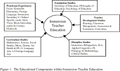
Existing models reflect a conception of immersion teacher education that presents it as resulting from an osmosis among a variety of fields including but not limited to foreign language education, second language acquisition, general education, and curriculum studies. However, as Obadia (1985) notes, there is always a danger that these discipline areas could come to take precedence over the immersion teacher training process itself. This issue explains why, in some programs, the “immersion training part” is operationalized as an add-on to existing foreign language or generalist teacher education programs rather than being conceived of as something distinct. Thus while it may be indispensable for an immersion teacher to be grounded in a knowledge base originating from curriculum content (mathematics, science, history, etc.) and foreign language education (second/foreign language methodology, linguistics, second language acquisition, cultural studies, etc.), Obadia suggests that, in order to refine immersion teacher education, immersion per se needs to be defined in its own right. Consequently, he proposes a third way: “It is only after a better insight of what characterizes immersion that we can better understand the training of French immersion teachers and propose … a ‘third way’ that differs from French second-language and firstlanguage teaching” (Obadia, 1985, p. 415). Obadia's “third way” places immersion at the heart of any immersion teacher education program enabling teacher educators to integrate the various competing theories and practices within a holistic program. Such a program takes account of the sociolinguistic and sociopolitical context into which the immersion teachers are placed when they graduate. Lapkin et al., (1990) and Majhanovich (1990) view immersion teacher education as a continuum, much like the development-chronology axis conceptualized by Freeman and Richards (1993). This idea of teacher education as a continuum raises issues such as induction and in-servicing leading to professional development and the development of the profession. For example, a number of “core components” have been flagged for inclusion into preservice programs as the necessary precursors for successfully training of immersion teachers. These include general teacher education units, curriculum units, discipline units, and practicum units. Figure 1 illustrates the educational components around which many preservice immersion teacher education programs have been built (Erben, 2001a; Day & Shapson, 1996a; Majhanovich & Fish, 1988). By the 1990s, a number of experimental models for the training of immersion teachers (Majhanovich with Gray, 1992) were established.

The Educational Components within Immersion Teacher Education
Preservice Models
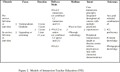
Existing pre-service immersion teacher education programs differ, depending on a range of contextual factors including: societal and educational objectives of the program, target immersion language, the target student–teacher population, instructional time allocated to the L1 and/or the L2, and the university level at which immersion teacher education commences. Information in Figure 2 is by no means an exhaustive summary, though it serves as a representational cross section of extant immersion teacher education models.

Models of Immersion Teacher Education (ITE)
As shown in Figure 2, models for ITE can be fundamentally divided into those that are preservice or initial immersion teacher education programs and those that are in-service or professional development teacher education programs. The former comprises student teachers who have no professional education apart from perhaps secondary school. The latter consists of participants who have already gained some expert knowledge or expertise in a complementary field (for example, generalist primary for L1 children, foreign language education, or even a discipline subject area such as mathematics, science or history. The needs of these individuals will differ from those of preservice student teachers, since they usually only need to gain competence in a set number of additional areas in which they find themselves deficient (usually one or more of L2 proficiency, content knowledge, and pedagogical knowledge). Preservice student teachers need to acquire expert knowledge in the full range of competencies that make up the core skills of an immersion teacher, in addition to proficiency in the immersion language. The differing nature and needs of immersion student-teachers will thus dictate the length of any program of study.
In 1985, Obadia noted that of 47 faculties of education in Canada only 16 offered some type of program, subject or module specifically geared towards immersion teacher training and that of these the majority were simply ad hoc add-on courses “qui vient s'ajouter à la formation classique de l'enseignant” (that typically reflect a classic teacher preparation model) (1985, p. 416). By 1993, this number had risen to 23 (Martin, Obadia, & Rodriquez, 1993), and by 2003 the number of faculties of education worldwide offering some type of immersion training rose in excess of 50. However, recently some immersion teacher education programs have also been terminated for lack of student numbers and funding cuts (Karen Johnson, personal communication, November 2003).
Models of ITE may vary in length, clientele, and delivery mode. For example, the ITE model established in the Faculté Saint-Jean at the University of Alberta caters primarily to student teachers who are native Francophone speakers. The Faculté itself is a French-medium department and the program is delivered in native-speaker mode. However, other models, primarily those ITE programs established as add-ons, use the L1 as the medium and mode of delivery, even though these student teachers will graduate and teach immersion through an L2. A third model includes programs that use both the L1 and the L2, where course content is delivered through the medium of both languages in native-speaker mode. An example of this model is the ITE program at Simon Fraser University. Last, there are models that deliver the content of the ITE program through the L2, through immersion mode itself. Examples of such programs primarily exist where the majority of client student teachers only speak the immersion language as their L2, such as the Language and Culture Initial Teacher Education: Primary (LACITEP) model at Central Queensland University, Australia (Erben, Cox, & Phillips, 1993), and the Reciclatge model in Spain2
When immersion was originally implemented in Catalonia, authorities were faced with a serious teacher education problem. Many teachers were non-Catalan speakers and, of those who were, few were qualified to teach the language (Siguán, 1986, cited in de Mejía, 1994): “After experiments with various forms of short-term inservice training schemes, the Catalan government decided in 1989 to initiate 30-day immersion teacher training cycles for primary school teachers working in immersion programmes. These courses were designed [to be delivered through immersion] both to improve teachers' language fluency as well as to provide them with first hand experience of immersion programmes” (de Mejía, 1994, p. 21).
In-Service Models
In-service models of immersion teacher education are primarily framed by the local conditions and needs of immersion teachers, schools, districts, and state authorities. Research in in-service teacher education reveals that, to be effective, inservice models need to be ongoing, relevant, collaborative, building on the prior strengths of participants, allowing participants to reorganize their existing pedagogical schemata, as well as being practical, conceptually based and didactically driven. From early on, a number of successful immersion in-service programs have been documented. One of the earliest (Brine & Shapson, 1989) was an exploratory study of a 12 month model specifically designed for experienced teachers with no immersion background and low L2 proficiency. Results showed that participants' major concerns (linguistic, financial, family, employment, and practica) by the end of the program were significantly reduced and that their effectiveness in L2 oral expression and knowledge of immersion methodology had significantly increased.
More recently, many different types of in-service provision for immersion teachers have been realized. In response to ongoing research into the professional development needs of immersion teachers (see Day & Shapson, 1996a), two organizations in particular merit particular mention. The Canadian Association of Immersion Teachers (http://acpi.scedu.umontreal.ca/) and the Center for Advanced Second Language Research at the University of Minnesota (http://carla.acad.umn.edu/) both host an array of in-service opportunities for immersion teachers. These include but are not limited to regular annual conferences, ongoing short- and longterm workshops/institutes, the publication of newsletters/journals, and the management of listservers and databases as well as the electronic storage of curriculum resources all specifically geared to immersion teachers. Lastly, a recent development in the advancement of professional development opportunities for immersion teachers is the creation of on-line courses for teachers, such as that developed by the Illinois Resource Center (http://www.dualu.org). Whether such inservice provision are effective remain open to investigation.
Descriptive Studies of Immersion Teachers' Competencies and Professional Needs
Met and Lorenz (1998) outline the general characteristics of a good immersion teacher. These include being reflective, interactive, engaging, responsive, flexible, and experiential in teaching approach, as well as knowing group dynamics. More importantly, they also outline practices that immersion teachers do more frequently than nonimmersion teachers, implying that immersion teachers need to be more competent in these skills, including preparing and adapting materials, contextualizing, making the abstract concrete, using more cooperative learning techniques, being aware of literacy development in two languages, teaching social as well as academic language, instructing on the cultures of second language communities, and applying general education trends to language immersion. While Met and Lorenz proposed these practices and characteristics from a recruitment perspective, they very much correspond to the perceived professional development needs flagged as issues in a number of surveys in the past decade. In particular, Day and Shapson (1996a, 1996b) conducted a survey of 2000 immersion teachers. Of all respondants, 67.1 percent indicated that they had not received specialized preparation for teaching immersion, and 30.3 percent received their teacher preparation in their L1. The most common form of professional development available to these teachers were workshops (60.5 percent). In terms of program issues, it was found that 57.1 percent of respondents rated teaching L2 language arts, and 34.9 percent rated immersion pedagogy, as two areas in which they had “great need” and/or “some need” of in-servicing. Other areas which ranked high included the need for inservicing in developing curriculum and resources, developing L2 cultural and language skills as well as in developing community outreach strategies (see also Koshiyama, 1994).
Empirical Research: Unpacking Immersion Teacher Education Processes
Nowadays there is a general consensus concerning the knowledge bases and competencies required of immersion teachers (Day & Shapson, 1996a). Recent research linked to broader theoretical developments in second language acquisition and teacher education has been carried out in a range of immersion teacher education contexts. Such research has focused on five areas: (1) the effectiveness of immersion teacher education programs, (2) L2 language use and acquisition by student teachers in immersion programs, (3) the nature of acquisition of professional knowledge and competencies through immersion practicum experiences; (4) the implications of using technology and the effects of mediating instruction through technology within immersion programs, and (5) the social dimension of immersion student-teachers' interactions and the professional cultures which develop within immersion teacher education programs.
Effectiveness of Immersion Teacher Education Programs
Nuttall and Langham (1997) carried out an issues-based evaluation of a South African government initiative designed to improve EFL teacher education efforts in that country. The initiative, called the Molteno Project, aimed to establish and infuse English-medium teacher education programs in the principles and practices of learner-centered methodology as well as to develop suitable materials so that teachers are more fully equipped to teach through the medium of English. The study indicates that a cyclical process of classroom research, ongoing EFL professional development after graduation, and teacher-led materials development are important factors in guaranteeing the success of extensive ongoing EFL teacher training. A number of studies, however, have investigated the cognitive and linguistic benefits of such English-medium teacher education programs in various European EFL environments (Finland, Sweden, Ukraine) and found that even when starting from higher EFL proficiency levels, participants continue to achieve significant positive gains (Buchberger, 2000; Tarnopolsky, 1996).
For the most part, studies in Asia are descriptive in nature and focus on issues involving certification (Sadtono, 1995), program implementation (Shiozawa, 1993), and program effectiveness (Guefrachi & Troudi, 2000). Studies that have focused on EFL acquisition through immersion show mixed results. Other studies, however, indicate less success both in terms of the overall level of proficiency realized by student teachers and their ultimate ability to engage in English with their students in their future classrooms. In research conducted in Hong Kong, Johnson (1997) indicates that students' abilities to study effectively through English at the tertiary level remains in doubt. In another study, Lim Swee Eng, Gan, and Sharpe (1997) report that English-medium teacher education programs in Singapore do not necessarily provide future bilingual or English immersion teachers with the necessary communicative competence and confidence to act as suitable language models in the classroom. They suggest that English-medium teacher education programs need to focus on introducing more communicative methods of language teaching to improve the overall English language proficiency of student teachers.
Language Use and Interaction
In a 1998 study of elementary Japanese as a Foreign Language (JFL) learners, Takahashi found patterns of interactional variability arising as a result of goal-directed collaborative group activity. Takahashi discovered that learners' learning and behavior through social interaction in classroom environments were very much influenced by what the teacher did. In contrast, Erben (2001b) reveals that the regulatory behavior and strategic orientation of immersion student teachers in similar classroom-group environments are very much influenced, not by the lecturer or class facilitator, but by the quality of interaction itself, the ability to appropriate mediational means as they are introduced through collective scaffolding, and the willingness of group participants to share in and build a collective pedagogic capital. This suggests that immersion student teachers' level of regulatory contribution to dialogic engagement is not only task-specific but, more important, goal-specific and dynamic-specific, that is, indicative of the level of collaborative willingness that participants within a task engage with each other or use mediated tools to help each other.
In 2001, Erben examined immersion student teachers' L2 interactions during microteaching planning and debriefing sessions (see LACITEP model at Central Queensland University, http://handbook.cqu.edu.au/pages/ugprgmcq51.thml). He found that the L2 used by student teachers initially represented a subgoal subordinated to the total activity of microteaching planning and execution. In fact, it was the L1 that in many groups stimulated the collective forming process. The L1 was used as a mediating linguistic tool to establish group roles, construct and confirm referential perspective, edit new information as well as to negotiate rules of participation, moderate the pace of interaction, and manage collaborative input. For an immersion teacher education setting, this is particularly poignant. In many of the first product-oriented immersion studies carried out in Canada during the 1970s, it was observed that children at the initial stages of their L2 immersion experience overwhelmingly used their L1 to negotiate the curriculum. As the children became more proficient, more L2 was used. However, this situation reversed itself somewhat in secondary school immersion settings where students progressively used more L1. This was not because of low L2 proficiency, but because of adolescent peer pressure and conformity. Like their Canadian early immersion antecedents, the university immersion student teachers in this Australian study initially used more English in the early part of their program, since they did not have the linguistic skills to talk about their microteaching experiences (Erben, 1995). This does not suggest that no L2 was used; on the contrary. What became evident was that the student teachers used the L1 to master the L2, talk about the L2, and construct L2 teacher scripts for their JFL classroom. They used Japanese within discursive events in which their Japanese knowledge sufficed. When it did not, assistance was either given by a more knowledgeable peer, or the novice student-teacher resorted to code switching or to the L1 in its entirety to maintain the momentum of the group's work.
In an ethnographic study within the LACITEP immersion program, Erben and Bartlett (1998) found that, in the context of developing an L2 repertoire to talk about their JFL teaching, student teachers were eventually able to use professional terminology to describe and make sense of their experience. The introduction of a professionally oriented discourse within content-based courses helped student teachers to construct critical and more different ways to understand their actions. In turn, this led student teachers to think and act in different ways, or as Freeman calls it, to “reconstruct practice” (1996, p. 735).
Practicum Experiences
Erben (2001b) carried out a six-month case study using a sociocultural theoretical framework (Tharp & Gallimore, 1988; Wells, 1999). He investigated how immersion student teachers engaged in collective-group curriculum planning during a school-based practicum came to construct L2 pragmatic and sociolinguistic knowledge as well as pedagogic knowledge of immersion teaching. Erben found many complex modes of social interaction among the immersion student teachers. Among others, student-teachers (1) frame their roles in learning, (2) did not recycle their notions of pedagogy and L2 classroom use, but jointly reconstructed new repertoires for engaging in immersion teaching, and (3) became more adept at navigating their regulatory orientations through the ongoing changes in the linguistic complexities of the content of interaction. On the one hand, L2 use was determined by the behavior of the more knowledgeable peer in group microteaching activities, and on the other hand, it was also determined by the receptivity of each individual student teacher to appropriate the use of mediational tools such as the L2. Both factors helped the student teachers to make sense of their engagement with the microteaching context of their learning as well as to understand and control the processes of such engagement itself.
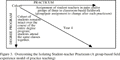
Erben (2001b) outlines a number of possible ways to enhance the collaborative nature of practica such that immersion student teachers have enhanced opportunities to collectively regulate their microgenetic growth, to establish multiple connections of intersubjectivity with peers, and to (re)construct as well as appropriate knowledges different to the ones legitimatized in current practice (see Figure 3). The conception is based on a notion of continuous strategic engagement. This is defined as a situation in which a student teacher's engagement with learning is never carried out alone, but is organized around a collective of peers who themselves may be at various levels of regulation. Collective engagement may occur at differing levels (for example, in pairs, in groups, in larger groupings or cohorts and in class configurations), with the guiding principle being that a student teacher's learning within a practicum context never takes place in isolation and that every student teacher has the discursive space to collectively construct L2 and pedagogic understandings, to regulate others as well as be regulated by others. To overcome the possible effects of cursory collaborative work routines becoming established within groupings, it is suggested that a more knowledgeable peer or expert, from a higher year level, take on the role of mentor to facilitate and to guide productive collaborations.

Overcoming the Isolating Student-teacher Practicum (A group-based field experience model of practice teaching)
Effects of Mediating Instruction through Technology within Immersion Programs
Of the many so-called innovations in the language education industry over the past 30 years, only two innovations have been credited with providing a unique contribution to the field. One is immersion pedagogy (Krashen, 1984), and the other is computer-mediated online learning (Warschauer, 1998). However, while the benefits of immersion education and the uses of technology in education have been well documented, research into computer-mediated communication and computermediated pedagogy in immersion settings remain at best scant. Erben (1999, 2002) provides a contextualized account of the linguistic and pedagogic changes which occur in a university teacher education immersion classroom (see LACITEP model) when instruction is networked through the medium of one particular online technology, namely audiographics. Audiographic technology is a network-based media tool that facilitates multimedia conferencing, data conferencing, and visual conferencing in the classroom. Providing a two-way audio and two-way virtual–visual computer link, it allows users to learn interactively, and store and/or send images and information (still video images, documents or pictures, CD ROM images, compressed audio or video clips) from separate computers linked over a network. It enables linked sites to share screens in such a way that any information written or typed is immediately seen at all remote sites. Linked sites are thus able to share software tools such as Windows and use these interactively. This work characterizes the linguistic and pedagogic adaptations in the classroom as student teachers develop from other- to self-regulated activity.
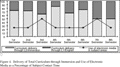
Figure 4 illustrates the levels of use of a range of electronic media, including e-mail, video conferencing, audiographics, and the like used in the LACITEP degree program. The main component of the study consisted of tracking one third-year LACITEP class over a seven-week period where (1) student teachers were taught a unit (six hours in total divided into 30-minute segments and delivered over a three week period) from the course “Teaching, Learning & Planning” through audiographics with the class being in ‘line-of-sight’, and where (2) the same student teachers were then taught a subsequent unit from the course “Teaching, Learning & Planning” (eight hours in total divided into thirty minute segments and delivered over a four-week period) where delivery was networked through audiographics and delivered over different sites. Classes were observed and videotaped, and the teacher and student teachers were interviewed at various stages throughout the study. The data were collated in terms of critical incidences of instruction and analyzed for their significance and effects on linguistic and pedagogical processes.

Delivery of Total Curriculum through Immersion and Use of Electronic Media as a Percentage of Subject Contact Time
Erben (2001b) noted that there was a narrowing of the range of symbolic cues in mediated interaction. This means that the degree of reciprocity and interpersonal exchange was less than one would observe in face-to-face interactions. Because there was no face-to-face access to a wider range of symbolic cues and reference systems that are known/learned/understood due to physical presence or context; teachers and individual student teachers had to “work” to produce cues (pedagogic and/or linguistic) that required amplification or reduction.
Amplification refers to those classroom discursive practices that, because of the nature of the mediated interaction at a distance, participants need to modify in terms of increasing the production, frequency, and/or intensity of cues, signs, and behaviors in order to achieve the same desired effect if the same cue, sign or behavior were produced in a face-to-face classroom. On the other hand, reduction refers to cues, signs, and other discursive practices that, due to their mediation through audiographics, are diminished, abridged, or shortened in production, intensity or frequency when compared to the same practice in a regular face-to-face classroom. Over the seven-week period in which student teachers were observed, pedagogical and linguistic adjustments did not remain constant. In the beginning, many more instantiations of amplifications and reductions occurred because students and teachers alike attempted to adjust known classroom practices and routines to the requirements of engaging in learning and interaction through Japanese immersion that was mediated through audiographics. However, as classroom participants adapted to the use of audiographics, instructional processes came to be increasingly reconstructed in ways that represented a substantive shift away from how these processes occurred in face-to-face immersion classrooms.
Social Dimensions of Student Teachers' Interactions and the Professional Cultures of Immersion Teacher Education Programs
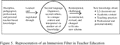
To better understand the various pedagogical attributes of postsecondary immersion endeavors in teacher education, Bartlett and Erben (1995) carried out a 12-month issues-based case study investigation of LACITEP, a four-year bachelor of education degree program through Japanese immersion in Australia (Erben, in press). According to Bartlett and Erben, the interpretation of immersion provided in the literature is largely a linguistic or sociolinguistic one. Far from being merely a linguistic bath, however, their study shows teacher education through immersion to be a multidimensional dialectic phenomenon. In terms of what a pre-service immersion teacher is actually immersed in, Bartlett and Erben identify four attributes characterized as language, culture, context, and content knowledge. By understanding the interplay of these four attributes as a process within different classroom environments, different learning experiences, different group dynamics, different microteaching experiences and subject contexts, Bartlett and Erben framed the outcomes and student achievement levels in the LACITEP immersion program through what might be called an immersion filter, shown in Figure 5.

Representation of an Immersion Filter in Teacher Education
Erben (2001a, 2001b) states that an immersion student teacher's cognitive growth is not guaranteed. Within the “situated” process of socialization into a community of JFL immersion practice, cognitive growth is framed by an individual's receptiveness, sensitivity towards and ability to manage those mediational means placed at his/her disposal. This might be by more knowledgeable peers through collective interaction or through interaction with the social setting per se. A more acute receptivity toward appropriating mediational means, a sensitivity toward identifying the quality of using such mediational means in terms of one's own microgenetic growth, and an ability to manage such means within interactional operations ultimately shape the extent of learning in the ZPD (see also Wells, 1999).
Conclusion
Immersion teacher education can be conceived in different ways, depending on how the nature of the world and the role of the teacher are framed. The ideological framework of immersion contains not only educational imperatives but also political, social, and cultural ones as well. In terms of each new immersion endeavor, the characteristics and nature of such contexts must be evaluated in terms of the effects of such endeavors, and in relation to our current knowledge of immersion practices as a whole. If one accepts the view that teaching and learning is a situated construction, one ceases to talk in terms of a good immersion teacher or good immersion teaching (Krashen, 1984) as some type of empirically tested or theoretically canonized and prescriptive entity. Rather, one needs to accept that immersion pedagogy is located in a range of sociopolitical, cultural, economic, and educational debates. One must then ask oneself whether different practicum models are required to graduate immersion teachers with the necessary competencies to meet specifically local needs. Obadia asserts that this is the case in saying that “French immersion is a unique Canadian phenomenon that needs its own self-analysis” (1985, p. 415).
ANNOTATED BIBLIOGRAPHY
Day, E., & Shapson, S. (1996a). French immersion teachers and their professional needs. Studies in immersion education. (pp. 117–131). Clevedon. Multilingual Matters.
Chapter 6, presenting results of a survey commissioned by the Canadian Association of Immersion Teachers (CAIT) regarding the professional development needs of immersion teachers in Canada is particularly important because of the large number of respondents (n=2000) and issues raised. Response rates ranged from 29.7 percent (Quebec) to 90 percnet (Northwest Territories).
Erben, T. (2001b). Student-teachers' use of microteaching activity to construct sociolinguistic knowledge within a Japanese immersion initial teacher education program in Australia. Unpublished Ph.D. dissertation. United Kingdom: Lancaster University.
This study attempted to investigate the nature of dialogic knowledge construction within one component of an immersion teacher education program, namely, microteaching. What is abundantly clear is that the process of teacher development may be seen as a continuing conversation among multiple actors. In this study, not only were immersion student teachers able to generate new understandings about their L2 and how to use the L2 in a JFL teaching context, but their strategic regulation of this knowledge was very much dependent on the quality of their mediated collaborative engagements with other student teachers in the group.
Johnson, R. K., & Swain, M. (Eds.). (1997). Immersion education: International perspectives. Cambridge: Cambridge University Press.
This edited book comprises articles from a range of stakeholders engaged in immersion education. Particularly interesting is the international perspectives it provides. All accounts of immersion practices are contextualized within the specific social, historical, educational, and political conditions of each country under focus.
Tedick, D. (Ed.). (in press). Teacher education for second or foreign language contexts: International perspectives on research and practice. Mahwah, NJ: Erlbaum.
The chapters in this collection represent the current thinking of some of the most respected teacher education scholars in the fields of ESL, EFL, FL, BE, and immersion education from around the world. The perspectives that teachers are professionals, not technicians; that teachers must construct their own knowledge (rather than someone else providing it to them); that knowledge construction occurs through collaboration; and that teachers need to be at the center of their own professional development are cutting edge positions that language teacher educators around the world are struggling to realize.
References
Allen P.,
Swain M.,
Harley B., &
Cummins J.
1990
Aspects of classroom treatment: Toward a more comprehensive view of second language education.
In B. Harley,
P. Allen,
J. Cummins, &
M. Swain (Eds.),
The development of second language proficiency
(pp. 57–
81).
Cambridge:
Cambridge University Press.
Bartlett L., &
Erben T.
1995
An investigation into the effectiveness of an exemplar model of LOTE teacher-training through partial immersion.
A report for the Innovative Languages Other Than English Project (ILOTES), Department of Employment, Education and Training.
Canberra:
Australian Government Printing Service.
Bartlett L.,
Erben T., &
Singh M. G.
1996
Teacher identity formation through language immersion in an initial-teacher-education curriculum.
Asia Pacific Journal of Teacher Education,
24
(2),
173–
196.Google Scholar
Bernhardt E. (Ed.).
1992
Life in immersion classrooms.
Clevedon:
Multilingual Matters.
Brine J. M., &
Shapson S.
1989
Case study of a teacher retraining program for French immersion.
The Canadian Modern Language Review,
45,
(3),
464–
477.Google Scholar
Buchberger I.
(2000, April).
Struggle for diversity in a harmonising European context: New tasks for teacher education.
Paper presented at the American Educational Research Association Conference, New Orleans, LA [ED442773].
Day E. M., &
Shapson S. M.
1993
French immersion teacher education: A study of two programs.
The Canadian Modern Language Review,
49
(3),
446–
465.Google Scholar
Day E. M., &
Shapson S. M.
1996b
A national survey: French immersion teachers' preparation and their professional development needs.
The Canadian Modern Language Review,
52,
248–
70.Google Scholar
de Mejía A. M.
1994
Bilingual teaching/learning events in early immersion classes: A case study in Cali, Columbia.
Unpublished Ph.D. dissertation,
Lancaster University.
Erben A.
1993
The importance of the practicum in teacher development. What happens in an immersion teacher training program?
Australian Association of Language Immersion Teachers.
1
(1),
16–
29.Google Scholar
Erben T.
(1995, October).
LACITEP: A bachelor of education degree program through immersion in Japanese. Perspectives on planning, pedagogy, research, administration, assessment and teacher training.
A poster presentation presented at the conference Research and Practice in Immersion Education: Looking Back and Looking Forward.
Center for Advanced Research on Language Acquisition: University of Minnesota.
Erben T.
1999
Constructing learning in a virtual immersion bath: LOTE teacher education through audiographics.
WorldCALL.
Amsterdam:
Zwetlinger.
Erben T.
2001a
Sustainable foreign language teacher education.
In G. Bräuer (Ed.),
Pedagogy of language learning
(pp. 195–
221).
New York:
Ablex.
Erben T.
2002
Immersion teacher education through audiographics.
American Council on Immersion Education ACIE Newsletter,
5
(3)
10–
13.
Minneapolis, MN: Center for Advanced Research in Language Acquisition, University of Minnesota.Google Scholar
Erben T.
(in press).
Teacher education through immersion and immersion teacher education.
In D. Tedick (Ed.),
Teacher education for second or foreign language contexts: International perspectives on research and practice.
Mahwah, NJ:
Erlbaum.
Erben A.,
Cox R., &
Phillips S.
(1993, July).
Primary teacher training through immersion; Multiskilling our LOTE teacher-force.
Babel, a journal of the Australian Federation of Modern Language Teachers' Associations.
15,
31–
45
[special issue].
Erben T. &
Bartlett L.
(1997, July).
Mediated interaction and the management of learning in an initial teacher education language immersion classroom.
In T. Gale,
T. Erben, &
P. Danaher (Eds.),
Diversity difference and discontinuity: Proceedings of the Australian Teacher Education Association conference,
Yeppoon, Queensland, Australia.
Available: http://atea.cqu.edu.au/content/soc_base/erbart.html.
Erben T., &
Bartlett L.
1998
Managing Japanese immersion through audiographics, Teachers networking instruction in an initial teacher education LOTE program.
Volume 1
(pp. 1–
100).
A Commonwealth curricula project for the Committee for the Advancement of University Teaching (CAUT).
Canberra:
Department of Employment, Education, and Training and Youth Affairs.
Freeman D.
1996
“To take them at their word:” Language data in the study of teachers' knowledge.
Harvard Educational Review,
66
(4),
732–
761.Google Scholar
Freeman D., &
Richards J. C.
1993
Conceptions of teaching and the education of second language teacher.
TESOL Quarterly,
27
(2),
193–
217.Google Scholar
Frisson-Rickson F., &
Rebuffot J.
1986
La formation et le perfectionnement des professeurs en immersion: pour des critères nationaux
[Initial preparation and further training for immersion teachers: Toward national criteria].
Ottawa:
Association Canadienne des Professeurs d'Immersion.
Guefrachi H., &
Troudi S.
2000
Enhancing English language teaching in the United Arab Emirates.
In K. E. Johnson (Ed.),
Teacher education: Case studies in TESOL practice series
(pp. 189–
204).
Alexandria, VA:
TESOL.
Harley B.
1994
After immersion: Maintaining the momentum.
Journal of Multilingual and Multicultural Development,
15
(2 & 3),
229–
244.Google Scholar
Hart D.,
Lapkin S.,
Swain M., &
Howard J.
1991
French immersion at the secondary/postsecondary interface: Toward a national study.
A report submitted to the Department of the Secretary of State.
Toronto:
Modern Language Centre, OISE.
Johnson R. K.
1997
The Hong Kong education system: Late immersion under stress.
In R. K. Johnson &
M. Swain (Eds.),
Immersion education: International perspectives
(pp. 171–
189).
Cambridge:
Cambridge University Press.
Koshiyama Y.
1994
A study of the current state and the needs of teacher training in Japanese immersion education in the United States.
Unpublished Ph.D. dissertation,
University of Southern California.
Krashen S.
1984
Immersion: Why it works and what it has taught us.
Language and Society,
12.
Ottawa: Commissioner of Official Languages.Google Scholar
Lapkin S.,
Swain M.,
with Shapson S.
1990
French immersion agenda for the 90's.
Canadian Modern Language Review,
46
(4),
638–
674.Google Scholar
Lim Swee Eng A.,
Gan L., &
Sharpe P.
1997
Immersion in Singapore preschools.
In R. K. Johnson and
M. Swain (Eds.),
Immersion education: International perspectives
(pp. 190–
210).
Cambridge:
Cambridge University Press.
Majhanovich S.
1990
Challenge for the 90s: The problem of finding qualified staff for French core and immersion programs.
Canadian Modern Language Review,
46
(3),
454–
468.Google Scholar
Majhanovich S.,
with Gray J.
1992
The practicum: An essential component in French immersion teacher education.
Canadian Modern Language Review,
48
(4),
682–
696.Google Scholar
Majhanovich S., &
Fish S.
1988
Training French immersion teachers for the primary grades. An experimental course at the University of Western Canada.
Foreign Language Annals,
21,
311–
320.Google Scholar
Martin M.,
Obadia A., &
Rodríguez F.
1993
Enquête nationale sur les programmes dê formation en immersion française au Canada
[National survey of teacher preparation for French immersion in Canada].
Necean, Ontario:
L'association canadienue des professeurs d'immersion.
Met M., &
Lorenz E.
1998
Recruitment, preparation, and supervision of immersion teachers.
In C. A. Klee,
A. Lynch, &
E. Tarone (Eds.),
Research and practice in immersion education: Looking back and looking ahead—Selected conterence proceedings
[from the inaugural conference on IMMERSION TEACHER EDUCATION 337 immersion education, Oct. 1995].
University of Minnesota:
CARLA Working Papers Series #10.
Nuttal C., &
Langham D.
1997
The Molteno project: A case study of immersion for English-medium instruction in South Africa.
In R. K. Johnson &
M. Swain (Eds.),
Immersion education: International perspectives
(pp. 210–
239).
Cambridge:
Cambridge University Press.
Obadia A. A.
1984
Le professeur d'immersion, le pivot du nouveau bilinguisme au Canada [The immersion teacher, linchpin of the new bilingualism in Canada].
Modern Canadian Language Review,
41
(2),
376–
387.Google Scholar
Obadia A. A.
1985
La formation du professeur d'immersion française au Canada: Une conception philosophique et pédagogique en devenir ou à la recherche d'une troisième voie [The formation of the immersion teacher in Canada: A philosophical and predagogical conception under development, or the search for a third way].
Canadian Journal of Education.
10
(4),
415–
426.Google Scholar
Richards J. C.
1990
The dilemma of teacher education in second language teaching.
In J. C. Richards &
D. Nunan (Eds.),
Second language teacher education
(pp. 3–
16).
Cambridge:
Cambridge University Press.
Sadtono E.
(1995, April).
The standardization of teacher trainees in EFL countries.
Paper presented at the International Conference on Language in Development: The Stakeholders' Perspectives.
Bali, Indonesia [ED388105].
Shiozawa T.
1993
Social and administrative parameters in methodological innovation and implementation in post-secondary language schools in Japan.
Journal of International Studies,
12
(11),
109–
139.Google Scholar
Siguán M.
1986
Education and bilingualism in Catalonia.
Journal of Multilingual and Multicultural Development,
1
(3),
231–
242.Google Scholar
Takahashi E.
1998
Language development in social interaction: A longitudinal study of a Japanese FLES program from a Vygotskan approach.
Foreign Language Annals,
31
(3),
392–
406.Google Scholar
Tardif C.
1984
La formation des enseignants en situation d'immersion.
Canadian Modern Language Review,
41
(2),
365–
375.Google Scholar
Tarnopolsky O. B.
(1996, September).
Intensive immersion ESP teaching in the Ukraine: Theoretical foundations and practical results.
Paper presented at the European Conference on Immersion Programs.
Barcelona, Spain [ED409707].
Tharp R., &
Gallimore R.
1988
Rousing minds to life.
New York:
Cambridge University Press.
Warschauer M.
1998
Online learning in a sociocultural context.
Anthropology and Education Quarterly,
29
(1),
68–
88.Google Scholar
Wells G.
1999
The zone of proximal development and its implications for teaching and learning.
Retrieved October, 2002, from http://www.oise.utoronto.ca/~gwells/zpd.discussion.txt.
Wesche M. B.
1985
Immersion and the universities.
Canadian Modern Language Review,
41
(5),
931–
940.Google Scholar
Wesche M. B.
1993
French immersion graduates at university and beyond: What difference has it made?
In J. M. Alatis (Ed.),
The Georgetown Roundtable on Languages and Linguistics 1992
(pp. 208–
239).
Washington, DC:
Georgetown University Press.
Wesche M. B.,
Morrison F.,
Ready D., &
Pawley C.
1990
French immersion: Post secondary consequences for individuals and universities.
Canadian Modern Language Review,
46
(3),
430–
451.Google Scholar
Wilton F.,
Obadia A.,
Roy R.,
Saunders A. B., &
Tafler R.
1984
National study of French immersion teacher training.
Ottawa:
Canadian Association of Immersion Teachers.
The Educational Components within Immersion Teacher Education
Models of Immersion Teacher Education (ITE)
Overcoming the Isolating Student-teacher Practicum (A group-based field experience model of practice teaching)
Delivery of Total Curriculum through Immersion and Use of Electronic Media as a Percentage of Subject Contact Time
Representation of an Immersion Filter in Teacher Education
 You have
Access
- 11
- Cited by