Community-acquired pneumonia (CAP) is a leading cause of hospitalizations, morbidity, and mortality worldwide.Reference Metlay, Waterer and Long1,Reference Musher and Thorner2 Optimal antibiotic management plays a crucial role in improving patient outcomes in CAP; however, a common diagnostic challenge lies in distinguishing bacterial pneumonia, which necessitates antibiotic treatment, from non-bacterial or noninfectious etiologies.
Procalcitonin (PCT), a peptide precursor to calcitonin that is produced by various cell types in response to bacterial infections and systemic inflammation, is upregulated in response to bacterial infections.Reference Chambliss, Patel and Colon-Franco3 PCT is FDA-approved to aid in the diagnosis and management of bacterial CAP. Although multiple randomized controlled trials (RCTs) have demonstrated the utility of procalcitonin in reducing antibiotic duration of therapy, adherence to PCT algorithms, which usually require multiple PCT measurements and demonstrate poor adherence rates, may limit real-world applicability.Reference Schuetz, Christ-Crain and Thomann4–Reference Huang, Yealy and Filbin6 Indeed, real-world studies on the utility of PCT to reduce antibiotic exposure have shown mixed results.Reference Albrich, Dusemund and Bucher7,Reference Heren, Lund, Alexander and Livorsi8
The American Thoracic Society and Infectious Diseases Society of America guidelines for the management of CAP now recommend against the use of PCT to guide decisions on antimicrobial initiation, citing widely variable sensitivity (38–91%) in detection of bacterial infection.Reference Metlay, Waterer and Long1 The guidelines suggest that PCT may be helpful in guiding durations of therapy, but indicate that the benefit of serial PCT trending may greatest in institutions where average durations of therapy and/or admission exceed those typically recommended (e.g., durations >5–7 days).Reference Metlay, Waterer and Long1
This real-world, multicenter study aims to evaluate antibiotic prescribing and patient-centered outcomes in hospitalized patients with suspected CAP managed with or without PCT testing. We hypothesize that PCT testing is frequently performed but minimally impactful on patient care when compared to non-PCT care (nPCT).
Methods
Patient consent
Patient consent was not required as this retrospective cohort study was deemed exempt by our institutional review board (IRB number 23–006380) and was reported following the Strengthening the Reporting of Observational Studies in Epidemiology guideline for cohort studies.
Study design
We sought to evaluate the impact of PCT testing on both antibiotic prescribing and patient-centric outcomes in patients hospitalized with suspected CAP compared to patients who did not receive PCT testing. This multisite, retrospective cohort study spanned 1 October 2018 to 31 March 2023 across the Mayo Clinic Enterprise, which consists of 3 destination medical centers in Rochester, Minnesota, Phoenix, Arizona, and Jacksonville, Florida, along with the Mayo Clinic Health System (MCHS) – a network of hospitals in Minnesota and Wisconsin. In all, 20 individual hospitals were included in the study. PCT testing was available at all sites but was available on-site at the destination medical centers and at MCHS hospitals Mankato, MN, Eau Claire, WI, and La Crosse, WI. All sites/regions have robust antimicrobial stewardship programs in place which largely function on the primary stewardship strategy of prospective audit with intervention and feedback.
Participants, data collection, and outcomes
Hospitalizations for adult patients were included if they had an International Classification of Diseases – 10 th revision (ICD-10) discharge diagnosis code for pneumonia (see Supplementary Table 1) and received systemic antibiotics with a clinician-specified indication for “respiratory tract infection” within 48 hours of hospitalization. Order-specified indications are a hard-stop requirement on all inpatient antimicrobial orders and are selected by the clinician at the time of ordering, thereby providing insight into the suspected source of infection. Prior studies have shown a high degree of accuracy of antibiotic indications selected at order entry.Reference Beardsley, Vestal and Rosario9–Reference Heil, Pineles and Mathur11 Thus, all included patients were initially treated for respiratory tract infections with antibiotics and received a final diagnosis of pneumonia. Additional inclusion criteria were admission for at least one overnight period and for ≥12 hours. Minnesota patients were included if they had provided documentation of authorization for their medical record to be used for research via the Minnesota Research Authorization. Patients transferred from outside hospitals were excluded to ensure community-acquired diagnosis of pneumonia. Patients with a concomitant diagnosis of COVID-19 were excluded given associations with elevated PCT levels in this patient population.Reference Hu, Han, Pei, Yin and Chen12,Reference Relph, Russell and Fairfield13 For each patient, only the first hospital encounter during the study period which satisfied criteria was included.
All data were extracted from an electronic health record database and an institutional data warehouse. Baseline demographics, including age, sex, race, ethnicity, and body mass index (BMI) were collected. Comorbidities were extracted along with the Charlson comorbidity index (CCI) as previously described.Reference Singh, Singh and Ahmed14 Clinical characteristics, such as day 1 maximum temperature, serum creatinine, white blood cell count, and respiratory rate were collected. PCT results on hospital days one through seven were collected.
The primary outcome was inpatient treatment duration, which was defined as the number of days that patients received any dose of an antibiotic (e.g., ceftriaxone and azithromycin administered on days one through five was logged as five days). Secondary outcomes included 30-day all-cause mortality, 90-day Clostridioides difficile infection, hospital length of stay (LOS), number of CT chest images up to day 7 of hospitalization, antibiotic days of therapy (DOT), and cumulative antibiotic spectrum score. DOT was defined as the sum of antibiotic days for each unique antibiotic administered on a given day (e.g., ceftriaxone and azithromycin administered on days one through five was logged as 10 DOT). Cumulative antibiotic burden during the hospitalization was assessed using a modified version of the Antibiotic Spectrum Index (ASI), which assigns numeric values to each antibiotic agent according to their spectrum of activity.Reference Ilges, Tande and Stevens15,Reference Ilges, Ritchie and Krekel16 Antimicrobial DOT were multiplied by spectrum scores and totaled for the entire hospitalization. This is referred to as the cumulative ASI. Only antibiotics with a user-specified indication of “respiratory tract infection” were evaluated in terms of treatment duration, DOT, and ASI.
Statistical analysis
To reduce the potential for confounding by indication, we constructed a matched cohort where patient with at least one PCT test ordered within the first seven days of admission were matched to patients without PCT testing (the nPCT group). We performed an exact matchReference Ho, Imai, King and Stuart17 based on age (18–34, 35–64, 65–79, and >80 years), CCI (0, 1–2, 3–4, and ≥5), intensive care unit (ICU) admission status within 24 hours of hospitalization, and year (2018–2019, 2021–2021, 2022–2023). These matching variables were chosen to control for both patient factors (e.g., illness severity and patient baseline comorbidity status) and temporal factors (i.e., admission year) that may have influenced the decision to order PCT.
We also performed several unmatched sensitivity analyses. To understand the influence of PCT testing in a “best case scenario” (i.e., where PCT values do not indicate bacterial infection and where results may prompt antibiotic de-escalation and/or cessation), we compared the overall cohort of patients without PCT testing to patients in the PCT group that had peak PCT values <0.25 ng/mL (i.e., below the value threshold frequently recommended to guide discontinuation of antimicrobial therapy).Reference Chambliss, Patel and Colon-Franco3 Additionally, we compared outcomes between patients with normal (<0.25 ng/mL) and abnormal (≥0.25 ng/mL) PCT results, as well as between those without PCT testing and those with abnormal (≥0.25 ng/mL) PCT results.
Continuous variables were summarized using mean and standard deviation (SD) or median and range/interquartile range (IQR). Categorical variables were summarized using frequency and percentage. Comparisons of outcomes between the PCT and nPCT matched pairs were performed using paired t-test for continuous variables and McNemar’s Chi-squared test for categorical variables. Comparisons of outcomes between the normal PCT and nPCT groups were performed using Wilcoxon rank sum test for continuous variables and Fisher’s exact test for categorical variables. All analysis was performed using R 4.2.2 (The R Foundation for Statistical Computing, Vienna, Austria). Missing data was treated as missing. All tests were 2-sided, and a P value of <0.05 was considered statistically significant.
Results
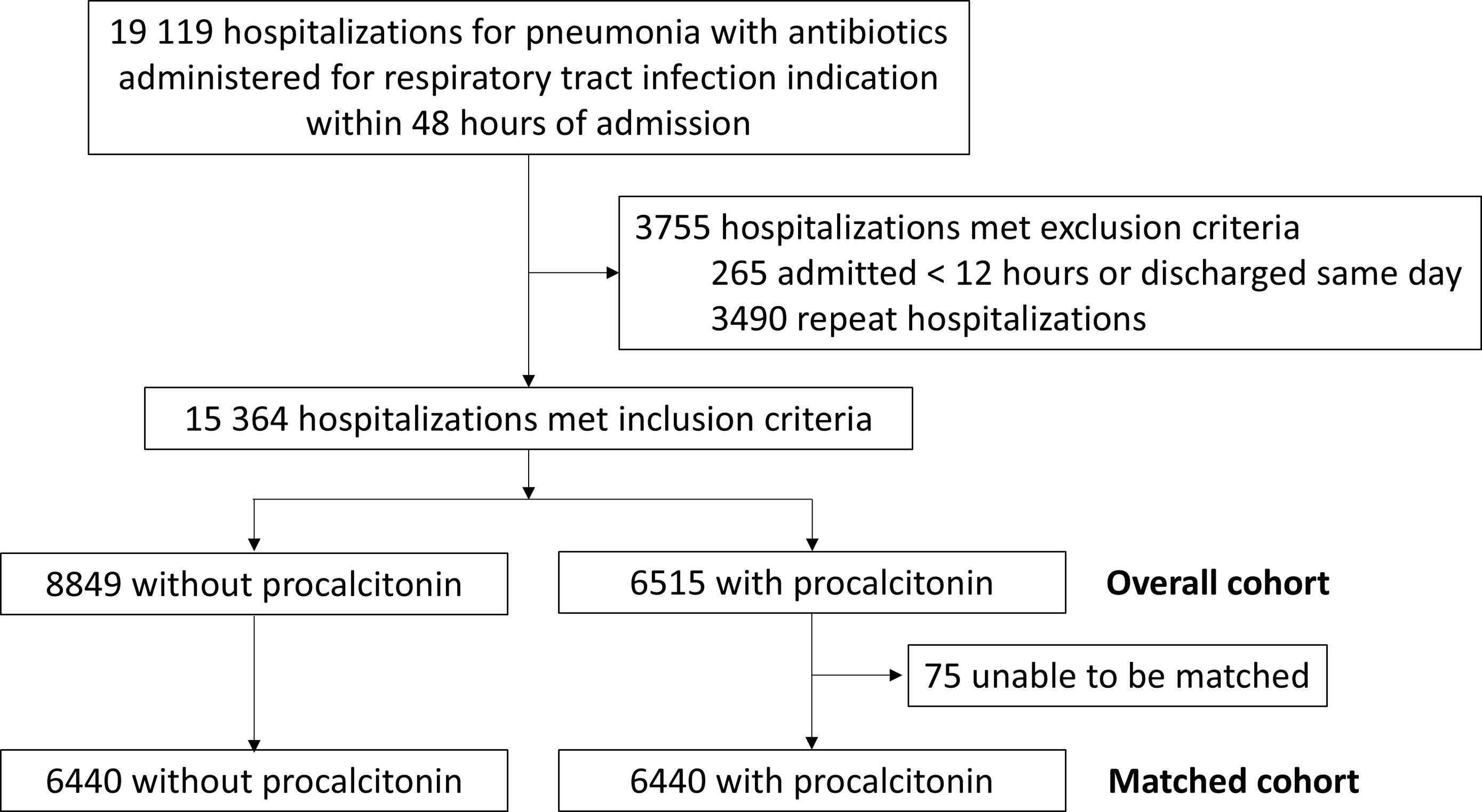
A total of 15364 hospitalizations met the inclusion criteria (Figure 1). Of these, at least one PCT was ordered within the first seven days in 42.4% (6515/15364), totaling 8214 PCT results. Of the 6515 patients with PCT testing, 6440 were able to be matched to patients who did not have PCT ordered, bringing the final matched cohort size to 12880 unique hospitalizations, 6440 in each group. The details of the exact match are shown in Supplementary Table 2.
Flow diagram.

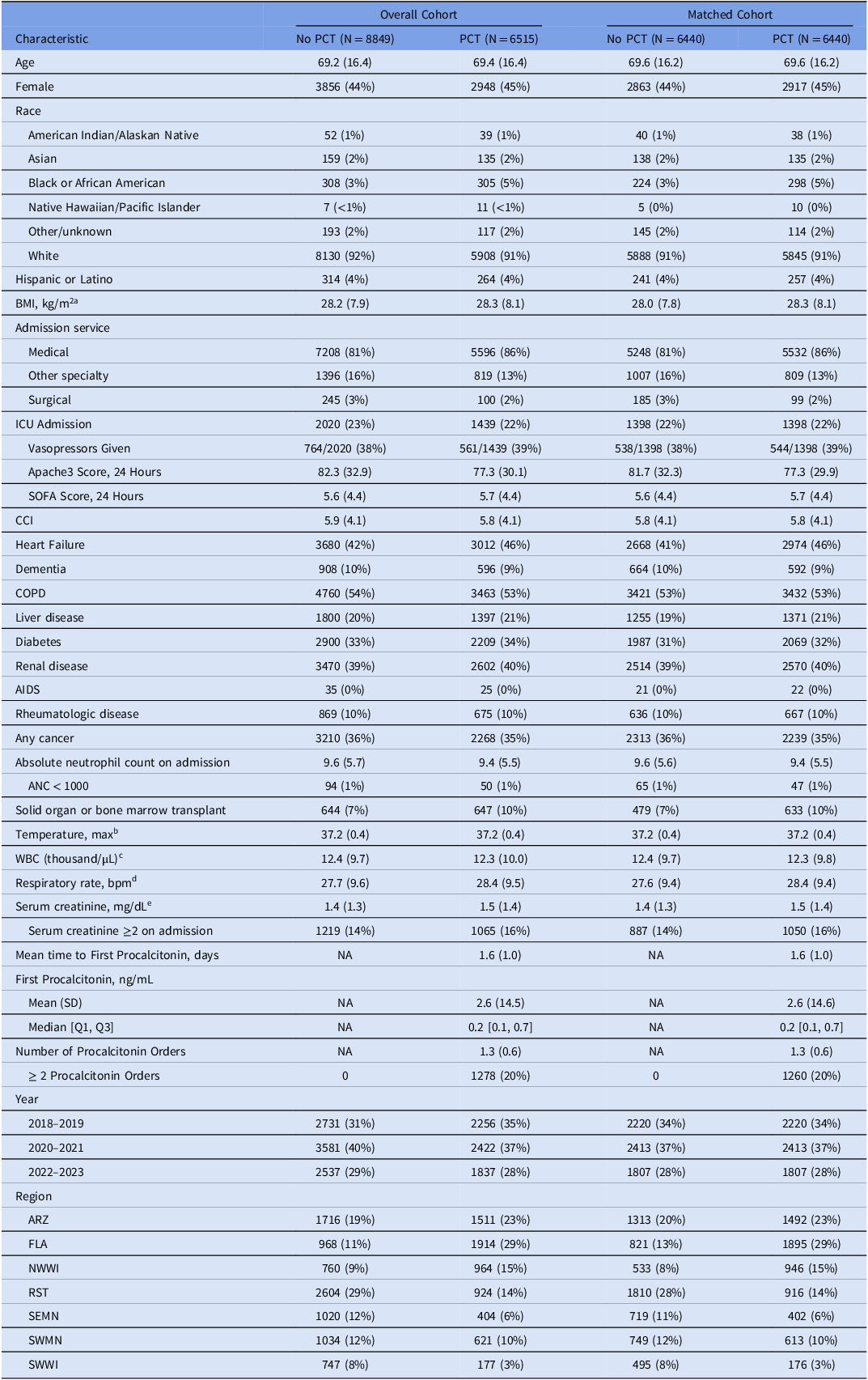
Baseline characteristics of the overall and matched cohorts are shown in Table 1. Groups were well-matched at baseline in both the overall and matched cohorts. In the matched cohort, the mean age was 69.6 years, and approximately 45% of patients were female. Most patients (>81%) were admitted to medical services, and 22% of patients in each group were admitted to the ICU within 24 hours of hospitalization. The mean CCI in each group in the matched cohort was 5.8. The overall average inpatient antibiotic treatment duration in each region across all hospitals was ≤5.3 days (Supplementary Table 3).
Baseline characteristics among patients with and without procalcitonin testing in the overall and matched cohorts

Results are shown as mean (standard deviation) or number (%) unless otherwise noted.
Abbreviations: BMI, body mass index; ICU, intensive care unit; CCI, Charlson Comorbidity Index; COPD, chronic obstructive pulmonary disease; AIDS, acquired immunodeficiency syndrome; ANC, absolute neutrophil count; WBC, white blood cell count; ARZ, Arizona; FLA, Florida; NWWI, Northwest Wisconsin; RST, Rochester; SEMN, Southest Minnesota; SWMN, Southwest Minnesota; SWWI, Southwest Wisconsin.
a 69 missing values in overall cohort.
b 9 missing values in overall cohort.
c 82 missing values in overall cohort.
d 4 missing values in overall cohort.
e 125 missing values in overall cohort.
The average time to first PCT was 1.6 days. PCT testing was ordered an average of 1.3 times per patient within the first 7 days of admission. The median first PCT value was 0.2 ng/mL, with an IQR of 0.1 to 0.7 ng/mL. Only 20% of patients had ≥2 PCT results.
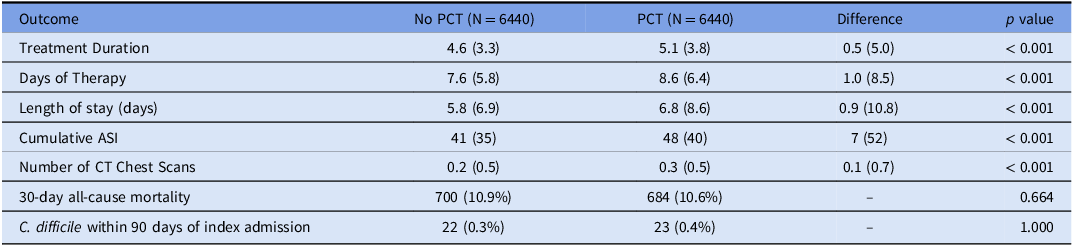
The outcomes of the matched cohort are shown in Table 2. For the primary outcome, patients with PCT testing received on average a half-day longer duration of therapy compared to patients who did not receive PCT testing (mean treatment duration = 4.6 nPCT vs. 5.1 PCT, P < 0.001). Patients in the PCT group also received more DOT (mean DOT = 7.6 nPCT vs. 8.6 PCT, P < 0.001), which translated to a higher overall antibiotic exposure as measured by cumulative ASI over the course of the hospitalization (mean cumulative ASI = 41 nPCT vs. 48 PCT, P < 0.001). Additionally, patients who received PCT testing had a longer length of stay (5.8 days nPCT vs. 6.8 days PCT, P < 0.001) and were more likely to receive CT chest imaging (mean CT chest obtainment = 0.2 nPCT vs. 0.3 PCT, P < 0.001). There was no difference in 30-day, all-cause mortality or C. difficile infection between groups.
Outcomes among patients with and without procalcitonin testing in the matched cohort

Results are shown as mean (standard deviation) or number (%) unless otherwise noted.
Abbreviations: ASI, antibiotic spectrum index
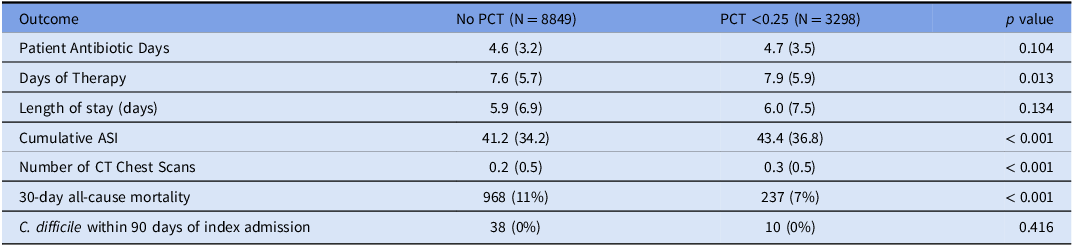
Table 3 displays the sensitivity analysis of nPCT patients compared to PCT patients with a peak value <0.25 ng/mL (i.e. normal result) in the overall cohort. There was no difference in treatment duration (mean = 4.6 nPCT vs. 4.7 normal PCT, P = 0.104) or LOS (mean LOS = 5.9 days nPCT vs. 6.0 days normal PCT, P = 0.134); however, patients with normal PCT testing still received statistically significantly more days of therapy and CT scans, and were exposed to a higher cumulative antibiotic burden as measured by cumulative ASI compared to nPCT patients. 30-day all-cause mortality was higher in the nPCT group compared to patients with normal PCT (11% vs 7%, p < 0.001).
Outcomes among patients without procalcitonin testing compared to patients with normal procalcitonin in the overall cohort

Results are shown as mean (standard deviation) or number (%) unless otherwise noted.
Abbreviations: ASI, antibiotic spectrum index
Supplementary Tables 4 and 5 show unmatched comparisons between patients with abnormal PCT vs. patients with normal PCT and nPCT patients vs. patients with abnormal PCT, respectively. Patients with elevated PCT values (≥0.25 ng/mL) received longer treatment durations (5.5 days) than both patients with normal PCT (4.7 days) and nPCT patients (4.6 days, P < 0.001 for both comparisons). Regardless of the longer treatment durations, patients with elevated PCT results ≥0.25ng/mL had higher 30-day all-cause mortality (14%) compared to patients with normal PCT (7%) and those without any PCT testing (11%, P < 0.001).
Discussion
PCT has been widely used as a biomarker to aid clinicians in discerning bacterial infections from alternative etiologies and to guide antimicrobial durations of therapy, with the goal of reducing unnecessary antimicrobial exposure. This is especially important in suspected lower respiratory tract infections (LRTIs), including CAP, where the most likely etiology is viral.Reference Jain, Williams and Arnold18 However, the test may be incorrectly ordered and/or interpreted, which negates the intended indication for ordering to reduce antimicrobial exposure and, in turn, adds unnecessary cost and contributes to medical waste.Reference Panteghini, Dolci, Birindelli, Szoke, Aloisio and Caruso19,Reference Pena, Cooper, Greer, Elders and Septimus20 In this large, multicenter, multiregional, retrospective matched cohort study, testing PCT was not found to facilitate antimicrobial stewardship or reduce all-cause mortality, but rather was associated with longer durations of treatment, longer hospitalizations, and obtainment of additional imaging. Further, there was no meaningful reduction in any of these outcomes in a sensitivity analysis of patients where PCT testing was performed but resulted within a normal range (i.e., highest 7-day PCT value <0.25 ng/mL) compared to patients who never received PCT testing at all.
Numerous RCTs and meta-analyses have been conducted to evaluate the impact of PCT testing on antibiotic exposure and clinical outcomes in patients with LRTIs.Reference Schuetz, Christ-Crain and Thomann4,Reference Huang, Yealy and Filbin6,Reference Bouadma, Luyt and Tubach21–Reference Branche, Walsh and Vargas24 Although a recent meta-analysis of patient-level data from RCTs found that PCT was associated with reduced antimicrobial exposure,Reference Schuetz, Wirz and Sager23 all four RCTs published since 2016 have failed to show a benefit with PCT compared to nPCT.Reference Montassier, Javaudin and Moustafa5,Reference Huang, Yealy and Filbin6,Reference Daubin, Valette and Thiolliere25,Reference Wussler, Kozhuharov and Tavares Oliveira26 Studies that have shown an effect with PCT testing typically have a longer-than-recommended duration of therapy in the control group and/or rigid algorithms that direct care.Reference Schuetz, Christ-Crain and Thomann4,Reference Bouadma, Luyt and Tubach21,Reference Christ-Crain, Jaccard-Stolz and Bingisser22 While PCT-directed algorithms may be helpful when adhered to carefully, high protocol adherence has proved difficult to obtain even within clinical trials, such as in the more recent ProACT trial, which found an adherence rate of 64.8%.Reference Huang, Yealy and Filbin6 A sub-study of the ProACT trial found that adherence rates of 84% in hospitalized patients would have been necessary for the investigators to have found a statistically significant reduction in antibiotic days, although this still would not have resulted in a full day of therapy saved (3.7 day with PCT vs. 4.3 days without PCT).Reference Malley, Yabes and Gimbel27 Additionally, there are a variety of cutoffs utilized in algorithms (e.g., 0.25 vs. 0.5 ng/mL) depending on indication (e.g., CAP vs. sepsis) and patient features (e.g., hemodialysis patients vs. non-hemodialysis patients). Further, recommendations guiding when, where, and in whom to utilize procalcitonin (e.g., to initiate therapy vs to stop therapy) have changed over time. For these reasons, our healthcare enterprise does not provide institutional-specific guidance on the usage and/or interpretation of procalcitonin results.
Several real-world evaluations of procalcitonin use have also been conducted.Reference Albrich, Dusemund and Bucher7,Reference Heren, Lund, Alexander and Livorsi8,Reference Walsh, DiSilvio and Hammer28–Reference Newton, Robinson, Ling, Zimmer, Kuper and Trivedi30 Most recently, Heren and colleagues conducted a real-world retrospective propensity-matched cohort study on the impact of PCT in a large cohort of veterans admitted with suspected LRTIs.Reference Heren, Lund, Alexander and Livorsi8 Despite slightly different patient selection criteria and the inclusion of discharge prescriptions towards duration of therapy, they also found the PCT testing was associated with longer lengths of antibiotic therapy with a median duration of 8 days in the PCT group compared with 7 days in the nPCT group (P < 0.01). They too performed a matched “best case scenario” sensitivity analysis of patients with PCT < 0.25 ng/mL or a decrease of at least 80% compared to nPCT patients. Here they detected a shorter duration of therapy in the normal PCT group, although the mean difference was only 0.1 day (9.3 days vs 9.4 days; P < 0.01), calling into question the clinical significance of this finding.Reference Heren, Lund, Alexander and Livorsi8 By contrast, our study had the added strengths of only including antibiotics targeted towards CAP treatment and also including patients that had a single PCT result.
An important consideration in interpreting any test is thorough understanding of the sensitivity and specificity, which can result in false-negative and false-positive results, respectively. PCT may be falsely elevated in a variety of conditions, including cardiogenic shock, trauma, surgery, burns, cerebral hemorrhage, pancreatitis, liver disease, COVID-19, and renal disease.Reference Chambliss, Patel and Colon-Franco3,Reference Grace and Turner31,Reference Kim32 False-negative results may also be observed in patients with atypical bacterial infections, such as Legionella spp., Mycoplasma spp., and Chlamydia spp. infections.Reference Kim32,Reference Haeuptle, Zaborsky and Fiumefreddo33 Of note, in our cohort, approximately 15% of patients had a baseline serum creatinine value ≥2 mg/dL, which may have resulted in unnecessary antibiotic treatment based on falsely elevated baseline PCT results.
We found a statistically significantly higher 30-day all-cause mortality in the sensitivity analysis of patients without PCT testing compared to patients with normal (i.e., < 0.25 ng/mL) PCT results (11% vs 7%, respectively, P < 0.001). Additionally, 30-day mortality was highest in the subgroup of patients with elevated PCT results at 14%. PCT is upregulated in response to pro-inflammatory cytokines, such as interleukin-1β, tumor necrosis factor-α, and interleukin-6. As a marker of inflammation, and similar to C-reactive protein, elevated PCT has been shown to be a risk factor for mortality, although this varies by patient population.Reference Chambliss, Patel and Colon-Franco3 Indeed, an elevated PCT concentration from a single result has been associated with 28/30-day mortality in both pneumoniaReference Liu, Su, Guan, Xiao and Xie34 and sepsis.Reference Liu, Su, Han, Yan and Xie35 Therefore, a higher 30-day all-cause mortality in the unmatched comparison of patients with normal PCT compared to non-tested patients is not an unexpected finding, as roughly half of the patients in the NPC group would likely have had elevated PCT values had they been tested, assuming the same rate of abnormality as observed in the PCT group. Of note, in the matched comparison of patients with any PCT testing compared to nPCT, there was no difference in mortality (10.6% PCT vs. 10.9% nPCT, P = 0.664).
This study has several limitations. First, we limited inclusion to patients with CAP, which we identified using a combination of ICD-10 codes and antibiotic administrations with order-specified indications for respiratory tract infections rather than a diagnosis based on clinical and radiographic features. This could have resulted in misclassification and/or misattribution of antimicrobial indications if errors in either diagnosis, coding, and/or indication selection existed. However, this represents a real-world scenario in which the diagnosis of CAP may be imperfect and employs an antimicrobial metric consistent with standard antimicrobial stewardship program practices and previously shown to maintain a high degree of accuracy.Reference Beardsley, Vestal and Rosario9–Reference Heil, Pineles and Mathur11 Second, we were not able to accurately discern the indication for discharge antibiotic prescriptions at our institution, and therefore post-hospitalization durations of therapy were not included in our analysis. Third, our Enterprise does not provide institutional guidance for the interpretation of PCT results. This may explain the lack of effect noted in our study, as well as the limited number of patients who received follow-up testing; however, PCT algorithms are available from tertiary reference sites accessible to all providers within our institution. Further, the availability of guidance algorithms does not guarantee adherence, as evidenced by suboptimal rates of adherence in controlled trials. Finally, given the observational nature of this study, there may have been residual unmeasured confounding variables contributing to antibiotic use.
If PCT testing does not reduce antimicrobial exposure or improve patient-centered outcomes, or worse, results in additional unnecessary antibiotic exposure and longer hospitalizations, healthcare systems should carefully weigh the pros and cons of offering such a test. Our large, contemporary, multiregional cohort demonstrates that PCT testing within the first seven days of hospitalization is common in patients with suspected CAP. Yet, given evidence that availability of PCT test results, even if normal, does not correlate with improvements in prescribing or patient-centered outcomes, along with trends towards overall shorter durations of therapy in contemporary medical practice, the utility of PCT testing in the setting of CAP would appear questionable.
Conclusion
In this large, retrospective, multiregional, health system-wide, matched cohort study, PCT testing was not associated with any appreciable reduction in antimicrobial utilization, hospital length of stay, 90-day C. difficile infection, or 30-day all-cause mortality, both in the matched PCT versus nPCT comparison or when comparing patients with normal PCT values to non-tested patients. These results call into question the benefit of PCT testing in hospitalized patients with CAP as compared to non-PCT guided care.
Supplementary material
To view supplementary material for this article, please visit https://doi.org/10.1017/ice.2025.35
Acknowledgement of author contributions
All authors have contributed meaningfully to the manuscript, vouch for the validity of the data, and have approved of the final manuscript.
Financial support
This work was supported in part by funding from the Mayo Clinic Arizona Pharmacy Department.
Competing interests
The authors have no conflicts of interest to report.
Prior abstract publication
None.
Conception
DI, DK, RWS, and AS. Data collection/validation: DK and DI. Data analysis: AKM. Data interpretation: DI, DK, AKM, RWS, and AS. Initial manuscript draft: DI. Manuscript review and editing: DI, DK, MTS, AKM, JO, CLS, RWS, and AS.