

Introduction
Entrepreneurs and small business owners require financial capital to start and grow their businesses, particularly considering that many fail during their first five years of initial trading (Reynolds and Lancaster Reference Reynolds and Lancaster2006). Having access to financial capital resources is more important for the success, survival, and growth of any business, specifically for small businesses, including ethnic minority small businesses (Haq et al. Reference Haq2024, Reference Haq2021), than large organizations, as small businesses almost always and everywhere have limited access to resources (Haq et al. Reference Haq2025, Reference Haq2024). Accessing initial finance is particularly crucial during the pre-start-up stage, as many aspiring entrepreneurs may abandon their plans to enter the commercial market for trading without sufficient financial capital (Evans and Jovanovic Reference Evans and Jovanovic1989). Moreover, an entrepreneurial opportunity requires the recombination of resources before the sale of outputs, and these resources require sourcing and financing by an entrepreneur (Shane Reference Shane2003). Any individual intending to pursue a business start-up needs funding from a wide range of formal and informal sources of finance (Yasin Reference Yasin2014), such as individual savings, borrowing from family and friends, trade creditors, bank loans, bank overdrafts, venture capital, and government loans and grants (Hussain and Matlay Reference Hussain and Matlay2007). More recently, the emergence of Islamic banking options has also started to prevail in the commercial banking market to cater to different religious communities. While Islamic banking may be more liquid and vulnerable to external shocks than conventional banking (Fakhri and Darmawan Reference Fakhri and Darmawan2021), it is a better option for those Muslims who practice religion because it aligns with their religious belief systems due to the absence of interest and spiritual preference over materialistic gains (Junaidi et al. Reference Junaidi, Wicaksono and Hamka2022).
Considering that acquiring and mobilizing financial resources is crucial during the pre-start-up phase, various strands of entrepreneurship literature illustrate the economic barriers for different types of entrepreneurs (i.e., refugees, female entrepreneurs, and other minority classifications), specifically immigrant entrepreneurs, due to structural constraints in the host country. Some unique features of the financing preferences for business start-ups among immigrant and ethnic minority entrepreneurs relate to the additional barriers, limitations, and opportunities that immigrant communities may possess or experience (Wood et al. Reference Wood, Davidson and Fielden2012). Immigrants and ethnic minorities may face capital market discrimination in the host society (Coate and Tennyson Reference Coate and Tennyson1992) (Sinkovics and Reuber Reference Sinkovics and Reuber2021; Dabić et al. Reference Dabić2020). Research indicates that ethnic minority business owners do not approach banks and other financial institutions in the UK for financing because they perceive being discriminated against by these institutions due to their ethnicity (Bank of England 1991; Haq Reference Haq2015; Rahman et al. Reference Rahman, Ullah and Thompson2018). A report published by the Bank of England (1991) added that there was little difference in the dependence on traditional financing between ethnic minority and indigenous businesses. However, it highlighted that the difficulties experienced by some ethnic communities in the institutional credit market were related to their sectoral occupation as opposed to ethnic discrimination. That said, Jones et al. (Reference Jones, McEvoy, Barrett, Hughes, Storey, Hughes and Storey1994a, Reference Jones, McEvoy and Barrett1994b) found that South Asian entrepreneurs experienced more significant difficulties in obtaining traditional financing from institutional lenders in the UK and expressed their fears of being negatively discriminated against by British banking staff and, therefore, did not pursue the option of sourcing capital from institutional lenders. Deakins et al. (Reference Deakins2003) also found that ethnic minority entrepreneurs perceived they were discriminated against in traditional financing and that bank managers did not conform to equality policies and expressed their prejudices against ethnic minority entrepreneurs.
Entrepreneurship research has traditionally categorized migrant entrepreneurs under a broad generalization, such as Black and Ethnic Minority (BAME), Asian, South Asian, and so on (Ram et al. Reference Ram, Jones and Villares-Varela2017). More recent studies have emphasized the need for more effective inter- and intra-ethnic comparisons among immigrant entrepreneurs (Vershinina et al. Reference Vershinina, Barrett and Meyer2011; Yasin and Hafeez Reference Yasin and Hafeez2023). Others have stressed cross-national comparative studies (Greene Reference Greene1997; Ilhan-Nas et al. Reference Ilhan-Nas, Sahin and Cilingir2011; I. Light and Bhachu Reference Light and Bhachu1993; Wood et al. Reference Wood, Davidson and Fielden2012). Yet others have more explicitly stressed exploring one migrant community across multiple jurisdictional contexts (Legros et al. Reference Legros2013).
The classical and stereotypical depiction is that migrant entrepreneurs establish low-value-added enterprises and are sectorally concentrated in industries with low barriers to entry and low capital requirements. This is well aligned with the structuralist and mixed embeddedness perspective that immigrant entrepreneurship is rooted in “push”-based entrepreneurship, also known as “necessity-based entrepreneurship” (Haq Reference Haq2015; Lerner et al. Reference Lerner, Khavul, Hisrich, Dana and Dana2007; Yasin and Poulin Reference Yasin, Poulin, Margaça, Walmsley and Knörr2025). According to Barrett and Mcevoy (Reference Barrett, McEvoy, Kaplan, Li, Kaplan and Li2006), the sectoral occupation of South Asian businesses tended to be concentrated in declining sectors of the British economy, as they often occupied low-value and growth sectors such as grocery shops, newsagents, tobacconists, and other forms of retail and catering, areas of trade which were less occupied or yet abandoned by the majority White British population. Jones et al. (Reference Jones, McEvoy, Barrett, Hughes, Storey, Hughes and Storey1994a) and Ram et al. (Reference Ram, Jones and Villares-Varela2017) argue that the sectoral concentration in which these migrants and ethnic minorities may start a business is often unvalued by the indigenous population in Britain.
However, one of the most overlooked aspects of existing scholarship on ethnic minority entrepreneurship is the recognition of the dynamics within more capital-intensive and demanding sectors, which require substantial financial capital, such as the precious metals industries (i.e., gold and diamonds), for a business start-up, except for a limited number of studies (cf. Yasin et al. Reference Yasin, Abaido, Nair and Beaumont2025b) Yasin (Reference Yasin2014) and Yasin et al (Reference Yasin2025a), for example, identified that each Pakistani immigrant enclave in the UK, Denmark, and Norway had some form of the gold jewelry trade. While the precious metals would include gold, platinum, and silver, this sector is considered rare owing to the high economic value of entering this trade line. The fluctuating rate of gold, according to the World Gold Council (2025), shows a substantial upward trend of gold prices in recent years, characterized as permacrisis (Haq et al. Reference Haq2024; Zuleeg et al. Reference Zuleeg, Borges de Castro and Emmanouilidis2021). Even this significant increase in gold price does not deter some ethnic groups, such as the Pakistani ethnic minority diaspora, due to the cultural significance of gold symbolizing wealth, power, and emblematic importance manifested as gifts at weddings and other special occasions (Haq et al. Reference Haq2024). Such precious metals are also passed down to subsequent generations, offering sentimental value.
While 10-carat is the minimum accepted standard in the United States (US), 14-carat gold is more common worldwide. Twenty-four carat (ct) is the purest form of gold, whereas 22ct, at approximately 91.6% purity, contains alloys such as silver, nickel, zinc, and copper. The latter is more widely used in the manufacture of jewelry and other gold articles. In Pakistani culture, only 22ct and 24ct gold are commercially and socially valued. A number of studies have also highlighted the role of spouses and wider families in financing immigrant enterprises in the US and Europe (Bird and Wenneberg Reference Bird and Wennberg2016; Chand and Ghorbani Reference Chand and Ghorbani2011; Kalnins and Chung Reference Kalnins and Chung2006).
Just as distinctions of carat value signify subtle yet consequential differences in the purity and social desirability of gold, intra-ethnic distinctions such as Khandani and Biraderi mark nuanced but powerful gradations of prestige and legitimacy within South Asian Muslim communities. Within this context of intra-ethnic variation and cultural stratification (Yasin and Hafeez Reference Yasin and Hafeez2023), the Urdu terms “khandani” and “biraderi” convey distinct but interconnected layers of social hierarchy in South Asian Muslim communities (Yasin Reference Yasin2014). Khandani refers primarily to lineage-based prestige, signifying ancestry from an esteemed family line and conferring symbolic capital tied to reputation and respectability (Ahmad Reference Ahmad1978). By contrast, Biraderi, literally meaning “brotherhood,” denotes broader kinship or occupational groupings that structure collective identity and regulate marriage alliances, mutual support, and political or economic cooperation (Ballard Reference Ballard, Clarke, Peach and Vertovec1990; Jodhka and Shah Reference Jodhka and Shah2010). Thus, Khandani status emphasizes inherited prestige within a family line, while Biraderi affiliation provides the communal framework in which such hierarchies are embedded and reproduced across generations. This distinction is central to understanding how immigrant entrepreneurs navigate credibility, legitimacy, and access to financial capital.
Accordingly, this paper asks: Are there differences between khandani and non-khandani entrepreneurs in rapidly accumulating start-up finances through their embeddedness and credibility within local, regional, or home-country contexts? The study seeks to provide a nuanced understanding of immigrant entrepreneurship across two contrasting countries. Its specific objectives are threefold: first, to explore formal and informal sources of financial capital among immigrant entrepreneurs in the precious metals industry within two enclaves (Dubai, UAE, and Manchester, UK); second, to analyze the rationale for acquiring and mobilizing financial resources in the start-up process; and third, to evaluate the extent to which these sources of finance are “embedded” within the wider institutional and regulatory framework, as well as within the particular social structures of ethnic resources in the respective immigrant communities.
The UK and the UAE Contexts
Pakistan was part of the former British Empire with a colonial presence in the Indian subcontinent from 1558 to 1947. The Indian subcontinent now comprises three sovereign nation-states: India, Pakistan, and Bangladesh. Due to this relationship, South Asian migrants arrived in the UK to fulfill demanding and least desirable work roles in the booming textiles and garment manufacturing in the 1950s and 1960s (Haq Reference Haq2015; Kalra Reference Kalra2000). However, these migrants were laid off and were “pushed” towards pursuing business start-ups in the 1980s and 1990s due to economic restructuring and rapid deindustrialization. The UAE was a British Empire protectorate since the early nineteenth century through a series of treaties, such as the General Treaty of 1820, before declaring its independence based on the unity of the seven emirates in 1971. Unlike Pakistan, which the British directly ruled, the UAE has no such history of colonial occupation, as the British only maintained a presence in the Middle East to secure trade rather than direct administration. With geographic proximity, the UAE and Pakistan have a longstanding history that predates both nations’ independence. Pakistan was one of the first countries to recognize the UAE as a sovereign nation.
The UK has a population of approximately 67.33 million, of which 1.5 million belong to the Pakistani ethnic minority (Office for National Statistics 2021). Unlike the UK, the UAE is more dependent on foreign migration than the UK due to the lower population of the indigenous “Emirati” community, which descends from two tribal groups. The overall population of the UAE is approximately 9.365 million, of which 11.6% comprises Emirati, while 59.4% are defined as “Asians” (Index Mundi 2015). Under this classification, the Pakistani ethnic group constitutes 9.4%.
The similarity between the UK and the UAE is that there is evidence of ethnic concentration in both countries’ residential and commercial immigrant enclaves. For example, there are notable areas of immigrant Pakistani presence throughout the UK, particularly prevalent in Manchester, Bradford, Birmingham, Glasgow, and the specific regions of London. Similarly, there is ethnic concentration among Pakistanis in the UAE, particularly prevalent in Karama, Deira, Bur Dubai, and Sharjah. While it is well recognized that the areas of Rusholme and Cheetham Hill in Manchester are clustered in the gold trade, similar ethnic enclaves are formed in Dubai in identifiable and designated touristic regions such as Meena Bazaar. While the UK and the UAE boast a modern cosmopolitan outlook, the predominant ethnic trends are varied between them.
Literature Review
Immigrant Entrepreneurship
Immigrant entrepreneurship literature in the context of the UK revolves primarily around two distinctive arguments to explain immigrant entrepreneurial phenomena. The first argument explains that immigrant entrepreneurial phenomena are a product of the cultural inclination of specific migrant communities based on the power of agentic influences. The second argument talks about the structuralist dimension, which explains the role of racism, discrimination, unemployment, and broader economic restrictions that leave specific migrants economically and socially stranded (Haq Reference Haq2015; Clark and Drinkwater 2010; Jones and Ram Reference Jones and Ram2010). Kloosterman et al.’s (Reference Kloosterman, Van Der Leun and Rath1999) work -the mixed embeddedness framework - replaces the agency-versus-structural discourse by explaining how the politico-institutional contexts and regulatory regime in the host nation shape the outcomes of openings in the opportunity structure for migrant entrepreneurs to utilize their ethnic resources. More recent work by Yasin (Reference Yasin2014) and Yasin and Hafeez (Reference Yasin and Hafeez2023) - underpinned by the mixed embeddedness perspective - illustrates how differences between the institutional and regulatory contexts in the Anglo-Saxon UK lead to different experiences compared to the socialist Scandinavian countries (i.e., Norway and Denmark) among a single immigrant community. While mixed embeddedness is a well-grounded framework, Berwing (Reference Berwing2019), based on large-scale data analysis in Germany, suggests that most immigrant entrepreneurs did not use their co-ethnic resources.
Irwin and Scott (Reference Irwin and Scott2010) conclude from a large-scale study on Small and Medium Enterprises (SMEs)—those employing 50 to 250 people (Haq Reference Haq2015)—by the Barclays Bank Small Business Research team that ethnic minority communitiesFootnote 1 in the UK experience greater challenges in obtaining finances than the majority White British population. Ram and Jones (Reference Ram and Jones2008) and Gidoomal (Reference Gidoomal1997) argue that immigrant entrepreneurs might also lack sufficient language proficiency, have an absence of recognizable credit history, and be unfamiliar with the British banking process, which may also narrow their opportunity to obtain finances for their business start-ups. Irwin and Scott (Reference Irwin and Scott2010) also refer to the educational background of migrants and argue that the lack of education makes no difference in their access to traditional financing. Their findings align with previous research conducted in this area (see Ram, Smallbone, and Deakins Reference Ram, Smallbone and Deakins2002; Ram and Deakins Reference Ram and Deakins1995). In terms of formal financing for business start-ups, Ram et al.’s (Reference Ram, Smallbone and Deakins2002) study on ethnic minority entrepreneurs’ financing arrangements highlighted the diversity between different ethnic groups’ experiences in obtaining external finances. They state that although all banks have favorable policies, the treatment by bank managers and the experiences of ethnic minority entrepreneurs vary between different ethnic groups.
The ethnic enclave, as a contextual factor, also forms part of the discussion of formal financing among ethnic minority entrepreneurs, as ethnic minority businesses (EMBs) are generally located in urban areas and are reflected in the ethnic settlement patterns of their communities (Basu Reference Basu1991; Reeves and Ward Reference Reeves, Ward, Ward and Jenkins1984). These inner city locations reflect a de-industrialized past and are considered to be deprived and socially excluded from the rest of the nation, and therefore present both opportunities for an entrepreneur’s livelihood but also challenges in the lack of resource availability, which may daunt them (Barrett et al. Reference Barrett2002; Deakins and Freel Reference Deakins and Freel2006). However, from a financing viewpoint, these ethnic enclaves present challenges for ethnic and migrant entrepreneurs in obtaining traditional financing because of the poorer local environmental conditions, such as vandalism, inadequate parking, physical dilapidation, and higher crime levels associated with such localities (Basu Reference Basu, Casson, Yeung and Wadeson2006). Moreover, these enclaves are constrained by the lower purchasing power of the target market of residents and the increasing cost and difficulties of obtaining reasonable insurance premiums (Bank of England 1991; Basu Reference Basu1991; Deakins and Freel Reference Deakins and Freel2006). The Bank of England (1999) stated that ethnic businesses are associated with producing modest returns and are in a greater risk category because of their poor payment records on loans, preventing formal lenders from offering them finances.
Considering the factors above, the sectoral occupations of immigrant and ethnic minority entrepreneurship require equal priority in this discussion. Immigrant entrepreneurs and ethnic small business owners are observed to be concentrated in areas of trade with low barriers to entry and low growth, which require modest amounts of financial capital for business start-ups such as retailing, textiles, and catering (A. Basu and Altinay Reference Basu and Altinay2002; Dhaliwal and Kangis Reference Dhaliwal and Kangis2006; Flap et al. Reference Flap, Kumcu, Bulder and Rath2000). This is observed among Pakistani businesses in Denmark as they are highly concentrated in low-profit-margin companies such as supermarkets and kiosks, which require long working hours (Rezaei Reference Rezaei2007). Therefore, such businesses largely depend on family finances and inward-looking networks (Dhaliwal and Kangis Reference Dhaliwal and Kangis2006; Lassalle Reference Lassalle2018). In the UK, Pakistani immigrants are concentrated in the transport industry (e.g., taxi drivers and taxi base ownership), further emphasizing their modest capital requirements (McEvoy and Hafeez Reference McEvoy and Hafeez2006).
Besides the structuralist and culturalist views (Haq Reference Haq2015; Basu Reference Basu1998), a relatively less prevalent strand of the argument in EMBs’ financing preferences points towards the reluctance of cultural and religious influences. Under this assumption, religion may prevent Muslims from pursuing traditional financing because the act of usury is prohibited in the Islamic faith (Adas Reference Adas2006). However, Basu and Altinay (Reference Basu and Altinay2002) suggest that religion has little effect on Muslim entrepreneurs in London in borrowing from institutional lenders. Similarly, Phizacklea and Ram (Reference Phizacklea and Ram1995) reported that half of their sample of Pakistani entrepreneurs in Birmingham’s Curry Mile obtained bank loans to start their businesses.
Ethnic minority and immigrant communities source financing from their personal sources, family and friends, and community networks for their business activities (Basu Reference Basu1998; Hussain and Matlay Reference Hussain and Matlay2007; Metcalf et al. Reference Metcalf, Modood and Virdee1996; Nee and Sanders Reference Nee and Sanders2001; Rezaei Reference Rezaei2007; Werbner Reference Werbner1990). The Global Entrepreneurship Monitor (Reference Harding2004) found that Pakistanis in the UK obtained more business start-up financing from their family and friends than any other ethnic group (including the native majority population) (Harding Reference Harding2004). However, ethnic comparative studies illustrate that excessive reliance on sourcing financial capital from family and close associate networks may not be different from managers and business owners among the native population (Hussain and Matlay Reference Hussain and Matlay2007).
Immigrant Pakistani entrepreneurs in the UK pursue informal financing methods for their entrepreneurial activities (Yasin Reference Yasin2013). Deakins et al.’s (Reference Deakins2009) investigation of minority ethnic enterprises in Scotland found that the Pakistani ethnic group excessively relies on informal sources of financing for their business activities. This trend was similar in Norway, where Krogstad (Reference Krogstad2002) highlighted through case studies that immigrant Pakistani entrepreneurs obtain resources for their business start-ups from their co-ethnic group. Similarly, in Denmark, Rezaei (Reference Rezaei2007) found in his comparative study among different ethnic groups’ “break-out” strategies that the Pakistanis report lower usage of institutional lenders, as they heavily rely on their co-ethnic group for savings, borrowings, or receive gifts from family and friends for their business activities.
Social Capital and Rotating Credit Association
While many competing definitions of social capital exist (see, for example, Haq et al. Reference Haq2021), Portes (Reference Portes1998, p.6) defines it as “the ability to secure benefits by members in social networks or other social structures.” The co-ethnic community may play an important role in supporting an immigrant entrepreneur through rotating credit associations (RCA), also referred to as “Kameti,” based on trust, ethnic solidarity, and social resources among a small network of people (Bates Reference Bates1997; Volery Reference Volery, Dana and Dana2007). RCA refers to “a voluntary grouping of individuals who agree to contribute financially at uniformly-spaced dates towards the creation of a fund, which will then be allotted in accordance with some prearranged principle to each member of the group in turn” (Calomiris and Rajaraman Reference Calomiris and Rajaraman1998) Accordingly, the sum is given to a member at the end of every period (usually a week or a month) according to a drawing that is done at the beginning (Light and Gold Reference Light and Gold2000; Portes and Manning Reference Portes, Manning, Olzak and Nagel2012).
The RCA concept was observed in different studies of immigrant groups, such as Kalra’s (Reference Kalra2000) investigation of Kashmiri (Mirpuri) immigrants in Oldham, which found that the elderly participants provided this type of support through a Biraderi Footnote 2 network for social purposes, such as financing funerals. It is a bilateral system which consists of consanguineal and affinal relatives, in that a brother system of relationship prevails (Wakil Reference Wakil1970). In the business context, these practices were observed among Chinese and Japanese immigrants in the US (Bates Reference Bates1997; Light Reference Light1972), Ethiopian and Bolivian immigrants in the US (Price and Chacko Reference Price and Chacko2009), and also noted as a process for financial capital in Werbner’s (Reference Werbner, Ward and Jenkins1984) seminal research among Punjabi-Pakistani entrepreneurs in Manchester’s retail industry.
Methodology
Methodological Approach and Sample
Since our chosen topic is an under-researched sector and ethnic-specific (Dabić et al. Reference Dabić2020; Haq et al. Reference Haq2021; Sinkovics and Reuber Reference Sinkovics and Reuber2021), a qualitative research approach was needed, which offered an opportunity for in-depth analysis (Haq and Davies Reference Haq and Davies2023; Dana and Dana Reference Dana and Dana2005; Angel et al. Reference Angel, Jenkins and Stephens2018). Underpinned by an interpretive paradigm, qualitative methods of inquiry were adopted to understand the behavior of actors (i.e., immigrant entrepreneurs) within a specific context (immigrant enclave start-ups) under two varying national contexts (UK and UAE). An ethnic minority enclave refers to a subset of an economy in which a group of ethnic minority business owners serve co-ethnic customers and employ co-ethnic workers in an ethnic majority socioeconomic space (Portes and Manning Reference Portes, Manning, Olzak and Nagel2012; Volery Reference Volery, Dana and Dana2007). Buchanan et al.’s (Reference Buchanan, Bobby, McCalman and Bryman1988) research access model was adopted to gain access to this hard-to-reach business community using formal and informal methods of access. In other words, we employed a purposive sampling method because purposive and informal access methods are more prominent and useful in interpretive exploratory research (Angel et al. Reference Angel, Jenkins and Stephens2018; Haq and Davies Reference Haq and Davies2023; Lassalle Reference Lassalle2018; Yasin et al. Reference Yasin2025a).
This study is based on 50 semi-structured interviews with immigrant entrepreneurs (25 participants in the UK and 25 in the UAE) with businesses focused on the precious metals industry. Predominantly, these comprised gold jewelry retailers, diamond traders and retailers, gold wholesalers, and small-scale manufacturing and repair companies. Adopting a purposive sample technique, followed by a snowballing sampling approach, we identified participants as first-generation immigrants, (2) all participants were the founders of the new enterprise, and (3) all enterprises were located in the defined immigrant enclave in the UAE and the UK. The immigrant enclaves for the UK sample were selected in Manchester (Rusholme and Cheetham Hill) and for the UAE (Meena Bazaar—Bur Dubai, Deira, and Sharjah).
These immigrant entrepreneurs were initially reluctant to discuss financial-related issues and to engage with academics due to business confidentiality. Also, this industry is more prone to armed robberies, theft, and other forms of crime. In such situations, a reference to a trusted mutual acquaintance is crucial (Yasin and Hafeez Reference Yasin and Hafeez2023). In other words, it is imperative to approach such businesses through a highly credible social network among the sample immigrant business community. The strength of credible references (also called “Sifarish” in Urdu) determines not only the interview access but also the level of openness, transparency, and detailed information the participant would be willing to share. Fortunately, we had a credible reference, as one of our research team members is from a business family of Pakistani descent that has been involved in the UK’s precious metals industry (gold jewelry trade) for several decades.
Research Context - Pakistani entrepreneurship in the UK and the UAE
According to the Office for National Statistics (2021), the ethnic Pakistani group comprises 11.9% of the total population of Manchester and is also the fourth-largest Pakistani community in the nation. This community arrived in the 1960s to fulfil industrial labor shortages in the textile industry. However, displacement compelled this group to start their businesses as a damage limitation exercise. As a result, this group and the Bangladeshi community are disproportionately represented in self-employment at 24% in the UK. For the UAE, the Pakistani immigrant community is the third largest immigrant group, which is spatially concentrated and represents 13% of Dubai’s total population. One of the critical challenges in cross-national comparative research and the reason for its scarcity in the extant literature is the lack of official information and statistics across nations.
Data collection
An initial interview guide was formulated based on the extant literature on business start-up finance and immigrant entrepreneurship literature. The researchers obtained the data in person using a semi-structured interview method from August 2022 to July 2023 in Urdu, Punjabi, and English. Each interview lasted one hour on average. All interviews were digitally recorded. The interviews that were recorded in Punjabi and Urdu were translated into English during transcription. One member of the research team is well-versed in Urdu and English, while another member is well-versed in Punjabi, Urdu, and English. We asked participants broad-based questions (with prompting and probing questions where and as required). These broad-based topics include demographic details of participants; migration context (reasons for migration, type of migration, date and year of migration); type of enterprise (i.e., gold, copper, silver, diamonds); nature of ownership, and date of establishment; location of the business (immigrant enclave); sources of finance used to launch the first business in the precious metals industry; financial capital requirements for the start-up; reasons for chosen financing options; challenges in financing for the business start-up.
Data Analysis
The interview guide was slightly modified after two pilot interviews (the two pilot interviews were included in data analysis). QSR NVivo 10 was used in data analysis and for data visualization purposes. The data were analyzed using Template Analysis (TA) (King Reference King2012). TA is a specific form of thematic analysis that accommodates structure and flexibility, allowing the use of a predefined coding structure (codes derived a priori from extant relevant literature), refining, adding new codes, or removing unrelated codes based on actual data as the coding process progresses (King, Reference King2012). Following the TA process, we adopted a three-phase process. First, we developed an initial coding framework based on our reading of relevant literature. Second, we read the interview data several times and applied this framework to our interview data. Third, we iteratively refined the coding framework underpinned by the interview data.
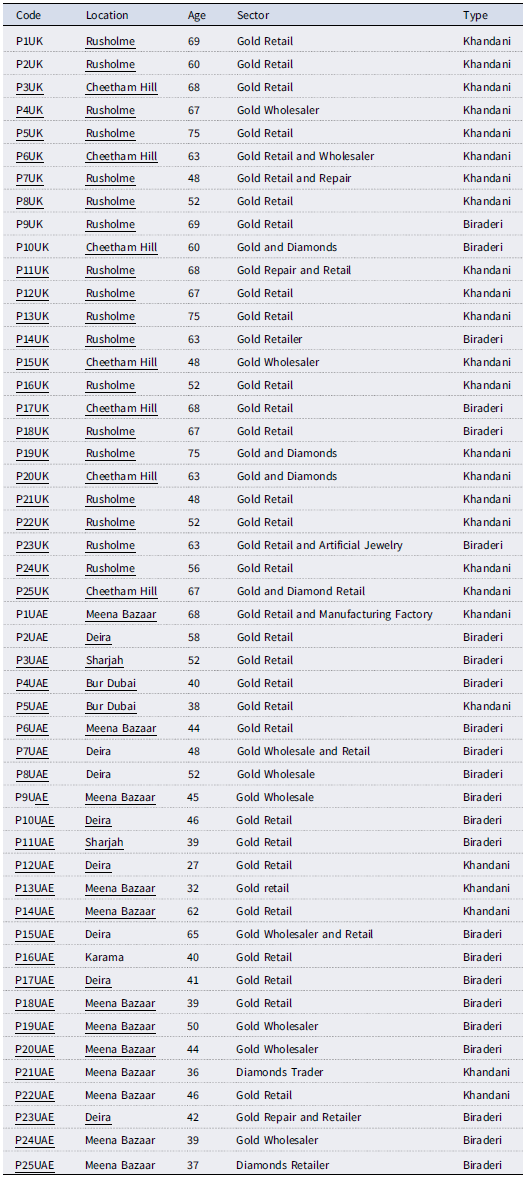
Overall, we found that individuals from a Khandan as a caste sectoral occupation have better access to financial capital than those belonging to a Biraderi. Data saturation was achieved when the data from the 23rd and 25th interviews were analyzed in the UK and the UAE, respectively. No further participants were interviewed. The data collection approach and strategy align with previous cross-national studies in immigrant entrepreneurship (Yasin Reference Yasin2014, Reference Yasin2022; Yasin and Hafeez Reference Yasin and Hafeez2023). As agreed with the research participants, their information has been anonymized, and personal data has been replaced with pseudonyms. An overview of participants is detailed in Table 1.
Participants’ Profile (UK and UAE)

Table 1 Long description
A table detailing participants' profiles in the UK and UAE. The table has 30 rows and 5 columns. Column headers are Code, Location, Age, Sector, and Type. Row 1: Code, P1UK; Location, Rusholme; Age, 69; Sector, Gold Retail; Type, Khandani. Row 2: Code, P2UK; Location, Rusholme; Age, 60; Sector, Gold Retail; Type, Khandani. Row 3: Code, P3UK; Location, Cheetham Hill; Age, 68; Sector, Gold Retail; Type, Khandani. Row 4: Code, P4UK; Location, Rusholme; Age, 67; Sector, Gold Wholesaler; Type, Khandani. Row 5: Code, P5UK; Location, Rusholme; Age, 75; Sector, Gold Retail; Type, Khandani. Row 6: Code, P6UK; Location, Cheetham Hill; Age, 63; Sector, Gold Retail and Wholesaler; Type, Khandani. Row 7: Code, P7UK; Location, Rusholme; Age, 48; Sector, Gold Retail and Repair; Type, Khandani. Row 8: Code, P8UK; Location, Rusholme; Age, 52; Sector, Gold Retail; Type, Khandani. Row 9: Code, P9UK; Location, Rusholme; Age, 69; Sector, Gold Retail; Type, Biraderi. Row 10: Code, P10UK; Location, Cheetham Hill; Age, 60; Sector, Gold and Diamonds; Type, Biraderi. Row 11: Code, P11UK; Location, Rusholme; Age, 68; Sector, Gold Repair and Retail; Type, Khandani. Row 12: Code, P12UK; Location, Rusholme; Age, 67; Sector, Gold Retail; Type, Khandani. Row 13: Code, P13UK; Location, Rusholme; Age, 75; Sector, Gold Retail; Type, Khandani. Row 14: Code, P14UK; Location, Rusholme; Age, 63; Sector, Gold Retailer; Type, Biraderi. Row 15: Code, P15UK; Location, Cheetham Hill; Age, 48; Sector, Gold Wholesaler; Type, Khandani. Row 16: Code, P16UK; Location, Rusholme; Age, 52; Sector, Gold Retail; Type, Khandani. Row 17: Code, P17UK; Location, Cheetham Hill; Age, 68; Sector, Gold Retail; Type, Biraderi. Row 18: Code, P18UK; Location, Rusholme; Age, 67; Sector, Gold Retail; Type, Biraderi. Row 19: Code, P19UK; Location, Rusholme; Age, 75; Sector, Gold and Diamonds; Type, Khandani. Row 20: Code, P20UK; Location, Cheetham Hill; Age, 63; Sector, Gold and Diamonds; Type, Khandani. Row 21: Code, P21UK; Location, Rusholme; Age, 48; Sector, Gold Retail; Type, Khandani. Row 22: Code, P22UK; Location, Rusholme; Age, 52; Sector, Gold Retail; Type, Khandani. Row 23: Code, P23UK; Location, Rusholme; Age, 63; Sector, Gold Retail and Artificial Jewelry; Type, Biraderi. Row 24: Code, P24UK; Location, Rusholme; Age, 56; Sector, Gold Retail; Type, Khandani. Row 25: Code, P25UK; Location, Cheetham Hill; Age, 67; Sector, Gold and Diamond Retail; Type, Khandani. Row 26: Code, P1UAE; Location, Meena Bazaar; Age, 68; Sector, Gold Retail and Manufacturing Factory; Type, Khandani. Row 27: Code, P2UAE; Location, Deira; Age, 58; Sector, Gold Retail; Type, Biraderi. Row 28: Code, P3UAE; Location, Sharjah; Age, 52; Sector, Gold Retail; Type, Biraderi. Row 29: Code, P4UAE; Location, Bur Dubai; Age, 40; Sector, Gold Retail; Type, Biraderi. Row 30: Code, P5UAE; Location, Bur Dubai; Age, 38; Sector, Gold Retail; Type, Khandani.
Source: Authors.
Findings
Based on the analysis of 50 semi-structured interviews across jurisdictional sites of first-generation immigrant entrepreneurs in the UK and UAE samples, the UK participants were, on average, older and more technically skilled in their line of trade than the younger participants in the UAE sample. Although all participants were recruited on the following criteria: (1) first-generation immigrants from Pakistan, (2) must own their own business in the gold jewelry industry, and (3) must have started their own business in the immigrant enclave. Due to the effect of a snowballing sampling strategy, all participants belonged to the Punjab region of Pakistan and were all male. The family (i.e., children and spouse) was actively involved in the business as managers among the more established businesses, whereas, for the younger participants in the UAE sample, younger brothers and cousins were employed in the enterprise as managers and key personnel.
The UK sample participants were considerably older than their UAE counterparts. The average age of the participants in the UK sample was 62.5 years, whereas the participants in the UAE sample were 45.2 years of age. The majority of the participants in the UK sample were mostly “Khandani” entrepreneurs (19 of 25), all of whom have naturalized in the UK as British citizens, while the UAE sample was more proliferated with those belonging to a “Biraderi” of entrepreneurs (18 of 25) and are best described as a male economic migrant entrepreneur with Pakistani passport holders with renewable UAE work visa permits. This nationality and visa status variation is regulated in the UAE, as foreigners are not normally eligible for naturalization. The mindsets of these two prolific samples confirm previous studies (for example, Yasin Reference Yasin2022) of the settler mentality of entrepreneurs in the UK and the transient mentality of the UAE samples.
The market orientation between the two samples was also distinctive. While the participants in the UK sample served a local and regional market of co-ethnic customers in a community context, the orientation of the UAE participants was predominantly on commercial trade among more affluent ethnic residents, international co-ethnic tourists, and local Emirati and citizens from surrounding Middle Eastern countries.
An elderly participant in the UK exemplified how skills in this trade are passed down to generations through hands-on practice:
I learned the line of trade from my father at a young age and have worked in the workshop to make things from scratch. This process involves melting the gold, processing it through machines, engraving designs with a diamond cutter, selling it in the shop, and repairing damaged jewellery. Due to global competition, we no longer need to do that, as it requires too much time and effort for little return. However, you must be prepared to do minor repair work.
However, younger participants, in both contexts, generally had few technical skills in manufacturing and repairing gold jewelry items, and, therefore, they were involved in jewelry retailing. Both younger and elderly participants tend to focus predominantly on retail and wholesale gold jewelry. Both young and elderly participants paid little attention to small-scale manufacturing repairs.
A younger participant in the UAE stated:
I’m unsure how to handle all the repairs and manufacturing. If a product is damaged, we send it to a repair shop. We only buy from the wholesaler and retail to the customers. Repairing jewellery or manufacturing from scratch is time-consuming because there isn’t much money for such small-scale activities.
Based on the emergent findings of the study, we found that the role of Biraderi-based networks was particularly evident among older and younger participants in most of the samples. These cannot be considered family businesses because each enterprise lacks unity and independence. However, within the Biraderi, those who belonged to a caste occupation of trading gold held a stronger presence and power in the community, increasing honor, respect, and social status than the rival competitors. This is defined in Urdu as a Khandan of caste occupations that refers to a particular line of trade (i.e., various types of commercial trade relating to gold). Individuals belonging to such Khandan are deemed reliable and trustworthy within the co-ethnic relatives in the network, which refers to the integrity of men and their words sufficient to be honored as a legal contract. Such individuals are considered pure and clean from any corruption or malpractice in their personal and business dealings to the extent that their lineage and close relations also uphold the same values.
This cultural dimension was evident among both sample groups (UK and UAE). Still, it was limited to those belonging to a caste profession (i.e., line of trade) in terms of cultural background, who could better access informal sources of capital in their business start-up. One participant highlighted:
There is a clear difference between the Biraderi of jewellers. A Biraderi signifies that we are all in the same line of trade, and this is a common social status and symbol recognised among us and the community we live and work with. However, those who are “Khandani” [Caste Occupation] have a much stronger network to rely on than those who are only part of the Biraderi. Like me, we are the real jewellers. Those in the Biraderi are much lower on the pecking order.
Comparatively, those not belonging to the Khandani jeweler trade in the UK sample had relatively limited access to sufficient financial capital in their business start-up. Although their social network did not include people from the business and affluent sectors, they had to sell their land in their home country, apply for bank loans there, and sometimes re-mortgage their assets to finance the initial investment. A Biraderi participant said:
I had to borrow a few thousand dollars from my friend, who works in the factory, and a similar amount from my in-laws to secure a loan on my fully paid home. It wasn’t enough to get started, so it took me much longer. I applied for a business loan, but it was refused.
All participants across both samples used some form of personal sources of finance that were classified under their personal savings, earnings from employment in the home country, or savings from co-ethnic employment in the immigrant enclave. There was a clear discrepancy between the UAE and the UK samples in mainstream banking and formalized channels of borrowing from financial institutions. The UAE sample did not apply for any loans in the host country and relied on informal sources to finance the start-up. In contrast, only the non-Khandani participants applied for loans in the UK but were rejected. A non-Khandani participant elaborated:
I applied for a loan several times, but it was rejected each time. It took me much longer to start my business because I had little choice, having already borrowed all the money I could and still being a long way off.
The sources of financial capital that were acquired, utilized, and mobilized for the start-up across both sample groups were predominantly financed through informal sources of finance.
While ascertaining the substantial financial capital needed to set up the enterprise, the risks associated with entering this trade diverged between sample groups. For the UK sample, all participants discussed the risks associated with working in this trade, related to the possibility of crime, arson, vandalism, and armed robbery. In contrast, the UAE participants mentioned the impact of the Coronavirus, including the rise in rental prices and seasonal tourism. The following divergent quotations illustrate these themes.
While sitting in the office backroom and being offered a cup of tea with trays filled with 22-carat gold jewelry rings on the office desk, a UK participant highlighted the risk of ideas and material being stolen in this sector as:
If you had claimed to be from a certain university, I wouldn’t have trusted you, and why would I have bothered? For all I know, anyone can steal anything from ideas to gold. What if I allowed someone here to talk to me, and he robbed this vault at gunpoint? I would only speak to you because I know [you (the researcher)] very well.
When asked if stealing is just fear due to secrecy and high-value goods in this sector, this participant elaborated:
Yes, [stealing] many times in broad daylight. The thief is more likely to target a gold jewellery shop in an immigrant neighbourhood than a commercial bank. After all, unfortunately, we are a small business. How much security is enough to be safe?
Another UK participant highlighted that this sector attracts theft and robbery due to the high value of goods, in these words:
This trade line’s biggest risk is criminal activities, robbery, and gun crime. Someone can easily walk in and rob us at gunpoint and steal hundreds of thousands of pounds worth of gold within seconds in broad daylight. That happened to us a few times. In the first weeks of opening, at 3 pm, a car drove straight into the building. They shattered the front entrance glass and took everything they could within minutes. Before we could even call the Police, they were already gone.
Given the high-level risk of stealing and robbery, a UAE participant stated that regulatory and structural changes also pose a risk:
The seasons affect gold prices, but that isn’t the only risk. Recently, a 5% VAT was also introduced. The rental prices change every year, and the cost of our lease can increase, so we may have to relocate to another building in this area. These are the only risks for us in the line of work; otherwise, gold holds its value. It’s been increasing over the past few years. We can only benefit from this. The UAE is extremely secure, and no one would dare steal even a Dhiram. We are only scared of Pandemics now, not petty thieves.
In summary, participants in both sample groups who belong to a Khandan as a caste sectoral occupation, predominantly in the UK sample, have better access to the required financial capital. Such entrepreneurs have comparative advantages due to their blood relations and exposure to networks of traders while being closely linked to the business community (i.e., family) within their sector, which enables them to finance the start-up in the host country more easily. This comparative advantage helps these entrepreneurs easily secure commercial lease agreements, co-list retail items, facilitate credit agreements with wholesalers, and tap into the most cost-effective suppliers in the host country without needing upfront payments. In comparison, those that belong to a Biraderi, mostly the UAE sample, are less able to finance their business start-up and rely on small-scale borrowing from individual co-ethnics, lack familial operational resources, have little technical skills, and have limited financial support. This comparative disadvantage delays their business start-up for many years, making them financially unable to start their own business in this industry. For the Khandani entrepreneurs, credit is easily obtained through “buy now and pay later” schemes due to the trust they have in their belonging to the “Khandan.” In contrast, for the Biraderi-related entrepreneurs, it is a “pay now, not later” approach.
Discussion
Theoretical Contributions
While answering our research question (whether there are differences between Khandani and non-Khandani entrepreneurs in rapidly accumulating the necessary finances through their embeddedness or credibility within the local, regional, and home-country contexts), we argue that Khandani entrepreneurs are more privileged within their immigrant communities than non-Khandani traders. Our argument highlights the privileges experienced by Khandani entrepreneurs over non-Khandani (or Biraderi entrepreneurs. We contend that this differential exists at the intersection of migration status and caste, even if both types of entrepreneurs have similar backgrounds, belong to the same/similar ethnicity, have identical sets of human capital, and have access to similar formal financial capital resources. Our argument extends the mixed embeddedness model, which explains that while ethnic minority entrepreneurship is embedded in the economic activity in the host country as well as the ethnic enclave (Kloosterman et al. Reference Kloosterman, Van Der Leun and Rath1999; Reference Kloosterman2010), ethnic resources play an important role in boosting immigrant entrepreneurial activity in the host nation. Therefore, in line with mixed embeddedness (Kloosterman et al. Reference Kloosterman, Van Der Leun and Rath1999; Reference Kloosterman2010), this study highlights that ethnic resources are socially embedded in the cultural milieu of this immigrant community across both host nations (UK and UAE). That said, the mixed embeddedness model emphasizes the integral role of the opportunity structure from the external environment and the impact of such macro-level forces on the agency of migrants (Ram et al. Reference Ram, Jones and Villares-Varela2017; Kloosterman et al. Reference Kloosterman, Van Der Leun and Rath1999; Kloosterman, Reference Kloosterman2010; Yasin et al. Reference Yasin2025a), little consideration has been attributed to the cultural dimensions that exist within the respective immigrant communities that enable, turns on off, accelerates, or impedes the start-up of the immigrant enterprise in this industry.
We believe the current study has narrowed this gap in extant literature. Besides the mixed embeddedness, our findings further the arguments that have been brought to the forefront by several relevant studies that have focused on ethnic minority entrepreneurship in geographic contexts similar to our research. For example, Bird and Wenneberg (Reference Bird and Wennberg2016) studied the impact of family resources on immigrant entrepreneurship in Sweden. Chand and Ghorbani (Reference Chand and Ghorbani2011) explore the role of ethnic culture in the Indian Gujarati immigrant community in the USA. Kalnins and Chung (Reference Kalnins and Chung2006) compared Indian and Chinese immigrants’ access to social capital in the USA. Haq et al. (Reference Haq2024; Reference Haq2021) explored how South Asian ethnic culture shapes entrepreneurial performance in the UK. These studies have expanded extant knowledge as they have highlighted how different aspects of ethnic culture shape ethnic minority entrepreneurship in various geographical contexts. The current research delves deeper into the social structure of immigrant communities to evaluate access to financial capital. Our study contributes new knowledge to ethnic minority entrepreneurship by exploring how different groups (such as Khandani and Biraderi) entrepreneurs from within the same/similar ethnic group face a different set of challenges to access financial resources. Our study also creates new knowledge by examining how one sub-group (Khandani) has a comparative competitive advantage due to sub-group belongingness over another sub-group (Biraderi) within the same overall ethnic group.
That said, we are reminded that not all immigrant communities use their social capital and that intra-ethnic variations exist between first-generation and second-generation immigrants. For example, Vershinina et al. (Reference Vershinina, Barrett and Meyer2011) found that Polish migrants in the UK do not use ethnic resources. Mitra and Rauf (Reference Mitra and Rauf2011) found mistrust between first-generation immigrant entrepreneurs and second-generation female Pakistani entrepreneurs in the UK. In contrast, the findings of this study shed light on the greater focus on the notion of “communities within communities” that are often little understood, overlooked, or ignored in extant empirical studies. Despite the structural perspective of immigrant entrepreneurship, it is a powerful predictor of understanding the realities of migrant entrepreneurial activity and formation. However, while the role of culture should not be dismissed, it should not be limited to the standpoint of pre-migratory cultural inclination and explanations towards pursuing entrepreneurship in the host country. It is equally important to understand the cultural structures inherent within particular immigrant communities, the business structure of the immigrant enterprise, and how such socio-cultural embeddedness facilitates the creation of an immigrant enterprise within respective industries.
One of the key findings of this study demonstrates that not all immigrants belonging to the same community, ethnicity, region, and even social status (Biraderi) are embedded in the same social networks within their community. Some of them (for example, Khandani entrepreneurs) are more privileged within their immigrant communities than other immigrant entrepreneurs who are non-Khandani traders. The emergent findings and internal classifications between Khandani and non-Khandani entrepreneurs revealed a unique insight into the sources, perspectives, and rationale among immigrant entrepreneurs and their financing methods in the precious metals industry.
Inter-Context Variations
While this study is based on semi-structured interviews conducted on-site in both locations by the same researchers, we cannot undermine the pseudo-ethnographic observations of the researchers that were derived as a result of conducting this research. We found three variations between the UK and UAE contexts. First, the UK’s wave of migration and the formation of such enclaves continue to struggle with deprivation, segregation, and a reluctance towards the receptivity of such immigrant enclaves. In contrast, the UAE’s migrant enclaves show greater promise regarding ethnic inclusivity, tolerance, and integration.
Second, there are variations between the two locations regarding the financial risk involved in starting a business in the gold jewelry trade. Despite both countries’ samples being in immigrant enclaves, the ghettoization effect was only seen in the UK sample, surrounded by co-ethnic customers, co-ethnic employees, and beggars on the streets from non-Asian communities, furthered by enhanced safety measures within these enterprises with electronically automated gates and CCTV cameras. In comparison, the UAE’s immigrant enclave was considered a far safer environment and a tourist destination that reflects the ethnic vibrancy of the UAE. This variation illustrates the difference between the two countries, as immigrant enclaves do not produce the same effect and are not considered “ghettos”. This difference is related to the effective implementation of law and order in the host country. Moreover, the level of financial risk was surprisingly not associated with the setting up of the enterprise. It is rather linked to the risk associated with criminal activity, such as arson, crime, and stealing in the UK sample, due to proximity to council estates, unemployment, vandalism, and graffiti.
In contrast, the UAE sample did not associate their immigrant enclave with such risks. However, the UAE sample mentioned value-added taxes and increases in commercial premises rent. Both sample groups mentioned high entry barriers due to the high initial financial investment required. Still, lower risks were associated with keeping gold items secure due to their high and increasing value, although more in the UK than in the UAE.
Third, although there are observable similarities pertaining to the sources of finances, they are mostly personal, informal, and socially embedded. The UK sample shows greater rejection from mainstream lenders. In contrast, the UAE sample did not approach any form of mainstream lenders in the host country for their business start-ups. The UAE sample emphasized their resilience in identifying alternative sources of finance and the lack of collateral required for business start-ups.
These variations add another dimension to the theoretical contribution of the current study to extant knowledge. That is, while the extant literature portrays a more generalist perspective of the importance of co-ethnic solidarity and ethnic resources that are conducive to immigrant entrepreneurial activity, it does not emphasize the variations in the internal structure and co-ethnic relationships between the different types of cultural spheres that bind such entrepreneurs together within their cultural contexts. Considering the differences between the two sample groups (UK and UAE), the regulatory and institutional context is grounded in similar local contexts (i.e., immigrant enclaves), but the profile of entrepreneurship varies.
This study contributes to immigrant entrepreneurship research by advancing the mixed embeddedness framework in three important ways. First, while existing scholarship has primarily conceptualized immigrant entrepreneurship through structural opportunity and ethnic resources (Kloosterman et al. Reference Kloosterman, Van Der Leun and Rath1999; Ram et al. Reference Ram, Jones and Villares-Varela2017), we demonstrate that intra-ethnic stratification matters just as much as external constraints. Specifically, we show that Khandani entrepreneurs—those with lineage-based prestige—are able to mobilize credibility, trust, and informal finance more rapidly than Biraderi entrepreneurs, even though both groups belong to the same ethnic community. This finding highlights the importance of recognizing hierarchies of symbolic capital within immigrant communities, rather than treating co-ethnic resources as equally accessible to all.
Second, our analysis extends comparative research on immigrant entrepreneurship beyond the dominant UK–US axis by examining two contrasting national contexts: a settler environment (UK) and a transient migration regime (UAE). This comparison reveals how the privileges of Khandani entrepreneurs are reproduced across different institutional and regulatory settings, but with varying implications: long-term embeddedness in the UK versus short-term resilience in the UAE.
Third, we contribute to the broader literature on ethnic resources and social capital by introducing the concept of “communities within communities.” While prior studies often assume ethnic networks operate uniformly, our findings reveal that internal cultural stratifications accelerate or impede entrepreneurial finance. In doing so, we demonstrate that immigrant entrepreneurship cannot be understood solely in terms of group-level cultural inclinations or structural exclusion, but must also account for intra-community hierarchies that shape access to financial capital. Together, these contributions position intra-ethnic variation—particularly the distinction between Khandani and Biraderi as a critical, yet overlooked, dimension in the study of immigrant entrepreneurship.
Conclusions
This study achieved its initial aim, “to respond to the dearth of cross-national studies in immigrant entrepreneurship literature” by innovatively focusing on the similarities and differences among one immigrant community across multiple jurisdictional contexts (Drori et al. Reference Drori, Honig and Wright2009; Ilhan-Nas et al. Reference Ilhan-Nas, Sahin and Cilingir2011; Legros et al. Reference Legros2013; Wood et al. Reference Wood, Davidson and Fielden2012). This aim was achieved by controlling the sample population with specific criteria to develop a credible comparison (i.e., gold jewelry sector/industry), local contextual environment (immigrant enclaves), and one immigrant ethnic group (Pakistani ethnic minority entrepreneurs) in two contexts (the UK and the UAE). The results of this study provide a nuanced understanding using mixed embeddedness as an enabling framework. While it is well established that the migrant group in both contexts accessed a similar space in the host nation’s opportunity structure and developed identical types of enterprises in similar industries, further heterogeneity was discovered within both sample groups that have extended the mixed embeddedness model under the ethnic resources component (Kloosterman et al. Reference Kloosterman, Van Der Leun and Rath1999; Kloosterman, Reference Kloosterman2010; Ram et al. Reference Ram, Theodorakopoulos and Jones2008); Ram et al. Reference Ram, Jones and Villares-Varela2017).
Responding to the limited literature (such as Dabić et al. Reference Dabić2020) of expanding beyond the specific jurisdictions of immigrant entrepreneurship literature, namely the UK and the USA, to countries with varying historical, contemporary, and visionary contexts reveals the importance of continued research outside these typical parameters such as the Middle East (cf. Yasin and Khansari Reference Yasin, Khansari, Dana, Salamzadeh, Ramadani and Palalic2022; Yasin and Poulin Reference Yasin, Poulin, Margaça, Walmsley and Knörr2025). Recognizing the dynamics and evolving nature of the industry grounded in the methodological approach remains central to the purpose of this study, which reveals different influences on the phenomenon.
This study has implications for both academics of immigrant entrepreneurship and policymakers across both countries. For academics, the extant literature emphasizes the competitive advantages derived from their endowed social capital among immigrants in entrepreneurship. Social capital continues to play an integral role in the financing of business start-ups across both groups. However, the internal cultural context and social structure within each of the samples among those that belong to the Biraderi and the more exclusive Khandani entrepreneurs reveal preferential differences. Therefore, this study provides a unique insight that not all migrants, even from the same community, have the same type of access to finances for business start-ups. For policymakers, promoting further formal financing methods is necessary to accelerate business start-ups among migrant entrepreneurs, who are currently limited to small-scale borrowing.
Limitations and Future Research
A primary limitation of this study is the inability to generalize from the sample to the population due to the small sample size. However, the small sample of the same co-ethnic group in two different country contexts with varying environments of business allowed us in-depth analysis to advance the argument that “one size does not always fit all.” Future research could expand on increasing the comparative samples to other countries in four specific research areas. Firstly, by expanding towards other empirically non-conventional sites of the immigrant Pakistani diaspora, including, but not limited to, Saudi Arabia, Spain, China, and Canada (Yasin et al. Reference Yasin2025c). Secondly, we will conduct a larger quantitative survey in the same countries (Haq and Yasin Reference Haq and Yasin2025) focusing on the same immigrant population (UK and UAE). Thirdly, employ qualitative methods to delve deeper into the role of networks within Khandani and Biraderi-based networks, utilizing egocentric analysis to examine the strength of ties between community members. Fourthly and finally, we request further research to clarify whether the caste of the entrepreneur plays a role in accessing financial resources independently of their residential status in the host country.
Funding statement
This research received no specific grant from any funding agency in the public, commercial, or not-for-profit sectors.