Epilepsy, which is due to abnormal electrical activity in the brain, is one of the major brain disorders worldwide (Reference Shinnar, Berg and O’Dell1;Reference Fisher, van Emde Boas and Blume2) and it directly affects approximately 10 million Africans (Reference Breman and Campbell3;4) and a much larger number indirectly. It affects all ages, but the impact is more on children due to its potential to damage the developing brain if not well controlled. The control of epilepsy is feasible with anti-convulsant drugs.
Although these drugs are available to treat epilepsy, approximately 90 percent of sufferers do not have access to these treatments (5) especially in low income countries. This lack of access to treatment could be due to the relatively high cost of treatment and lack of usage of financial risk protection mechanism in most African health sectors (Reference Lagarde and Palmer6;Reference Onwujekwe and Uzochukwu7). According to Lagunju et al. (Reference Lagunju, Imam and Adedokun8), an annual cost of epilepsy (COE) ranged from USD155 to USD21,900 per patient per year. This cost cannot be afforded by many households, where in most sub-Saharan African countries, 59 percent and 43 percent of the rural and urban population respectively are living under poverty line of USD311.00 per person/year and USD521.00 per person/year, respectively (Reference Ali Abdel and Thorbecke9). Summing up to 61 to 72.8 percent of the population living on less than USD1.00 per day (10;11).
The high levels of expenditure to treat epilepsy can be catastrophic for most households. Health expenditure can be catastrophic when the household that incurs it is at the risk of going into further poverty due to the health cost. The Catastrophic Health Expenditure (CHE) is often measured referring to a standard setting, then estimate the proportion of households whose health expenditure over a stipulated period could be catastrophic (Reference Ichoku and Fonta12). The high level of expenditure to treat childhood epilepsy is further worsened, when out-of-pocket (OOP) payment mechanisms are mostly used in most sub-Saharan African countries such as Nigeria as reported by Soyibo et al. (Reference Soyibo, Lawanson and Olaniyan13), and Onwujekwe et al. (Reference Onwujekwe, Hanson and Uzochukwu14). Therefore, a relatively small spending on health care may be catastrophic to most households.
In view of the cost implication of epilepsy, policy makers and health program managers will value any economic analysis that determines the cost of epilepsy. Knowledge of the COE will increase awareness of its economic burden on individuals and society as well as highlight the potential benefits to be obtained if there is a reduction in the incidence of epilepsy by implementation of epilepsy control program(s).
Unfortunately, there is limited awareness on the COE and its impact on household expenditure in Nigeria. This study estimated both direct and indirect COE among children and its catastrophic effect across different socio-economic groups. The study also explored the payment and payment coping mechanisms that households used to pay and cope with childhood epilepsy. The findings of this study are useful to the policy makers in advocating health reforms in the terms of ensuring the availability of financial risk protection mechanisms such as health insurance for households with chronic conditions such as childhood epilepsy.
METHODS
Ethical Considerations
Ethical clearance was obtained from the Ethical Committee of the University of Nigeria Teaching Hospital (UNTH), Enugu.
Research Area and Population
This study was conducted in the children neurology clinic of the UNTH, a tertiary health facility located at Ituku/Ozalla, Enugu State, South Eastern region of Nigeria. Enugu State has a population of approximately 3.3 million people (15), according to national census of 2006. The dominant occupation is trading and farming, and children under 14 years make up 41 percent of the entire population (16). It has two tertiary specialist hospitals; UNTH and Enugu State University Teaching Hospital (ESUTH), but only UNTH renders specialist neurology care. The UNTH is strategically located and receives referral from within Enugu and neighboring states. Patients from Port Harcourt, in Rivers State and Onitsha in Anambra State, travel an average distance of approximately 231 km and 106 km, respectively, to get to UNTH. Approximately 35 children with neurological problems are attend the clinic weekly and are seen by neurologists. The UNTH is a government hospital that charges fees for services, with no form of subsidy to the out-patient or in-patient services, and patients bear the full cost of treatment. Individual departments such as pharmacy, and laboratory set the unit costs for their services.
Study Design
The study was a cross-sectional, case study, based on a teaching hospital. All children, irrespective of their ages that presented at the clinic with a history of epilepsy, who were on anti-epileptic drugs, whose caregiver gave consent (verbal/written), were studied. It is a common experience in this locality for some respondents to give their verbal consent to participate in a study, but refuse to sign the consent form, even after reading or having the consent section read out to him/her. Therefore, to make provision for those in this category, although few in number, we retain the clause verbal/written. The subjects were recruited from August to November 2012.
Data Collection
The Epi-Info software version 6.04 (17) was used to calculate the sample size. With the input of prevalence (p) of epilepsy among children in Nigeria of 0.03 percent (Reference Dada18) and at 95 percent confidence limit, power of 80 percent and a minimum sample size of 11 epileptic children was obtained. However, effort was made to survey all the patients who had already enrolled at the neurology clinic, thus a total of 134 subjects were studied, which is approximately 75 percent of the total enrollees in the clinic. The subjects were consecutively recruited as they attended neurology clinic. A pre-tested structured questionnaire was administered by the researcher to the caregivers of eligible children.
The questionnaire was used to collect information on the household size, and expenditures on food, cooking gas/kerosene/firewood, electricity bill, premium motor spirit/diesel for generators, the occupation of the caregiver, ownership of assets and household items, the child's illness history and expenditure on health care, mode of payment for the health care received, source of the funds. The healthcare expenditure was categorized into outpatient or inpatient care and was further grouped under drugs, transportation, consultation and investigations. A 1-month recall period was used to collect data on health expenditures for out-patient visits. This is to minimize effect of recall bias that will be most likely if prolonged periods were used. In-patient care cost recall period was 6 months. This is to allow adequate length of time for possibility of admission to have occurred.
Data Analysis
The socio-economic status (SES) indexes of the patients were computed, using principal component analysis based on the information on the household assets. Weekly household spending on food was also considered. The generated index was used to divide the households into four equal sized SES groups (quartiles). The quartiles were Q1 (poorest), Q2 (very poor), Q3 (poor), and Q4 (least poor). Mean and standard deviation was used to summarize quantitative variables (age of the children).
For calculation of the CHE, a cutoff of 40 percent of the capacity to pay; this is what remains of the monthly income after removal of expenditure on food (Reference Yardim, Cilingiroglu and Yardim19), was supposed to be used. However, because it is difficult to get an estimate of monthly income for respondents, in this study the incidence of CHE was calculated based on health expenditure, more than 40 percent of monthly non-food expenditure (Reference Xu, Klavus, Kawabata, Murray and Evans20).
The monthly expenditures were annualized by calculating what their expenditure in a year will amount to. The indirect medical cost was a factor of daily income loss of the caregivers who accompanied the children to the clinics or while on admission and the time such children spent receiving treatment. The different units were generated based on the estimated daily income of different occupations obtained in a survey: unemployed, housewife, student, petty trader, Okada rider, and laborer were assigned USD5.8 income per day, based on the minimum wage in Nigeria of USD11.3; civil servants and commercial driver USD12.7, employed in private sector; self-employed professional USD16.8; medium and big businesses USD40.3.
All costs were calculated in Nigerian Naira and converted to U.S. dollars at 2012 exchange rate.
RESULTS
A total of 134 respondents were sampled. The mean age of the respondents was 36.81 years. Majority of the respondents were female and most had formal education. The main occupations were medium/big businesses (32.7 percent) and civil servants (20.8 percent). The overall mean household size was 6.0 people per household.
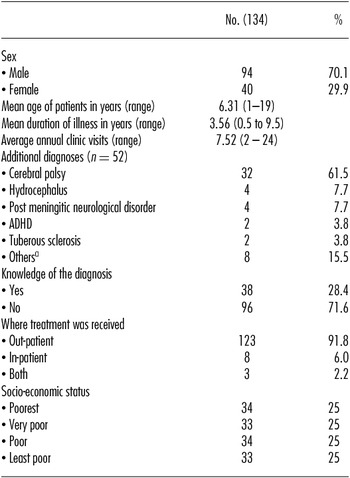
There were 134 epileptic children sampled as shown in Table 1. They were mainly male, of an average age of 6.31 years. The mean duration of illness was 3.56 years and average visit per year of 7.52 times. Cerebral palsy (61.5 percent) was the commonest diagnosis. Most (91.8 percent) of the treatment received was on out-patient care basis. There was a relatively equal access to care by different SES groups.
Demographic Characteristics and Socio-economic Status of the Pediatric Patients

aOthers: mental retardation, speech defect, congenital blindness.
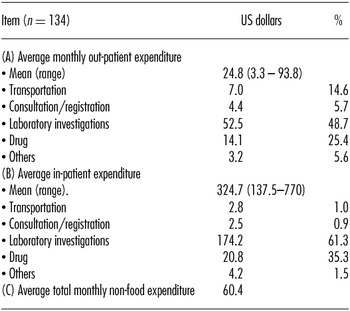
The mean monthly out-patient health expenditure was USD24.8 and for in-patient health expenditure was USD324.7/admission as shown in Table 2. The expenditure on laboratory and drugs constituted the bulk of the cost (Supplementary Table 1, which can be viewed online at http://dx.doi.org/10.1017/S0266462314000518).
Expenditures on epilepsy care in tertiary health facility.

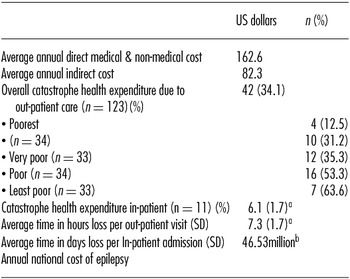
Indirect cost was USD82.3. Forty-two (42%) of out-patient care was CHE as against 63.6% of in-patient care. For the out-patient care, CHE was highest among the least poor (53.3%) and lowest among the poorest (12.5%). Average time spent of each out-patient visit was 6.1 hours.
The annual national cost of epilepsy is USD46.53 million about 0.018% of national gross domestic product (GDP) (Table 3). Out of 134 healthcare payments, 100% were OOPs without any form of reimbursement.
Average Annual Medical Expenditure per Epileptic Child and Total National Cost of Treatment of Childhood Epilepsy

aThe unit is in hours.
b0.018 % of Nigerian GDP of USD254.billion.
DISCUSSION
Cerebral palsy; a disorder of motor, sensory and cognitive function due to a non-progressive lesion that affects a growing brain (Reference Beukelman and Mirenda21) was the highest additional diagnosis among the studied children. This could be due to a high level of unattended deliveries common in Nigeria (Reference Olusegun, Thomas and Ikorok22). Therefore, evaluating COE will help policy makers to make informed decision concerning resource allocation either to program interventions that will improve maternal and child health indices or sustenance of childhood epileptic treatments.
This study has shown that epilepsy is a costly disease to treat, both on out-patient and in-patient basis, similar to what Lagunju et al. (Reference Lagunju, Imam and Adedokun8) had reported. The highest contributors to the direct cost were laboratory and drugs, similar to reports of Lagunju et al. (Reference Lagunju, Imam and Adedokun8), Strzelczyk et al. (Reference Strzelczyk, Reese, Dodel and Hamer23), Javanbakht et al. (Reference Javanbakht, Baradaran and Mashayekhi24), and Estghamati et al. (Reference Estghamati, Khalilzadeh and Anvari25). Fortunately, a review study by Chisholm and Saxena (Reference Chisholm and Saxena26) revealed that drug treatment for epilepsy is the most cost-effective intervention at the primary healthcare level.
The average annual direct cost; USD162.6 of treatment of childhood epilepsy was high. This contrasted to USD2,000 that was reported in review of cost of epilepsy in the United States (Reference Gay Frankenfield27). The discrepancy in cost estimate could be due to difference in cost structure in the two localities, as well as the age of the population studied. The U.S. study cut across all age range, not restricted only to children, and the cost of adult medication is expected to be higher than that of a child. Nonetheless, both studies have highlighted the high economic burden of epilepsy. Strzelczyk et al. (Reference Strzelczyk, Reese, Dodel and Hamer23) reported a range for the mean annual direct cost to lie between forty international purchasing power parities (PPP); which is a method of measuring the relative purchasing power of the currencies of different countries over the same types of goods and services, by eliminating the differences in price level between countries, in rural Burundi and PPP 4,748 in Germany. An Indian study calculated that the total cost per epilepsy case was USD344 per year (or 88 percent of the average income per capita).
Average indirect cost of childhood epilepsy in Nigeria of USD82.3 was high and approximately 33.6 percent of the average annual cost. This is similar to what Strzelczyk et al. (Reference Strzelczyk, Reese, Dodel and Hamer23) reported in Burundi and Germany, where the proportion of mean annual indirect COE to the total average annual cost range from 12 percent to 85 percent, respectively. There is a lack of evening specialist clinic, and a non-appointment visit, means that any day the child visits hospital for care will cost a whole day off duty.
The incidence of CHE was high in the households of the epileptic children, and higher among the least poor. There are several reports of high incidence of CHE; Onwujekwe et al. (Reference Onwujekwe, Hanson and Uzochukwu14), Javanbakht et al. (Reference Javanbakht, Baradaran and Mashayekhi24), Xu et al. (Reference Xu, Evans and Kawabata28), Gotsadze et al. (Reference Gotsadze, Zoidze and Rukhadze29), and Onoka et al. (Reference Onoka, Onwujekwe, Hanson and Uzochukwu30). However, the finding in this study where households in highest SES quartile incurred highest percentage of CHE differed from what other authors reported. A possible explanation could be that, most households in high socio-economic quartile can access most of the requested investigations; electroencephalogram, computer-axial tomography scan, magnetic resonance imaging, etc., opt for branded expensive drugs, and get their complete medications, compared with the poor households.
Although among the three principal pre-conditions; availability of health services that need payment, low capacity to pay, and lack of health financial risk pooling, for CHE according to Xu et al. (Reference Xu, Evans and Kawabata28) approximately two; lack of prepayment mechanism, and capacity to pay were reported in this study. All the payments made in this study were OOPs and more than half of the households’ main source of income was either big business or civil service, which can be translated to mean ability to pay. It is surprising to know that despite the reported 20 percent of the respondents being employees of a formal sector (civil service), none used National Health Insurance Scheme (NHIS) to settle hospital bill, a scheme that was inaugurated in Nigeria in 2005, though covers only federal government employees (Reference Monye31;32). However, this study reveals that those supposed to be using NHIS are not doing so. It will be difficult to achieve universal coverage if OOP payments exceed 30 percent of the total health expenditures (33), but in this study it was 100 percent OOPs, likewise other study (Reference Xu, Evans, Carrin and Aguilar-Rivera34). Because OOP create substantial financial barriers in accessing health care and low-income households frequently face CHE, the magnitude of this OOPs is underscored by estimation that the total COE is approximately 0.018 percent of Nigeria GDP.
One limitation to this study was the cross-sectional design of the study, with possibility of recall bias. A prospective design, whereby patients were allowed to document their expenditures as they were being incurred, would have yielded a more accurate data. Another limitation is the inclusion of respondents that gave only verbal consent, but did not agree to sign the consent form, which should have been excluded from the study.
CONCLUSION
The study found that the cost of managing epilepsy in children was high in the study area. Among the contributors to the cost, drug and laboratory expenditure ranked the most. Virtually all payment mechanism used was OOP and this cost was catastrophic in most households, highest among the well-off. There was virtually non-utilization of NHIS. If the cost for the epileptic drugs and investigations is subsidized, as well as expand coverage of NHIS, the negative effect of these costs on the households may be reduced drastically.
SUPPLEMENTARY MATERIAL
Supplementary Table 1: http://dx.doi.org/10.1017/S0266462314000518
CONTACT INFORMATION
Dr Maduka Donatus Ughasoro, MBBS, M.Ph, M.Sc Health Econ, Mgt&Policy, FWACP (maduka.ughasoro@unn.edu.ng), Department of Paediatrics, University of Nigeria Enugu Campus, Enugu, P.M.B 01129, Enugu, Nigeria
Prof. Obinna Emmanuel Onwujekwe, MBBS, MSc, DLSHTM (Public Health and Policy), P.hD., Department of Health Administration and Management, University of Nigeria Enugu campus, Enugu, P.M.B 01129, Enugu, Nigeria
Prof. Ngozika Chinyelum Ojinnaka, MBBS, M.Sc, FWACP, Department of Paediatrics, University of Nigeria Enugu Campus, Enugu, P.M.B 01129, Enugu, Nigeria
CONFLICTS OF INTEREST
The study was not funded. None of the authors has any conflict of interest to disclose. The authors confirm that they have read the Journal's position on issues involved in ethical publication and affirm that this report is consistent with those guidelines.