For over 50 years, research has focused on identifying the best predictors of success in different second language (L2) learning contexts using language aptitude and affective measures. Most studies have focused on predicting learners' L2 proficiency in either high school or college and specialized L2 training programs. More recently, there have been large numbers of studies that have investigated the relationship between first language (L1) and L2 skills, especially with young children who have mastered spoken language in their L1 and are learning to read an L2. However, most of the aforementioned studies have administered the predictive measures at the time L2 study began and then followed the participants learning an L2 over a short time period. There have been very few studies that have administered predictive measures several years prior to beginning L2 study and then followed the students until they began the study of an L2 many years later. Moreover, most studies have used either language aptitude or affective variables, but not both, to predict L2 proficiency (McCollum, Reference McCollum2003).
In this study, students were followed over a 10-year period to determine the best predictors of performance on measures of L2 proficiency: word decoding, reading comprehension, writing, spelling, and listening/speaking (oral proficiency). Predictor variables included measures of L1 skill and L1 academic aptitude administered in early elementary school several years prior to beginning L2 study and measures of L2 aptitude and L2 affect administered at the beginning of L2 study. Prediction of L2 proficiency using the aforementioned variables simultaneously could determine which types of variables are most strongly related to L2 outcomes in both the oral (listening, speaking) and written (reading, spelling, writing) components. In addition, examination of the predictive value of L1 skills in elementary school for L2 proficiency in US high schools, where the study of an L2 does not generally begin until high school, might provide insights for researchers interested in long-term cross-linguistic transfer of L1 skills in elementary school to L2s with similar orthographies several years after the L1 had been acquired. In addition, there may also be value in using the results of this type of study for predicting L2 learning in different contexts, for example, early bilingual programs, high school and college courses, intensive language training programs, and for identifying students who may exhibit problems with L2 learning.
This review focuses on three of the major variables that researchers have used to predict L2 proficiency: L2 aptitude, L2 affect, and L1 skills.
L2 APTITUDE AND L2 LEARNING
L2 aptitude tests were among the earliest predictors of foreign language (L2) achievement. These tests were developed to measure one's probable degree of success for learning an L2 (Carroll, Reference Carroll and Glaser1962). Aptitude tests typically measure specific aspects of language such as learning and remembering sound/symbol relationships and inferring linguistic rules as well as the levels of one's native language (L1) vocabulary and rote learning capacity. In the 1950s and 1960s, John Carroll conducted studies on L2 learning and found that learning an L2 is a specialized talent, or group of talents, relatively independent of performance on general intelligence tests, a finding confirmed by other researchers (e.g., see Gardner & Lambert, Reference Gardner and Lambert1965). Examples of L2 aptitude tests that have been used in prediction studies are the Modern Language Aptitude Test (MLAT; Carroll & Sapon, 1959/Reference Carroll and Sapon2000), the Language Aptitude Battery (Pimsleur, Reference Pimsleur1966), the Defense Language Aptitude Battery (Petersen & Al-Haik, Reference Peterson and Al-Haik1976), the VORD (Parry & Child, Reference Parry, Child, Parry and Stansfield1990), and the Cognitive Ability for Novelty in Acquisition of Language—Foreign (Grigorenko, Sternberg, & Ehrman, Reference Grigorenko, Sternberg and Ehrman2000).
The most often used and best researched L2 aptitude test is the MLAT. Through factor analytic studies, Carroll (Reference Carroll and Glaser1962, Reference Carroll, Parry and Stansfield1990) found that four independent variables were most relevant to L2 learning: (a) phonetic coding, which is the ability to code and remember sound–symbol relationships; (b) grammatical sensitivity, which is the ability to learn and use grammar; (c) inductive language learning ability, which is the ability to infer linguistic forms, rules, and patterns from new linguistic content; and (d) rote memory, which is the capacity to recall phonetic and grammatical associations. The MLAT measures these variables with five subtests that use a simulated format (i.e., a “fake” L2) and English grammar and vocabulary items.
Research has shown consistently that L2 aptitude is the single best predictor of achievement in an L2 (Gardner & MacIntyre, Reference Gardner and MacIntyre1992; Sparks & Ganschow, Reference Sparks and Ganschow2001). L2 aptitude tests have shown reliably strong correlations (.4 –.6) with performance in L2 courses, and recent studies have confirmed earlier research on the utility of L2 aptitude tests for predicting L2 proficiency (Skehan, Reference Skehan and Robinson2002). For example, in a study with adults at the Foreign Service Institute, Ehrman (Reference Ehrman1998) found that the MLAT was the best predictor of L2 achievement among a variety of instruments that included learning styles, biographical information, and personality variables. In another study, Ehrman and Oxford (Reference Ehrman and Oxford1995) found that among a number of demographics, learning styles and strategies, and affective variables, the MLAT showed the strongest correlation with foreign language proficiency in an adult population. Sparks, Ganschow, and Patton (Reference Sparks, Ganschow and Patton1995) found that the MLAT and students’ eighth-grade English (L1) grades were the best predictors of L2 course grades for high school students. In several studies the MLAT has also been found to distinguish between high- and low-achieving L2 learners in both high school and college (e.g., see reviews by Ganschow & Sparks, Reference Ganschow and Sparks2001; Sparks, Humbach, & Javorsky, Reference Sparks, Humbach and Javorsky2008).
Since the 1960s, researchers have speculated about why aptitude tests predict L2 learning. Carroll (Reference Carroll1973) hypothesized that L2 aptitude as measured by the MLAT is a “residual” of L1 skills. Skehan (Reference Skehan1986) posited that L2 aptitude tests measure linguistic skills, for example, grammar, vocabulary, and require students to use “decontextualized” language skills that are necessary for L2 learning. Gardner and MacIntyre (Reference Gardner and MacIntyre1992) suggested that L2 aptitude facilitates L2 acquisition because of “positive transfer”; that is, a student who possesses strong facility for language will acquire new material that requires language skill more quickly than others who have weaker language skills. Sparks, Patton, Ganschow, Humbach, and Javorsky (Reference Sparks, Patton, Ganschow, Humbach and Javorsky2006) concurred with these researchers and also speculated that there is a strong link between home literacy activities prior to school, L1 literacy skills developed in school, and later L2 aptitude.
L2 AFFECT AND L2 LEARNING
Students’ affective characteristics have always held a special place for L2 researchers and educators. Affective variables refer to “emotionally relevant characteristics of the individual that influence how she/he will respond to any situation” (Gardner & MacIntyre, Reference Gardner and MacIntyre1993, p. 1). Dörnyei (Reference Dörnyei2005) has proposed that motivation is important for learning an L2 because it provides the necessary “impetus” to begin L2 learning and the “driving force” to continue the process of L2 acquisition (p. 65). In his Model of School Learning, Carroll (Reference Carroll1963) also proposed that motivation was an important attribute for L2 learning. Researchers have investigated several affective variables for the prediction of L2 proficiency, but most studies have investigated the role of motivation and language anxiety.
Gardner and colleagues (Gardner, Reference Gardner1985a; Gardner & Lambert, Reference Gardner and Lambert1972; Gardner, Lalonde, & Moorcroft, Reference Gardner, Lalonde and Moorcroft1985) have conducted extensive research into the construct of motivation and its relationship to L2 learning. In his socioeducational model of L2 acquisition, Gardner proposed that motivation is a relatively stable trait related to the learner's social perceptions of the L2 and its speakers, generalized attitudes toward the L2 learning situation and interethnic contact, and amount of linguistic self-confidence. Gardner (Reference Gardner1985b) developed a well-recognized measure of L2 motivation, the Attitude/Motivation Test Battery (AMTB), which has been used in several studies of L2 learning. The AMTB includes a number of attitudinal and affective attributes that are believed to be related to L2 learning including integrativeness (attitudes toward other language groups), attitudes toward the learning situation (classroom context), and motivation (Gardner, Reference Gardner, Parry and Stansfield1990). Numerous studies have found positive but moderate correlations between the aforementioned variables and L2 achievement (e.g., for a complete review of these studies, see Gardner, Reference Gardner, Parry and Stansfield1990). In a more recent meta-analysis of the contribution of motivation to L2 achievement, Masgoret and Gardner (Reference Masgoret and Gardner2003) found overall correlations ranging from .29 to .39, depending on the achievement criteria measures.
In recent years, other L2 researchers have posited that language anxiety may play a role in L2 proficiency and achievement. Language anxiety has been described as “the apprehension experienced when a situation requires the use of an L2 with which the individual is not fully proficient” (Gardner & MacIntyre, Reference Gardner and MacIntyre1993, p. 5). Proponents of the language anxiety hypothesis argue that anxiety is a stable personality trait triggered when a student has to perform oral and written tasks in the L2. Horwitz, Horwitz, and Cope (Reference Horwitz, Horwitz and Cope1986) developed an instrument specifically designed to measure general L2 classroom anxiety, the Foreign Language Classroom Anxiety Scale (FLCAS). Studies involving anxiety instruments such as the FLCAS and L2 proficiency and achievement are largely correlational and qualitative, but have found moderately negative correlations between L2 anxiety and L2 achievement (usually course grades; MacIntyre, Reference MacIntyre2002). A small number of prediction studies on L2 anxiety and L2 achievement have yielded mixed findings (e.g., see Bailey, Onwuegbuzie, & Daley, Reference Bailey, Onwuegbuzie and Daley2000; Onwuegbuzie, Bailey, & Daley, Reference Onwuegbuzie, Bailey and Daley2000; Scovel, Reference Scovel, Horwitz and Young1991). One explanation for these findings has to do with the debilitating and facilitating aspects of anxiety. That is, a certain amount of anxiety may be needed to stimulate L2 performance; conversely, too much anxiety might interfere with L2 performance.
The idea that L2 anxiety is independent of language achievement has been questioned by some researchers, who have proposed that students’ L1 skills and L2 aptitude are confounding variables when investigating the impact of anxiety on L2 learning. In studies that have used the FLCAS in conjunction with L1 and L2 aptitude measures, results have shown that students with lower levels of anxiety achieve significantly stronger scores on measures of L1 skill (reading, spelling, writing), L2 aptitude (MLAT), and L2 proficiency and achievement than students with higher levels of anxiety (e.g., see Ganschow & Sparks, Reference Ganschow and Sparks1996; Ganschow et al., Reference Ganschow, Sparks, Anderson, Javorsky, Skinner and Patton1994; Sparks, Ganschow, Artzer, Siebenhar, & Plageman, Reference Sparks, Ganschow, Artzer, Siebenhar and Plageman1997), and that language variables account for a large part of the variance in predicting anxiety (Chen & Chang, Reference Chen and Chang2004). In a more recent study, Sparks and Ganschow (Reference Sparks and Ganschow2007) found that anxiety for language learning measured by the FLCAS in ninth grade was negatively correlated with students’ L1 oral and literacy skills as early as first grade several years prior to the time they began L2 instruction.
L1 SKILLS AND L2 LEARNING
Since the 1970s, researchers have speculated that L1 skills, L2 aptitude, and L2 proficiency are related. For example, bilingual educator Cummins (Reference Cummins1979, Reference Cummins and Rivera1984) developed the linguistic interdependence hypothesis in which he posited that L2 language and literacy are partially dependent on L1 literacy at the time of the exposure to the L2. Cummins speculated that if a student's competence in the L1 is low, his/her competence in the L2 will also be low. Cummins’ hypotheses have received empirical support from a number of researchers (e.g., see Abu-Rabia, Reference Abu-Rabia2001; Droop & Verhoeven, Reference Droop and Verhoeven2003; Proctor, August Carlo, & Snow, Reference Proctor, August, Carlo and Snow2006; Verhoeven, Reference Verhoeven1994). Likewise, special educators Sparks and Ganschow developed the linguistic coding differences hypothesis in which they speculated that both L1 and L2 learning depend on basic language learning mechanisms that are similar to both languages and that problems with one component of language, for example, phonology, would have a negative effect on both L1 and L2 learning (Sparks, Reference Sparks1995; Sparks & Ganschow, Reference Sparks and Ganschow1993, Reference Sparks and Ganschow1995). Their studies have shown consistently that L2 learners with significantly stronger L1 skills exhibit stronger L2 aptitude and L2 proficiency and achievement, and also that students with phonological processing problems exhibit problems in both the written (decoding, spelling, writing) and oral (listening, speaking) aspects of L2 learning. Their findings have been supported by other researchers who have investigated the impact of L1 skills on L2 learning (e.g., see Holm & Dodd, Reference Holm and Dodd1996; Humes-Bartlo, Reference Humes-Bartlo, Hyltenstam and Obler1989; Service & Kohonen, Reference Service and Kohonen1995).
In recent years, researchers have found strong support for linkages between students’ L1 skills and their L2 proficiency and achievement (i.e., cross-linguistic transfer). For example, recent studies have shown that L1 phonological awareness is a strong predictor of and highly correlated with L2 word decoding (Cisero & Royer, Reference Cisero and Royer1995; Comeau, Cormier, Grandmaison, & Lacroix, Reference Comeau, Cormier, Grandmaison and Lacroix1999; Durgunoglu, Reference Durgunoglu2002; Lindsey, Manis, & Bailey, Reference Lindsey, Manis and Bailey2003). Hulstijn and Bossers (Reference Hulstijn and Bossers1992) found that individual differences in L2 achievement were explained by individual differences in L1 skills among Dutch elementary students. In a study with Finnish elementary age students, Dufva and Voeten (Reference Dufva and Voeten1999) found that over half of the variance in L2 vocabulary, writing, and listening comprehension were explained by students’ L1 word decoding, listening and reading comprehension, and phonological memory skills. In a study with American college students, Meschyan and Hernandez (Reference Meschyan and Hernandez2002) found that English nonword decoding skill predicted L2 vocabulary, grammar, decoding, and reading comprehension skills. Researchers who have conducted studies on the effects of literacy activities in the home (i.e., the home literacy model; Senechal, LeFevre, Thomas, & Daley, Reference Senechal, LeFevre, Thomas and Daley1998) have found that not only are formal and informal literacy activities in the home related to both early and later literacy development (e.g., see Senechal, Reference Senechal2006) but also home literacy activities may be related to both L1 and L2 literacy development (e.g., see Bus, van Ijzendoorn, & Pelligrini, Reference Bus, Ijzendoorn and Pelligrini1995; Dickinson, MaCabe, Clark-Chiarelli, & Wolf, Reference Dickinson, McCabe, Clark-Chiarelli and Wolf2004). Numerous studies in several areas of research have generated support for the notion of cross-linguistic transfer of L1 to L2 skills (Durgunoglu, Nagy, & Hancin-Bhatt, Reference Durgunoglu, Nagy and Hancin-Bhatt1993; Hancin-Bhatt & Bhatt, Reference Hancin-Bhatt and Bhatt1997; Kahn-Horwitz, Shimron, & Sparks, Reference Kahn-Horwitz, Shimron and Sparks2005, Reference Kahn-Horwitz, Shimron and Sparks2006; Koda, Reference Koda2005; Olshtain, 1983; Rutherford, Reference Rutherford, Gass and Selinker1983; Verhoeven, Reference Verhoeven2000).
Longitudinal studies have also supported the idea of long-term cross-linguistic transfer of L1 skills to both L2 aptitude and L2 proficiency. Skehan and Ducroquet (Reference Skehan and Ducroquet1988) followed children who had been a part of the Bristol Language Project (Wells, Reference Wells1985) whose L1 skills had been tested at the ages of 15–60 months and administered measures of L2 aptitude and L2 achievement when they were 13–14 years old. Their results showed that (a) L1 development, especially early measures of vocabulary and comprehension prior to entering school, was significantly related to L2 aptitude many years later (i.e., correlations up to .54 even after 10 years), (b) L2 aptitude was significantly related to oral and written L2 achievement (i.e., correlations ranged from .49 to .73 on three different L2 aptitude tests), and (c) L1 comprehension and vocabulary at 57–66 months of age were significantly related to L2 achievement at age 13 (i.e., correlations up to .55–.67). In two studies, Sparks et al. found that measures of L1 literacy administered as early as fourth grade and a measure of L2 aptitude (MLAT) best discriminated students who scored significantly different on measures of L2 proficiency several years later in high school (Sparks, Ganschow, & Patton, Reference Sparks, Patton, Ganschow, Humbach and Javorsky2008; Sparks, Humbach, & Javorsky, Reference Sparks, Patton, Ganschow, Humbach and Javorsky2008).
In a more recent investigation that followed students over 10 years from 1st through 10th grades, Sparks and colleagues administered measures of L1 academic aptitude, L1 literacy (word decoding, spelling, reading comprehension, phonological awareness) and oral language (vocabulary, listening comprehension, verbal ability) in elementary school and followed the students into high school where they administered the MLAT in 9th grade and measures of L2 word decoding, spelling, reading comprehension, writing, and listening/speaking at the end of 2 years of L2 study. In the first study, findings showed that measures of L1 literacy in elementary school accounted for 40% of the variance in oral and written L2 proficiency in high school, and that measures of L1 literacy (reading, spelling), receptive vocabulary, and verbal ability in elementary school accounted for 73% of the variance in L2 aptitude on the MLAT in 9th grade (Sparks et al., Reference Sparks, Patton, Ganschow, Humbach and Javorsky2006). Even after several years, students’ L1 skills in 1st grade were strongly correlated with L2 aptitude on the MLAT and the correlations increased from 1st through 5th grade (i.e., from .46 to .63 at the beginning of 1st grade to .51 to .78 at the end of 5th grade). In the second study, Sparks et al. found that the best predictor of L2 decoding skill in 10th grade was a measure of L1 decoding skill administered in elementary school and that the best predictors of L2 spelling were L1 spelling skills and L1 phonological awareness (Sparks, Patton, Ganschow, Humbach, & Javorsky, Reference Sparks, Ganschow, Patton, Kormos and Kontra2008). These findings, as well as those of Skehan and Ducroquet (Reference Skehan and Ducroquet1988), not only support the transfer hypothesis but also suggest the possibility of long-term cross-linguistic transfer of L1–L2 skills.
PURPOSE OF STUDY
Research evidence to date shows that students with stronger L1 skills have stronger L2 aptitude and also achieve higher levels of L2 proficiency and achievement. Evidence over many years also indicates that L2 aptitude measured by tests such as the MLAT are not only good predictors of subsequent L2 proficiency and achievement but are also strongly correlated with L1 skills prior to entering school and early L1 literacy and language skills in elementary school. Other studies show that affective variables such as motivation for and anxiety about L2 learning account for part of the variance in L2 proficiency. However, there are no studies involving prediction of L2 proficiency and achievement that have used L1 achievement, L2 aptitude, and L2 affective measures as predictor variables in the same study. Moreover, very few studies have measured students’ early L1 skills and followed them over several years when they completed L2 courses. Studies that use all of the aforementioned variables simultaneously and over time may yield a model that better predicts the full range of skills and affective characteristics that are important for strong L2 proficiency. Studies that use students’ early L1 achievement in, for example, reading, spelling, vocabulary, as predictor variables might also provide support for theories that posit long-term cross linguistic transfer of L1 skills to L2 aptitude and L2 proficiency.
The purpose of the present study was to determine the best predictors of L2 proficiency in high school among a battery of L1 academic aptitude (verbal ability), early L1 achievement (word decoding, spelling, reading comprehension, vocabulary, listening comprehension, phonological awareness), L2 aptitude (MLAT), and L2 affective (motivation, anxiety) measures. In this study, the aforementioned predictor variables were used simultaneously to predict L2 proficiency. Based on the interdependence and threshold hypotheses work of Cummins, the linguistic coding differences hypothesis (i.e., L1 and L2 learning depend on language learning mechanisms similar to both languages), the authors hypothesized that there would be long-term cross-linguistic transfer of L1 skills developed in elementary school to both L2 aptitude and L2 proficiency several years later when students first encountered an L2 in high school. Because previous studies have found that L1 skills are strongly related to L2 aptitude, it was expected that L2 aptitude would be the most robust predictor of oral and written L2 proficiency. The L2 affective variables, L2 motivation, and L2 anxiety, were expected to account for a small amount of the variance in L2 proficiency. Such findings would provide support for assertions that (a) early L1 skills are strongly related to later L2 learning, (b) L2 aptitude is the best predictor of subsequent L2 proficiency in high school, and (c) language-related variables are the most robust predictors of L2 proficiency. Evidence in favor of these assertions would support the notion of long-term cross-linguistic transfer in alphabetic languages from L1 to L2.
The study presented here is part of a larger prospective investigation conducted with the participants described earlier in the review (Sparks et al., Reference Sparks, Patton, Ganschow, Humbach and Javorsky2006, Reference Sparks, Ganschow, Patton, Kormos and Kontra2008; Sparks, Patton, Ganschow, Humbach, & Javorsky, Reference Sparks, Patton, Ganschow, Humbach and Javorsky2009). The study differs from the aforementioned studies by specifically combining both “cognitive” (early L1 achievement, early L1 academic aptitude, L2 aptitude, L2 word decoding and spelling) and “noncognitive” (L2 motivation, L2 anxiety) variables and examining their roles in predicting oral and written L2 proficiency in high school.
METHODS
Participants
The participants were 54 high school students (25 male, 29 female) from a large middle class, rural school district in the Midwestern United States. All of the students had completed 2 years of L2 study in one of three languages in the same high school: Spanish (n = 30), French (n = 14), or German (n = 10). The students were followed from 1st through 10th grades. All of the participants completed their second year of the L2 by the end of the 10th grade. The mean age of the participants at the beginning of the 1st grade was 6 years, 9 months; at the end of the study 10 years later, the mean age of the participants was 16 years, 4 months (age range = 15 years, 9 months to 16 years, 11 months). All of the students were Caucasian. A cohort model was used in which a sample of students in first grade was selected and followed over 10 years. The study began with 156 students when they entered 1st grade in this school district. By the 9th grade, 101 of the 156 students still attended school in the district. Seventy-seven of the 101 students began to learn an L2 in the 9th grade. Fifty-four of the 77 students chose to continue their participation in the study when they began their first year in an L2 course. None of the 54 participants had learned an L2 or had received L2 instruction prior to 9th grade (i.e., prior to 14 years of age). All of the participants’ were monolingual, and their home language background was English. To the authors' knowledge, the participants were not exposed to the L2 in which they were enrolled outside of the classroom. Each participant was exposed to similar learning conditions (the same L2 curriculum) and had the same number of hours of L2 instruction in the classroom over 2 years (180-day school year, one class period/day). None of the participants repeated an L2 course. Parental permission was obtained for each participant.
Instruments
There were several types of testing measures used as predictor variables in this study: L1 achievement, L1 academic aptitude, L2 aptitude, and L2 affect. Each of these measures is described here.
Predictor variables
Measures of L1 achievement
WORD DECODING. The measure of L1 word decoding was the Woodcock Reading Mastery Test—Revised Basic Skills Cluster, Forms G and H (Woodcock, Reference Woodcock1987). The Basic Skills Cluster comprises two subtests: word identification and word attack. On the word identification subtest, a student read aloud a list of increasingly difficult words. On the word attack subtest, a student read aloud a list of increasingly difficult pseudowords. For a response to be considered correct, the student had to produce a natural reading (pronunciation) of the word or pseudoword in order to be correct. A test–retest reliability of .96 was reported for the Basic Skills Cluster.
SPELLING. The measure of L1 spelling was the Test of Written Spelling—2 (Larsen & Hammill, Reference Larsen and Hammill1986). On this dictated word test, the student wrote the words spoken by the examiner. The response was marked as correct or incorrect. A test–retest reliability of .95 was reported for this test.
READING COMPREHENSION. The measure of L1 reading comprehension was the Formal Reading Inventory, Forms A and B (Wiederholt, Reference Wiederholt1986). On this multiple-choice test, the student answered five questions after reading a short paragraph silently. The response was marked as correct or incorrect. Internal consistency of .92 to .97 was reported for the two forms of the test used in this study.
PHONOLOGICAL AWARENESS. The measure of L1 phonological awareness was the Lindamood Auditory Conceptualization Test, Forms A and B (Lindamood & Lindamood, 1979). On this test, the student manipulated blocks of various colors to indicate his/her conceptualization of speech sounds spoken by the examiner. The student showed the number, sameness, or difference of sounds, for example, “Show me /b/ /b/ /z/,” and represented with the blocks changes in spoken patterns without associating the sounds with letter, for example, “If that says /ups/, show me /usp/.” This test yielded raw scores with a range of 0 to 100. Pretest and posttest reliability of .96 was reported for the two forms of the test.
VOCABULARY. The Peabody Picture Vocabulary Test—Revised, Forms L and M (Dunn & Dunn, Reference Dunn and Dunn1981) was used to assess L1 vocabulary. The test measured receptive vocabulary for standard American English. The student was shown four pictures and asked to identify the picture for the word spoken by the examiner. The response was marked as correct or incorrect. A median test–retest reliability of .82 was reported for the two forms of the test.
LISTENING COMPREHENSION. The Woodcock Reading Mastery Test—Revised Passage Comprehension subtest, Forms G and H (Woodcock, Reference Woodcock1987) was used to appraise L1 listening comprehension. This cloze test consists of reading a short passage (one to two sentences) aloud to a student and asking him/her to identify aloud a key word missing from the passage. The student was not permitted to read (see) the passage, but the passage could be repeated. Again, the response was marked as correct or incorrect. This subtest is generally used as a measure of reading comprehension; however, the aforementioned alternative procedure was recommended by Aaron (Reference Aaron1989) as a diagnostic indicator in identifying problem readers and was used for this study. A test–retest reliability of .92 when used as a measure of reading comprehension was reported for the two forms of this subtest.
Each of the preceding L1 achievement measures was chosen to examine whether the processes used in learning the L1 would be important for learning the L2 several years later.
Measure of L1 academic aptitude. The Test of Cognitive Skills (CTB/McGraw Hill, 1983) was used to assess a student's academic aptitude and predicts the student's potential for success in school. The test consists of four subtests: sequences tests the ability to recognize a rule or principle in a pattern or sequence of figures, letters, or numbers; analogies tests the ability to recognize relationships that may be literal or symbolic; memory tests the ability to recall previously presented material; and verbal reasoning tests the ability to reason logically and discern relationships between pictures or words. All test items are presented orally and no reading or writing was necessary to complete the items. A test–retest reliability of .91 was reported for this test.
Measure of L2 aptitude. The MLAT Long Form (Carroll & Sapon, 1959/Reference Carroll and Sapon2000) was used to measure L2 aptitude. The test uses a simulated format to provide an indication of the probable degree of success in learning a foreign language. The Long Form includes five subtests: Part I—number learning, a measure on which the student learns numbers of a made-up language and then transcribes spoken number words into written digits on hearing them presented rapidly; Part II—phonetic script, a measure on which the student listens to a sequence of syllables (many with no meaning in English) while looking at their graphemic transcriptions and is asked to quickly learn how the sounds (phonemes) correspond to the letters (graphemes); Part III—spelling clues, a measure on which the student reads English words presented as abbreviated spellings (e.g., luv) and then chooses the one word (out of five) that corresponds most nearly in meaning (e.g., carry, exist, affection, wash, spy); Part IV—words in sentences, a measure on which the student reads a key sentence in which a word is underlined, reads another sentence in which five words and phrases are marked as possible choices, and chooses the word or phrase in the second sentence that has the same grammatical function that the marked word or phrase has in the key sentence; and Part V—paired associates, a measure on which the student studies a list of nonsense words with assigned English meanings and chooses the correct English word from a multiple choice format to match the nonsense word. Each of the five subsets measures a different skill, for example, phonetic coding measures phonological processing of speech sounds and the ability to connect a sound to a letter, words in sentences measures grammar (Carroll, Reference Carroll, Parry and Stansfield1990). A test–retest reliability of .90 (ninth grade males) to .91 (ninth grade females) was reported for the Long Form.
Measures of L2 affect
L2 MOTIVATION. To measure students’ L2 motivation, the authors used selected items from the AMTB (Gardner, Reference Gardner1985b; Gliksman, Gardner, & Smythe, Reference Gliksman, Gardner and Smythe1982). The instrument was modified by the authors to use with secondary level students in the United States. The final instrument, which the authors called the L2 Motivation Survey, consisted of 27 items that used a 7-point rating scale with a forced-choice, balanced design format. A student responded to each item with a single answer: strongly agree, moderately agree, agree, neither agree nor disagree, disagree, moderately disagree, or strongly disagree. To make an accurate estimate of a student's level of motivation for L2 learning, local norms were established. First, the authors calculated each student's mean score on the instrument. Then, all of the students’ mean scores were transformed to z scores. Each student's z score was used in subsequent analyses. The reliability of the L2 Motivation Survey instrument was checked by calculating the Cronbach alpha. The reliability coefficient for this instrument was .92. The items on the L2 Motivation Survey are included in Appendix A.
L2 ANXIETY. The FLCAS (Horwitz et al., Reference Horwitz, Horwitz and Cope1986) was used to determine students’ anxiety for learning a foreign language in the classroom. The FLCAS has 33 items and uses a 5-point rating scale with a forced-choice, balanced design format. A student responds to each item with a single answer: strongly agree, agree, neither agree nor disagree, disagree, or strongly disagree. The reliability of the FLCAS was checked by calculating the Cronbach alpha. The reliability coefficient for this instrument was .94. A list of the questions on the FLCAS is provided in Appendix B.
Outcome variables
Measures of L2 proficiency. The L2 proficiency measures used in this study tested students’ skills in the four areas identified by the American Council on Teaching Foreign Language (ACTFL) Proficiency Guidelines (1986, 1989) as essential for L2 acquisition: reading, writing, listening, and speaking. In their previous studies, Sparks and colleagues have used reading comprehension, writing, and listening/speaking tests to measure students’ oral and written L2 proficiency (e.g., see Sparks, Ganschow, Artzer, Siebenhar, & Plageman, Reference Sparks, Ganschow, Artzer, Siebenhar and Plageman1998; Sparks, Ganschow, Patton, Artzer, Siebenhar, & Plageman, Reference Sparks, Ganschow, Artzer, Siebenhar and Plageman1997). However, these studies did not include two important components of L2 proficiency: word decoding and spelling. In L1 research, the simple view of reading model (Juel, Griffith, & Gough, Reference Juel, Griffith and Gough1986) posits that reading is composed of decoding and comprehension and that writing is composed of spelling and ideation, (i.e., generation and organization of ideas). In the present study, measures of L2 word decoding and L2 spelling were added to the proficiency test battery to more fully assess participants’ L2 reading and writing skills and to enhance the measure of overall L2 proficiency. The inclusion of the decoding and spelling measures is supported by recent research, which has found that inefficient decoding skill is characteristic of poor L2 readers and spellers and that L2 decoding skills contribute to L2 reading comprehension (e.g., see Koda, Reference Koda2005; Sparks, Patton, et al., Reference Sparks, Humbach and Javorsky2008).
Three L2 educators, who were formally trained in ACTFL guidelines, designed the proficiency tests in their respective languages. The measures were designed to ensure uniformity as closely as possible across the three languages (i.e., Spanish, French, German); that is, reading comprehension, writing, listening, and speaking in German were measured by using the same items and prompts as those used for Spanish and French. The directions were the same for each of the three languages. The only differences in the three reading comprehension tests were those specific to a particular language. All of the proficiency measures had been used by the authors in their previous studies (see Sparks & Ganschow, Reference Sparks and Ganschow2007; Sparks et al., Reference Sparks, Ganschow, Artzer, Siebenhar and Plageman1998; Sparks et al., Reference Sparks, Patton, Ganschow, Humbach and Javorsky2006; Sparks, Patton, et al., Reference Sparks, Humbach and Javorsky2008) A description of each measure is provided here.
L2 READING COMPREHENSION. Students read a one-page letter written in the L2 and answered 10 multiple-choice questions in English about the letter. The questions were written in English to conform to the ACTFL proficiency guidelines. The letter was designed using criteria descriptive of the intermediate–high level of the ACTFL guidelines. Next, the students were given a passage to read from Reader's Digest in Spanish, French, or German and were asked to answer 10 multiple-choice questions in English about the passage. The students were given 15 min to read the letter and answer the questions and 15 min to read the passage and answer the questions (maximum score = 20).
L2 WRITING. Students wrote a response in the L2 to the letter that had been read for the reading comprehension task. The letter contained five questions to which the students were asked to respond. The students were given 15 min to write the letter. Each student's writing sample was scored for five criteria: vocabulary, cultural appropriateness, structure, comprehensibility, and spelling. The ACTFL guidelines for determining proficiency levels were used in assigning the scores (0–5) on each of the five criteria. Each student was evaluated in the five areas using a 6-point scale: 0 = no production, 1 = novice-low, 2 = novice-mid, 3 = novice-high, 4 = intermediate-low, and 5 = intermediate-high and above (maximum score = 25). A score of 0 was used in the scoring because some students may have been unable to produce any response in the L2 after 2 years of L2 learning in high school.
L2 LISTENING AND SPEAKING. Students’ proficiency was assessed through a 10–15-min individual oral proficiency interview. The interviewers had no previous information about the participant, including their L1 achievement and L2 aptitude test scores or their L2 classroom achievement. Interviewers used randomly selected topics about which the students conversed. Each student's interview was taped so that it could be scored at a later date. The oral interview was scored for five criteria: pronunciation, vocabulary, grammar, comprehensibility, and listening comprehension (maximum score = 25). The remainder of the scoring procedure and maximum score (25) was the same as for the L2 writing test.
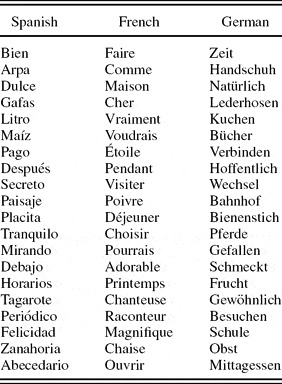
L2 WORD DECODING. The word decoding task for each of the three languages consisted of a real word list of 20 actual words and a list of 20 pseudowords. The real and pseudowords in the three L2s measured a specific decoding task that involved use of vowel sounds in each L2 that were not consistent with the vowel sounds in English. The vowel sounds in the L2s used different letter combinations and contained multisyllabic words and words with diacritical markings. Each student read aloud the list of real words and pseudowords. For a response to be considered correct, the student had to pronounce the word correctly. If the student spontaneously self-corrected a response, that response was counted as correct. Each student read the word lists at the end of the second year L2 course. The maximum score for the L2 word decoding measure was 40 points (20 real words, 20 pseudowords). The reliability of the L2 word decoding lists and pseudoword lists was checked by calculating the Cronbach alpha. For the Spanish words, the reliability coefficient for the word decoding list was .75, and for the pseudoword decoding list, .75. For the French words, the reliability coefficient for the word decoding list was .78, and for the pseudoword decoding list, .84. For the German words, the reliability coefficient for the word decoding list was .81, and for the pseudoword decoding list, .79. The word lists in the three L2s are presented in Appendix C.
L2 SPELLING. The L2 spelling task for each of the three languages consisted of 20 words designed to measure a specific decoding task. Like the word decoding task, this measure included vowel sounds in the L2 that were not consistent with the vowel sounds in English, used different letter combinations, and contained multisyllabic words and words with diacritical markings. The students wrote the words on paper as the examiner read the word aloud; the examiner repeated a word as often as necessary. Students’ responses were marked as correct or incorrect. The maximum score on the spelling test was 20 words. The reliability of the L2 spelling lists was checked by calculating the Cronbach alpha. For the Spanish words, the reliability coefficient was .78; for the French words, the reliability coefficient was .81; and for the German words, the reliability coefficient was .74. The spelling lists are presented in Appendix D.
TOTAL L2 PROFICIENCY. Total L2 proficiency was the combined number of points on the L2 reading comprehension, writing, listening/speaking, word decoding, and spelling tests (maximum score = 130). There were two lines of justification for combining the scores on the five tests. First, the ACTFL guidelines define proficiency as reading, writing, speaking, and listening to an L2. Second, analyses of variance (ANOVAs) showed that there were no significant differences among the three L2 groups (Spanish, French, German) on the five L2 tests: L2 reading comprehension, F (2, 51) = 1.34, p = .27; L2 writing, F (2, 51) = 1.08, p = .35; L2 listening/speaking, F (2, 51) = 1.86, p = .17; L2 word decoding, F (2, 51) = 0.73, p = .49; and L2 spelling, F (2, 51) = 1.25, p = 30. In addition, there were no significant differences among the three L2 groups on the total L2 proficiency test (reading comprehension + writing + listening/speaking + word decoding + spelling), F (2, 51) = 1.22, p = .30. The reliability of the total L2 proficiency measure was checked by calculating the Cronbach alpha. For the total L2 proficiency, the reliability coefficient was .89.
Procedure
Four of the L1 measures (Woodcock Reading Mastery Test Basic Skills Cluster, Test of Written Spelling, Formal Reading Inventory, and Peabody Picture Vocabulary Test) were administered in elementary school at five different time intervals: the beginning of first grade and the end of first, second, third, and fifth grades. The Lindamood was administered only through the third grade and the listening comprehension test was administered only at the end of third and fifth grades. For each of the L1 measures, a student's scores were combined across years from first through fifth grades to obtain a mean score on each measure. The L1 measures were administered by the first and third authors with assistance from undergraduate and graduate students trained prior to administration of the tests. Scores on the Test of Cognitive Skills were obtained from school records at the end of the first grade.
The MLAT and the L2 Motivation Survey were administered in small groups by the first author at the beginning of the ninth grade. The FLCAS was administered by the first and last authors individually at the end of ninth grade. Because the authors of the FLCAS and the AMTB (L2 Motivation Survey) do not include norms to which students can be compared, participants’ raw scores on these measures were changed to z scores.
The L2 word decoding and L2 spelling measures were administered individually to each student at the end of the tenth grade by the last author of this study and graduate students trained by the author. The L2 reading comprehension and L2 writing measures were administered in groups by the first author at the end of the students’ second-year L2 course. The listening/speaking (oral proficiency) measure was administered individually by the last author at the end of the students’ second-year L2 course.
RESULTS
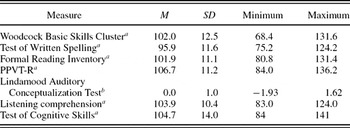
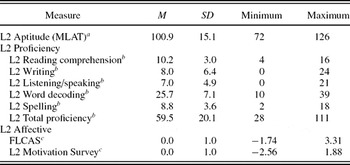
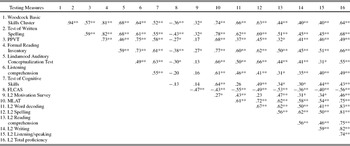
Table 1 reports the mean scores of the 54 participants on the L1 cognitive ability and L1 achievement measures. Table 2 reports the scores of the participants on the L2 aptitude, L2 affect, and L2 proficiency measures. Table 3 presents intercorrelations among the L1 academic aptitude, L1 achievement, L2 aptitude, L2 affect, and L2 proficiency measures for the total group.
Means and standard deviations of participants on the first language achievement and academic aptitude measures

Note: PPVT-R, Peabody Picture Vocabulary Test—Revised, Forms L and M (Dunn & Dunn, Reference Dunn and Dunn1981).
aStandard scores, M = 100, SD = 15.
bz scores.
Means and standard deviations of participants on the L2 aptitude, L2 proficiency, and L2 affective measures

Note: L2, second language; MLAT, Modern Language Aptitude Test (Carroll & Sapon, Reference Carroll and Sapon2000); FLCAS, Foreign Language Classroom Anxiety Scale (Horwitz, Horwitz, & Cope, Reference Horwitz, Horwitz and Cope1986).
aStandard score, M = 100, SD = 15.
bRaw scores.
cz scores.
Intercorrelations among L1 Achievement, L1 Academic Aptitude, L2 Proficiency, L2 Aptitude, and L2 Affective Variables

Note: L1, first language; L2, second language; PPVT, Peabody Picture Vocabulary Test (Dunn & Dunn, Reference Dunn and Dunn1981); FLCAS, Foreign Language Classroom Anxiety Scale (Horwitz, Horwitz, & Cope, Reference Horwitz, Horwitz and Cope1986); MLAT, Modern Language Aptitude Test (Carroll & Sapon, Reference Carroll and Sapon2000).
*p ≤ .05. **p ≤ .01.
Multiple regression analyses utilizing the Maximum R 2 Improvement (MAXR) technique for variable selection was applied to determine which variables were important predictors of L2 word decoding, L2 spelling, and L2 reading comprehension. This procedure is sometimes used on datasets of smaller size so that relationships of interest that may exist in the population might not be overlooked. The MAXR, first calculates the “best” one-variable model (i.e., which single measure best correlates with a specific outcome variable). Then, the “best” two-variable model is selected on the basis of the maximum R 2 (coefficient of determination) improvement. The best two-variable model indicates the two measures that explain the highest percentage of the variance in L2 proficiency about its mean. This process continues by determining the “best” three-variable model yielding the largest R 2 improvement, and so forth, until a model containing all the measures as predictors of an outcome variable is generated. Unlike the traditional stepwise selection methods, for example, forward selection, backward elimination, stepwise regression, that provide one “best” variable model, the MAXR procedure provides several alternative models from which to choose and does not perform any inferential tests in selecting its best models. To ascertain the size of the “best” model to select, the Mallow Cp statistic was used. The model having a Cp statistic that is less than the number of predictors allows the choice of a model having a small mean square error and small regression bias. The mean square error gauges the average squared deviation between the actual score on an outcome variable for a student and the score predicted by the regression procedures, taking into account the degrees of freedom in the data. A model with minimal regression bias has strong predictive power on observations not necessarily included in the sample from which the model is based. The final model chosen is the one having all of the variables that show mild or strong significance and are not suppressors.
For the prediction models, a tolerance diagnostic was computed for each predictor variable to determine if multicolinearity among the variables might exist. A tolerance of less than .10 would indicate the presence of significant multicolinearity problems (Mendenhall & Sincich, Reference Mendenhall and Sincich1989). The tolerance was ≥.26 (range = .26–.70).
For this study, prediction analyses were conducted for each of the five L2 proficiency subtests and for the total L2 proficiency measure: reading comprehension + writing + listening/speaking + word decoding + spelling. The rationale for conducting prediction analyses for each of the five subtests and also the total test was to determine whether different variables might be predictive of different components of L2 proficiency, for example, writing versus spelling, and of the total proficiency test.
L2 reading comprehension
The analysis yielded a three-variable model in which the best predictors were the MLAT (β = .46), L2 Motivation Survey (β = .23), and FLCAS (β = −.23), F (3, 50) = 17.86, p < .0001. The three variables accounted for 52% of the variance in the model. The MLAT alone accounted for 39% of the variance in the model. The L2 Motivation Survey and the FLCAS accounted for an additional 9% and 3% of the variance, respectively.
L2 writing
The analysis yielded a one-variable model in which the best predictor was the MLAT (β = .58), F (1, 52) = 26.67, p < .0001. The MLAT accounted for 34% of the variance in the model.
L2 listening/speaking
The analysis yielded a two-variable model in which the best predictors were the MLAT (β = .49) and L2 Motivation Survey (β = .20), F (2, 51) = 12.63, p < .0001. The two variables accounted for 33% of the variance in the model. The MLAT alone accounted for 29% of the variance in the model and the L2 Motivation Survey accounted for an additional 4% of the variance.
L2 word decoding
The analysis yielded a four-variable model in which the best predictors were the Woodcock Basic Skills Cluster (β = .44), the FLCAS (β = −.30), the MLAT (β = .28), and the Test of Cognitive Skills (β = −.19), F (4, 49) = 16.37, p = <.0001. The four variables accounted for 57% of the variance in the model. The Woodcock alone accounted for 43% of the variance in the model and the FLCAS accounted for an additional 11% of the variance. The Test of Cognitive Skills and the MLAT accounted for an additional 2% and 1% of the variance, respectively.
L2 spelling
The analysis yielded a three-variable model in which the best predictors were the MLAT (β = .42), Lindamood (β = .32), and the FLCAS (β = −.21), F (3, 50) = 26.43, p < .0001. The three variables accounted for 61% of the variance in the model. The MLAT alone accounted for 52% of the variance in the model. The Lindamood and FLCAS accounted for an additional 6% and 3%, respectively.
Total L2 proficiency (reading comprehension + writing + listening /speaking + word decoding + spelling)
The analysis yielded a three-variable model in which the best predictors were the MLAT (β = .60), the FLCAS (β = −.22), and L2 Motivation Survey (β = .19), F (3, 50) = 31.65, p < .0001. The three variables accounted for 66% of the variance in the model. The MLAT alone accounted for 56% of the variance in the model. The FLCAS and L2 Motivation Survey accounted for an additional 7% and 3% of the variance, respectively.
DISCUSSION
The purpose of the present study was to determine the best predictors of L2 proficiency in high school among a battery of L1 academic aptitude (verbal ability), early L1 achievement (word decoding, spelling, reading comprehension, vocabulary, listening comprehension, phonological awareness), L2 aptitude (MLAT), and L2 affective (motivation, anxiety) measures. In this study, the aforementioned predictor variables were used in combination to predict oral and written L2 proficiency. The authors hypothesized that L2 aptitude would be the most robust predictor of oral and written L2 proficiency and that early L1 skills would be strongly related to later L2 proficiency. The L2 affective variables, motivation and anxiety, were expected to account for a small amount of the variance in L2 proficiency.
Using both cognitive (L1 skills, L1 academic aptitude, L2 aptitude) and noncognitive (motivation, anxiety) variables in combination explained a substantial proportion (66%) of the variance in L2 proficiency. This is a new finding in the L2 literature that suggests that the inclusion of L1 skills, L2 aptitude, and L2 affective variables simultaneously in a prediction model may explain more of the variance in L2 proficiency than previous studies in which the aforementioned variables were used separately as predictors. The results support L2 researchers who have suggested that students’ proficiency in an L2 may be dependent on both language aptitude (“cognitive” skills) and affective characteristics (“noncognitive” variables).
Although the model explained 66% of the variance in total L2 proficiency, the MLAT accounted for most of the variance (56%) in predicting overall L2 proficiency even in the presence of the affective variables. This finding is consistent with previous studies conducted by L2 researchers, which have found that L2 aptitude tests such as the MLAT are strong predictors of proficiency in an L2 and classroom achievement in L2 courses (e.g., see Carroll, Reference Carroll, Parry and Stansfield1990; Ehrman & Oxford, Reference Ehrman and Oxford1995; Skehan, Reference Skehan1986; Sparks & Ganschow, Reference Sparks and Ganschow2001). The MLAT comprises tasks that measure important components of language learning, for example, phonetic coding, grammar, vocabulary, inductive language learning. Therefore, one would expect this measure to explain most of the variance in L2 proficiency because both oral and written proficiency in an L2 is largely dependent on mastering language skills (e.g., phonetic coding, grammar, vocabulary, inductive language learning) in the new language (Sparks, Reference Sparks1995; Sparks & Ganschow, Reference Sparks and Ganschow1995).
The inclusion of L2 word decoding and L2 spelling tests as measures of L2 proficiency resulted in a more substantial correlation between the MLAT and the total L2 proficiency measure than measures of L2 proficiency used in previous studies. In those studies, the MLAT showed correlations of .4 –.6 with L2 proficiency and achievement, depending on the outcome measure, for example, course grades, L2 reading, L2 oral proficiency (Skehan, Reference Skehan and Robinson2002). In a related study with the same participants as this study, the MLAT achieved a correlation of .68 with the L2 proficiency measure that included tests of reading comprehension, writing, and listening/speaking (oral proficiency). In that study as well as other studies that measured L2 proficiency, L2 word decoding had been measured indirectly through L2 reading comprehension tasks and L2 spelling had been measured indirectly through L2 writing tasks (e.g., see Ehrman & Oxford, Reference Ehrman and Oxford1995; Sparks et al., Reference Sparks, Ganschow, Artzer, Siebenhar and Plageman1998). In the present study in which L2 word decoding and spelling were measured directly and included in the students’ total L2 proficiency score, the MLAT achieved a correlation of .75 with the total L2 proficiency measure. Support for the use of direct measures of L2 decoding and spelling comes from research in L1 and L2 reading that has shown that reading skill comprises both comprehension and decoding and that writing skill is composed of both ideation and spelling (i.e., the simple view of reading; Juel et al., Reference Juel, Griffith and Gough1986; Hoover & Gough, Reference Hoover and Gough1990), word decoding skill is separable from language comprehension (e.g., see Rayner, Foorman, Perfetti, Pesetsky, & Seidenberg, Reference Rayner, Foorman, Perfetti, Pesetsky and Seidenberg2001; Stanovich, Reference Stanovich2000), and L2 decoding skills explain a large part of the variance in L2 reading comprehension (e.g., see Koda, Reference Koda2005; Sparks, Patton, Ganschow, Humbach, et al., Reference Sparks, Patton, Ganschow, Humbach and Javorsky2008). The strong correlation between the MLAT and the total L2 proficiency measure in this study may have resulted from the addition of the L2 word decoding and L2 spelling measures to the total L2 proficiency battery. Indeed, findings showed that the L2 word decoding and L2 spelling measures were strongly correlated with two of the MLAT subtests, phonetic script (.72 and .70, respectively) and spelling clues (.63 and .66, respectively), both of which tap phonological/orthographic (sound–symbol) processing. To test the speculation that the L2 word decoding and spelling measures enhanced the measurement of L2 proficiency, the authors removed the students’ L2 word decoding and L2 spelling scores from their total L2 proficiency score and repeated the regression analysis. The results showed that the MLAT alone explained only 44% of the variance in L2 proficiency.
When the test battery was used to predict students’ performance on the individual L2 proficiency measures, the MLAT explained the largest percentage of the variance on four of the five measures (reading comprehension, writing, listening/speaking, spelling). However, the MLAT alone explained less of the variance for each of the four proficiency subtests (i.e., from 29% for L2 listening/speaking to 52% for L2 spelling) than it did for the total L2 proficiency measure (56%). This finding was expected because the MLAT comprises subtests that measure different components of language aptitude, for example, phonetic coding, grammar, inductive language learning ability, and rote memory. Thus, it is unlikely that the test would explain a large part of the variance in a particular L2 skill that does not require the explicit use of the skill tapped by a particular subtest; for example, listening/speaking would not require sound/symbol decoding. The finding that the MLAT predicted total L2 proficiency better than it predicted performance in a particular skill such as reading comprehension, writing, or listening/speaking is similar to findings in L1 research, which have shown that although a student's academic aptitude (IQ) may predict his/her overall school performance, the score does not predict performance in a specific skill such as reading, especially word decoding (Snowling & Hulme, Reference Snowling and Hulme2007). Nonetheless, the finding that the MLAT was the best predictor of and explained the largest percentage of the variance in specific L2 skills reveals the importance of language aptitude for L2 learning.
The finding that L1 word decoding rather than the MLAT was the best predictor of L2 word decoding skill is consistent with the results of a recent study in which the Woodcock Basic Skills Test alone accounted for 52% of the variance in L2 word decoding skill (Sparks, Patton, et al., Reference Sparks, Humbach and Javorsky2008). In that study, the MLAT was not included as a predictor variable. The results of the present study in which the Woodcock Basic Skills Test alone accounted for 43% of the variance in L2 word decoding skill despite the inclusion of the MLAT in the regression analysis demonstrates the importance of phonological processing skill for the development of L2 word decoding skill. In alphabetic orthographies, word recognition skill has been found to be causally related to phonological processing (e.g., see McCardle & Chhabra, 2004; Snowling & Hulme, Reference Snowling and Hulme2007). Moreover, phonological processing is thought to be a modular skill that is not under the direction of higher level cognitive structures (Stanovich, Reference Stanovich1988). Thus, it is unlikely that L2 word decoding skill would be predicted well by the results of an L2 aptitude test that measures language skills other than phonological processing. Koda (Reference Koda2005) reported that phonological processing skills are important for word decoding but indicated that skills other than phonological coding affect word decoding such as the orthographic distance between the L1 and L2 and the orthographic depth of the L2 (Katz & Frost, Reference Katz, Frost, Frost and Katz1992). In the present study, it was more likely that L1 decoding skill would be strongly related to L2 decoding skill because Spanish, French, and German are more or less transparent orthographies and there is less orthographic distance between English and three L2s in this study and other orthographies that are less similar to English.
Findings showed that noncognitive variables explained a small proportion of the variance in L2 proficiency. Motivation for L2 learning explained some of the variance in L2 reading comprehension (9%), L2 listening/speaking (4%), and total L2 proficiency (3%). There were weak to moderate correlations between the L2 Motivation Survey and the L2 proficiency measures (.23–.47), a finding consistent with other studies in which the L2 Motivation Survey showed overall correlations of .29–.39 with L2 achievement (e.g., see Masgoret & Gardner, Reference Masgoret and Gardner2003). The results of this study suggest that language skills measured by L2 aptitude tests and L1 decoding measures are necessary skills for L2 learning but that motivation alone is unlikely to be sufficient for mastering an L2 in high school, although motivation for L2 learning may be more important in a context in which bilingualism is a social and/or economic necessity. Sparks (Reference Sparks1995) has speculated that motivation for L2 learning may be related to students’ language learning skills. To test this speculation, the participants in this study were divided into three groups (high, average, and low motivation) by their z scores on the L2 Motivation Survey and compared on the measures of L1 skill, L1 academic aptitude, L2 aptitude, and L2 proficiency. (High motivation students scored .67 SD and higher, low motivation students scored −.67 SD and lower, average students scored from .66 to −.66 SD on the survey.) The three groups were then compared on the measures of L1 skill and L1 academic aptitude, the MLAT, and the L2 proficiency tests. Findings showed no L1 academic aptitude differences among the three groups. Yet, the results of the ANOVAs showed significant group differences on the MLAT and all of the L2 proficiency measures except spelling and significant differences on three of the L1 skill measures (vocabulary, word decoding, and spelling) administered several years earlier in elementary school. On the L1 and L2 measures, most differences were found between the high and low motivation groups. These findings support the authors' speculation that the differences in L2 proficiency (and L2 aptitude) may be related to students’ lower levels of L1 skill acquired many years earlier before exposure to an L2 rather than low motivation.
Another affective variable, L2 anxiety (FLCAS), explained part of the variance in L2 reading comprehension (4%), L2 listening/speaking (4%), L2 word decoding (11%), L2 spelling (3%), and total L2 proficiency (7%). The FLCAS was negatively correlated with all L1 achievement (−.13 to −.43), L2 aptitude (−.43), and L2 proficiency (−.36 to −.56) measures. At face value, these findings suggest that anxiety has a debilitating effect on L2 performance; that is, as anxiety increases, language skills decrease. However, Sparks and Ganschow have questioned the explanation that an anxiety specific to foreign language learning negatively affects L2 aptitude and L2 proficiency. Rather, they have suggested that students’ language learning skills are likely a confounding factor in studies involving L2 anxiety. For example, in a 1991 paper they reported that the items on the FLCAS were related to a student's comfort level with oral and written language (Sparks & Ganschow, Reference Sparks and Ganschow1991). In subsequent studies, they found that students grouped by anxiety levels according to their responses on the FLCAS exhibited significant differences on measures of L1 achievement (e.g., reading, spelling), L2 aptitude (MLAT), and L2 proficiency (e.g., Ganschow & Sparks, Reference Ganschow and Sparks1996; Ganschow et al., Reference Ganschow, Sparks, Anderson, Javorsky, Skinner and Patton1994; Sparks et al., Reference Sparks, Ganschow, Patton, Artzer, Siebenhar and Plageman1997). More substantial support for this position came from an investigation with participants in the current study who were divided into low, average, and high anxiety groups based on their FLCAS scores and then compared on the L1 achievement, L2 aptitude, and L2 proficiency measures (Sparks & Ganschow, Reference Sparks and Ganschow2007). Results showed not only that high anxious students scored significantly lower than the low anxious students on all L2 aptitude, L2 proficiency, and L2 achievement (course grades) measures but also that differences in L1 skill were apparent as early as second grade. Moreover, students’ scores on all L1 achievement measures were negatively correlated with the FLCAS as early as the first grade 9 years before they were exposed to the L2. Sparks and Ganschow suggested that if the FLCAS were measuring an anxiety specific to L2 learning, there would be no reason to expect that students’ L1 skills would be negatively correlated with L1 anxiety several years before they encountered an L2.
Given the aforementioned findings with the L2 Motivation Survey and L2 anxiety measures, results suggest that measures of affect in studies involving L2 learning may (a) directly measure a student's self-perceptions about his/her language learning skills, for example, a low anxiety or a high motivation score reflects accurately the student's perceptions that s/he does well in the L2, which suggests that s/he has average or better L1 learning skills; or (b) indirectly measures the student's L1 achievement skills and L2 proficiency, for example, a high anxiety score or low motivation survey indicates lower achievement in L1 skills related to language learning and lower L2 proficiency. Thus, any variance added to the prediction models in this study by the FLCAS or the L2 Motivation Survey may be related to students’ language learning skills, not to a specific motivation for or an anxiety about L2 learning.
For a number of years now, Sparks and Ganschow have conducted studies with high school and college L2 learners, which have supported the position that L1 skills are related to L2 aptitude and L2 proficiency and achievement. Yet, in the current study L1 skills were either absent from or explained only a small amount of the variance in L2 proficiency. Why was the MLAT the most important predictor of L2 proficiency? It would appear that L2 aptitude tests such as the MLAT “cut out” the variance in L2 proficiency that might be explained by L1 skills. Skehan and Ducroquet (Reference Skehan and Ducroquet1988) followed children from age 3 to 13–14 years of age and found that early L1 development prior to entering school was strongly correlated with L2 aptitude and L2 achievement many years later; however, students’ performance on L2 aptitude tests was a stronger predictor of L2 achievement than their early L1 skills. Likewise in the present study, there were strong correlations between L1 achievement skills in elementary school and total L2 proficiency several years later (.43–.68) but L2 aptitude was a better predictor of L2 proficiency (except for L2 word decoding). A simple explanation for the superiority of the MLAT is that L2 aptitude tests comprise basic language tasks that measure the skills necessary for language learning generally, whether L1 or L2. According to Skehan (Reference Skehan1989), a more complex explanation may be that the MLAT measures an “underlying language learning capacity which is similar in first and foreign language learning settings . . .” and has “the capacity to function as a measure of the ability to learn from decontextualized material” (p. 34). In effect, L2 aptitude tests may draw their predictive value from tapping into students’ metalinguistic skills, which is the ability to think about, reflect on, and manipulate language (Moats, Reference Moats2000). Ranta (Reference Ranta and Robinson2002) proposes that language analytic ability and metalinguistic ability are “two sides of the same coin” (p. 163) and suggests that the skills measured by L2 aptitude tests are those that affect the development of metalinguistic skills that emerge over time. Both Skehan's and Ranta's hypotheses are supported by research over several years, which has shown that L2 learners with stronger L2 aptitude on the MLAT have stronger L1 literacy and language skills and attain higher levels of oral and written L2 proficiency than L2 learners with weaker L2 aptitude; that is, students with stronger L2 aptitude have greater capacity to think about, reflect on, and manipulate language in both their L1 and the L2. Thus, L2 aptitude may be a proxy for students’ L1 language analytic abilities and their metalinguistic skills. In retrospect, Carroll's speculation that students’ L2 aptitude is a “residual” of their L1 skills may be correct.
LIMITATIONS AND IMPLICATIONS
This study has limitations that restrict generalization of the findings. The use of nonvalidated measures for assessing L2 proficiency and achievement was necessary because standardized tests for measuring L2 skills are unavailable. The authors attempted to construct L2 assessments that closely resembled the L1 measures used in this research; for example, on the L1 and L2 reading comprehension tests, the student read the text silently and answered multiple choice comprehension questions. Although the internal consistency of the five L2 measures was checked, their construct or criterion-related validity was not determined. Thus, it is possible that higher scores on any one of the L2 subtests, with the other four subtest scores held constant, would not necessarily result in higher L2 proficiency. Also, the small sample size limits the power of the statistical analyses. In addition, the participants studied three different L2s, each of which has a different orthography, and their scores were combined in the analyses. Combining the three different L2 groups may have served to blur unique distinctions between L1 and L2 skills in the three L2s.
With these limitations in mind, there are several implications of this study. First, scores on L2 aptitude tests are reflective of long-term cross-linguistic transfer of L1 skills to the task of learning an L2, even when the L1 has been acquired several years earlier. Second, longitudinal studies that begin prior to school entry and continue through high school and college are needed to continue exploration of the impact of early L1 development and early L1 literacy skills on later L2 proficiency and to clarify the roles of affective variables for L2 learning. Third, these longitudinal studies should include additional measures of L1 skill such as L1 working memory, grammar, oral expression, listening comprehension (see Miyake & Friedman, Reference Miyake, Friedman, Healy and Bourne1998), and phonological short-term memory (see Gathercole & Thorn, Reference Gathercole, Thorn, Healy and Bourne1998) to determine how these skills might impact the relationships among early L1 skills, L2 aptitude, and L2 proficiency. Fourth, an L2 proficiency battery might be enhanced by specific measures of L2 working memory, grammar, listening comprehension, vocabulary, and phonological awareness. Fifth, it might be useful for L2 researchers to refer to recent models of reading on the role of phonological processing skills in the acquisition of reading and spelling skills by including measures of word decoding and spelling in L2 proficiency batteries. Sixth and finally, because of the strong evidence for long-term cross linguistic transfer of L1–L2 skills, L2 researchers should give increasing attention to theories that propose cross linguistic explanations that have the potential to more fully explain prediction of and individual differences in L2 learning.
APPENDIX A: L2 MOTIVATION SURVEY
Directions: Indicate your opinion about each statement by circling the alternative below that best indicates the extent to which you agree or disagree with that statement.

1. If I were visiting a foreign country, I would like to be able to speak the language of the people.
2. Studying a foreign language can be important for me because I'll need it for my future career.
3. It is important for Americans to learn foreign languages.
4. Learning a foreign language is a waste of time.
5. It embarrasses me to volunteer answers in my foreign language class.
6. Studying a foreign language can be important for me because other people will respect me more if I have knowledge of a foreign language.
7. I wish I could speak another language.
8. When I leave school, I will give up the study of a foreign language entirely because I am not interested in it.
9. Studying a foreign language can be important for me because it will allow me to meet and converse with more and varied people.
10. I often wish I could read newspapers and magazines in another language.
11. I really enjoy learning a foreign language.
12. Studying a foreign language is an enjoyable experience.
13. Studying a foreign language can be important for me because I think it will someday be useful in getting a good job.
14. I love learning a foreign language.
15. Studying a foreign language can be important for me because I will be able to participate more freely in the activities of other cultural groups.
16. Foreign language is an important part of my school program.
17. I would really like to learn a lot of foreign languages.
18. Studying a foreign language can be important for me because it will make me a more knowledgeable person.
19. Learning a foreign language is really great.
20. Studying a foreign language can be important for me because it will allow me to be more at ease with fellow citizens who speak that language.
21. I hate foreign language class.
22. If I planned to stay in another country, I would make a great effort to learn the language even though I could get along in English.
23. I would rather spend my time on subjects other than foreign language.
24. I think that learning a foreign language is dull.
25. I would study a foreign language in school even if it were not required.
26. I plan to learn as much foreign language as possible.
27. I enjoy meeting and listening to people who speak other languages.
APPENDIX B: FLCAS
Directions: Indicate your opinion about each statement by circling the alternative below that best indicates the extent to which you agree or disagree with that statement.

1. I never feel quite sure of myself when I am speaking in my foreign language class.
2. I don't worry about making mistakes in language class.
3. I tremble when I know that I'm going to be called on in language class.
4. It frightens me when I don't understand what the teacher is saying in the foreign language.
5. It wouldn't bother me at all to take more foreign language classes.
6. During language class, I find myself thinking about things that have nothing to do with the course.
7. I keep thinking that the other students are better at languages than I am.
8. I am usually at ease during tests in my language class.
9. I start to panic when I have to speak without preparation in language class.
10. I worry about the consequences of failing my foreign language class.
11. I don't understand why some people get so upset over foreign language classes.
12. In language class, I can get so nervous I forget things I know.
13. It embarrasses me to volunteer answers in my language class.
14. I would not be nervous speaking the foreign language with native speakers.
15. I get upset when I don't understand what the teacher is correcting.
16. Even if I am well prepared for language class, I feel anxious about it.
17. I often feel like not going to my language class.
18. I feel confident when I speak in foreign language class.
19. I am afraid that my language teacher is ready to correct every mistake I make.
20. I can feel my heart pounding when I'm going to be called on in language class.
21. The more I study for a language test, the more confused I get.
22. I don't feel pressure to prepare very well for language class.
23. I always feel that the other students speak the foreign language better than I do.
24. I feel very self-conscious about speaking the foreign language in front of other students.
25. Language class moves so quickly I worry about getting left behind.
26. I feel more tense and nervous in language class than in my other classes.
27. I get nervous and confused when I am speaking in my language class.
28. When I'm on my way to language class, I feel very sure and relaxed.
29. I get nervous when I don't understand every word the language teacher says.
30. I feel overwhelmed by the number of rules you have to learn to speak a foreign language.
31. I am afraid that the other students will laugh at me when I speak the foreign language.
32. I would probably feel comfortable around native speakers of the foreign language.
33. I get nervous when the language teacher asks questions which I haven't prepared in advance.
APPENDIX C
Lists of real words and pseudowords for Spanish, French, and German

APPENDIX D
List of spelling words for Spanish, French, and German