Introduction
Background
Longer working lives are a key goal of ageing societies (Organisation for Economic Co-operation and Development (OECD), 2006). An understanding of the factors that influence work and retirement is therefore crucial for later-life employment promotion and the development of pension policies. The goal to increase employment participation among older employees – who differ considerably with respect to their working conditions, employment opportunities, health and social circumstances – has contributed to a demand for flexible pension solutions (OECD, 2006), which in turn are related to changes in the timing of retirement and work after standard retirement age. Retirement is a complex process and does not necessarily mean immediate full withdrawal from the labour market (Tang and Burr, Reference Tang and Burr2015; Cahill et al., Reference Cahill, Giandrea and Quinn2015; Calvo et al., Reference Calvo, Madero-Cabib and Staudinger2018). Individuals may, for example, take on various forms of bridge employment after leaving their career jobs and before eventual full retirement (Beehr and Bennett, Reference Beehr and Bennett2015). It is therefore important to consider this complexity when examining later-life labour market participation.
Labour market behaviour among older people is influenced by a wide range of factors such as individual circumstances and traits, workplace characteristics, labour market conditions, the policy environment, as well as the wider societal context (Wang and Shultz, Reference Wang and Shultz2010; Beehr and Bennett, Reference Beehr and Bennett2015; Fisher et al., Reference Fisher, Chaffee and Sonnega2016). Socio-economic circumstances are among the key individual factors. Socio-economic position is a complex, multi-dimensional concept that comprises various sub-domains reflecting particular social and economic circumstances (e.g. Galobardes et al., Reference Galobardes, Shaw, Lawlor, Lynch and Davey Smith2006a, Reference Galobardes, Shaw, Lawlor, Lynch and Davey Smith2006b; Lynch and Kaplan, Reference Lynch, Kaplan, Berkman and Kawachi2000). The different sub-domains of socio-economic position may thus have diverse effects on labour market participation. Education and occupational class are closely associated with the characteristics of the working career and position in the labour market. Those with high education and occupational class may have better employment opportunities. Furthermore, those with low education and occupational class may be less willing to participate in later-life employment because the jobs they can occupy are typically characterised by less-favourable working conditions, e.g. high physical demands, high exposure to stress and low job control. Economic considerations, such as those related to income, wealth, debt and housing expenses, may also matter. On the one hand, economic hardship may necessitate continued employment until older ages. On the other hand, those with more economic resources may be inclined to continue in employment in order to accumulate their wealth further or to maintain their standard of living (Wang and Shultz, Reference Wang and Shultz2010; Beehr and Bennett, Reference Beehr and Bennett2015; Fisher et al., Reference Fisher, Chaffee and Sonnega2016; Virtanen et al., Reference Virtanen, Oksanen, Pentti, Ervasti, Head, Stenholm, Vahtera and Kivimäki2017; Chandola et al., Reference Chandola, Rouxel, Marmot and Kumari2018).
Many studies on the socio-economic predictors of retirement have focused on the receipt of different types of early retirement benefits that are typically available for older employees before reaching the statutory pension age. Important predictors of disability retirement include multiple measures of low socio-economic position such as education, occupational class, income and economic difficulties (Krokstad et al., Reference Krokstad, Johnsen and Westin2002; Leinonen et al., Reference Leinonen, Martikainen and Lahelma2012; Samuelsson et al., Reference Samuelsson, Alexanderson, Ropponen, Lichtenstein and Svedberg2012; Schuring et al., Reference Schuring, Robroek, Otten Ferdy, Arts and Burdorf2013; Lallukka et al., Reference Lallukka, Mauramo, Lahelma and Rahkonen2015). However, these effects have typically been weaker among older workers than younger workers (Krokstad et al., Reference Krokstad, Johnsen and Westin2002; Leinonen et al., Reference Leinonen, Martikainen and Lahelma2012). Moreover, findings on the role of socio-economic factors as predictors of non-disability-based early retirement have been somewhat more mixed. Previous studies have reported that a lower level of education has either no effect (de Wind et al., Reference de Wind, Geuskens, Ybema, Blatter, Burdorf, Bongers and van der Beek2014; Leijten et al., Reference Leijten, de Wind, van den Heuvel, Ybema, van der Beek, Robroek and Burdorf2015) or it is associated with a higher likelihood of retirement (Bloemen, Reference Bloemen2011; Schuring et al., Reference Schuring, Robroek, Otten Ferdy, Arts and Burdorf2013). However, a lower level of income (Schuring et al., Reference Schuring, Robroek, Otten Ferdy, Arts and Burdorf2013), work in lower-paid employment grades (Mein et al., Reference Mein, Martikainen, Stansfeld, Brunner, Fuhrer and Marmot2000), economic difficulties (Mein et al., Reference Mein, Martikainen, Stansfeld, Brunner, Fuhrer and Marmot2000; de Wind et al., Reference de Wind, Geuskens, Ybema, Blatter, Burdorf, Bongers and van der Beek2014), a lower level of wealth (Bloemen, Reference Bloemen2011) and higher mortgage debt (Bloemen, Reference Bloemen2011) have been associated with a lower likelihood of retirement. Delayed retirement beyond a Finnish public-sector employee's pensionable age was found to be associated with a non-manual occupational class and with living in a rented apartment in the metropolitan area, i.e. having particularly high housing expenses (Virtanen et al., Reference Virtanen, Oksanen, Batty, Ala-Mursula, Salo, Elovainio, Pentti, Lybäck, Vahtera and Kivimäki2014, Reference Virtanen, Oksanen, Pentti, Ervasti, Head, Stenholm, Vahtera and Kivimäki2017). The effect of the different socio-economic sub-domains on non-disability-based early retirement may therefore operate in different directions; a high occupational position in the labour market, on the one hand, and a lack of economic resources, on the other hand, may both lead to later retirement.
Participation in post-retirement employment adds to the total length of working lives. Post-retirement employment refers to any type of employment after initial exit from the labour force among older people or after taking a statutory pension. Previous studies indicate that post-retirement employment is more common among those with higher education (Pleau, Reference Pleau2010; Larsen and Pedersen, Reference Larsen and Pedersen2013; Pleau and Shauman, Reference Pleau and Shauman2013; Pettersson, Reference Pettersson2014; Kanabar, Reference Kanabar2015; Dingemans et al., Reference Dingemans, Henkens and van Solinge2017; Platts et al., Reference Platts, Corna, Worts, Mcdonough, Price and Glaser2019) and occupational class (Dingemans et al., Reference Dingemans, Henkens and van Solinge2016). Findings on the effects of various economic resources have been mixed. Having more resources such as higher income (Pleau, Reference Pleau2010; Pleau and Shauman, Reference Pleau and Shauman2013), home ownership (Larsen and Pedersen, Reference Larsen and Pedersen2013) and wealth (Pleau, Reference Pleau2010; Pettersson, Reference Pettersson2014), as well as fewer resources such as lower retirement income (Larsen and Pedersen, Reference Larsen and Pedersen2013; Pleau and Shauman, Reference Pleau and Shauman2013; Pettersson, Reference Pettersson2014; Dingemans et al., Reference Dingemans, Henkens and van Solinge2017), living in rented or mortgaged housing (Platts et al., Reference Platts, Corna, Worts, Mcdonough, Price and Glaser2019) and economic difficulties (de Wind et al., Reference de Wind, van der Pas, Blatter and van der Beek2016; Fasbender et al., Reference Fasbender, Wang, Voltmer and Deller2016), have been found to be associated with a higher likelihood of post-retirement employment. Moreover, some studies have reported no effects of education (de Wind et al., Reference de Wind, van der Pas, Blatter and van der Beek2016; Fasbender et al., Reference Fasbender, Wang, Voltmer and Deller2016), occupational class (Pleau, Reference Pleau2010), household income (Platts et al., Reference Platts, Corna, Worts, Mcdonough, Price and Glaser2019), pension shortfall (Dingemans et al., Reference Dingemans, Henkens and van Solinge2016) or economic difficulties (Platts et al., Reference Platts, Corna, Worts, Mcdonough, Price and Glaser2019) on post-retirement employment, and some of the effects of economic resources may only apply to men (Pleau, Reference Pleau2010; Pleau and Shauman, Reference Pleau and Shauman2013). While post-retirement employment seems to be generally more common among those with higher education and occupational class, evidence on economic resources is mixed, suggesting diversity in the effects of some of the socio-economic sub-domains.
Overall, the above-mentioned findings suggest that socio-economic circumstances reflect both necessity and choice with respect to later-life labour market behaviour. Disadvantaged socio-economic groups appear to have a financial imperative to continue working in order to make ends meet, while at the same time the more advantaged socio-economic groups may utilise the employment opportunities provided by their flexible and rewarding jobs. However, the net effects of these two possibly contradictory processes remain unclear.
Finnish context and aims of the study
Since 2005, the Finnish statutory old-age pension system has applied a flexible pension age between 63 and 68, i.e. individuals can choose to retire at any time within this age range. The system is meant to promote longer working lives by providing economic incentives for continuing in work at ages 63–67 with a pension accrual rate of 4.5 per cent of annual earnings (1.5% until the age of 52 and 1.9% at 53–62). Moreover, the system allows participation in other employment after retirement, i.e. after starting to receive a pension from the pre-retirement job, and such post-retirement employment also accrues pension. Post-retirement employment while receiving an old-age pension differs essentially from part-time employment while receiving a part-time pension. In the latter, arrangements are made with the employer so that the individual continues part-time in their pre-retirement job.
Previous findings indicated that having higher education and physically less-demanding work were associated with intentions to extend employment within the Finnish old-age pension system with flexible pension age (Forma et al., Reference Forma, Tuominen and Väänänen-Tomppo2005). A previous study on actual retirement behaviour found that although poorer health was associated with disability and other types of early retirement, health was not associated with the timing of statutory retirement within the flexible pension age system (Leinonen et al., Reference Leinonen, Laaksonen, Chandola and Martikainen2016). Predictors of statutory retirement are thus likely to vary from those of claiming early retirement benefits, especially when individuals can choose when they retire. Nevertheless, little is known of how socio-economic factors influence actual retirement behaviour and post-retirement employment within the flexible pension age system.
In the present study, we examined various socio-economic predictors of the timing of retirement and time spent in post-retirement employment within the Finnish flexible old-age pension system between the ages of 63 and 68. By including multiple measures of socio-economic position, we aimed to increase our understanding of the specific social and economic circumstances that may influence retirement and post-retirement employment in different ways. Moreover, the two outcomes give different but complementary information on later-life labour market behaviour. The timing of retirement, defined as the onset of statutory pension receipt, has important implications for the sustainability of the social security system, but it does not fully capture later-life employment participation. While both pre- and post-retirement employment have been separately investigated in previous studies, it is important to also follow up these alternative forms of later-life employment participation prospectively in the same cohort of individuals. We do this by utilising the Finnish flexible pension age system, which provides a nationally uniform context where individuals in the particular age range can choose the timing of their statutory retirement and, further, have the choice of continuing in post-retirement employment after starting to receive their pension.
More specifically, we aimed to answer the following research questions:
(1) How are education, occupational class, housing tenure, household income, household wealth and household debt associated with time to retirement (i.e. time spent in pre-retirement employment) and with time spent in post-retirement employment in a pension regime characterised by a flexible pension age?
(2) How do the socio-economic differences in the time spent in pre- and post-retirement employment contribute to variation in the total time spent in employment at these ages?
Design and methods
Study population
We used longitudinal register data from various administrative sources linked by Statistics Finland by means of unique personal identification numbers. The data comprise a nationally representative 11 per cent random sample of the population permanently residing in Finland at the end of any of the years 1987–2007. The fully register-based data include information on the various socio-demographic factors and employment from Statistics Finland until 2012 and information on pension episodes from the Finnish Centre for Pensions until the end of 2015.
We examined cohorts born between 1942 and 1947, i.e. cohorts who reached age 63 after introduction of the flexible old-age pension age of 63–68 years in 2005, and who reached age 68 by the end of 2015. Retirement before reaching the lower limit of the statutory pension age is common in Finland, and for our study cohorts it could have occurred through disability pension, unemployment pension (at age 60+), early old-age pension (at age 60+ for those born before 1945 and afterwards at age 62) and occupation-specific pension arrangements. Part-time pensions have been granted to those aged 56+ (58+ for those born after 1946) who continue in part-time employment before claiming the statutory old-age pension (Finnish Centre for Pensions and The Social Insurance Institution of Finland, 2015). We restricted the study population to employed wage earners since actual labour market choices among the non-employed are limited and since particular pension legislation is applied to the self-employed. More specifically, individuals were excluded if they: received pensions before their 63rd birthday (with the exception of part-time pensions because, by definition, individuals still continue in their pre-retirement employment while receiving this pension) (59.9%), were otherwise outside the labour force (2.8%) or unemployed (5.1%) before baseline at age 62 or during follow-up at ages 63–67, were self-employed before baseline (6.0%), were not residing in Finland at the time of measurement of the study variables at ages 53–62 or during follow-up (0.2%), died during follow-up (0.6%), or had missing information on socio-economic factors (0.2%) or on vital status during follow-up (0.1%). The final study population consisted of 10,879 individuals.
Measurement of socio-economic factors
Education was measured at the end of the year when individuals turned 62 and included the categories (a) tertiary, (b) secondary and (c) primary education. Information on occupational class was available in five-year intervals between 1970 and 2005, and annually since 2008. We used the most recent available end-of-year information before age 63 for each birth cohort. The groups are defined on the basis of a classification schema by Statistics Finland (2017a), including (a) upper non-manual employees (upper-level employees with administrative, managerial, professional and related occupations, e.g. upper management as well as senior officials and employees in research, planning, education and training), (b) lower non-manual employees (lower-level employees with administrative and clerical occupations, e.g. supervisors as well as clerical and sales employees doing either independent or routine work) and (c) manual workers.
Housing tenure was measured at the end of the year when individuals turned 62 and included the categories (a) owner, (b) renter and (c) other. Household income was based on the individual disposable income of all household members including wages, capital income and income transfers, taking taxes into account. Household wealth was based on assets subject to taxation and household debt on liabilities of the household members. The measurement of ‘assets subject to taxation’, ‘liabilities (debts)’ and ‘disposable income’ are described in more detail by Statistics Finland (2017b). We calculated average household income in the years when individuals turned 60–62 years. Household wealth and household debt were measured at the end of the year when individuals turned 58, because subsequent information on wealth was unavailable. Household income, household wealth and household debt were divided by the number of consumption units in order to adjust for household size. Using the OECD-modified scale, the first adult in the household was given the consumption unit value 1.0, all other adults the value 0.5 and all children aged 0−13 the value 0.3 (OECD, 2018). The household income measure was then divided into quintiles (cut points at €19,280, 23,226, 27,738 and 34,887). Household wealth and household debt were divided into tertiles after first separating the categories of no wealth and no debt (cut points for wealth at €29,456 and 51,141 and for debt at €5,410 and 18,318). The tertiles will be referred to as ‘low’, ‘medium’ and ‘high’ levels of wealth or debt. All monetary variables were inflation corrected.
Measurement of control variables
We included key demographic factors including birth year, sex and marital status as control variables. Marital status included the categories (a) never married, (b) married, (c) divorced and (d) widowed. We also included receipt of part-time pension as a control variable, thereby accounting for the fact that some individuals have already started their gradual retirement process before statutory old-age retirement. Part-time pension included the categories (a) no (employed full- or part-time without part-time pension) and (b) yes (employed part-time with part-time pension). The data did not include information on whether employment was full- or part-time, but part-time pensioners work part-time by definition. Marital status and part-time pension were used as time-varying covariates by annually updating the status using the available information between ages 62 and 65.
Follow-up of retirement and employment
We followed up transition to retirement in one-month intervals within the flexible pension age range, i.e. between a study person's 63rd and 68th birthday, altogether 60 months. The follow-up occurred sometime between 2005 and 2015 depending on the date of birth. The retirement outcome was based on pension receipt, and this information was fully available for all cohorts until their 68th birthday. A person was considered to transition into retirement regardless of potential post-retirement employment, i.e. participation in employment after receiving the pension. However, since the receipt of part-time pension by definition requires that a person continues in his or her current job, we did not classify part-time pensioners as retired.
The outcome of time spent in post-retirement employment was based on participation in paid employment after the defined month of retirement. The employment data were based on information on the total annual number of months spent in employment. We assumed that employment occurred in a continuous episode starting from the beginning of the calendar year. Employment data were available until 2012. Individuals born in 1942–1944 could thus be followed up for post-retirement employment over the whole flexible pension age range, i.e. between their 63rd and 68th birthday. Individuals born in 1945–1947 were followed up for post-retirement employment until ages 67, 66 or 65, and censored afterwards.
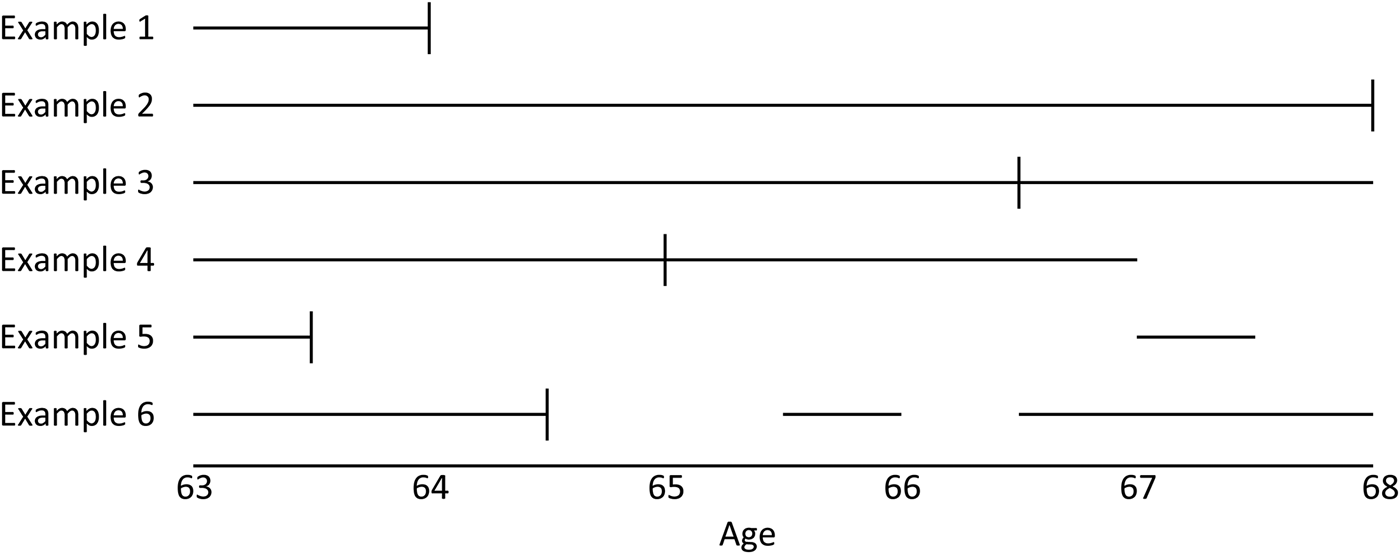
The design for the follow-up of labour market participation is presented in Figure 1. Since those who became non-employed for reasons other than retirement were excluded from the study, time until the retirement transition corresponds with time spent in pre-retirement employment at the flexible pension ages. The time that was not spent in either pre- or post-retirement employment was defined as time spent in full retirement.
Design for the follow-up of labour market participation within the flexible pension age range.

Statistical methods
We used Cox regression analysis to model time to retirement and negative binomial regression to model the number of months spent in post-retirement employment between the ages of 63 and 68. The negative binomial model was chosen due to over-dispersion in the data, i.e. large proportions of zero values (87.0%) for the months of post-retirement employment measured for each year of age, with the variance therefore exceeding the mean for this count variable. We used the estimated over-dispersion parameter alpha as a constant in a generalised estimation equations (GEE) model based on repeated negative binomial regression. GEEs account for the interdependence between repeated within-subject measurements by assigning them a correlation structure. An autoregressive correlation structure was chosen on the assumption that the correlation is stronger between observations that are closer to each other in time.
We calculated hazard ratios (HR) for retirement, incidence rate ratios (IRR) for post-retirement employment and their 95 per cent confidence intervals by the different socio-economic factors. In addition, we calculated the mean number of months spent in different labour market statuses over the 60-month follow-up period between the ages of 63 and 68. Months of pre-retirement employment (corresponds with the follow-up time before retirement in our data) were calculated from estimated survival curves derived from the Cox regression model (sum of survival probabilities at each month of follow-up while holding covariates at their mean value). Months of post-retirement employment were calculated from the marginal means derived from the GEE model (sum of the mean months of post-retirement employment estimated for each year of age, and thereby accounting for the different follow-up times among different birth cohorts, while holding covariates at their mean value). Using these estimations, we derived total months of employment (months of pre-retirement employment + months of post-retirement employment), months of full retirement (60 − total months of employment) and total months of retirement (60 − months of pre-retirement employment).
Analyses on socio-economic factors were adjusted for birth year, sex, marital status and part-time pension. We present descriptive results separately for men and women, and tested interactions between sex and the socio-economic factors in the regression models.
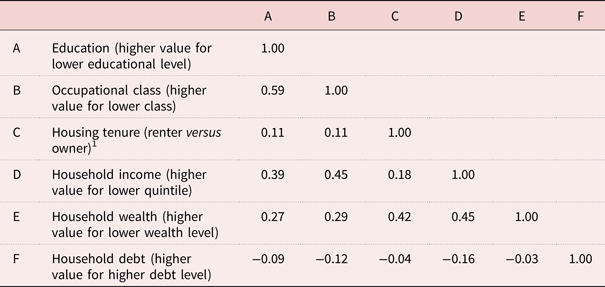
Some of the socio-economic measures were strongly associated with each other, the correlations varying from 0.03 between wealth and debt to 0.59 between education and occupational class (Table 1). All correlations between debt and other socio-economic factors were negative, indicating that the more disadvantaged groups had less debt. We performed sensitivity analyses for interactions between debt and other socio-economic factors to ascertain whether the effects of debt are similar across different socio-economic groups.
Spearman's correlation coefficients for the different pairs of socio-economic factors

Note: 1. The small group with housing tenure ‘other’ (1.8%) are excluded.
Results
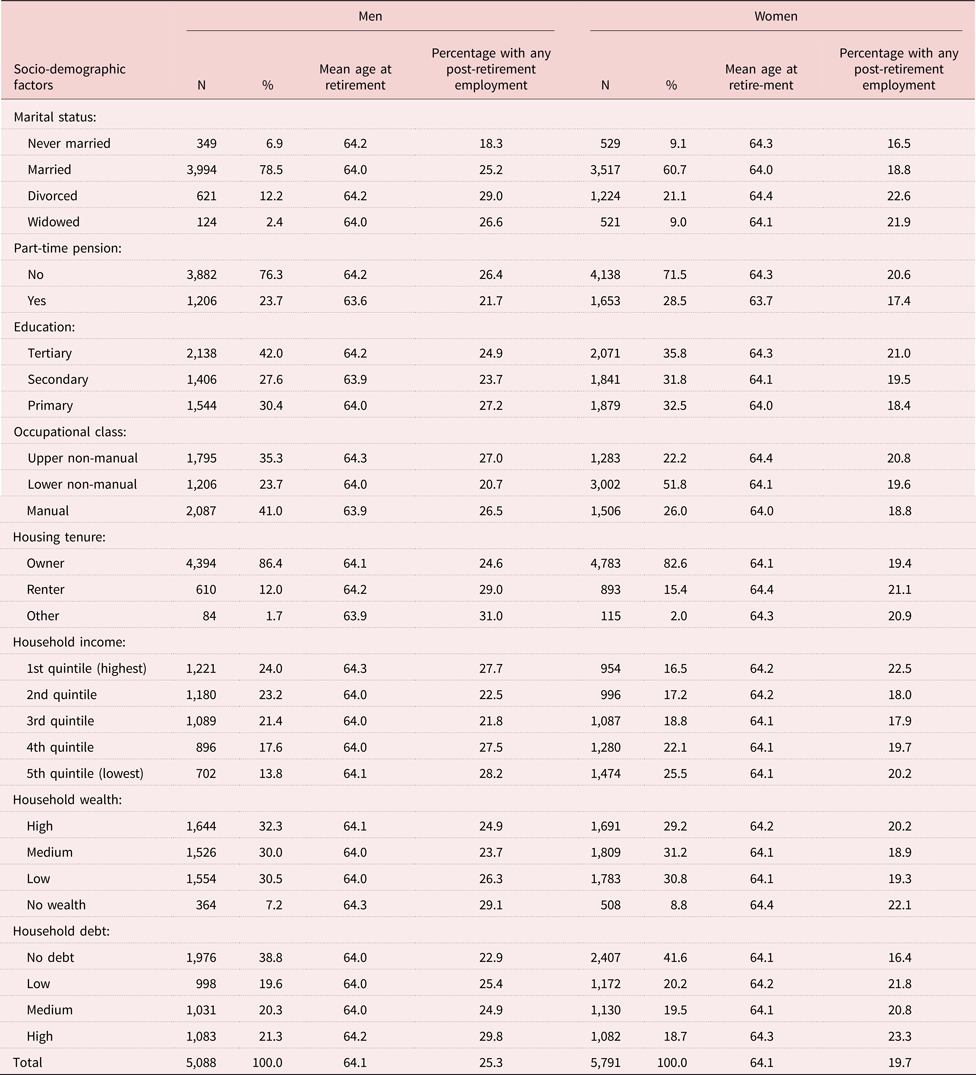
The mean age of retirement within the flexible pension age range between 63 and 68 was a little above 64 years (Table 2). Around one-quarter of men and one-fifth of women participated in post-retirement employment over the 60-month follow-up period within the flexible pension age range. Those who were divorced, did not receive a part-time pension, had tertiary education, were upper non-manual employees, were home renters, had high household income, had no household wealth and had high household debt were generally more likely to retire later and participate in post-retirement employment. For men, however, post-retirement employment was also common among those with primary education, manual workers and those with low household income. Interactions between these socio-economic factors and sex were not, however, statistically significant when testing these in the regression models (results not shown). Men and women were thus pooled in subsequent analyses.
Distribution of the study population at baseline by socio-demographic factors, mean age at retirement and the percentage with any post-retirement employment between the ages of 63 and 68 among men and women

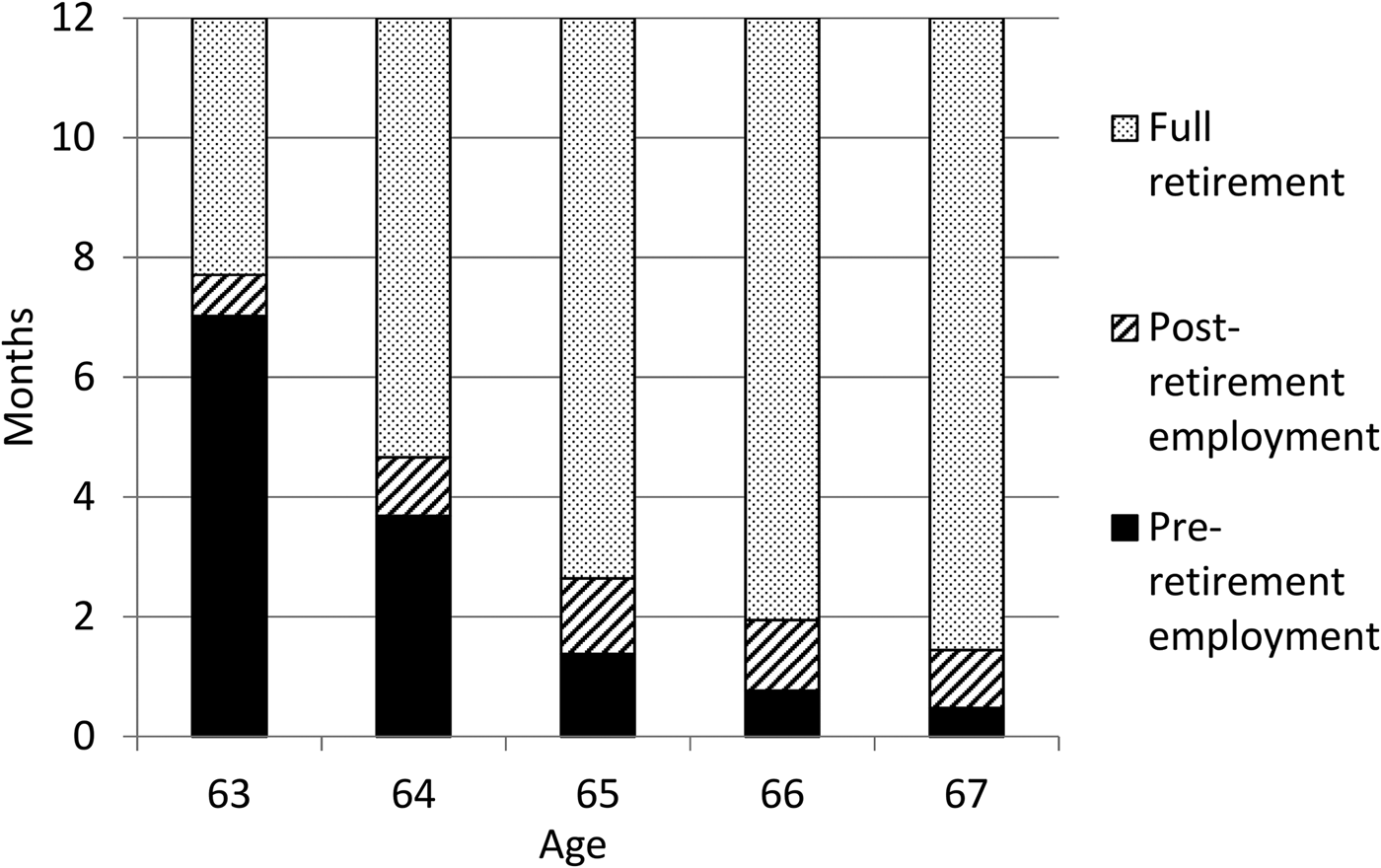
Descriptive findings indicate that the time spent in pre-retirement employment at a particular year of age decreased rapidly as workers became older; from 7.0 months at age 63 to 1.4 months at age 65 (Figure 2). Post-retirement employment was at its highest at age 65 – on average 1.3 months. After age 65, time spent in post-retirement employment actually exceeded the time spent in pre-retirement employment.
Observed mean number of months spent in pre-retirement employment, post-retirement employment and full retirement among the study population by year of age.

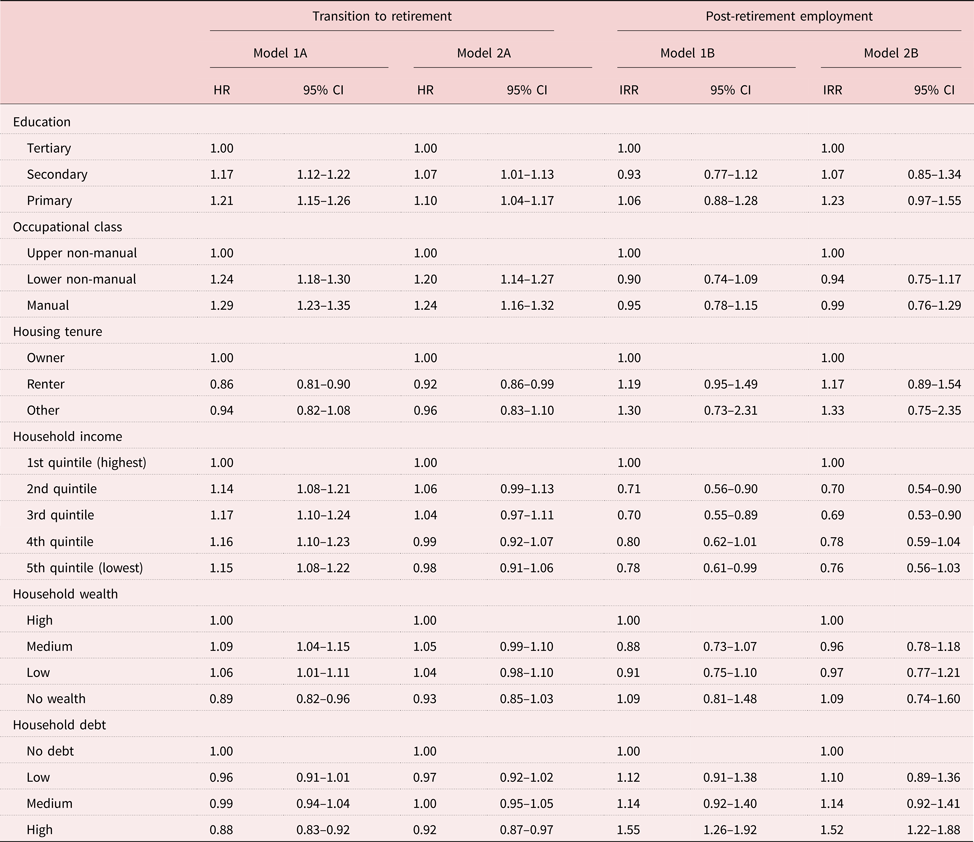
Table 3 presents the risks of retirement and post-retirement employment by socio-economic factors. Low HR values indicate later retirement and high IRR values indicate a longer time spent in post-retirement employment. Those who had tertiary education, were upper non-manual employees or were home renters were more likely to retire later. Those belonging to the highest household income quintile were the most likely to both retire later and participate in post-retirement employment. However, the effect of household income on retirement attenuated and lost its statistical significance after adjusting for all other covariates. The effect of household wealth on retirement appeared to be U-shaped, with those with either high wealth or no wealth being more likely to retire later. After full adjustments, however, the differences by wealth were no longer statistically significant. Those with high household debt were more likely to both retire later and participate in post-retirement employment. Sensitivity analyses showed that there were no interactions between debt and the other socio-economic factors (p values for the interaction ranging between 0.172 and 0.748 for retirement and between 0.499 and 0.895 for post-retirement employment).
Socio-economic differences in the transition to retirement and months spent in post-retirement employment among the study population between the ages of 63 and 68

Notes: Model 1: Adjustment for birth year and sex. Model 2: Model 1 + adjustment for marital status, part-time pension and all socio-economic variables in the table. HR: hazard ratio. IRR: incidence rate ratio. CI: confidence interval.
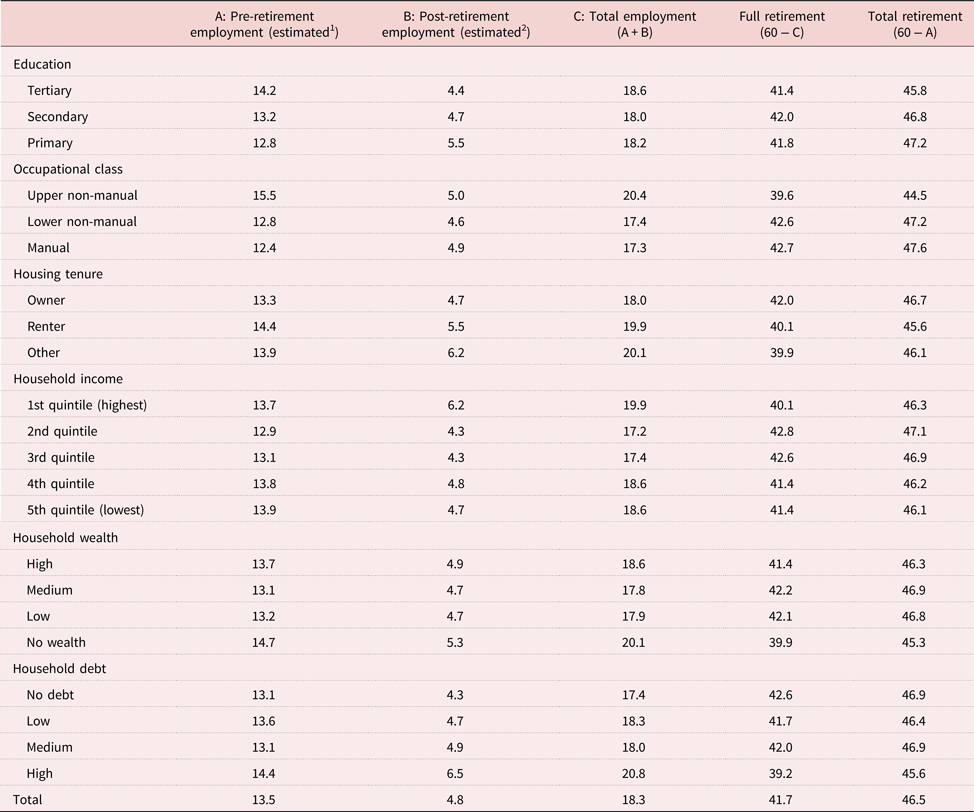
In total, over the 60-month follow-up between age 63 and 68, an average study person spent 18.3 months in employment, divided into 13.5 and 4.8 months of pre-retirement employment (corresponds with time to retirement) and post-retirement employment, respectively (Table 4). An average study person spent 46.5 months in retirement, of which 41.7 months were spent in full retirement, i.e. without post-retirement employment. When both pre- and post-retirement employment were considered, the educational differences in employment participation were small. The association between household income and total employment participation appeared to be U-shaped, with longest employment among those in the highest quintile and relatively long durations also in the two lowest quintiles. Upper non-manual employees, those who were not home-owners, those with no household wealth and those with high household debt also had longer total time spent in employment, which was attributable to time spent in both pre- and post-retirement employment, although some of the socio-economic differences were not statistically significant (see Table 3). The differences in total employment participation were largest by occupational class and household debt (Table 4); the time spent in employment was over three months longer among upper non-manual employees and those with high household debt compared to those in lower occupational classes and those with no debt.
Socio-economic differences in the mean number of months spent in different labour market statuses among the study population over the 60-month follow-up between the ages of 63 and 68

Notes: Adjusted for birth year, sex, marital status, part-time pension and all socio-economic variables in the table. 1. Based on survival curve data derived from Model 2A in Table 3 (months survived before retirement). 2. Based on margins derived from Model 2B in Table 3 (sum of the mean months of post-retirement employment at each year of age).
Discussion
We found that within the Finnish flexible old-age pension system where people can choose to retire any time between the ages of 63 and 68, individuals with higher education retired later, i.e. spent a longer time in pre-retirement employment, than individuals with lower education, but the educational differences in the total time spent in employment were small when post-retirement employment was also considered. There was little variation in the timing of retirement by household income measured at ages 60–62, but individuals in the highest quintile spent the longest time in post-retirement employment. Upper non-manual employees, home renters and individuals with high household debt were more likely to retire later, and at least those with high household debt also to spend a longer time in post-retirement employment.
The effects of socio-economic measures on later-life labour market participation are therefore diverse. The multiple socio-economic sub-domains appear to reflect particular social and economic circumstances that determine both necessities and choices relating to continued employment. We found that socio-economic advantage in terms of occupational class and household income was associated with a longer time spent in employment in the form of later retirement or participation in post-retirement employment. Health status was not likely to mediate the associations, since previous findings from Finland indicated that different measures of health were not associated with the timing of retirement or with employment exit within the flexible pension age system while controlling for socio-demographic factors (Leinonen et al., Reference Leinonen, Laaksonen, Chandola and Martikainen2016). The healthy worker effect was nevertheless likely to play a role, i.e. those with the poorest health had already exited the labour market before reaching the lower limit of the flexible pension age (see below for a more detailed discussion on considerations related to selection). Further, other factors that could not be measured in this study may have contributed to the socio-economic differences. For example, those in high socio-economic positions may be more likely to participate in later-life employment due to better employment opportunities, more favourable working conditions, lower stress, or a larger value for work participation or its material rewards (Wang and Shultz, Reference Wang and Shultz2010; Beehr and Bennett, Reference Beehr and Bennett2015; Fisher et al., Reference Fisher, Chaffee and Sonnega2016; Virtanen et al., Reference Virtanen, Oksanen, Pentti, Ervasti, Head, Stenholm, Vahtera and Kivimäki2017; Chandola et al., Reference Chandola, Rouxel, Marmot and Kumari2018). However, we also found that socio-economic disadvantage related to economic constraints such as household debt and living in rented housing were associated with continued employment before and after retirement. In our study context, debt had negligible association with wealth, thereby reflecting an independent measure of economic hardship. Even though Finland has a relatively generous social security and pension system, not all socio-economic groups appear to be able to afford to retire at the lower limit of the institutional pension age range. Both necessity related to economic disadvantage and choice related to socio-economic advantage thus appear to influence labour market behaviour within the Finnish flexible pension age system.
Comparison of our findings to previous ones is not straightforward. Firstly, in contexts with fixed statutory pension ages, the potential role of individual-level predictors of retirement among older employees is limited. Secondly, in contexts where retirement behaviour is driven less by statutory pension ages, it is difficult to distinguish between disability-based and other types of retirement, the predictors of which may vary. Thirdly, although many countries have non-disability-based early retirement benefits, the predictors of various types of early retirement may still be different from the predictors of statutory old-age retirement. With some caution, our findings can nevertheless be compared to those based on non-disability-based early retirement. In line with our study, previous ones on non-disability-based early retirement have implicated varying effects of different socio-economic sub-domains, and previous ones on post-retirement employment have shown similar diversity. Higher education and occupational class have been associated with a higher likelihood of continued employment in one form or the other (Pleau, Reference Pleau2010; Bloemen, Reference Bloemen2011; Larsen and Pedersen, Reference Larsen and Pedersen2013; Pleau and Shauman, Reference Pleau and Shauman2013; Schuring et al., Reference Schuring, Robroek, Otten Ferdy, Arts and Burdorf2013; Pettersson, Reference Pettersson2014; Virtanen et al., Reference Virtanen, Oksanen, Batty, Ala-Mursula, Salo, Elovainio, Pentti, Lybäck, Vahtera and Kivimäki2014, Reference Virtanen, Oksanen, Pentti, Ervasti, Head, Stenholm, Vahtera and Kivimäki2017; Kanabar, Reference Kanabar2015; Dingemans et al., Reference Dingemans, Henkens and van Solinge2016, Reference Dingemans, Henkens and van Solinge2017; Platts et al., Reference Platts, Corna, Worts, Mcdonough, Price and Glaser2019). The effects of various measures of economic resources have been mixed: economic constraints appear to lead to delayed retirement (Mein et al., Reference Mein, Martikainen, Stansfeld, Brunner, Fuhrer and Marmot2000; Bloemen, Reference Bloemen2011; Schuring et al., Reference Schuring, Robroek, Otten Ferdy, Arts and Burdorf2013; de Wind et al., Reference de Wind, Geuskens, Ybema, Blatter, Burdorf, Bongers and van der Beek2014; Virtanen et al., Reference Virtanen, Oksanen, Batty, Ala-Mursula, Salo, Elovainio, Pentti, Lybäck, Vahtera and Kivimäki2014), whereas their associations with post-retirement employment are inconsistent (Pleau, Reference Pleau2010; Larsen and Pedersen, Reference Larsen and Pedersen2013; Pleau and Shauman, Reference Pleau and Shauman2013; Pettersson, Reference Pettersson2014; de Wind et al., Reference de Wind, van der Pas, Blatter and van der Beek2016; Fasbender et al., Reference Fasbender, Wang, Voltmer and Deller2016; Dingemans et al., Reference Dingemans, Henkens and van Solinge2016, Reference Dingemans, Henkens and van Solinge2017; Platts et al., Reference Platts, Corna, Worts, Mcdonough, Price and Glaser2019). Discrepancies in the findings may be partly attributable to the diversity of early and statutory retirement options between countries, to the multifaceted nature of post-retirement employment, as well as to the variation in the measures used to reflect economic resources.
Our study had particular strengths. We used a nationally representative sample of birth cohorts entering the newly introduced flexible pension regime in Finland, which allowed us to follow up both pre- and post-retirement employment prospectively in the same cohort of individuals. Using this design, we were able to provide more comprehensive information on later-life labour market behaviour than studies investigating pre- or post-retirement employment separately. The longitudinal register data also had other advantages including a large data-set, no self-reporting bias or loss to follow-up, and rich socio-economic information. By analysing multiple measures of socio-economic position, we could simultaneously capture specific social and economic circumstances as well as quantify their contradictory effects on retirement and post-retirement employment.
Our study also had certain limitations. Due to restrictions on data availability, wealth and debt were measured at an earlier age than the other socio-economic factors and may therefore provide less accurate information on the current social conditions. Furthermore, since our data on employment participation do not include information on working time, we were unable to distinguish between full- and part-time employment. The contribution of post-retirement employment to total employment would likely be smaller if part-time employment were taken into consideration. However, the magnitude of post-retirement employment may also be somewhat underestimated, since our data may lack information on initiation of self-employment in the post-retirement period. This may occur because our data cover only pension-insured employment, and at the flexible pension ages the insurance is voluntary for the self-employed. In the analyses of post-retirement employment participation, individuals born in 1945–1947 were censored at ages 65–67, which may weaken the generalisability of the findings to these cohorts. Based on observed data, however, there were no large changes or clear differences in post-retirement employment patterns across the cohorts after age 65 (results not shown).
Our study population included individuals who were still employed at age 62, which was only a minority of the original study population. The most disadvantaged part of the population had already exited the labour market through, for example, disability retirement before reaching the lower limit of the flexible pension age. However, despite such a selected study population, we found clear socio-economic effects on retirement and employment participation. The effects of socio-economic factors may be even larger in contexts where the baseline employment rate is higher. Furthermore, it should be noted that our findings do not apply to employment participation after reaching age 68.
In Finland, the public sector still also operates a month-specific personal pension age system between 63 and 65 that is based on the length of public-sector employment. Public-sector employees nevertheless also have the opportunity to retire flexibly between the ages of 63 and 68, but the economic incentives for continuing in employment until the personal pension age is strong (Keva, 2017). A previous study found that public-sector employees intended to continue in employment until the upper age limit of the Finnish flexible pension system less often than private-sector employees (Forma et al., Reference Forma, Tuominen and Väänänen-Tomppo2005). Other studies from Finland found that less than one-fifth of municipal employees extended their employment past their personal pension age (Virtanen et al., Reference Virtanen, Oksanen, Batty, Ala-Mursula, Salo, Elovainio, Pentti, Lybäck, Vahtera and Kivimäki2014, Reference Virtanen, Oksanen, Pentti, Ervasti, Head, Stenholm, Vahtera and Kivimäki2017). Our data do not include information on employment sector, but it is likely that private-sector employees are more flexible in choosing their timing of retirement within the flexible age range, whereas public-sector employees often choose to retire at their personal pension age. Such effects in opposite directions may partly cancel each other out and result in relatively similar mean levels between the sectors. Lack of information on the employment sector in our study is thus unlikely to have a large influence on the findings.
Conclusions
Due to the diversity of pension systems, complexity in the retirement process, and a certain trade-off between the length of primary working careers and post-retirement working lives, it is important to consider simultaneously both pre- and post-retirement employment when examining predictors of later-life labour market participation. Furthermore, it is important to use multiple measures of socio-economic position in order to capture the diverse effects of social and economic circumstances on employment at older ages. In a context where individuals can choose the timing of their statutory retirement, upper non-manual occupational class and a high level of household income are associated with a longer time spent in employment in the form of later retirement or participation in post-retirement employment. However, socio-economic disadvantage in terms of household debt and living in rented housing also appear to necessitate continued employment before and after retirement. In addition to preferences and opportunities, economic necessity therefore plays an important role in later-life labour market behaviour even in a context of a relatively generous social security and pension system. The varied social and economic circumstances of older employees should be recognised when developing pension and social security policies for older workers.
Acknowledgements
We are grateful to Statistics Finland and the Finnish Centre for Pensions for making the data available to us. We would also like to acknowledge the IUSSP International Seminar on Causal Mediation Analysis in Health and Work, at which this paper was presented.
Financial support
This study was supported by the Academy of Finland; the Joint Committee for Nordic Research Councils for the Humanities and the Social Sciences (project number 219643/F10); the Finnish Centre for Pensions; and the Economic and Social Research Council (ES/J019119/1).
Ethical standards
We followed data protection guidelines and ethical regulations approved by the data protection authorities, Statistics Finland and the University of Helsinki in the collection, use and reporting of the data. Statistics Finland provided permission to use the anonymous register-based data.